
Products
-
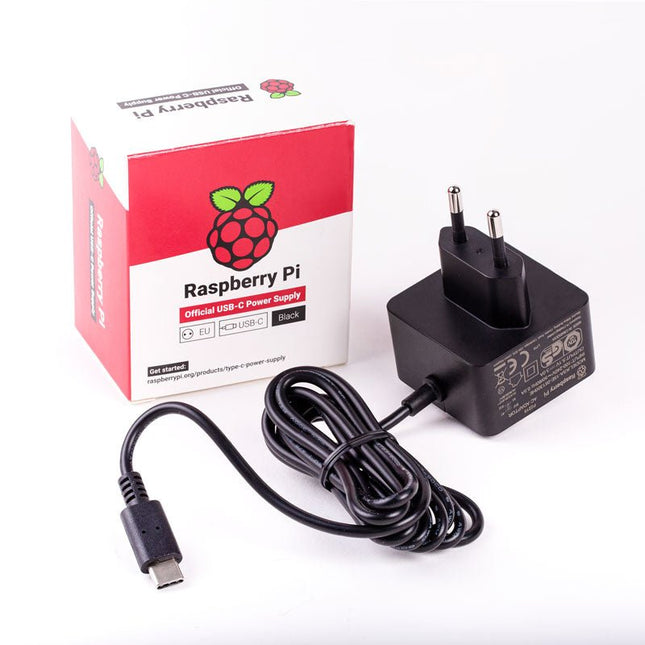
Raspberry Pi Foundation Offizielles EU-Netzteil für Raspberry Pi 4 (schwarz)
Das Raspberry Pi USB-C-Netzteil ist speziell für die Stromversorgung des Raspberry Pi 4 konzipiert. Das Netzteil verfügt über ein USB-C-Kabel und ist in vier verschiedenen Modellen für unterschiedliche internationale Steckdosen und in zwei Farben erhältlich. Technische Daten Ausgang Ausgangsspannung +5.1 V DC Mindestlaststrom 0 A Nennlaststrom 3.0 A Maximale Leistung 15.3 W Lastregelung ±5% Linienregelung ±2% Wellen & Rauschen 120 mVp-p Anstiegszeit 100 ms maximal bis zur Regelgrenze für DC-Ausgänge Einschaltverzögerung 3000 ms maximal bei nominaler Eingangswechselspannung und Volllast Schutzmaßnahmen Schutz gegen KurzschlussSchutz gegen ÜberstromSchutz gegen Übertemperatur Effizienz 81% Minimum (Ausgangsstrom von 100%, 75%, 50%, 25%)72% Minimum bei 10% Last Ausgangskabel 1.5 m 18AWG Ausgangsstecker USB-C Eingang Spannungsbereich 100-240 V AC (rated)96-264 V AC (operating) Frequenz 50/60 Hz ±3 Hz Stromstärke 0.5 A maximum Stromverbrauch (ohne Last) 0.075 W maximum Einschaltstrom Es dürfen keine Schäden auftreten und die Eingangssicherung darf nicht auslösen. Umgebungstemperatur bei Betrieb 0-40°C
-
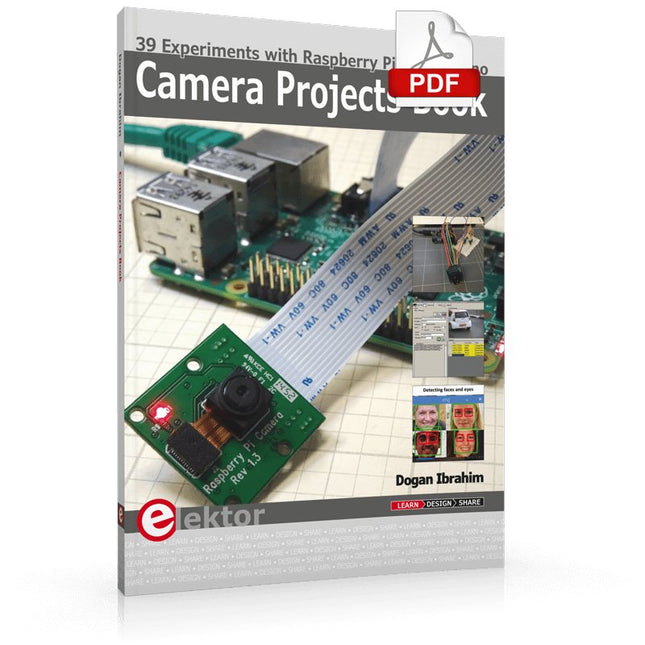
Elektor Digital Camera Projects Book (E-book)
39 Experiments with Raspberry Pi and Arduino This book is about Raspberry Pi 3 and Arduino camera projects. The book explains in simple terms and with tested and working example projects, how to configure and use a Raspberry Pi camera and USB based webcam in camera-based projects using a Raspberry Pi. Example projects are given to capture images, create timelapse photography, record video, use the camera and Raspberry Pi in security and surveillance applications, post images to Twitter, record wildlife, stream live video to YouTube, use a night camera, send pictures to smartphones, face and eye detection, colour and shape recognition, number plate recognition, barcode recognition and many more. Installation and use of popular image processing libraries and software including OpenCV, SimpleCV, and OpenALPR are explained in detail using a Raspberry Pi. The book also explains in detail how to use a camera on an Arduino development board to capture images and then save them on a microSD card. All projects given in this book have been fully tested and are working. Program listings for all Raspberry Pi and Arduino projects used in this book are available for download on the Elektor website.
€ 29,95
Mitglieder: € 26,96
-

iFixit iFixit Essential Electronics Toolkit
Das iFixit Essential Electronics Toolkit ist genau das, was Sie für die wichtigsten Reparaturen an Elektronikgeräten benötigen – wie den Austausch von Bildschirmen und Akkus – und enthält alles, was Sie für die meisten Reparaturen im Haushalt benötigen. Starten Sie in die Elektronikreparatur mit allen Bits und Präzisionswerkzeugen, um Ihre dringendsten Bildschirmbrüche und Akkuwechsel zu beheben. Oder erweitern Sie einfach Ihr Heimwerker-Werkzeugset mit allem, was Sie für die Reparatur von Türgriffen, Haushaltsgeräten, Brillen und vielem mehr benötigen. Kit beinhaltet Magnetisierter Fahrergriff Abgewinkelte Präzisionspinzette Spudger Jimmy iFixit-Öffnungstool iFixit Opening Picks 6er-Set Sauggriff Leicht zu öffnendes magnetisiertes Gehäuse Mitglied mit integriertem Sortierfach Sechzehn 4-mm-Präzisions-Schraubendreher-Bits Phillips - 000, 00, 0, 1 Pentalobe - P2, P5 Flachkopf – 1 mm, 2,5 mm, 4 mm Torx - T4, T5 Torx-Sicherheit – TR6, TR8, TR10 Tri Point - Y000 SIM-Auswurfbit Technische Daten Bit-Metall: 6150 Stahl Treibermaterial: Polymer Gehäusematerial: ABS Schaum: EVA
€ 34,37
-

Elektor Digital SDR Hands-on Book (E-book)
The short-wave technique has a very particular appeal: It can easily bridge long distances. By reflecting short-wave signals off the conductive layers of the ionosphere, they can be received in places beyond the horizon and therefore can reach anywhere on earth. Although technology is striving for ever higher frequencies, and radio is usually listened to on FM, DAB+, satellite or the Internet, modern means of transmission require extensive infrastructure and are extremely vulnerable. In the event of a global power outage, there is nothing more important than the short-wave. Amateur radio is not only a hobby, it’s also an emergency radio system! Elektor’s SDR-Shield is a versatile shortwave receiver up to 30 MHz. Using an Arduino and the appropriate software, radio stations, morse signals, SSB stations, and digital signals can be received. In this book, successful author and enthusiastic radio amateur, Burkhard Kainka describes the modern practice of software defined radio using the Elektor SDR Shield. He not only imparts a theoretical background but also explains numerous open source software tools.
€ 29,95
Mitglieder: € 26,96
-
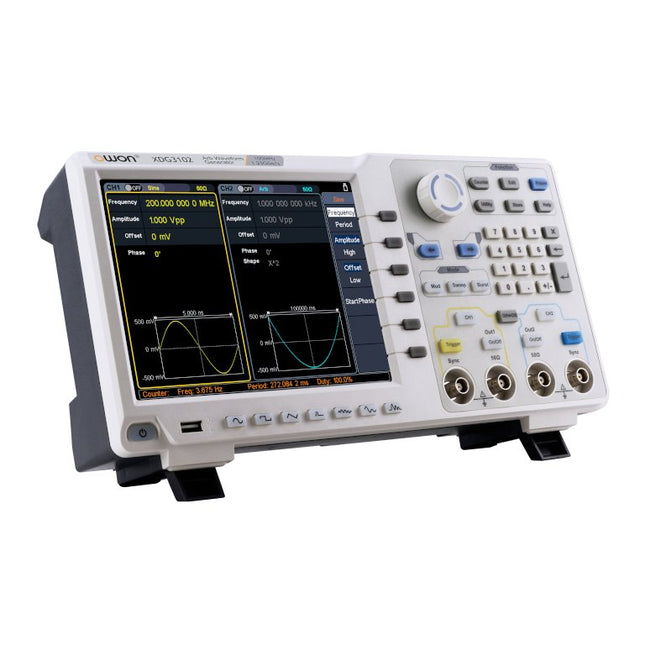
OWON OWON XDG3102 2-Kanal Arbiträrwellenformgenerator (100 MHz)
Features Fortschrittliche DDS-Technologie, bis zu 250 MHz Frequenzausgang 1,25 GS/s Abtastrate und 1 μHz Frequenzauflösung Bis zu 1M beliebige Wellenformlänge Vertikale Auflösung: 14 Bit Umfassende Wellenformausgabe: 6 Gruppenwellenformen und 152 Gruppen integrierter beliebiger Wellenformen Umfassende Modulationsmöglichkeiten: AM, FM, PM, FSK, 3FSK, 4FSK, PSK, OSK, ASK, BPSK, PWM, Sweep und Burst Hochpräziser Frequenzzähler integriert, im Bereich von 100 MHz bis 200 MHz SCPI und LabVIEW werden unterstützt 8-Zoll-LCD-Touchscreen mit 800 x 600 Pixeln Technische Daten XDG3102 Kanal 2 Frequenzausgang 100 MHz Beispielrate 1,25 GSa/s Vertikale Auflösung 14 Bit Wellenform Standardwellenform Sinus, Rechteck, Puls, Rampe, Rauschen und Harmonische Beliebige Wellenform exponentieller Anstieg, exponentieller Abfall, sin(x)/x, Stufenwelle und andere,insgesamt 150 integrierte Wellenformen und benutzerdefinierte beliebige Wellenformen Frequenz (Auflösung 1μHz) Sinus 1 μHz bis 100 MHz Quadrat 1 μHz – 40 MHz Impuls 1 μHz – 25 MHz Rampe 1 μHz bis 5 MHz Harmonisch 1 μHz – 50 MHz Lärm 120 MHz (-3 dB, typisch) Beliebige Wellenform integrierte Wellenform: 1 uHz – 15 MHzbenutzerdefinierte Wellenform: 1 uHz – 50 MHz Genauigkeit ±1 ppm, 0 °C bis 40 °C Amplitude Amplitude (50Ω) 1 mVpp – 10 Vpp (≤ 40 MHz); 1 mVpp – 5 Vpp (≤ 80 MHz)1 mVpp – 2,5 Vpp (≤ 120 MHz); 1 mVpp – 1 Vpp (≤ 250 MHz) Amplitude (hohe Impedanz) 2 mVpp – 20 Vpp (≤ 40 MHz); 2 mVpp – 10 Vpp (≤ 80 MHz);2 mVpp – 5 Vpp (≤ 120 MHz); 2 mVpp – 2 Vpp (≤ 250 MHz) Auflösung 1 mV oder 4 Ziffern DC-Offset Bereich (50Ω) ±(5 Vpk – Amplitude Vpp/2) Reichweite (High-Z, offener Stromkreis) ±(10 Vpk – Amplitude Vpp/2) Genauigkeit ±(1 % der |Einstellung| + 1 mV + Amplitude Vpp x 0,5 %) Auflösung 1 mV oder 4 Ziffern Lastimpedanz 50 Ω (typisch) Genauigkeit ±(1 % der Einstellung + 1 mVpp) (typisch, 1 kHz Sinus, 0 V Offset) Reinheit des Sinuswellenspektrums Harmonische VerzerrungTypisch (0 dB) DC – 1 MHz: <-65 dBc1 MHz – 10 MHz: <-60 dBc10 MHz - 120 MHz: <-50 dBc120 MHz - 200 MHz: <-45 dBc Totale harmonische Verzerrung <0,05 %, 10 Hz bis 20 kHz, 1 Vpp Unecht (nicht harmonisch),Typisch (0 dB) ≤10MHz: <-70dBc>10MHz: <-70dBc + 6dB/ Oktave PhasenrauschenTypisch (0 dBm, 10 kHz Abweichung) 10 MHz: ≤-110 dBc/Hz Quadrat Anstiegs-/Abfallzeit <5 ns Überschwingen <3 % Auslastungsgrad 50,0 % (fest) Jitter (rms) 300 ps + 100 ppm Impuls Impulsbreite 12 ns – 996.875 s Vorder-/Rückflankenzeit ≧7ns Überschwingen <3 % Jitter (rms) 300 ps + 100 ppm Rampe Linearität ≤1 % der Spitzenleistung (typisch, 1 kHz, 1 Vpp, 50 % Symmetrie) Symmetrie 0 % bis 100 % Harmonisch Harmonische Ordnung ≤16 Harmonischer Typ gerade, ungerade, alle, Benutzer Harmonische Amplitude könnte für alle Harmonischen eingestellt werden Harmonische Phase Willkürlich Wellenformlänge 2 Punkte – 1 Million Punkte Vertikale Auflösung 14 Bit Minimale Anstiegs-/Abfallzeit <7 ns Jitter (rms) 3 ns Modulation Typ AM, FM, PM, PWM, FSK, 3FSK, 4FSK, PSK, OSK, ASK, BPSK, Sweep und Burst BIN Trägerwellenform Sinus, Rechteck, Rampe und beliebig (außer DC) Quelle intern extern Modulierende Wellenform Sinus, Quadrat, Rampe, Rauschen und beliebig Tiefe 0,0 % – 100,0 % Modulationsfrequenz 2 MHz – 100 kHz FM Trägerwellenform Sinus, Rechteck, Rampe und beliebig (außer DC) Quelle intern extern Modulierende Wellenform Sinus, Quadrat, Rampe, Rauschen und beliebig Modulationsfrequenz 2 MHz – 100 kHz PM Trägerwellenform Sinus, Rechteck, Rampe und beliebig (außer DC) Quelle intern extern Modulierende Wellenform Sinus, Quadrat, Rampe, Rauschen und beliebig Phasenabweichung 0° - 180° Modulationsfrequenz 2 MHz – 100 kHz PWM Trägerwellenform Impuls Quelle intern extern Modulierende Wellenform Sinus, Quadrat, Rampe, Rauschen und beliebig Breitenabweichung 0 ~ Minimum (Puls-Tastverhältnis, 100 % - Puls-Tastverhältnis) Modulationsfrequenz 2 MHz – 100 kHz FSK / 3FSK / 4FSK Trägerwellenform Sinus, Rechteck, Rampe und beliebig (außer DC) Quelle intern extern Modulierende Wellenform Quadrat mit 50% Einschaltdauer Schlüsselfrequenz 2 MHz – 1 MHz PSK Trägerwellenform Sinus, Rechteck, Rampe und beliebig (außer DC) Quelle intern extern Modulierende Wellenform Quadrat mit 50% Einschaltdauer Schlüsselfrequenz 2 MHz – 1 MHz OSK Trägerwellenform Sinus, Rechteck, Rampe und beliebig (außer DC) Quelle intern Schwingungsdauer Quadrat mit 50% Einschaltdauer Schlüsselfrequenz 2 MHz – 1 MHz FRAGEN Trägerwellenform Sinus, Rechteck, Rampe und beliebig (außer DC) Quelle intern extern Modulierende Wellenform Quadrat mit 50% Einschaltdauer Schlüsselfrequenz 2 MHz – 1 MHz BPSK Trägerwellenform Sinus, Rechteck, Rampe und beliebig (außer DC) Quelle intern Modulierende Wellenform Quadrat mit 50% Einschaltdauer Schlüsselfrequenz 2 MHz – 1 MHz Fegen Trägerwellenform Sinus, Rechteck, Rampe und beliebig (außer DC) Typ linear und log Richtung auf und ab Sweep-Zeit 1 ms bis 500 s, ± 0,1 % Triggerquelle intern, extern und manuell Platzen Trägerwellenform Sinus, Rechteck, Rampe, Puls und beliebig (außer DC) Burst-Anzahl 1 bis 50.000 Periode, unendlich, Gating Interner Zeitraum 10 ns - 500 s Gegatete Quelle Externer Auslöser Frequenzzähler Funktion Frequenzperiode, +Breite, -Breite, +Tastverhältnis und -Tastverhältnis Frequenzbereich 100 MHz – 200 MHz Frequenzauflösung 7 Ziffern Input-Output Anzeige 8-Zoll-LCD-Touchscreen mit 800 x 600 Pixeln Typ Frequenzzähler, externer Modulationseingang,externer Trigger-Eingang,externer Referenztakt Eingang / Ausgang Kommunikationsinterface USB-Host, USB-Gerät und LAN Abmessungen 340 x 177 x 90 mm Gewicht 2,50 kg
€ 639,26
-

Elektor Digital Vanderveen Trans Tube Amplifiers (E-book)
Menno van der Veen is well known for his research publications on tube amplifiers used in audio systems. In this book he describes one of his research projects which focuses on the question of whether full compensation for distortion in tubes and output transformers is possible. In the past, a variety of techniques have been developed. One of them has largely been forgotten: trans-conductance, which means converting current into voltage or voltage into current. Menno van der Veen has breathed new life into this technique with his research project titled “Trans”. This book discusses all aspects of this method and discusses its pitfalls. These pitfalls are addressed one by one. The end result is a set of stringent requirements for Trans amplifiers. Armed with these requirements, Menno then develops new Trans amplifiers, starting with Transie 1 and Transie 2. These DC-coupled, single-ended tube amplifiers have unusually good characteristics and are suitable for hobbyist construction. Next the Trans principle is applied to amplifiers with higher output power. A trial-and-error process ultimately leads to the Vanderveen Trans 30 amplifier, which optimizes the features of Trans. The characteristics of this amplifier are so special and unique that Menno believes he has struck gold. To ensure that variations in tube characteristics cannot interfere with optimal Trans behavior, Menno makes use of simulations and comparison with other amplifier types. This book reads like an adventure story, but it is much more – it is an account of solid research into new ways to achieve optimal audio reproduction.
€ 29,95
Mitglieder: € 26,96
-

Elektor Digital Embedded in Embedded (E-book)
ARM Cortex-M Embedded Design from 0 to 1 Hobbyists can mash together amazing functional systems using platforms like Arduino or Raspberry Pi, but it is imperative that engineers and product designers understand the foundational knowledge of embedded design. There are very few resources available that describe the thinking, strategies, and processes to take an idea through hardware design and low-level driver development, and successfully build a complete embedded system. Many engineers end up learning the hard way, or never really learn at all. ARM processors are essentially ubiquitous in embedded systems. Design engineers building novel devices must understand the fundamentals of these systems and be able to break down large, complicated ideas into manageable pieces. Successful product development means traversing a huge amount of documentation to understand how to accomplish what you need, then put everything together to create a robust system that will reliably operate and be maintainable for years to come. This book is a case study in embedded design including discussion of the hardware, processor initialization, low‑level driver development, and application interface design for a product. Though we describe this through a specific application of a Cortex-M3 development board, our mission is to help the reader build foundational skills critical to being an excellent product developer. The completed development board is available to maximize the impact of this book, and the working platform that you create can then be used as a base for further development and learning. The Embedded in Embedded program is about teaching fundamental skill sets to help engineers build a solid foundation of knowledge that can be applied in any design environment. With nearly 20 years of experience in the industry, the author communicates the critical skill development that is demanded by companies and essential to successful design. This book is as much about building a great design process, critical thinking, and even social considerations important to developers as it is about technical hardware and firmware design. Downloads EiE Software Archive (200 MB) IAR ARM 8.10.1 (Recommended IDE version to use) (1.2 GB) IAR ARM 7.20.1 (Optional IDE version to use) (600 MB)
€ 44,95
Mitglieder: € 40,46
-
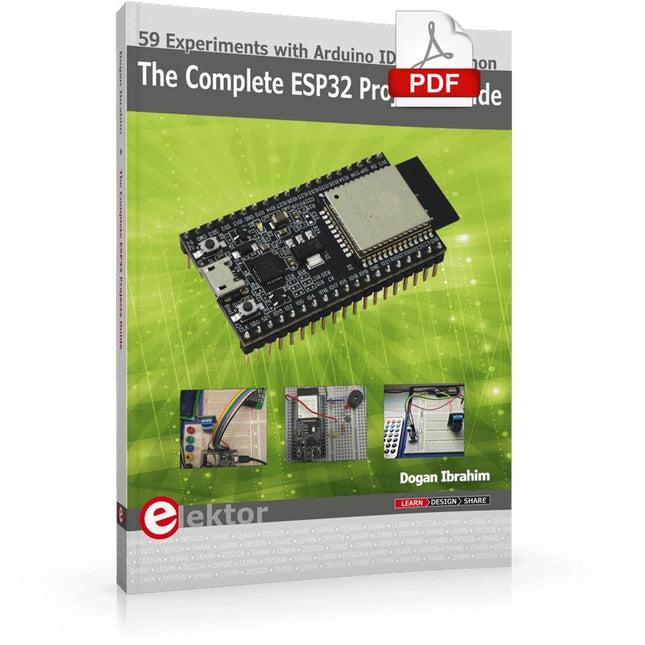
Elektor Digital The Complete ESP32 Projects Guide (E-book)
59 Experiments with Arduino IDE and Python The main aim of this book is to teach the Arduino IDE and MicroPython programming languages in ESP32 based projects, using the highly popular ESP32 DevKitC development board. Many simple, basic, and intermediate level projects are provided in the book using the Arduino IDE with ESP32 DevKitC. All projects have been tested and work. Block diagrams, circuit diagrams, and complete program listings of all projects are given with explanations. In addition, several projects are provided for programming the ESP32 DevKitC using MicroPython. The projects provided in this book are designed to teach the following features of the ESP32 processor: GPIOs Touch sensors External interrupts Timer interrupts I²C and I²S SPI PWM ADC DAC UART Hall sensor Temperature sensor Infrared controller Reading and writing to SD card Reading and writing to flash memory RTC timer Chip ID Security and encryption Wi-Fi and network programming Bluetooth BLE programming Communication mobile devices Low power design ESP-IDF programming The projects have been organized with increasing levels of difficulty. Readers are encouraged to tackle the projects in the order given. A specially prepared hardware kit (SKU 18305) is available from Elektor. With the help of this hardware, it should be easy and fun to build the projects in this book.
€ 34,95
Mitglieder: € 31,46
-

Sensepeek Sensepeek 4003 PCBite Kit inkl. 4x SP10-Sonde und Testdrähten
Das minimalistische Design und die federbelastete Prüfnadel ermöglichen die gleichzeitige Messung von Fine-Pitch-Komponenten und nahegelegenen Signalen. Die Sonde ist stabil und dennoch flexibel und eignet sich für sofortige Messungen oder völlig freihändigen Betrieb zusammen mit Ihrem Multimeter, Logikanalysator oder Ihrem bevorzugten Werkzeug. Der Dual-Pin-Header-Stecker passt direkt auf einen 2,54-mm-Stecker (0,100 Zoll). Der SP10 verfügt wie alle PCBite-Sonden und -Halter über einen starken Magneten in der Basis, der das Platzieren und Neupositionieren der Sonde erleichtert. Inbegriffen 4x PCBite-Halter 1x große Grundplatte (A4) 4x PCBite-Sonde mit Testnadel mit Stiftspitze 4x zusätzliche Prüfnadel mit Kronenspitze 1x Satz gelbe Isolierscheiben 5x Dupont-zu-Dupont-Testkabel 2x Bananen-zu-Dupont-Testkabel 1x Mikrofasertuch Downloads Benutzerhandbuch
€ 149,94
-

OWON OWON SDS1102 2-Kanal Oszilloskop (100 MHz)
Das OWON SDS1102 ist ein erschwingliches Benchtop-Digitaloszilloskop, das solide Leistung mit wichtigen Messfunktionen kombiniert. Dieses 2-Kanal-Oszilloskop bietet eine Bandbreite von 100 MHz, eine Abtastrate von 1 GS/s, ein 7-Zoll-LCD-Display und eine Speichertiefe von 10 kpts. Damit ist es eine praktische Wahl für alltägliche Elektroniktests, Fehlersuche und den Bildungsbereich. Das SDS1102 verfügt über ein vereinfachtes Triggersystem mit Pegel- und Flankentriggerung, wodurch sich gängige Signale einfach erfassen und analysieren lassen. Es wurde für Anwendungen entwickelt, die keine große Speichertiefe oder erweiterten Triggerfunktionen erfordern, und bietet eine unkomplizierte sowie kostengünstige Lösung für die grundlegende Signalanalyse. Features Bandbreite: 100 MHz 2 Kanäle Abtastrate: 1 GS/s Ultradünnes Gehäuse 7-Zoll-LCD mit hoher Auflösung Unterstützung von SCPI und LabVIEW Technische Daten Bandbreite 100 MHz Horizontale Skala (s/div) 5 ns/Teilung - 1000 s/Teilung Kanal 2 Vertikale Empfindlichkeit 5 mV/div - 5 V/div (am Eingang) Gleichstromverstärkungsgenauigkeit 3% Vertikale Auflösung (A/D) 8 Bit (2 Kanäle gleichzeitig) Eingang Eingangsimpedanz 1 MΩ, 10 pF Eingangskopplung AC, DC, GND Max. Eingangsspannung ± 400 V, CATI, CATII Passive Sonden х1; х10 Sonden-Dämpfungsfaktor х1; х10; х100; х1000 Auslösesystem Auslösemodus Auto, Normal, Einzeln Auslösertyp Kante, Video Edge-Trigger-Quelle CH1, CH2 Video-Trigger Abtastungstyp Echtzeit Abtastrate 1 GS/s Äquivalente Abtastrate Nein Wellenlänge 10.000 Punkte Interpolation sin(x)/x Mess- und mathematisches Behandlungssystem Automatische Messung Vpp, Vavg, RMS, Frequenz, Periode, Vmax, Vmin, Vtop, Vbase, Breite, Überschwingen, VorschwingenAnstiegszeit, Abfallzeit, +Width, -Width, +Duty, -Duty, Verzögerung A→B, Verzögerung A→B, Bereich, Zyklusbereich Mathematische Funktionen Addition, Subtraktion, Multiplikation, Division, FFT Allgemeine Eigenschaften Anzeigetyp 7" Farb-LCD Anzeigeauflösung 800 x 480 Leistung 100-240 V, 45-440 Hz, < 15 W Abmessungen 301 x 70 x 152 mm Gewicht 1,1 kg Lieferumfang 1x OWON SDS1102 Oszilloskop 2x Oszilloskop-Tastkopf 1x Sondenanpassung 1x Netzkabel 1x USB-Kabel 1x CD-ROM 1x Schnellstartanleitung Downloads Quick Guide Manual PC Software SCPI Commands
€ 219,00
Mitglieder: € 197,10
-

OWON OWON OW18B Bluetooth-Multimeter
Merkmale Datenlogger & Multimeter & Thermometer 3 (5/6) Ziffern True RMS-Test wird unterstützt Drahtlose BLE 4.0-Übertragung, stabiler, weniger Stromverbrauch Diagramm- und Diagrammmodus zur Analyse Ihrer Daten Unterstützt NCV Voice Broadcast vereinfacht das Testen Taschenlampenfunktion Integrierte Offline-Aufnahmefunktion Unterstützt Android, iOS Inbegriffen Messleitungen Thermoelement vom K-Typ 9V-Batterie Bolzenschrauber Krokodilklemme Kurzanleitung
€ 38,97
-

Raspberry Pi Foundation Raspberry Pi 3 A+
Wie der Raspberry Pi 3 B+ verfügt auch der Raspberry Pi 3 A+ über einen 64-Bit-Quad-Core-Prozessor mit 1,4 GHz, Dual-Band-WLAN mit 2,4 GHz und 5 GHz sowie Bluetooth 4.2/BLE. Das Dual-Band-WLAN verfügt über eine modulare Konformitätszertifizierung, die es ermöglicht, das Board in Endprodukte einzubauen, wobei die Konformitätstests für das Wireless LAN erheblich reduziert werden, was sowohl die Kosten als auch die Markteinführungszeit verbessert. Der Raspberry Pi 3 A+ hat die gleiche mechanische Grundfläche wie der Raspberry Pi 1 A+. Technische Daten Prozessor Broadcom BCM2837B0, Cortex-A5364-bit SoC @ 1,4 GHz Speicher 512 MB LPDDR2 SDRAM Konnektivität 2,4 GHz und 5 GHz IEE 802.11.b/g/n/ac Wireless LANBluetooth 4.2/BLE Video & Ton 1x HDMI in voller GrößeMIPI DSI Display-AnschlussMIPI CSI Kamera-Anschluss4-poliger Stereoausgang und Composite Video-Anschluss Multimedia H.264, MPEG-4 Dekodierung (1080p30)H.264 Kodierung (1080p30)OpenGL ES 1.1, 2.0 Grafik SD-Karten-Unterstützung Mikro SD Format zum Laden des Betriebssystems und zur Datenspeicherung Stromversorgung 5 V/2.5 A DC über micro-USB-Anschluss5 V DC über GPIO-Header Umgebung Betriebstemperatur, 0-50°C Abmessungen 65 x 56.5 mm
-

Adafruit Adafruit Adalogger FeatherWing (RTC + SD-Add-on)
Mit diesem FeatherWing können Sie ganz einfach Datenprotokollierung zu jedem Feather Board hinzufügen. Sie erhalten sowohl eine I²C-Echtzeituhr (PCF8523) mit 32-kHz-Quarz und Batterie-Backup als auch einen microSD-Sockel, der an die SPI-Port-Pins (+ zusätzlicher Pin für CS) angeschlossen wird. Hinweis: FeatherWing wird ohne microSD-Karte geliefert. Zur Nutzung der RTC-Batterie-Backup-Funktionen ist eine CR1220-Knopfzelle erforderlich. Wenn Sie den RTC-Teil des FeatherWing nicht verwenden, ist keine Batterie erforderlich. Zur Kommunikation mit dem microSD-Kartensteckplatz wird die Standard-SD-Bibliothek von Arduino empfohlen. Zum Anbringen der Header am Wing sind leichte Lötarbeiten erforderlich. Pinbelegung Stromanschlüsse In der unteren Reihe werden der 3,3-V-Pin (zweiter von links) und der GND- Pin (vierter von links) verwendet, um die SD-Karte und RTC mit Strom zu versorgen (um die Knopfzellenbatterie zu entlasten, wenn Netzstrom verfügbar ist). RTC- und I²C-Pins Oben rechts werden SDA (ganz rechts) und SCL (links von SDA) verwendet, um mit dem RTC-Chip zu kommunizieren. SCL - I²C-Taktpin zum Anschluss an die I²C -Taktleitung Ihres Mikrocontrollers. Dieser Pin verfügt über einen 10 kΩ Pull-Up-Widerstand gegen 3,3 V SDA - I²C-Datenpin zum Anschluss an die I²C -Datenleitung Ihres Mikrocontrollers. Dieser Pin verfügt über einen 10 kΩ Pull-Up-Widerstand gegen 3,3 V Es gibt auch einen Breakout für INT , den Ausgangspin der RTC. Er kann als Interrupt-Ausgang oder auch zum Erzeugen einer Rechteckwelle verwendet werden. Beachten Sie, dass dieser Pin ein Open Drain ist. Sie müssen den internen Pull-Up an dem digitalen Pin aktivieren, mit dem er verbunden ist. SD- und SPI-Pins Von links beginnend haben Sie SPI-Takt (SCK) - Ausgabe von der Feder zum Flügel SPI Master Out Slave In (MOSI) - Ausgabe von der Feder zum Flügel SPI Master In Slave Out (MISO) - Eingabe vom Flügel zur Feder Diese Pins befinden sich bei jedem Feather an der gleichen Stelle. Sie werden für die Kommunikation mit der SD-Karte verwendet. Wenn die SD-Karte nicht eingelegt ist, sind diese Pins völlig frei. MISO wird immer dann in den Tri-State-Zustand versetzt, wenn der SD CS-Pin (Chip Select) hochgezogen wird.
-
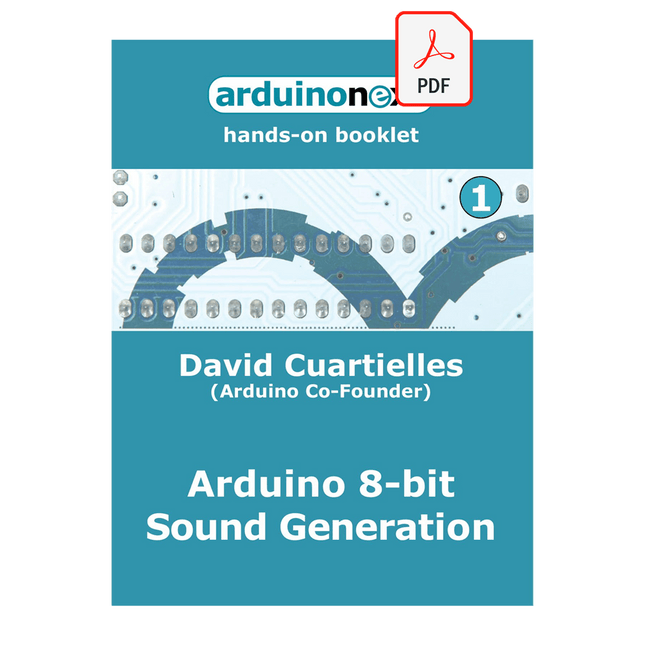
Elektor Digital Arduino 8-bit Sound Generation (E-book)
Arduinonext is an initiative powered by an electronics and microcontrollers specialist team aiming to help all those who are entering in the technology world, using the well-known Arduino platform to take the next step in electronics. We strive to bring you the necessary knowledge and experience for developing your own electronics applications; interacting with environment; measuring physical parameters; processing them and performing the necessary control actions. This is the first title in the 'Hands-On' series in which Arduino platform co-founder, David Cuartielles, introduces board programming, and demonstrates the making of an 8-bit Sound Generator.
€ 7,95
Mitglieder: € 7,16
-

Elektor Digital The Bottle Builder (E-book)
The author, Johan Basse Bergqvist, is an engineer, a musician, and an audiophile with a knack for building projects that produce the desired results. The combination of these skills leads to a uniquely valuable perspective on audio design that is routinely reflected in the book and passed on to the readers. Several design projects are provided, 40 in total. The designs are explained, and the unique features or methods he uses are described in further detail. Each design includes detailed schematics and a complete parts list. Many of the projects also include layout documentation in the form of CAD photos of the PCB layouts. The range of projects is very diverse and includes something that will appeal to everyone. Stereo amplifiers, guitar and bass amplifiers, preamplifiers for phono, and microphones are all covered. Several variants for each type are included, and the power amplifier designs range from a few watts to several hundred watts, which meet almost any power level you might tackle.
€ 64,95
Mitglieder: € 58,46
-

Elektor Digital Power Electronics in Motor Drives (E-book)
This book is for people who want to understand how AC drives (also known as inverter drives) work and how they are used in industry by showing mainly the practical design and application of drives. The key principles of power electronics are described and presented in a simple way, as are the basics of both DC and AC motors. The different parts of an AC drive are explained, together with the theoretical background and the practical design issues such as cooling and protection. An important part of the book gives details of the features and functions often found in AC drives and gives practical advice on how and where to use these. Also described is future drive technology, including a matrix inverter. The mathematics is kept to an essential minimum. Some basic understanding of mechanical and electrical theory is presumed, and a basic knowledge of single andthree phase AC systems would be useful. Anyone who uses or installs drives, or is just interested in how these powerful electronic products operate and control modern industry, will find this book fascinating and informative.
€ 29,95
Mitglieder: € 26,96
-

Weller Weller WT1010 Digitale Lötstation (90 W)
High-quality soldering with the most important tools and consumables, ideal for universal soldering applications. Features Power unit, 1 channel 1-channel Soldering Station digital 90 W (95 W) WTP 90: The soldering iron for universal use with power response tips. Tip family XNT & THM (high mass tips) Lock function Specifications Dimensions W x D x H (mm): 149 x 138 x 101 Dimensions W x D x H (inch): 5.87 x 5.43 x 3.98 Weight (ca) in kg: 1.9 Channels: 1 Voltage: 230 V, 50/60 Hz Heating output: 90 W (95 W) Temperature accuracy °C: ±9 Display: Backlit LCD Temperature range: Adjustable from 50°C - 450°C (150°F - 850°C)Adjustable temperature range varies among tools Temperature stability °C: ±2 Temperature accuracy °F: ±17 Temperature stability °F: ±4 Temperature range (depends on tool) °C: 100-450 Temperature range (depends on tool) °F: 150-850 Equipotential balance: yes Fuse: 0,5 A WT compatible: yes ESD-safe: yes Power cord: EMEA
€ 529,55
-

Weller Weller WE1010 Digitale Lötstation (70 W)
High-quality soldering station with the most important tools and consumables, ideal for universal soldering applications. Features 1-Channel Power Unit, digital, 70 W Power unit, 1 channel with soldering iron WEP 70 and safety rest PH 70 70W solder iron with ergonomic handle and providing toolless tip change ESD safe station, iron and heat-resistant silicon cable for safe handling Using ET soldering tips Standby mode and auto setback conserves energy, protects equipment Password-protected to preserve settings Specifications Dimensions: 150 x 120 x 98 mm Weight: 1.4 kg Display: Digital LC Display Temperature range: Adjustable from 100°C - 450°C (200°F - 850°F) Voltage: 230 V Channels: 1 Temperature range (depends on tool) °C: 100-450 Temperature range (depends on tool) °F: 200-850 Temperature accuracy °C: Average tip temperature can be „offset“ to +/- 5°C at idle with no load Temperature accuracy °F: Average tip temperature can be „offset“ to +/- 9°F at idle with no load Temperature stability °C: ±6 Temperature stability °F: ±10 Heat-up time (ca) in seconds (50-350°C / 120-660°F): 28 sec. Heating output: 85 W
€ 155,00
-

Great Scott Gadgets Great Scott Gadgets ANT500 Teleskopantenne (75 MHz – 1 GHz)
ANT500 von Great Scott Gadgets ist eine Teleskopantenne für den Betrieb von 75 MHz bis 1 GHz. Ihre Gesamtlänge ist von 20 cm bis 88 cm konfigurierbar. ANT500 ist aus rostfreiem Stahl gefertigt und verfügt über einen SMA-Stecker, eine drehbare Welle und einen verstellbaren Winkel. ANT500 ist eine 50-Ohm-Antenne für allgemeine Zwecke. Sie ist die perfekt Einstiegsantenne für die Verwendung mit HackRF One/Pro.
€ 34,95
Mitglieder: € 31,46
-

Great Scott Gadgets Great Scott Gadgets ANT700 Teleskopantenne (300 MHz – 1100 MHz)
ANT700 von Great Scott Gadgets ist eine leichte Teleskopantenne für den Betrieb von 300 MHz bis 1100 MHz. Ihre Gesamtlänge ist von 9,5 cm bis 24,5 cm konfigurierbar. ANT700 ist aus rostfreiem Stahl gefertigt und verfügt über einen SMA-Stecker, eine drehbare Welle und einen verstellbaren Kniestück. ANT700 ist eine 50-Ohm-Antenne für allgemeine Zwecke. Sie ist eine perfekte Einstiegsantenne für die Verwendung mit HackRF One/Pro.
-

Raspberry Pi Foundation Raspberry Pi 3 B+
Der Raspberry Pi ist der populärste und erfolgreichste Einplatinencomputer der Welt. Der Raspberry Pi 3B+ verfügt über einen Broadcom BCM2837B0 ARM Cortex-A53 64-bit-Quad-Core-Prozessor (1,4 GHz). Damit ist der Raspberry Pi 3 B+ 15% schneller als der Vorgänger. Mit integriertem Dual-Band-WLAN 802.11ac und Bluetooth 4.2 ist der Raspberry Pi 3B+ weiterhin abwärtskompatibel zu den älteren Modellen. Neue Features (gegenüber Modell B) Quad-Core-Prozessor (4x 1,4 GHz) Dual-Band-WLAN 802.11ac (2,4 GHz/5 GHz) Bluetooth 4.2 Power over Ethernet (PoE) vorbereitet Neuer Ethernet-Controller Dual-Band WLAN 802.11ac (2,4 GHz/5 GHz) Erhöhte Verbindungsgeschwindigkeit und -bandbreite Größere Reichweite bei Anschluss an den 5-GHz-Kanal Abwärtskompatibilität innerhalb von Anwendungen Verbessertes Streaming von HD-Video über WLAN Erhöhte Effektivität als drahtloser Access Point Verbesserte Rechenleistung Vierkernprozessor arbeitet jetzt 15% schneller (4x 1,4 GHz) Power over Internet (PoE) PoE-Betrieb (vorbereitet) Raspberry Pi 3 B+ braucht keine Steckdose mehr: Speisung bei Bedarf bis zu einer Reichweite von 100 m über Ethernet-Verbindung Einfache und effektive Vernetzung von mehreren Raspberry Pi's Neuer Ethernet-Controller Ethernet-Geschwindigkeit 3x höher (~300 Mbps) Schnellerer Datentransfer im Netzwerk Technische Daten Prozessor Broadcom BCM2837B0 CPU 64-bit ARM Cortex-A53 (4x 1,4 GHz) GPU Dual-Core VideoCore IV Multimedia Co-Processor RAM 1024 MB USB 4x USB-A 2.0 GPIO 40 Pins Ethernet Gigabit Ethernet via USB 2.0 Wireless LAN 802.11b/g/n/ac (2,4 GHz/5 GHz) Bluetooth 4.2 + LE SD-Karte microSD (für Betriebssystem und Datenspeicherung) Stromversorgung Micro-USB (5 V | 2,5 A) Abmessungen 85 x 56 x 17 mm
-

Elektor Digital Raspberry Pi 3 – Basic to Advanced Projects (E-book)
This book is about the Raspberry Pi 3 computer and its use in various control and monitoring applications. The book explains in simple terms and with tested and working example projects, how to configure the Raspberry Pi 3 computer, how to install and use the Linux operating system, and how to write hardware based applications programs using the Python programming language. The nice feature of this book is that it covers many Raspberry Pi 3 based hardware projects using the latest hardware modules such as the Sense HAT, Swiss Pi, MotoPi, Camera module, and many other state of the art analog and digital sensors. An important feature of the Raspberry Pi 3 is that it contains on-board Bluetooth and Wi-Fi modules. Example projects are given in the book on using the Wi-Fi and the Bluetooth modules to show how real-data can be sent to the Cloud using the Wi-Fi module, and also how to communicate with an Android based mobile phone using the Bluetooth module. The book is ideal for self-study, and is intended for electronic/electrical engineering students, practising engineers, research students, and for hobbyists. It is recommended that the book should be followed in the given Chapter order. Over 30 projects are given in the book. All the projects in the book are based on the Python programming language and they have been fully tested. Full program listings of every project are given in the book with comments and full descriptions. Experienced programmers should find it easy to modify and update the programs to suit their needs. The following sub-headings are given for each project to make it as easy as possible for the readers to follow the projects: Project title Description Aim of the project Raspberry Pi type Block diagram Circuit diagram Program listing
€ 29,95
Mitglieder: € 26,96
-

Andonstar Andonstar ADSM302 5" HDMI Digital-Mikroskop
Das Andonstar ADSM302 ist ein vielseitiges digitales Mikroskop mit integriertem 5-Zoll-LCD-Display und HDMI-Ausgang für gestochen scharfe Ansichten in Full-HD (1080p). Mit einem 3-Megapixel-Sensor, bis zu ~560-facher Vergrößerung und zwei einstellbaren LED-Lichtern macht es feinste Details sichtbar – ideal für Leiterplatten-Inspektionen, Lötarbeiten, Schmuck- oder Insekten-Analysen. Features 5" verstellbarer LCD-Monitor mit einstellbarem Neigungswinkel Hochauflösende Video- und Fotoaufnahme Breiter Tisch mit bequemer Kopffreiheit Schwerer, stabiler Metallständer mit hohem Gewicht Hoher Hebebügel (26 cm) Stufenlose Verstellräder für Fokus und Höhe Tasten auf dem Monitor + Fernbedienung AV-, USB- und HDMI-Ausgänge SD-Kartenspeicher <32 GB Technische Daten Bildsensor 3 Megapixel HD-Sensor Videoausgang 1080p Full HD (über HDMI)720p (über PC) Videoformat Echtzeit-Wiedergabe über HDMI ohne Aufnahme;MJPEG-Aufnahme über PC/Mac-Software Vergrößerung Bis zu 560 mal (HDMI-Monitor 22 Zoll) Fotoauflösung 12M Fotoformat JPEG Fokussierbereich 5 to 22 cm Bildrate Bis zu 30 f/s bei 600 Lux Helligkeit Video-Schnittstelle HDMI/AV Speichermedium microSD-Karte, bis zu 32 GB PC-Unterstützung Windows XP/7/8/10PC-Software mit MessungMacOS erfolgreich unter OSX mit OBS getestet Stromversorgung 5 V DC Beleuchtung 2 LEDs mit Stativ Bildschirmgröße 5 Zoll (12,7 cm) Standfußgröße 20 x 12 x 26,5 cm Auflösung Aufgenommene Fotos 4032 x 3024 3648 x 2736 3264 x 2448 2592 x 1944 2048 x 1536 640 x 480 1920 x 1080 1280 x 960 1280 x 720* Videos 1920 x 1080 640 x 480* * (USB mit Software) Lieferumfang 1x Andonstar ADSM302 Digital-Mikroskop 1x Metallständer mit 2 LEDs 1x USB-Kabel 1x HDMI-Kabel 1x Adapter 1x AI-Fernbedienung 1x Handbuch Downloads Manual Software
€ 195,71
-

Elektor Publishing Acoustics in Performance
All you need to know about good acoustics and sound systems in performance and worship spaces! Everyone knows that the ability to hear music in balance and to understand speech is essential in any space used for performance or worship. Unfortunately, in the early 21st century, we find that buildings with good acoustics are the exception rather than the rule. Much of the fault leading to this result can be traced to the widespread perception that acoustics is a black art. In fact, scientific acoustics as developed in the last century is a well-defined engineering practice that can lead to predictable excellent results. A basic, non-engineering understanding of acoustics will help building owners, theater managers, ministers and teachers of music, performers, and other professionals to achieve their goals of excellent acoustics in venues with which they work. Performers having a basic understanding of acoustics will be able to make the most of the acoustics of the venue in which they perform. This book helps those responsible for providing good acoustics in performance and worship spaces to understand the variables and choices entailed in proper acoustic design for performance and worship. Practicing acoustical consultants will find the book a useful reference as well. The level of presentation is comfortable and straightforward without being simplistic. If correct acoustical principles are incorporated into the design, renovation, and maintenance of performance and worship venues, good acoustics will be the result.
€ 29,95
Mitglieder: € 26,96


