
Produkte
-

Elektor Digital High-End mit Röhren (PDF)
High-End mit Röhren (E-Book)
€ 44,80
Mitglieder: € 40,32
-

Elektor Publishing High-End Tube Amplifier Design
A Toolbox for Audio Lovers and Engineers Without any ambition to reach scientific levels, this book aims to be a toolbox for both audio lovers and high-end equipment designers. The elementary theory presented is the bare minimum for readers to grasp the operation and practical use of electrical, electromagnetic, physics, and electronic operations available in the designers’ toolbox. Each tool is explained in a minimum of words and theory without needless coverage of underlying equations or figures. The book chapters guide you through the process of designing quality amplifiers with vacuum tubes, from the very beginning, considering both technical and subjective requirements – in theory and practice. The book is a compilation of the author’s notes used in his professional and educational career but was nevertheless primarily written as a result of true love for the audiophile hobby.
€ 69,95
Mitglieder: € 62,96
-

Elektor Digital High-End Tube Amplifier Design (E-book)
A Toolbox for Audio Lovers and Engineers Without any ambition to reach scientific levels, this book aims to be a toolbox for both audio lovers and high-end equipment designers. The elementary theory presented is the bare minimum for readers to grasp the operation and practical use of electrical, electromagnetic, physics, and electronic operations available in the designers’ toolbox. Each tool is explained in a minimum of words and theory without needless coverage of underlying equations or figures. The book chapters guide you through the process of designing quality amplifiers with vacuum tubes, from the very beginning, considering both technical and subjective requirements – in theory and practice. The book is a compilation of the author’s notes used in his professional and educational career but was nevertheless primarily written as a result of true love for the audiophile hobby.
€ 54,95
Mitglieder: € 49,46
-

Elektor Digital High-End Valve Amplifiers 2 (E-book)
Nobody has any doubt that valve amplifiers produce a remarkably beautiful sound. They have a lively, deep, clear, and expressive sound, and dynamically they do not appear to have any limitations. The author investigates, in a systematic theoretical approach, the reasons for these beautiful properties. He develops new models for power valves and transformers, thus enabling the designer to determine the properties of the amplifier during the design process. Mathematical models for the coupling of power valve(s) and output transformer are provided. These will generate new insights in a special kind of distortion: the dynamic damping factor distortion (DDFD). With mathematical models in the complex domain, especially the properties at the limits of our hearing range (from 20 Hz to 20 kHz) are investigated and the minimal stability criteria for the amplifier are formulated. The often-applied negative feedback in amplifiers is extensively modelled and discussed in relation to our hearing appreciating. And after all this theory a fine selection of special amplifiers is presented and discussed. You will notice in this book that the author not only writes about amplifier technique, but tells about the way the development of valve amplifiers can have an influence on your daily life; even the usefulness of patents is discussed. Summarizing: new theories and solutions for perfect audio with valve amplifiers. Not only the professional and the DIY-er but everyone who wants to understand valve amplifiers will read this book with much pleasure.
€ 34,95
Mitglieder: € 31,46
-
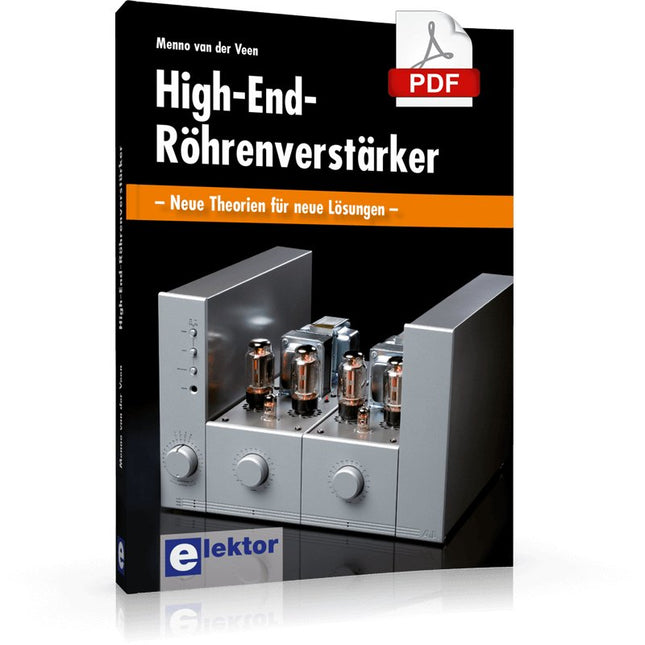
Elektor Digital High-End-Röhrenverstärker (PDF)
Es gibt wohl kaum noch jemanden, der den außerordentlich guten Klang von Röhrenverstärkern ernsthaft bezweifelt. Sie klingen lebendig, durchzeichnet, produzieren räumliche Tiefe, ihr Klangbild ist unaufdringlich angenehm, und im Hinblick auf die entwickelte Dynamik scheinen sie keinerlei Einschränkungen zu kennen. In einer systematisch-theoretischen Untersuchung geht der Autor den Ursachen dieser Kennzeichen nach. Die Kopplung zwischen Endröhren und Ausgangsübertragern wird mit der erforderlichen Tiefe dargestellt. Die formulierten Stabilitätsbedingungen müssen moderne, hochwertige Verstärker mindestens erfüllen. Besonders hervorzuheben an diesem Buch ist, dass es sich nicht allein auf die Darstellung technisch nackter Fakten beschränkt. Der Autor versteht es gleichermaßen spannend und anschaulich zu berichten, dass das Entwickeln von Röhrenverstärkern durchaus in unser alltägliches Dasein eingreifen kann. Ja, selbst der Nutzen von Patenten wird angesprochen. Neue Theorien und neue Lösungen für eine perfekte Audioqualität mit Röhrenverstärkern sind Gegenstand dieses Buches. Sowohl der ambitionierte Selbstbauer, als auch derjenige, der seine Kenntnisse und Einsichten in die Zusammenhänge vertiefen möchte, wird dieses Buch mit Gewinn zur Hand nehmen. Update Auf Seite 322 sind die Bilder 12.4.2 und 12.4.3 identisch; das ist falsch. Das korrekte Bild 12.4.3 steht unter "Downloads" zur Verfügung.
€ 44,80
Mitglieder: € 40,32
-
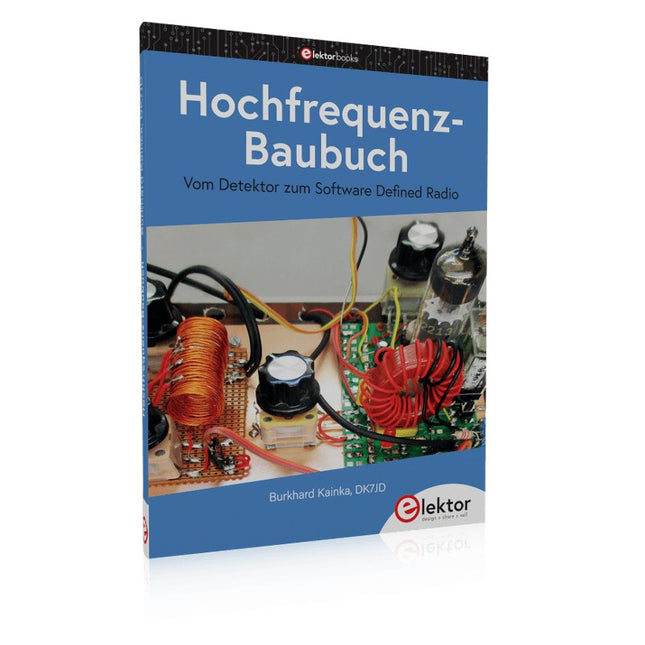
Elektor Publishing Hochfrequenz-Baubuch
Die Hochfrequenztechnik ist eines der Gebiete, auf denen man auch heute noch eigene Ideen in die Tat umsetzen kann. Unzählige Schaltungsvarianten mit besonderen Zielsetzungen geben Raum für sinnvolle Experimente und Projekte. Vieles kann man nicht einfach kaufen. Detektorradios ohne eigene Energiequelle, einfache Röhrenempfänger mit einem Hauch von Nostalgie, die ersten Empfangsversuche mit dem Software Defined Radio oder Spezialempfänger für den Amateurfunk, all dies lässt sich mit wenig Aufwand realisieren. Lange Zeit war das Radiobasteln der Einstieg in die Elektronik. Inzwischen gibt es auch andere Wege, vor allem über Computer, Mikrocontroller und die Digitaltechnik. Allerdings kommen die analogen Wurzeln der Elektronik oft zu kurz. Die Radiotechnik eignet sich besonders gut als Lernfeld der Elektronik, weil man hier mit den einfachsten Grundlagen beginnen kann. Aber auch die Verbindung zur modernen Digitaltechnik liegt auf der Hand, wenn es z. B. um moderne Abstimmverfahren wie PLL und DDS oder um moderne DSP-Radios geht. Dieses Buch gibt einen Überblick und stellt eine Sammlung einfacher Projekte vor. Der Autor möchte Sie dabei unterstützen, eigene Ideen zu entwickeln, eigene Empfänger zu entwerfen und sie zu erproben.
€ 39,80
Bestpreis
-

Elektor Digital Hochfrequenz-Baubuch (PDF)
Die Hochfrequenztechnik ist eines der Gebiete, auf denen man auch heute noch eigene Ideen in die Tat umsetzen kann. Unzählige Schaltungsvarianten mit besonderen Zielsetzungen geben Raum für sinnvolle Experimente und Projekte. Vieles kann man nicht einfach kaufen. Detektorradios ohne eigene Energiequelle, einfache Röhrenempfänger mit einem Hauch von Nostalgie, die ersten Empfangsversuche mit dem Software Defined Radio oder Spezialempfänger für den Amateurfunk, all dies lässt sich mit wenig Aufwand realisieren. Lange Zeit war das Radiobasteln der Einstieg in die Elektronik. Inzwischen gibt es auch andere Wege, vor allem über Computer, Mikrocontroller und die Digitaltechnik. Allerdings kommen die analogen Wurzeln der Elektronik oft zu kurz. Die Radiotechnik eignet sich besonders gut als Lernfeld der Elektronik, weil man hier mit den einfachsten Grundlagen beginnen kann. Aber auch die Verbindung zur modernen Digitaltechnik liegt auf der Hand, wenn es z. B. um moderne Abstimmverfahren wie PLL und DDS oder um moderne DSP-Radios geht. Dieses Buch gibt einen Überblick und stellt eine Sammlung einfacher Projekte vor. Der Autor möchte Sie dabei unterstützen, eigene Ideen zu entwickeln, eigene Empfänger zu entwerfen und sie zu erproben.
€ 32,80
Mitglieder: € 29,52
-

Holybro Holybro QAV 250 ARF Drohnen-Kit
Das QAV250-Kit ist der perfekte Einstieg in die Entwicklung auf PX4 oder Ardupilot. Es kombiniert einen Carbonfaser-250-Rennrahmen und wichtige Elektronik mit dem Mini-Autopiloten Pixhawk 6C. Der Bausatz ist einfach zu montieren, Löten ist nicht erforderlich. Technische Daten Micro-Leistungsmodul (PM06 v2) Motoren: 2207 KV1950 Radstand: 250 mm Abmessungen: 198 x 235 x 70 mm Gewicht: 347 g Lieferumfang Carbonfaser-250-Flugzeugzelle mit Hardware Micro-Leistungsmodul (PM06 v2) Motoren: 2207 KV1950 5" Kunststoff-Requisiten Vollständig montiertes Power Management Board mit ESCs (BLHeli S ESC 20A) Akkugurte Hinweis: Der LiPo-Akku ist nicht im Lieferumfang enthalten.
€ 214,95
Bestpreis
-
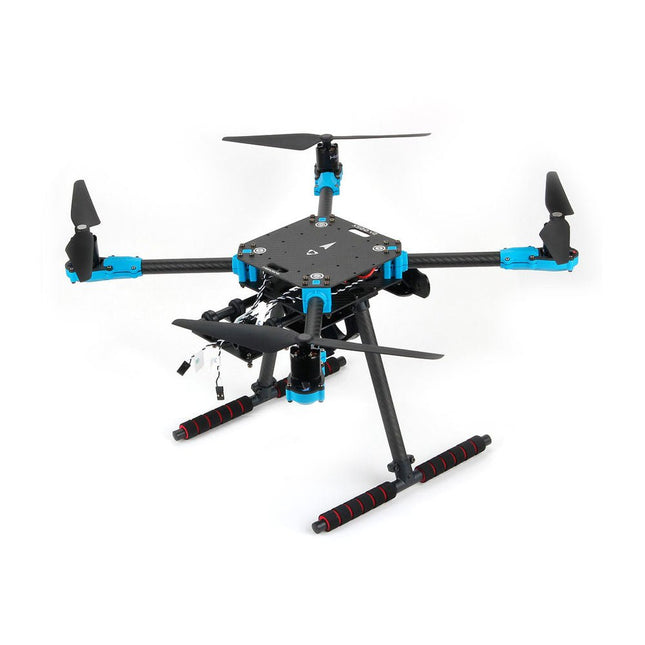
Holybro Holybro X500 V2 ARF Drohnen-Kit
Das X500 V2 ARF-Kit ist ein erschwingliches, leichtes und robustes professionelles Drohnen-Kit aus Kohlefaser, das einfach zusammenzubauen ist (weniger als 15 Minuten). Es wird mit dem X500 V2-Rahmenkit und vorinstallierten Motoren, Reglern, Stromverteilerplatinen und Propellern geliefert. Es ist perfekt kompatibel mit verschiedenen Flugsteuerungen wie der Holybro Pixhawk-Serie, Durandal, Pix32 V5 usw. Im Vergleich zum Vorgängermodell gibt es zahlreiche Verbesserungen. Technische Daten Radstand: 500 mm Motormontagemuster: 16x16 mm Rahmenkörper: 144x144 mm, 2 mm dick Fahrwerkshöhe: 215 mm Abstand zwischen Ober- und Unterplatte: 28 mm Gewicht: 610 g Flugzeit: ca. 18 Minuten im Schwebeflug ohne zusätzliche Nutzlast. Getestet mit 5000 mAh-Akku. Nutzlast: 1500 g (ohne Akku) Batterieempfehlung: 4S 3000-5000 mAh 20C+ mit XT60 Lipo-Batterie (nicht im Lieferumfang enthalten) Lieferumfang X500 V2 Rahmenkit Mit vorinstallierten Elementen: 4x Motoren: Holybro 2216 KV920 Motor (4 Stück) mit XT30-Stecker 4x Regler (BLHeli S ESC 20A) 6x 1045 Propeller Stromverteilungsplatine – XT60-Stecker für Batterie & XT30-Stecker für ESCs & Peripheriegeräte Hinweis: Die Tiefenkamerahalterung ist separat erhältlich.
€ 379,95
Bestpreis
-
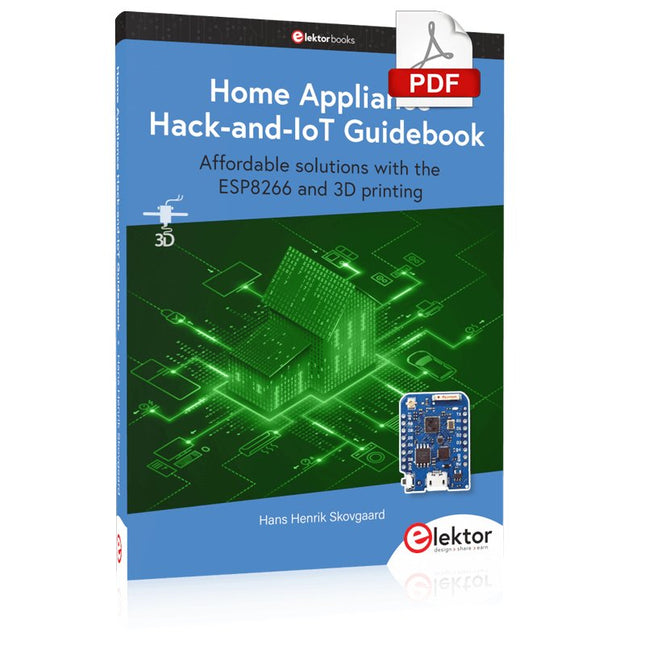
Elektor Digital Home Appliance Hack-and-IoT Guidebook (E-book)
Affordable solutions with the ESP8266 and 3D printing If you are looking for a small yet powerful IoT device, you are likely to come across the ESP8266 and compatible products on the market today. One of these, the Wemos/Lolin D1 Mini Pro board strikes a remarkable balance between cost and performance. A small and very affordable prototype board, the D1 Mini Pro stands out with its WiFi functionality and a 16-Mbytes flash memory for easy creation of a flash file system. In addition, there are sufficient input and output pins (only one analog input though) to support PWM, I²C, and One-Wire systems to mention but a few. The book describes the operation, modding, construction, and programming of home appliances including a colorful smart home accessory, a refrigerator/greenhouse controller, an AC powerline monitor, a door lock monitor, and an IKEA Trådfri controller. As a benefit, all firmware developed for these DIY, "IoT-ized" devices can be updated over-the-air (OTA). For most of the designs in the book, a small printed circuit board (PCB) and an enclosure are presented so readers can have a finished and attractive-looking product. Readers having – or with access to! – a 3D printer can "print" the suggested enclosures at home or in a shop. Some of the constructions benefit from a Raspberry Pi configured as a gateway or cms server. This is also described in detail with all the necessary configuring. You don’t need to be an expert but the prerequisites to successful replication of the projects include basic skills with PC software including the ability to surf the Internet. In terms of hardware, you should be comfortable with soldering and generally assembling the PCBs presented in the book. All custom software written for the IoT devices, the PCB layouts, and 3D print files described in the book are available for free downloading.
€ 34,95
Mitglieder: € 31,46
-

Elektor Digital Home Automation and Electronics for Starters (E-book)
Projects with Arduino, ESPHome, Home Assistant, and Raspberry Pi & Co. This e-book contains various example projects, beginning with an introduction to electronics. It also explains how to install Home Assistant on a Raspberry Pi, how to use indoor climate sensors for temperature and humidity, how to implement the MQTT protocol and other interfaces, and how to use ESPHome to integrate sensors and actuators into Home Assistant. Numerous video tutorials complement the book. Fundamentals of electrical engineering The book begins with an introduction to electrical engineering. You will learn the basics of voltage, current, resistors, diodes and transistors. Arduino and microcontrollers A complete section is dedicated to the Arduino Uno. You will get to know the structure, write your first programs and work on practical examples. Home Assistant and automation You will learn how to set up Home Assistant on a Raspberry Pi and how to use automations, scenes and devices. In addition, Zigbee, MQTT and ESP-NOW – important technologies for home automation – will be discussed. ESP8266, ESP32 and ESP32-CAM The popular ESP microcontrollers are covered in detail. A theoretical introduction is followed by practical projects that show you how to get the most out of these devices. Sensors and actuators The book explains the functionality and application of numerous sensors such as temperature and humidity sensors, motion detectors and RFID readers. For actuators, stepper motors, e-ink displays, servo motors and much more are covered. There are practical application examples for all devices. ESPHome This chapter shows you how to integrate sensors and actuators into Home Assistant without any programming effort. You will be guided step by step through the setup with ESPHome. LEDs and lighting technology In this chapter, you will learn about different types of LEDs and how they can be used. The basics of lighting technology are also explained. Node-RED A whole chapter is dedicated to Node-RED. You will learn the basics of this powerful tool and be guided step by step through its setup and use. Integrated Circuits (ICs) In electronics, there are numerous ICs that make our lives easier. You will get to know the most important ones and apply your knowledge in practical projects. Professional programming Advanced topics such as the correct use of buttons, the use of interrupts and the use of an NTP server for time synchronisation are covered in detail in this chapter. Downloads GitHub
€ 59,95
Bestpreis
-
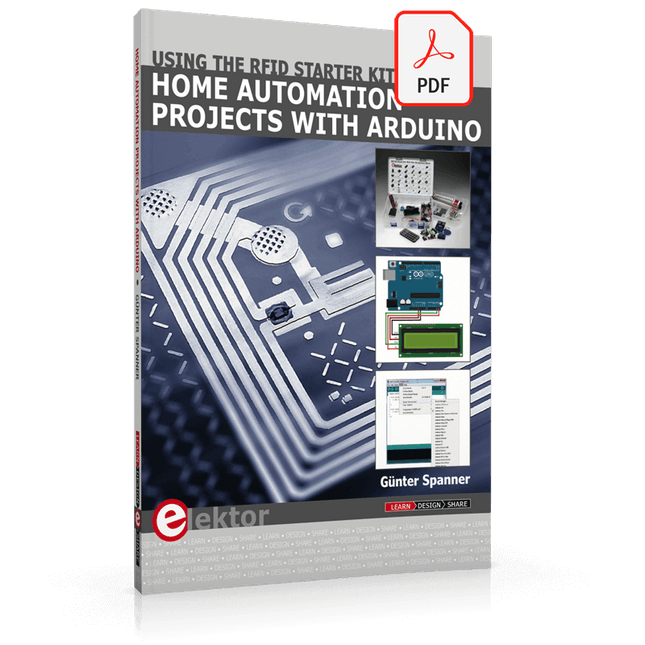
Elektor Digital Home Automation Projects with Arduino (E-book)
Using the RFID Starter Kit An Arduino board has now become ‘the’ basic component in the maker community. No longer is an introduction to the world of microcontrollers the preserve of the expert. When it comes to expanding the capabilities of the basic Arduino board however, the developer is still largely on his own. If you really want to build some innovative projects it’s often necessary to get down to component level. This can present many beginners with major problems. That is exactly where this book begins. This book explains how a wide variety of practical projects can be built using items supplied in a single kit together with the Arduino board. This kit, called the 'RFID Starter Kit for Arduino' (SKU 17240) is not just limited to RFID applications but contains more than 30 components, devices and modules covering all areas of modern electronics. In addition to more simple components such as LEDs and resistors there are also complex and sophisticated modules that employ the latest technology such as: A humidity sensor A multicolor LED A large LED matrix with 64 points of light A 4-character 7-segment LED display An infra red remote-controller unit A complete LC-display module A servo A stepper motor and controller module A complete RFID reader module and security tag On top of that you will get to build precise digital thermometers, hygrometers, exposure meters and various alarm systems. There are also practical devices and applications such as a fully automatic rain sensor, a sound-controlled remote control system, a multifunctional weather station and so much more. All of the projects described can be built using the components supplied in the Elektor kit.
€ 29,95
Mitglieder: € 26,96
-

Elektor Publishing How Humanity Turned Electricity into Electronics
From Rubbing Amber to Swiping Glass "The story of electricity, told one connection at a time."Why does rubbing amber attract dust? How did we go from that curious effect to a world where screens respond to a single touch? And how did we get from mysterious sparks to tiny chips packed with billions of transistors? For centuries, electricity puzzled and fascinated those who encountered its curious effects—long before it even had a name. From the earliest observations of static charge to the complex electronics that shape our lives today, this book traces the gradual, and often surprising, story of how humanity came to understand and harness this powerful force. This book offers an engaging and accessible account of the people, ideas, and inventions that transformed electricity from a scientific curiosity into the foundation of our digital age. Along the way, you’ll meet a host of inquisitive minds—some famous, others less so—whose persistence and creativity helped unravel the mysteries of the natural world and gave rise to the technologies we now take for granted. Covering everything from Leyden jars and batteries to transistors, microcontrollers and the internet, this book presents a clear and enjoyable overview of electronics and its relatively short, yet rich, history. Whether you have a technical background or simply a curiosity about how things work, From Rubbing Amber to Swiping Glass offers a thoughtful look at how far we’ve come—and a gentle nudge to wonder what might come next.
€ 39,95
Mitglieder: € 35,96
-

Elektor Digital I/O-Projekte für den PC (E-book)
Computer können mehr, als bloß Texte verarbeiten, Digitalfotos bearbeiten oder im Internet surfen; sie sind bestens geeignet zum Steuern, Messen und Regeln. Mit ein wenig Zusatz-Hardware können sie mit der Umwelt kommunizieren, ohne dass ein Eingriff ins Computerinnere notwendig ist.Die in diesem Buch beschriebenen Selbstbau-Schaltungen werden über die Standard-Ports (paralleler Druckeranschluss, serielle Schnittstelle oder USB-Anschluss) mit dem Computer verbunden. Die externe Hardware macht zusammen mit der Software aus dem Computer ein Steuerungssystem bzw. ein komplettes Mess- und Regelsystem. Da von den meisten Programmen auch der Quellcode vorhanden ist, sind mit etwas Kreativität auch noch andere, individuell angepasste Möglichkeiten als die hier beschriebenen Applikationen denkbar.Aus dem Inhalt: Akku-Kapazitätsmessung mit dem PC A/D-Wandler 8-Kanal Ein- und Ausgangskarte Temperatur-Rekorder und Datenlogger USB-Interface I²C-Interface für Druckerschnittstelle CAN-Bus-Interface PIC- und AVR-Programmer
€ 34,80
Mitglieder: € 31,32
-

iFixit iFixit Essential Electronics Toolkit
Das iFixit Essential Electronics Toolkit ist genau das, was Sie für die wichtigsten Reparaturen an Elektronikgeräten benötigen – wie den Austausch von Bildschirmen und Akkus – und enthält alles, was Sie für die meisten Reparaturen im Haushalt benötigen. Starten Sie in die Elektronikreparatur mit allen Bits und Präzisionswerkzeugen, um Ihre dringendsten Bildschirmbrüche und Akkuwechsel zu beheben. Oder erweitern Sie einfach Ihr Heimwerker-Werkzeugset mit allem, was Sie für die Reparatur von Türgriffen, Haushaltsgeräten, Brillen und vielem mehr benötigen. Kit beinhaltet Magnetisierter Fahrergriff Abgewinkelte Präzisionspinzette Spudger Jimmy iFixit-Öffnungstool iFixit Opening Picks 6er-Set Sauggriff Leicht zu öffnendes magnetisiertes Gehäuse Mitglied mit integriertem Sortierfach Sechzehn 4-mm-Präzisions-Schraubendreher-Bits Phillips - 000, 00, 0, 1 Pentalobe - P2, P5 Flachkopf – 1 mm, 2,5 mm, 4 mm Torx - T4, T5 Torx-Sicherheit – TR6, TR8, TR10 Tri Point - Y000 SIM-Auswurfbit Technische Daten Bit-Metall: 6150 Stahl Treibermaterial: Polymer Gehäusematerial: ABS Schaum: EVA
€ 34,37
-

iFixit iFixit iOpener Toolkit
Elektronikgeräte mit verklebten Displays und Akkus sind immer stärker im Umlauf. Die Versiegelung schützt zwar vor Schmutz und Wasser, erschwert aber ein einfaches Öffnen des Gerätes – und damit auch jede Reparatur. Tschüss, Klebebefestigung: Mit dem iOpener Kleber lösen Bis jetzt, denn mit dem iOpener löst du problemlos und schnell Klebeverbindungen, ohne das Risiko, mit einer Heißluftpistole und zu viel Hitze dein Gerät zu beschädigen. Entwickelt wurde er zunächst zum Öffnen von Apple iPads, eignet sich aber auch für Tablets von Samsung, Smartphones von Sony und jedem anderen Hersteller, der inzwischen lieber klebt, statt schraubt. Und so funktioniert es iOpener erhitzen und auflegen: Den iOpener erwärmst du ganz einfach in der Mikrowelle oder in einem Topf mit kochendem Wasser. Anschließend positionierst du ihn auf der Kante deines Elektronikgeräts. Die Wärme löst den Klebstoff, ohne dein Gadget in Mitleidenschaft zu ziehen, sodass du ein Opening Pick zwischen Display und Gehäuse klemmen kannst. Danach wiederholst du den Vorgang für alle weiteren verklebten Stellen, denn der iOpener ist beliebig oft wiederverwendbar. Klebstoffreste mit Opening Tools entfernen: Mit den richtigen Werkzeugen kannst du dein Gerät nun mühelos öffnen. Die Opening Picks sind scharf genug, um Klebestreifen zu durchtrennen. Mit einem Opening Tool hebelst du abschließend das Gehäuse deines Gerätes auf oder hebst ein Display mit einem Saugheber oder iSclack ab. Ein Muss für Elektronikreparaturen Den nervigsten Teil einer Reparatur hast du damit schon hinter dir – so wird der Rest fast schon zum Selbstläufer. Ob Einsteiger oder Fachmann – der iOpener gehört in jeden Werkzeugkoffer, denn leichter lässt sich Kleber nicht lösen. Deine Vorteile auf einen Blick Löst Klebebefestigungen zielgerichtet Unkompliziert in der Mikrowelle oder kochendem Wasser zu erhitzen Wiederverwendbar Auf Wunsch mit zusätzlichen Öffnungswerkzeugen Inhalt aus lebensmittelechtem Glycerin Schont Geldbeutel und Umwelt Lieferumfang iOpener Spudger (Spatel) iFixit Öffnungswerkzeug 6x Fixit Opening Pick (Plektrum) iFixit Battery Isolation Pick Plastikkarten Saugheber Gebogene Pinzette Schraubendreher aus Kunststoff mit magnetischem Bithalter (4 mm), gummierter Griffzone und Drehkappe Präzisions-Bits (4 mm) in folgenden Größen: Kreuzschlitz (Phillips) #00 Schlitz 2.5 mm
€ 24,54
-

iFixit iFixit Magnetische Projektmatte
Die 8x10" große magnetische iFixit-Projektmatte fängt Schrauben auf und hält sie sicher fest, wenn Sie sie aus einem Gerät herausziehen. Jetzt müssen Sie sich keine Gedanken mehr darüber machen, alle losen Schrauben im Auge zu behalten, und können sich auf Ihre Reparatur konzentrieren. Schrauben und Kleinteile bleiben genau dort, wo Sie sie gelassen haben. Verwenden Sie bei Laptops mit Hunderten von Schrauben die gesamte Matte als Schraubenführung und machen Sie sich sorgfältige Notizen zum Standort. Im Lieferumfang ist ein Stift enthalten – hergestellt von Staedtler, Hersteller hochwertiger Stifte und Bleistifte für Künstler und Architekten – der speziell für die Project Mat entwickelt wurde. Der Lumocolor Correctable-Stift ist wischfest und lässt sich nicht durch eine einfache Handbewegung wegwischen. Wenn Ihre Reparatur abgeschlossen ist, wischen Sie die Tinte mit der Radiergummispitze oder einem trockenen Tuch sauber weg. Features Organisieren Sie alle Ihre Kleinteile, während Sie an einem Gerät arbeiten. Auf der trocken abwischbaren Oberfläche können Sie Notizen und Standortskizzen festhalten. Reduziert die Montagezeit um bis zu 40 % und verhindert gleichzeitig Fehler.
€ 19,62
-

iFixit iFixit Manta Driver Kit
Dieses Kit enthält das größte Sortiment an Bits von iFixit, komplett mit allen Schraubendreherköpfen, die Sie für jedes Reparatur- oder Heimwerkerprojekt benötigen. Es umfasst Standard-Bits wie Kreuzschlitz- und Flachkopf-Bits in einer breiten Palette von Größen, um alles von der Präzisionsreparatur von Elektronikgeräten bis hin zu Heimwerkerprojekten zu bewältigen. Und es wäre kein iFixit-Bit-Set, wenn es nicht alle exotischen Bits von Pentalobes für die Reparatur von Apple iPhone und MacBook bis hin zu Gamebits für Ihre Vintage-Nintendo-Konsolen enthalten würde. Alle Bitsätze der nächsten Generation wurden neu gestaltet, um den Komfort und die Benutzerfreundlichkeit zu maximieren. Der Bit-Set-Deckel wird mit Magneten an Ort und Stelle gehalten, um die Lebensdauer des Produkts zu verlängern (keine kaputten Scharniere oder Verschlüsse mehr) und wird auch an der Rückseite des Bit-Set-Koffers befestigt, damit er Ihnen bei der Arbeit nicht im Weg ist. Wenn Sie Hilfe bei der Organisation Ihrer Schrauben und Teile benötigen, können Sie die integrierte Sortierschale im Deckel verwenden. Die 4-mm-Bits wurden angepasst und verfügen nun über einen längeren Hals für eine tiefere und präzisere Reichweite. Toolkit enthält Leicht zu öffnendes magnetisiertes Gehäuse Mitglied mit integriertem Sortierfach 4-mm-Aluminium-Bit-Treiber 1/4' Aluminium-Bit-Treiber 4-mm-Schraubendreherbits Phillips - 000, 00, 0 Flachkopf – 1, 1,5, 2, 2,5, 3, 3,5 mm Torx – T2, T3, T4, T5 Torx-Sicherheit – TR6, TR7, TR8 Pentalobe - P2, P5, P6 JIS - 000, 00, 0, 1 Sechskant – 0,7, 0,9, 1,3, 1,5 mm Sechskantsicherheit – 2, 2,5, 3, 3,5 mm Dreipunkt – Y000, Y00, Y0, Y1 Steckschlüssel – 2,5, 3, 3,5, 4, 4,5, 5, 5,5 mm Spielbit - 3,8, 4,5 mm Spanner - 4, 6 Dreieck - 2, 2,2, 2,6, 3 mm Ovales Gebiss iPhone-Abstandsbit Sim-Auswurfbit Magnetischer Pickup-Bit 1/4'-Schraubendreher-Bits Phillips – 1, 2, 3 Flachkopf – 4, 5, 6, 7, 8 mm Sechskantsicherheit – 4, 5, 6, 7, 8 mm Sechskantsicherheit SAE – 1/8, 9/64, 5/32, 3/16, 7/32, 1/4 Pozidriv - PZ0, PZ1, PZ2, PZ3 Drehmomentsatz - 6, 8, 10 Spanner - 8, 10, 12 Quadrat - 0, 1, 2, 3 Spline – M5, M6, M8 Torx-Sicherheit – TR9, TR10, TR15, TR20, TR25, TR27, TR30, TR35, TR40 Tri Wing 1, 2, 3, 4 Kupplung 1, 2, 3 Schrader-Ventil Hakenantrieb 1/4' auf 4 mm Adapter 1/4'-Treiber auf 1/4'-Buchse 1/4'-Schraubendreher auf 3/8'-Stecknuss 1/4'-Buchse auf 1/4'-Schraubendreher Technische Daten Bit-Metall: 6150 Stahl Treibermaterial: Eloxiertes Aluminium Gehäusematerial: ABS Schaum: EVA
€ 63,88
-

iFixit iFixit Pro Tech Toolkit
Das Pro Tech Toolkit ist das Einzige, was jeder Heimwerker, Reparateur, Hacker, Bastler und Profi braucht, um jede Aufgabe zu bewältigen. Jedes Tool im Pro Tech Toolkit wurde überarbeitet, um besser zu sein. Vom 64 Bit-Treiber-Kit bis hin zu den iFixit Opening Picks wurde jedes Werkzeug speziell entwickelt und ausgewählt, um Ihre Reparaturmöglichkeiten zu maximieren. Das Herzstück dieses Kits ist das iFixit 64 Bit-Schraubendreher-Kit, das auf der Grundlage umfangreicher Untersuchungen darüber entwickelt wurde, welche Befestigungstypen derzeit in der Unterhaltungselektronikindustrie verwendet werden und welche älteren Befestigungselemente von Verbrauchern immer noch nachgefragt werden. Von der Apple Watch mit ihren neuen winzigen Tri-Point-Schrauben bis hin zu Vintage-Nintendo-Spielekonsolen mit Gamebit-Befestigungen – das 64-Bit-Kit deckt sie alle mit CNC-gefrästen Bits höchster Qualität ab. Sogar das robuste Gehäuse wurde sorgfältig konstruiert, hat keine Scharniere oder Riegel, die brechen könnten, und verfügt über ein Sortierfach im magnetisch befestigten Deckel. Das umfassende Werkzeug-Set für Elektronikreparaturen aller Art Perfekt geeignet für DIY-Enthusiasten und professionelle Reparaturtechniker. Enthält Werkzeuge zum Schrauben, Öffnen, Greifen, Hebeln und Sondieren - alles was benötigt wird um Geräte aus dem Bereich der Unterhaltungselektronik zu reparieren. Und das ESD-sicher. Komplette Neuentwicklung – kein Werkzeug zu viel oder zu wenig. Inhalt des Sets Erdungsarmband – schützt dich und empfindliche Geräte vor elektrostatischen Entladungen Saugheber – zum sicheren Anheben und Halten griffloser Komponenten 3x iFixit Opening Tool – aus weichem Kunststoff zum kratzerfreien Aufhebeln von Gehäusen 6x iFixit Opening Picks – zum Aufhebeln, Aufschieben, Auftrennen und natürlich zum Luftgitarre spielen Kreuzpinzette – Zum Festhalten kleiner Teile ohne Fingerdruck Gebogene Pinzette – ESD-sicher, mit gezahnter Greiffläche Stumpfe Pinzette – ESD-sicher, mit gezahnter Greiffläche Spudger (Spatel) – robustes ESD-sicheres Allround-Tool Halberd Spudger – spezieller Spudger (Spatel) mit Haken, ESD-sicher Metallspatel – für die härteren Fälle Jimmy – der ultimative Geräteöffner Magnetische Unterlage – hält Schrauben und Kleinteile an ihrem Platz Werkzeugrolle – praktische Aufbewahrung für alle Bestandteile des Kits Mako Precision Bit Set – 64 essentielle Bits für Arbeiten an unterschiedlichsten Elektronikgeräten Inhalt des Mako Precision Bit Sets Magnetischer Aluminiumschraubendreher 4 mm mit kugelgelagerter Drehkappe Flexible Wellenverlängerung Länge 150 mm 64 Bits (4 mm) in folgenden Größen: Kreuzschlitz (Phillips) 000, 00, 0, 1, 2 Schlitz 1, 1.5, 2, 2.5, 3, 4 mm Torx T2, T3, T4, T5 Torx Security TR6, TR7, TR8, TR9, TR10, TR15, TR20, TR25 Pentalobe P2, P5, P6 JIS J000, J00, J0, J1 Sechskant 0.7, 0.9, 1.3, 1.5, 2, 2.5, 3, 3.5, 4, 4.5, 5 mm Tri-point Y000, Y00, Y0, Y1 Innensechskant Nuss 2.5, 3, 3.5, 4, 5, 5.5 mm Quadrat 1, 2 Gamebit 3.8, 4.5 mm Spanner 6, 8 Dreieck 2, 3 mm Standoff Bit für iPhone Oval Bit magnetisches Bit zur Aufnahme von Kleinteilen SIM Eject Bit 1/4 Zoll auf 4 mm Adapter
€ 68,79
-
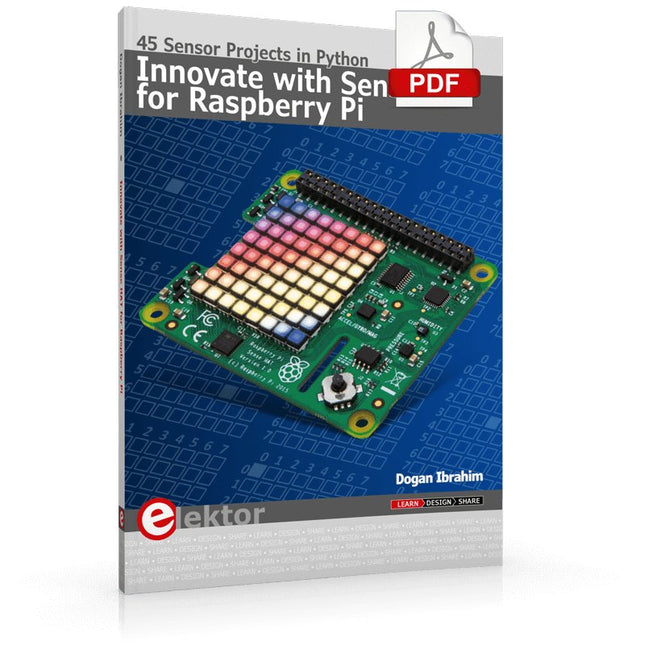
Elektor Digital Innovate with Sense HAT for Raspberry Pi (E-book)
Ready to explore the world around you? By attaching the Sense HAT to your Raspberry Pi, you can quickly and easily develop a variety of creative applications, useful experiments, and exciting games. The Sense HAT contains several helpful environmental sensors: temperature, humidity, pressure, accelerometer, magnetometer, and gyroscope. Additionally, an 8x8 LED matrix is provided with RGB LEDs, which can be used to display multi-color scrolling or fixed information, such as the sensor data. Use the small onboard joystick for games or applications that require user input. In Innovate with Sense HAT for Raspberry Pi, Dr. Dogan Ibrahim explains how to use the Sense HAT in Raspberry Pi Zero W-based projects. Using simple terms, he details how to incorporate the Sense HAT board in interesting visual and sensor-based projects. You can complete all the projects with other Raspberry Pi models without any modifications. Exploring with Sense HAT for Raspberry Pi includes projects featuring external hardware components in addition to the Sense HAT board. You will learn to connect the Sense HAT board to the Raspberry Pi using jumper wires so that some of the GPIO ports are free to be interfaced to external components, such as to buzzers, relays, LEDs, LCDs, motors, and other sensors. The book includes full program listings and detailed project descriptions. Complete circuit diagrams of the projects using external components are given where necessary. All the projects were developed using the latest version of the Python 3 programming language. You can easily download projects from the book’s web page. Let’s start exploring with Sense HAT.
€ 29,95
Mitglieder: € 26,96
-
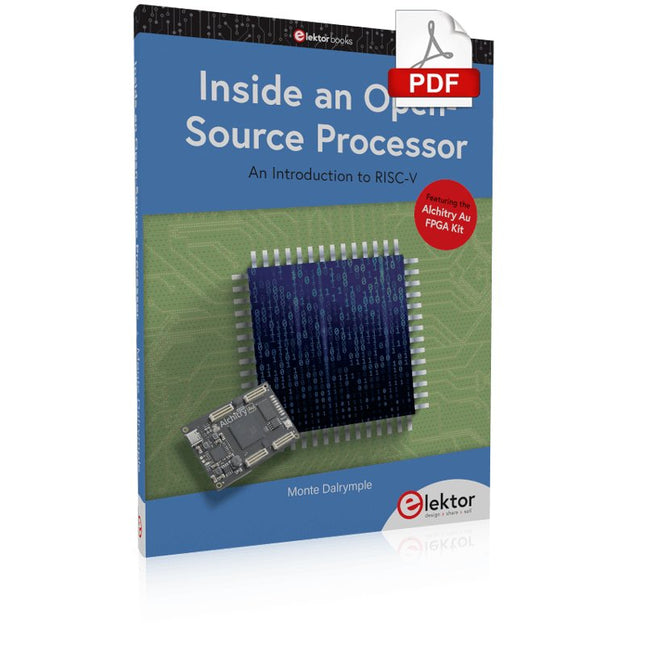
Elektor Digital Inside an Open-Source Processor (E-book)
An Introduction to RISC-V RISC-V is an Instruction Set Architecture (ISA) that is both free and open. This means that the RISC-V ISA itself does not require a licensing fee, although individual implementations may do so. The RISC-V ISA is curated by a non-profit foundation with no commercial interest in products or services that use it, and it is possible for anyone to submit contributions to the RISC-V specifications. The RISC-V ISA is suitable for applications ranging from embedded microcontrollers to supercomputers. This book will first describe the 32-bit RISC-V ISA, including both the base instruction set as well as the majority of the currently-defined extensions. The book will then describe, in detail, an open-source implementation of the ISA that is intended for embedded control applications. This implementation includes the base instruction set as well as a number of standard extensions. After the description of the CPU design is complete the design is expanded to include memory and some simple I/O. The resulting microcontroller will then be implemented in an affordable FPGA development board (available from Elektor) along with a simple software application so that the reader can investigate the finished design.
€ 32,95
Mitglieder: € 29,66
-

Elektor Digital Internet of Things (DE) | E-book
35 Projekte mit Raspberry Pi und Arduino Das Internet of Things (Internet der Dinge) ist eine unumkehrbare Entwicklung. Wir möchten gerne alles im Haus mit unserem Smartphone oder Tablet erledigen – von Facebook bis Fernsehen, Lampen steuern oder die Heizungstemperatur einstellen. In diesem Buch stellen wir 35 interessante und nützliche Projekte vor, die demonstrieren, wie Sie selbst ein Internet-of-Things-System anlegen können. Wir gehen auf die Hardware ein, einer perfekten Symbiose von Raspberry Pi und Arduino, und entwickeln die Software, die eine Steuerung über das Internet verwirklicht. Wir setzen dabei WLAN- und Funkverbindungen ein und vermeiden so einen Kabelsalat im Haus. Wenn Sie die Projekte aufbauen, verfügen Sie über ein vollständiges Internet-of-Things-System, mit dem Sie alles im Haus bedienen, steuern und überwachen können, zum Beispiel ob Post im Briefkasten steckt oder das Auto in der Garage steht. Sie können bequem vom Sofa aus das Licht einschalten oder die Alarmanlage aktivieren/deaktivieren. Durch die ausführlichen Erläuterungen wird es Ihnen ein Leichtes sein, Projekte anzupassen, um zum Beispiel die Kaffeemaschine oder das Fernsehgerät aus der Ferne ein- und auszuschalten. Über den Index finden Sie leicht kreative Projekte, die Ihnen als Ausgangspunkt für eigene Entwicklungen dienen können, mit denen Sie selber alles, was Sie wollen, mit dem Internet verbinden können.
€ 34,80
Mitglieder: € 31,32
-

Elektor Digital Introduction to Control Engineering (E-book)
This book is aimed at practising engineers, students and hobbyists. It is intended as a source of reference for hardware and software associated with instrumentation and control engineering. Examples are presented from a range of industries and applications. Throughout the book, circuit diagrams and software listings are described, typical of many measurement and control applications. The hardware and software designs may be used as a basis for application by the reader. The book contains examples of PIC, PLC, PAC and PC programming. All code samples are available to download free of charge from the support website. After an introductory section on control theory and modelling, the text focus is upon software for control system simulation and implementation, with appropriate reference to interfacing, electronic hardware and computing platforms. Introduction to Control Engineering is a sourcebook of solutions for control system applications!
€ 24,95
Mitglieder: € 22,46
-

Elektor Publishing Introduction to Electronic Filters
Learn RC and RL Filters with Hands-On Circuits and Simulation Introduction to Electronic Filters is your comprehensive guide to understanding, designing, and applying first-order electronic filters using resistors, capacitors, and inductors. Whether you are a student, maker, or educator, this book demystifies the theory behind RC and RL filters and bridges the gap between concepts and real-world applications through simulation and experimentation. From the basics of frequency response and phase shift to hands-on breadboard builds and Python-based simulations, this book offers a deeply practical learning experience. You will learn to analyse filters using Bode plots and phasors, and explore applications in audio tone shaping, sensor signal conditioning, noise reduction, and power supply filtering. As you progress, you’ll build, measure, simulate, and tune filters using modern tools like CircuitLab, Python, and the Analog Discovery 3. Each chapter includes thoughtfully crafted activities that reinforce learning by doing – designing filters for specific tasks, simulating dynamic behaviour, and observing how theory translates into performance. Inside you’ll find: A clear introduction to the fundamentals of electronic filters Detailed explanations of RC and RL filters, cutoff frequency, and phase Guided activities using both simulation and hardware tools Real-life applications in audio, sensors, power supplies, and more A beginner-friendly primer on Python and algebra for electronics Whether you’re working through simulations or experimenting with real components on your workbench, this book will help you develop a solid understanding of electronic filters and their role in practical circuits.
€ 39,95
Mitglieder: € 35,96


