Dies ist eine leistungsstarke Kühllösung, die darauf ausgelegt ist, Wärme effektiv abzuleiten und optimale Betriebstemperaturen für den Raspberry Pi sicherzustellen. Es ist ein unverzichtbares Zubehör für Benutzer, die die Leistung und Langlebigkeit ihres Raspberry Pi-Geräts verbessern möchten.
Das kompakte Design des Wasserkühlungskits für Raspberry Pi 5 ermöglicht die nahtlose Installation auf der Ober- und Unterseite des Raspberry Pi 5, wodurch eine effiziente Wärmeübertragung gewährleistet und die Unterseite des Raspberry Pi perfekt geschützt wird . Dank des einfachen Installationsprozesses ist keine komplexe Verkabelung oder zusätzliches Werkzeug erforderlich, sodass es sowohl für Anfänger als auch für erfahrene Raspberry-Pi-Enthusiasten geeignet ist.
Mit seiner leistungsstarken Kühlleistung leitet das Wasserkühlungsset für Raspberry Pi 5 die vom Raspberry Pi bei intensiven Aufgaben oder längerer Nutzung erzeugte Wärme effektiv ab. Dies verhindert eine Überhitzung und sorgt für eine stabile Leistung. Eine effiziente wassergekühlte Kühlung ermöglicht es Ihnen, mehrere Raspberry Pi-Boards an eine Reihe von Kühlgeräten anzuschließen. Wenn Sie Raspberry Pi in einem Cluster verwenden, können Sie eine Reihe wassergekühlter Geräte verwenden, um mehrere Raspberry Pi-Boards effektiv zu kühlen.
Features
Hergestellt für Raspberry Pi: Speziell für Raspberry Pi 5 entwickelt, 1:1-Formöffnung, deckt alle Wärmequellen ab, einschließlich CPU, WLAN, Power-Chip und eMMC.
Kühlleistung: Leitet die vom Raspberry Pi erzeugte Wärme effektiv ab, sorgt für optimale Betriebstemperaturen und verhindert Überhitzung.
Einfach zu bedienen: Das integrierte Design der Wasserpumpe und des Kühlventilators ist für Benutzer bequem zu installieren.
RGB-Farbbeleuchtung: An den Lüfter- und Wasserpumpenstandorten sind RGB-Farblichter installiert.
Lieferumfang
1x Wasserkühlungsset
1x Wasserkühlungskühler
1x schwarzer Kühlkörper
2x Silikonschlauch
1x 12 V/2 A Netzteil (US)
4x Sechskantschraube M2,5x10
1x L-Schlüssel-Inbusschlüssel
Features
Internal LNA amplifier and selectable attenuator
Low frequency support from 50KHz covering LF, MF, HF, VHF and UHF up to 960Mhz
New HELP and SET buttons to improve user interface and configuration selection with 2-clicks
Wide band coverage to all popular sub-1Ghz bands, including FM, TV and DTV, ISM, RFID, GSM, etc.
Ideal choice for HAM bands from 160meters to 33cm
Pocket size and light weight
Solid metal case
Spectrum Analyzer mode with Peak Max and Hold, Normal, Overwrite and Averaging modes
High capacity internal Lithium battery for 20hs+ of continuous run, rechargeable by USB
Multi-platform Windows/Linux/MacOS Open Source software and API libraries
Can be extended with internal Expansion Modules for additional band and functionality
Specifications
Frequency band: 0.05 MHz - 960 MHz
Frequency span: 0.1 MHz - 960 MHz
Internal selectable LNA 25 dB gain
Internal selectable Attenuator 30 dB
Graphics LCD 128 x 64 pixels, great visibility outdoors
Support included for Windows, Linux and MacOS X
Backlight for great visibility indoor
Internal Lithium Ion 1800mA/h rechargeable battery
Standard SMA 50 Ω connector
Wideband 144/433MHz dual band telescopic antenna included
UHF 400-900 MHz rubber duck articulated antenna included
Amplitude resolution: 0.5dBm
Dynamic range: -125 dBm to 10 dBm
Absolute Max input power: +30dBm
Average noise level (typical LNA): -125 dBm
Frequency stability and accuracy (typical): +-10 ppm
Amplitude stability and accuracy (typical): +-2d Bm
Frequency resolution: 1kHz
Resolution bandwidth (RBW): automatic 2.6 kHz to 600 kHz
Included
1x RF Explorer WSUB1G+ Spectrum Analyzer
1x Mini USB cable
1x Dual band 144/430MHz Telescopic antenna
1x UHF 400-900Mhz antenna
1x EVA case
You can use RF Explorer 3G Combo equally well outdoor and indoor, and you can also connect it to a PC for extra functionality using standard mini-USB 2.0 connector.
This model includes a WSUB1G baseline unit plus an RFEMWSUB3G Expansion Module conveniently assembled and tested. It comes with two SMA connectors and two antennas,a dual band telescopic 144 / 430 MHz antenna for all Sub-GHz frequencies and a whip helical antenna for 2.4 GHz band. Additional, specific band antennas may be needed to cover efficiently some of the frequencies supported.
The combination of these two models offer the wide band coverage of the WSUB3G module, together with the highest sensitivity and quick response of the WSUB1G model for the popular sub-1GHz frequencies.
Features
Pocket size and light weight
Solid aluminum metal case
Includes a transport EVA carry case for RF Explorer
Spectrum Analyzer mode with Peak Max and Hold, Normal, Overwrite and Averaging modes
Lifetime free firmware upgrades available, open to community requested features
High capacity Lipo for 16 hours+ of continuous run, rechargeable by USB
Windows PC client Open Source
Can be extended with internal Expansion Modules for additional band and functionality
Wide band coverage to all popular RF frequencies, starting at 15 MHz and going up to 2.7 GHz. This includes very interesting frequency areas such as 2 m HAM radio, all VHF and UHF, FM radio, GPS, WiFi and WiMax, Bluetooth, etc.
Firmware: RF Explorer 3G Combo is delivered with upgraded firmware v1.09. Note some of the features and operation accuracy will be improved in upcoming free firmware revisions.
Specifications
Battery
Lithium Cells / Batteries contained in equipment UN3481 - PI967
Frequency band
15-2700 MHz
Frequency span
112 KHz - 600 MHz
Graphics LCD
128 x 64 pixels, great visibility outdoors
PC Windows client
supports Windows XP/Vista/Win7 both 32 and 64bits
Backlight
for great indoor visibility
2 standard SMA 50 ohms connector,
one for Sub-GHz wideband Nagoya NA-773 telescopic antenna included and another 2.4 GHz one for 15-2700 MHz band with helical antenna included.
Amplitude resolution
0.5 dBm
Dynamic range
Left SMA port (WSUB1G)
-115 dBm to 0 dBm
Right SMA port (WSUB3G)
-110 dBm to -10 dBm
Absolute Max input power
Left SMA port (WSUB1G)
+5 dBm
Right SMA port (WSUB3G)
+30 dBm
Average noise level (typical)
-110 dBm
Frequency stability and accuracy (typical)
+-10 ppm
Amplitude stability and accuracy (typical)
+-6 dBm
Frequency resolution
1 KHz
Resolution bandwidth (RBW)
automatic 3 KHz to 600 KHz
Weight
185 g
Size
113 x 70 x 25 mm
Included
RF Explorer 3G Combo
Nagoya NA-773 wideband telescopic antenna
2.4 GHz band antenna
EVA Case
Documentation
For more info and to get started with your RF Explorer, visit the start page.
For questions and support, please visit https://support.rf-explorer.com
Der Unitree Go2 D1 Servo-Roboterarm ist ein leistungsstarker 6-DOF-Roboterarm, der speziell für die nahtlose Integration mit dem Unitree Go2 Vierbeiner entwickelt wurde. Er ist auf Flexibilität und Präzision ausgelegt und somit ein ideales Werkzeug für Bildung, Forschung, Automatisierung und fortschrittliche Robotikentwicklung.
Mit sechs vollbeweglichen Gelenken und einem integrierten Greifer bietet der D1 echte Sechs-Achsen-Bewegung und außergewöhnliche Bewegungsfreiheit. Dank der Unterstützung von Positions-, Geschwindigkeits- und Kraftregelung ermöglicht er präzises Arbeiten in einem breiten Aufgabenspektrum – vom realen Einsatz bis hin zu experimentellen Lernumgebungen.
Der aus einer leichten Aluminiumlegierung gefertigte Arm wiegt nur 2,37 kg und verfügt über eine Reichweite von 670 mm. Diese Kombination aus Robustheit und Agilität macht ihn ideal für mobile Anwendungen, ohne Kompromisse bei Stabilität oder Reichweite einzugehen.
Dank seiner zweistufigen Schnittstellenarchitektur unterstützt der D1 sowohl einfache Motorbefehle als auch komplexe Verhaltensprogrammierung. So haben Entwickler, Lehrkräfte und Forscher volle Kontrolle – egal, ob sie Bewegungsabläufe optimieren oder komplexe Roboter-Workflows erstellen.
Der Unitree D1 ist mit externen Komponenten wie Kameras oder mobilen Roboterchassis kompatibel und eröffnet so vielfältige, erweiterte Anwendungsfälle. Ob autonome Objektmanipulation, KI-Training oder praxisnahe Robotik-Ausbildung – der D1 verwandelt jede Umgebung in eine dynamische und interaktive Innovationsplattform.
Technische Daten
DoF
6 Achsen + 1 Greifer
Nutzlast
500 g
Armreichweite
550 mm (ohne Greifer)670 mm (mit Greifer)
Schnittstellen
DC5.5-2.1 (Stromversorgung)RJ45 (Kommunikation)USB-C (Debugging über serielle Schnittstelle)
Motortyp
Bus-Servo
Leistung
60 W
Gewicht
2,37 kg
Gelenk-Rotationsbereich
J1: ±135°J2: ±90°J3: ±90°J4: ±135°J5: ±90°J6: ±135°
Der Elektor Super Servo Tester kann Servos steuern und Servosignale messen. Es können bis zu vier Servokanäle gleichzeitig getestet werden.
Der Super Servo Tester wird als Bausatz geliefert. Alle zum Zusammenbau des Super Servo Testers erforderlichen Teile sind im Bausatz enthalten. Für den Zusammenbau des Bausatzes sind grundlegende Lötkenntnisse erforderlich. Der Mikrocontroller ist bereits programmiert.
Der Super Servo Tester verfügt über zwei Betriebsmodi: Steuerung/Manuell und Messen/Eingänge.
Im Control/Manual Modus generiert der Super Servo Tester an seinen Ausgängen Steuersignale für bis zu vier Servos oder für den Flugregler oder ESC. Die Signale werden über die vier Potentiometer gesteuert.
Unter Measure/Inputs misst der Super Servo Tester die an seine Eingänge angeschlossenen Servosignale. Diese Signale können beispielsweise von einem Regler, einem Flugregler, dem Empfänger oder einem anderen Gerät stammen. Die Signale werden auch an die Ausgänge weitergeleitet, um die Servos oder den Flugregler bzw. ESC zu steuern. Die Ergebnisse werden auf dem Display angezeigt.
Technische Daten
Betriebsmodi
Control/Manual & Measure/Inputs
Kanäle
3
Servosignaleingänge
4
Servosignalausgänge
4
Alarm
Summer & LED
Anzeige
0,96' OLED (128 x 32 Pixel)
Eingangsspannung an K5
7-12 VDC
Eingangsspannung an K1
5-7,5 VDC
Eingangsstrom
30 mA (9 VDC an K5, nichts an K1 und K2 angeschlossen)
Abmessungen
113 x 66 x 25 mm
Gewicht
60 g
Lieferumfang
Widerstände (0,25 W)
R1, R3
1 kΩ, 5%
R2, R4, R5, R6, R7, R9, R10
10 kΩ, 5%
R8
22 Ω, 5%
P1, P2, P3, P4
10 kΩ, lin/B, vertikales Potentiometer
Kondensatoren
C1
100 µF 16 V
C2
10 µF 25 V
C3, C4, C7
100 nF
C5, C6
22 pF
Halbleiter
D1
1N5817
D2
LM385Z-2.5
D3
BZX79-C5V1
IC1
7805
IC2
ATmega328P-PU, programmiert
LED1
LED, 3 mm, rot
T1
2N7000
Außerdem
BUZ1
Piezo-Summer mit Oszillator
K1, K2
2-reihiger, 12-poliger Pinheader, 90°
K5
Barrel jack
K4
1-reihige, 4-polige Stiftbuchse
K3
2-reihiger, 6-fach geschachtelter Pinheader
S1
Slide Switch DPDT
S2
Slide Switch SPDT
X1
Crystal, 16 MHz
28-polige DIP-Buchse für IC2
Elektor Platine
OLED-Display, 0,96', 128 x 32 Pixel, 4-pin I²C-Interface
Links
Elektor Magazine
Elektor Labs
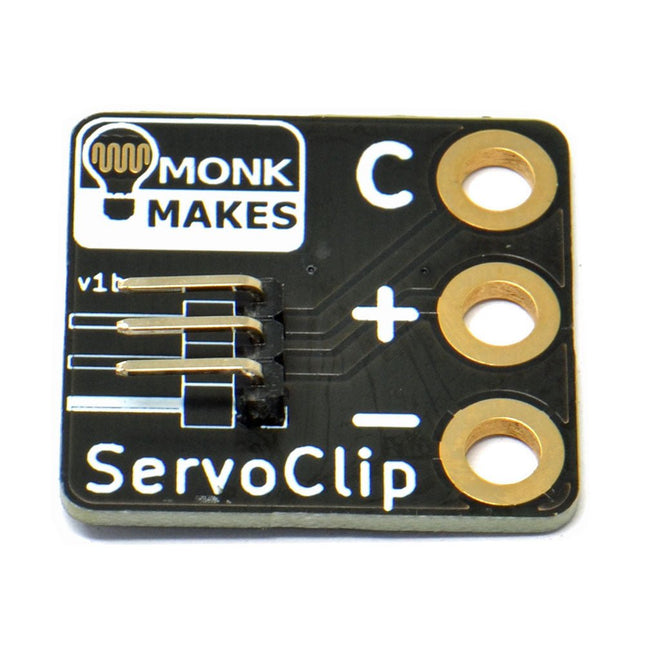
Ein Adapter zum Anschluss eines Servometers mit Krokodil-/Krokodilklemmen.
Dies ist eine praktische kleine Klemme zum Anschließen eines Servomotors mit 5,4-mm-Stiftleiste mithilfe von Krokodilklemmen. Es ist ideal für die Verwendung mit Boards wie dem BBC micro:bit und dem Circuit Playground Express oder Gemma von Adafruit.
Breite: 27 mm
Höhe: 35 mm
Downloads
Datasheet
AI Projects for the Raspberry Pi with the AI HAT+
Edge AI is transforming everyday devices by putting intelligence where it matters most: directly inside the hardware. With on-device inference, a camera can recognize a visitor instantly, a phone can translate speech without streaming audio to the cloud, and a wearable can detect anomalies in real time—fast, private, and reliable even when the network disappears.
This book is your practical guide to building exactly those kinds of systems with the Raspberry Pi AI HAT+ and the Hailo-8L accelerator. You’ll start with clear foundations: core AI and machine-learning concepts, how neural networks work, and what truly distinguishes Edge AI from cloud AI—plus an honest look at ethical considerations and future impacts.
Then it’s straight to hands-on physical computing. Step by step, you’ll set up Raspberry Pi OS, power and cooling, and develop in Python using the Thonny IDE. You’ll learn GPIO basics with lights and servos, mount the AI HAT+ hardware, install and verify the Hailo software stack, and connect the right camera—official modules or USB webcams, even multiple cameras.
From your first pipeline to real projects, you’ll run person detection, pose estimation, segmentation, and depth estimation, then level up with YOLO object detection: smart alerts, guest counters, and custom extensions. You’ll even connect vision to motion by combining gesture recognition with servo-driven mechanisms, including a robotic arm.
With troubleshooting tips, hardware essentials, and a practical Python refresher, this book turns Edge AI from buzzword into buildable reality.
AI Projects for the Raspberry Pi with the AI HAT+
Edge AI is transforming everyday devices by putting intelligence where it matters most: directly inside the hardware. With on-device inference, a camera can recognize a visitor instantly, a phone can translate speech without streaming audio to the cloud, and a wearable can detect anomalies in real time—fast, private, and reliable even when the network disappears.
This book is your practical guide to building exactly those kinds of systems with the Raspberry Pi AI HAT+ and the Hailo-8L accelerator. You’ll start with clear foundations: core AI and machine-learning concepts, how neural networks work, and what truly distinguishes Edge AI from cloud AI—plus an honest look at ethical considerations and future impacts.
Then it’s straight to hands-on physical computing. Step by step, you’ll set up Raspberry Pi OS, power and cooling, and develop in Python using the Thonny IDE. You’ll learn GPIO basics with lights and servos, mount the AI HAT+ hardware, install and verify the Hailo software stack, and connect the right camera—official modules or USB webcams, even multiple cameras.
From your first pipeline to real projects, you’ll run person detection, pose estimation, segmentation, and depth estimation, then level up with YOLO object detection: smart alerts, guest counters, and custom extensions. You’ll even connect vision to motion by combining gesture recognition with servo-driven mechanisms, including a robotic arm.
With troubleshooting tips, hardware essentials, and a practical Python refresher, this book turns Edge AI from buzzword into buildable reality.
Bestellen Bezahlen Versand Widerruf Fragen? Bestellen Sie haben die Möglichkeit, wie in einem gewöhnlichen Shop, Ihren Warenkorb mit den von Ihnen gewünschten Produkten zu füllen. Auch hier besteht immer die Möglichkeit, Produkte wieder zurückzulegen, also aus dem Warenkorb zu löschen. Indem Sie auf den grünen Warenkorb-Button des gewünschten Produkts klicken,...
Weiterlesen
,
von Johan van den Brande
ESP32 Terminal (Review)
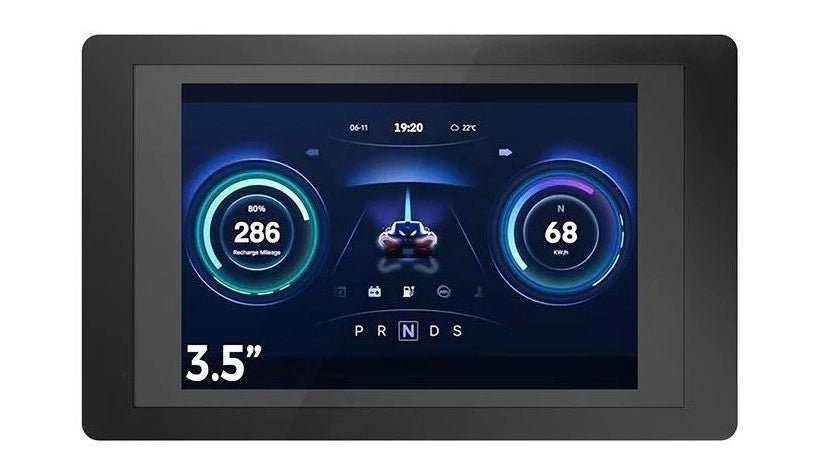
Das Elecrow ESP32 Terminal ist ein ESP32-S3 betriebenes mobiles Gerät mit einem 3,5 Zoll 480 × 320 TFT kapazitiven Touchdisplay und einer Vielzahl von Anwendungsmöglichkeiten....
,
von Clemens Valens
Arduino Alvik, ein Wendepunkt in der STE(A)M-Ausbildung? (Review)
Eine Möglichkeit, die Ingenieure von morgen zu finden und hervorzubringen, besteht darin, unter unseren Kindern zu suchen. Die Idee besteht darin, ihnen unterhaltsame und einfach...
,
von Udo Bormann
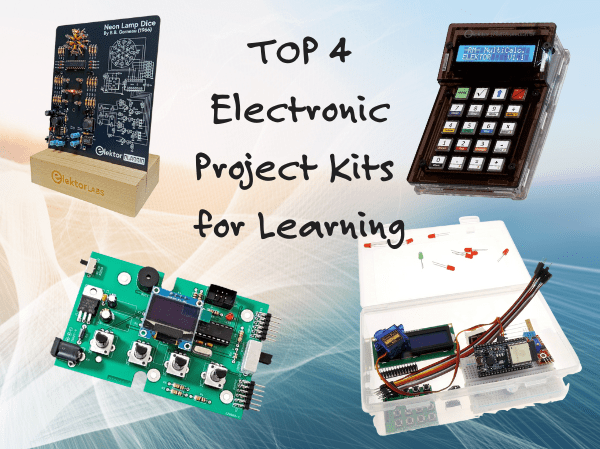
Die 4 besten Elektor-Elektronik-Projektbaukästen zum Lernen und Entwickeln von Fertigkeiten
Entdecken Sie vier der spannendsten Elektronikbausätze von Elektor - von IoT und Arduino bis hin zu Retro-Logik und Bewegungssteuerung. Egal, ob Sie gerade erst anfangen...