Dies ist eine leistungsstarke Kühllösung, die darauf ausgelegt ist, Wärme effektiv abzuleiten und optimale Betriebstemperaturen für den Raspberry Pi sicherzustellen. Es ist ein unverzichtbares Zubehör für Benutzer, die die Leistung und Langlebigkeit ihres Raspberry Pi-Geräts verbessern möchten.
Das kompakte Design des Wasserkühlungskits für Raspberry Pi 5 ermöglicht die nahtlose Installation auf der Ober- und Unterseite des Raspberry Pi 5, wodurch eine effiziente Wärmeübertragung gewährleistet und die Unterseite des Raspberry Pi perfekt geschützt wird . Dank des einfachen Installationsprozesses ist keine komplexe Verkabelung oder zusätzliches Werkzeug erforderlich, sodass es sowohl für Anfänger als auch für erfahrene Raspberry-Pi-Enthusiasten geeignet ist.
Mit seiner leistungsstarken Kühlleistung leitet das Wasserkühlungsset für Raspberry Pi 5 die vom Raspberry Pi bei intensiven Aufgaben oder längerer Nutzung erzeugte Wärme effektiv ab. Dies verhindert eine Überhitzung und sorgt für eine stabile Leistung. Eine effiziente wassergekühlte Kühlung ermöglicht es Ihnen, mehrere Raspberry Pi-Boards an eine Reihe von Kühlgeräten anzuschließen. Wenn Sie Raspberry Pi in einem Cluster verwenden, können Sie eine Reihe wassergekühlter Geräte verwenden, um mehrere Raspberry Pi-Boards effektiv zu kühlen.
Features
Hergestellt für Raspberry Pi: Speziell für Raspberry Pi 5 entwickelt, 1:1-Formöffnung, deckt alle Wärmequellen ab, einschließlich CPU, WLAN, Power-Chip und eMMC.
Kühlleistung: Leitet die vom Raspberry Pi erzeugte Wärme effektiv ab, sorgt für optimale Betriebstemperaturen und verhindert Überhitzung.
Einfach zu bedienen: Das integrierte Design der Wasserpumpe und des Kühlventilators ist für Benutzer bequem zu installieren.
RGB-Farbbeleuchtung: An den Lüfter- und Wasserpumpenstandorten sind RGB-Farblichter installiert.
Lieferumfang
1x Wasserkühlungsset
1x Wasserkühlungskühler
1x schwarzer Kühlkörper
2x Silikonschlauch
1x 12 V/2 A Netzteil (US)
4x Sechskantschraube M2,5x10
1x L-Schlüssel-Inbusschlüssel
Features
Internal LNA amplifier and selectable attenuator
Low frequency support from 50KHz covering LF, MF, HF, VHF and UHF up to 960Mhz
New HELP and SET buttons to improve user interface and configuration selection with 2-clicks
Wide band coverage to all popular sub-1Ghz bands, including FM, TV and DTV, ISM, RFID, GSM, etc.
Ideal choice for HAM bands from 160meters to 33cm
Pocket size and light weight
Solid metal case
Spectrum Analyzer mode with Peak Max and Hold, Normal, Overwrite and Averaging modes
High capacity internal Lithium battery for 20hs+ of continuous run, rechargeable by USB
Multi-platform Windows/Linux/MacOS Open Source software and API libraries
Can be extended with internal Expansion Modules for additional band and functionality
Specifications
Frequency band: 0.05 MHz - 960 MHz
Frequency span: 0.1 MHz - 960 MHz
Internal selectable LNA 25 dB gain
Internal selectable Attenuator 30 dB
Graphics LCD 128 x 64 pixels, great visibility outdoors
Support included for Windows, Linux and MacOS X
Backlight for great visibility indoor
Internal Lithium Ion 1800mA/h rechargeable battery
Standard SMA 50 Ω connector
Wideband 144/433MHz dual band telescopic antenna included
UHF 400-900 MHz rubber duck articulated antenna included
Amplitude resolution: 0.5dBm
Dynamic range: -125 dBm to 10 dBm
Absolute Max input power: +30dBm
Average noise level (typical LNA): -125 dBm
Frequency stability and accuracy (typical): +-10 ppm
Amplitude stability and accuracy (typical): +-2d Bm
Frequency resolution: 1kHz
Resolution bandwidth (RBW): automatic 2.6 kHz to 600 kHz
Included
1x RF Explorer WSUB1G+ Spectrum Analyzer
1x Mini USB cable
1x Dual band 144/430MHz Telescopic antenna
1x UHF 400-900Mhz antenna
1x EVA case
You can use RF Explorer 3G Combo equally well outdoor and indoor, and you can also connect it to a PC for extra functionality using standard mini-USB 2.0 connector.
This model includes a WSUB1G baseline unit plus an RFEMWSUB3G Expansion Module conveniently assembled and tested. It comes with two SMA connectors and two antennas,a dual band telescopic 144 / 430 MHz antenna for all Sub-GHz frequencies and a whip helical antenna for 2.4 GHz band. Additional, specific band antennas may be needed to cover efficiently some of the frequencies supported.
The combination of these two models offer the wide band coverage of the WSUB3G module, together with the highest sensitivity and quick response of the WSUB1G model for the popular sub-1GHz frequencies.
Features
Pocket size and light weight
Solid aluminum metal case
Includes a transport EVA carry case for RF Explorer
Spectrum Analyzer mode with Peak Max and Hold, Normal, Overwrite and Averaging modes
Lifetime free firmware upgrades available, open to community requested features
High capacity Lipo for 16 hours+ of continuous run, rechargeable by USB
Windows PC client Open Source
Can be extended with internal Expansion Modules for additional band and functionality
Wide band coverage to all popular RF frequencies, starting at 15 MHz and going up to 2.7 GHz. This includes very interesting frequency areas such as 2 m HAM radio, all VHF and UHF, FM radio, GPS, WiFi and WiMax, Bluetooth, etc.
Firmware: RF Explorer 3G Combo is delivered with upgraded firmware v1.09. Note some of the features and operation accuracy will be improved in upcoming free firmware revisions.
Specifications
Battery
Lithium Cells / Batteries contained in equipment UN3481 - PI967
Frequency band
15-2700 MHz
Frequency span
112 KHz - 600 MHz
Graphics LCD
128 x 64 pixels, great visibility outdoors
PC Windows client
supports Windows XP/Vista/Win7 both 32 and 64bits
Backlight
for great indoor visibility
2 standard SMA 50 ohms connector,
one for Sub-GHz wideband Nagoya NA-773 telescopic antenna included and another 2.4 GHz one for 15-2700 MHz band with helical antenna included.
Amplitude resolution
0.5 dBm
Dynamic range
Left SMA port (WSUB1G)
-115 dBm to 0 dBm
Right SMA port (WSUB3G)
-110 dBm to -10 dBm
Absolute Max input power
Left SMA port (WSUB1G)
+5 dBm
Right SMA port (WSUB3G)
+30 dBm
Average noise level (typical)
-110 dBm
Frequency stability and accuracy (typical)
+-10 ppm
Amplitude stability and accuracy (typical)
+-6 dBm
Frequency resolution
1 KHz
Resolution bandwidth (RBW)
automatic 3 KHz to 600 KHz
Weight
185 g
Size
113 x 70 x 25 mm
Included
RF Explorer 3G Combo
Nagoya NA-773 wideband telescopic antenna
2.4 GHz band antenna
EVA Case
Documentation
For more info and to get started with your RF Explorer, visit the start page.
For questions and support, please visit https://support.rf-explorer.com
Mastering the I²C Bus takes you on an exploratory journey of the I²C Bus and its applications. Besides the Bus protocol, plenty of attention is given to the practical applications and designing a stable system. The most common I²C compatible chip classes are covered in detail.
Two experimentation boards are available that allow for rapid prototype development. These boards are completed by a USB to I²C probe and a software framework to control I²C devices from your computer. All samples programs can be downloaded from the 'Attachments/Downloads' section on this page.
Projects built on Board 1:
USB to I²C Interface, PCA 9534 Protected Input, PCA 9534 Protected Output, PCA 9553 PWM LED Controller, 24xxx EEPROM Module, LM75 Temperature Sensor, PCA8563 Real-time Clock with Battery Backup, LCD and Keyboard Module, Bus Power Supply.
Projects built on Board 2:
Protected Input, Protected Output, LM75 Temperature Sensor, PCF8574 I/O Board, SAA1064 LED Display, PCA9544 Bus Expander, MCP40D17 Potentiometer, PCF8591 AD/DA, ADC121 A/D Converter, MCP4725 D/A Converter, 24xxx EEPROM Module.
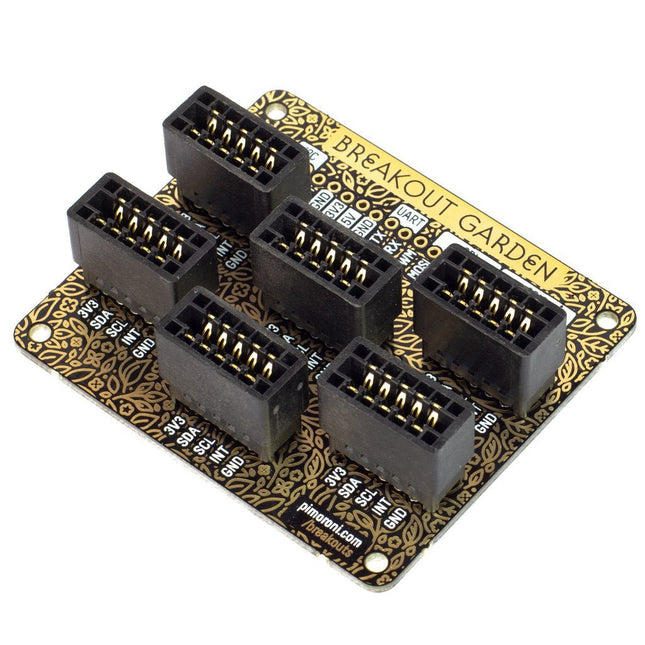
Dank seiner sechs stabilen Steckplätze ermöglicht Breakout Garden den Benutzern das einfache Plug-and-Play mit verschiedenen kleinen Breakout-Boards.
Stecken Sie einfach ein oder mehrere Boards in die Steckplätze im Breakout Garden HAT und schon kann es losgehen. Die Mini-Breakouts fühlen sich in den Edge-Connector-Steckplätzen sicher genug an und es ist sehr unwahrscheinlich, dass sie herausfallen.
An der Oberseite des Breakout Garden befinden sich eine Reihe nützlicher Pins, mit denen Sie andere Geräte anschließen und in Ihr Projekt integrieren können.
Dank des Verpolungsschutzes müssen Sie sich keine Sorgen machen, wenn Sie eine Platine falsch herum einsetzen. Es spielt auch keine Rolle, welchen Steckplatz Sie für jeden Breakout verwenden, da die I²C-Adresse des Breakouts von der Software erkannt wird und diese korrekt erkennt, falls Sie sie verschieben.
Merkmale
Sechs stabile Kantensteckplätze für Pimoroni-Breakouts
0,1-Zoll-Raster, 5-polige Anschlüsse
Ausgebrochene Stifte (1 × 10 Streifen- oder Stiftleiste im Lieferumfang enthalten)
Im Lieferumfang sind Abstandshalter (M2,5, 10 mm Höhe) enthalten, um Ihren Breakout Garden sicher zu halten
Verpolungsschutz (in Breakouts integriert)
Platine im HAT-Format
Kompatibel mit Raspberry Pi 3 B+, 3, 2, B+, A+, Zero und Zero W
Es wird empfohlen, die mitgelieferten Abstandshalter zu verwenden, um Breakout Garden an Ihrem Raspberry Pi zu befestigen.
Software
Breakout Garden erfordert keine eigene Software, aber jeder von Ihnen verwendete Breakout benötigt eine Python-Bibliothek. Auf der Breakout Garden GitHub-Seite finden Sie ein automatisches Installationsprogramm, das die entsprechende Software für einen bestimmten Breakout installiert. Es gibt auch einige Beispiele, die Ihnen zeigen, was Sie sonst noch mit Breakout Garden machen können.
A Toolbox for Audio Lovers and Engineers
Without any ambition to reach scientific levels, this book aims to be a toolbox for both audio lovers and high-end equipment designers. The elementary theory presented is the bare minimum for readers to grasp the operation and practical use of electrical, electromagnetic, physics, and electronic operations available in the designers’ toolbox. Each tool is explained in a minimum of words and theory without needless coverage of underlying equations or figures.
The book chapters guide you through the process of designing quality amplifiers with vacuum tubes, from the very beginning, considering both technical and subjective requirements – in theory and practice.
The book is a compilation of the author’s notes used in his professional and educational career but was nevertheless primarily written as a result of true love for the audiophile hobby.
Menno van der Veen is well known for his research publications on tube amplifiers used in audio systems.
In this book he describes one of his research projects which focuses on the question of whether full compensation for distortion in tubes and output transformers is possible.
In the past, a variety of techniques have been developed. One of them has largely been forgotten: trans-conductance, which means converting current into voltage or voltage into current. Menno van der Veen has breathed new life into this technique with his research project titled “Trans”. This book discusses all aspects of this method and discusses its pitfalls. These pitfalls are addressed one by one. The end result is a set of stringent requirements for Trans amplifiers.
Armed with these requirements, Menno then develops new Trans amplifiers, starting with Transie 1 and Transie 2. These DC-coupled, single-ended tube amplifiers have unusually good characteristics and are suitable for hobbyist construction. Next the Trans principle is applied to amplifiers with higher output power.
A trial-and-error process ultimately leads to the Vanderveen Trans 30 amplifier, which optimizes the features of Trans. The characteristics of this amplifier are so special and unique that Menno believes he has struck gold. To ensure that variations in tube characteristics cannot interfere with optimal Trans behavior, Menno makes use of simulations and comparison with other amplifier types. This book reads like an adventure story, but it is much more – it is an account of solid research into new ways to achieve optimal audio reproduction.
Nobody has any doubt that valve amplifiers produce a remarkably beautiful sound. They have a lively, deep, clear, and expressive sound, and dynamically they do not appear to have any limitations. The author investigates, in a systematic theoretical approach, the reasons for these beautiful properties. He develops new models for power valves and transformers, thus enabling the designer to determine the properties of the amplifier during the design process. Mathematical models for the coupling of power valve(s) and output transformer are provided. These will generate new insights in a special kind of distortion: the dynamic damping factor distortion (DDFD). With mathematical models in the complex domain, especially the properties at the limits of our hearing range (from 20 Hz to 20 kHz) are investigated and the minimal stability criteria for the amplifier are formulated. The often-applied negative feedback in amplifiers is extensively modelled and discussed in relation to our hearing appreciating. And after all this theory a fine selection of special amplifiers is presented and discussed.
You will notice in this book that the author not only writes about amplifier technique, but tells about the way the development of valve amplifiers can have an influence on your daily life; even the usefulness of patents is discussed. Summarizing: new theories and solutions for perfect audio with valve amplifiers. Not only the professional and the DIY-er but everyone who wants to understand valve amplifiers will read this book with much pleasure.
A Toolbox for Audio Lovers and Engineers
Without any ambition to reach scientific levels, this book aims to be a toolbox for both audio lovers and high-end equipment designers. The elementary theory presented is the bare minimum for readers to grasp the operation and practical use of electrical, electromagnetic, physics, and electronic operations available in the designers’ toolbox. Each tool is explained in a minimum of words and theory without needless coverage of underlying equations or figures.
The book chapters guide you through the process of designing quality amplifiers with vacuum tubes, from the very beginning, considering both technical and subjective requirements – in theory and practice.
The book is a compilation of the author’s notes used in his professional and educational career but was nevertheless primarily written as a result of true love for the audiophile hobby.
Valve Amplifiers are regarded by many to be the ne plus ultra when it comes to processing audio signals. The combination of classical technology and modern components has resulted in a revival of the valve amplifier. The use of toraidal-core output transformers, developed by the author over the past 15 years, has contributed to this revival. The most remarkable features of these transformers are their extremely wide frequency ranges and their very low levels of linear and nonlinear distortion.
This book explains the whys and wherefores of toroidal output transformers at various technical levels, starting with elementary concepts and culminating in complete mathematical descriptions. In all of this, the interactions of the output valves, transformer and loudspeaker form the central theme.
Next come the practical aspects. The schematic diagram of a valve amplifier often appears to be very simple at first glance, but anyone who has built a modern valve amplifier knows that a lot of critical details are hidden behind this apparent simplicity. These are discussed extensively, in connection with designs for amplifiers with output powers ranging from 10 to 100 watts. Finally, the author gives some attention to a number of special valve amplifiers, and to the theory and practice of negative feedback.
In summary, this book offers innovative solutions for achieving perfect audio quality. Do-it-yourself builders, as well as persons who want to gain a deeper technical understanding of the complex world of audio transformers, valve amplifiers and audio signal processing, will find this book a rich and useful source of information.
This complete ESP32 microcontroller programming course features a textbook, a component kit, hands-on projects, and a comprehensive online course with simulations. It is ideal for step-by-step learning of embedded systems programming with Arduino using a practical, hands-on approach.
A Practical Introduction to Embedded Systems with the ESP32
This course is designed for people who are new to embedded systems and looking for a structured, example-driven way to get started.
A kit of parts comprising LEDs and resistors, switches, sensors and actuators, displays, a breadboard and wires, and more is included. These are used in the course to illustrate example applications.
No prior experience with Arduino or embedded development is required. Each section features hands-on examples and mini projects designed to reinforce key concepts and inspire deeper exploration. By the end of the course, you’ll be able not only to reproduce the examples but also to build on them with your own ideas and applications.
What Will You Learn?
Microcontroller programming with the ESP32 using the Arduino IDE
Working with Digital I/O, read buttons and encoders, control LEDs and relays
Read analog inputs, voltages, and analog sensors
Generating analog output signals and PWM
Use serial communication like UART, I²C and SPI to control displays and read digital sensors and SD cards
Managing time
Working with interrupts
Real-time sensor input and control via buttons, LEDs, and displays
Control actuators like relays and servo motors
Who Is It For?
Students and self-learners exploring embedded systems
Makers and IoT enthusiasts looking to improve their hardware skills
Educators and trainers seeking ready-to-teach material
What's Inside the Box?
ESP32 microcontroller board + USB cable
Book: Programming Microcontrollers in C/C++ Using Arduino
Component Box:
2× LED, red, 5 mm
LED, green, 5 mm
3× Resistor, 470 Ω, 0.25 W
LDR
Potentiometer, 10 kΩ, linear
Pushbutton
Rotary encoder module
Relay module
DHT22 Humidity & Temperature Sensor
TM1637-compatible 4-digit 7-segment display
MPU-6050 IMU with headers
SSD1306-compatible I²C OLED display
Micro SD card adapter with header
Buzzer
SG90 Micro Servo
ILI9341-compatible SPI 240×320 TFT display
20× Jumper wires
Breadboard
Access to the full course on the Elektor Academy Pro Learning Platform
Downloadable project files for every module
All Programming Courses (and differences in content)
Arduino
Raspberry Pi Pico with Arduino C/C++
ESP32 with Arduino C/C++
Raspberry Pi Pico with MicroPython
ESP32 with MicroPython
Uno R3
Raspberry Pi Pico
ESP32
Raspberry Pi Pico
ESP32
Book: Programming Microcontrollers in C/C++ Using Arduino
Book: Programming Microcontrollers in MicroPython
40-piece Component Box
Access to Full Course
Access to Full Course
Access to Full Course
Access to Full Course
Access to Full Course
,
von Clemens Valens
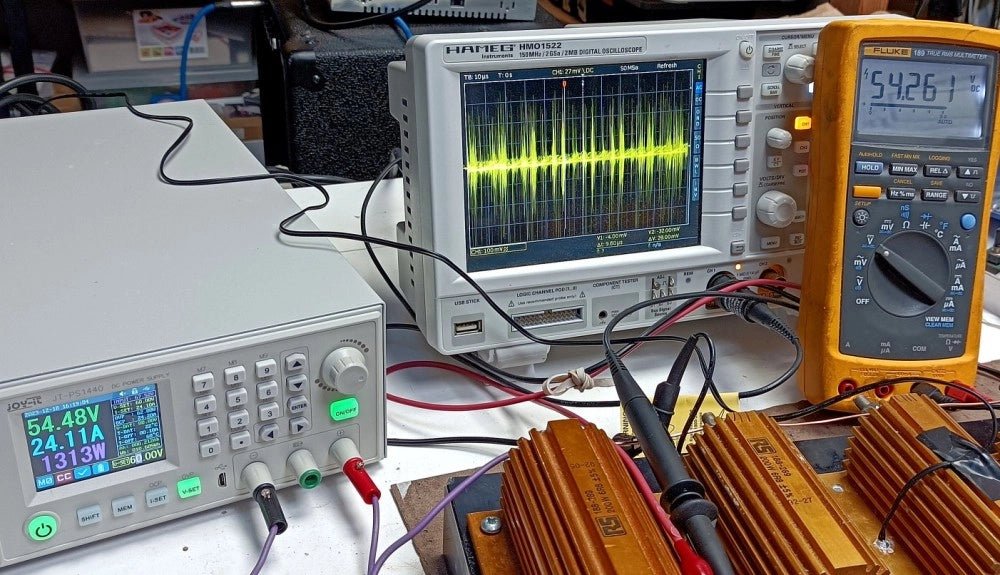
Labortest des 1,5kW-JOY-iT Netzteils JT-PS1440-C
In Zeiten von E-Bikes, Elektrorollern und anderen Fahrzeugen sind leistungsstarke programmierbare Stromversorgungen für das Testen von Motoren und das Laden von Batterien unerlässlich. Ihr gutes...