
Suchergebnisse für "pimoroni OR explorer OR starter OR kit"
-
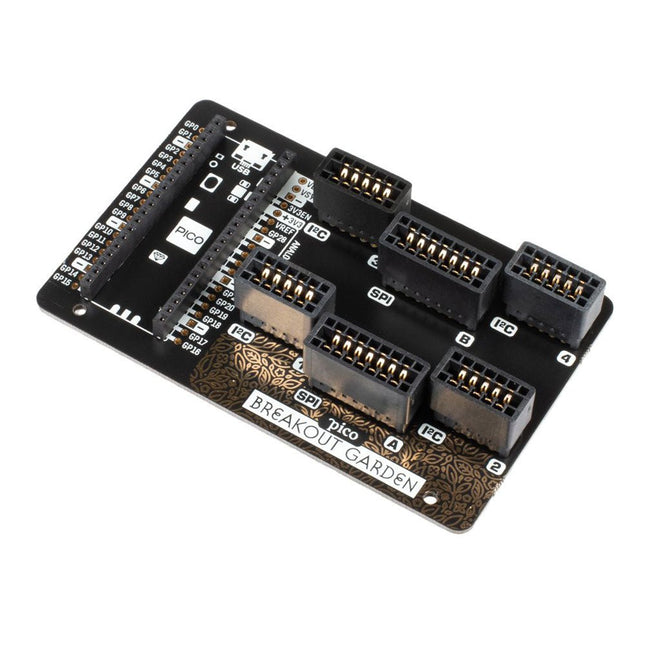
Pimoroni Pimoroni Raspberry Pi Pico Breakout Garten Basis
Die Pico Breakout Garden Base befindet sich unter Ihrem Pico und ermöglicht den Anschluss von bis zu sechs unserer umfangreichen Auswahl an Pimoroni-Breakouts. Sei es Umgebungssensoren, mit denen Sie die Temperatur und Luftfeuchtigkeit in Ihrem Büro im Auge behalten, eine ganze Reihe kleiner Bildschirme für wichtige Benachrichtigungen und Anzeigen und natürlich LEDs. Scrollen Sie nach unten für eine Liste der Breakouts, die derzeit mit unseren C++/MicroPython-Bibliotheken kompatibel sind! Neben einem beschrifteten Landebereich für Ihren Pico gibt es auch einen vollständigen Satz herausgebrochener Pico-Anschlüsse für den Fall, dass Sie noch mehr Sensoren, Kabel und Schaltkreise anschließen müssen. Wir haben einige Gummifüße eingebaut, um die Basis schön stabil zu halten und zu verhindern, dass sie Ihren Schreibtisch zerkratzt, oder es gibt M2,5-Befestigungslöcher an den Ecken, damit Sie sie bei Bedarf auf einer festen Oberfläche festschrauben können. Bei den sechs stabilen schwarzen Steckplätzen handelt es sich um Kantenverbinder, die die Breakouts mit den Pins Ihres Pico verbinden. Es gibt zwei Steckplätze für SPI-Breakouts und vier Steckplätze für I²C-Breakouts. Da es sich bei I²C um einen Bus handelt, können Sie mehrere I²C-Geräte gleichzeitig verwenden, vorausgesetzt, sie haben nicht die gleiche I²C-Adresse (wir haben dafür gesorgt, dass alle unsere Breakouts unterschiedliche Adressen haben, und wir drucken sie auf der Rückseite auf). die Ausbrüche, damit sie leicht zu finden sind). Breakout Garden ist nicht nur eine praktische Möglichkeit, Ihrem Pico Funktionalität hinzuzufügen, sondern ist auch sehr nützlich für Prototyping-Projekte, ohne dass komplizierte Verkabelungen, Lötarbeiten oder Steckbretter erforderlich sind, und Sie können Ihr Setup jederzeit erweitern oder ändern. Merkmale Sechs stabile Kantensteckplätze für Breakouts 4x I²C-Steckplätze (5 Pins) 2x SPI-Steckplatz (7 Pins) Landebereich mit Buchsenleisten für Raspberry Pi Pico 0,1-Zoll-Raster, 5- oder 7-polige Steckverbinder Ausgebrochene Stifte Verpolungsschutz (in Breakouts integriert) Zu 99 % montiert – nur noch die Füße aufkleben! Kompatibel mit Raspberry Pi Pico
€ 17,95€ 7,18
Mitglieder identisch
-

Paggen Werkzeugtechnik SMD Starter I – Fertigungslinie für Prototypen
Die Prototypen-Fertigungslinie SMD Starter I besteht aus dem Schablonendrucker TSD240, dem SMD-Bestückungsgerät PlaceMAN und dem Reflow-Ofen 3LHR10. Schablonendrucker SD240 (+ Metallrakel 155 mm) Schablonengröße: max. 175 x 255 mm Platinengröße: max. 180 x 240 mm Gerätegröße: 410 x 270 x 110 mm Gewicht: 6,7 kg inkl. Metallrakel 155 mm inkl. 8 Magnete zum Halten der Leiterplatte, 6 davon mit M3-Madenschraube inkl. transparente Platzierhilfe und Faserschreiber Manuelles SMD-Bestückungsgerät PlaceMAN für Standardbauteile inkl. Vakuumpumpe (ohne Zuführungen, Kamera, Monitor und Dispenser) Ausgestattet mit leichtgängigem Bestückungsarm, Bestückungskopf mit Einhandbedienung, Rotation der Z-Achse und automatischer Vakuumabschaltung, inkl. Leiterplattenhalterung, Vakuumeinheit und 2 Bestückungsnadeln mit Gummisaugern. Kapazität an Feeder (nicht im Lieferumfang enthalten) 2x Feederkassette für 10 x 8 mm Rollen links 4x Feederkassette für Stangenfeeder für jeweils 5 Stangen weiter Zuführsysteme sind innerhalb des Bestückungsbereiches möglich, z. B. Strip-Feeder Stecksystem Abmessungen Grundgerät (LxBxH): 765 x 390 x 210 mm Mit Feederkassette für 10 x 8 mm Rollen (LxBxH): 765 x 390 x 210 mm Mit Feederkassette für 10 x 8 mm Rollen und Feederkassette für Stangenfeeder (LxBxH): 765 x 430 x 210 mm (Höhe kann durch die Stangenlänge variieren) Mit Feederkassette für 10 x 8 mm Rollen inkl. Halter für 10 Rollen und Feederkassette für Stangenfeeder (LxBxH): 765 x 430 x 210 mm (Höhe kann durch die Stangenlänge variieren) Technische Daten Gewicht Grundgerät: ca. 6 kg Verfahrweg der Achsen (x,y,z): 470 x 230 x 15 mm Max. Arbeitsbereich: 380 x 240 mm Max. PCB-Größe: 230 x 360 mm Stromversorgung Netzteil: 230/12 V, 800 mA Stromversorgung Vakuumpumpe: 230 V, 6 W 3LHR10 Reflow-Ofen (programmierbar für bleifreie Lötungen mit manueller Schublade und Tablet-Steuerung) Reflow-Ofen mit IR und Konvektionsheizung. Die erzwungene Heißluftkonvektion sorgt für ein gleichmäßiges Temperaturprofil in der gesamten Kammer. Nach dem manuellen Öffnen der Tür werden die Lüfter eingeschaltet und die gelötete Leiterplatte schnell abgekühlt. Kleiner Reflow-Ofen mit manueller Türöffnung Industrie 4.0 bereit, Bluetooth-Kommunikation + Tablet IR + Konvektionsheizung. Android-Anwendung zur Verbindung mit Tablet oder Smartphone 100 verschiedene Benutzerprogramme Lieferumfang: 3LHR10, Tablet mit App, Schutzhülle für Tablet, 4 Leiterplattenhalter, externes Thermoelement, Handbuch im Tablet Anwendung Schließen Sie den Ofen an die Stromversorgung an und schließen Sie die optional erhältliche Absaugung (3LFE10S) an den Abluftstutzen an. Nach dem ersten Einschalten sucht der Ofen nach einem Tablet oder Smartphone. Wenn beide in der Android-App verbunden sind, wählen Sie die Programmierung des Ofens. Hier sind programmierbare Temperatur und Vorheizzeit sowie Temperatur und andere Daten einzustellen. Registrieren Sie sich mit dem Tablet, um den vollen Umfang der Software nutzen zu können. Wenn der Ofen bereits programmiert ist, kann der Benutzer den Vorgang mit Tasten und Anzeige auf der Vorderseite steuern. Nach Abschluss des Reflow-Vorgangs ertönt ein akustisches Signal. Ein Signal wird auch auf dem Tablet/Smartphone angezeigt. Die Schublade muss nun manuell geöffnet werden. Die Android-Anwendung zeigt Prozessstatus, Zeit und Temperatur oder andere Informationen an. Technische Daten Netzanschluss: 230 V, 50 Hz Maximale Leistung: 3100 W Temperaturen: 50-260°C Abmessungen: 510 x 370 x 340 mm Maximales Gewicht: 16 kg Gitterabmessungen: 350 x 220 mm Maximale Abmessungen der Leiterplatte: 300 x 200 mm Maximale Komponentenhöhe auf der Leiterplatte: 50 mm oben, 30 mm unten Lieferumfang Schablonendrucker TSD240 SMD-Bestückungsgerät PlaceMAN Reflow-Ofen 3LHR10
€ 6.549,00
Mitglieder identisch
-

Seeed Studio Seeed Studio RF Explorer WSUB1G+ Slim Spectrum Analyzer
Features Internal LNA amplifier and selectable attenuator Low frequency support from 50KHz covering LF, MF, HF, VHF and UHF up to 960Mhz New HELP and SET buttons to improve user interface and configuration selection with 2-clicks Wide band coverage to all popular sub-1Ghz bands, including FM, TV and DTV, ISM, RFID, GSM, etc. Ideal choice for HAM bands from 160meters to 33cm Pocket size and light weight Solid metal case Spectrum Analyzer mode with Peak Max and Hold, Normal, Overwrite and Averaging modes High capacity internal Lithium battery for 20hs+ of continuous run, rechargeable by USB Multi-platform Windows/Linux/MacOS Open Source software and API libraries Can be extended with internal Expansion Modules for additional band and functionality Specifications Frequency band: 0.05 MHz - 960 MHz Frequency span: 0.1 MHz - 960 MHz Internal selectable LNA 25 dB gain Internal selectable Attenuator 30 dB Graphics LCD 128 x 64 pixels, great visibility outdoors Support included for Windows, Linux and MacOS X Backlight for great visibility indoor Internal Lithium Ion 1800mA/h rechargeable battery Standard SMA 50 Ω connector Wideband 144/433MHz dual band telescopic antenna included UHF 400-900 MHz rubber duck articulated antenna included Amplitude resolution: 0.5dBm Dynamic range: -125 dBm to 10 dBm Absolute Max input power: +30dBm Average noise level (typical LNA): -125 dBm Frequency stability and accuracy (typical): +-10 ppm Amplitude stability and accuracy (typical): +-2d Bm Frequency resolution: 1kHz Resolution bandwidth (RBW): automatic 2.6 kHz to 600 kHz Included 1x RF Explorer WSUB1G+ Spectrum Analyzer 1x Mini USB cable 1x Dual band 144/430MHz Telescopic antenna 1x UHF 400-900Mhz antenna 1x EVA case
€ 201,11
-

Seeed Studio Seeed Studio RF Explorer 3G Combo Spectrum Analyzer
You can use RF Explorer 3G Combo equally well outdoor and indoor, and you can also connect it to a PC for extra functionality using standard mini-USB 2.0 connector. This model includes a WSUB1G baseline unit plus an RFEMWSUB3G Expansion Module conveniently assembled and tested. It comes with two SMA connectors and two antennas,a dual band telescopic 144 / 430 MHz antenna for all Sub-GHz frequencies and a whip helical antenna for 2.4 GHz band. Additional, specific band antennas may be needed to cover efficiently some of the frequencies supported. The combination of these two models offer the wide band coverage of the WSUB3G module, together with the highest sensitivity and quick response of the WSUB1G model for the popular sub-1GHz frequencies. Features Pocket size and light weight Solid aluminum metal case Includes a transport EVA carry case for RF Explorer Spectrum Analyzer mode with Peak Max and Hold, Normal, Overwrite and Averaging modes Lifetime free firmware upgrades available, open to community requested features High capacity Lipo for 16 hours+ of continuous run, rechargeable by USB Windows PC client Open Source Can be extended with internal Expansion Modules for additional band and functionality Wide band coverage to all popular RF frequencies, starting at 15 MHz and going up to 2.7 GHz. This includes very interesting frequency areas such as 2 m HAM radio, all VHF and UHF, FM radio, GPS, WiFi and WiMax, Bluetooth, etc. Firmware: RF Explorer 3G Combo is delivered with upgraded firmware v1.09. Note some of the features and operation accuracy will be improved in upcoming free firmware revisions. Specifications Battery Lithium Cells / Batteries contained in equipment UN3481 - PI967 Frequency band 15-2700 MHz Frequency span 112 KHz - 600 MHz Graphics LCD 128 x 64 pixels, great visibility outdoors PC Windows client supports Windows XP/Vista/Win7 both 32 and 64bits Backlight for great indoor visibility 2 standard SMA 50 ohms connector, one for Sub-GHz wideband Nagoya NA-773 telescopic antenna included and another 2.4 GHz one for 15-2700 MHz band with helical antenna included. Amplitude resolution 0.5 dBm Dynamic range Left SMA port (WSUB1G) -115 dBm to 0 dBm Right SMA port (WSUB3G) -110 dBm to -10 dBm Absolute Max input power Left SMA port (WSUB1G) +5 dBm Right SMA port (WSUB3G) +30 dBm Average noise level (typical) -110 dBm Frequency stability and accuracy (typical) +-10 ppm Amplitude stability and accuracy (typical) +-6 dBm Frequency resolution 1 KHz Resolution bandwidth (RBW) automatic 3 KHz to 600 KHz Weight 185 g Size 113 x 70 x 25 mm Included RF Explorer 3G Combo Nagoya NA-773 wideband telescopic antenna 2.4 GHz band antenna EVA Case Documentation For more info and to get started with your RF Explorer, visit the start page. For questions and support, please visit https://support.rf-explorer.com
€ 275,32
-

Elektor Digital Home Automation and Electronics for Starters (E-book)
Projects with Arduino, ESPHome, Home Assistant, and Raspberry Pi & Co. This e-book contains various example projects, beginning with an introduction to electronics. It also explains how to install Home Assistant on a Raspberry Pi, how to use indoor climate sensors for temperature and humidity, how to implement the MQTT protocol and other interfaces, and how to use ESPHome to integrate sensors and actuators into Home Assistant. Numerous video tutorials complement the book. Fundamentals of electrical engineering The book begins with an introduction to electrical engineering. You will learn the basics of voltage, current, resistors, diodes and transistors. Arduino and microcontrollers A complete section is dedicated to the Arduino Uno. You will get to know the structure, write your first programs and work on practical examples. Home Assistant and automation You will learn how to set up Home Assistant on a Raspberry Pi and how to use automations, scenes and devices. In addition, Zigbee, MQTT and ESP-NOW – important technologies for home automation – will be discussed. ESP8266, ESP32 and ESP32-CAM The popular ESP microcontrollers are covered in detail. A theoretical introduction is followed by practical projects that show you how to get the most out of these devices. Sensors and actuators The book explains the functionality and application of numerous sensors such as temperature and humidity sensors, motion detectors and RFID readers. For actuators, stepper motors, e-ink displays, servo motors and much more are covered. There are practical application examples for all devices. ESPHome This chapter shows you how to integrate sensors and actuators into Home Assistant without any programming effort. You will be guided step by step through the setup with ESPHome. LEDs and lighting technology In this chapter, you will learn about different types of LEDs and how they can be used. The basics of lighting technology are also explained. Node-RED A whole chapter is dedicated to Node-RED. You will learn the basics of this powerful tool and be guided step by step through its setup and use. Integrated Circuits (ICs) In electronics, there are numerous ICs that make our lives easier. You will get to know the most important ones and apply your knowledge in practical projects. Professional programming Advanced topics such as the correct use of buttons, the use of interrupts and the use of an NTP server for time synchronisation are covered in detail in this chapter. Downloads GitHub
€ 59,95
Mitglieder identisch
-
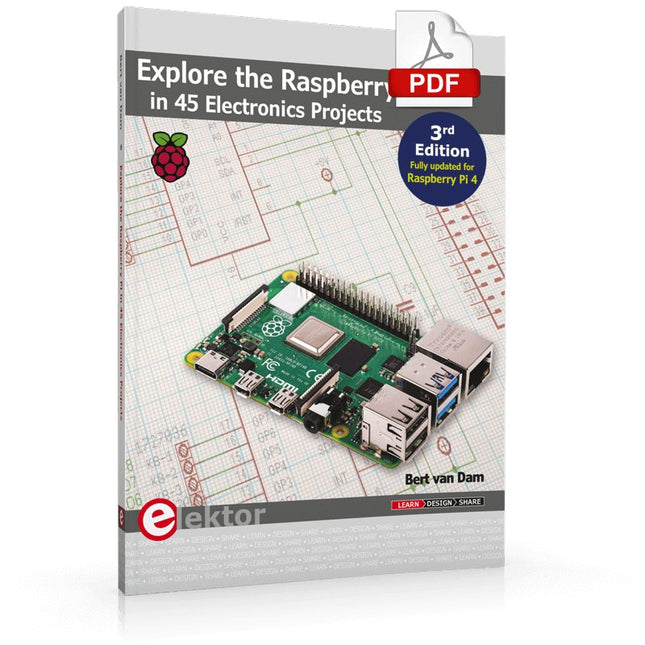
Elektor Digital Explore the Raspberry Pi in 45 Electronics Projects (3rd Edition | E-book)
3rd Edition – Fully updated for Raspberry Pi 4 The Raspberry Pi is a very cheap but complete computer system that allows all sorts of electronics parts and extensions to be connected. This book addresses one of the strongest aspects of the Raspberry Pi: the ability to combine hands-on electronics and programming. Combine hands-on electronics and programming After a short introduction to the Raspberry Pi you proceed with installing the required software. The SD card that can be purchased in conjunction with this book contains everything to get started with the Raspberry Pi. At the side of the (optional) Windows PC, software is used which is free for downloading. The book continues with a concise introduction to the Linux operating system, after which you start programming in Bash, Python 3 and Javascript. Although the emphasis is on Python, the coverage is brief and to the point in all cases – just enabling you to grasp the essence of all projects and start adapting them to your requirements. All set, you can carry on with fun projects. The book is ideal for self-study No fewer than 45 exciting and compelling projects are discussed and elaborated in detail. From a flashing lights to driving an electromotor; from processing and generating analog signals to a lux meter and a temperature control. We also move to more complex projects like a motor speed controller, a web server with CGI, client-server applications and Xwindows programs. Each project has details of the way it got designed that way The process of reading, building, and programming not only provides insight into the Raspberry Pi, Python, and the electronic parts used, but also enables you to modify or extend the projects any way you like. Also, feel free to combine several projects into a larger design.
€ 32,95
Mitglieder € 26,36
-
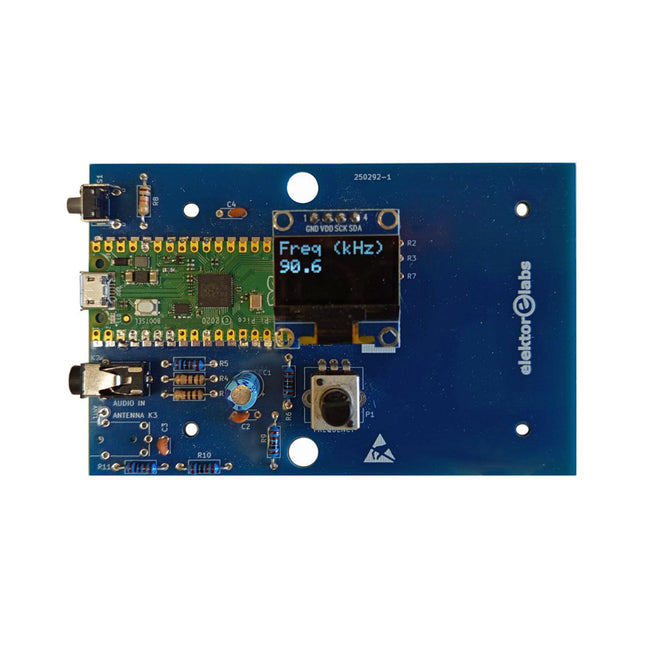
Elektor Labs Elektor AM-Sender-Kit
Bauen Sie Ihren eigenen Vintage-Radiosender Das Elektor AM-Sender-Kit ermöglicht das Streamen von Audio auf Vintage-AM-Radioempfänger. Basierend auf einem Raspberry Pi Pico Mikrocontroller-Modul kann der AM-Sender auf 32 Frequenzen im AM-Band senden, von 500 kHz bis 1,6 MHz in 32 Schritten von ca. 35 kHz. Die Frequenz wird mit einem Potentiometer gewählt und auf einem 0,96" OLED-Display angezeigt. Eine Taste ermöglicht das Umschalten des Sendemodus zwischen Ein und Aus. Die Reichweite des Senders hängt von der Antenne ab. Die integrierte Antenne bietet eine Reichweite von wenigen Zentimetern, sodass der AM-Sender nahe am Radio oder im Radio selbst platziert werden muss. Eine externe Loop-Antenne (nicht enthalten) kann angeschlossen werden, um die Reichweite zu erhöhen. Das Elektor AM-Sender-Kit wird als Bausatz geliefert, den Sie selbst auf die Platine löten müssen. Features Die Platine ist kompatibel mit einem Hammond-1593N-Gehäuse (nicht enthalten).Ein 5-VDC-Netzteil mit Micro-USB-Anschluss (z. B. ein altes Handy-Ladegerät) wird benötigt, um das Kit zu betreiben (nicht enthalten). Stromaufnahme: 100 mA. Die Arduino-Software (benötigt Earle Philhowers RP2040-Boards-Paket) für das Elektor-AM-Sender-Kit sowie weitere Informationen sind auf der Elektor-Labs-Seite dieses Projekts verfügbar. Stückliste Widerstände R1, R4 = 100 Ω R2, R3, R8 = 10 kΩ R5, R6, R9, R10, R11 = 1 kΩ R7 = optional (nicht enthalten) P1 = Potentiometer 100 kΩ, linear Kondensatoren C1 = 22 µF 16V C2, C4 = 10 nF C3 = 150 pF Sonstiges K1 = 4×1 Stiftleiste K2, K3 = 3,5-mm-Buchse Raspberry Pi Pico Drucktaste, Winkelmontage 0,96" monochromes I²C-OLED-Display Leiterplatte 150292-1
€ 34,95€ 29,95
Mitglieder identisch
-

iFixit iFixit Manta Driver Kit
Dieses Kit enthält das größte Sortiment an Bits von iFixit, komplett mit allen Schraubendreherköpfen, die Sie für jedes Reparatur- oder Heimwerkerprojekt benötigen. Es umfasst Standard-Bits wie Kreuzschlitz- und Flachkopf-Bits in einer breiten Palette von Größen, um alles von der Präzisionsreparatur von Elektronikgeräten bis hin zu Heimwerkerprojekten zu bewältigen. Und es wäre kein iFixit-Bit-Set, wenn es nicht alle exotischen Bits von Pentalobes für die Reparatur von Apple iPhone und MacBook bis hin zu Gamebits für Ihre Vintage-Nintendo-Konsolen enthalten würde. Alle Bitsätze der nächsten Generation wurden neu gestaltet, um den Komfort und die Benutzerfreundlichkeit zu maximieren. Der Bit-Set-Deckel wird mit Magneten an Ort und Stelle gehalten, um die Lebensdauer des Produkts zu verlängern (keine kaputten Scharniere oder Verschlüsse mehr) und wird auch an der Rückseite des Bit-Set-Koffers befestigt, damit er Ihnen bei der Arbeit nicht im Weg ist. Wenn Sie Hilfe bei der Organisation Ihrer Schrauben und Teile benötigen, können Sie die integrierte Sortierschale im Deckel verwenden. Die 4-mm-Bits wurden angepasst und verfügen nun über einen längeren Hals für eine tiefere und präzisere Reichweite. Toolkit enthält Leicht zu öffnendes magnetisiertes Gehäuse Mitglied mit integriertem Sortierfach 4-mm-Aluminium-Bit-Treiber 1/4' Aluminium-Bit-Treiber 4-mm-Schraubendreherbits Phillips - 000, 00, 0 Flachkopf – 1, 1,5, 2, 2,5, 3, 3,5 mm Torx – T2, T3, T4, T5 Torx-Sicherheit – TR6, TR7, TR8 Pentalobe - P2, P5, P6 JIS - 000, 00, 0, 1 Sechskant – 0,7, 0,9, 1,3, 1,5 mm Sechskantsicherheit – 2, 2,5, 3, 3,5 mm Dreipunkt – Y000, Y00, Y0, Y1 Steckschlüssel – 2,5, 3, 3,5, 4, 4,5, 5, 5,5 mm Spielbit - 3,8, 4,5 mm Spanner - 4, 6 Dreieck - 2, 2,2, 2,6, 3 mm Ovales Gebiss iPhone-Abstandsbit Sim-Auswurfbit Magnetischer Pickup-Bit 1/4'-Schraubendreher-Bits Phillips – 1, 2, 3 Flachkopf – 4, 5, 6, 7, 8 mm Sechskantsicherheit – 4, 5, 6, 7, 8 mm Sechskantsicherheit SAE – 1/8, 9/64, 5/32, 3/16, 7/32, 1/4 Pozidriv - PZ0, PZ1, PZ2, PZ3 Drehmomentsatz - 6, 8, 10 Spanner - 8, 10, 12 Quadrat - 0, 1, 2, 3 Spline – M5, M6, M8 Torx-Sicherheit – TR9, TR10, TR15, TR20, TR25, TR27, TR30, TR35, TR40 Tri Wing 1, 2, 3, 4 Kupplung 1, 2, 3 Schrader-Ventil Hakenantrieb 1/4' auf 4 mm Adapter 1/4'-Treiber auf 1/4'-Buchse 1/4'-Schraubendreher auf 3/8'-Stecknuss 1/4'-Buchse auf 1/4'-Schraubendreher Technische Daten Bit-Metall: 6150 Stahl Treibermaterial: Eloxiertes Aluminium Gehäusematerial: ABS Schaum: EVA
€ 63,88


-

, von Clemens Valens Review: Strahlungsdetektion mit dem Geigerzähler-Kit von MightyOhm
Der Geigerzähler von MightyOhm kann Beta- und Gammastrahlung erkennen. Da radioaktive Strahlung so gefährlich ist, sollten Sie Ihre Umgebung im Auge behalten und sich einen...
-
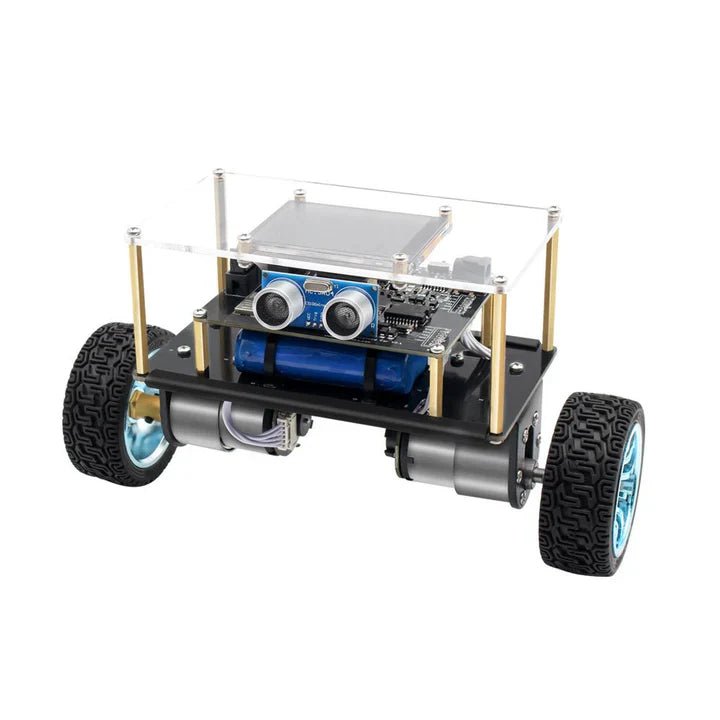
, von Lobna Belarbi Affordable Robot Kits to Kickstart Your Robotics Journey
Robotics is an exciting and rewarding field, but getting started can be intimidating—especially when it comes to choosing the right kit. Fortunately, Elektor offers a...
-
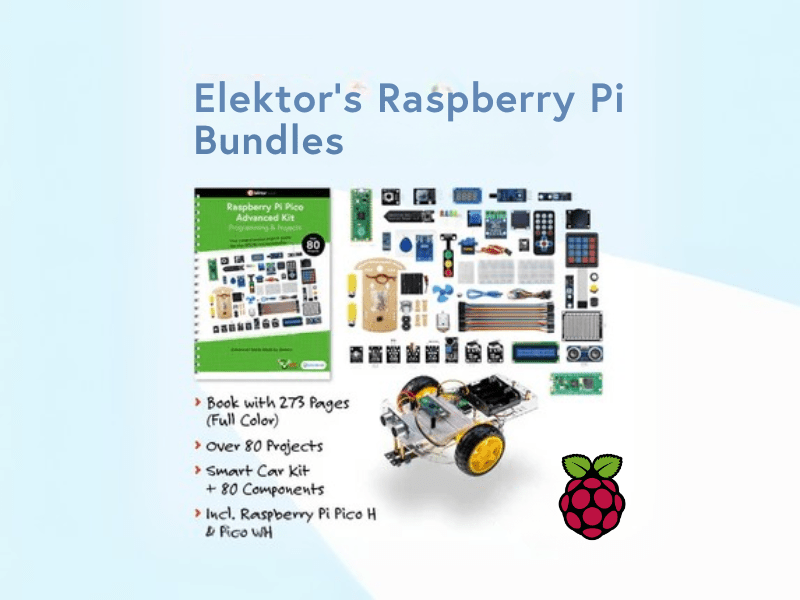
, von Lobna Belarbi Elektors Raspberry Pi Bundles: Von Einsteiger-Sets bis zu fortgeschrittenen Kits
Finde das perfekte Raspberry Pi Bundle für dein Erfahrungsniveau Egal, ob du gerade erst in die Welt des Raspberry Pi eintauchst oder bereits anspruchsvolle Projekte...
-

, von Lobna Belarbi Unverzichtbare Boards, Kits & Werkzeuge von Elektor für deinen Arduino-Einstieg
Egal ob du als Einsteiger die Welt der Mikrocontroller entdecken oder als erfahrener Maker dein Werkzeugarsenal erweitern möchtest – Elektor bietet eine sorgfältig zusammengestellte Auswahl...

