
Suchergebnisse für "elecrow OR 10 OR 1 OR ips OR touch OR display OR 1280x800"
-
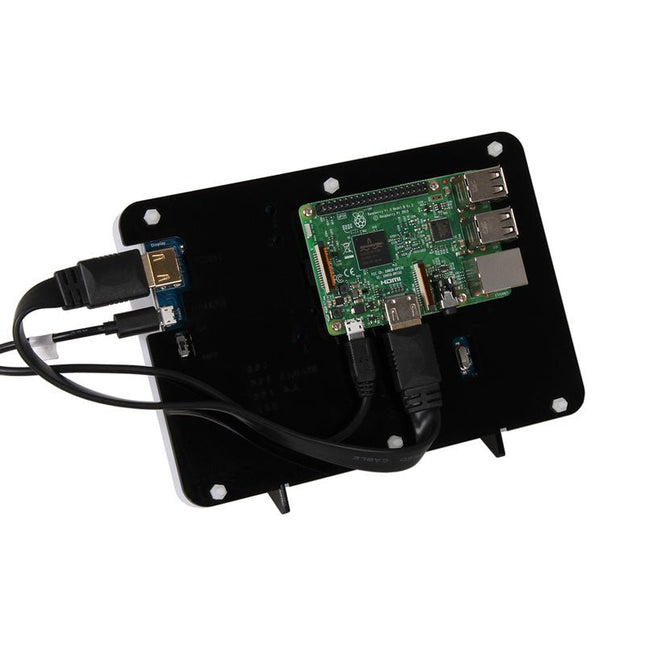
JOY-iT Gehäuse für 7" Touch-Display für Raspberry Pi
Gehäuse für 7" Touch-Display für Raspberry Pi
€ 12,95€ 5,18
Mitglieder identisch
-
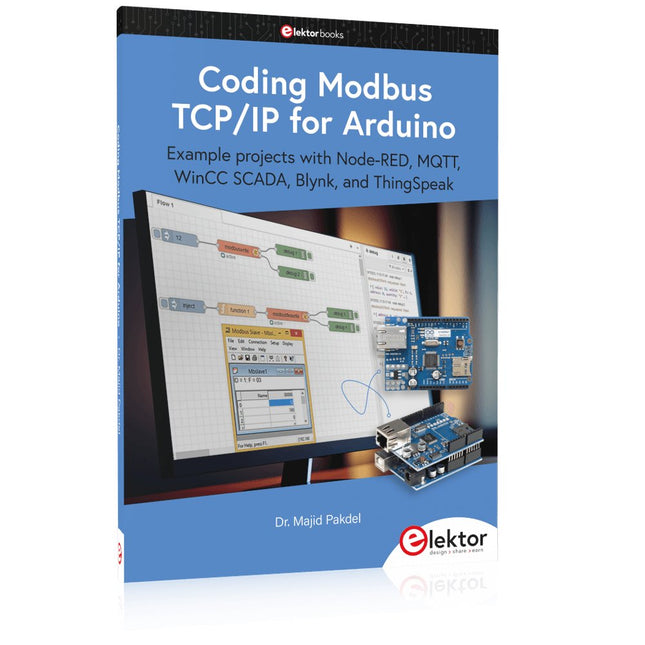
Elektor Publishing Coding Modbus TCP/IP for Arduino
Example projects with Node-RED, MQTT, WinCC SCADA, Blynk, and ThingSpeak This comprehensive guide unlocks the power of Modbus TCP/IP communication with Arduino. From the basics of the Modbus protocol right up to full implementation in Arduino projects, the book walks you through the complete process with lucid explanations and practical examples. Learn how to set up Modbus TCP/IP communication with Arduino for seamless data exchange between devices over a network. Explore different Modbus functions and master reading and writing registers to control your devices remotely. Create Modbus client and server applications to integrate into your Arduino projects, boosting their connectivity and automation level. With detailed code snippets and illustrations, this guide is perfect for beginners and experienced Arduino enthusiasts alike. Whether you‘re a hobbyist looking to expand your skills or a professional seeking to implement Modbus TCP/IP communication in your projects, this book provides all the knowledge you need to harness the full potential of Modbus with Arduino. Projects covered in the book: TCP/IP communication between two Arduino Uno boards Modbus TCP/IP communication within the Node-RED environment Combining Arduino, Node-RED, and Blynk IoT cloud Interfacing Modbus TCP/IP with WinCC SCADA to control sensors Using MQTT protocol with Ethernet/ESP8266 Connecting to ThingSpeak IoT cloud using Ethernet/ESP8266
€ 39,95
Mitglieder identisch
-
Elektor Classics Elektor Röhren 1 bis 10 (USB-Stick)
Im Digitalzeitalter wird die Technikwelt von hochkomplexen Elektronikelementen dominiert. Sie funktionieren – oder auch nicht. Ganz anders ist es in der Röhrentechnik. Es ist wirklich eine Technik zum Anfassen, wobei sich das Anfassen nicht auf heiße Röhrenkolben und Widerstände bezieht. Der Anwender kann bei entsprechendem technischem Verständnis die Funktion jedes einzelnen Bauteils nachvollziehen. Es lässt sich auch jedes defekte Bauteil einzeln austauschen und so das Gerät wieder zum Laufen bringen: ein Paradies für jeden Elektronikbastler aus Leidenschaft! 2005 brachte der Elektor Verlag sein erstes Röhren-Sonderheft heraus – und es stieß auf ungeahnt starke Resonanz! Die vielen positiven Reaktionen nicht nur von Technik-Begeisterten, sondern auch von Musikern, zeigten dem Verlag, dass die Röhrentechnik lebt! 10 Röhren-Sonderhefte mit unzähligen Selbstbauanleitungen, Schaltplänen und praxisnahen Einsatzberichten zeigen, dass die Röhrentechnik einen festen Platz in der modernen Audio-Technologie hat. Inhalt des USB-Sticks Alle bisher erschienenen 10 Röhren-Sonderhefte 1 bis 10 als PDF Röhrenverstärker-Workshop 1 'Die Kunst, Audio-Röhrenverstärker zu verstehen und zu entwerfen' von und mit Menno van der Veen Röhrenverstärker-Workshop 2 'Die Kunst, Audio-Röhrenverstärker zu messen und zu beurteilen' von und mit Menno van der Veen Technische Daten USB USB 3.0 Speicher 32 GB Anschlüsse 1x USB-A1x USB-C
€ 59,95€ 23,98
Mitglieder identisch
-
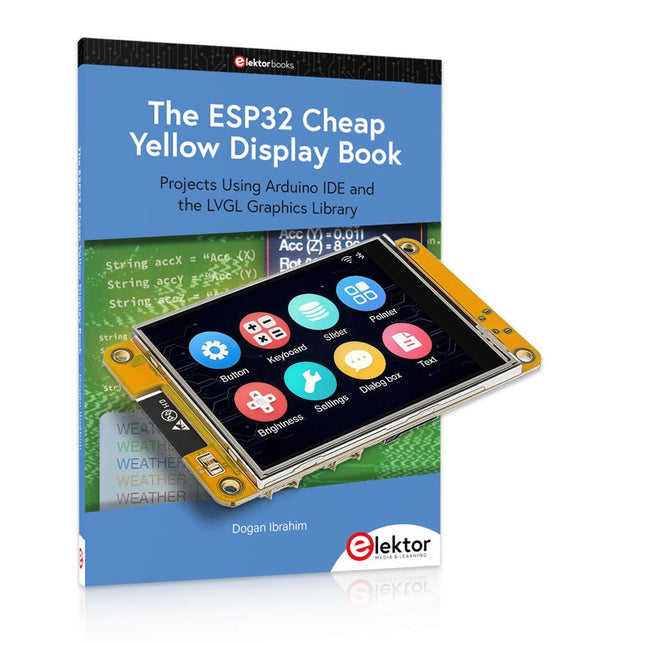
Elektor Bundles The ESP32 Cheap Yellow Display Bundle
Über 40 vollständig getestete ESP32-Projekte mit Arduino IDE und der LVGL-Grafikbibliothek Dieses Bundle enthält das ESP32 Cheap Yellow Display (CYD) – ein kompaktes Entwicklungsboard, das einen Standard-ESP32-Mikrocontroller mit einem 320 x 240 Pixel großen TFT-Farbdisplay kombiniert. Das Board verfügt außerdem über mehrere Anschlüsse für GPIO, serielle Kommunikation (TX/RX), Strom und Masse. Das integrierte Display ist ein großer Vorteil und ermöglicht die Erstellung komplexer, grafikbasierter Projekte ohne externe LCDs oder Displays. Das Begleitbuch stellt die Hardware und die integrierten Anschlüsse des CYD-Boards detailliert vor. Es bietet eine Reihe von Projekten für Anfänger und Fortgeschrittene, die mit der beliebten Arduino IDE 2.0 entwickelt wurden. Sowohl grundlegende Grafikfunktionen als auch die leistungsstarke LVGL-Grafikbibliothek werden behandelt, und praktische Projekte veranschaulichen jeden Ansatz. Alle enthaltenen Projekte wurden vollständig getestet und sind sofort einsatzbereit. Das Buch enthält Blockdiagramme, Schaltpläne, vollständige Codelisten und Schritt-für-Schritt-Erklärungen. Mit der LVGL-Bibliothek können Leser moderne, vollfarbige grafische Benutzeroberflächen mit Widgets wie Schaltflächen, Beschriftungen, Schiebereglern, Kalendern, Tastaturen, Diagrammen, Tabellen, Menüs, Animationen und mehr erstellen. ESP32 Cheap Yellow Display Board Dieses Entwicklungsboard (auch bekannt als "Cheap Yellow Display") wird vom ESP-WROOM-32 angetrieben, einem Dual-Core-MCU mit integrierten Wi-Fi- und Bluetooth-Funktionen. Es arbeitet mit einer Hauptfrequenz von bis zu 240 MHz, mit 520 KB SRAM, 448 KB ROM und einem 4 MB Flash-Speicher. Das Board verfügt über ein 2,8" Display mit einer Auflösung von 240x320 und Resistive Touch. Darüber hinaus enthält die Platine einen Steuerkreis für die Hintergrundbeleuchtung, einen Schaltkreis für die Berührungssteuerung, einen Schaltkreis für die Lautsprecheransteuerung, einen lichtempfindlichen Schaltkreis und einen RGB-LED-Steuerschaltkreis. Es bietet außerdem einen TF-Kartensteckplatz, eine serielle Schnittstelle, eine DHT11-Schnittstelle für Temperatur- und Feuchtigkeitssensoren und zusätzliche E/A-Anschlüsse. Das Modul unterstützt die Entwicklung in Arduino IDE, ESP-IDE, MicroPython und Mixly. Anwendungen Bildübertragung für Smart Home-Gerät Drahtlose Überwachung Intelligente Landwirtschaft QR-Funkerkennung Signal des drahtlosen Positionierungssystems Und andere IoT-Anwendungen Technische Daten Mikrocontroller ESP-WROOM-32 (Dual-Core-MCU mit integriertem WLAN und Bluetooth) Frequenz Bis zu 240 MHz (Rechenleistung bis zu 600 DMIPS) SRAM 520 KB ROM 448 KB Flash 4 MB Betriebsspannung 5 V Stromverbrauch ca. 115 mA Display 2,8" TFT-Farbbildschirm (240 x 320) Touch Resistive Touch Treiberchip ILI9341 Abmessungen 50 x 86 mm Gewicht 50 g Downloads GitHub Inhalt des Bundles The ESP32 Cheap Yellow Display Book (Einzelpreis: 35 €) ESP32 Cheap Yellow Display Board (Einzelpreis: 25 €) 1x ESP32 Dev-Board mit 2,8" Display und Acrylgehäuse 1x Touch-Stift 1x Verbindungskabel 1x USB-Kabel
€ 59,95€ 49,95
Mitglieder identisch
-

Elektor Digital Coding Modbus TCP/IP for Arduino (E-book)
Example projects with Node-RED, MQTT, WinCC SCADA, Blynk, and ThingSpeak This comprehensive guide unlocks the power of Modbus TCP/IP communication with Arduino. From the basics of the Modbus protocol right up to full implementation in Arduino projects, the book walks you through the complete process with lucid explanations and practical examples. Learn how to set up Modbus TCP/IP communication with Arduino for seamless data exchange between devices over a network. Explore different Modbus functions and master reading and writing registers to control your devices remotely. Create Modbus client and server applications to integrate into your Arduino projects, boosting their connectivity and automation level. With detailed code snippets and illustrations, this guide is perfect for beginners and experienced Arduino enthusiasts alike. Whether you‘re a hobbyist looking to expand your skills or a professional seeking to implement Modbus TCP/IP communication in your projects, this book provides all the knowledge you need to harness the full potential of Modbus with Arduino. Projects covered in the book: TCP/IP communication between two Arduino Uno boards Modbus TCP/IP communication within the Node-RED environment Combining Arduino, Node-RED, and Blynk IoT cloud Interfacing Modbus TCP/IP with WinCC SCADA to control sensors Using MQTT protocol with Ethernet/ESP8266 Connecting to ThingSpeak IoT cloud using Ethernet/ESP8266
€ 32,95
Mitglieder € 26,36
-
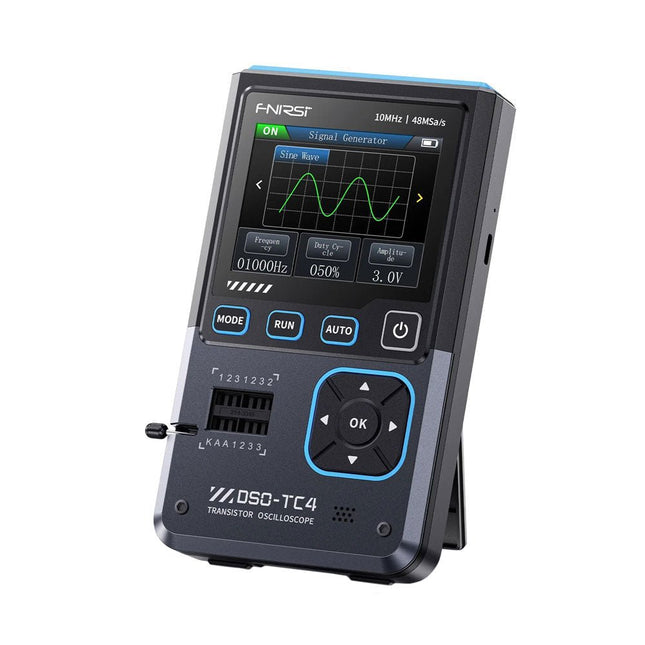
FNIRSI FNIRSI DSO-TC4 (3-in-1) Oszilloskop (10 MHz) + Transistortester + Signalgenerator
Das FNIRDSI DSO-TC4 ist ein multifunktionales Transistor-Oszilloskop, das sowohl umfassend als auch praktisch ist. Es wurde für den Einsatz in Wartungs- und Forschungsanwendungen entwickelt und vereint Oszilloskop, Transistortester und Signalgenerator in einem Gerät. Features Ausgestattet mit einem 2,8-Zoll-TFT-Farbdisplay für eine klare und intuitive Anzeige Eingebauter Lithium-Akku mit hoher Kapazität (1500 mAh) und einer Standby-Zeit von bis zu 4 Stunden Kompakt und leicht, ideal für den mobilen Einsatz Technische Daten Oszilloskop Analoge Bandbreite 10 MHz Echtzeit-Abtastrate 48 MSa/s Eingangsimpedanz 1 MΩ Kopplungsmodus AC/DC Prüfspannungsbereich 1:1-Tastkopf: 80 Vpp (+40 V) 10:1-Tastkopf: 800 Vpp (+400 V) Vertikale Empfindlichkeit 10 mV/div~10 V/div (X1-Bereich) Vertikale Auslenkung Einstellbar mit Anzeige Zeitbasisbereich 50 ns~20 s Triggermodus Auto/Normal/Single Triggertyp Rising edge, Falling edge Triggerpegel Einstellbar mit Anzeige Wellenform einfrieren Ja (HOLD-Funktion) Automatische Messung Max, Min, Avg, RMS, Vpp, Frequency, Cycle, Duty Cycle Transistortester Transistor Verstärkungsfaktor "hfe"; Basis-Emitter-Spannung „Ube“, Ic/Ie, Kollektor-Emitter-Sperrstrom „Iceo“, Ices, Durchlassspannungsabfall der Schutzdiode „Uf“ Diode Durchlassspannungsabfall <5 V (Durchlassspannungsabfall, Sperrschichtkapazität, Rückwärtsleckstrom) Zenerdiode 0,01-32 V Rückwärtsdurchbruchspannung (K-A-A-Testbereich) Feldeffekttransistor (FET) JFET: Gatekapazität „Cg“, Drainstrom Id unter „Vgs“, Durchlassspannungsabfall der Schutzdiode "Uf" IGBT: Drainstrom Id unter Vgs, Durchlassspannungsabfall der Schutzdiode Uf MIOSTET: Schwellenspannung "Vt", Gatekapazität "Cg", Drain-Source-Widerstand "Rds", Durchlassspannungsabfall der Schutzdiode "Uf" Unidirektionaler Thyristor Triggerspannung <5 V, Gatepegel (Gate-Spannung) Bidirektionaler Thyristor Triggerstrom <6 mA (Gate-Spannung) Kondensator 25 pF–100 mF, Kapazitätswert, Verlustfaktor "Vloss" Widerstand 0,01 Ω-50 MΩ Induktivität 10 μH-1000 μH, Gleichstromwiderstand DS18B20 Temperatursensor, Pins: GND, DQ, VDD DHT11 Temperatur- und Feuchtigkeitssensor, Pins: VDD, DATA, GND Signalgenerator Ausgangswellenform Unterstützt 13 Wellenformausgänge Wellenformfrequenz 0-50 kHz Rechteckwellen-Tastverhältnis 0-100% Wellenformamplitude 0,1-3,0 V Allgemein Display 2,8" TFT-Farbbildschirm Hintergrundbeleuchtung Helligkeit einstellbar Stromversorgung USB-C (5 V/1 A) Akku 3,7 V/1500 mAh Sprachen Englisch, Deutsch, Spanisch, Portugiesisch, Russisch, Chinesisch, Japanisch, Koreanisch Abmessungen 90 x 142 x 27,5 mm Gewicht 186 g Lieferumfang 1x FNIRSI DSO-TC4 (3-in-1) Oszilloskop (10 MHz) 1x P6100 Oszilloskop-Tastkopf (10x) 1x Krokodilklemmensonde 3x Testhaken 1x Adapter 1x USB-C-Ladekabel 1x Manual Downloads Manual Firmware V0.0.7 (+V1.0.9)
€ 73,71
-

Elektor Digital The ESP32 Cheap Yellow Display Book (PDF)
Projects Using Arduino IDE and the LVGL Graphics Library The ESP32 is probably one of the most popular microcontrollers used by many people, including students, hobbyists, and professional engineers. Its low cost, coupled with rich features makes it a popular device to use in many projects. Recently, a board called the ESP32 Cheap Yellow Display (CYD for short) is available from its manufacturers. The board includes a standard ESP32 microcontroller together with a 320x240 pixel TFT display. Additionally, the board provides several connectors for interfaces such as GPIO, serial port (TX/RX), power and Ground. The inclusion of a TFT display is a real advantage as it enables users to design complex graphics-based projects without resorting to an external LCD or graphics displays. The book describes the basic hardware of the ESP32 CYD board and provides details of its on-board connectors. Many basic, simple, and intermediate-level projects are given in the book based on the ESP32 CYD, using the highly popular Arduino IDE 2.0 integrated development environment. The use of both the basic graphics functions and the use of the popular LVGL graphics library are discussed in the book and projects are given that use both types of approaches. All the projects given in the book have been tested and are working. The block diagram, circuit diagram, and the complete program listings and program descriptions of all the projects are given with explanations. Readers can use the LVGL graphics library to design highly popular eye-catching full-color graphics projects using widgets such as buttons, labels, calendars, keypads, keyboards, message boxes, spinboxes, sliders, charts, tables, menus, bars, switches, drop-down lists, animations, and many more widgets.
€ 29,95
Mitglieder € 23,96
-

SparkFun SparkFun MicroMod Eingabe- und Display-Trägerplatine
Dieses Trägerboard kombiniert ein 2,4"-TFT-Display, sechs adressierbare LEDs, einen Onboard-Spannungsregler, einen 6-poligen IO-Anschluss und einen microSD-Steckplatz mit dem M.2-Steckplatz, sodass es mit kompatiblen Prozessorboards in unserem MicroMod-Ökosystem verwendet werden kann. Außerdem haben wir dieses Trägerboard mit dem ATtiny84 von Atmel mit 8kb programmierbarem Flash bestückt. Dieser kleine Kerl ist vorprogrammiert, um mit dem Prozessor über I2C zu kommunizieren und Tastendrücke zu lesen. Features M.2 MicroMod-Anschluss 240 x 320 Pixel, 2,4" TFT-Display 6 adressierbare APA102 LEDs Magnetischer Buzzer USB-C-Anschluss 3,3 V 1 A Spannungsregler Qwiic-Anschluss Boot/Reset-Tasten RTC-Backup-Batterie & Ladeschaltung microSD Phillips #0 M2,5 x 3 mm Schraube enthalten
€ 72,95€ 29,18
Mitglieder identisch
-
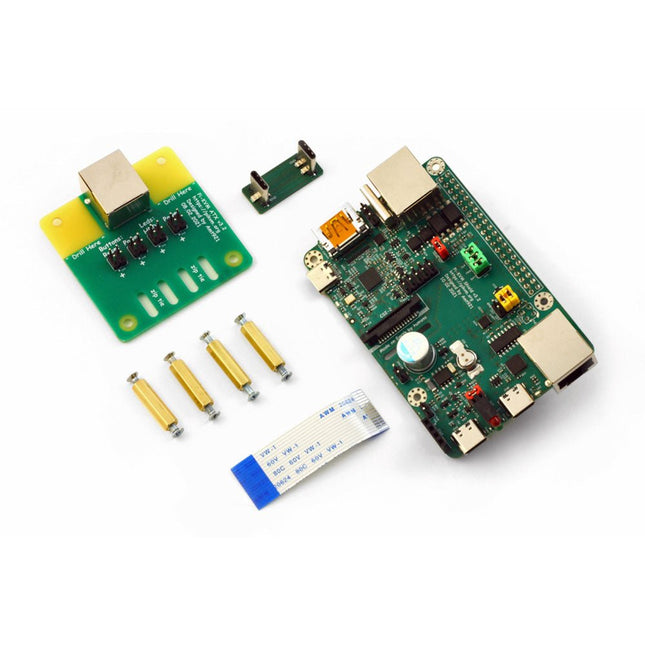
PiKVM PiKVM V3 KVM over IP für Raspberry Pi 4
PiKVM V3 ist ein auf Raspberry Pi-basiertes Open Source KVM over IP-Gerät. Es hilft Ihnen bei der Fernverwaltung von Servern oder Workstations, unabhängig vom Status des Betriebssystems oder davon, ob eines installiert ist. Mit PiKVM V3 können Sie Ihren Computer ein-/ausschalten oder neu starten, das UEFI/BIOS konfigurieren und sogar das Betriebssystem mithilfe der virtuellen CD-ROM oder des Flash-Laufwerks neu installieren. Sie können Ihre Remote-Tastatur und -Maus verwenden oder PiKVM kann eine Tastatur, Maus und einen Monitor simulieren, die dann in einem Webbrowser angezeigt werden, als ob Sie direkt an einem Remote-System arbeiten würden. Features HDMI Full HD Aufnahme basierend auf dem TC358743-Chip (extra niedrige Latenz ~100 ms und viele Funktionen wie Kompressionskontrolle) OTG Tastatur & Maus; Emulation von Massenspeicherlaufwerken Fähigkeit zur Simulation von "Entfernen und Einstecken" für USB Integrierte ATX-Stromsteuerung Integrierte Lüftersteuerung Echtzeituhr (RTC) RJ-45 und serieller USB-Konsolenanschluss (zur Verwaltung des PiKVM OS oder zur Verbindung mit dem Server) Optionales AVR-basiertes HID (für einige seltene und seltsame Motherboards, deren BIOS die OTG-emulierte Tastatur nicht versteht) Optionaler OLED-Bildschirm zur Anzeige des Netzwerkstatus oder anderer gewünschter Informationen Fertig aufgebautes Board, kein Löten oder Breadboarding erforderlich. PiKVM OS – die Software ist vollständig quelloffen Lieferumfang PiKVM V3 HAT Karte für Raspberry Pi 4 USB-C Bridge Board, um den HAT mit dem RPi über USB-C zu verbinden ATX-Controller-Adapterplatine und Verkabelung, um den HAT mit dem Motherboard zu verbinden (wenn Sie die Stromversorgung über die Hardware verwalten möchten) 2 flache CSI-Kabel Schrauben und Messingabstandshalter Erforderlich Raspberry Pi 4 MicroSD-Karte USB-C nach USB-A Kabel HDMI-Kabel Gerades Ethernet-Kabel (für den Anschluss der ATX-Erweiterungskarte) Netzteil (5,1 V/3 A USB-C, offizielles Raspberry Pi-Netzteil wird empfohlen) Downloads User Guide Images GitHub Links Das PiKVM-Projekt und seine Lehren: Ein Interview mit Maxim Devaev (Entwickler von PiKVM) Raspberry Pi als KVM-Fernsteuerung
€ 229,00€ 91,60
Mitglieder identisch
-

Elektor Digital Universal Display Book for PIC Microcontrollers (E-book)
The newcomer to Microchip’s PIC microcontrollers invariably gets an LED to flash as their first attempt to master this technology. You can use just a simple LED indicator in order to show that your initial attempt is working, which will give you confidence to move forward. This is how the book begins — simple programs to flash LEDs, and eventually by stages to use other display indicators such as the 7-segment display, alphanumeric liquid crystal displays and eventually a colour graphic LCD. As the reader progresses through the book, bigger and upgraded PIC chips are introduced, with full circuit diagrams and source code, both in assembler and C. In addition, a small tutorial is included using the MPLAB programming environment, together with the EAGLE schematic and PCB design package to enable readers to create their own designs using the book’s many case studies as working examples to work from.
€ 19,95
Mitglieder € 15,96
-
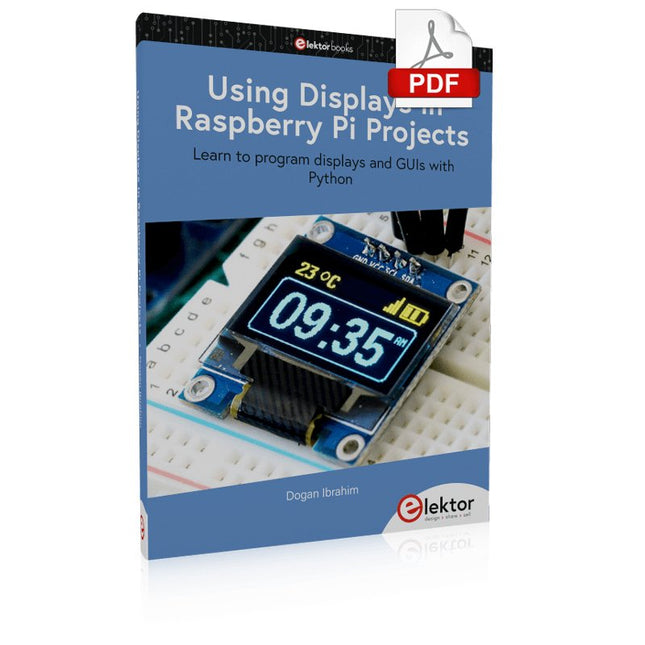
Elektor Digital Using Displays in Raspberry Pi Projects (E-book)
Learn to program displays and GUIs with Python This book is about Raspberry Pi 4 display projects. The book starts by explaining how to install the latest Raspbian operating system on an SD card, and how to configure and use the GPIO ports. The core of the book explains the following topics in simple terms with fully tested and working example projects: Simple LED projects Bar graph LED projects Matrix LED projects Bitmap LED projects LED strips LCDs OLED displays E-paper displays TFT displays 7-inch touch screen GUI Programming with Tkinder One unique feature of this book is that it covers almost all types of display that readers will need to use in their Raspberry Pi based projects. The operation of each project is fully given, including block diagrams, circuit diagrams, and commented full program listings. It is therefore an easy task to convert the given projects to run on other popular platforms, such as Arduino or PIC microcontrollers. Python program listings of all Raspberry Pi projects developed in this book are available for download at Elektor.com. Readers can use these programs in their projects. Alternatively, they can modify the programs to suit their applications.
€ 32,95
Mitglieder € 26,36
-

Elektor Digital Röhren 10 (PDF)
Inhalt Grundlagen Kathodengegenkopplung – bei Endröhren durch eine Übertragerwicklung Der Zwischenübertrager Bauanleitungen Eintakt-A-Endstufe mit 4x 6V6 – 6V6 quatroSE – ernsthafter Eintakter mit 16 W, nicht nur für hocheffiziente Lautsprecher CD-Vorverstärker mit CD-Filter Moderne Hybridendstufe Die Kathedrale in der Streichholzschachtel – Elektronische Hallspirale UKW-Mischteil – mit der Doppeltriode ECC2000 und der Triode/Pentode ECF80 Technik In die Röhre geschaut – Computer-tomografische Bilder vom Röhreninneren 6L6GC – with best Regards from the United States of America Röhrensockel Info Die Röhren-Sonderheft-Reihe hat die runde Zahl 10 erreicht Nachruf Jan Jurco – Gründer von JJ Electronic Buchbesprechung Röhrendaten
€ 18,50
Mitglieder € 16,65


