
Products
-
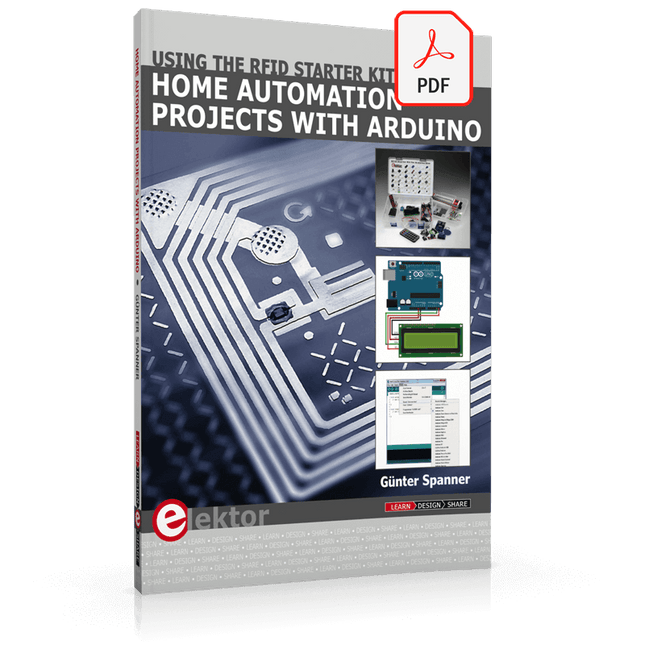
Elektor Digital Home Automation Projects with Arduino (E-book)
Using the RFID Starter Kit An Arduino board has now become ‘the’ basic component in the maker community. No longer is an introduction to the world of microcontrollers the preserve of the expert. When it comes to expanding the capabilities of the basic Arduino board however, the developer is still largely on his own. If you really want to build some innovative projects it’s often necessary to get down to component level. This can present many beginners with major problems. That is exactly where this book begins. This book explains how a wide variety of practical projects can be built using items supplied in a single kit together with the Arduino board. This kit, called the 'RFID Starter Kit for Arduino' (SKU 17240) is not just limited to RFID applications but contains more than 30 components, devices and modules covering all areas of modern electronics. In addition to more simple components such as LEDs and resistors there are also complex and sophisticated modules that employ the latest technology such as: A humidity sensor A multicolor LED A large LED matrix with 64 points of light A 4-character 7-segment LED display An infra red remote-controller unit A complete LC-display module A servo A stepper motor and controller module A complete RFID reader module and security tag On top of that you will get to build precise digital thermometers, hygrometers, exposure meters and various alarm systems. There are also practical devices and applications such as a fully automatic rain sensor, a sound-controlled remote control system, a multifunctional weather station and so much more. All of the projects described can be built using the components supplied in the Elektor kit.
€ 29,95
Mitglieder: € 26,96
-

Elektor Digital C Programming with Arduino (E-book)
Technology is constantly changing. New microcontrollers become available every year. The one thing that has stayed the same is the C programming language used to program these microcontrollers. If you would like to learn this standard language to program microcontrollers, then this book is for you! Arduino is the hardware platform used to teach the C programming language as Arduino boards are available worldwide and contain the popular AVR microcontrollers from Atmel. Atmel Studio is used as the development environment for writing C programs for AVR microcontrollers. It is a full-featured integrated development environment (IDE) that uses the GCC C software tools for AVR microcontrollers and is free to download. At a glance: Start learning to program from the very first chapter No programming experience is necessary Learn by doing – type and run the example programs A fun way to learn the C programming language Ideal for electronic hobbyists, students and engineers wanting to learn the C programming language in an embedded environment on AVR microcontrollers Use the free full-featured Atmel Studio IDE software for Windows Write C programs for 8-bit AVR microcontrollers as found on the Arduino Uno and MEGA boards Example code runs on Arduino Uno and Arduino MEGA 2560 boards and can be adapted to run on other AVR microcontrollers or boards Use the AVR Dragon programmer/debugger in conjunction with Atmel Studio to debug C programs
€ 39,95
Mitglieder: € 35,96
-

Elektor Digital Internet of Things (E-book)
The Internet of Things (IoT) is a new concept in intelligent automation and intelligent monitoring using the Internet as the communications medium. The “Things” in IoT usually refer to devices that have unique identifiers and are connected to the Internet to exchange information with each other. Such devices usually have sensors and/or actuators that can be used to collect data about their environments and to monitor and control their environments. The collected data can be processed locally or it can be sent to centralized servers or to the cloud for remote storage and processing. For example, a small device at the size of a matchbox can be used to collect data about the temperature, relative humidity and the atmospheric pressure. This data can be sent and stored in the cloud. Anyone with a mobile device can then access and monitor this data at any time and from anywhere on Earth provided there is Internet connectivity. In addition, users can for example, adjust the central heating remotely using their mobile devices and accessing the cloud. This book is written for students, for practising engineers and for hobbyists who want to learn more about the building blocks of an IoT system and also learn how to setup an IoT system using these blocks. Chapter 1 is an introduction to the IoT systems. In Chapter 2, the basic concepts and possible IoT architectures are discussed. The important parts of any IoT system are the sensors and actuators and they are described briefly in Chapter 3. The devices in an IoT system usually communicate with each other and the important aspect of IoT communication is covered in Chapter 4. Chapter 5 proceeds with the features of some of the commonly used development kits. One of these, the Clicker 2 for PIC18FJ manufactured by mikroElektronika, can be used as a processor in IoT systems and its features are described in detail in Chapter 6. A popular microcontroller C language, mikroC Pro for PIC gets introduced in Chapter 7. Chapter 8 covers the use of a click board with the Clicker 2 for PIC18FJ development kit. Similarly, the use of a sensor click board is described as a project in Chapter 9, and an actuator board in Chapter 10. Chapters 11 and 12 cover Bluetooth and Wi-Fi technologies in microcontroller based systems, and the remaining chapters of the book demo the creation of a simple Wi-Fi based IoT system with cloud-based data storage. This book has been written with the assumption that the reader has taken a course on digital logic design and has been exposed to writing programs using at least one high-level programming language. Knowledge of the C programming language will be very useful. Also, familiarity with at least one member of the PIC series of microcontrollers (e.g. PIC16 or PIC18) will be an advantage. The knowledge of assembly language programming is not required because all the projects in the book are based on using the C language. If you are a total beginner in programming you can still access the e-book, but first you are advised to study introductory books on microcontrollers.
€ 34,95
Mitglieder: € 31,46
-

Elektor Digital Retro Audio (E-book)
The intention of this book is to offer the reader understandings, ideas and solutions from the perspective of a workbench technician and electronics hobbyist. It is a descriptive text with many tables of useful data, servicing tips and supplementary notes of not so common knowledge. Today there is a re-emerging, nostalgic interest in vinyl records and associated music entertainment gear. With this interest, there is a paralleled market for the repair of this gear. This ‘hands-on’ servicing guide opens with fundamental considerations of the work space of repair and servicing. This includes a comprehensive discussion of essential test equipment and tools. Two chapters are devoted to obtaining servicing information about repair and obtaining spare parts. A key chapter is on general diagnosis and testing and includes the discussion of resistance, capacitance and inductance. These electrical properties are regularly in the mind of the repairer, so understanding of them is a key objective of this book. The next chapter is about time saving repair techniques and ensuring quality repair. The remaining chapters discuss entertainment equipment itself. Each of the chapters begins with an orderly discussion of the theory of operation and common and not so common problems specific to the equipment. All chapters conclude with a summary.
€ 24,95
Mitglieder: € 22,46
-

Elektor Digital C Programming for Embedded Microcontrollers (E-book)
Technology is constantly changing. New microcontrollers become available every year and old ones become redundant. The one thing that has stayed the same is the C programming language used to program these microcontrollers. If you would like to learn this standard language to program microcontrollers, then this book is for you! ARM microcontrollers are available from a large number of manufacturers. They are 32-bit microcontrollers and usually contain a decent amount of memory and a large number of on-chip peripherals. Although this book concentrates on ARM microcontrollers from Atmel, the C programming language applies equally to other manufacturer’s ARMs as well as other microcontrollers. Features of this book Use only free or open source software. Learn how to download, set up and use free C programming tools. Start learning the C language to write simple PC programs before tackling embedded programming - no need to buy an embedded system right away! Start learning to program from the very first chapter with simple programs and slowly build from there. No programming experience is necessary! Learn by doing - type and run the example programs and exercises. Sample programs and exercises can be downloaded from the Internet. A fun way to learn the C programming language. Ideal for electronic hobbyists, students and engineers wanting to learn the C programming language in an embedded environment on ARM microcontrollers.
€ 29,95
Mitglieder: € 26,96
-

Elektor Digital Controller Area Network Projects with ARM and Arduino (E-book)
This book details the use of the ARM Cortex-M family of processors and the Arduino Uno in practical CAN bus based projects. Inside, it gives a detailed introduction to the architecture of the Cortex-M family whilst providing examples of popular hardware and software development kits. Using these kits helps to simplify the embedded design cycle considerably and makes it easier to develop, debug, and test a CAN bus based project. The architecture of the highly popular ARM Cortex-M processor STM32F407VGT6 is described at a high level by considering its various modules. In addition, the use of the mikroC Pro for ARM and Arduino Uno CAN bus library of functions are described in detail. This book is written for students, for practising engineers, for hobbyists, and for everyone else who may need to learn more about the CAN bus and its applications. The book assumes that the reader has some knowledge of basic electronics. Knowledge of the C programming language will be useful in later chapters of the book, and familiarity with at least one microcontroller will be an advantage, especially if the reader intends to develop microcontroller based projects using CAN bus. The book should be useful source of reference to anyone interested in finding an answer to one or more of the following questions: What bus systems are available for the automotive industry? What are the principles of the CAN bus? What types of frames (or data packets) are available in a CAN bus system? How can errors be detected in a CAN bus system and how reliable is a CAN bus system? What types of CAN bus controllers are there? What are the advantages of the ARM Cortex-M microcontrollers? How can one create a CAN bus project using an ARM microcontroller? How can one create a CAN bus project using an Arduino microcontroller? How can one monitor data on the CAN bus?
€ 32,95
Mitglieder: € 29,66
-
Elektor Digital ARM Microcontroller Projects (E-book)
It is becoming important for microcontroller users to quickly learn and adapt to new technologies and architecture used in high performance 32-bit microcontrollers. Many manufacturers now offer 32-bit microcontrollers as general purpose processors in embedded applications. ARM provide 32 and 64-bit processors mainly for embedded applications. These days, the majority of mobile devices including mobile phones, tablets, and GPS receivers are based on ARM technology. The low cost, low power consumption, and high performance of ARM processors makes them ideal for use in complex communication and mixed signal applications. This book makes use of the ARM Cortex-M family of processors in easy-to-follow, practical projects. It gives a detailed introduction to the architecture of the Cortex-M family. Examples of popular hardware and software development kits are described. The architecture of the highly popular ARM Cortex-M processor STM32F107VCT6 is described at a high level, taking into consideration its clock mechanisms, general input/output ports, interrupt sources, ADC and DAC converters, timer facilities, and more. The information provided here should act as a basis for most readers to start using and programming the STM32F107VCT6 microcontroller together with a development kit. Furthermore, the use of the mikroC Pro for ARM integrated development environment (IDE) has been described in detail. This IDE includes everything required to create a project; namely an editor, compiler, simulator, debugger, and device programmer. Although the book is based on the STM32F107VCT6 microcontroller, readers should not find it difficult to follow the projects using other ARM processor family members.
€ 34,95
Mitglieder: € 31,46
-
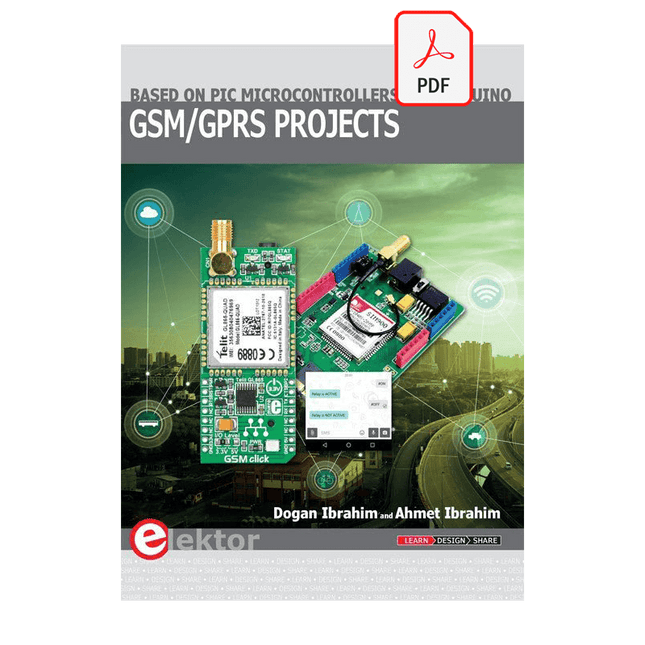
Elektor Digital GSM/GPRS Projects (E-book)
Based on PIC microcontrollers and Arduino Every mobile phone includes a GSM/GPRS modem which enables the phone to communicate with the external world. With the help of the GSM modems, users can establish audio conversations and send and receive SMS text messages. In addition, the GPRS modem enables users to connect to the internet and to send and receive large files such as pictures and video over the internet. This book is aimed for the people who may want to learn how to use the GSM/GPRS modems in microcontroller based projects. Two types of popular microcontroller families are considered in the e-book: PIC microcontrollers, and the Arduino. The highly popular mid-performance PIC18F87J50 microcontroller is used in PIC based projects together with a GSM Click board. In addition, the SIM900 GSM/GPRS shield is used with the Arduino Uno projects. Both GSM and GPRS based projects are included in the e-book. The book will enable you to control equipment remotely by sending SMS messages from your mobile phone to the microcontroller, send the ambient temperature readings from the microcontroller to a mobile phone as SMS messages, use the GPRS commands to access the internet from a microcontroller, send temperature readings to the cloud using UDP and TCP protocols and so on. It is assumed that the reader has some basic working knowledge of the C language and the use of microcontrollers in simple projects. Although not necessary, knowledge of at least one member of the PIC microcontroller family and the Arduino Uno will be an advantage. It will also be useful if the user has some knowledge of basic electronics.
€ 24,95
Mitglieder: € 22,46
-

Elektor Digital BBC micro:bit (E-book)
35 Touch Develop & MicroPython Projects The BBC micro:bit is a credit sized computer based on a highly popular and high performance ARM processor. The device is designed by a group of 29 partners for use in computer education in the UK and will be given free of charge to every secondary school student in the UK. The device is based on the Cortex-M0 processor and it measures 4 x 5 cm. It includes several important sensors and modules such as an accelerometer, magnetometer, 25 LEDs, 2 programmable push-button switches, Bluetooth connectivity, micro USB socket, 5 ring type connectors, and a 23-pin edge connector. The device can be powered from its micro USB port by connecting it to a PC, or two external AAA type batteries can be used. This book is about the use of the BBC micro:bit computer in practical projects. The BBC micro:bit computer can be programmed using several different programming languages, such as Microsoft Block Editor, Microsoft Touch Develop, MicroPython, and JavaScript. The book makes a brief introduction to the Touch Develop programming language and the MicroPython programming language. It then gives 35 example working and tested projects using these language. Readers who learn to program in Touch Develop and MicroPython should find it very easy to program using the Block Editor or any other languages. The following are given for each project: Title of the project Description of the project Aim of the project Touch Develop and MicroPython program listings Complete program listings are given for each project. In addition, working principles of the projects are described briefly in each section. Readers are encouraged to go through the projects in the order given in the book.
€ 24,95
Mitglieder: € 22,46
-

Elektor Digital Red Pitaya for Test and Measurement (E-book)
The Red Pitaya (STEMlab) is a credit card-sized, open-source test and measurement board that can be used to replace most measurement instruments used in electronics laboratories. With a single click, the board can transform into a web-based oscilloscope, spectrum analyser, signal generator, LCR meter, Bode plotter, and microcontroller. The Red Pitaya (STEMlab) can replace the many pieces of expensive measurement equipment found at professional research organisations and teaching laboratories. The device, that based on Linux, includes an FPGA, digital signal processing (DSP), dual core ARM Cortex processor, signal acquisition and generation circuitry, micro USB socket, microSD card slot, RJ45 socket for Ethernet connection, and USB socket – all powered from an external mains adaptor. This book is an introduction to electronics. It aims to teach the principles and applications of basic electronics by carrying out real experiments using the Red Pitaya (STEMlab). The book includes many chapters on basic electronics and teaches the theory and use of electronic components including resistors, capacitors, inductors, diodes, transistors, and operational amplifiers in electronic circuits. Many fun and interesting Red Pitaya (STEMlab) experiments are included in the book. The book also makes an introduction to visual programming environment. The book is written for college level and first year university students studying electrical or electronic engineering.
€ 29,95
Mitglieder: € 26,96
-

Elektor Digital Programmeerbare Logica (E-book)
Het boek Programmeerbare Logica neemt je mee op een ontdekkingstocht door de wereld van de digitale elektronica. Na het leggen van een grondige basis is er uitgebreid aandacht voor het maken van logische circuits. Auteur Vincent Himpe toont o.a. hoe je met bestaande bouwstenen logische elektronica systemen maakt. Hij laat verder zien hoe je om gaat met de interfacing met de buitenwereld. Hierbij komen stroomvoorziening, bord layout en beveiliging uitvoerig aan bod. Moderne logische systemen zijn zo complex dat het ontwerpen met kleine bouwstenen zoals losse poortjes, flipflops en tellers een haast onbegonnen zaak geworden is. Daarom gaat Himpe in de tweede helft van het boek in op de programmeerbare logica zoals CPLD en FPGA. Hij belicht een ontwerpmethode waarmee je snel de brug slaat tussen het klassieke ontwerp en het ontwerp in FPGA. Naast schematisch ontwerp komt ook het ontwerpen met synthesetalen zoals Verilog en VHDL aan de orde. Ter afsluiting wordt een project (een klok met alarmfunctie) geïmplementeerd in Verilog en VHDL. Ook het fysieke ontwerp met deze logische componenten komt aan bod. Hoe programmeer je deze en wat zijn de randvoorwaarden zoals stroomvoorziening en signaalconditionering. De inhoud van het boek is 'state of the art'. En alles wat besproken wordt is direct implementeerbaar met de gratis ontwikkelomgeving Quartus van Altera. Over de auteur Vincent Himpe (B) leeft sinds 2005 in San Jose – hartje Silicon Valley – en werkt aan de ontwikkeling van nieuwe harddisktechnologie en de chips.Himpe heeft meerdere patenten en over de jaren verschillende artikelen gepubliceerd in onder andere IMeko / TSCC, The Journal of Computer Standards AND Interfaces, Elektor en EDN. Hij is ook auteur van de bestseller 'Visual Basic for electronic engineering applications' uitgegeven door Elektor.
€ 39,95
Mitglieder: € 35,96
-

Peak Peak Atlas ZEN50 Zenerdioden-Analyzer
Der Peak Atlas ZEN50 ist ideal zum Testen von Zenerdioden (einschließlich Lawinendioden), Transientenunterdrückern, LEDs und LED-Strängen. Es erzeugt konstante Stromimpulse (wählbar zwischen 2 mA, 5 mA, 10 mA und 15 mA) bei Spannungen von 0 V bis 50 V. So können sogar Hochspannungs-Zener oder Hochspannungs-LED-Stränge getestet werden. Prüfströme werden in schmalen Impulsen zugeführt, um sicherzustellen, dass die zu prüfende Komponente eine konstante Temperatur behält. Die Spannung des Teils wird auf dem Bildschirm zusammen mit dem Prüfstrom und einem Maß für den Steilheitswiderstand des Bauteils (auch als dynamische Impedanz bezeichnet) angezeigt. Technische Daten Analyzertyp Zener, LEDs, TVS usw Testströme 2mA, 5mA, 10mA, 15mA Spannungsbereich 0,00 bis 50,00 V Neigungswiderstandsbereich 0 bis 8000 Ohm Akku-Typ Einzelnes AAA (im Lieferumfang enthalten). Die Lebensdauer beträgt normalerweise 1400 Operationen Testmethode Dreifachimpuls-Burst bei 10pps (typisch) Testen Sie den aktuellen Arbeitszyklus 3% Anzeigetyp Alphanumerisches LCD (mit Hintergrundbeleuchtung) Lieferumfang Peak Atlas ZEN50 Zenerdioden-Analyzer Angepasste flexible Messleitungen mit vergoldeten Krokodilen Umfangreiche bebilderte Bedienungsanleitung AAA-Alkalibatterie Downloads Datenblatt (EN) Benutzerhandbuch (DE)
€ 84,49
-
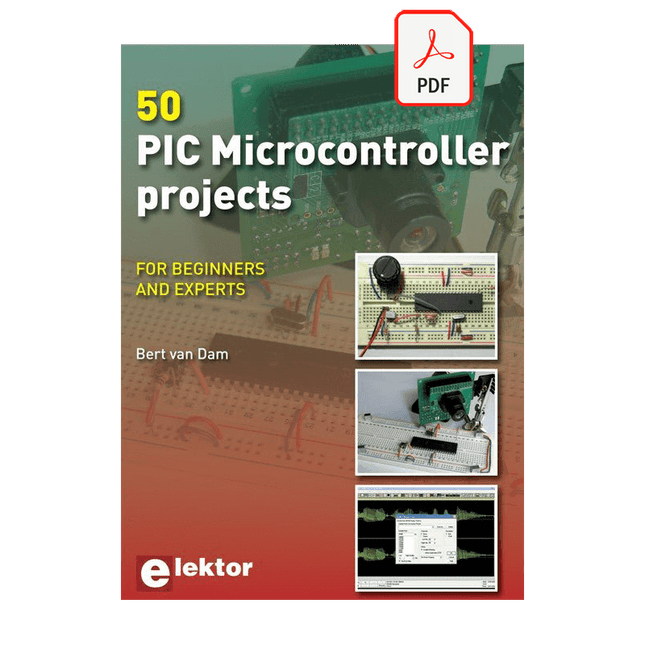
Elektor Digital 50 PIC Microcontroller Projects (E-book)
This book contains 50 fun and exciting projects for PIC microcontrollers such as a laser alarm, USB teasing mouse, eggtimer, youth repellent, soundswitch, capacitive liquid level gauge, 'finger in the water' sensor, guarding a room using a camera, mains light dimmer (110-240 volts), talking microcontroller and much more. Several different techniques are discussed such as relay, alternating current control including mains, I²C, SPI, RS232, USB, pulse width modulation, rotary encoder, interrupts, infrared, analog-digital conversion (and the other way around), 7-segment display and even CAN bus. You can use this book to build the projects for your own use. The clear explanations, schematics and even pictures of each project make this a fun activity. For each project the theory is discussed and why the project has been executed in that particular way. That means you can also use this book as a studybook, or as basis for larger and more complicated projects. All projects use a breadboard so modification and expansion is easy. Three PIC microcontrollers are used, the 16f877A, 18f4455 and 18f4685. It is also discussed how you can migrate your project from one microcontroller to another – 15 types are supported - including two example projects. All software that is used in this book can be downloaded for free. That also applies to the open source programming language JAL. This powerful and yet easy to learn language is used by hobbyists as well as professionals. This book can also be used as a reference guide. It explains all JAL commands, as well as the expansion libraries. Using the index you can easily find example projects that illustrate the use of these commands. Even when you have built all projects in this book you will still want to keep it within arm's reach.
€ 34,95
Mitglieder: € 31,46
-

Elektor Digital Arduino Uno – 45 Projects for Beginners and Experts (E-book)
This book covers a series of exciting and fun projects for the Arduino, such as a silent alarm, people sensor, light sensor, motor control, internet and wireless control (using a radio link). Contrary to many free projects on the internet all projects in this book have been extensively tested and are guaranteed to work! You can use it as a projects book and build more than 45 projects for your own use. The clear explanations, schematics, and pictures of each project make this a fun activity. The pictures are taken of a working project, so you know for sure that they are correct. You can combine the projects in this book to make your own projects. To facilitate this, clear explanations are provided on how the project works and why it has been designed the way it has That way you will learn a lot about the project and the parts used, knowledge that you can use in your own projects. Apart from that, the book can be used as a reference guide. Using the index, you can easily locate projects that serve as examples for the C++ commands and Arduino functionality. Even after you’ve built all the projects in this book, it will still be a valuable reference guide to keep next to your PC.
€ 29,95
Mitglieder: € 26,96
-
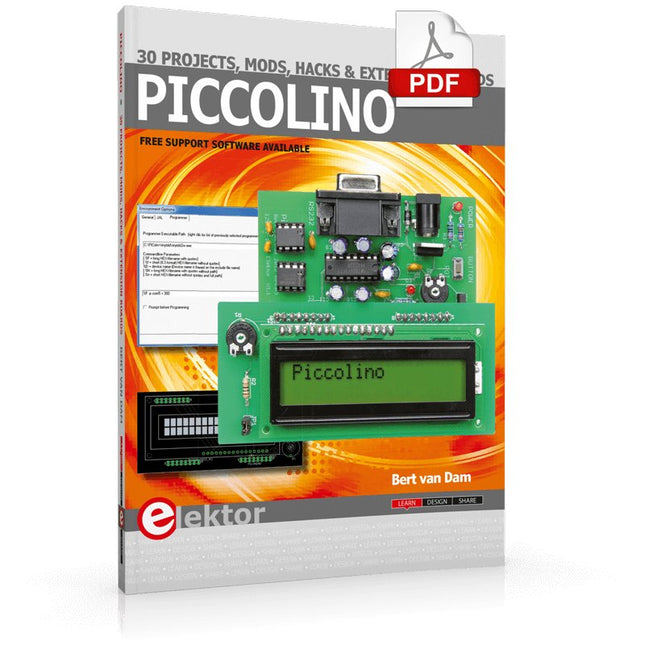
Elektor Digital Piccolino - 30 Projects, mods, hacks and extension (E-book)
The Piccolino rapid development board can be used to design microcontroller circuits quickly. The Piccolino has a fast 16f887 PIC microcontroller, voltage regulator, and communications module, and can be easily extended using its four headers. This e-book contains 30 projects based on the Piccolino. We'll use its unique communications facilities and get the Piccolino to communicate with programs on a PC. On the PC, we use the free programming language Small Basic. You can use this to create Windows programs with buttons and graphs quickly. You will learn how to analyze components such as inductors, capacitors, and OPAMPs, and how to display the measurement results in a graphical format. This will help you to design your circuits easily. We will then start to adapt to the Piccolino. We'll add components to it to make it more powerful, with extra features such as flow control and digital to analog conversion. The clear instructions will enable you to design and build your adaptations. This way you can make your custom designed Piccolino. We'll end up making an extension: a PCB that that can be mounted on the Piccolino headers. As an example, we'll design and build an extension for an LCD. You can use the included board layout to make your PCB or have it made for you. At the same time, you will learn how to make your extensions. The only limitation is your imagination! The clear descriptions along with circuit diagrams and photos, will make the building of these projects an enjoyable experience. Each project has a clear explanation of the reasons why it was designed in a particular way. This helps you learn a lot about the Piccolino, as well as Small Basic, and the components that are used in this e-book. You can adapt the projects to suit your requirements or combine several projects.
€ 34,95
Mitglieder: € 31,46
-

Siglent Siglent SPD3303X 3-Kanal DC-Netzteil (220 W)
Bei der SPD3000X-Serie handelt es sich um lineare und programmierbare Labornetzteile mit 4,3’’-TFT-LCD. Seine Programmierbarkeit und sein Echtzeit-Display bieten einen besonderen Bedienkomfort. Die Netzteile verfügen über drei isolierte Ausgänge: zwei für kontinuierlich einstellbare und einer für umschaltbare Spannungen von 2,5, 3,3 und 5,0 V. Die Ausgänge sind zudem gegen Kurzschluss und Überlastung geschützt. Die Labornetzteile eignen sich für den Einsatz in der Entwicklung und in der Produktion. Features 3 unabhängige und isolierte Ausgänge, 2 x 0...32 V / 3,2 A, 1 x 2,5/3,3/5,0 V / 3,2 A Gesamtleistung: maximal 220 W Anzeige: Spannung 4 Digits, Strom 3 Digits, Auflösung: min. 1 mV, 1 mA Unterstützt zeitgesteuerte Ausgangsfunktionen 4,3’’-Farb-TFT-LCD mit einer Auflösung von 480 x 272 Pixel 3 Betriebsmodi: unabhängig, seriell und parallel Netzspannung 100/120/220/230 für den Betrieb an unterschiedlichen Netzen Intelligenter temperaturgesteuerter Lüfter für geringes Betriebsgeräusch Klares grafisches Interface mit Anzeigemöglichkeit für Kurvenformen Interne Speichermöglichkeit für 5 Sätze an System-Parametern Unterstützt Erweiterung des Datenspeichers Im Lieferumfang: PC-Software Easypower, Unterstützung für SCPI, LabVIEW-Treiber Hochauflösender und präziser Ausgang Die hohe Auflösung von 1 mV/1 mA erleichtert die genaue Einstellung und die leichte Ablesbarkeit der Werte. Die Elektronik garantiert minimalste Abweichungen bei Spannung und Strom. Funktionen für unabhängigen, seriellen und parallelen Betrieb Die drei Ausgänge können dank Isolation völlig unabhängig voneinander genutzt werden. Darüber hinaus können zwei Ausgänge für mehr Spannung in Serie oder für mehr Strom parallelgeschaltet werden, was den Einsatzbereich des Labornetzteils deutlich erweitert. Weiter kann jeder der drei Ausgänge individuell oder auch gemeinsam ein- und ausgeschaltet werden. Anzeige des zeitlichen Verlaufs Es können fünf Gruppen für das Timing bzw. die Ausgangssteuerung angezeigt werden, was eine einfache Programmiermöglichkeit der Verläufe ergibt. Das Labornetzteil kann auch mit der PC-Software EasyPower von Siglent gesteuert werden, was die Möglichkeiten nochmals erweitert. Speicherung von Parametern Die programmierbare SPD3000X-Labornetzteil-Serie ist dazu in der Lage, bis zu 5 Parameter-Gruppen im internen Speicher abzulegen und wieder aufzurufen. Zudem wird eine Speichererweiterung unterstützt. Auf diese Weise hat man jederzeit die benötigten Einstellungen per Knopfdruck zur Verfügung.
€ 600,50
Bestpreis
-

Elektor Digital The EAGLE Companion (E-book)
EAGLE – the “Easily Applicable Graphical Layout Editor“ is a professional-grade CAD (computer aided design) software package for the design and drafting of electronic schematics as well as the design and fabrication of printed circuit boards (PCBs). This Advanced User Guide provides the experienced EAGLE user with insight into using some of the more advanced features of EAGLE software. It is not a guide to teach the reader the basic concepts of EAGLE, nor does it discuss the ‘how to’ of the EAGLE interface and the simpler operations and commands of the software. That is the purpose of the author’s previous title EAGLE V6 Getting Started Guide also published by Elektor. This eBook is intended as an enduring document covering the more advanced modules, commands, and functions which make up EAGLE. It is hoped that this eBook will provide a quick, succinct reference to assist with more complex applications and uses of EAGLE – an ‘EAGLE User’s Companion’, if you like. Complementing the EAGLE Advanced User Guide, the EAGLE User Language manual is included in this eBook in unabridged form, reproduced with permission of CadSoft GmbH. At the time of writing, the material in this eBook covers version 7 of the EAGLE software suite.
€ 39,95
Mitglieder: € 35,96
-

Elektor Digital Experimenten met de Elektor Sensor Kit voor Arduino en ATtiny85 (E-book)
De mens is van nature uitgerust met sensoren voor geluid, licht, geur, smaak en gevoel. Zintuigen die met elektronica slechts ten dele gekopieerd kunnen worden. Met de Elektor sensorkit kunnen we wel aardig in de buurt komen. Sensoren kunnen elektronica aansturen, maar ze kunnen ons ook van informatie voorzien. Daarom vormt niet alleen het meten van grootheden, maar ook het zichtbaar maken ervan via de Arduino seriële monitor een niet onbelangrijk deel van dit boek. De microprocessor ATtiny85 die de Arduino-taal begrijpt, maakt het experimenteren met sensoren gemakkelijk en goedkoop. We zullen niet snel een Arduino-kaartje vast solderen in een permanente opstelling. Bij een achtpotige ATtiny zal dat geen schuldgevoel opleveren. Dat neemt niet weg dat alle sketches gewoon op elk Arduino-board draaien met mogelijk hier en daar een aanpassing van pennummers omdat die kunnen verschillen met reguliere Arduino-boards. We zullen uitgebreid aandacht besteden aan het programmeren van de ATtiny. Veel schakelingen zijn bruikbaar in het natuurkundepracticum op school of voor bedrijfsmatige toepassingen. Maar de nadruk ligt toch wel op de (beginnende) elektronicahobbyist die zijn vrije tijd op een leuke maar vooral ook nuttige manier wil besteden. Want meer dan ooit tevoren heeft techniek de toekomst.
€ 19,95
Mitglieder: € 17,96
-

Peak Peak Atlas Pro Pack (LCR45 und DCA75)
Dieses Paket enthält den LCR45, perfekt für erfahrene Bastler und Experten. Es beinhaltet außerdem das sehr populäre DCA Pro (model DCA75), fantastisch für die Identifikation von Komponenten. Kompletiert wird das Paket durch ein USB-Kabel und einem USB-Stick mit der nötigen Software. DCA75 Der DCA75 unterstützt alle Komponenten die von PEAK Atlas DCA55 unterstützt werden und beinhaltet sogar noch weitere: Transistoren (BJT’s mit Darlingtons und “digitale” Transistoren), Silikon und Germanuim Typen. Misst den Verstärkungsfaktor, VBE, Ableitstrom und die Sättigungsspannung. Unijunctiontransistoren (UJT’s) werden nicht unterstützt. MOSFET‘s, Anreicherungstyp und Abreicherungstyp. Misst mit einem Ansprechwert (von ID=5 mA), einer geschätzten Transkonduktanz (in einer Spanne von 3 mA - 5 mA) und RDS(on) mit einer Auflösung von 1 Ω. JFETs, mit SiC-Typen. Misst mit pinch-off Spannung (ID=5μA), geschätzter Transkonduktanz (in einer Spanne von 3 mA – 5 mA) und RDS(on) bei einer Auflösung von 1 Ω. IGBTs (Biopolartransistor). Misst mit einem Ansprechwert (IC=5mA), geschätzter Transkonduktanz (in einer Spanne von 3 mA – 5 mA) und Sättigungsspannung. Dioden und Diodennetzwerke. Misst eine Durchlassspannung bei 5 mA. LED’s und zweifarbige LED’s (2 Leiter und 3 Leiter Typ). Misst Durchlassspannung von jedem LED-Element bei 5 mA. Zener Dioden mit einer gemessenen Zener Spannung bis zu 9 V bei 5 mA. Spannungsregulatoren (misst Spannungsregulierung von < 8 V, Abfallspannung, Ruhestrom). Triac’s und Thyristoren welche weniger als 10 mA von Steuerstrom und Haltestrom benötigen. Unabhängig oder mit PC funktionstüchtig Das ATLAS DCA75 PRO kann eigenständig arbeiten oder mit einem PC verbunden werden. Wie auch immer, das DCA Pro wird automatisch die Komponente und die Kontaktbelegung identifizieren. Außerdem misst es eine Reihe von Komponenteneigenschaften, wie den Transistorfaktor, Ableitungen, MOSFET und IGBT-Spannung. Curve Tracing Wenn das ATLAS DCA75 PRO mit einem PC mit dem beiliegenden USB-Kabel verbunden wird, hat man einen Überblick über eine Reihe von Schwachspannungskurven. Verschiedene Graphen sind nutzbar, weitere folgen: Bipolartransistor Ausgabekennlinie, IC vs VCE Bipolartransistor Verstärkungsfaktoren, hFE vs VCE Bipolartransistor Verstärkungsfaktoren, hFE vs IC MOSFET und IGBT Ausgabefunktion, ID vs VDS MOSFET und IGBT Transferfunktion, ID vs VGS JFET Ausgabefunktion, ID vs VDS JFET Transferfunktion, ID vs VGS Spannungsregulator, VOUT vs VIN Spannungsregulator, IQ vs VIN PN Anschluss I/V Kurven, vorwärts und rückwärts Optionen (für Zener Dioden). Beim Curve tracing werden Testparameter von +/- 12 V, +/- 12 mA eingestellt. Sämtliche curve-tracing Daten können direct in Excel© für weitere Grafikanalysen eingespeist werden. Die Software ist für die Betriebssysteme Windows XP, Vista, 7, 8 and 10 gemacht. LCR45 Ein großartiger LCR Analysator, welcher die passiven Komponenten (Spulen, Kondensatoren und Widerstände) messen kann.Das LCR45 bietet eine erhöhte Messauflösung (besser aks 0.1 uH!). Des Weiteren kann die Test-Frequenz DC manuel oder automatisch auf, 1 kHz, 15 kHz und 200 kHz verändert werden. Nicht hergestellt für schaltungsinterne Messungen. Automatische oder manuelle Komponenten Slektion: Spule, Kondensator oder Widerstand Automatische oder manuelle Test-Frequenz- Selektion: DC, 1 kHz, 15 kHz und 200 kHz Induktivitäten von 0.1 uH bis 10 H Kapazitäten von 0.1 pF bis 10,000 uF Widerstände von 0.1 Ohm bis 2 MOhm Induktivitäten Messung zeigt auch die Spulenwiderstände Zeigt "Component type and values", "Complex Impedance", "Magnitude/Phase" und "Admittance" Test-Frequenz wird für alle Messungen angezeigt Abweichung von 1,5% für Spulen und Kondensatoren (siehe Tabelle für weiterer Details) Abweichung von 1% für Widerständen Tastkopf wird mit 2 mm vergoldeten Steckern und Buchsen komplettiert Vergoldete Prüfspitzen sind austauschbar Lieferumfang LCR45 DCA75 Extra GP23 Batterie Extra AAA Zelle Dual Carry Gehäuse
€ 320,11
-

Elektor Digital Sensoren aan de Raspberry Pi (E-book)
Het boek “Sensoren aan de Raspberry Pi” richt zich tot iedereen die zich wil verdiepen in een Raspberry Pi in combinatie met Windows 10 IoT Core. Dit besturingssysteem biedt samen met een RPi weliswaar veel rekenkracht, maar voor de communicatie met de buitenwereld zijn nog externe modules en sensoren nodig. Daartoe wordt in dit boek gebruik gemaakt van een sensor-kit met 35 modules die nog geen 60 euro kost. Auteur Florian Schäffer begint zijn boek met de introductie van de Raspberry Pi en hij beschrijft welke hardware u nodig hebt om met de RPi te kunnen werken. Dan volgt een eerste kennismaking met Windows 10 IoT Core. Daarna wordt dieper ingegaan op het gebruik van Visual Studio 2015 en worden de eerste programmeervoorbeelden beschreven. Ook wordt uitgelegd hoe een MySQL-databank kan worden aangestuurd via een app en hoe de als webserver kan worden ingezet. In het tweede deel worden de sensoren stuk voor stuk beschreven met hun eigenschappen en worden er veel toepassingsvoorbeelden gegeven. De source-codes van de programma’s zijn als download bij het boek beschikbaar. Tot slot wordt nog aandacht besteed aan het gebruik van druktoetsen en schakelaars, en het werken met digitale uitgangen en analoge ingangen.
€ 24,95
Mitglieder: € 22,46
-

Peak Peak Atlas ESR70 gold (ESR- und Kapazitätsmessgerät)
Der Peak Atlas ESR70 gold ist eine verbesserte Version des früheren Peak Atlas ESR70 Plus. Er kann alles, was der ESR70 Plus konnte, nur noch besser. Dank neuer Prüfalgorithmen misst er die Kapazität jetzt bis zu 10-mal schneller und über einen größeren Bereich. Dank unseres neuen Triple-Slope-Messsystems wird die Kapazitätsmessung auch viel weniger durch parallele Widerstände oder Leckströme beeinflusst. Mit den mitgelieferten vergoldeten Sonden (abnehmbar) kann der Atlas ESR70 gold den ESR bis zu einer Auflösung von 0,01 Ohm und bis zu 40 Ohm messen. Es kann sogar den ESR von Kondensatoren messen, die sich im Stromkreis befinden. Die Messfühler sind abnehmbar, so dass 2 mm kompatible Messfühler angebracht werden können. Bei verschiedenen ESR-Werten ertönt ein akustisches Warnsignal, so dass Sie viele Tests hintereinander durchführen können, ohne auf das Display schauen zu müssen. Der ESR70 berücksichtigt automatisch den kapazitiven Blindwiderstand, so dass der ESR auch bei Kondensatoren mit niedrigem Wert (bis zu 0,3 uF) genau gemessen werden kann. Features Verwendet eine einzelne AAA-Alkalizelle (im Lieferumfang enthalten). Alphanumerisches LCD mit Hintergrundbeleuchtung. Automatischer Analysestart, wenn Sie die Sonden anwenden. Automatische Kondensatorentladung durch kontrollierte Entladefunktion. ESR-Messung (und niedriger Gleichstromwiderstand) (auch im Schaltkreis). Kapazitive Reaktanz wird automatisch berücksichtigt, um einen genauen ESR zu gewährleisten. Kapazitätsmessung (bei Prüfung außerhalb des Schaltkreises). Akustische Warnungen für verschiedene ESR-Stufen. Erweiterter ESR-Messbereich bis zu 40 Ohm. Optionale Sondenalternativen einfach zu montieren. Neue gold Features Verbessertes LCD mit besserer Hintergrundbeleuchtung. 10x schnellere Kapazitätsmessung für große Kondensatoren. Erweitertes Benutzeroptionensystem. Neues Triple-Slope-Messsystem, um den Einfluss von Parallelwiderstand und/oder Leckstrom auf Kapazitätsmessungen erheblich zu reduzieren. Viel größerer Kapazitätsmessbereich jetzt 0,3 uF bis 90.000 uF (vorher 1 uF bis 22.000 uF). Technische Daten Analyzertyp ESR und Kapazität Komponententypen Kondensatoren (>0,3 uF) ESR-Bereich 0,00 Ohm bis 40,0 Ohm ESR-Auflösung Ab 0,01 Ohm In-Circuit-Verwendung Nur ESR Kapazitätsbereich 0,3 uF bis 90000 uF Batterietyp 1,5-V-Alkali-AAA-Zelle (im Lieferumfang enthalten). Lebensdauer normalerweise 1500 Operationen Anzeigetyp Alphanumerisches LCD (mit Hintergrundbeleuchtung) Lieferumfang Widerstandsmessgerät der äquivalenten Serie ESR70 Extra lange und besonders flexible Prüfkabel (450 mm silikonummanteltes Kabel) 2 mm vergoldete Stecker und Buchsen mit abnehmbaren vergoldeten Krokodilklemmen Umfassende bebilderte Bedienungsanleitung AAA-Alkalizelle Downloads Datasheet (EN) User Guide (DE)
€ 141,61
-

Siglent Siglent SDG2042X 2-Kanal Funktionsgenerator (40 MHz)
Bei der Siglent SDG2000X-Serie handelt es sich um zwei-kanalige Funktionsgeneratoren mit der Möglichkeit, arbiträre Kurvenformen und eine Bandbreite bis zu 120 MHz zu generieren. Hinzu kommen 1,2 GSa/s Abtastrate und 16-bit vertikale Auflösung. Die proprietären Techniken von TrueArb & EasyPulse helfen den traditionellen DDS Generatoren dabei, arbiträre, quadratische und pulsierende Wellen zu generieren. Mit diesen Erweiterungen kann das SDG2000X ein breites Spektrum von hoher Qualität und niedrigen Jitter-Signalen erzeugen, welche den ansteigenden Anforderungen an komplexen und umfangreichen Applikationen standhalten kann. Features 2-Kanal, 40 MHz Bandbreite, 20 Vpp maximale Ausgangsamplitude, hohe Genauigkeit mit einer dynamischen Breite von 80 dB. High-Performance Stichprobensystem mit einer Abtastrate von 1.2 GSa/s und 16-bit vertikaler Auflösung. Kein Detail der Wellen geht verloren. Innovative TrueArb Technologie, basierend auf der Punkt-zu-Punkt Architektur. Unterstützt alle 8 pts ~ 8 Mpts Arb Wellenformen mit einer Abtastrate von 1 μSa/s ~ 75 MSa/s. Innovative EasyPulse Technologie, ermöglicht niedrige Jitter-Signale zu erzeugen. Bringt eine Reihe von hochpräzisen Einstellungsmöglichkeiten. Viele analoge und digitale Modultypen: AM, DSB-AM, FM, PM, FSK, ASK und PWM. Sweep- und Burst-Funktionen Hochpräziser Frequenzzähler Standard Interface: USB Host, USB Device (USBTMC), LAN (VXI-11) Optionales Interface: GPIB 4.3” Touchscreen-Display für einfachere Benutzung Technische Daten Max. Ausgangsfrequenz 40 MHz Ausgangskanäle 2 Abtastrate 1.2 GSa/s (4x Interpolation) Wellenlänge CH1:16 Kpts, CH2: 512 Kpts Frequenzauflösung 1 μHz Vertikale Auflösung 16-bit Standard Interface USB Host, USB Device (USBTMC), LAN (VXI-11) High-Performance Stichprobensystem Begünstigt von der 1.2 GSa/s Abtastrate und der 16-bit vertikalen Auflösung erreicht das SDG2000X extrem hohe Genauigkeit in beiden Dimensionen (Zeit und Amplitude). Dadurch werden sehr akkurate Wellen rekonstruiert und sind weniger gestört. Innovative EasyPulse Technologie Wenn eine quadratische oder puls-Welle von dem DDS generiert wird, kommt es zu einem Jitter, falls die Abtastrate kein ganzzahliger Wert der Ausgangsfrequenz ist. Die SDG2000X EasyPulse Technologie dient dabei als Stabilisator und überbrückt diese vermeintliche Schwäche des DDS, sodass man dadurch niedrigere Jitter-Signale erzeugen kann. Innovative TrueArb Technologie Für arbiträre Wellen bietet das TrueArb eine Möglichkeit, flimmern zu verringern und Störungen zu vermeiden. Einfache Kontrolle über das 4.3” Touchscreen-Display und Erstellung arbiträrer Wellen durch die Software EasyWave Das 4.3” Touchscreen-Display macht Operationen wesentlich zielführender. EasyWave ist ein starkes Werkzeug, um arbiträre Wellen zu generieren und unterstützt verschiedene Methoden, wie z. B. manual drawing, line-drawing, equation-drawing, coordinate-drawing, usw. Es ist sehr sinnvoll für Benutzer, welche ihre eigenen Wellen generieren wollen. Lieferumfang Siglent SDG2042X Arbiträrer Funktionsgenerator Benutzerhandbuch (Englisch) Garantie CD (mit EasyWave 1.0 Computer Software) Stecker USB-Kabel Schnellstartanleitung (Englisch)
€ 560,39
Bestpreis
-

iFixit iFixit Pro Tech Toolkit
Das Pro Tech Toolkit ist das Einzige, was jeder Heimwerker, Reparateur, Hacker, Bastler und Profi braucht, um jede Aufgabe zu bewältigen. Jedes Tool im Pro Tech Toolkit wurde überarbeitet, um besser zu sein. Vom 64 Bit-Treiber-Kit bis hin zu den iFixit Opening Picks wurde jedes Werkzeug speziell entwickelt und ausgewählt, um Ihre Reparaturmöglichkeiten zu maximieren. Das Herzstück dieses Kits ist das iFixit 64 Bit-Schraubendreher-Kit, das auf der Grundlage umfangreicher Untersuchungen darüber entwickelt wurde, welche Befestigungstypen derzeit in der Unterhaltungselektronikindustrie verwendet werden und welche älteren Befestigungselemente von Verbrauchern immer noch nachgefragt werden. Von der Apple Watch mit ihren neuen winzigen Tri-Point-Schrauben bis hin zu Vintage-Nintendo-Spielekonsolen mit Gamebit-Befestigungen – das 64-Bit-Kit deckt sie alle mit CNC-gefrästen Bits höchster Qualität ab. Sogar das robuste Gehäuse wurde sorgfältig konstruiert, hat keine Scharniere oder Riegel, die brechen könnten, und verfügt über ein Sortierfach im magnetisch befestigten Deckel. Das umfassende Werkzeug-Set für Elektronikreparaturen aller Art Perfekt geeignet für DIY-Enthusiasten und professionelle Reparaturtechniker. Enthält Werkzeuge zum Schrauben, Öffnen, Greifen, Hebeln und Sondieren - alles was benötigt wird um Geräte aus dem Bereich der Unterhaltungselektronik zu reparieren. Und das ESD-sicher. Komplette Neuentwicklung – kein Werkzeug zu viel oder zu wenig. Inhalt des Sets Erdungsarmband – schützt dich und empfindliche Geräte vor elektrostatischen Entladungen Saugheber – zum sicheren Anheben und Halten griffloser Komponenten 3x iFixit Opening Tool – aus weichem Kunststoff zum kratzerfreien Aufhebeln von Gehäusen 6x iFixit Opening Picks – zum Aufhebeln, Aufschieben, Auftrennen und natürlich zum Luftgitarre spielen Kreuzpinzette – Zum Festhalten kleiner Teile ohne Fingerdruck Gebogene Pinzette – ESD-sicher, mit gezahnter Greiffläche Stumpfe Pinzette – ESD-sicher, mit gezahnter Greiffläche Spudger (Spatel) – robustes ESD-sicheres Allround-Tool Halberd Spudger – spezieller Spudger (Spatel) mit Haken, ESD-sicher Metallspatel – für die härteren Fälle Jimmy – der ultimative Geräteöffner Magnetische Unterlage – hält Schrauben und Kleinteile an ihrem Platz Werkzeugrolle – praktische Aufbewahrung für alle Bestandteile des Kits Mako Precision Bit Set – 64 essentielle Bits für Arbeiten an unterschiedlichsten Elektronikgeräten Inhalt des Mako Precision Bit Sets Magnetischer Aluminiumschraubendreher 4 mm mit kugelgelagerter Drehkappe Flexible Wellenverlängerung Länge 150 mm 64 Bits (4 mm) in folgenden Größen: Kreuzschlitz (Phillips) 000, 00, 0, 1, 2 Schlitz 1, 1.5, 2, 2.5, 3, 4 mm Torx T2, T3, T4, T5 Torx Security TR6, TR7, TR8, TR9, TR10, TR15, TR20, TR25 Pentalobe P2, P5, P6 JIS J000, J00, J0, J1 Sechskant 0.7, 0.9, 1.3, 1.5, 2, 2.5, 3, 3.5, 4, 4.5, 5 mm Tri-point Y000, Y00, Y0, Y1 Innensechskant Nuss 2.5, 3, 3.5, 4, 5, 5.5 mm Quadrat 1, 2 Gamebit 3.8, 4.5 mm Spanner 6, 8 Dreieck 2, 3 mm Standoff Bit für iPhone Oval Bit magnetisches Bit zur Aufnahme von Kleinteilen SIM Eject Bit 1/4 Zoll auf 4 mm Adapter
€ 68,79
-

Peak Peak Atlas DCA75 Pro (Advanced Semiconductor Analyzer)
Der DCA75 Pro ist ein großartiges Instrument, das Benutzerfreundlichkeit mit erstaunlichen Funktionen kombiniert. Es kann eine Vielzahl von Halbleitern automatisch identifizieren, Pinbelegungen automatisch identifizieren und detaillierte Parameter messen. Features Integriertes Grafikdisplay (jetzt mit Hintergrundbeleuchtung) zur Anzeige eines detaillierten Schaltplans der zu testenden Komponente sowie der Pinbelegung und Messdaten. USB-Konnektivität, um Kurvenverfolgung, Datenspeicherung/-abruf und Geräteabgleich auf Ihrem Windows-PC (Windows 7 und höher) zu ermöglichen. Einzelne interne AAA-Alkalizelle für den eigenständigen Betrieb. Komponentenunterstützung Bipolartransistoren (NPN/PNP inkl. Silizium/Germanium) Darlington-Transistoren (NPN/PNP) Anreicherungsmodus-MOSFETs (N-Kanal und P-Kanal) Verarmungsmodus-MOSFETs (N-Ch und P-Ch) Sperrschicht-FETs (N-Ch und P-Ch). Sowohl symmetrische als auch asymmetrische Typen Erweiterungs-IGBTs (N-Ch und P-Ch) Dioden und Diodennetzwerke (2- und 3-Leiter-Typen) Zenerdioden (bis ca. 9 V) Spannungsregler (bis ca. 8 V) LEDs und Bi-Color-LEDs (2-Leiter- und 3-Leiter-Typen) Niedrigstromempfindliche Triacs und Thyristoren (<10 mA Trigger und Halten) Messungen BJT-Stromverstärkung (hFE) BJT-Basis-Emitter-Spannung (Vbe) Leckstrom des BJT-Kollektors MOSFET-Ein- und Aus-Gate-Schwellenspannungen MOSFET-Transkonduktanz JFET-Abschnürspannung JFET-Transkonduktanz JFET IDSS (Drainstrom für Vgs=0) IGBT-Ein- und Aus-Gate-Schwellenspannungen IGBT-Transkonduktanz Ausgangsspannung des Spannungsreglers Ruhestromaufnahme des Spannungsreglers Abfallspannung des Spannungsreglers Zenerspannung Spannungsabfall in Vorwärtsrichtung der Diode Technische Daten Analyzertyp Halbleiterkomponenten Komponentenerkennung Automatisch Pinout-Erkennung Automatisch, beliebig herum verbinden Anzeigetyp Grafisches LCD (jetzt hintergrundbeleuchtet) Oberflächentyp USB für optionalen PC-Anschluss PC-Funktionen Kurvenverfolgung (Windows 7 und höher) Software Auf USB-Stick für Windows 7 und höher enthalten Batterie Einzelne AAA-Zelle (im Lieferumfang enthalten) Lieferumfang Peak Atlas DCA75 Proalysator PC-Software auf einem USB-Stick für Windows 11, 10, 8, 7, XP Micro-USB-Kabel Ausgestattet mit universellen Premium-Hakensonden AAA-Alkalibatterie Downloads Datasheet (EN) User Guide (DE) Software Installation Guide (EN) Software and Firmware Package
€ 189,21


