
Suchergebnisse für "elektor OR magazine OR december OR 2013 OR en"
-

Elektor Bundles Arduino Uno R4 WiFi (Bundle)
Buch: Mastering the Arduino Uno R4 Das Arduino Uno R3 Board basiert auf dem kostengünstigen 8-Bit-Prozessor ATmega328P und dürfte sich als das beliebteste Mitglied der Arduino-Familie erweisen. Dieses zuverlässige Board begleitet uns seit vielen Jahren. Elf Jahre später erschien der lang erwartete Nachfolger, das Arduino Uno R4. Es basiert auf einem 48-MHz-32-Bit-Arm-Cortex-M4-Mikrocontroller und bietet deutlich erweiterten SRAM- und Flash-Speicher. Zusätzlich wurden ein hochpräziserer ADC und ein neuer DAC integriert. Das Uno R4 Board unterstützt außerdem den CAN-Bus mit einer entsprechenden Schnittstelle. Das Board ist in zwei Versionen erhältlich: Uno R4 Minima und Uno R4 WiFi. Dieses Buch zeigt, wie man mit diesen neuen Boards und nur wenigen Bauteilen und externen Modulen viele verschiedene und interessante Projekte realisieren kann. Alle im Buch beschriebenen Projekte wurden, je nach Modell, vollständig auf dem Uno R4 Minima oder dem Uno R4 WiFi-Board getestet. Die Projektthemen umfassen das Auslesen, Steuern und Ansteuern zahlreicher Komponenten und Module des Bausatzes sowie des jeweiligen Uno R4-Boards, einschließlich LEDs 7-Segment-Anzeigen (mit Timer-Interrupts) LCDs Sensoren RFID-Leser 4×4-Tastatur Echtzeituhr (RTC) Joystick 8×8 LED-Matrix Motoren DAC (Digital-Analog-Wandler) LED-Matrix WiFi-Konnektivität Serieller UART CAN-Bus Infrarot-Controller und -Empfänger Simulatoren … alles auf kreative und lehrreiche Weise, wobei die Funktionsweise des Projekts und die zugehörige Software sehr detailliert erklärt werden. Arduino Uno R4 WiFi Der Arduino Uno R4 wird vom Renesas RA4M1 32-Bit ARM Cortex-M4 Prozessor angetrieben und bietet dadurch eine deutliche Steigerung der Rechenleistung, des Speichers und der Funktionalität. Die WiFi-Version verfügt zusätzlich zum RA4M1 über ein ESP32-S3 WLAN-Modul und erweitert so die kreativen Möglichkeiten für Maker und Ingenieure. Der Arduino Uno R4 taktet mit 48 MHz und bietet damit eine dreifache Steigerung gegenüber dem beliebten Uno R3. Darüber hinaus wurde der SRAM von 2 kB auf 32 kB und der Flash-Speicher von 32 kB auf 256 kB erweitert, um komplexere Projekte zu unterstützen. Auf Wunsch der Community wurde der USB-Anschluss auf USB-C umgestellt und die maximale Versorgungsspannung dank eines verbesserten Wärmemanagements auf 24 V erhöht. Die Platine verfügt über einen CAN-Bus und einen SPI-Anschluss, wodurch Anwender den Verkabelungsaufwand reduzieren und durch den Anschluss mehrerer Shields parallele Aufgaben ausführen können. Ein 12-Bit-Analog-DAC ist ebenfalls auf der Platine vorhanden. Technische Daten Mikrocontroller Renesas RA4M1 (ARM Cortex-M4) USB USB-C Programmieranschluss Anschlüsse Digitale Ein-/Ausgangsanschlüsse 14 Anschlüsse Analoge Eingangsanschlüsse 6 DAC 1 RTC 1 PWM-Anschlüsse 6 Kommunikation UART 1x I²C 1x SPI 1x Qwiic I²C-Anschluss 1x CAN 1x CAN-Bus Stromversorgung Betriebsspannung 5 V Eingangsspannung (VIN) 6-24 V Gleichstrom pro I/O-Pin 8 mA Taktfrequenz Hauptkern 48 MHz Speicher RA4M1 256 kB Flash, 32 kB RAM LED-Matrix 12 x 8 (96 rote LEDs) Abmessungen 68,9 x 53,4 mm Downloads Datasheet Schematics Dieses Bundle enthält: Buch: Mastering the Arduino Uno R4 (Einzelpreis: 45 €) Arduino Uno R4 WiFi (Einzelpreis: 30 €)
€ 74,95€ 64,95Bestpreis
-

Elektor Digital Arduino & Co – Measure, Control, and Hack (E-book)
Clever Tricks with ATmega328 Pro Mini Boards With a simple Pro Mini board and a few other components, projects that 20 or 30 years ago were unthinkable (or would have cost a small fortune) are realized easily and affordably in this book: From simple LED effects to a full battery charging and testing station that will put a rechargeable through its paces, there’s something for everyone. All the projects are based on the ATmega328 microcontroller, which offers endless measuring, switching, and control options with its 20 input and output lines. For example, with a 7-segment display and a few resistors, you can build a voltmeter or an NTC-based thermometer. The Arduino platform offers the perfect development environment for programming this range of boards. Besides these very practical projects, the book also provides the necessary knowledge for you to create projects based on your own ideas. How to measure, and what? Which transistor is suitable for switching a certain load? When is it better to use an IC? How do you switch mains voltage? Even LilyPad-based battery-operated projects are discussed in detail, as well as many different motors, from simple DC motors to stepper motors. Sensors are another exciting topic: For example, a simple infrared receiver that can give disused remote controls a new lease on life controlling your home, and a tiny component that can actually measure the difference in air pressure between floor and table height!
€ 32,95
Mitglieder: € 29,66
-
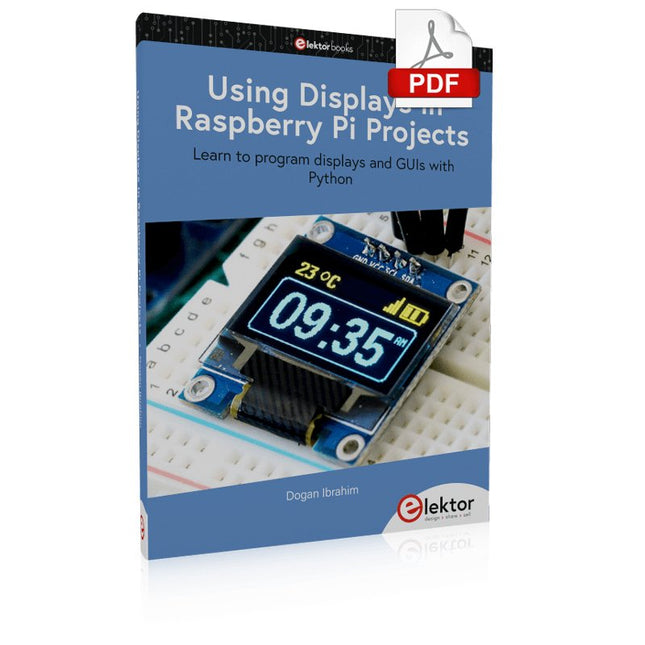
Elektor Digital Using Displays in Raspberry Pi Projects (E-book)
Learn to program displays and GUIs with Python This book is about Raspberry Pi 4 display projects. The book starts by explaining how to install the latest Raspbian operating system on an SD card, and how to configure and use the GPIO ports. The core of the book explains the following topics in simple terms with fully tested and working example projects: Simple LED projects Bar graph LED projects Matrix LED projects Bitmap LED projects LED strips LCDs OLED displays E-paper displays TFT displays 7-inch touch screen GUI Programming with Tkinder One unique feature of this book is that it covers almost all types of display that readers will need to use in their Raspberry Pi based projects. The operation of each project is fully given, including block diagrams, circuit diagrams, and commented full program listings. It is therefore an easy task to convert the given projects to run on other popular platforms, such as Arduino or PIC microcontrollers. Python program listings of all Raspberry Pi projects developed in this book are available for download at Elektor.com. Readers can use these programs in their projects. Alternatively, they can modify the programs to suit their applications.
€ 32,95
Mitglieder: € 29,66
-

Elektor Digital Hardware-Design mit FPGA (E-book)
Die "Field Programmable Gate Array"-Bausteine sind der moderne Weg, digitale Schaltungen schnell und effizient aufzubauen. Mit preiswerten Evaluierungskits lassen sich komplexe digitale Schaltungen realisieren, ohne auf die immer schwieriger werdende Löttechnik zurückzugreifen. Jedoch hat sich hierdurch die Beschreibung der digitalen Schaltungen geändert, womit auch die Methodik angepasst werden muss.Dieses Buch Buch gibt zunächst eine kurze Einführung in die digitale Schaltungstechnik, mit dem Schwerpunkt auf den in FPGA-Bausteinen verwendeten Grundelementen. Danach werden die Randbedingungen und Effekte, die beim Entwurf digitaler Schaltungen auftreten können, beschrieben und schließlich die Grundelemente als HDL-Beschreibungen in den Sprachen VHDL und Verilog aufgeführt. Die Methodik zum Erstellen einer FPGA-Schaltung mit den Schritten Simulation, Verifikation und Implementierung sowie die Programmwerkzeuge zur Durchführung dieser Schritte werden erläutert. Abschließend wird an dem Beispiel eines Algorithmus für einen Frequenzgenerator zur direkten digitalen Synthese das Vorgehen demonstriert.Der Autor hat sein Wissen in langjähriger Entwicklungsarbeit beim Systementwurf und in der Verifikation von ASIC-Schaltungen aufgebaut und diese Methodiken erfolgreich bei der Implementierung von Prototypen und Produkten mit FPGA-Bausteinen umgesetzt. Mit diesem Buch möchte er die praktischen Erfahrungen zusammenfassen und in kompakter Form weitergeben.
€ 39,80
Mitglieder: € 35,82
-
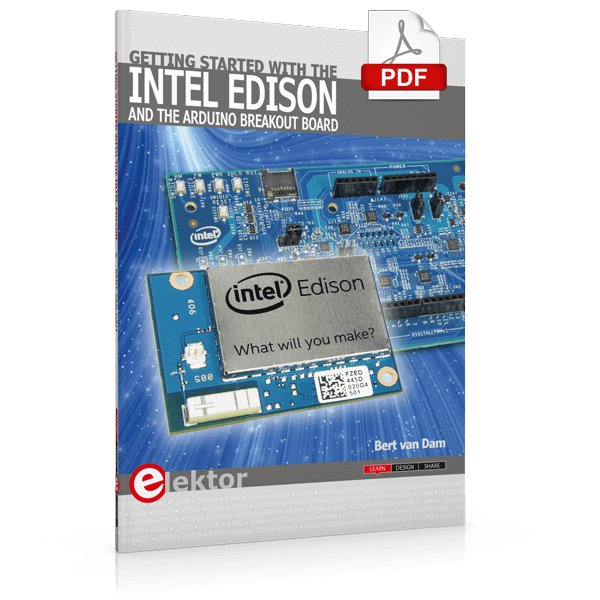
Elektor Digital Getting Started with the Intel Edison (E-book)
The Internet of Things is rapidly gaining interest, and that has fueled the development of the Edison. A tiny computer, the size of a postage stamp, with a lot of power and built-in wireless communication capabilities. In this eBook we will help you get up-to-speed with the Edison, by installing the software both on the Edison as well as on your Windows PC. We will use the Edison Arduino break-out board because it is easy to work with. We will discuss Linux, Arduino C++ and Python, and show examples of how the Edison can interface with other hardware. We will use Wi-Fi and Bluetooth to set up wireless connections, and show you a trick to program sketches over Wi-Fi. Once you have completed this book your Edison will be up and running with the latest software version, and you will have sufficient knowledge of both hardware and software to start making your own applications. You will even be able to program the Edison over USB and wireless both in Arduino C++ and Python. This is not a projects eBook, but a toolbox that will allow you to explore the wonderful world of the Intel Edison!
€ 24,95
Mitglieder: € 22,46
-

Elektor Digital Kickstart to Arduino Nano (E-book)
Get Cracking with the Arduino Nano V3, Nano Every, and Nano 33 IoT The seven chapters in this book serve as the first step for novices and microcontroller enthusiasts wishing to make a head start in Arduino programming. The first chapter introduces the Arduino platform, ecosystem, and existing varieties of Arduino Nano boards. It also teaches how to install various tools needed to get started with Arduino Programming. The second chapter kicks off with electronic circuit building and programming around your Arduino. The third chapter explores various buses and analog inputs. In the fourth chapter, you get acquainted with the concept of pulse width modulation (PWM) and working with unipolar stepper motors. In the fifth chapter, you are sure to learn about creating beautiful graphics and basic but useful animation with the aid of an external display. The sixth chapter introduces the readers to the concept of I/O devices such as sensors and the piezo buzzer, exploring their methods of interfacing and programming with the Arduino Nano. The last chapter explores another member of Arduino Nano family, Arduino Nano 33 IoT with its highly interesting capabilities. This chapter employs and deepens many concepts learned from previous chapters to create interesting applications for the vast world of the Internet of Things. The entire book follows a step-by-step approach to explain concepts and the operation of things. Each concept is invariably followed by a to-the-point circuit diagram and code examples. Next come detailed explanations of the syntax and the logic used. By closely following the concepts, you will become comfortable with circuit building, Arduino programming, the workings of the code examples, and the circuit diagrams presented. The book also has plenty of references to external resources wherever needed. An archive file (.zip) comprising the software examples and Fritzing-style circuit diagrams discussed in the book may be downloaded free of charge below.
€ 29,95
Mitglieder: € 26,96
-

Elektor Digital Microcontroller Basics with PIC (E-book)
In this book the author presents all essential aspects of microcontroller programming, without overloading the reader with unnecessary or quasi-relevant bits of information. Having read the book, you should be able to understand as well as program, 8-bit microcontrollers. The introduction to microcontroller programming is worked out using microcontrollers from the PIC series. Not exactly state-of-the-art with just 8 bits, the PIC micro has the advantage of being easy to comprehend. It is offered in a DIP enclosure, widely available and not overly complex. The entire datasheet of the PIC micro is shorter by decades than the description of the architecture outlining the processor section of an advanced microcontroller. Simplicity has its advantages here. Having mastered the fundamental operation of a microcontroller, you can easily enter into the realms of advanced softcores later. Having placed assembly code as the executive programming language in the foreground in the first part of the book, the author reaches a deeper level with ‘C’ in the second part. Cheerfully alongside the official subject matter, the book presents tips & tricks, interesting measurement technology, practical aspects of microcontroller programming, as well as hands-on options for easier working, debugging and faultfinding.
€ 32,95
Mitglieder: € 29,66
-

Elektor Publishing Autonomous Robotics from the Ground Up
The Black Shadow Project: From Sensors to Embedded AI Most robotics books stop at individual components or jump to frameworks that hide the hardware. This book explores how a complete autonomous robot is designed, integrated and debugged from first principles, following an engineer’s practical problems, failed approaches and workable solutions. Three dedicated dual-core microcontrollers divide perception, motor control and navigation, reducing timing conflicts. Sixteen time-of-flight sensors across eight independent I²C buses provide 360° environmental coverage at 20 Hz. Their measurements feed a trained neural network that performs real-time obstacle avoidance directly on the microcontroller using TensorFlow Lite for Microcontrollers, without cloud services or a GPU. A built-in Wi-Fi access point and browser interface give your smartphone access to live telemetry, sensor visualisation and manual driving without installing an app. An onboard virtual machine executes bytecode scripts one instruction per scheduler tick, allowing multi-step manoeuvres without blocking real-time control loops. This establishes a foundation for increasingly independent behaviour. The closing chapter examines what separates shared control from the book’s goal of Level 3 autonomy: self-localisation, mission planning, reliable heading, predictive power management and recognising when to stop. It outlines possible solutions, then challenges you to design Black Shadow 2.0. Throughout, the emphasis remains on integration, troubleshooting and practical engineering decisions.
€ 39,95
Mitglieder: € 35,96
-

Elektor Digital Explore ATtiny Microcontrollers using C and Assembly Language (E-book)
AVR Architecture and Programming An in-depth look at the 8-bit AVR architecture found in ATtiny and ATmega microcontrollers, mainly from a software and programming point of view. Explore the AVR architecture using C and assembly language in Microchip Studio (formerly Atmel Studio) with ATtiny microcontrollers. Learn the details of how AVR microcontrollers work internally, including the internal registers and memory map of ATtiny devices. Program ATtiny microcontrollers using an Atmel-ICE programmer/debugger, or use a cheap hobby programmer, or even an Arduino Uno as a programmer. Most code examples can be run using the Microchip Studio AVR simulator. Learn to write programs for ATtiny microcontrollers in assembly language. See how assembly language is converted to machine code instructions by the assembler program. Find out how programs written in the C programming language end up as assembly language and finally as machine code instructions. Use the Microchip Studio debugger in combination with a hardware USB programmer/debugger to test assembly and C language programs, or use the Microchip Studio AVR simulator. DIP packaged ATtiny microcontrollers are used in this volume for easy use on electronic breadboards, targeting mainly the ATtiny13(A) and ATtiny25/45/85. Learn about instruction timing and clocks in AVR microcontrollers using ATtiny devices. Be on your way to becoming an AVR expert with advanced debugging and programming skills.
€ 34,95
Mitglieder: € 31,46
-
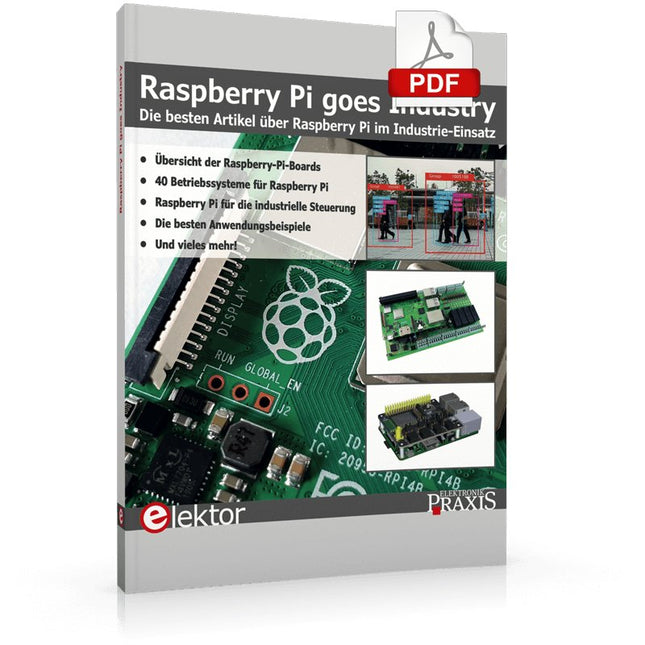
Elektor Digital Raspberry Pi goes Industry (E-book)
Der Raspberry Pi wurde ursprünglich für die Forschung und Lehre entwickelt. Der kleine Bastler-PC hat jedoch bewiesen, dass er auch in der Industrie vielseitig einsetzbar ist. Aufgrund der zahlreichen Anwendungen des Raspberry Pi in privaten Hobbykellern und Hochschullabors ist er etlichen angehenden Ingenieuren bereits bekannt, daher ist es nicht verwunderlich, dass er schon in unterschiedlichsten industriellen Betrieben zum Einsatz kommt. Im Gegensatz zu vielen anderen PCs, die in der Industrie verwendet werden, bringt der Raspberry Pi einige Vorteile mit sich. Er ist nicht nur kostengünstig, sondern auch einfach in der Anwendung. Dies zeigt sich besonders anhand der benutzerfreundlichen Standard-Software Raspbian, welche sich sehr einfach und ohne viel Zeitaufwand installieren lässt. Besonders einzigartig ist jedoch die große Support-Community, die über soziale Netzwerke für Hilfe bei der Anwendung und Problemlösungen bereitsteht. Mitbegründer des Raspberry Pi, Eben Upton, sieht Chancen für den Raspberry Pi, in der Industrie Fuß zu fassen und so die industrielle Steuerung erheblich zu erleichtern. Dieses Buch bietet eine anschauliche Übersicht über die Möglichkeiten der industriellen Anwendung des Raspberry Pi. Von Sensoren, Blockchain-Technologie, Industrie-Controller über Automatisierung und KI, werden zahlreiche Anwendungsmöglichkeiten für den Raspberry Pi anschaulich erklärt. Außerdem werden unterschiedlichste Tools zur erweiterten Nutzung des Raspberry Pi sowie die verschiedenen Betriebssysteme vorgestellt. Die Möglichkeiten und Grenzen für den Raspberry Pi in der Industrie und konkrete Anwendungsbeispiele liefern ein realistisches Gesamtbild.
€ 24,90
Mitglieder: € 22,41
-

Elektor Digital Digitale Systeme mit FPGAs entwickeln (E-book)
Field Programmable Gate Arrays (FPGAs) sind Standard-ICs, die dem Anwender die Konfiguration von Hardwarestrukturen ermöglichen. Mit FPGAs ist die Umsetzung digitaler Systeme ab Stückzahl eins machbar. Durch die Verfügbarkeit kostenloser Lizenzen und preiswerter Entwicklungsboards ist die finanzielle Einstiegsschwelle in diese Technik niedrig. Bei der Überwindung der fachlichen Schwelle hilft dieser Kurs.Die ersten beiden Kursteile bieten eine Einführung in die Digitaltechnik. Wer sich damit bereits gut auskennt, lässt den ersten Teil weg und wird im zweiten Teil VHDL als Sprache zur Beschreibung digitaler Grundfunktionen (z. B. Gatter und Flip-Flops) kennenlernen.Der dritte Kursteil beschäftigt sich mit höheren Funktionen Digitaler Systeme sowie deren Modellierung in VHDL. Im vierten Kursteil wird der Umgang mit einem VHDL-Simulator geübt und die Entwicklungsmethodik mit VHDL weiter verfeinert.Den Höhepunkt bildet der fünfte Teil. Hier wird am Beispiel eines einfachen Prozessors Schritt für Schritt die Entwicklung eines komplexeren digitalen Systems behandelt. Am Ende des fünften Teiles kann man sich dann FPGA-Entwickler nennen.Der sechste Teil behandelt abschließend den Hardwareaufbau von FPGA-Bausteinen.Der Kurs ist durchgehend mit praktischen Übungen angereichert und liefert sehr schnell erste Erfolgserlebnisse. Er eignet sich insbesondere für• Studierende der MINT-Fächer mit Interesse an Elektronik• Schüler an technischen Gymnasien und berufsbildenden Schulen• Ingenieure und Informatiker, die sich fachlich weiterentwickeln wollen
€ 44,80
Mitglieder: € 40,32
-
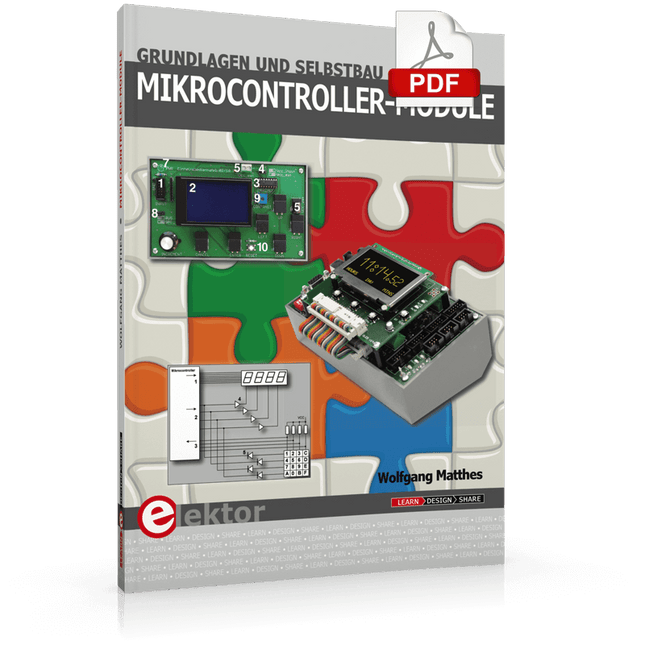
Elektor Digital Mikrocontroller-Module (PDF)
Grundlagen und Selbstbau Weshalb nicht damit beginnen, Mikrocontroller-Module selbst zu entwickeln, zumindest aber sich in Gedanken mit solchen Aufgaben zu beschäftigen? Wie Mikrocontroller-Module aufgebaut sind und wozu sie verwendet werden, soll in 'Mikrocontroller-Module – Grundlagen und Selbstbau' dargestellt werden. Das vorliegende Buch beleuchtet Mikrocontroller-Module, die vor allem zum Experimentieren, zum Lernen und zum Einarbeiten in die Entwicklung und Programmierung von Embedded Systems gedacht sind. Die Entwurfsgrundsätze, Lösungsvorschläge und Projekte, die in diesem Buch beschrieben werden, sind aus zwei Ideen hervorgegangen: Erstens können neue Entwicklungen zwischen den weit verbreiteten kostengünstigen Mikrocontroller-Modulen und der industriellen Computer- und Steuerungstechnik ihren Platz finden und zweitens ist es eine Herausforderung an sich, solche Module zu entwickeln und einzusetzen. In den ersten sieben Kapiteln dieses Buches werden die technischen Grundlagen diskutiert und anhand eigener Entwicklungen veranschaulicht. Das achte Kapitel gibt einen Überblick über diesen Modulbaukasten. Alle Fotos aus dem Buch können hier vierfarbig heruntergeladen werden.
€ 32,80
Mitglieder: € 29,52


