
Suchergebnisse für "adafruit or adalogger or featherwing or rtc or sd or add or on"
-

Elektor Publishing PLC Programming with the Raspberry Pi and the OpenPLC Project
ModbusRTU and ModbusTCP examples with the Arduino Uno and ESP8266 Introduction to PLC programming with OpenPLC, the first fully open source Programmable Logic Controller on the Raspberry Pi, and Modbus examples with Arduino Uno and ESP8266 PLC programming is very common in industry and home automation. This book describes how the Raspberry Pi 4 can be used as a Programmable Logic Controller. Before taking you into the programming, the author starts with the software installation on the Raspberry Pi and the PLC editor on the PC, followed by a description of the hardware. You'll then find interesting examples in the different programming languages complying with the IEC 61131-3 standard. This manual also explains in detail how to use the PLC editor and how to load and execute the programs on the Raspberry Pi. All IEC languages are explained with examples, starting with LD (Ladder Diagram) over ST (Structured Control Language) to SFC (Special Function Chart). All examples can be downloaded from the author's website. Networking gets thorough attention too. The Arduino Uno and the ESP8266 are programmed as ModbusRTU or ModbusTCP modules to get access to external peripherals, reading sensors and switching electrical loads. I/O circuits complying with the 24 V industry standard may also be of interest for the reader. The book ends with an overview of commands for ST and LD. After reading the book, the reader will be able to create his own controllers with the Raspberry Pi.
€ 39,95
Mitglieder: € 35,96
-

Elektor Special: Robotics and Automation
AI in Practice Dive into the fascinating world of robotics and automation! This Elektor Special shows you how to build your own robots with creativity, a little know-how, and affordable technology. From your first DIY project with Arduino or Raspberry Pi to intelligent systems with AI – this issue makes modern robotics understandable and accessible. Discover practical instructions, inspiring projects, and exciting insights into the maker scene. Learn how experimentation, community, and openness give rise to true innovation – and why robotics is so much more than just a technical hobby. Contents Imagination turns into reality Arduino-controlled Drawing Robot GalaxyRVR Mars Rover Kit for Arduino YDLIDAR X4Pro Lidar xHuskyLens AI Camera DOF Robot Arm with Raspberry Pi Pico Manufacturing Robots with Fischertechnik Pneumatic Industrial Robot Why Do We Keep Building Robot Dogs? Elektor Mini-Wheelie Robot Vehicles and Autonomous Driving
€ 19,95
Mitglieder: € 17,96
-

Elektor Publishing Hands-on Microcontroller Course for Advanced Arduino Users
32 new Projects, Practical Examples and Exercises with the Elektor Arduino Nano MCCAB Training Board Electronics and microcontroller technology offer the opportunity to be creative. This practical microcontroller course provides you with the chance to bring your own Arduino projects and experience such moments of success. Ideally, everything works as you imagined when you switch it on for the first time. In practice, however, things rarely work as expected. At that point, you need knowledge to efficiently search for and find the reason for the malfunction. In this book for advanced users, we delve deep into the world of microcontrollers and the Arduino IDE to learn new procedures and details, enabling you to successfully tackle and solve even more challenging situations. With this book, the author gives the reader the necessary tools to create projects independently and also to be able to find errors quickly. Instead of just offering ready-made solutions, he explains the background, the hardware used, and any tools required. He sets tasks in which the reader contributes their own creativity and writes the Arduino sketch themselves. If you don’t have a good idea and get stuck, there is, of course, a suggested solution for every project and every task, along with the corresponding software, which is commented on and explained in detail in the book. This practical course will teach you more about the inner workings of the Arduino Nano and its microcontroller. You will get to know hardware modules that you can use to realize new and interesting projects. You will familiarize yourself with software methods such as ‘state machines,’ which can often be used to solve problems more easily and clearly. The numerous practical projects and exercise sketches are once again realized on the Arduino Nano MCCAB Training Board, which you may already be familiar with from the course book ‘Microcontrollers Hands-on Course for Arduino Starters’, and which contains all the hardware peripherals and operating elements we need for the input/output operations of our sketches. Readers who do not yet own the Arduino Nano MCCAB Training Board can purchase the required hardware separately, or alternatively, build it on a breadboard.
€ 49,95€ 39,95Bestpreis
-
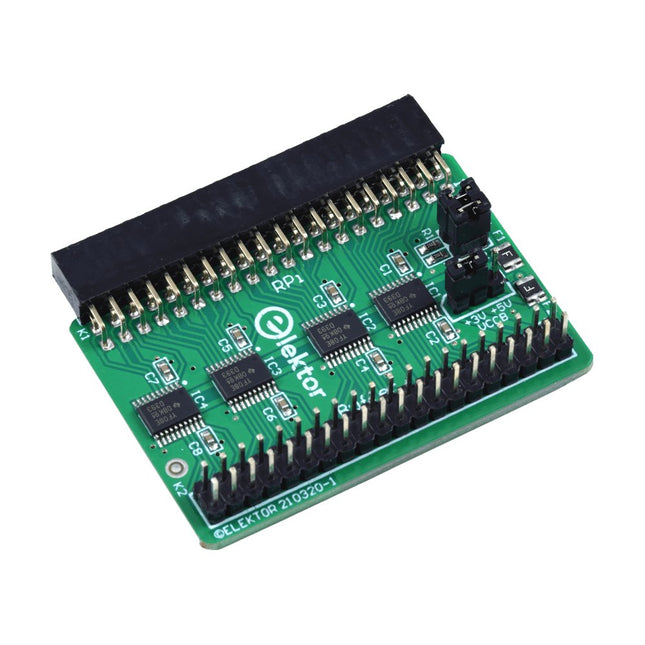
Elektor Labs Elektor Raspberry Pi Buffer Board
Wenn Sie regelmäßig mit dem Raspberry Pi experimentieren und eine Vielzahl von externer Hardware über die Stiftleiste an den GPIO-Port anschließen, haben Sie in der Vergangenheit vielleicht schon einige Schäden verursacht. Das Elektor Raspberry Pi Buffer Board ist dazu da, dies zu verhindern! Das Board ist kompatibel mit Raspberry Pi Zero, Zero 2 (W), 3, 4, 5, 400 und 500. Alle 26 GPIOs sind mit bidirektionalen Spannungswandlern gepuffert, um den Raspberry Pi beim Experimentieren mit neuen Schaltungen zu schützen. Die Platine ist dafür vorgesehen, auf der Rückseite des Raspberry Pi 400/500 eingesetzt zu werden. Der Stecker zum Anschluss an den Raspberry Pi ist eine rechtwinklige 40-polige Buchse (2x20). Die Platine ist nur ein wenig breiter. An die Pufferausgangsbuchse kann ein 40-poliges Flachbandkabel mit entsprechenden 2x20-Steckern angeschlossen werden, um z. B. mit einer Schaltung auf einem Breadboard oder einer Platine zu experimentieren. Die Schaltung verwendet 4x TXS0108E ICs von Texas Instruments. Die Platine lässt sich auch auf einem Raspberry Pi aufstellen. Downloads Schematics Layout
€ 34,95
Mitglieder: € 31,46
-

Miniware Miniware MDP-M01 Smart Digital-Monitor
MDP-M01 ist ein Display-Steuermodul, das mit einem 2,8-Zoll-TFT-Display ausgestattet ist. Das Display kann um 90 Grad gedreht werden, was für Benutzer bequem ist, um Daten und Wellenformen anzuzeigen. MDP-M01 kann Online-Anzeige und -Steuerung mit MDP-P906 Mini-Digital-Netzteilmodulen und anderen Modulen des MDP-Systems über drahtlose 2,4-GHz-Kommunikation realisieren und bis zu 6 Sub-Module gleichzeitig steuern. Technische Daten Bildschirmgröße 2,8" TFT Bildschirmauflösung 240 x 320 Leistung Micro-USB-Stromeingang oder Stromversorgung vom Submodul über dediziertes Stromkabel Eingabe DC 5 V/0,3 A Andere Funktionen Kann bis zu 6 Submodule steuernUpgrade der Formware über Micro USB Abmessungen 107 x 66 x 13,6 mm Gewicht 133 g Included 1x MDP-M01 Smart Digital-Monitor 1x Kabel (2,5 mm Klinke auf Micro USB) Downloads User Manual v3.4 Firmware v1.32
€ 77,69
-

Elektor Digital Elektor März/April 2022 (PDF)
Bauen Sie Ihren RISC-V-Controller Debütieren Sie auf dem RISC-V-Softwareknoten NEORV32 für FPGA mit einfacher Berechnung Grafiktracker mit Arduino Dies ist mit dem Arduino-Serien-Traceur ganz einfach. CLUE-Karte von Adafruit Eine intelligente Lösung für IoT-Projekte Kartenleser für Raspberry Pi 400 Schutz der Ein- und Ausgänge Raspberry Pi RP2040-Karten auf Gogo DIY-Ansatz zur Sicherheit und elektronischen Spionage Heizen oder kühlen Sie die SRAM Identifizierung der Bestandteile Tricks und Kniffe, gute Praktiken und andere nützliche Informationen Kontaktloser Schalter zum Selbermachen Elektronisch starten? (12) Anpassung von Impedanz und Transformatoren Was ist neu in der Entwicklung der Blockade? Rost und Aktualisierung von IoT-Implementierungen Infografik Die Vorteile von 5G für Industrie und Automobil Relais für mobile Spulen Besuch vor Ort Chacun Sohn Tour Reise durch das neuronale Netzwerk (4. Teil) Die verstörten Neuronen Magnetische Schwebebahn: noch einfacher Dritte Version: die kompaktere Automatisierte Programmierung mit Raspberry Pi und dem OpenPLC-Projekt Visualisierung von SPS-Programmen mit AdvancedHMI Über das Leben Eingewickelt, das ist pesé Unter Ihrem Radar Die Mikrocontroller, die Sie kennen müssen Überwachung und Entsendung ohne Draht Eine Lösung für Arduino, ESP32 und Co. Station zur Messung von Temperatur und Luftfeuchtigkeit im Beutelformat Nutzung der vorinstallierten Module Reparatur von Lithiumbatterien Sparen Sie Geld und steigern Sie die Leistung! Erstellen grafischer Schnittstellen in Python Meme-Generator Drei grundlegende Fragen Warum, mit wem, mit wem? Hexadoku
€ 10,95
-

Elektor Digital Elektor Juli/August 2023 (PDF)
Der vollständige Download dieser Nummer ist für unsere GOLD- und GREEN-Mitglieder auf der Elektor Magazine- Site verfügbar! Nicht noch einmal Mitglied? Klicken Sie hier . das drehbare Telefon als Fernbedienung um das Licht anzuzünden, komponiere 1; für die Kaffeemaschine, komponiere die 2 GPS-Geschwindigkeitsregler die meisten Verstöße gegen die Geschwindigkeitsüberschreitung RVB-Stroboskop mit Arduino ein nützliches, lehrreiches und verwirrendes Instrument Notfall-Poussoir-Taste ohne Draht Mit LoRa verstärkte Sicherheit elektronisch starten ...der überwachte Hysteresekomparator mit unabhängigen Niveaus Simulationen, Felder aus Analysis und Algorithmen Impedanzanalysator basierend auf einem ESP32 einfach, mit ein paar Bestandteilen und einer schwachen Rechnung?! Besuch zu Hause Förderung der Personalrealisierung Der MCCAB-Lernplan für Arduino Nano Plattform für den Kurs „Mikrocontroller-Praxiskurs“ über das Leben des modernen Luddismus Baby-Sensor: der Temperatursensor DS18B20 1-Wire-Bus-Verbindung welche Standards dienen der Vereinheitlichung der Haussteuerung?? Materie und Faden unterscheiden sich Materie oder die Übereinstimmung der Objekte Testen Sie Matter mit der Karte Thing Plus Matter und Simplicity Studio Infografik: IdO und Captures Matter, ExpressLink, Rainmaker? Warum macht man das? Fragen und Antworten mit Amey Inamdar, Leiter für technisches Marketing bei Espressif Einführungsleitfaden zur Auswahl von Mikrocontroller-Entwicklungskits für IoT- und IIoT-Anwendungen ein Kondensator ist nicht immer kapazitiv?! NTP-Uhr und CircuitPython Warum verwende ich diese Programmiersprache? Erstellen Sie einen sympathischen IdO-Bildschirm mit dem Phambili Newt Doppler-Bewegungsdetektor HB100 Theorie und Praxis Leitfaden zur Bare-Metal-Programmierung für STM32 und andere Mikrocontroller Testmultimeter Siglent SDM3045X Mikroprozessoren für blockierte Systeme Drôle de composants, die Serie die Dokumentation der Mikrocontroller ohne Stift (3) Grundrisse und andere Dokumente LoRa-Wetterstation mit schwacher Leistung realisieren Sie auch eine Wetterstation auf der linken Seite Transverter für Band 70 cm Klima ruft Ingenieure Bewegen Sie sich schnell und reparieren Sie die Dinge Hexadoku
€ 10,95
-
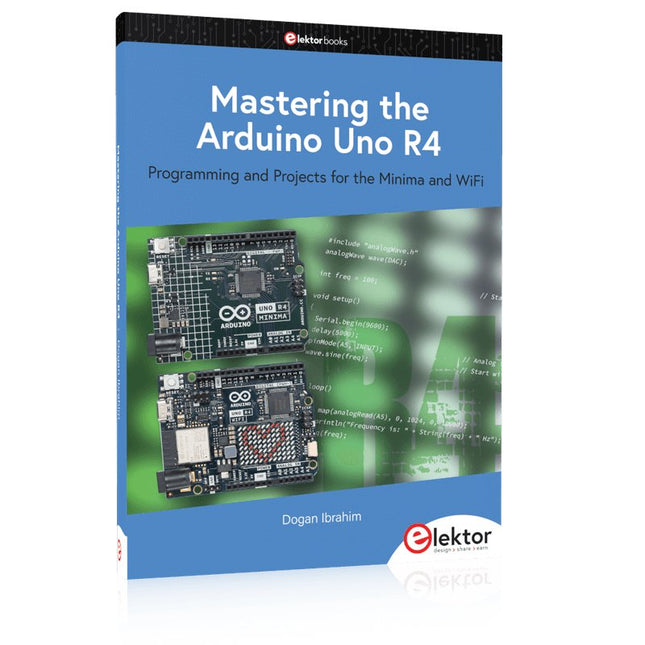
Elektor Publishing Mastering the Arduino Uno R4
Programming and Projects for the Minima and WiFi Based on the low-cost 8-bit ATmega328P processor, the Arduino Uno R3 board is likely to score as the most popular Arduino family member, and this workhorse has been with us for many years. Eleven years later, the long-overdue successor, the Arduino Uno R4, was released. It is built around a 48 MHz, 32-bit Arm Cortex-M4 microcontroller and provides significantly expanded SRAM and Flash memory. Additionally, a higher-precision ADC and a new DAC are added to the design. The Uno R4 board also supports the CAN Bus with an interface. Two versions of the board are available: Uno R4 Minima, and Uno R4 WiFi. This book is about using these new boards to develop many different and interesting projects with just a handful of parts and external modules. All projects described in the book have been fully tested on the Uno R4 Minima or the Uno R4 WiFi board, as appropriate. The project topics include the reading, control, and driving of many components and modules in the kit as well as on the relevant Uno R4 board, including LEDs 7-segment displays (using timer interrupts) LCDs Sensors RFID Reader 4x4 Keypad Real-time clock (RTC) Joystick 8×8 LED matrix Motors DAC (Digital-to-analog converter) LED matrix WiFi connectivity Serial UART CAN bus Infrared controller and receiver Simulators … all in creative and educational ways with the project operation and associated software explained in great detail.
€ 44,95
Mitglieder: € 40,46
-

OWON OWON XDG2035 2-Kanal Funktionsgenerator (35 Mhz)
Der 2-Kanal OWON XDG2035 ist ein Funktions-/Wellenformgenerator, der Signale mit einer maximalen Frequenz von 35 MHz erzeugen kann. Der Generator hat eine Auflösung von 1 µHz und eine Abtastrate von 500 MSa/s.Der OWON XDG2035 ist in der Lage, 6 Standardwellenformen und 150 Arbiträrwellenformen zu erzeugen. Mit der mitgelieferten Software können Sie erweiterte Funktionen bis zu 10 Millionen Punkte schreiben. Wellenformen können mit einem PC über USB oder LAN im internen Speicher des Funktionsgenerators gespeichert werden.Der OWON XDG2035 unterstützt auch SCPI-Befehle und LabView. Der Funktionsgenerator verfügt über einen integrierten hochwertigen Frequenzzähler, der von 100 bis 200 MHz arbeiten kann.FeaturesMax. 35 MHz Frequenzausgang500 MSa/s Abtastrate, vertikale Auflösung 1 μHz14 Bit vertikale Auflösung, 10 Marb WellenformlängeUmfassende Wellenformausgabe: 6 Grundwellenformen und 150 integrierte ArbiträrwellenformenUmfassende Modulationsfunktionen: AM, FM, PM, FSK, 3FSK, 4FSK, PSK, OSK, ASK, BPSK, PWM, Sweep und BurstHochpräziser Frequenzzähler integriert, unterstützter Bereich 100-200 MHzSCPI und LabVIEW werden unterstützt7 Zoll Multi-Touch-Bildschirm (800 x 480 Pixel)Technische DatenKanäle2Frequenzausgang35 MHzAbtastrate500 MSa/sVertikale Auflösung14 bitsWellenform Standard WaveformSine, square, pulse, ramp, noise, and harmonicArbitrary WaveformExponential rise, exponential fall, sin(x)/x, step wave, and others, total 150 built-in waveforms, and user-defined arbitrary waveformFrequenz (Auflösung 1 μHz) Sine1 μHz-100 MHzSquare1 μHz ~ 30 MHzPulse1 μHz ~ 25 MHzRamp1 μHz ~ 3 MHzNoise (-3 dB, typical)100 MHzArbitrary Waveform1 μHz ~ 15 MHzHarmonic1 μHz ~ 50 MHzAccuracy±2ppm, 25°C ±5°CWaveform Length2 points - 10M pointsAmplitude Into 50Ω load1mVpp ~ 10Vpp (≤25 MHz); 1mVpp ~ 5Vpp (≤60 MHz); 1mVpp ~ 2.5Vpp (≤100 MHz)Modulation TypeAM, DSB-AM, FM, PM, ASK, FSK, PSK, BPSK, QPSK, 3FSK, 4FSK, OSK, PWM, SUMFrequenzzähler FunctionFrequency, period, +width, -width, +duty, and -dutyFrequency Range100 ~ 200 MHzFrequency Resolution7 digitsInput/Output Input modefrequency counter, external modulation input, external trigger input, internal clock output, external reference clock input/outputCommunication InterfaceUSB Host, USB Device, LAN, RS232 (optional)Mechanische Spezifikationen Abmessungen340 x 177 x 90 mmGewicht2,3 kgLieferumfang1x OWON XDG20351x Netzkabel1x CD-ROM1x Kurzanleitung1x USB-Kabel1x BNC-BNC-KabelDownloadsQuick Guide
€ 333,40
-

Elektor Digital Logic Analyzers in Practice (E-book)
PC USB Logic Analyzers with Arduino, Raspberry Pi, and Co. Step-by-step instructions guide you through the analysis of modern protocols such as I²C, SPI, UART, RS-232, NeoPixel, WS28xx, HD44780 and 1-Wire. With the help of numerous experimental circuits based on the Raspberry Pi Pico, Arduino Uno and the Bus Pirate, you will learn the practical application of popular USB logic analyzers. All the experimental circuits presented in this book have been fully tested and are fully functional. The necessary program listings are included – no special programming or electronics knowledge is required for these circuits. The programming languages used are MicroPython and C along with the development environments Thonny and Arduino IDE. This book uses several models of flexible and widely available USB logic analyzers and shows the strengths and weaknesses of each price range. You will learn about the criteria that matter for your work and be able to find the right device for you. Whether Arduino, Raspberry Pi or Raspberry Pi Pico, the example circuits shown allow you to get started quickly with protocol analysis and can also serve as a basis for your own experiments. After reading this book, you will be familiar with all the important terms and contexts, conduct your own experiments, analyze protocols independently, culminating in a comprehensive knowledge set of digital signals and protocols.
€ 29,95
Mitglieder: € 26,96
-

Elektor Digital Coding Modbus TCP/IP for Arduino (E-book)
Example projects with Node-RED, MQTT, WinCC SCADA, Blynk, and ThingSpeak This comprehensive guide unlocks the power of Modbus TCP/IP communication with Arduino. From the basics of the Modbus protocol right up to full implementation in Arduino projects, the book walks you through the complete process with lucid explanations and practical examples. Learn how to set up Modbus TCP/IP communication with Arduino for seamless data exchange between devices over a network. Explore different Modbus functions and master reading and writing registers to control your devices remotely. Create Modbus client and server applications to integrate into your Arduino projects, boosting their connectivity and automation level. With detailed code snippets and illustrations, this guide is perfect for beginners and experienced Arduino enthusiasts alike. Whether you‘re a hobbyist looking to expand your skills or a professional seeking to implement Modbus TCP/IP communication in your projects, this book provides all the knowledge you need to harness the full potential of Modbus with Arduino. Projects covered in the book: TCP/IP communication between two Arduino Uno boards Modbus TCP/IP communication within the Node-RED environment Combining Arduino, Node-RED, and Blynk IoT cloud Interfacing Modbus TCP/IP with WinCC SCADA to control sensors Using MQTT protocol with Ethernet/ESP8266 Connecting to ThingSpeak IoT cloud using Ethernet/ESP8266
€ 32,95
Mitglieder: € 29,66
-

Elektor Digital Elektor Green Mitgliedschaft
Elektronik lernen, entwickeln und verstehen – mit Elektor Projekte, Fachwissen, Archiv-Zugriff und exklusive Rabatte – alles in einer Mitgliedschaft Möchten Sie Elektronik lernen, eigene Schaltungen entwickeln und moderne Technologien besser verstehen? Das Elektor Magazin gehört seit 65 Jahren zu den führenden Informationsquellen für Elektronikingenieure, Entwickler, Start-ups und Unternehmen. Mit einer Elektor Green Mitgliedschaft sichern Sie sich: ✅ Jährlich 8 Ausgaben der internationalen Elektronik-Fachzeitschrift Elektor (PDF) ✅ Zugang zum Elektor-Archiv mit 65 Jahren Elektronik-Know-how ✅ Selbstbauprojekte, getestete Schaltungen, In-depth-Reviews und Tutorials ✅ Exklusive Mitgliederrabatte auf Elektor.de Warum Elektor? Seit 65 Jahren steht Elektor für fundiertes Elektronik-Wissen, praxisnahe Projekte und innovative Technologien. Von Mikrocontrollern und Embedded Systems über Raspberry Pi, Arduino und ESP32 bis hin zu IoT, KI, Messtechnik, Audio, HF und Robotik deckt Elektor die wichtigsten Plattformen und Anwendungsfelder moderner Elektronik ab. Egal, ob Sie Einsteiger, Maker oder Profi sind – mit Elektor bringen Sie Ihre Fähigkeiten auf das nächste Level. Für wen ist die Mitgliedschaft? Einsteiger – Starten Sie mit verständlichen Grundlagen und ersten Projekten in die Welt der Elektronik Maker – Entdecken Sie neue Projekte, Ideen und Inspiration für Ihre eigenen Entwicklungen Profis & Ingenieure – Bleiben Sie auf dem neuesten Stand moderner Technologien und vertiefen Sie Ihr Fachwissen Ihre Vorteile auf einen Blick Magazin (Digital) – Erhalten Sie jede Ausgabe digital direkt in Ihr Postfach 65 Jahre Elektronik-Wissen – Greifen Sie jederzeit auf das umfangreiche Elektor-Archiv zu Praxis & Projekte – Setzen Sie eigene Ideen um, mit Anleitungen, Schaltungen und Tutorials Exklusive Rabatte – Sparen Sie bei jedem Einkauf auf Elektor.de Jetzt alle Elektor-Vorteile freischalten! Free Mitgliedschaft Green Mitgliedschaft ❌ 8× Elektor (Digitalausgabe) als PDF ✅ 8× Elektor (Digitalausgabe) als PDF ❌ 12 Monate Zugriff auf das gesamte Elektor-Archiv ✅ 12 Monate Zugriff auf das gesamte Elektor-Archiv ❌ Zugriff auf über 5.000 Gerber-Dateien ✅ Zugriff auf über 5.000 Gerber-Dateien ❌ 10% Mitgliederrabatt auf Elektor.de ✅ 10% Mitgliederrabatt auf Elektor.de ✅ Elektor jeden Freitagmorgen wöchentlich lesen ✅ Elektor jeden Freitagmorgen wöchentlich lesen ℹ️ Lesen Sie Elektor lieber gedruckt? Hier erfahren Sie alles über die Elektor Gold-Mitgliedschaft (Print).
€ 89,95 - € 169,95


