
Suchergebnisse für "elektor or 07 or 08 or 2019 or de"
-

Elektor Digital Introductie tot de Elektro-akoestiek (E-book)
Dit boek is bedoeld voor diegenen die zich bezig houden met geluidsversterking en geluidsdistributie. Het gaat in op de akoestische eigenschappen van open, halfopen en omsloten ruimten. Belangrijk is hoe luidsprekers aangepast kunnen worden op allerlei omgevingen. Meestal moet men een keuze maken uit het aanbod van luidsprekers en microfoons. De vraag is dan welke luidspreker en microfoon de juiste keuze zijn. En hoe deze moeten worden opgesteld waarbij spraak- en muziekverstaanbaarheid en de maximaal haalbare versterking in de live-situatie de belangrijkste criteria zijn. Dit boek geeft antwoord op die vragen. Verder wordt de lezer meegenomen naar het ontwerpen van luidsprekers op basis van de T/S parameters. Met eenvoudige software is het mogelijk akoestische en mechanische elementen van een luidspreker met de eventuele behuizing te vertalen naar de elektrische analogieën, zodat de luidspreker op de PC gesimuleerd kan worden. Aan de hand van rekenvoorbeelden worden bovenstaande simulaties ondersteund. Tot slot zijn in de referentielijst een aantal internetlinks opgenomen waaruit zeer waardevolle gegevens gehaald kunnen worden. De auteur, Peter Swarte, is natuurkundig ingenieur en was werkzaam bij Philips. Momenteel is hij_eigenaar van consultancy bureau P.A.S. Electro Acoustics en is hij actief lid van zowel het NAG (Nederlands Akoestisch Genootschap) als de AES (Audio Engineering Society).
€ 29,95
Mitglieder: € 26,96
-

Zhongdi ZD-8962B ESD-Lötstation (70 W)
Die Lötstation ZD-8962B verfügt über einen einstellbaren Temperaturbereich von 160°C bis 480°C und eine Ausgangsleistung von 70 W. Dank des integrierten Heizelements in der Lötspitze erreicht die Station die gewünschte Betriebstemperatur in nur 8 Sekunden. Ein großes Digitaldisplay ermöglicht die Echtzeitüberwachung und zeigt sowohl die voreingestellte Zieltemperatur als auch die tatsächliche Temperatur des Lötkolbens für eine präzise Steuerung an. Darüber hinaus ist die Station ESD-sicher und schützt so empfindliche elektronische Bauteile während des Betriebs vollständig vor elektrostatischer Entladung. Technische Daten Leistung 70 W Eingangsspannung 220–240 V AC/50 Hz Ausgangsspannung 20 V Temperaturbereich 160°C – 480°C Aufheizzeit ~8 s Display Großes, zweizeiliges LED-Display zur Anzeige von Soll- und Ist-Temperatur Besonderheiten ESD-Schutz, Energiesparmodus, Zwischen °C und °F umschalten Lieferumfang ZD-8962B Lötstation Lötkolben Lötspitze N12-1 Lötkolbenständer mit Kupferbürste und Schwamm Lötdrahtständer mit bleifreiem Lötdraht (10 g) Netzkabel (EU) Manual
€ 69,95€ 59,95Bestpreis
-

Elektor Digital Raspberry Pi 5 for Radio Amateurs (E-book)
Program and Build Raspberry Pi 5 Based Ham Station Utilities with the RTL-SDR The RTL-SDR devices (V3 and V4) have gained popularity among radio amateurs because of their very low cost and rich features. A basic system may consist of a USB based RTL-SDR device (dongle) with a suitable antenna, a Raspberry Pi 5 computer, a USB based external audio input-output adapter, and software installed on the Raspberry Pi 5 computer. With such a modest setup, it is possible to receive signals from around 24 MHz to over 1.7 GHz. This book is aimed at amateur radio enthusiasts and electronic engineering students, as well as at anyone interested in learning to use the Raspberry Pi 5 to build electronic projects. The book is suitable for both beginners through experienced readers. Some knowledge of the Python programming language is required to understand and eventually modify the projects given in the book. A block diagram, a circuit diagram, and a complete Python program listing is given for each project, alongside a comprehensive description. The following popular RTL-SDR programs are discussed in detail, aided by step-by-step installation guides for practical use on a Raspberry Pi 5: SimpleFM GQRX SDR++ CubicSDR RTL-SDR Server Dump1090 FLDIGI Quick RTL_433 aldo xcwcp GPredict TWCLOCK CQRLOG klog Morse2Ascii PyQSO Welle.io Ham Clock CHIRP xastir qsstv flrig XyGrib FreeDV Qtel (EchoLink) XDX (DX-Cluster) WSJT-X The application of the Python programming language on the latest Raspberry Pi 5 platform precludes the use of the programs in the book from working on older versions of Raspberry Pi computers.
€ 32,95
Mitglieder: € 29,66
-
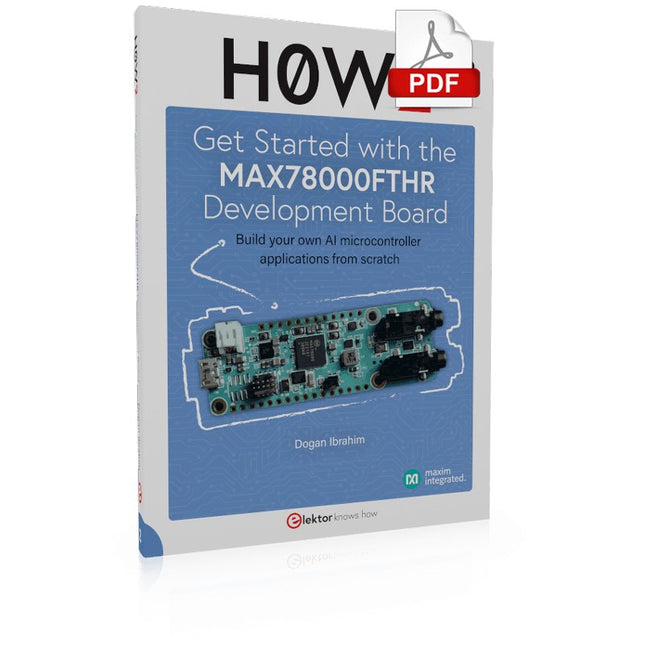
Elektor Digital H0W2: Get Started with the MAX78000FTHR Development Board (E-book)
Build your own AI microcontroller applications from scratch The MAX78000FTHR from Maxim Integrated is a small development board based on the MAX78000 MCU. The main usage of this board is in artificial intelligence applications (AI) which generally require large amounts of processing power and memory. It marries an Arm Cortex-M4 processor with a floating-point unit (FPU), convolutional neural network (CNN) accelerator, and RISC-V core into a single device. It is designed for ultra-low power consumption, making it ideal for many portable AI-based applications. This book is project-based and aims to teach the basic features of the MAX78000FTHR. It demonstrates how it can be used in various classical and AI-based projects. Each project is described in detail and complete program listings are provided. Readers should be able to use the projects as they are, or modify them to suit their applications. This book covers the following features of the MAX78000FTHR microcontroller development board: Onboard LEDs and buttons External LEDs and buttons Using analog-to-digital converters I²C projects SPI projects UART projects External interrupts and timer interrupts Using the onboard microphone Using the onboard camera Convolutional Neural Network
€ 32,95
Mitglieder: € 29,66
-
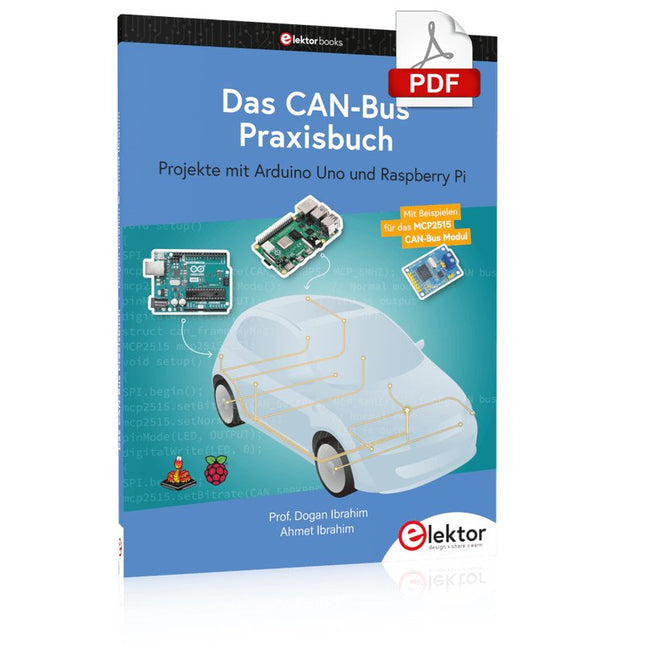
Elektor Digital Das CAN-Bus Praxisbuch (PDF)
Projekte mit Arduino Uno und Raspberry Pi In diesem Buch werden Anwendungen von Arduino Uno und Raspberry Pi 4 in praxisnahen Projekten auf Basis von CAN-Bus detailliert beschrieben. Durch den Einsatz von entweder Arduino Uno oder Raspberry Pi in Verbindung mit handelsüblichen CAN-Bus-Schnittstellenmodulen werden die Entwicklung, Fehlersuche und Fehlerbeseitigung sowie die Überprüfung von Projekten auf CAN-Bus-Basis erheblich erleichtert. Dieses Buch richtet sich an jeden, der mehr über den CAN-Bus lernen möchte und mit den Grundlagen der Elektronik vertraut ist. Hilfreich ist auch, Erfahrungen mit den Programmiersprachen C und Python sowie mit der Programmierung von Arduino Uno unter Verwendung seiner IDE und von Raspberry Pi zu haben. Das Buch ist eine nützliche Informationsquelle und ein Nachschlagewerk für jeden, der Antworten auf eine oder mehrere der folgenden Fragen sucht: Welche Bussysteme stehen für die Automobilindustrie zur Verfügung? Was sind die Grundprinzipien des CAN-Bus? Welche Arten von Frames (oder Datenpaketen) stehen in einem CAN-Bussystem zur Verfügung? Wie können Fehler in einem CAN-Bussystem erkannt werden, und wie zuverlässig ist ein CAN-Bussystem? Welche Arten von CAN-Bus-Controllern gibt es? Was sind die Funktionsprinzipien des MCP2515 CAN-Bus-Controllers? Wie kann ich ein CAN-Bus-Projekt mit Arduino Uno realisieren? Wie kann ich Arduino- oder Raspberry Pi-CAN-Bus-Projekte mit 2 und 3 Knoten erstellen? Wie kann ich die Daten auf dem CAN-Bus analysieren? Wie kann ich ein CAN-Bus-Projekt mit Raspberry Pi ausführen?
€ 29,80
Mitglieder: € 26,82
-

Elektor Digital MIT App Inventor for AI and IoT (E-book)
Build Smart Applications with Raspberry Pi, Arduino, and ESP32 Discover how easy and exciting mobile app development can be with MIT App Inventor. This hands-on guide takes you from basic concepts to building real-world mobile applications using a simple visual programming approach—no prior coding experience required. You will create IoT and AI-powered apps for Android devices and explore how App Inventor can also be used with iPhones and iPads. Connect your applications to platforms such as Arduino UNO R4 WiFi, ESP32, Raspberry Pi Pico (2)W and Raspberry Pi 5, enabling you to build smart, connected systems. Inside the book, you will learn how to: Build interactive apps using buttons, images, sound, and multimedia Create text-to-speech and speech-recognition applications Develop camera-based and location-aware (GPS) apps Design useful tools such as calculators and educational apps Work with smartphone sensors like accelerometers and light sensors Build AI-powered applications, including voice assistants and image-generation features Send and receive messages, and create communication-based apps Connect mobile apps to hardware using Wi-Fi and Bluetooth Control real devices such as LEDs, motors, and sensors Designed for beginners, students, and hobbyists, this book focuses on learning by doing. By the end, you will have the skills and confidence to create your own innovative applications that interact with both the digital and physical worlds. Start building and turning your ideas into reality.
€ 34,95
Mitglieder: € 31,46
-
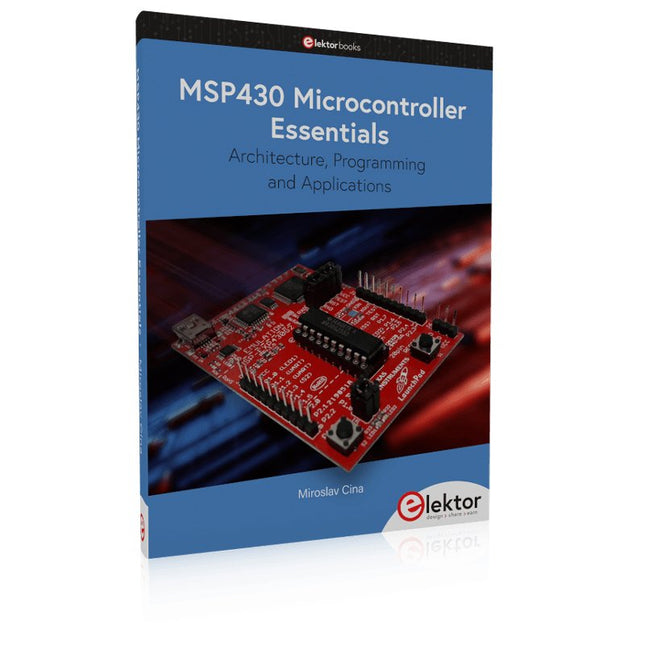
Elektor Publishing MSP430 Microcontroller Essentials
Architecture, Programming and Applications The MSP430 is a popular family of microcontrollers from Texas Instruments. In this book we will work with the smallest type, which is the powerful MSP430G2553. We will look at the capabilities of this microcontroller in detail, as it is well-suited for self-made projects because it is available in a P-DIP20 package. We will take a closer look at the microcontroller and then build, step by step, some interesting applications, including a 'Hello World' blinking LED and a nice clock application, which can calculate the day of the week based on the date. You also will learn how to create code for the MSP microcontroller in assembler. In addition to that, we will work with the MSP-Arduino IDE, which makes it quite easy to create fast applications without special in-depth knowledge of the microcontrollers. All the code used in the book is available for download from the Elektor website.
€ 39,95
Mitglieder: € 35,96
-
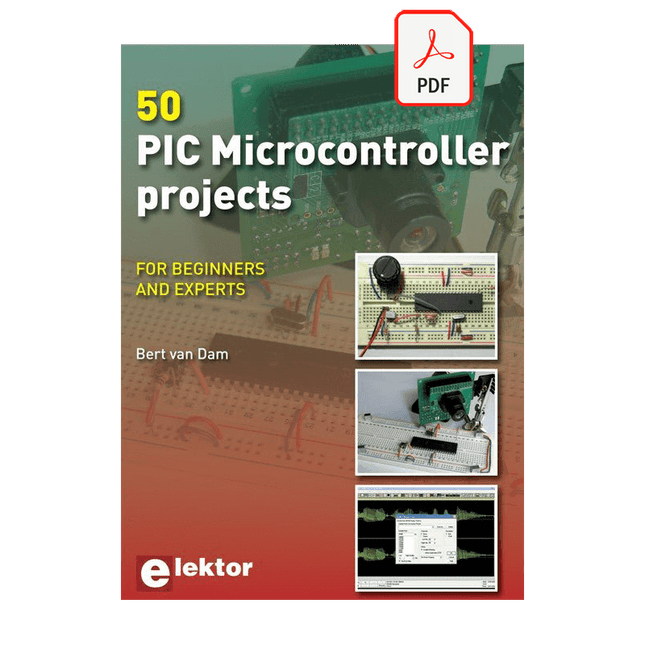
Elektor Digital 50 PIC Microcontroller Projects (E-book)
This book contains 50 fun and exciting projects for PIC microcontrollers such as a laser alarm, USB teasing mouse, eggtimer, youth repellent, soundswitch, capacitive liquid level gauge, 'finger in the water' sensor, guarding a room using a camera, mains light dimmer (110-240 volts), talking microcontroller and much more. Several different techniques are discussed such as relay, alternating current control including mains, I²C, SPI, RS232, USB, pulse width modulation, rotary encoder, interrupts, infrared, analog-digital conversion (and the other way around), 7-segment display and even CAN bus. You can use this book to build the projects for your own use. The clear explanations, schematics and even pictures of each project make this a fun activity. For each project the theory is discussed and why the project has been executed in that particular way. That means you can also use this book as a studybook, or as basis for larger and more complicated projects. All projects use a breadboard so modification and expansion is easy. Three PIC microcontrollers are used, the 16f877A, 18f4455 and 18f4685. It is also discussed how you can migrate your project from one microcontroller to another – 15 types are supported - including two example projects. All software that is used in this book can be downloaded for free. That also applies to the open source programming language JAL. This powerful and yet easy to learn language is used by hobbyists as well as professionals. This book can also be used as a reference guide. It explains all JAL commands, as well as the expansion libraries. Using the index you can easily find example projects that illustrate the use of these commands. Even when you have built all projects in this book you will still want to keep it within arm's reach.
€ 34,95
Mitglieder: € 31,46
-

Peak Peak Atlas LCR45 LCR-Meter
Der LCR45 bietet die gleichen Funktionen wie der beliebte LCR40, verfügt jedoch über einige bedeutende Verbesserungen. Der LCR45 verfügt über einen neuen Mikroprozessor mit hoher Kapazität und hochauflösende ADCs. Der LCR45 verfügt über eine fortschrittliche Mathematik, die auf der Analyse komplexer Impedanzen basiert. Dies ermöglicht eine verbesserte Messung der Komponentenwerte sowie eine umfassende und detaillierte Impedanzanzeige. Features Lieferung erfolgt mit vergoldeten, abnehmbaren Hakensonden Flüssigkeitsmessungen mit Hold-Funktion Automatischer oder manueller Komponententyp Automatische oder manuelle Testfrequenz, DC, 1 kHz, 15 kHz oder 200 kHz Verbesserte Messauflösung: 0,2 µH, 0,2 pF und 0,2 Ohm Einfaches Menüsystem für Benutzereinstellungen Verbesserte Kompensation für Komponentenparasiten und -verluste (wie Kernverluste usw.) Automatisches oder manuelles Ausschalten Technische Daten Analysertyp LCR und Komponentenimpedanz Komponententypen Auto/Manuell für L,C & R Messungstypen Induktivität, Kapazität und Widerstand Andere Messungen Komplexe Impedanz/Admittanz Weitere Messungen Größe und Phase der Impedanz Induktivitätsbereich 0uH bis 2H Kapazitätsbereich 0pF bis 10000uF Widerstandsbereich 0R bis 2MR Testhäufigkeit Automatisch und manuell: Gleichstrom, 1 kHz, 15 kHz, 200 kHz Anzeigetyp Alphanumerisches LCD (nicht hintergrundbeleuchtet) Messschema Kontinuierlich (mit optionaler Sperre) Batterie GP23 (12 V/55 mAH Typ), ~700 Operationen Lieferumfang LCR45 Passivkomponenten-Impedanzmessgerät 2-mm-Stecker und -Buchsen und abnehmbare Hakensonden Umfassende bebilderte Bedienungsanleitung 2 Batterien, eine eingebaut und eine Ersatzbatterie. GP23 Alkalibatterie. (12 V/55 mAH) Downloads Datasheet (EN) User Guide (DE)
€ 129,71
-

Elektor Publishing Logic Analyzers in Practice
PC USB Logic Analyzers with Arduino, Raspberry Pi, and Co. Step-by-step instructions guide you through the analysis of modern protocols such as I²C, SPI, UART, RS-232, NeoPixel, WS28xx, HD44780 and 1-Wire. With the help of numerous experimental circuits based on the Raspberry Pi Pico, Arduino Uno and the Bus Pirate, you will learn the practical application of popular USB logic analyzers. All the experimental circuits presented in this book have been fully tested and are fully functional. The necessary program listings are included – no special programming or electronics knowledge is required for these circuits. The programming languages used are MicroPython and C along with the development environments Thonny and Arduino IDE. This book uses several models of flexible and widely available USB logic analyzers and shows the strengths and weaknesses of each price range. You will learn about the criteria that matter for your work and be able to find the right device for you. Whether Arduino, Raspberry Pi or Raspberry Pi Pico, the example circuits shown allow you to get started quickly with protocol analysis and can also serve as a basis for your own experiments. After reading this book, you will be familiar with all the important terms and contexts, conduct your own experiments, analyze protocols independently, culminating in a comprehensive knowledge set of digital signals and protocols.
€ 34,95
Mitglieder: € 31,46
-

FNIRSI FNIRSI GC-03 Multifunktionaler Strahlungsdetektor
Das FNIRSI GC-03 ist ein multifunktionales Strahlungsmessgerät, das für die professionelle Messung ionisierender Strahlung in alltäglichen Umgebungen – wie etwa zu Hause, im Büro, im Auto oder im Freien – konzipiert wurde. Ausgestattet mit einem hochauflösenden 2,4-Zoll-Farbdisplay, ermöglicht es die Echtzeitüberwachung von ionisierender Strahlung sowie der elektrischen und magnetischen Feldstärke. Für zusätzliche Sicherheit verfügt das Gerät über drei Alarmmodi: akustisches Signal, Vibration und optische Warnung. Features 3-in-1-Erfassung: Überwacht elektrische, magnetische und ionisierende Strahlung mit einem einzigen Gerät. Hochpräzises Geiger-Müller-Zählrohr: Erfasst präzise Gamma-, Röntgen- und harte Betastrahlung bei geringem Stromverbrauch. Echtzeit-Kurvendarstellung & 50 Alarmprotokolle: Verfolgt Strahlungstrends und speichert die Alarmhistorie zur einfachen Überprüfung. Individuelle dreifache Alarmierung: Unterstützt visuelle, akustische und Vibrationsalarme mit einstellbaren Schwellenwerten. Lange Akkulaufzeit: 1500-mAh-Akku für einen ausdauernden und zuverlässigen Einsatz im Außendienst. Technische Daten Kernstrahlung Messbereich: 0,01 μSv/h – 999,99 μSv/h Genauigkeit: 0,01 μSv/h Elektrisches Feld Messbereich: 1 V/m – 1999 V/m Genauigkeit: 1 V/m Magnetfeld Messbereich: 0,01 μT – 99,99 μT Genauigkeit: 0,01 μT Strahlungsleistung 0,2 – 1000 mW/m² Erfasste Strahlungsart Ionisierende Strahlung (Gammastrahlung usw.) Detektor Energiekompensiertes GM-Zählrohr (Geiger-Müller-Zählrohr) Dosisleistungsrate 0,00 – 10000 μSv/h (10 mSv/h) Kumulierte Dosis 0,00 μSv – 500,0 mSv Energiebereich 48 keV – 1,5 MeV ≤ ±30% (für 137Cs) Empfindlichkeit 80 CPM/μSv Dosiseinheit μSv/h, μGy/h, mR/h, CPS, CPM Alarmmodus Licht, Vibration, Ton Display 2,4-Zoll-Farbbildschirm Hintergrundbeleuchtung Helligkeit einstellbar Stromversorgung USB-C (5 V / 1 A) Akku 1500 mAh Sprachen Englisch, Chinesisch Abmessungen 138 x 63 x 32 mm Gewicht 141 g Lieferumfang 1x FNIRSI GC-03 Strahlungsdetektor 1x USB-Kabel 1x Manual Downloads Manual Firmware v1.0.4
€ 99,95€ 84,95Bestpreis
-

Elektor Publishing Edge AI Made Practical
AI Projects for the Raspberry Pi with the AI HAT+ Edge AI is transforming everyday devices by putting intelligence where it matters most: directly inside the hardware. With on-device inference, a camera can recognize a visitor instantly, a phone can translate speech without streaming audio to the cloud, and a wearable can detect anomalies in real time—fast, private, and reliable even when the network disappears. This book is your practical guide to building exactly those kinds of systems with the Raspberry Pi AI HAT+ and the Hailo-8L accelerator. You’ll start with clear foundations: core AI and machine-learning concepts, how neural networks work, and what truly distinguishes Edge AI from cloud AI—plus an honest look at ethical considerations and future impacts. Then it’s straight to hands-on physical computing. Step by step, you’ll set up Raspberry Pi OS, power and cooling, and develop in Python using the Thonny IDE. You’ll learn GPIO basics with lights and servos, mount the AI HAT+ hardware, install and verify the Hailo software stack, and connect the right camera—official modules or USB webcams, even multiple cameras. From your first pipeline to real projects, you’ll run person detection, pose estimation, segmentation, and depth estimation, then level up with YOLO object detection: smart alerts, guest counters, and custom extensions. You’ll even connect vision to motion by combining gesture recognition with servo-driven mechanisms, including a robotic arm. With troubleshooting tips, hardware essentials, and a practical Python refresher, this book turns Edge AI from buzzword into buildable reality.
€ 34,95
Mitglieder: € 31,46


