
Suchergebnisse für "elektor OR ultimate OR sensor OR kit"
-

Elektor Digital Elektronicavoedingen zonder stress (E-book)
Eén ding hebben alle elektronische schakelingen en apparaten gemeen: de werking ervan staat of valt met de voeding. Alleen al daarom verdient deze deelschakeling speciale aandacht. Dit boek behandelt principes en schakelingen uit de praktijk van de voedingstechniek. Geheel in overeenstemming met de huidige trend gaat de auteur in het bijzonder in op 'mobiele' voedingen en op de techniek van schakelende voedingen. Ook wordt aandacht besteed aan het feit dat constante-stroombronnen ten opzichte van spanningsbronnen een steeds belangrijker rol gaan spelen. Naast de vereiste theoretische achtergronden en principes voor het ontwerpen en bouwen van eigen voedingsschakelingen biedt dit boek ook praktische toepassingsvoorbeelden, zoals het vervangen van defecte nettransformatoren, de voeding voor elektronica tijdens fietstochten of het aansturen van LED‘s in de verlichtingstechniek. Auteur Franz Peter Zantis is afgestudeerd als ingenieur communicatietechniek en houdt zich als elektronicus bezig met energie-installaties. Tijdens een onderzoeksproject heeft hij zich grondig verdiept in de stroomvoorziening van zelfstandig werkende apparaten en hij heeft talrijke artikelen over schakelende voedingen gepubliceerd.
€ 34,95
Mitglieder: € 31,46
-

Elektor Digital Grundlagen und Schaltungen der Stromversorgungstechnik (PDF)
Aus der Reihe "Stromversorgung ohne Stress" (Band 1) 2., überarbeitete und erweiterte Auflage Eines haben alle elektronischen Schaltungen und Geräte gemeinsam: Ihre Funktion hängt von der Stromversorgung ab. Deshalb muss dieser Baugruppe besondere Aufmerksamkeit gewidmet werden. Dieses Buch beinhaltet Grundlagen und Schaltungen der Stromversorgungstechnik für elektronische Geräte aus der Praxis. Dem aktuellen Trend folgend behandelt der Autor insbesondere die mobile Stromversorgungstechnik sowie die Schaltnetzteiltechnik. Dabei wird berücksichtigt, dass Stromkonstanter gegenüber Spannungskonstantern zunehmend an Bedeutung gewinnen. Im Buch finden sich die notwendigen Grundlagen zum Bau eigener Stromversorgungsgeräte und -baugruppen. Außerdem enthält es ganz praktische Anwendungsbeispiele, z. B. für den Ersatz defekter Netztransformatoren, für die mobile Stromversorgung auf Fahrradtouren oder für den Betrieb von LEDs. Diese zweite Auflage wurde gründlich überarbeitet, Fehler wurden behoben und einige Ergänzungen vorgenommen. Der Autor Franz Peter Zantis ist Energieanlagenelektroniker und Ingenieur der Nachrichtentechnik. In einem Forschungsprojekt hat er sich ausführlich mit der Stromversorgung eigensicherer Geräte auseinandergesetzt und zahlreiche Beiträge zum Thema Schaltnetzteile veröffentlicht.
€ 32,80
Mitglieder: € 29,52
-

Elektor Digital Das MSP430 Mikrocontroller Buch (E-book)
Moderne Mikrocontroller werden immer leistungsfähiger und können vielfältige Aufgaben übernehmen, für die vor wenigen Jahren noch ein kompletter Computer nötig gewesen wäre. Gerade für die Entwicklung tragbarer Geräte bringt die Prozessorfamilie der MSP430-Mikrocontroller von Texas Instruments alle nötigen Peripheriekomponenten integriert mit, um ohne aufwendige externe Beschaltung komplexe Funktionen einfach zu realisieren. Die RISC-Architektur des Prozessors ist dabei ganz auf Rechengeschwindigkeit, aber gleichzeitig auch auf Energie-Effizienz getrimmt.Dieses Buch eröffnet einen schrittweisen Einstieg in die Welt der Mikrocontrollerprogrammierung und führt mit ausführlichen Anwendungsbeispielen in die Fähigkeiten dieser außergewöhnlichen Prozessorfamilie ein. Jede Komponente des Prozessors wird ausführlich erklärt und deren Funktion in kleinen Beispielprogrammen gleich umgesetzt. Abgerundet wird jedes Kapitel mit einigen Übungsaufgaben. So entsteht neben dem eigentlichen Lerneffekt gleichzeitig eine Referenzbibliothek von Funktionsmodulen, die später in eigenen Anwendungen leicht weiter verwendet werden können.DownloadsDie Listings der im Buch beschriebenen Programmbeispiele (ausschließlich in 'C') und weitere Infos finden Sie hier.
€ 39,80
Mitglieder: € 35,82
-

Elektor Digital Les oscilloscopes anciens & modernes pour les débutants (E-book)
Ce qui se passe en électronique est par définition invisible à l'oeil nu. L'instrument qui permet précisément de rendre visibles les signaux électriques, celui par le truchement duquel les effets de l'électronique se manifestent à nous, c'est l'oscilloscope. Hélas, quand on commence à faire de l'électronique, c'est souvent sans oscilloscope. Et l'on en est réduit à tâtonner, aussi bien physiquement que mentalement. Le jour où l'on goûte à la visualisation des signaux sur un écran, c'est une révélation. Plus personne ne souhaite se priver de cet enchantement. Pas de retour en arrière. En électronique, si l'on veut progresser dans le plaisir et dans la compréhension, il faut un oscillo. Commence alors une période d'interrogation : comment choisir ? Et à peine cette question-là aura-t-elle trouvé sa réponse, il en viendra une ribambelle d'autres que l'on peut résumer en une seule : comment se servir de l'oscilloscope de telle sorte que ce qu'il affiche corresponde bien à la réalité des signaux ? Dans ce livre, Rémy Mallard, répond clairement à ces questions. Il donne aussi de nombreuses informations pour aider son lecteur à élucider lui-même de nouveaux mystères qui ne manqueront pas de surgir. Ceux qui le connaissent déjà comme l'auteur d'un livre sur l'électronique dont le titre est un programme à lui tout seul : L'électronique pour les débutants qui sèchent les cours mais soudent sans se brûler les doigts, ainsi que d'un livre d'initiation à la programmation des microcontrôleurs PIC, savent qu'ils trouveront ici un ouvrage utile, qu'ils rouvriront souvent.
€ 34,95
Mitglieder: € 31,46
-

Elektor Digital Linux PC-based Measurement Electronics (E-book)
This book is intended as a highly-practical guide for Hobbyists, Engineers and Scientists wishing to build measurement and control systems to be controlled by a local or remote Personal Computer running the Linux operating system. Both hardware and software aspects of designing typical embedded systems are covered in detail with schematics, code listings and full descriptions. Numerous examples have been designed to show clearly how straightforward it can be to create the interfaces between digital and analog electronics, with programming techniques for creating control software for both local and remote systems. Hardware developers will appreciate the variety of circuits, including a novel, low cost modulated wireless link and will discover how using Matlab® overcomes the need for specialist programming skills. Software developers will appreciate how a better understanding of circuits plus the freedom offered by Linux to directly control at the register level enables them to optimize related programs. There is no need to buy special equipment or expensive software tools in order to create embedded projects covered in this book. You can build such quality systems quickly using popular low-cost electronic components and free distributed or low-cost software tools. Some knowledge of basic electronics plus the very basics of C programming only is required. Many projects in this book are developed using Matlab® being a very popular worldwide computational tool for research in engineering and science. The book provides a detailed description of how to combine the power of Matlab® with practical electronics. With an emphasis on learning by doing, readers are encouraged by examples to program with ease; the book provides clear guidelines as to the appropriate programming techniques “on the fly”. Complete and well-documented source code is provided for all projects. If you want to learn how to quickly build Linux-based applications able to collect, process and display data on a PC from various analog and digital sensors, how to control circuitry attached to a computer, then even how to pass data via a network or control your embedded system wirelessly and more – then this is the book for you! Features of this Book Use the power, flexibility and control offered only by a Linux operating system on a PC. Use a free, distributed downloadable GNU C compiler Use (optional) a low-cost Student Version of Matlab®. Use low-cost electronic sub-assemblies for projects. Improve your skills in electronics, programming, networking and wireless design. A full chapter is dedicated to controlling your sound card for audio input and output purposes. Program sound using OSS and ALSA. Learn how to combine electronic circuits, software, networks and wireless technologies in the complete embedded system.
€ 29,95
Mitglieder: € 26,96
-
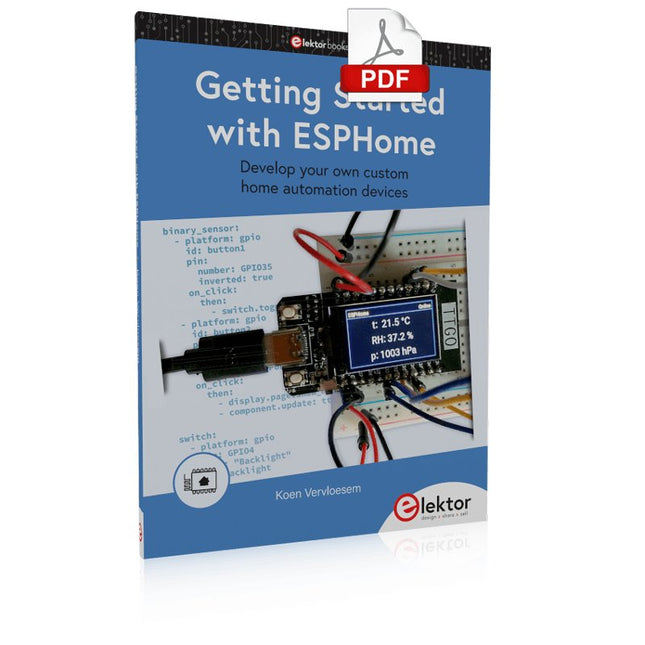
Elektor Digital Getting Started with ESPHome (E-book)
Develop your own custom home automation devices Espressif's ESP8266 and ESP32 microcontrollers have brought DIY home automation to the masses. However, not everyone is fluent in programming these microcontrollers with Espressif's C/C++ SDK, the Arduino core, or MicroPython. This is where ESPHome comes into its own: with this project, you don’t program your microcontroller but configure it. This book demonstrates how to create your own home automation devices with ESPHome on an ESP32 microcontroller board. You’ll learn how to combine all kinds of electronic components and automate complex behaviours. Your devices can work completely autonomously, and connect over Wi-Fi to your home automation gateways such as Home Assistant or MQTT broker. By the end of this book, you will be able to create your own custom home automation devices the way you want. Thanks to ESPHome and the ESP32, this is within everyone’s grasp. Set up an ESPHome development environment and create maintainable configurations Use buttons and LEDs Sound a buzzer and play melodies Read measurements from various types of sensors Communicate over a short distance with NFC, infrared light, and Bluetooth Low Energy Show information on various types of displays Downloads Software
€ 29,95
Mitglieder: € 26,96
-

Siglent Siglent SDM3045X True RMS Multimeter
Das Siglent SDM3045X ist ein 4½-stelliges Digital-Multimeter (66000 Zähler, Abtastrate 150 Sa/s) mit Doppelanzeige und eignet sich besonders gut für die Anforderungen hochpräziser, multifunktionaler und automatischer Messungen. Mit seinem großen 4,3" (10,9 cm) TFT-Farbdisplay (480x272 Pixel) ist die Menüführung sehr intuitiv zu bedienen und sehr gut lesbar. Features Echte 4½-stellige (66000 Zähler) Messwertauflösung Bis zu 150 rdgs/s Messgeschwindigkeit True-RMS-Wechselspannungs- und Wechselstrommessung 1 GB NAND-Flash-Größe, Massenspeicher-Konfigurationsdateien und Datendateien Eingebaute Kaltanschlusskompensation für Thermoelement Mit einfacher, bequemer und flexibler PC-Software: EasyDMM Standardschnittstelle: USB-Gerät, USB-Host, LAN USB & LAN-Remote-Schnittstellen unterstützen den gemeinsamen SCPI-Befehlssatz. Kompatibel mit anderen beliebten DMMs auf dem Markt. Anwendungsfelder Forschungslabor Entwicklungslabor Erkennung und Wartung Kalibrierlabor Automatischer Produktionstest Messfunktionen Gleichspannung: 600 mV – 1000 V Gleichstrom: 600 μA – 10 A Wechselspannung: True-RMS, 600 mV – 750 V Wechselstrom: True-RMS, 60 mA – 10 A 2/4-Draht-Widerstand: 600 Ω – 100 MΩ Kapazität: 2 nF – 10000 μF Durchgangstest: Bereich ist auf 2 kΩ festgelegt. Diodentest: Einstellbarer Bereich beträgt 0-4 V. Frequenzmessung: 20 Hz – 500 KHz Periodenmessung: 2 μs – 0,05 s Temperatur: Unterstützung für TC- und RTD-Sensor Max, Min, Durchschnitt, Standardabweichung, dBm/dB, relative Messung, Pass/Fail, Histogramm, Trenddiagramm Technische Daten Gleichspannung 200 mV, 2 V, 20 V, 200 V, 1000 V Gleichstrom 200 μA, 2 mA, 20 mA, 200 mA, 2 A, 10 A Wechselspannung True-RMS, 200 mV, 2 V, 20 V, 200 V, 750 V Wechselstrom True-RMS, 20 mA, 200 mA, 2 A, 10 A 2/4-Leiter-Widerstand 200 Ω, 2 K, 20 K, 200 K, 2 M, 10 M, 100 MΩ Kapazität 2 nF, 20 nF, 200 nF, 2 μF, 20 μF, 200 μF, 10000 μF Konnektivitätstest Bereich fest 2 KΩ Diodentest Bereich fest 2 V Häufigkeit 20 Hz ~ 1 MHz Zeitraum 1 μs ~ 0,05 s Temperatur Unterstützt Thermoelement, RTD-Temperatursensor Maximale Eingangsspannung 1000 V Konfigurationsschnittstelle USB-Gerät, USB-Host, LAN Lieferumfang 1x Siglent SDM3065X Multimeter 1x USB-Kabel 2x Multimetersonde 1x Netzkabel 1x Quick Start Guide Downloads User Manual Datasheet Remote Manual Service Manual
€ 435,33
Bestpreis
-
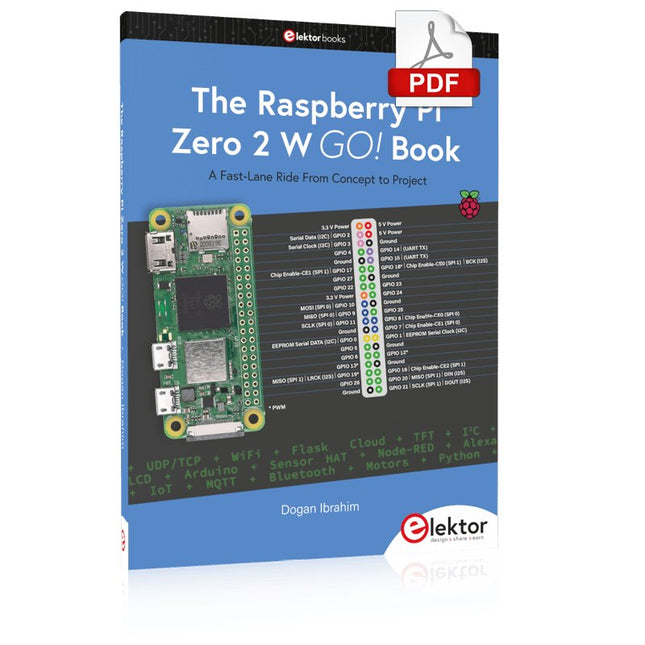
Elektor Digital The Raspberry Pi Zero 2 W GO! Book (PDF)
A Fast-Lane Ride From Concept to Project The core of the book explains the use of the Raspberry Pi Zero 2 W running the Python programming language, always in simple terms and backed by many tested and working example projects. On part of the reader, familiarity with the Python programming language and some experience with one of the Raspberry Pi computers will prove helpful. Although previous electronics experience is not required, some knowledge of basic electronics is beneficial, especially when venturing out to modify the projects for your own applications. Over 30 tested and working hardware-based projects are given in the book, covering the use of Wi-Fi, communication with smartphones and with a Raspberry Pi Pico W computer. Additionally, there are Bluetooth projects including elementary communication with smartphones and with the popular Arduino Uno. Both Wi-Fi and Bluetooth are key features of the Raspberry Pi Zero 2 W. Some of the topics covered in the book are: Raspberry Pi OS installation on an SD card Python program creation and execution on the Raspberry Pi Zero 2 W Software-only examples of Python running on the Raspberry Pi Zero 2 W Hardware-based projects including LCD and Sense HAT interfacing UDP and TCP Wi-Fi based projects for smartphone communication UDP-based project for Raspberry Pi Pico W communication Flask-based webserver project Cloud storage of captured temperature, humidity, and pressure data TFT projects Node-RED projects Interfacing to Alexa MQTT projects Bluetooth-based projects for smartphone and Arduino Uno communications
€ 32,95
Mitglieder: € 29,66
-
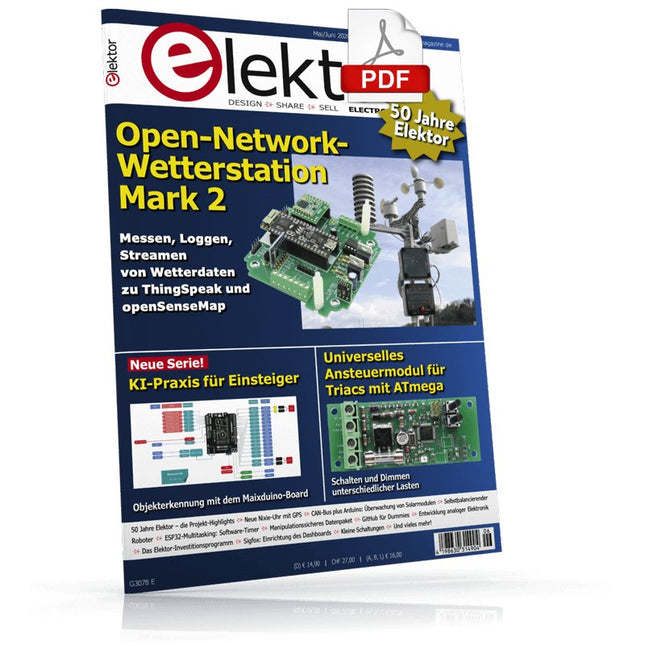
Elektor Digital Elektor 05-06/2020 (PDF)
50 Jahre Elektor – die Projekt-HighlightsMarkantes und Außergewöhnliches aus einem halben Jahrhundert Technik-Geschichte Elektor wird 50Stimmen zum Jubiläum Start-Up-Update: Das Elektor-Investitionsprogramm Open-Network-Wetterstation Mark 2Teil 1: Einführung und Hardware KI für Einsteiger (1)Objekterkennung mit dem Maixduino-Board Universelles Ansteuermodul für Triacs mit ATmegaSchalten und Dimmen unterschiedlicher Lasten Nachruf: Gerhard Haas Gewusst wie: GitHub für DummiesWie man etwas von GitHub herunterlädt Mein IoT-Button: Der Knopf fürs NetzTeil 2: Prototyping mit Board und Cloud Sprachsynthesizer TMS0280Bemerkenswerte Bauteile InteraktivKorrekturen & Updates || Fragen & Antworten BASIC für ESP32/ESP8266 (2)Sanduhr mit ESP8266 und Annex WiFi RDS Automatische Identifizierung mithilfe der RFID-Lesegeräte von Elatec Von Entwicklern für EntwicklerTipps & Tricks, Best Practice und andere nützliche Infos BalBot: Ein selbstbalancierender RoboterModerne Beschleunigungssensoren erleichtern den Bau Aller Anfang...muss nicht schwer sein! Von der Pike auf gelerntNeues aus der Elektor-Ideenkiste Manipulationssicheres DatenpaketDaten sicher mit der Post verschicken Reloaded: Neue Nixie-Uhr mit GPSEin Engineering-Bulletin für begeisterte Nutzer Praktisches ESP32-MultitaskingTeil 3: Software-Timer Mit dem Fuchs ins IoT (4)Einrichtung des Dashboards Zutritt für Unbefugte verboten!Ein Blick ins Allerheiligste aller Elektroniker Review: Elektronische USB-Last Joy-iT HD35Elektronische Last zum Test der Belastbarkeit von USB-Ports CAN-Bus plus Arduino: Überwachung von SolarmodulenErkennen und Lokalisieren von problematischen Panels in großen Anordnungen Entwicklung analoger ElektronikFall Nr. 1 – Teil 3: Optimierung des Vorverstärkerverhaltens und Kompromisse Review: Labornetzteil PeakTech 6080 AViel Netzteil für wenig Geld Eine große HerausforderungSichere Produkte im IoT-Zeitalter HexadokuSudoku für Elektroniker
€ 11,90
-
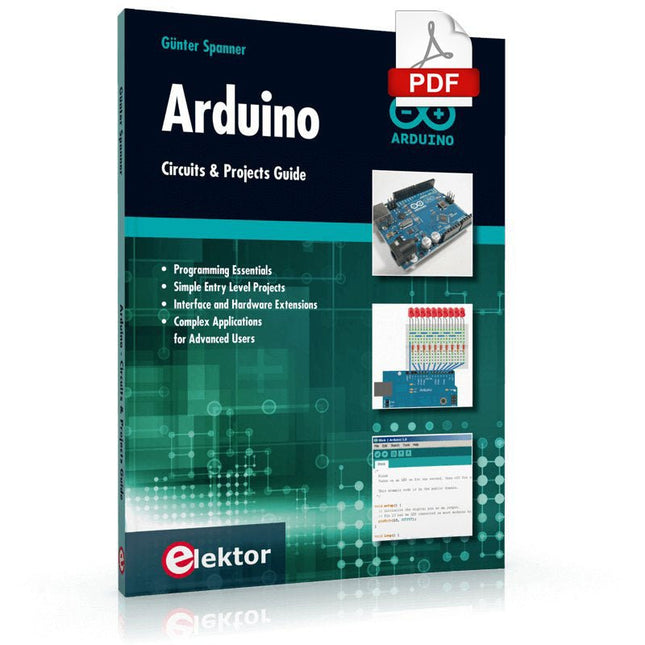
Elektor Digital Arduino – Circuits & Projects Guide (E-book)
Two reasons can be identified for the immense success of the Arduino platform. First, the cheap, ready to go processor board greatly simplifies the introduction to hardware. The second success factor is the free and open-source programming suite that does not require an installation procedure. Simple entry-level examples ensure rapid successes. Complex selection procedures for parameters like the microprocessor version or interface settings are not required. The first sample programs can be uploaded to the Arduino board, and tested, in a matter of minutes. The Arduino user is supported by an array of software libraries. However, the daily increasing volume of libraries poses initial problems to the newcomer, and the way ahead may be uncertain after a few entry-level examples. In many cases, detailed descriptions are missing, and poorly described projects tend to confuse rather than elucidate. Clear guidance and a single motto are missing, usually owing to the projects having been created by several different persons—all with different aims in mind. This book represents a different approach. All projects are presented in a systematical manner, guiding into various theme areas. In the coverage of must-know theory great attention is given to practical directions users can absorb, including essential programming techniques like A/D conversion, timers and interrupts—all contained in the hands-on projects. In this way readers of the book create running lights, a wakeup light, fully functional voltmeters, precision digital thermometers, clocks of many varieties, reaction speed meters, or mouse controlled robotic arms. While actively working on these projects the reader gets to truly comprehend and master the basics of the underlying controller technology.
€ 29,95
Mitglieder: € 26,96
-
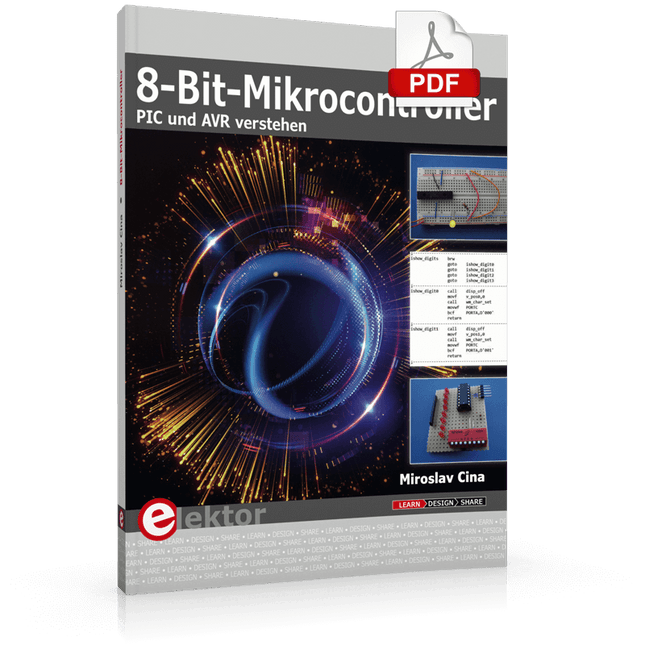
Elektor Digital 8-Bit-Mikrocontroller (PDF)
PIC und AVR verstehen In diesem Buch werden wir uns ausschließlich mit 8-Bit-Mikrocontrollern beschäftigen, und zwar mit Mikrocontrollern der 8-Bit-PIC- und der 8-Bit-AVR-Mikrocontroller-Linien. Bei der PIC-Familie handelt es sich dabei um PIC10, PIC12, PIC16 und PIC18; bei der AVR-Familie um ATtiny, ATmega und ATxmega. Die vorgestellten 8-Bit-Chips sind für sehr viele Anwendungen vollkommen ausreichend und preislich auch attraktiv. Durch die Lektüre des Buches erhalten Sie ein fundiertes Wissen über die genannten 8-Bit-Mikrocontroller, über ihre Architektur, ihre Pinbelegungen und über ihre Programmierung. Weil wir uns in diesem Buch mit den Grundlagen der Architektur der PICs und AVRs vertraut machen möchten, werden wir auch für alle PIC- und AVR-Anwendungen Assembler einsetzen, denn die Assembler-Sprache erlaubt es, die Technik im Detail kennenzulernen. Wenn man wirklich wissen möchte, was sich im Mikrocontroller abspielt, greift man zu Assembler. Damit hat man die beste Gelegenheit, sehr nah an den Kern zu kommen. Und wenn man schon einen Mikrocontroller-Typ kennengelernt und verstanden hat, ist es bei dem nächsten deutlich einfacher, auch wenn er von einem anderen Hersteller kommt. Bei anderen Programmiersprachen bleibt die Technik immer ziemlich tief versteckt. Die Assembler-Beispiele sind so einfach gestaltet, dass sie jeder mit den im Buch aufgezeigten Programmiertechniken erstellen kann. Weil es sich um einfache Beispiele handelt, werden wir sie alle auf einer universellen Lochrasterplatine realisieren. Manche sind auch auf einem Experimentier-Breadboard umsetzbar.
€ 32,80
Mitglieder: € 29,52
-

Elektor Digital PLC Programming with the Raspberry Pi and the OpenPLC Project (E-book)
ModbusRTU and ModbusTCP examples with the Arduino Uno and ESP8266 Introduction to PLC programming with OpenPLC, the first fully open source Programmable Logic Controller on the Raspberry Pi, and Modbus examples with Arduino Uno and ESP8266 PLC programming is very common in industry and home automation. This book describes how the Raspberry Pi 4 can be used as a Programmable Logic Controller. Before taking you into the programming, the author starts with the software installation on the Raspberry Pi and the PLC editor on the PC, followed by a description of the hardware. You'll then find interesting examples in the different programming languages complying with the IEC 61131-3 standard. This manual also explains in detail how to use the PLC editor and how to load and execute the programs on the Raspberry Pi. All IEC languages are explained with examples, starting with LD (Ladder Diagram) over ST (Structured Control Language) to SFC (Special Function Chart). All examples can be downloaded from the author's website. Networking gets thorough attention too. The Arduino Uno and the ESP8266 are programmed as ModbusRTU or ModbusTCP modules to get access to external peripherals, reading sensors and switching electrical loads. I/O circuits complying with the 24 V industry standard may also be of interest for the reader. The book ends with an overview of commands for ST and LD. After reading the book, the reader will be able to create his own controllers with the Raspberry Pi.
€ 32,95
Mitglieder: € 29,66


