Elektor GREEN en GOLD leden kunnen deze uitgave hier downloaden.
Nog geen lid? Klik hier om een lidmaatschap af te sluiten.
OBD2-sensordashboardOude meters vormden het startpunt van een zoektocht naar echte gegevens
OBD2: voeg een toerenteller en schakelindicator toe aan je autoRetro, maar uiterst nuttig
LiDAR- en Visiesensoren voor Robotica
Sensor+Test 2025 en PCIM 2025
Contactloze E-Veldmetingen (1)Een Trillende Membraan voor het Detecteren van Gelijkspanningen of Statische Elektrische Velden
Draadloze brievenbusmeldervan optische sensoren tot radar: enkele mogelijkheden
Elektor Mini-Wheelieeen zelfbalancerende robot
ZonnecellenVreemde onderdelen, de serie
Aan de slag met een moderne radarsensorStaat een nauwkeurige meting op uw radar?
Uit het leven gegrepenpapierfabriek
CybersecurityZware tijden voor hackers
Infographics: IoT en sensoren 2025
Bluetooth 6.0 brengt verbeterde toepassingen voor afstandsbepalingNieuwe versie biedt betere apparaatpositionerings- en -locatieservices
Draadloze communicatie verkennen met BeagleY-AI
Err-lectronicsCorrecties, updates en lezerspost
Alle begin......sluit het thema opamps af
Een krachtige AI-codeerassistentsneller ontwikkelen met Continue en Visual Studio Code
Zonne-laadregelaar met MPPT (2)Het schema
Ultrasone obstakeldetectoreen eenvoudig project om slechtzienden te helpen
2025: Een AI-odysseeHalfjaaroverzicht
Raspberry Pi Standalone MIDI-synthesizer (3)Het slimmer maken en een gebruikersinterface toevoegen
Meshtastic: een demonstratieprojectEen slim netwerk van LoRa-radio's
Analoge audio-frequentiegeneratorHoogwaardige sinusgenerator met instelbare frequentie
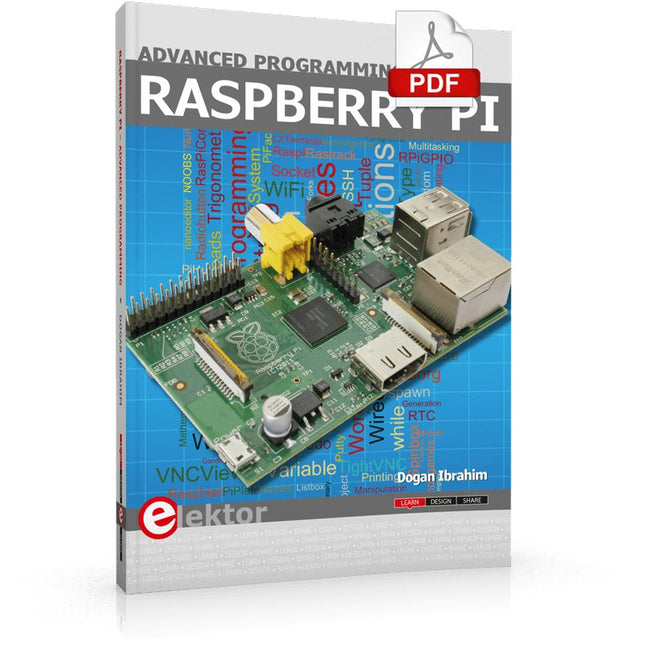
This book is about advanced programming of the Raspberry Pi computer using the Python programming language. The book explains in simple terms and with examples:
How to configure the Raspberry Pi computer;
How to install and use the Linux operating system and the desktop;
How to write advanced programs using the Python programming language;
How to use graphics in our programs;
How to develop hardware based projects using the Raspberry Pi.
The book starts with an introduction to the Raspberry Pi computer and covers the topics of purchasing all the necessary accessories and installing and operating the Linux operating system in command mode. The network interface of the RPi is explained in simple steps, demonstrating how the computer can be accessed remotely from a desktop or a laptop computer.
The remaining parts of the book cover the Python programming language in detail, including advanced topics such as operating system calls, multitasking, interprocess synchronization and interprocess communication techniques. The important topic of network programming using UDP and TCP protocols is described with working examples. The Tkinter graphical user interface module (GUI) is described in detail with example widgets and programs.
The last part of the book includes hardware projects based on using the advanced programming topics such as multitasking and interprocess communication techniques. All the projects given in the book have been fully tested and are working. Complete program listings of all projects are provided with detailed explanations.
Diese Ausgabe steht allen GOLD- und GREEN-Mitgliedern auf der ElektorMagazine-Website zum Download bereit!
Sie sind noch kein Mitglied? Hier klicken!
Relio v1.0 – Anwesenheitserkennung und FernsteuerungEin Matter-fähiger Smart-Controller für Hausgeräte
Bessere Leiterplatten entwerfenEin praxisnaher Leitfaden für Profis und Maker
KiCad 9Die wichtigsten neuen und aktualisierten Funktionen
Präzisions-Picoamperemeter (Teil 1)Mit Kennlinienschreiber-Funktion bis in den pA-Bereich
Analoger Pipeline-VerzerrerEin cooler Audioeffekt für Gitarren und andere Instrumente
Halogene in LötmittelnFakten statt Mythen
100-mV-Durchgangsprüfer
Wer treibt die europäische Elektronik voran?Unternehmen im Fokus
productronica 2025Neuheiten in Elektronikentwicklung und -fertigung
Automatisierung bewältigt Herausforderungenwie Reshoring, Zölle und Arbeitskräftemangel
Mehr als ZukunftssicherheitKreislaufwirtschaft in der Elektronik
Passive BauelementeVerlustarme Induktivitäten für hocheffiziente DC/DC-Wandler
PCB-Produktion im WandelDesktop-Maschinen eröffnen neue Wege für die Leiterplattenfertigung
Aller Anfang ...... braucht Spannung
UHD-Displays mühelos ansteuernIhr Leitfaden, um unterschiedliche TFT-LCDs schnell in Betrieb zu nehmen
Löten im Jahr 2025Praktische Tipps direkt von der Werkbank
Weihnachtsstern 2025Ein Stern wird gelötet
SimulIDEEin All-in-One-Werkzeug für die Schaltungsentwicklung
2025: Eine KI-OdysseeVom Autovervollständiger zum Kollegen
Wortreicher WeihnachtsbaumEin festliches Elektronikprojekt mit verbalem Highlight
Projekt 2.0Korrekturen, Updates und Leserbriefe
ESP32-Audio-Transceiver-Board (Teil 3)Stereosender und Dual Radio
Technology is constantly changing. New microcontrollers become available every year and old ones become redundant. The one thing that has stayed the same is the C programming language used to program these microcontrollers. If you would like to learn this standard language to program microcontrollers, then this book is for you!
ARM microcontrollers are available from a large number of manufacturers. They are 32-bit microcontrollers and usually contain a decent amount of memory and a large number of on-chip peripherals. Although this book concentrates on ARM microcontrollers from Atmel, the C programming language applies equally to other manufacturer’s ARMs as well as other microcontrollers.
Features of this book
Use only free or open source software.
Learn how to download, set up and use free C programming tools.
Start learning the C language to write simple PC programs before tackling embedded programming - no need to buy an embedded system right away!
Start learning to program from the very first chapter with simple programs and slowly build from there.
No programming experience is necessary!
Learn by doing - type and run the example programs and exercises.
Sample programs and exercises can be downloaded from the Internet.
A fun way to learn the C programming language.
Ideal for electronic hobbyists, students and engineers wanting to learn the C programming language in an embedded environment on ARM microcontrollers.
Elektor GREEN en GOLD leden kunnen deze uitgave hier downloaden.
Nog geen lid? Klik hier om een lidmaatschap af te sluiten.
Relio v1.0 – Aanwezigheidsdetectie en afstandsbedieningEen smart controller met Matter-functionaliteit voor AC-apparaten
Betere printplaten ontwerpenEen praktische gids voor professionals en makers
KiCad 9De belangrijkste nieuwe en verbeterde functies
Precisie pico-ampèremeter (1)Met curvetracer-functionaliteit tot in het pA-bereik!
Kerstster 2025soldeer de sterren van de hemel!
100mV-doorgangstester
Wie verlegt de grenzen van de Europese elektronica?Bedrijven om in het oog te houden
Productronica 2025: Wat is er nieuw in de ontwikkeling en productie van elektronica
Automatisering om reshoring van productie, invoerheffingen en tekorten aan arbeidskrachten aan te pakken
Meer dan toekomstbestendigCirculariteit in elektronica
Passieve componentenVerliesarme inductoren voor hoogrendements DC/DC-converters
Hoe desktopmachines de printplaatproductie toegankelijker maken
Alle begin......heeft voeding nodig
Uit het leven gegrepenKnopjeskoorts
Soldeertechniek in 2025Praktische soldeertips rechtstreeks van de werkbank
SimulIDEEen alles-in-één tool voor circuit-prototyping
2025: Een AI OdysseyVan autocomplete tot collega
Wordy Christmas TreeEen feestelijk elektronica-project met een taalkundig tintje
Err-lectronicsCorrecties, updates en lezersbrieven
Analoge pipeline-vervormingEen fraai audio-effect voor gitaren en andere instrumenten
ESP32 audiotransceiver-board (deel 3)Stereotransmissie en dual-radio
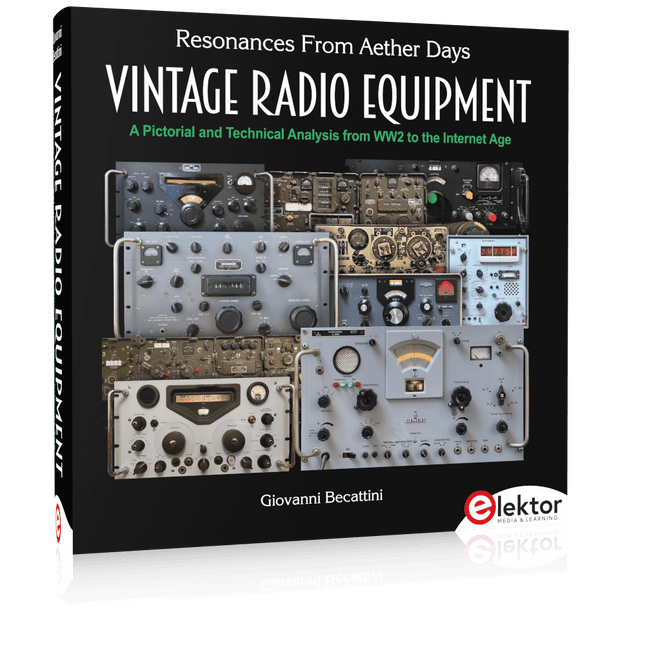
Resonances From Aether Days
A Pictorial and Technical Analysis from WWII to the Internet Age
From the birth of radio to the late 1980s, much of real life unfolded through shortwave communication. World War II demonstrated—beyond a shadow of a doubt—that effective communications equipment was a vital prerequisite for military success. In the postwar years, shortwave became the backbone on which many of the world's most critical services depended every day.
All the radio equipment—through whose cathodes, grids, plates, and transistors so much of human history has flowed—is an exceptional subject of study and enjoyment for those of us who are passionate about vintage electronics. In this book, which begins in the aftermath of World War II, you’ll find a rich collection of information: descriptions, tips, technical notes, photos, and schematics that will be valuable for anyone interested in restoring—or simply learning about—these extraordinary witnesses to one of the most remarkable eras in technological history.
My hope is that these pages will help preserve this vast treasure of knowledge, innovation, and history—a heritage that far transcends the purely technical.
310 Schakelingen – alweer het elfde boek uit de bekende „driehonderd“-reeks. De 310 schakelingen, tips en ideeën in dit boek vormen een (bijna) onuitputtelijke schatkamer op alle terreinen die de elektronica rijk is: audio en video, hobby en modelbouw, hoogfrequenttechniek, huis en tuin, meten en testen, microprocessor, PC-hardware en -software, voedingen en acculaders plus al dat andere dat niet zo gemakkelijk in een van deze categorieën kan worden ondergebracht.
310 Schakelingen – bevat veel complete oplossingen of in elk geval de aanzet daartoe. En de 310 beschreven schakelingen vormen in elk geval een bron van inspiratie voor nieuwe eigen ontwikkelingen!
310 Schakelingen – samengesteld uit de Halfgeleidergidsen van 2006, 2007 en 2008. De Halfgeleidergids is het jaarlijkse dubbeldikke juli/augustus-zomernummer van het maandblad Elektor.
310 Schakelingen – een must voor iedereen die creatief met elektronica bezig is, beroepsmatig of als hobby.
310 Schakelingen – met dit jaar een speciaal aan robots en robotica gewijde sectie.
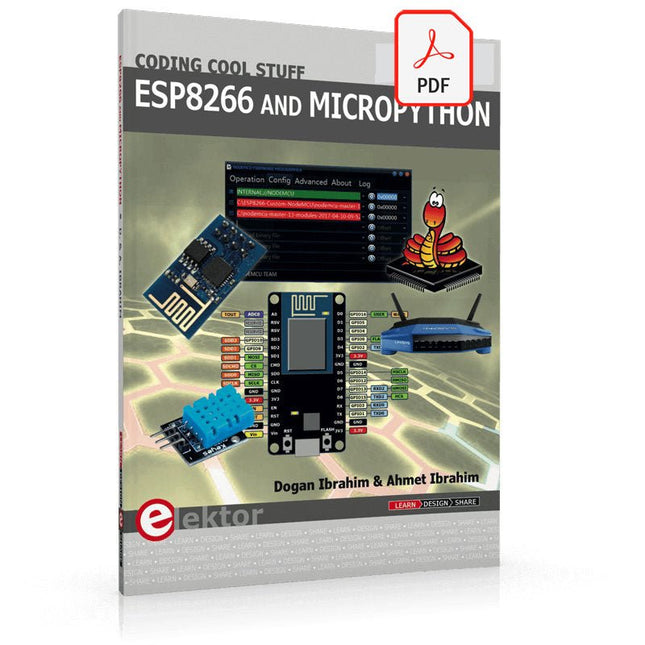
Recently, the development of a tiny chip called the ESP8266 has made it possible to interface any type of microcontroller to a Wi-Fi AP. The ESP8266 is a low-cost tiny Wi-Fi chip having fully built-in TCP/IP stack and a 32-bit microcontroller unit. This chip, produced by Shanghai based Chinese manufacturer Espressif System, is IEEE 802.11 b/g/n Wi-Fi compatible with on-chip program and data memory, and general purpose input-output ports. Several manufacturers have incorporated the ESP8266 chip in their hardware products (e.g. ESP-xx, NodeMCU etc) and offer these products as a means of connecting a microcontroller system such as the Android, PIC microcontroller or others to a Wi-Fi. The ESP8266 is a low-power chip and costs only a few Dollars.
ESP8266 and MicroPython – Coding Cool Stuff is an introduction to the ESP8266 chip and describes the features of this chip and shows how various firmware and programming languages such as the MicroPython can be uploaded to the chip. The main aim of the book is to teach the readers how to use the MicroPython programming language on ESP8266 based hardware, especially on the NodeMCU.
Several interesting and useful projects are given in the e-book (pdf) to show how to use the MicroPython in NodeMCU type ESP8266 hardware:
Project “What shall I wear today?”: You will be developing a weather information system using a NodeMCU development board together with a Text-to-Speech processor module.
Project “The Temperature and Humidity on the Cloud”: You will be developing a system that will get the ambient temperature and humidity using a sensor and then store this data on the cloud so that it can be accessed from anywhere.
Project “Remote Web Based Control”: You will be developing a system that will remotely control two LEDs connected to a NodeMCU development board using an HTTP Web Server application.
Dieser verstellbare Platinenhalter ist ideal zum Klemmen von Platinen zum Löten, Entlöten oder Nacharbeiten.
Fetaures
2 verstellbare Griffe auf einem einziehbaren Ständer für verschiedene Boardgrößen.
Die verstellbaren Klemmen ermöglichen es der Leiterplatte, sich um 360 Grad zu drehen und in jeder Position zu bleiben.
Die Grundplatte dieses starren Metallständers verfügt über vier Gummifüße, um Stabilität zu gewährleisten.
Technische Daten
Produktgröße
30 x 16,5 x 12,5 cm
Max. Größe der Halterung
20 x 14 cm
Gewicht
450 g
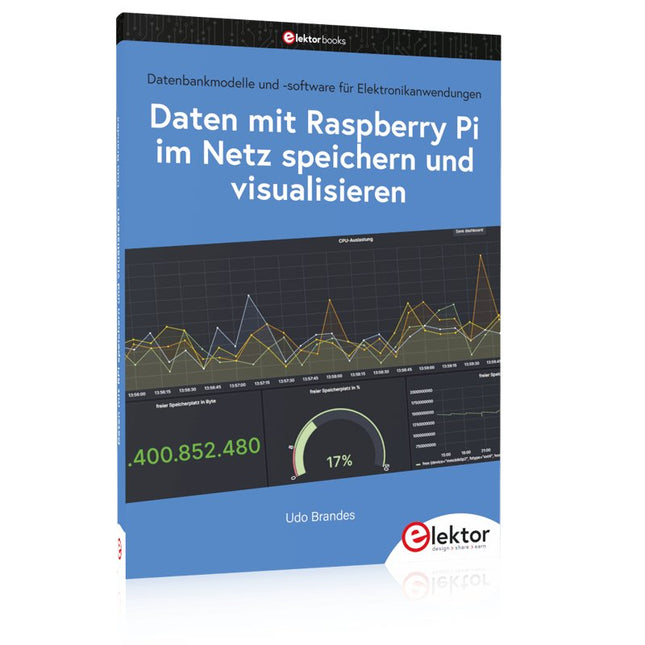
Datenbankmodelle und -software für Elektronikanwendungen
Mit seiner Energieeffizienz und seinem reichen Spektrum an quelloffener Software eignet sich der Einplatinencomputer Raspberry Pi auch für die Speicherung von Daten und deren grafische Aufbereitung lokal oder im World Wide Web (WWW).
Dieses Buch stellt verschiedene Datenbankmodelle und diverse Datenbanksoftware vor:
SQL: MariaDB, SQLite
InfluxDB: Telegraf
Grafana
MQTT
Verschlüsselung mit RPi
Apache
PHP
Node RED
Docker
Es zeigt darüber hinaus ausgewählte Ansätze, gespeicherte Daten anzuzeigen und zu verwalten. Ein eigener Abschnitt ist sowohl der SSL-Verschlüsselung der Verbindung als auch dem Betrieb von Servern im WWW gewidmet.
Das Buch richtet sich an alle,
die neugierig sind und gerne die Möglichkeiten des Raspberry Pi ausloten möchten,
die einen Einstieg in das Datenmanagement mit Datenbanken suchen,
die mit einfachen Mitteln schnell loslegen möchten,
die Alternativen aufgezeigt bekommen möchten,
die in komprimierter Form Tipps für eigene Entwicklungen suchen,
die Freude am eigenen Entwickeln und Realisieren haben.
Programmierkenntnisse und -erfahrungen sind für die Installation der Software nicht erforderlich. Jeder einzelne Schritt wird detailliert beschrieben und mit Screenshots visuell unterlegt.
Diese Ausgabe steht allen GOLD- und GREEN-Mitgliedern auf der ElektorMagazine-Website zum Download bereit!
Sie sind noch kein Mitglied? Hier klicken!
Relio v1.0 – Anwesenheitserkennung und FernsteuerungEin Matter-fähiger Smart-Controller für Hausgeräte
Bessere Leiterplatten entwerfenEin praxisnaher Leitfaden für Profis und Maker
KiCad 9Die wichtigsten neuen und aktualisierten Funktionen
Präzisions-Picoamperemeter (Teil 1)Mit Kennlinienschreiber-Funktion bis in den pA-Bereich
Analoger Pipeline-VerzerrerEin cooler Audioeffekt für Gitarren und andere Instrumente
Halogene in LötmittelnFakten statt Mythen
100-mV-Durchgangsprüfer
Wer treibt die europäische Elektronik voran?Unternehmen im Fokus
productronica 2025Neuheiten in Elektronikentwicklung und -fertigung
Automatisierung bewältigt Herausforderungenwie Reshoring, Zölle und Arbeitskräftemangel
Mehr als ZukunftssicherheitKreislaufwirtschaft in der Elektronik
Passive BauelementeVerlustarme Induktivitäten für hocheffiziente DC/DC-Wandler
PCB-Produktion im WandelDesktop-Maschinen eröffnen neue Wege für die Leiterplattenfertigung
Aller Anfang ...... braucht Spannung
UHD-Displays mühelos ansteuernIhr Leitfaden, um unterschiedliche TFT-LCDs schnell in Betrieb zu nehmen
Löten im Jahr 2025Praktische Tipps direkt von der Werkbank
Weihnachtsstern 2025Ein Stern wird gelötet
SimulIDEEin All-in-One-Werkzeug für die Schaltungsentwicklung
2025: Eine KI-OdysseeVom Autovervollständiger zum Kollegen
Wortreicher WeihnachtsbaumEin festliches Elektronikprojekt mit verbalem Highlight
Projekt 2.0Korrekturen, Updates und Leserbriefe
ESP32-Audio-Transceiver-Board (Teil 3)Stereosender und Dual Radio
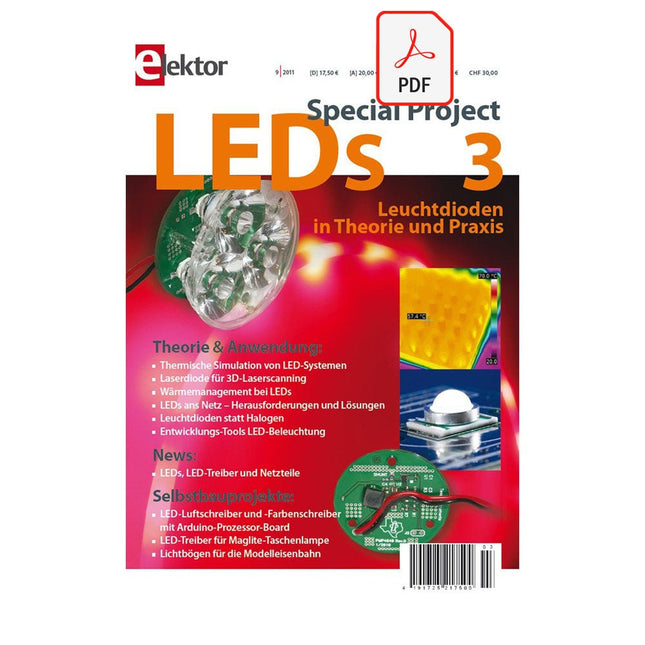
Inhalt
Theorie & Anwendung
Thermische Simulation von LED-Systemen
LUVLED
100 LEDs
LEDs ans Netz
Laserstrukturierung von TCOs
Ha(l)lo LED
Wärmemanagement bei LEDs
3D-Laserscanning mit Linienlaser und Smart Camera
Selbstbauprojekte
Lichtbögen für die Modelleisenbahn
LED-Anwendungen mit Arduino
LED-Treiber für Maglite-Taschenlampe