
Suchergebnisse für "toolcraft OR st OR 100d OR digital OR soldering OR station OR 100 OR w"
-

UFactory UFactory 850 Roboterarm
UFactory 850 ist der leistungsstärkste Roboter mit Leistung auf Industrieniveau. Funktionen 6DoF Nutzlast: 5 kg Reichweite: 850 mm Wiederholgenauigkeit: 0,02 mm Gewicht: 20 kg Anwendungen Glambot Schweißen Schrauben Roboter-Vision Industrielle Produktion Entwickelt sowohl für mobile Plattformen als auch für Ihre Werkbank In der AC-Steuerbox befindet sich ein AC-DC-Adapter, 100-240 V AC ist alles betriebsbereit. Die DC-Steuerbox unterstützt 48-72 V breite Eingänge und passt perfekt zum Batteriesystem Ihrer mobilen Plattform. Flexible Bereitstellung mit sicherer Funktion Hand-Teaching, platzsparend und einfach für mehrere Anwendungen einsetzbar, ohne Ihr Produktionslayout zu ändern. Perfekt für wiederkehrende Aufgaben. Kollisionserkennung ist für alle unsere Cobots verfügbar. Ihre Sicherheit hat immer oberste Priorität. Grafische Oberfläche für einsteigerfreundliche Programmierung Kompatibel mit verschiedenen Betriebssystemen, einschließlich macOS und Windows. Webbasierte Technologie, kompatibel mit allen gängigen Browsern. Drag & Drop, um Ihren Code in wenigen Minuten zu erstellen. Leistungsstarkes und Open-Source-SDK immer zur Hand Das voll funktionsfähige Open-Source-Python/C++-SDK bietet eine flexiblere Programmierung. ROS/ROS2-Pakete sind einsatzbereit. Beispielcodes helfen Ihnen, den Roboterarm reibungslos einzusetzen. Technische Daten UFactory 850 xArm 5 xArm 6 xArm 7 Nutzlast 5 kg 3 kg 5 kg 3,5 kg Reichweite 850 mm 700 mm 700 mm 700 mm Freiheitsgrade 6 5 6 7 Wiederholbarkeit ±0,02 mm ±0,1 mm ±0,1 mm ±0,1 mm Maximale Geschwindigkeit 1 m/s 1 m/s 1 m/s 1 m/s Gewicht (nur Roboterarm) 20 kg 11,2 kg 12,2 kg 13,7 kg Maximale Geschwindigkeit 180°/s 180°/s 180°/s 180°/s Joint 1 ±360° ±360° ±360° ±360° Joint 2 -132°~132° -118°~120° -118°~120° -118°~120° Joint 3 -242°~3.5° -225°~11° -225°~11° ±360° Joint 4 ±360° -97°~180° ±360° -11°~225° Joint 5 -124°~124° ±360° -97°~180° ±360° Joint 6 ±360° ±360° -97°~180° Joint 7 ±360° Hardware Umgebungstemperaturbereich 0-50°C Stromverbrauch Typisch 240 W, maximal 1000 W Eingangsstromversorgung 48 V DC, 20,8 A Fußabdruck Ø 190 mm Materialien Aluminium, Kohlefaser Basis-Connector-Typ M8x4 Reinraum der ISO-Klasse 5 Robotermontage Alle Endeffektor-Kommunikationsprotokoll Modbus RTU Endeffektor-E/A 2x DI / 2x DO / 2x AI / 1x RS485 Kommunikationsmodus Ethernet Lieferumfang 1x UFactory 850 Roboterarm 1x AC-Steuerbox 1x Steuerbox-Stromkabel
€ 11.779,00
Bestpreis
-
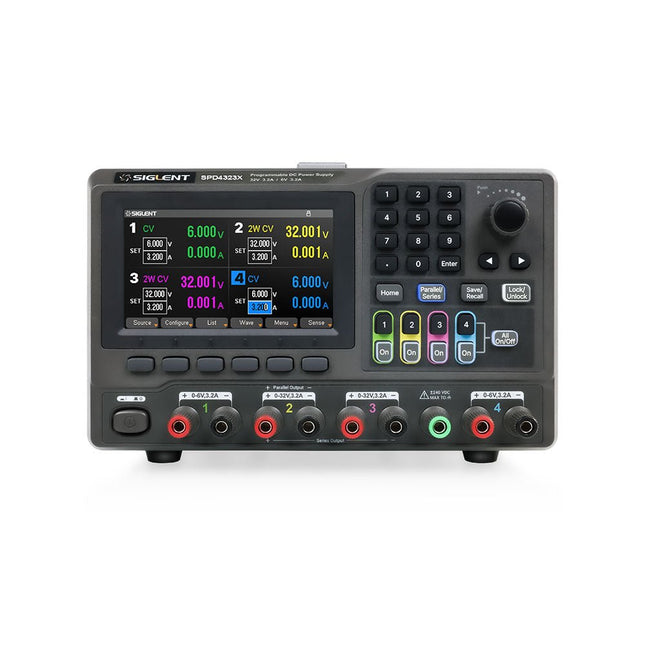
Siglent Siglent SPD4323X 4-Kanal Netzteil (240 W)
The Siglent SPD4323X is a 4-channel DC Linear Programmable Power Supply equipped with a 4.3-inch TFT-LCD display, friendly human-machine interface, and excellent performance indicators. Real-time waveform display provides engineers with an informative user interface. SPD4323X offers a total output power of 240 W with a resolution of 1 mV/1 mA. The maximum voltage and current for each channel are as follows: CH1: 6 V/3.2 A CH2: 32 V/3.2 A CH3: 32 V/3.2 A CH4: 6 V/3.2 A Features Rated output power: 240 W Rated voltage: 32 V, 12 V, 30 V Up to four high-precision power supplies with independent controllable outputs, supporting CH2 and CH3 series and parallel connections Clear graphical interface with waveform and timer display modes 5-digit voltage and current display with minimum resolution of 1 mV, 1 mA Fast output response time: <50us The high current channel support remote voltage compensation sense function. The maximum compensation voltage is 0.6 V Overvoltage protection and overcurrent protection or safe and accurate operation Equipped with a 4.3-inch TFT-LCD display (480 x 272 resolution) USB and LAN standard communication USB-GPIB module is optional Excellent channel density with up to 4 channels in a 3U half rack package Internal data storage for setups and parameters Embedded Web Server with instrument communication that doesn’t require software installation Fully SCPI programming command set support as well as a LabView driver for remote control and system automation Technische Daten SPD4323X SPD4121X SPD4306X Channel Output CH1: Voltage 0 to 6 V Current 0 to 3.2 ACH2: Voltage 0 to 32 V Current 0 to 3.2 ACH3: Voltage 0 to 32 V Current 0 to 3.2 ACH4: Voltage 0 to 6 V Current 0 to 3.2 A CH1: Voltage 0 to 15 V Current 0 to 1.5 ACH2: Voltage 0 to 12 V Current 0 to 10 ACH3: Voltage 0 to 12 V Current 0 to 10 ACH4: Voltage 0 to 15 V Current 0 to 1.5 A CH1: Voltage 0 to 15 V Current 0 to 1.5 ACH2: Voltage 0 to 30 V Current 0 to 6 ACH3: Voltage 0 to 30 V Current 0 to 6 ACH4: Voltage 0 to 15 V Current 0 to 1 A Resolution 1 mV, 1 mA 1 mV, 1 mA 1 mV, 1 mA Setting Accuracy Voltage: ±(0.03% of reading+10) mV, Current: ±(0.3% of reading+10) mA Voltage: ±(0.03% of reading+10) mV, Current: ±(0.3% of reading+10) mA Voltage: ±(0.03% of reading+10) mV, Current: ±(0.3% of reading+10) mA Readback Accuracy Voltage: ±(0.03% of reading+10) mV, Current: ±(0.3% of reading+10) mA Voltage: ±(0.03% of reading+10) mV, Current: ±(0.3% of reading+10) mA Voltage: ±(0.03% of reading+10) mV, Current: ±(0.3% of reading+10) mA Display 4.3" TFT-LCD 5-digit voltage and current display 4.3" TFT-LCD 5-digit voltage and current display 4.3" TFT-LCD 5-digit voltage and current display Output power 240 W 285 W 400 W Lieferumfang 1x Siglent SPD4323X Power Supply 1x Power cord (EU) 1x Output test cord (3 A) 1x USB cable 1x Quick start guide Downloads Datasheet Manual Quick start
€ 762,30
Bestpreis
-

Siglent Siglent SPD4306X 4-Kanal Netzteil (400 W)
The Siglent SPD4306X is a 4-channel DC Linear Programmable Power Supply equipped with a 4.3-inch TFT-LCD display, friendly human-machine interface, and excellent performance indicators. Real-time waveform display provides engineers with an informative user interface. SPD4306X offers a total output power of 400 W with a resolution of 1 mV/1 mA. The maximum voltage and current for each channel are as follows: CH1: 15 V/1.5 A CH2: 30 V/6 A CH3: 30 V/6 A CH4: 15 V/1 A Features Rated output power: 400 W Rated voltage: 32 V, 12 V, 30 V Up to four high-precision power supplies with independent controllable outputs, supporting CH2 and CH3 series and parallel connections Clear graphical interface with waveform and timer display modes 5-digit voltage and current display with minimum resolution of 1 mV, 1 mA Fast output response time: <50us The high current channel support remote voltage compensation sense function. The maximum compensation voltage is 0.6 V Overvoltage protection and overcurrent protection or safe and accurate operation Equipped with a 4.3-inch TFT-LCD display (480 x 272 resolution) USB and LAN standard communication USB-GPIB module is optional Excellent channel density with up to 4 channels in a 3U half rack package Internal data storage for setups and parameters Embedded Web Server with instrument communication that doesn’t require software installation Fully SCPI programming command set support as well as a LabView driver for remote control and system automation Technische Daten SPD4323X SPD4121X SPD4306X Channel Output CH1: Voltage 0 to 6 V Current 0 to 3.2 ACH2: Voltage 0 to 32 V Current 0 to 3.2 ACH3: Voltage 0 to 32 V Current 0 to 3.2 ACH4: Voltage 0 to 6 V Current 0 to 3.2 A CH1: Voltage 0 to 15 V Current 0 to 1.5 ACH2: Voltage 0 to 12 V Current 0 to 10 ACH3: Voltage 0 to 12 V Current 0 to 10 ACH4: Voltage 0 to 15 V Current 0 to 1.5 A CH1: Voltage 0 to 15 V Current 0 to 1.5 ACH2: Voltage 0 to 30 V Current 0 to 6 ACH3: Voltage 0 to 30 V Current 0 to 6 ACH4: Voltage 0 to 15 V Current 0 to 1 A Resolution 1 mV, 1 mA 1 mV, 1 mA 1 mV, 1 mA Setting Accuracy Voltage: ±(0.03% of reading+10) mV, Current: ±(0.3% of reading+10) mA Voltage: ±(0.03% of reading+10) mV, Current: ±(0.3% of reading+10) mA Voltage: ±(0.03% of reading+10) mV, Current: ±(0.3% of reading+10) mA Readback Accuracy Voltage: ±(0.03% of reading+10) mV, Current: ±(0.3% of reading+10) mA Voltage: ±(0.03% of reading+10) mV, Current: ±(0.3% of reading+10) mA Voltage: ±(0.03% of reading+10) mV, Current: ±(0.3% of reading+10) mA Display 4.3" TFT-LCD 5-digit voltage and current display 4.3" TFT-LCD 5-digit voltage and current display 4.3" TFT-LCD 5-digit voltage and current display Output power 240 W 285 W 400 W Lieferumfang 1x Siglent SPD4306X Power Supply 1x Power cord (EU) 1x Output test cord (3 A) 1x USB cable 1x Quick start guide Downloads Datasheet Manual Quick start
€ 1.101,10
Bestpreis
-
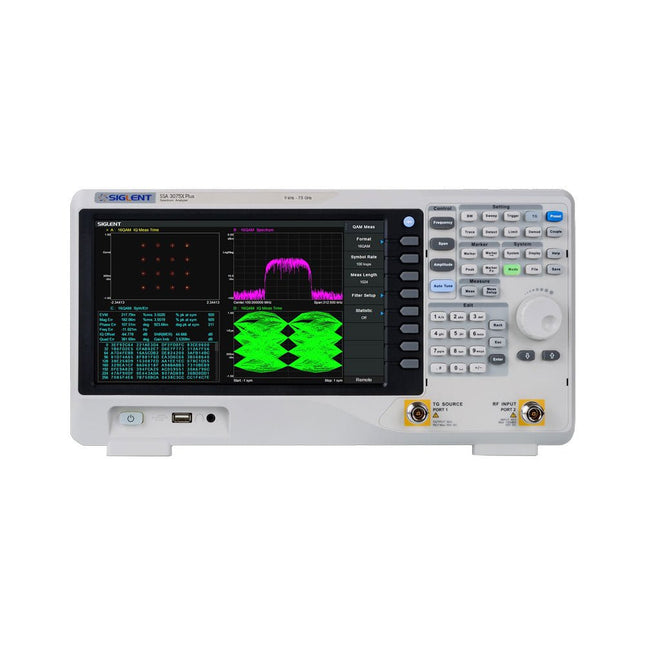
Siglent Siglent SSA3075X Plus Spektrum-Analyzer (9 kHz - 7,5 GHz)
Der Siglent SSA3075X Plus Spektrum-Analyzer ist ein leistungsstarkes und flexibles Werkzeug für die HF-Signal- und Netzwerkanalyse. Mit einem Frequenzbereich von 7,5 GHz bietet der Analysator zuverlässige automatische Messungen und mehrere Betriebsarten: Spektrum-Analyzer als Basis, optionale Funktionen umfassen HF-Leistungsmessung, Vektorsignal-Modulationsanalyse, Reflexionsmessung und EMI-Test. Zu den Anwendungsbereichen gehören die Überwachung/Bewertung von Sendungen, Standortvermessung, S-Parameter-Messung, analoge/digitale Modulationsanalyse, EMI-Vorprüfung, Forschung und Entwicklung, Ausbildung, Produktion und Wartung. Features Frequenzbereich des Spektrum-Analyzer von 9 kHz bis 7,5 GHz –165 dBm/Hz Angezeigter durchschnittlicher Geräuschpegel (typisch) –98 dBc/Hz. @ 10 kHz Offset-Phasenrauschen (1 GHz, typ.) Pegelmessunsicherheit <0,7 dB (typ.) 1 Hz Mindestauflösungsbandbreite (RBW) Vorverstärker (Std.) Tracking Generator (kostenlos inkl.) Analysemodus für analoge und digitale Signalmodulation (opt.) Reflexionsmesskit (opt.) EMI-Filter und Quasi-Peak-Detektor-Kit (opt.) Erweitertes Messkit (opt.) 10,1-Zoll-Multi-Touch-Bildschirm, Maus und Tastatur werden unterstützt Webbrowser-Fernsteuerung auf PCs und mobilen Endgeräten sowie Dateibetrieb Technische Daten SSA3015X Plus SSA3021X Plus SSA3032X Plus SSA3075X Plus Frequenzbereich 9 kHz ~ 1,5 GHz 9 kHz ~ 2,1 GHz 9 kHz ~ 3,2 GHz 9 kHz ~ 7,5 GHz Auflösung Bandbreite 1 Hz ~ 1 MHz 1 Hz ~ 1 MHz 1 Hz ~ 1 MHz 1 Hz ~ 3 MHz Phasenrauschen <–99 dBc/Hz <–98 dBc/Hz <–98 dBc/Hz <–98 dBc/Hz Genauigkeit der Gesamtamplitude <1,2 dB <0,7 dB <0,7 dB <0,7 dB Anzeige des durchschnittlichen Geräuschpegels –156 dBm/Hz –161 dBm/Hz –161 dBm/Hz –165 dBm/Hz Lieferumfang Siglent SSA3075X Plus Spektrum-Analyzer USB-Kabel Netzkabel Kurzanleitung Downloads Datasheet Manual Documentation Firmware
€ 7.875,89
Bestpreis
-

Velleman Whadda 3D-Weihnachtsbaum-Kit
Das Whadda 3D-Weihnachtsbaum-Kit richtet sich an Bastler und Anfänger, die sich für Löten und Elektronik interessieren. Mit diesem DIY-Kit können Sie einen festlichen LED-Weihnachtsbaum bauen. Features 16 blinkende rote LEDs Zusätzliche grüne und gelbe LEDs zur individuellen Gestaltung Ihres Baumes Kann an Drähten aufgehängt und durch diese geführt werden Wird mit 12 V Gleichstrom betrieben (z. B. in Autos) Technische Daten Geringer Stromverbrauch 8 mA Stromversorgung 9 V Batterie (nicht im Lieferumfang enthalten) Abmessungen 102 x 88 x 80 mm Gewicht 65 g Downloads Manual
€ 10,77
-

Elektor Digital Elektor November/December 2022 PDF (NL)
Elektor GREEN en GOLD leden kunnen deze uitgave hier downloaden.Nog geen lid? Klik hier om een lidmaatschap af te sluiten. High-end uit het Elektor-lab Fortissimo-100 high-end versterkervolledig symmetrische audio-eindtrap levert 100/190 W Controleer de frequentie van afgestemde kringen en kristallen Printen ontwerpentips en trucs Solderen – nou en?moderne soldeertechnologie nader bekeken Bluetooth-garagedeurbediening met geringe latentiemet korte BLE-berichten vanaf een smartphone Ideale diode-controllerdiodeschakelingen met geringe vermogensdissipatie LED-slingers met ESP32 en FreeRTOSknipperen dat het een lieve lust is Alle begin......zenert er vrolijk op los FM/DAB+ ontvangerhet beste van twee werelden Uit het leven gegrepenelektronica obscura De oorzaak van software-bugs draadloos opsporencirculaire buffer en webserver op de ESP32 Heeft Covid de innovatie gestimuleerd?innovatieve componenten en oplossingen uit 2022 Ersa i-CON TRACEhet IoT-soldeerstation voor makers Elektor Infographics Wat moeten we met al die computers? Aansturing van het e-paper display van Ynvisible InnoFaith: innovatie en nog eens innovatievraaggesprek met Walter Arkesteijn Industriële automatiseringeenvoudige en schaalbare IoT-retrofitting Reed-relaisvreemde onderdelen Low-profile lineaire connectorenvereenvoudigen multisignaal-databeheer Slim – Innovatief – KosteneffectiefGateMate FPGA’s worden ontwikkeld en geproduceerd in Duitsland Tools voor de ontwikkeling van goedkope sensoren Polyfusesvreemde onderdelen Geïsoleerde analoge uitgang voor Arduino Uno Oost West Lab Best...ontdekt de Theremin electronica fast forward 2022 – powered by Elektorde deelnemers en het programma Radiorichtingzoekerspoor verloren weersensoren op Schat de interne ruis van een ICeen eenvoudige methode Ethiek in actiepowered by WEEF Zonder ethiek geen duurzaam ondernemenvraaggesprek met professor Stefan Heinemann De WEEF Index 2023 Filtersoftwareontwerp-tools voor analoge filters TV-B-Gone!...of tenminste TV tabee Meting van de luchtkwaliteitop basis van de RP2040 elekterminal Snelstart met Python 3voorbeeldhoofdstuk: digitale beeldbewerking en de Wand-bibliotheek SOLARPUNKeen mooiere toekomst in het verschiet Hexadoku
€ 9,95
-

OWON OWON XDG2035 2-Kanal Funktionsgenerator (35 Mhz)
Der 2-Kanal OWON XDG2035 ist ein Funktions-/Wellenformgenerator, der Signale mit einer maximalen Frequenz von 35 MHz erzeugen kann. Der Generator hat eine Auflösung von 1 µHz und eine Abtastrate von 500 MSa/s.Der OWON XDG2035 ist in der Lage, 6 Standardwellenformen und 150 Arbiträrwellenformen zu erzeugen. Mit der mitgelieferten Software können Sie erweiterte Funktionen bis zu 10 Millionen Punkte schreiben. Wellenformen können mit einem PC über USB oder LAN im internen Speicher des Funktionsgenerators gespeichert werden.Der OWON XDG2035 unterstützt auch SCPI-Befehle und LabView. Der Funktionsgenerator verfügt über einen integrierten hochwertigen Frequenzzähler, der von 100 bis 200 MHz arbeiten kann.FeaturesMax. 35 MHz Frequenzausgang500 MSa/s Abtastrate, vertikale Auflösung 1 μHz14 Bit vertikale Auflösung, 10 Marb WellenformlängeUmfassende Wellenformausgabe: 6 Grundwellenformen und 150 integrierte ArbiträrwellenformenUmfassende Modulationsfunktionen: AM, FM, PM, FSK, 3FSK, 4FSK, PSK, OSK, ASK, BPSK, PWM, Sweep und BurstHochpräziser Frequenzzähler integriert, unterstützter Bereich 100-200 MHzSCPI und LabVIEW werden unterstützt7 Zoll Multi-Touch-Bildschirm (800 x 480 Pixel)Technische DatenKanäle2Frequenzausgang35 MHzAbtastrate500 MSa/sVertikale Auflösung14 bitsWellenform Standard WaveformSine, square, pulse, ramp, noise, and harmonicArbitrary WaveformExponential rise, exponential fall, sin(x)/x, step wave, and others, total 150 built-in waveforms, and user-defined arbitrary waveformFrequenz (Auflösung 1 μHz) Sine1 μHz-100 MHzSquare1 μHz ~ 30 MHzPulse1 μHz ~ 25 MHzRamp1 μHz ~ 3 MHzNoise (-3 dB, typical)100 MHzArbitrary Waveform1 μHz ~ 15 MHzHarmonic1 μHz ~ 50 MHzAccuracy±2ppm, 25°C ±5°CWaveform Length2 points - 10M pointsAmplitude Into 50Ω load1mVpp ~ 10Vpp (≤25 MHz); 1mVpp ~ 5Vpp (≤60 MHz); 1mVpp ~ 2.5Vpp (≤100 MHz)Modulation TypeAM, DSB-AM, FM, PM, ASK, FSK, PSK, BPSK, QPSK, 3FSK, 4FSK, OSK, PWM, SUMFrequenzzähler FunctionFrequency, period, +width, -width, +duty, and -dutyFrequency Range100 ~ 200 MHzFrequency Resolution7 digitsInput/Output Input modefrequency counter, external modulation input, external trigger input, internal clock output, external reference clock input/outputCommunication InterfaceUSB Host, USB Device, LAN, RS232 (optional)Mechanische Spezifikationen Abmessungen340 x 177 x 90 mmGewicht2,3 kgLieferumfang1x OWON XDG20351x Netzkabel1x CD-ROM1x Kurzanleitung1x USB-Kabel1x BNC-BNC-KabelDownloadsQuick Guide
€ 333,40
-

Siglent Siglent SSA3015X Plus Spektrum-Analyzer (9 kHz - 1,5 GHz)
Der Siglent SSA3015X Plus Spektrum-Analyzer ist ein leistungsstarkes und flexibles Werkzeug für die HF-Signal- und Netzwerkanalyse. Mit einem Frequenzbereich von 1,5 GHz bietet der Analysator zuverlässige automatische Messungen und mehrere Betriebsarten: Spektrum-Analyzer als Basis, optionale Funktionen umfassen HF-Leistungsmessung, Vektorsignal-Modulationsanalyse, Reflexionsmessung und EMI-Test. Zu den Anwendungsbereichen gehören die Überwachung/Bewertung von Sendungen, Standortvermessung, S-Parameter-Messung, analoge/digitale Modulationsanalyse, EMI-Vorprüfung, Forschung und Entwicklung, Ausbildung, Produktion und Wartung. Features Frequenzbereich des Spektrum-Analyzers von 9 kHz bis 1,5 GHz –156 dBm/Hz Angezeigter durchschnittlicher Geräuschpegel (typisch) –99 dBc/Hz. @ 10 kHz Offset-Phasenrauschen (1 GHz, typ.) Pegelmessunsicherheit <0,7 dB (typ.) 1 Hz Mindestauflösungsbandbreite (RBW) Vorverstärker (Std.) Tracking Generator (kostenlos inkl.) Analysemodus für analoge und digitale Signalmodulation (opt.) Reflexionsmesskit (opt.) EMI-Filter und Quasi-Peak-Detektor-Kit (opt.) Erweitertes Messkit (opt.) 10,1-Zoll-Multi-Touch-Bildschirm, Maus und Tastatur werden unterstützt Webbrowser-Fernsteuerung auf PCs und mobilen Endgeräten sowie Dateibetrieb Technische Daten SSA3015X Plus SSA3021X Plus SSA3032X Plus SSA3075X Plus Frequenzbereich 9 kHz ~ 1,5 GHz 9 kHz ~ 2,1 GHz 9 kHz ~ 3,2 GHz 9 kHz ~ 7,5 GHz Auflösung Bandbreite 1 Hz ~ 1 MHz 1 Hz ~ 1 MHz 1 Hz ~ 1 MHz 1 Hz ~ 3 MHz Phasenrauschen <–99 dBc/Hz <–98 dBc/Hz <–98 dBc/Hz <–98 dBc/Hz Genauigkeit der Gesamtamplitude <1,2 dB <0,7 dB <0,7 dB <0,7 dB Anzeige des durchschnittlichen Geräuschpegels –156 dBm/Hz –161 dBm/Hz –161 dBm/Hz –165 dBm/Hz Lieferumfang Siglent SSA3015X Plus Spektrum-Analyzer USB-Kabel Netzkabel Kurzanleitung Downloads Datasheet Manual Documentation Firmware
€ 1.402,39
Bestpreis
-

Siglent Siglent SSA3032X Plus Spektrum-Analyzer (9 kHz - 3,2 GHz)
Der Siglent SSA3032X Plus Spektrum-Analyzer ist ein leistungsstarkes und flexibles Werkzeug für die HF-Signal- und Netzwerkanalyse. Mit einem Frequenzbereich von 3,2 GHz bietet der Analysator zuverlässige automatische Messungen und mehrere Betriebsarten: Spektrum-Analyzer als Basis, optionale Funktionen umfassen HF-Leistungsmessung, Vektorsignal-Modulationsanalyse, Reflexionsmessung und EMI-Test. Zu den Anwendungsbereichen gehören die Überwachung/Bewertung von Sendungen, Standortvermessung, S-Parameter-Messung, analoge/digitale Modulationsanalyse, EMI-Vorprüfung, Forschung und Entwicklung, Ausbildung, Produktion und Wartung. Features Frequenzbereich des Spektrum-Analyzer von 9 kHz bis 3,2 GHz –161 dBm/Hz Angezeigter durchschnittlicher Geräuschpegel (typisch) –98 dBc/Hz. @ 10 kHz Offset-Phasenrauschen (1 GHz, typ.) Pegelmessunsicherheit <0,7 dB (typ.) 1 Hz Mindestauflösungsbandbreite (RBW) Vorverstärker (Std.) Tracking Generator (kostenlos inkl.) Analysemodus für analoge und digitale Signalmodulation (opt.) Reflexionsmesskit (opt.) EMI-Filter und Quasi-Peak-Detektor-Kit (opt.) Erweitertes Messkit (opt.) 10,1-Zoll-Multi-Touch-Bildschirm, Maus und Tastatur werden unterstützt Webbrowser-Fernsteuerung auf PCs und mobilen Endgeräten sowie Dateibetrieb Technische Daten SSA3015X Plus SSA3021X Plus SSA3032X Plus SSA3075X Plus Frequenzbereich 9 kHz ~ 1,5 GHz 9 kHz ~ 2,1 GHz 9 kHz ~ 3,2 GHz 9 kHz ~ 7,5 GHz Auflösung Bandbreite 1 Hz ~ 1 MHz 1 Hz ~ 1 MHz 1 Hz ~ 1 MHz 1 Hz ~ 3 MHz Phasenrauschen <–99 dBc/Hz <–98 dBc/Hz <–98 dBc/Hz <–98 dBc/Hz Genauigkeit der Gesamtamplitude <1,2 dB <0,7 dB <0,7 dB <0,7 dB Anzeige des durchschnittlichen Geräuschpegels –156 dBm/Hz –161 dBm/Hz –161 dBm/Hz –165 dBm/Hz Lieferumfang Siglent SSA3032X Plus Spektrum-Analyzer USB-Kabel Netzkabel Kurzanleitung Downloads Datasheet Manual Documentation Firmware
€ 2.951,19
Bestpreis
-

Elektor Circuit Special 2025 (EN)
Elektor GREEN and GOLD members can download their digital edition here. Not a member yet? Click here. USB Measurement AdapterTesting Current and Signal Quality of USB Ports 4...20 mA Current Output for Arduino UnoA Reliable, EMI-Insensitive Current Loop Interface Vacuum Cleaner Automatic ControlKeep Your Tools’ Work Area Clean DDS Generator with ATtiny Opamp-Tester V2New PCB – Now Also Suitable for SMDs 550-mW “Lamp” Audio AmplifierGet the Warm Sound of Vacuum Tubes With Ease Fuse GuardMonitoring a Fuse with a Flashing LED HQ RIAA PreamplifierGet the Most Out of Your Vinyl Records! Turntable Speed CalibratorAn Arduino-Based 100–120 Hz Strobe Light Generator Elektor Classics: video buffer/repeater Infrared Remote-Controlled DimmerControl Your Halogen or LED Floor Lamp Effortlessly and With Style How to Use switch…case on Strings in C++/Arduino IDE Magnet FinderWith a Simple Hall-Effect Sensor Raspberry Pi Smart Power ButtonA Solution for Raspberry Pi Up to Model 4 Essential Maker TipsProfessional Insights for Everyday Making Practical Projects with the 555 TimerDC Motor Control and Fast Reaction Challenges Basic AC-Load-On MonitorSave Energy with a Simple Device Power Banks in ParallelA Three-Day Continuous Power Solution VFO Up to 15 MHzAn Implementation With Raspberry Pi Pico Violin Tuner with ATtiny202 Elektor Classics: video amplifier for B/W television sets Capacitance Meter20 pF to 600 nF Quasi-Analog Clockwork Mk IITwo LED Rings for Hours and Minutes You Can Do Anything You Want(with the Arduino Ecosystem at Your Side) Neon Lamp Dice Elektor Classics: RTTY calibrator indicator Inspiring Hardware Designs for Your ESPs Elektor Classics: variable 3 A power supply RGB LEDs with Integrated Control CircuitLight with Precision: ICLEDs Set Standards Experiment: Towards a Mixed-Signal Theremin?Blending Modern Time-of-Flight Sensors With the Timeless XR2206 Analog Generator ESP32 Audio Transceiver Board (Part 1)SD Card WAV File Player Demo Infographics: Circuits and Circuit Design 2025 Small Audio MixerA Simple and Versatile Scalable Design Smart Staircase Light TimerSave More Money on the Energy Bill! Smarten Up Your ShuttersControlling Velux Hardware With an ESP32 and MQTT Solid-State Foot WarmerEnergy-Efficient Comfort Is the M5Stamp Fly Quadcopter the Next Tello? Boosting Wi-Fi Range of the ESP32-C3 SuperMiniA Simple and Effective Antenna Mod ZD-8968 Hot-Air Soldering StationA Budget-Friendly Workhorse or Just Hot Air? Parking Sensor TesterFinding Defects in the PDC System of a Car
€ 14,90
-

Elektor Digital Elektor January/February 2020 (PDF) EN
GUI with Touch — for ESP32, RPi & Co.Graphical user interfaces with the LittlevGL library "Not Just Any Guy's Project”Interview with Gábor Kiss-Vámosi, the developer of LittlevGL Capaci-Meterwith two-digit Dekatron-style LED display How To: Debounce a Mechanical Contact or SwitchA switch is either open or closed, isn't It? Developer's ZoneTips & Tricks, Best Practices and Other Useful Information Extendable Environmental Monitoring Systempublishes data on IoT platforms Practical ESP32 MultitaskingTask programming with FreeRTOS and the Arduino IDE InteractiveCorrections & Updates || Questions & Answers Automotive Headlight TuningLegal, illegal — it matters! Review: Toolcraft Digital Soldering Station Arduino Pro IDE - First Impressions Two Thermal Imaging Cameras ComparedSeek ShotPro and Seek Compact Steeped in ElectronicsOutfitting the e-lab and e-workshop Monsanto MAN1 LED DisplayPeculiar Parts, the series Thermoelectric Tea TimerFirst dealings with energy harvesting Single-Phase 1-Kilowatt AC Motor DriveThree-mode design: integral-cycle switching, phase-cut trailing, or phase-cut leading edge. RPi Gets a Fast 3.5" Touch DisplayMore power at no extra charge Lab, Sweet LabA glimpse of The Holy Place — no unauthorized entry. First Steps with RISC-VTrying out the LoFive Board Elektor Labs Challenged: a DIY LoRa Tracker Glitches and results in electronics development Sigfox and the IoT (2)Registration in the Sigfox network Starting Out in ElectronicsEasier than imagined! Analogue Electronics Design Case Study #1 — Section 1: MEMS Microphone… Testing 1-2-3 Small Circuits RevivalCapita Selecta from the Elektor Project Suggestions Box In a Nutshell: Text for MicrocontrollersUsing compression to save memory Focus On: Autonomous DrivingState of the art at a glance Start-Up Leaders and Innovators Talk “Innovation 4.0” in Munich Lego Electronic Train Set from 196850 years on, electronic toys still fascinate Beyond ElectronicsThe MX3D Bridge Senses the City
€ 7,50
-

SunFounder SunFounder Kepler Kit (Ultimate Starter Kit für Raspberry Pi Pico W)
Ihr Einstieg in die IoT- und Mikrocontroller-Programmierung Mit über 450 Komponenten und 117 Online-Projekten beflügelt dieses umfassende Kit Ihre Kreativität. Die Tutorials von Paul McWhorter machen das Lernen sowohl für Anfänger als auch für Fortgeschrittene angenehm. Dieses Kit unterstützt MicroPython, C/C++ und Piper Make und bietet vielfältige Programmieroptionen. Entdecken Sie Sensoren, Aktoren, LEDs und LCDs für endlose Projektmöglichkeiten. Von der Heimautomation bis zur Robotik unterstützt dieses Kit Ihre technische Reise. Features IoT-Starterkit für Anfänger: Dieses Kit bietet eine reichhaltige IoT-Lernerfahrung für Anfänger. Mit über 450 Komponenten, 117 Projekten und von Experten geleiteten Videolektionen macht dieses Kit das Erlernen der Mikrocontroller-Programmierung und des IoT ansprechend und leicht zugänglich. Von Experten geleitete Video-Lektionen: Das Kit enthält 27 Video-Tutorials des renommierten Pädagogen Paul McWhorter. Sein engagierter Stil vereinfacht komplexe Konzepte und sorgt so für ein effektives Lernerlebnis in der Mikrocontroller-Programmierung. Große Auswahl an Hardware: Das Kit enthält eine Vielzahl von Komponenten wie Sensoren, Aktoren, LEDs, LCDs und mehr, sodass Sie mit dem Raspberry Pi Pico W experimentieren und eine Vielzahl von Projekten erstellen können. Unterstützt mehrere Sprachen: Das Kit bietet Vielseitigkeit mit Unterstützung für drei Programmiersprachen – MicroPython, C/C++ und Piper Make – und bietet so ein abwechslungsreiches Programmier-Lernerlebnis. Dedizierter Support: Profitieren Sie von unserer fortlaufenden Unterstützung, einschließlich eines Community-Forums und zeitnaher technischer Hilfe für ein nahtloses Lernerlebnis. Lieferumfang Raspberry Pi Pico W Breadboard Überbrückungsdrähte Widerstand Transistor Kondensator Diode Li-Po-Lademodul 74HC595 TA6586 – Motortreiberchip LED RGB-LED LED-Balkendiagramm 7-Segment-Anzeige 4-stellige 7-Segment-Anzeige LED-Punktmatrix I²C LCD1602 WS2812 RGB 8 LED-Streifen Summer Gleichstrommotor Servo DC-Wasserpumpe Relais Schaltfläche Mikroschalter Schiebeschalter Potentiometer Infrarotempfänger Joystick-Modul 4x4-Tastatur MPR121-Modul MFRC522-Modul Fotowiderstand Thermistor Neigungsschalter Reed-Schalter PIR-Bewegungssensormodul Wasserstandsensormodul Ultraschallmodul DHT11 Feuchtigkeitssensor MPU6050-Modul Dokumentation Online-Tutorials in 3 Sprachen (DE, EN und JP)


