
Suchergebnisse für "raspberry or pi or 45 or w or usb or c or power or supply"
-

FNIRSI FNIRSI DPS150 DC-Netzteil (150 W)
Das FNIRSI DPS150 ist ein leistungsstarkes, einstellbares Gleichstromnetzteil, das über eine USB-C-Eingangsschnittstelle und mehrere Stromversorgungsmodi verfügt und eine präzise Einstellung der Ausgangsspannung (0-30 V) und des Ausgangsstroms (0-5 A) ermöglicht. Es bietet einen effizienten, verbrauchsarmen und stabilen Ausgang und ist mit mehreren Sicherheitsschutzfunktionen ausgestattet, darunter Überspannung, Überstrom, Überlastung, Überhitzung und Verpolung. Es kann flexibel für die serielle Verbindung mehrerer Geräte eingesetzt werden, verfügt über eine umfangreiche und benutzerfreundliche Anzeige und Bedienung sowie ein kompaktes und tragbares Design und erfüllt verschiedene Anwendungsanforderungen. Features 30 V, 5 A, 150 W variabler Gleichstrom mit 0,01 V, 0,001 A Präzision, CC/CV-Modi und <20 mV Welligkeit zum Schutz empfindlicher Elektronik. Unterstützt PC-, QC- und DC-Eingänge mit programmierbaren Ausgängen und 6 voreingestellten Spannungs-/Stromeinstellungen. Kompatibel mit 4 mm-Bananensteckern, U-förmigen Anschlüssen und Kupferdrähten für verschiedene Geräte. 8 Sicherheitsmechanismen, einschließlich Überspannungs-, Strom-, Kurzschluss- und Überhitzungsschutz. 2,8" HD-IPS-Bildschirm mit um 90° umklappbarer, numerischer und Kurvenanzeige für einfache Überwachung. Kleines, platzsparendes Design für den Einsatz in Laboren, Reparaturen und Heimwerkerprojekten. Technische Daten Eingangsspannung 5~32 V DC Eingangsstrom 100 mA-5 A Ausgangsspannung 0-30 V Ausgangsstrom 0~5 A Ausgangsleistung 0-150 W Eingabeweg PD-Schnellladegerät QC-Schnellladegerät Powerbank Gleichstromadapter Betriebsumgebung 0-40°C Regulierung laden 0,49% Volllasteffizienz 96,30% Display 2,8 Zoll (320 x 240) Abmessungen 106 x 76 x 28 mm Gewicht 178 g Lieferumfang 1x DPS150 Netzteil 2x Krokodilklemmendrähte (schwarz und rot) 1x Micro-USB-Kabel 1x Manual Downloads Manual Firmware V0.0.1
€ 58,02
-

Elektor Digital Raspberry Pi Pico W en un tournemain (PDF)
Maîtrise de la puce RP2040 avec plus de 60 projets à réaliser et à programmer Les cartes Raspberry Pi Pico et Pico W sont animées par un microcontrôleur ARM Cortex M0+ RP2040 à double coeur, rapide, efficace et peu coûteux, qui fonctionne jusqu'à 133 MHz et dispose de 264 Ko de SRAM et de 2 Mo de mémoire Flash. Outre une vaste mémoire, le Pico et le Pico W disposent de nombreuses broches GPIO et d'interfaces telles que CA/N, SPI, I²C, UART, MLI, de fonctions de temporisation, d'une interface de débogage matériel et d'un capteur de température interne. La carte Raspberry Pi Pico W comporte en plus une puce CYW43439 Bluetooth et Wi-Fi d'Infineon. Au moment de la rédaction de ce livre, le micrologiciel Bluetooth pour le Pico W n'était pas encore disponible. Le Wi-Fi à 2,4 GHz est toutefois entièrement pris en charge avec les protocoles 802.11b/g/n. Ce livre est une introduction à l'utilisation du Raspberry Pi Pico W avec le langage de programmation MicroPython. Les quelque soixante projets testés et opérationnels sont présentés à l'aide de l'environnement de développement intégré (EDI) Thonny. Les sujets abordés sont nombreux : Installation de MicroPython sur le Raspberry Pi Pico depuis un PC Interruptions de l'horloge et interruptions externes Convertisseur analogique-numérique (CA/N) Capteurs de température interne et externe Capteurs externes (pression, humidité, pouls, à ultrasons) Enregistrement de données MLI, UART, I²C et SPI Bluetooth, Wi-Fi et applis sur smarphone Convertisseur numérique-analogique (CN/A) Tous les projets ont été testés et éprouvés. Ils peuvent être mis en oeuvre sur le Raspberry Pi Pico ainsi que sur le Raspberry Pi Pico W. Toutefois les projets avec une liaison Wi-Fi ne fonctionnent que sur le Pico W. Une petite expérience en programmation et en électronique est nécessaire pour suivre les projets. De brèves descriptions, des schémas fonctionnels, des schémas détaillés du câblage des montages et des listings MicroPython complets sont fournis pour tous les projets.
€ 34,95
Mitglieder: € 31,46
-
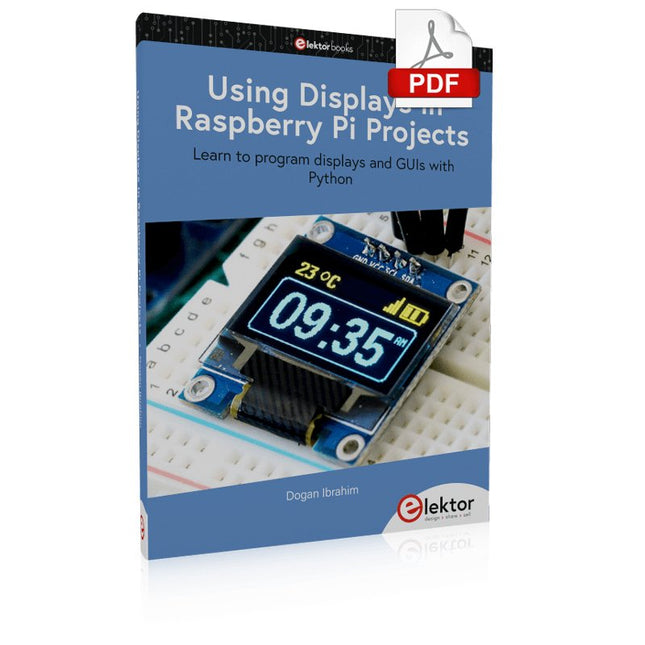
Elektor Digital Using Displays in Raspberry Pi Projects (E-book)
Learn to program displays and GUIs with Python This book is about Raspberry Pi 4 display projects. The book starts by explaining how to install the latest Raspbian operating system on an SD card, and how to configure and use the GPIO ports. The core of the book explains the following topics in simple terms with fully tested and working example projects: Simple LED projects Bar graph LED projects Matrix LED projects Bitmap LED projects LED strips LCDs OLED displays E-paper displays TFT displays 7-inch touch screen GUI Programming with Tkinder One unique feature of this book is that it covers almost all types of display that readers will need to use in their Raspberry Pi based projects. The operation of each project is fully given, including block diagrams, circuit diagrams, and commented full program listings. It is therefore an easy task to convert the given projects to run on other popular platforms, such as Arduino or PIC microcontrollers. Python program listings of all Raspberry Pi projects developed in this book are available for download at Elektor.com. Readers can use these programs in their projects. Alternatively, they can modify the programs to suit their applications.
€ 32,95
Mitglieder: € 29,66
-

Elektor Digital Raspberry Pi Select (PDF) NL
61 pagina's met de beste Raspberry Pi artikelen en projecten uit Elektor Magazine: Windows op de Raspberry Pi (1) Windows op de Raspberry Pi (2) Windows op de Raspberry Pi (3) Raspberry Pi wobbulator Raspberry-Pi-emulator Raspberry-Pi-voltmeter Raspberry Pi prototyping-board Visual Basic op de Raspberry Pi RPi meet energieverbruik Voor Linux-board en Raspberry Pi Maak uw eigen I2C-device voor de Raspberry Pi SD-kaart-upgrade voor RPi model 2 Mini-workshop GestIC & 3D-touchpad (2) Surfen op de golven van de RPi ATmega op het web (1) ATmega op het web (2)
€ 9,50
Mitglieder: € 8,55
-
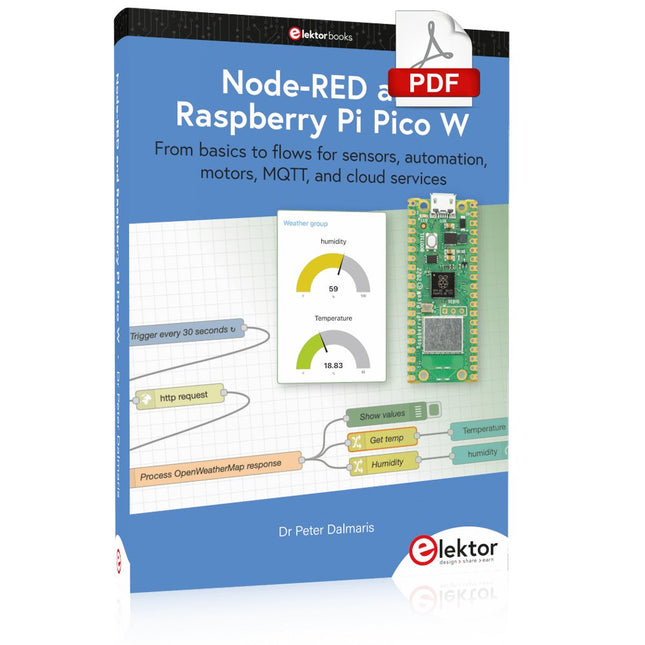
Elektor Digital Node-RED and Raspberry Pi Pico W (E-book)
From basics to flows for sensors, automation, motors, MQTT, and cloud services This book is a learning guide and a reference. Use it to learn Node-RED, Raspberry Pi Pico W, and MicroPython, and add these state-of-the-art tools to your technology toolkit. It will introduce you to virtual machines, Docker, and MySQL in support of IoT projects based on Node-RED and the Raspberry Pi Pico W. This book combines several elements into a platform that powers the development of modern Internet of Things applications. These elements are a flow-based server, a WiFi-enabled microcontroller, a high-level programming language, and a deployment technology. Combining these elements gives you the tools you need to create automation systems at any scale. From home automation to industrial automation, this book will help you get started. Node-RED is an open-source flow-based development tool that makes it easy to wire together devices, APIs, and online services. Drag and drop nodes to create a flowchart that turns on your lights at sunset or sends you an email when a sensor detects movement. Raspberry Pi Pico W is a version of the Raspberry Pi Pico with added 802.11n Wi-Fi capability. It is an ideal device for physical computing tasks and an excellent match to the Node-RED. Quick book facts Project-based learning approach. Assumes no prior knowledge of flow-based programming tools. Learn to use essential infrastructure tools in your projects, such as virtual machines, Docker, MySQL and useful web APIs such as Google Sheets and OpenWeatherMap. Dozens of mini-projects supported by photographs, wiring schematics, and source code. Get these from the book GitHub repository. Step-by-step instructions on everything. All experiments are based on the Raspberry Pi Pico W. A Wi-Fi network is required for all projects. Hardware (including the Raspberry Pi Pico W) is available as a kit. Downloads GitHub
€ 39,95
Mitglieder: € 35,96
-

Elektor Digital The CAN Bus Companion (E-book)
Projects with Arduino Uno & Raspberry Pi with Examples for the MCP2515 CAN Bus Interface Module This book details the use of the Arduino Uno and the Raspberry Pi 4 in practical CAN bus based projects. Using either the Arduino Uno or the Raspberry Pi with off-the-shelf CAN bus interface modules considerably ease developing, debugging, and testing CAN bus based projects. This book is written for students, practicing engineers, enthusiasts, and for everyone else wanting to learn more about the CAN bus and its applications. The book assumes that the reader has some knowledge of basic electronics. Knowledge of the C and Python programming languages and programming the Arduino Uno using its IDE and Raspberry Pi will be useful, especially if the reader intends to develop microcontroller-based projects using the CAN bus. The book should be a useful source of reference material for anyone interested in finding answers to questions such as: What bus systems are available for the automotive industry? What are the principles of the CAN bus? How can I create a physical CAN bus? What types of frames (or data packets) are available in a CAN bus system? How can errors be detected in a CAN bus system and how dependable is a CAN bus system? What types of CAN bus controllers exist? How do I use the MCP2515 CAN bus controller? How do I create 2-node Arduino Uno-based CAN bus projects? How do I create 3-node Arduino Uno-based CAN bus projects? How do I set the acceptance masks and acceptance filters? How do I analyze data on the CAN bus? How do I create 2-node Raspberry Pi-based CAN bus projects? How do I create 3-node Raspberry Pi-based CAN bus projects?
€ 32,95
Mitglieder: € 29,66
-

Elektor Digital Raspberry Pi (überarbeitete und erweiterte Neuauflage | PDF)
Raspberry Pi (Neuauflage) | E-Buch
€ 34,80
Mitglieder: € 31,32
-
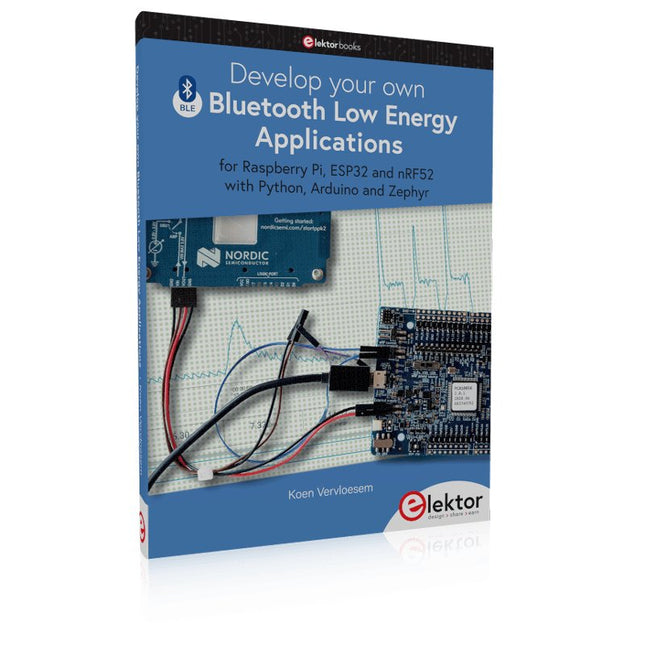
Elektor Publishing Develop your own Bluetooth Low Energy Applications
For Raspberry Pi, ESP32 and nRF52 with Python, Arduino and Zephyr Bluetooth Low Energy (BLE) radio chips are ubiquitous from Raspberry Pi to light bulbs. BLE is an elaborate technology with a comprehensive specification, but the basics are quite accessible. A progressive and systematic approach will lead you far in mastering this wireless communication technique, which is essential for working in low power scenarios. In this book, you’ll learn how to: Discover BLE devices in the neighborhood by listening to their advertisements. Create your own BLE devices advertising data. Connect to BLE devices such as heart rate monitors and proximity reporters. Create secure connections to BLE devices with encryption and authentication. Understand BLE service and profile specifications and implement them. Reverse engineer a BLE device with a proprietary implementation and control it with your own software. Make your BLE devices use as little power as possible. This book shows you the ropes of BLE programming with Python and the Bleak library on a Raspberry Pi or PC, with C++ and NimBLE-Arduino on Espressif’s ESP32 development boards, and with C on one of the development boards supported by the Zephyr real-time operating system, such as Nordic Semiconductor's nRF52 boards. Starting with a very little amount of theory, you’ll develop code right from the beginning. After you’ve completed this book, you’ll know enough to create your own BLE applications.
€ 39,95
Mitglieder: € 35,96
-

Elektor Digital Edge AI Made Practical (E-book)
AI Projects for the Raspberry Pi with the AI HAT+ Edge AI is transforming everyday devices by putting intelligence where it matters most: directly inside the hardware. With on-device inference, a camera can recognize a visitor instantly, a phone can translate speech without streaming audio to the cloud, and a wearable can detect anomalies in real time—fast, private, and reliable even when the network disappears. This book is your practical guide to building exactly those kinds of systems with the Raspberry Pi AI HAT+ and the Hailo-8L accelerator. You’ll start with clear foundations: core AI and machine-learning concepts, how neural networks work, and what truly distinguishes Edge AI from cloud AI—plus an honest look at ethical considerations and future impacts. Then it’s straight to hands-on physical computing. Step by step, you’ll set up Raspberry Pi OS, power and cooling, and develop in Python using the Thonny IDE. You’ll learn GPIO basics with lights and servos, mount the AI HAT+ hardware, install and verify the Hailo software stack, and connect the right camera—official modules or USB webcams, even multiple cameras. From your first pipeline to real projects, you’ll run person detection, pose estimation, segmentation, and depth estimation, then level up with YOLO object detection: smart alerts, guest counters, and custom extensions. You’ll even connect vision to motion by combining gesture recognition with servo-driven mechanisms, including a robotic arm. With troubleshooting tips, hardware essentials, and a practical Python refresher, this book turns Edge AI from buzzword into buildable reality.
€ 29,95
Mitglieder: € 26,96
-
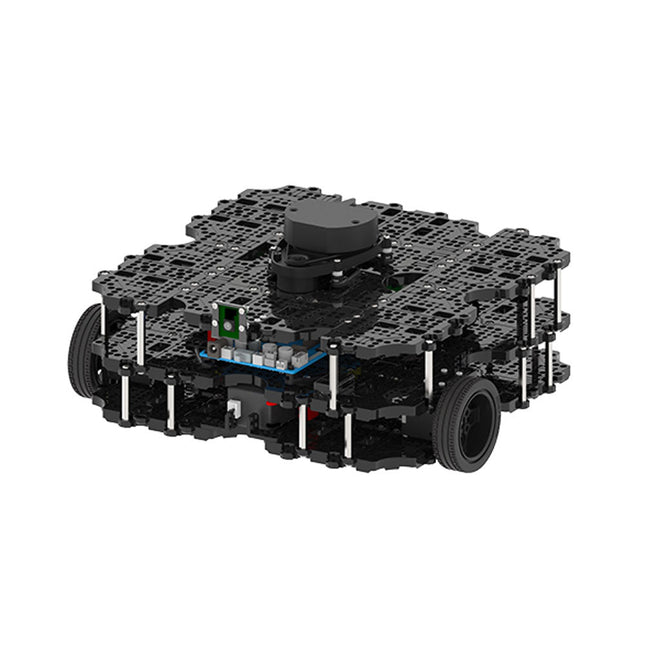
Robotis Robotis TurtleBot3 Waffle Pi (inkl. Raspberry Pi 4)
Weltweit beliebteste ROS-Plattform TurtleBot ist der beliebteste Open-Source-Roboter für Bildung und Forschung. Die neue Generation TurtleBot3 ist ein kleiner, kostengünstiger, voll programmierbarer, ROS-basierter mobiler Roboter. Er ist für Bildung, Forschung, Hobby und Produktprototyping gedacht. Erschwingliche Kosten TurtleBot wurde entwickelt, um die kostenbewussten Bedürfnisse von Schulen, Laboren und Unternehmen zu erfüllen. TurtleBot3 ist der erschwinglichste Roboter unter den SLAM-fähigen mobilen Robotern, die mit einem 360°-Laser-Distanzsensor LDS-01 ausgestattet sind. ROS Standard Die Marke TurtleBot wird von Open Robotics verwaltet, das ROS entwickelt und pflegt. Heutzutage ist ROS die bevorzugte Plattform für alle Robotiker auf der ganzen Welt geworden. TurtleBot kann mit bestehenden ROS-basierten Roboterkomponenten integriert werden, aber TurtleBot3 kann eine erschwingliche Plattform für diejenigen sein, die mit dem Erlernen von ROS beginnen möchten. Erweiterbarkeit TurtleBot3 ermutigt Benutzer, seine mechanische Struktur mit einigen alternativen Optionen anzupassen: Open Source Embedded Board (als Steuerplatine), Computer und Sensoren. Der TurtleBot3 Waffle Pi ist eine zweirädrige Plattform mit Differentialantrieb, kann aber strukturell und mechanisch in vielerlei Hinsicht angepasst werden: Autos, Fahrräder, Anhänger und so weiter. Erweitern Sie Ihre Ideen jenseits der Vorstellungskraft mit verschiedenen SBC, Sensoren und Motoren auf einer skalierbaren Struktur. Modularer Aktuator für mobilen Roboter TurtleBot3 ist in der Lage, durch den Einsatz von 2 DYNAMIXEL's in den Radgelenken präzise räumliche Daten zu erhalten. Die DYNAMIXEL der XM-Serie können in einem von 6 Betriebsmodi betrieben werden (XL-Serie: 4 Betriebsmodi): Geschwindigkeitsregelung für die Räder, Drehmomentregelung oder Positionsregelung für die Gelenke, usw. DYNAMIXEL kann auch für die Herstellung eines mobilen Manipulators verwendet werden, der leicht ist, aber mit Geschwindigkeits-, Drehmoment- und Positionssteuerung präzise gesteuert werden kann. DYNAMIXEL ist eine Kernkomponente, die den TurtleBot3 perfekt macht. Er ist einfach zu montieren, zu warten, zu ersetzen und neu zu konfigurieren. Offene Steuerplatine für ROS Die Steuerplatine ist sowohl hardware- als auch softwareseitig für die ROS-Kommunikation offengelegt. Die Open-Source-Steuerungsplatine OpenCR1.0 ist leistungsfähig genug, um nicht nur DYNAMIXELs, sondern auch ROBOTIS-Sensoren zu steuern, die häufig für grundlegende Erkennungsaufgaben auf kostengünstige Weise verwendet werden. Verschiedene Sensoren wie z. B. Berührungssensor, Infrarotsensor, Farbsensor und eine Handvoll weiterer sind verfügbar. Das OpenCR1.0 verfügt über einen IMU-Sensor im Inneren des Boards, so dass es die präzise Steuerung für unzählige Anwendungen verbessern kann. Das Board verfügt über 3,3 V, 5 V und 12 V Stromversorgungen, um die verfügbaren Computergeräte zu verstärken. Open Source Die Hardware, Firmware und Software von TurtleBot3 sind Open Source, was bedeutet, dass die Benutzer willkommen sind, die Quellcodes herunterzuladen, zu ändern und zu teilen. Alle Komponenten des TurtleBot3 werden aus kostengünstigem Kunststoff im Spritzgussverfahren hergestellt, die 3D-CAD-Daten sind jedoch auch für den 3D-Druck verfügbar. Technische Daten Maximale Translationsgeschwindigkeit 0,26 m/s Maximale Rotationsgeschwindigkeit 1,82 rad/s (104.27 deg/s) Maximale Nutzlast 30 kg Abmessungen (L x B x H) 281 x 306 x 141 mm Gewicht (+ SBC + Batterie + Sensoren) 1,8 kg Schwelle des Kletterns 10 mm oder niedriger Voraussichtliche Betriebsdauer 2h Voraussichtliche Ladezeit 2h 30m SBC (Single Board Computer) Raspberry Pi 4 (2 GB RAM) MCU 32-bit ARM Cortex-M7 mit FPU (216 MHz, 462 DMIPS) Fernbedienung RC-100B + BT-410 Set (Bluetooth 4, BLE) Aktuator XL430-W210 LDS (Laser-Abstandssensor) 360 Laser-Abstandssensor LDS-01 or LDS-02 Kamera Raspberry Pi Camera Module v2.1 IMU Gyroskop 3 AchsenBeschleunigungsmesser 3 Achsen Stromanschlüsse 3,3 V/800 mA5 V/4 A12 V/1 A Erweiterungspins GPIO 18 PinsArduino 32 Pin Peripherie 3x UART, 1x CAN, 1x SPI, 1x I²C, 5x ADC, 4x 5-pin OLLO DYNAMIXEL Ports 3x RS485, 3x TTL Audio Several programmable beep sequences Programmierbare LEDs 4x User LED Status-LEDs 1x Board Status LED1x Arduino-LED1x Power-LED Tasten und Schalter 2x Drucktasten, 1x Reset-Taste, 2x Dip-Schalter Akku Lithium Polymer 11,1 V 1800 mAh / 19,98 Wh 5C PC-Verbindung USB Firmware-Upgrade via USB / via JTAG Netzadapter (SMPS) Eingang: 100-240 VAC 50/60 Hz, 1,5 A @maxAusgang: 12 VDC, 5 A Downloads ROS Robot Programming GitHub E-Manual Community
€ 1.879,00
Bestpreis
-
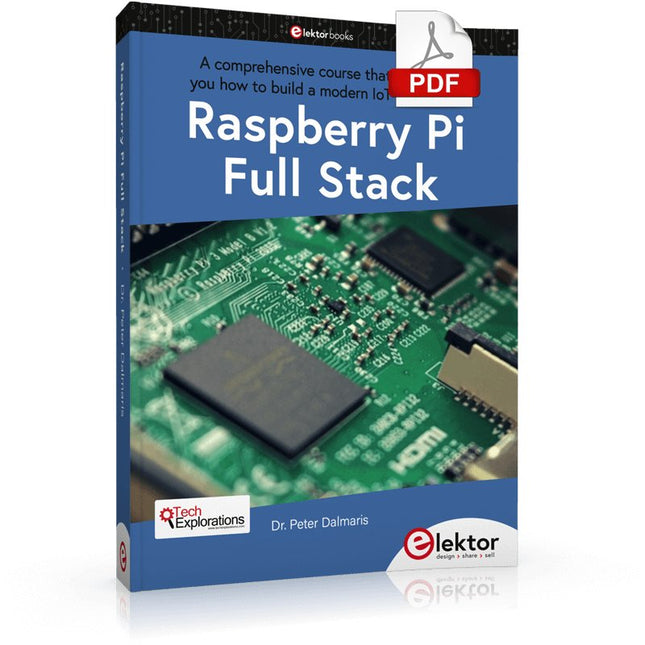
Elektor Digital Raspberry Pi Full Stack (E-book)
Dieses Buch nimmt Sie mit auf eine spannende Tour durch die Entwicklung von Full-Stack-Webanwendungen mit Raspberry Pi. Sie lernen, wie Sie eine Anwendung von Grund auf erstellen. Sie erwerben Erfahrung und Wissen über Technologien, darunter: Das Linux-Betriebssystem und die Befehlszeile. Die Programmiersprache Python. Die GPIOs (General Purpose Input Output Pins) des Raspberry Pi. Der Nginx-Webserver. Flask Python-Mikroframework für Webanwendungen. JQuery und CSS zum Erstellen von Benutzeroberflächen. Umgang mit Zeitzonen. Erstellen von Diagrammen mit Plotly und Google Charts. Datenerfassung mit Google Sheet. Entwickeln von Applets mit IFTTT. Sichern Sie Ihre Anwendung mit SSL. Empfangen Sie mit Twilio Textnachrichten auf Ihrem Telefon. In diesem Buch erfahren Sie außerdem, wie Sie einen drahtlosen Arduino-Sensorknoten aus der Ferne einrichten und Daten von ihm sammeln. Ihre Raspberry Pi-Webanwendung kann Arduino-Knotendaten auf die gleiche Weise verarbeiten, wie sie Daten von ihrem integrierten Sensor verarbeitet. Raspberry Pi Full Stack vermittelt Ihnen viele Fähigkeiten, die für die Erstellung von Web- und Internet-of-Things-Anwendungen unerlässlich sind. Die Anwendung, die Sie in diesem Projekt erstellen, ist eine Plattform, die Sie erweitern können. Dies ist nur der Anfang dessen, was Sie mit einem Raspberry Pi und den Software- und Hardwarekomponenten tun können, die Sie lernen werden. Dieses Buch wird vom Autor durch einen eigenen Diskussionsbereich unterstützt.
€ 34,95
Mitglieder: € 31,46
-

SDRplay SDRplay RSP1B 14-Bit SDR-Empfänger (1 kHz bis 2 GHz)
Der SDRplay RSP1B ist eine verbesserte Version des beliebten RSP1A – ein leistungsstarker, breitbandiger und voll ausgestatteter 14-Bit-SDR, der das HF-Spektrum von 1 kHz bis 2 GHz abdeckt. Der RSP1B ist in einem robusten, schwarz lackierten Stahlgehäuse untergebracht und bietet eine deutlich verbesserte Rauschleistung. Für die hervorragende Empfangsfunktionalität benötigen Sie lediglich einen Computer und eine Antenne. Im Lieferumfang enthalten sind SDRuno für Windows und die plattformübergreifende Software SDRconnect für Windows, macOS und Linux (kostenlos von SDRplay bereitgestellt). Sie können bis zu 10 MHz Spektrum gleichzeitig überwachen. Eine dokumentierte API ermöglicht es Entwicklern, neue Demodulatoren oder Anwendungen für die Plattform zu erstellen. Features Deckt alle Frequenzen von 1 kHz über VLF, LF, MW, HF, VHF, UHF und L-Band bis 2 GHz lückenlos ab Empfang, Überwachung und Aufzeichnung von bis zu 10 MHz Spektrum auf einmal Kostenlose Nutzung der Windows-basierten SDRuno-Software, die eine ständig wachsende Anzahl von Funktionen bietet. Starkes und wachsendes Software-Support-Netzwerk Kalibrierte S-Meter/HF-Leistungs- und SNR-Messung mit SDRuno (einschließlich Datenprotokollierung in CSV-Dateien) Dokumentierte API für die Entwicklung von Demodulatoren und Anwendungen auf verschiedenen Plattformen Ausgezeichneter Dynamikbereich für schwierige Empfangsbedingungen Funktioniert mit gängiger SDR-Software von Drittanbietern (einschließlich HDSDR, SDR Console und Cubic SDR) ExtIO-basiertes Plugin verfügbar Software upgradefähig für zukünftige Standards Starkes und wachsendes Software-Support-Netzwerk API für die Entwicklung von Demodulatoren und Anwendungen Multiplattform-Treiber und API-Unterstützung, einschließlich Windows, Linux, Mac, Android und Raspberry Pi Bis zu 16 individuelle Empfänger in jedem 10-MHz-Spektrumbereich mit SDRuno Kalibrierte S-Meter und Leistungsmessungen mit SDRuno Eigenständige Windows-basierte Spektrumanalysator-Software verfügbar (mit Sweep-, Sample- und Hold-Funktionen) Ideal für die Überwachung von ISM/ IoT/ Telemetrie-Bändern <2 GHz Ideal für den portablen Betrieb Technische Daten Frequenzbereich 1 kHz – 2 GHz Antennenanschluss SMA Antennenimpedanz 50 Ohm Stromverbrauch (typisch) 185 mA (ohne Bias-T) USB-Anschluss USB Typ B Maximale Eingangsleistung +0 dBm kontinuierlich+10 dBm kurzzeitig ADC Abtastraten 2-10,66 MSPS ADC Anzahl der Bits 14 bit 2-6,048 MSPS12 bit 6,048-8,064 MSPS10 bit 8,064-9,216 MSPS8 bit >9,216 MSPS Bias-T 4,7 V100 mA garantiert Referenz 0,5ppm 24 MHz TCXO.Frequenzfehler auf 0,01ppm im Feld trimmbar. Betriebstemperatur -10˚C bis +60˚C Abmessungen 98 x 88 x 34 mm Gewicht 110 g Downloads Datasheet Software RSP1B vs RSPdx vs RSPduo RSP1B RSPdx RSPduo Kontinuierlicher Bereich von 1 kHz bis 2 GHz ✓ ✓ ✓ Bis zu 10 Mhz sichtbare Bandbreite ✓ ✓ ✓ 14-Bit-ADC-Siliziumtechnologie plus mehrere Hochleistungs-Eingangsfilter ✓ ✓ ✓ Per Software wählbare AM/FM- und DAB-Rundfunkband-Sperrfilter ✓ ✓ ✓ 4,7 V Bias-T für die Versorgung eines externen Antennenverstärkers ✓ ✓ ✓ Stromversorgung über das USB-Kabel mit einer einfachen Typ-B-Buchse ✓ ✓ ✓ 50Ω SMA-Antenneneingang(e) für 1 kHz bis 2 GHz Betrieb (per Software wählbar) 1 2 2 Zusätzlicher per Software wählbarer Hi-Z-Eingang für bis zu 30 Mhz-Betrieb ✓ Zusätzlicher per Software wählbarer 50-Ω-BNC-Eingang für den Betrieb mit bis zu 200 MHz ✓ Zusätzlicher LF/VLF-Filter für unter 500 kHz ✓ 24 MHz Referenztakt-Eingang (+ Ausgang auf RSPduo) ✓ ✓ Duale Tuner ermöglichen den Empfang auf 2 völlig unabhängigen 2-MHz-Bereichen ✓ Zwei Tuner ermöglichen Diversity-Empfang mit SDRuno ✓ Robustes und widerstandsfähiges Kunststoffgehäuse (mit interner RF-Abschirmungsschicht) ✓ Robustes schwarz lackiertes Stahlgehäuse ✓ ✓ Gesamtleistung unter 2 MHz für MW und LF + ++ + Mehrere gleichzeitige Anwendungen + + ++ Leistung unter schwierigen Fading-Bedingungen (*mit Diversity-Abstimmung) + + *++
€ 146,53


