
Suchergebnisse für "pirate OR radio OR rpi OR zero OR w OR project OR kit"
-

FNIRSI FNIRSI DPOS350P (4-in-1) 2-Kanal Tablet-Oszilloskop (350 MHz) + Signalgenerator + Frequenzganganalyzer + Spektrum Analyzer
2 Kanäle • 350 MHz • 1 GSa/s • 50.000 wfm/s • 7 Zoll Touchscreen Das FNIRSI DPOS350P ist ein elegantes 4-in-1-Kraftpaket im Tablet-Format! Dieses kompakte und tragbare Gerät bietet umfangreiche Funktionen: Es vereint ein 2-Kanal Oszilloskop (350 MHz), einen Signalgenerator (50 MHz), einen Frequenzganganalyzer (50 MHz) und einen Spektrum-Analyzer (200 kHz–350 MHz) in einem Gerät. Ob in Forschung und Entwicklung, Fehlersuche oder Feldtests – das DPOS350P bietet Ihnen die Werkzeuge, die Sie zum präzisen und klaren Messen, Generieren, Analysieren und Visualisieren elektronischer Signale benötigen. Der reaktionsschnelle, hochauflösende Touchscreen und die intuitiven Bedienelemente machen die Signalanalyse schnell, flexibel und effizient. Features Leistungsstarke Multifunktionsintegration 350 MHz 2-Kanal-Oszilloskop mit 1 GSa/s Echtzeit-Abtastung 50 MHz Signalgenerator mit 14 Standard- und benutzerdefinierten Wellenformen Spektrumanalysator (200 kHz–350 MHz): Ideal für EMI, HF und HF-Tests Frequenzganganalysator (FRA) bis 50 MHz Hochleistungs-Wellenformerfassung 50.000 wfm/s Bildwiederholrate für klare Signale in Echtzeit 350 MHz Bandbreite (Einzelkanalmodus) Erkennt seltene und unwahrscheinliche Anomalien Scharfes Display & Reibungsloser Betrieb 7-Zoll-IPS-Touchscreen (Auflösung 1024 x 600 Pixel) Umschalten zwischen Graustufen- und Farbtemperaturanzeige Einfache Bedienung in verschiedenen Testumgebungen Zuverlässig, geschützt und schnell ladend Hochspannungsschutz bis 400 V Schnellladen mit QC 18 W (vollständige Ladung in 2 Stunden) Für stabilen Langzeitbetrieb konzipiert Datenspeicherung und -export Speichern Sie bis zu 500 Wellenformaufzeichnungen + 90 Screenshots USB-Export für einfache Berichterstellung und Offline-Analyse Technische Daten Allgemein Display 7 Zoll (IPS, voller Betrachtungswinkel) Auflösung 1024 x 600 Pixel Interaktionsmodus Kapazitiver Touchscreen Gesamtstromverbrauch 10 W Einschaltkonfiguration 5 Voreinstellungen Laden QC 18 W, 12 V/1,5 A (USB-C) Akku 3,7 V, 8000 mAh Lithium-Akku Akkulaufzeit ca. 3 Stunden Betrieb, 5 Stunden Standby Wärmeableitung Luftkühlung Erweiterungsschnittstelle USB-Datenanschluss Automatische Abschaltung 15-60 Minuten / Aus Firmware-Upgrade Unterstützung für ISO-Image-Upgrades Sprachen Englisch / Portugiesisch / Russisch / Chinesisch Abmessungen 190 x 128 x 37 mm Oszilloskop Analogkanäle 2 Analogbandbreite 350 MHz Anstiegszeit 1 ns Echtzeit-Abtastrate 1 GSa/s Speichertiefe 60 Kpts Eingangsimpedanz 1 MΩ / 14 pF Zeitbasis Bereich 5 ns ~ 50 s Rollzeitbasis 50 ms ~ 50 s Vertikale Empfindlichkeit 2 mV ~ 20 V (1X) Vertikaler Bereich 16 mV ~ 160 V (1X) DC-Genauigkeit ±2% Zeitgenauigkeit ±0,01% Eingangskopplung DC / AC Sondendämpfung 1x / 10x / 100x Hardware-Bandbreitenlimit 150 M / 20 M Hochauflösender Modus 8-16 Bit Parametermessungen 12 Typen Cursormessung Zeit, Periode, Frequenz, Pegel, Spannung Triggererkennung Digitaler Trigger Triggerkanal CH1 / CH2 Triggermodus Auto / Einzeln / Normal Triggerflanke Rising edge / Falling edge Triggerunterdrückung L1 ~ L3 Triggerpegel Manuell / Automatisch 10% ~ 90% Screenshot-Speicher 90 Bilder Wellenform-Speicher 500 Gruppen Hintergrundraster Ein-/Ausblenden Wellenform-Bewegung Grobeinstellung/Feineinstellung Überspannungsschutz Spannungsfestigkeit 400 V Wellenform-Helligkeit Einstellbar Einfache FFT-Anzeige Ja Digitale Fluoreszenz Ja Farbtemperaturanzeige Ja X-Y-Modus Ja ZOOM-Zeitbasis Ja Automatische Justierung per Tastendruck Ja Nullrückstellung per Tastendruck Ja Daten Browser Ja Signalgenerator Wellenformtypen 14 Standardfunktionen + erfasste Wellenform Frequenz 0-50 MHz (nur Sinuswelle, andere Wellenformen bis 10M/5M/3M) Amplitude 0–5 VPP Offset -2,5 V ~ +2,5 V Tastverhältnis 0,1-99,9% Frequenz Auflösung 1 Hz Amplitudenauflösung 1 mV Offsetauflösung 1 mV Tastverhältnisauflösung 0,1% Anpassbare erfasste Wellenform 500 Gruppen Frequenzganganalyzer (FRA) Frequenz des Anregungssignals 100 Hz ~ 50 MHz Amplitude des Anregungssignals 0~5 VPP Offset des Anregungssignals -2,5 V ~ +2,5 V Anzahl der Anregungsfrequenzen 20~500 Cursormessung Frequenz / Verstärkung / Phase Betrieb Modus Einzeln / Zyklisch Systemkalibrierung Ja Spektrum Analyzer Konvertierungsmethode FFT FFT-Länge 4K ~ 32K Frequenzbereich 200 KHz ~ 350 MHz Pegelbereich -60 dBmV ~ +260 dBmV Cursormessung Frequenz / Amplitude Markierungsparameter Maximale Energie-Oberschwingungen Wasserfalldiagramm Ja 3D-Wasserfalldiagramm Ja Automatische Anpassung Ja Systemkalibrierung Ja Lieferumfang 1x FNIRSI DPOS350P (4-in-1) 2x 350 MHz Tastköpfe 1x QC 18 W Schnellladegerät (EU) 1x USB-Datenkabel 1x Krokodilklemme 1x Aufbewahrungstasche 1x Manual Downloads Manual Firmware
€ 309,00€ 259,00Bestpreis
-
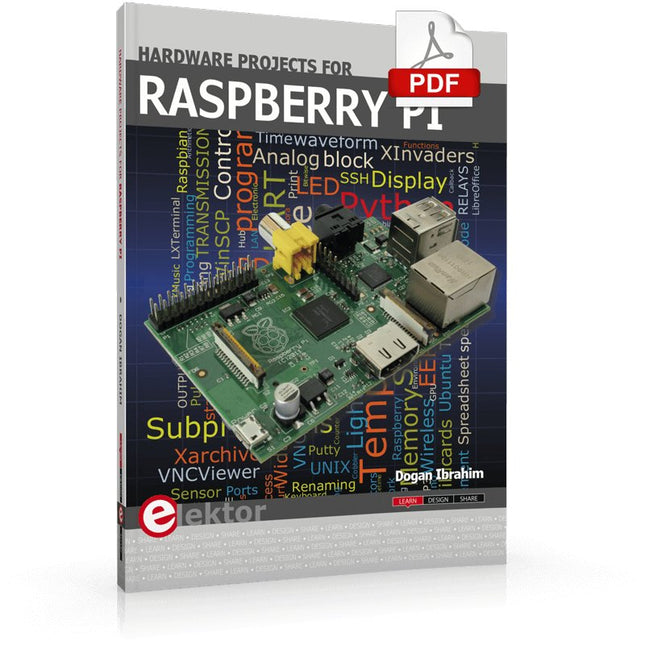
Elektor Digital Hardware Projects for Raspberry Pi (E-book)
The Raspberry Pi is a $35 credit-card sized computer with many applications, such as in desktop computing, audio and video playback, and as a controller in many industrial, commercial and domestic applications. This book is about the Raspberry Pi computer and its use in control applications. The book explains in simple terms, with examples, how to configure the RPi, how to install and use the Linux operating system, how to write programs using the Python programming language and how to develop hardware based projects. The book starts with an introduction to the Raspberry Pi computer and covers the topics of purchasing all the necessary equipment and installing/using the Linux operating system in command mode. Use of the user-friendly graphical desktop operating environment is explained using example applications. The RPi network interface is explained in simple steps and demonstrates how the computer can be accessed remotely from a desktop or a laptop computer. The remaining parts of the book cover the Python programming language, hardware development tools, hardware interface details, and RPi based hardware projects. All the 23 projects given in the book have been tested and are working. The following headings are given for each project: Project title Project description Project block diagram Project circuit diagram Project program description using the Program Description Language (PDL) Complete program listing Description of the program The book is ideal for self-study, and is intended for electronic/electrical engineering students, practising engineers, research students, and hobbyists.
€ 34,95
Mitglieder: € 31,46
-
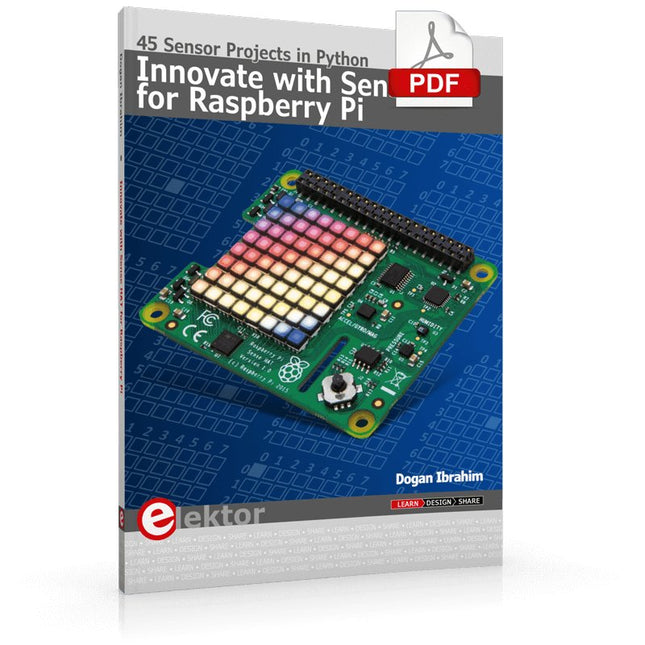
Elektor Digital Innovate with Sense HAT for Raspberry Pi (E-book)
Ready to explore the world around you? By attaching the Sense HAT to your Raspberry Pi, you can quickly and easily develop a variety of creative applications, useful experiments, and exciting games. The Sense HAT contains several helpful environmental sensors: temperature, humidity, pressure, accelerometer, magnetometer, and gyroscope. Additionally, an 8x8 LED matrix is provided with RGB LEDs, which can be used to display multi-color scrolling or fixed information, such as the sensor data. Use the small onboard joystick for games or applications that require user input. In Innovate with Sense HAT for Raspberry Pi, Dr. Dogan Ibrahim explains how to use the Sense HAT in Raspberry Pi Zero W-based projects. Using simple terms, he details how to incorporate the Sense HAT board in interesting visual and sensor-based projects. You can complete all the projects with other Raspberry Pi models without any modifications. Exploring with Sense HAT for Raspberry Pi includes projects featuring external hardware components in addition to the Sense HAT board. You will learn to connect the Sense HAT board to the Raspberry Pi using jumper wires so that some of the GPIO ports are free to be interfaced to external components, such as to buzzers, relays, LEDs, LCDs, motors, and other sensors. The book includes full program listings and detailed project descriptions. Complete circuit diagrams of the projects using external components are given where necessary. All the projects were developed using the latest version of the Python 3 programming language. You can easily download projects from the book’s web page. Let’s start exploring with Sense HAT.
€ 29,95
Mitglieder: € 26,96
-

Elektor Special: Robotics and Automation
AI in Practice Dive into the fascinating world of robotics and automation! This Elektor Special shows you how to build your own robots with creativity, a little know-how, and affordable technology. From your first DIY project with Arduino or Raspberry Pi to intelligent systems with AI – this issue makes modern robotics understandable and accessible. Discover practical instructions, inspiring projects, and exciting insights into the maker scene. Learn how experimentation, community, and openness give rise to true innovation – and why robotics is so much more than just a technical hobby. Contents Imagination turns into reality Arduino-controlled Drawing Robot GalaxyRVR Mars Rover Kit for Arduino YDLIDAR X4Pro Lidar xHuskyLens AI Camera DOF Robot Arm with Raspberry Pi Pico Manufacturing Robots with Fischertechnik Pneumatic Industrial Robot Why Do We Keep Building Robot Dogs? Elektor Mini-Wheelie Robot Vehicles and Autonomous Driving
€ 19,95
Mitglieder: € 17,96
-

Elektor Digital Raspberry Pi Pico W en un tournemain (PDF)
Maîtrise de la puce RP2040 avec plus de 60 projets à réaliser et à programmer Les cartes Raspberry Pi Pico et Pico W sont animées par un microcontrôleur ARM Cortex M0+ RP2040 à double coeur, rapide, efficace et peu coûteux, qui fonctionne jusqu'à 133 MHz et dispose de 264 Ko de SRAM et de 2 Mo de mémoire Flash. Outre une vaste mémoire, le Pico et le Pico W disposent de nombreuses broches GPIO et d'interfaces telles que CA/N, SPI, I²C, UART, MLI, de fonctions de temporisation, d'une interface de débogage matériel et d'un capteur de température interne. La carte Raspberry Pi Pico W comporte en plus une puce CYW43439 Bluetooth et Wi-Fi d'Infineon. Au moment de la rédaction de ce livre, le micrologiciel Bluetooth pour le Pico W n'était pas encore disponible. Le Wi-Fi à 2,4 GHz est toutefois entièrement pris en charge avec les protocoles 802.11b/g/n. Ce livre est une introduction à l'utilisation du Raspberry Pi Pico W avec le langage de programmation MicroPython. Les quelque soixante projets testés et opérationnels sont présentés à l'aide de l'environnement de développement intégré (EDI) Thonny. Les sujets abordés sont nombreux : Installation de MicroPython sur le Raspberry Pi Pico depuis un PC Interruptions de l'horloge et interruptions externes Convertisseur analogique-numérique (CA/N) Capteurs de température interne et externe Capteurs externes (pression, humidité, pouls, à ultrasons) Enregistrement de données MLI, UART, I²C et SPI Bluetooth, Wi-Fi et applis sur smarphone Convertisseur numérique-analogique (CN/A) Tous les projets ont été testés et éprouvés. Ils peuvent être mis en oeuvre sur le Raspberry Pi Pico ainsi que sur le Raspberry Pi Pico W. Toutefois les projets avec une liaison Wi-Fi ne fonctionnent que sur le Pico W. Une petite expérience en programmation et en électronique est nécessaire pour suivre les projets. De brèves descriptions, des schémas fonctionnels, des schémas détaillés du câblage des montages et des listings MicroPython complets sont fournis pour tous les projets.
€ 34,95
Mitglieder: € 31,46
-

Elektor Academy Pro ESP32 by Example (Lernkurs)
Vollständiger ESP32-Mikrocontroller-Lernkurs mit speziell entwickelter MCU-Erweiterungsplatine, praxisorientierten Projekten und einem umfassenden Online-Guide – ideal, um Hardware, Programmierung und Konnektivität Schritt für Schritt zu erlernen. Praktische Einführung in eingebettete Systeme mit dem ESP32 Dieser Kurs richtet sich an Einsteiger in die Welt der eingebetteten Systeme, die einen strukturierten, beispielorientierten Einstieg suchen. Falls Sie sich bereits mit allgemeiner Elektronik oder Arduino-basierten Materialien beschäftigt haben, diese aber als zu allgemein oder zu wenig praxisnah empfunden haben, bietet dieser Kurs eine fokussiertere Alternative. Mit dem "ESP32 by Example Kit" (EEK) – einem kompakten und kostengünstigen Komponentensatz mit LEDs, Sensoren, einem OLED-Display und einem Bewegungsprozessor – arbeiten Sie während des gesamten Kurses mit einem einheitlichen Hardware-Setup. Nach dem Zusammenbau bleibt das EEK weitgehend unverändert, sodass Sie sich ganz auf das Lernen und Experimentieren konzentrieren können, ohne ständig neu konfigurieren zu müssen. Themen: Verstehen und Programmieren des ESP32-Mikrocontrollers Programmieren und Ausführen von Code mit der Arduino IIDE Erkunden von cyber-physischen Systemen, abschließend zur grundlegenden Drohnensteuerung Vorkenntnisse in Arduino oder Embedded-Entwicklung sind nicht erforderlich. Jeder Abschnitt enthält praktische Beispiele und Miniprojekte, die die wichtigsten Konzepte festigen und zu einer tiefergehenden Auseinandersetzung anregen. Am Ende des Kurses können Sie die Beispiele des Buches nicht nur nachvollziehen, sondern auch mit eigenen Ideen und Anwendungen erweitern. Ob Sie sich für Embedded-Programmierung, interaktive Systeme oder die Grundlagen der Drohnensteuerung interessieren – dieser Kurs bietet einen klaren und praxisorientierten Einstieg. Was Sie lernen werden Eingebettete Programmierung mit dem ESP32 mithilfe der Arduino IDE Echtzeit-Sensoreingabe und -steuerung über Tasten, LEDs und Displays Gestenbasierte Interaktion mit dem Bewegungssensor MPU6050 Integration von Bluetooth-Gamepads und Drohnensteuerungssimulation WLAN- und UDP-Netzwerke, lokale Webserver und NTP MQTT-Kommunikation mit Cloud-Plattformen wie AWS und Arduino IoT Aufbau und Bereitstellung voll funktionsfähiger IoT-Systeme Perfekt für Studierende und Autodidakten, die sich mit eingebetteten Systemen beschäftigen Bastler und IoT-Begeisterte, die ihre Hardwarekenntnisse verbessern möchten Lehrkräfte und Dozenten, die nach sofort einsetzbarem Unterrichtsmaterial suchen Entwickler, die über die Grundlagen von Raspberry Pi oder Arduino hinausgehen möchten Support, wenn Sie ihn brauchen Zugang zu Kursleitern über die Elektor Academy Hilfreiche Community-Foren und wichtige Dokumentation Was ist in der Box (Kurs)? Neues 384-seitiges Buch: "ESP32 by Example" (Wert: 45 €) Elektor ESP32 by Example Kit (EEK): Mikrocontroller-Erweiterungsplatine mit 6 LEDs und 6 Tasten + OLED-Display, MPU6050 3-Achsen Beschleunigungsmesser und Gyroskop-Modul (Wert: 40 €) Adafruit HUZZAH32 – ESP32 Feather MCU Board (Wert: 30 €) ESP32 Cheap Yellow Display Board (Wert: 25 €) DHT11 Feuchtigkeitssensor & Temperatursensor Breadboard Jumperkabel USB-C-Kabel Zugang zum vollständigen Kurs auf der Elektor Academy Pro Lernplattform Lehrvideos Herunterladbare Arduino-Projektdateien für jedes Modul Lernmaterial (dieser Box) ▶ Klicken Sie hier zum Öffnen Module 1 – Getting Started with the ESP32 & EEK Module 2 – Digital Output – LEDs and GPIO Module 3 – Switches and Input Handling Module 4 – EEK and PWM Module 5 – OLED and Display Output Module 6 – Motion Sensing with the MPU6050 Module 7 – Capstone Project (EEK in Action) Module 8 – WiFi and Web Control with ESP32 Module 9 – Cloud Concepts using EEK Module 10 – Hands-on: Arduino IoT Cloud and EEK Module 11 – BlueTooth and EEK GamePad Integration Module 12 – Why Drones? Module 13 – Drone Simulator Concepts Module 14 – Simple Drone Flight Control Module 15 – Real-Time Drone Flight Control Module 16 – Drone Control Mini-Projects Module 17 – Middleware and Python Scripting Module 18 – Python Applications for Drone Control Module 19 – Capstone EEK Control Project and Presentation Über den Autor Dr. Jim Solderitsch ist Dozent, Softwarearchitekt, Systementwickler und Cybersicherheitsforscher mit Schwerpunkt auf cyber-physischen Systemen. Derzeit ist er als Lehrbeauftragter für Informatik an der Villanova University in Pennsylvania tätig. Was ist Elektor Academy Pro? Elektor Academy Pro bietet maßgeschneiderte Lernlösungen für Fachkräfte, Ingenieurteams und technische Experten in der Elektronik- und Embedded-Systems-Branche. Sie unterstützt Einzelpersonen und Organisationen dabei, ihr praktisches Know-how zu vertiefen, ihre Skills gezielt auszubauen und dank hochwertiger Inhalte und praxisnaher Tools stets einen Schritt voraus zu sein. Von realen Projekten und spezialisierten Kursen bis hin zu fundierten technischen Insights – Elektor versetzt Ingenieure in die Lage, aktuelle Herausforderungen der Branche erfolgreich zu meistern. Unser Bildungsportfolio umfasst Academy-Bücher, Pro-Boxen, Webinare, Konferenzen und B2B-Fachmagazine – alles mit Blick auf praxisnahe Weiterbildung und berufliches Wachstum. Ob Ingenieur, F&E-Spezialist oder technischer Entscheider: Elektor Academy Pro schlägt die Brücke zwischen Theorie und Praxis – und hilft Ihnen, neue Technologien zu beherrschen und Innovationen in Ihrem Unternehmen gezielt voranzutreiben.
€ 269,00€ 219,00Bestpreis
-

Elektor Digital Raspberry Pi 3 – Basic to Advanced Projects (E-book)
This book is about the Raspberry Pi 3 computer and its use in various control and monitoring applications. The book explains in simple terms and with tested and working example projects, how to configure the Raspberry Pi 3 computer, how to install and use the Linux operating system, and how to write hardware based applications programs using the Python programming language. The nice feature of this book is that it covers many Raspberry Pi 3 based hardware projects using the latest hardware modules such as the Sense HAT, Swiss Pi, MotoPi, Camera module, and many other state of the art analog and digital sensors. An important feature of the Raspberry Pi 3 is that it contains on-board Bluetooth and Wi-Fi modules. Example projects are given in the book on using the Wi-Fi and the Bluetooth modules to show how real-data can be sent to the Cloud using the Wi-Fi module, and also how to communicate with an Android based mobile phone using the Bluetooth module. The book is ideal for self-study, and is intended for electronic/electrical engineering students, practising engineers, research students, and for hobbyists. It is recommended that the book should be followed in the given Chapter order. Over 30 projects are given in the book. All the projects in the book are based on the Python programming language and they have been fully tested. Full program listings of every project are given in the book with comments and full descriptions. Experienced programmers should find it easy to modify and update the programs to suit their needs. The following sub-headings are given for each project to make it as easy as possible for the readers to follow the projects: Project title Description Aim of the project Raspberry Pi type Block diagram Circuit diagram Program listing
€ 29,95
Mitglieder: € 26,96
-

Elektor Digital Raspberry Pi 5 for Radio Amateurs (E-book)
Program and Build Raspberry Pi 5 Based Ham Station Utilities with the RTL-SDR The RTL-SDR devices (V3 and V4) have gained popularity among radio amateurs because of their very low cost and rich features. A basic system may consist of a USB based RTL-SDR device (dongle) with a suitable antenna, a Raspberry Pi 5 computer, a USB based external audio input-output adapter, and software installed on the Raspberry Pi 5 computer. With such a modest setup, it is possible to receive signals from around 24 MHz to over 1.7 GHz. This book is aimed at amateur radio enthusiasts and electronic engineering students, as well as at anyone interested in learning to use the Raspberry Pi 5 to build electronic projects. The book is suitable for both beginners through experienced readers. Some knowledge of the Python programming language is required to understand and eventually modify the projects given in the book. A block diagram, a circuit diagram, and a complete Python program listing is given for each project, alongside a comprehensive description. The following popular RTL-SDR programs are discussed in detail, aided by step-by-step installation guides for practical use on a Raspberry Pi 5: SimpleFM GQRX SDR++ CubicSDR RTL-SDR Server Dump1090 FLDIGI Quick RTL_433 aldo xcwcp GPredict TWCLOCK CQRLOG klog Morse2Ascii PyQSO Welle.io Ham Clock CHIRP xastir qsstv flrig XyGrib FreeDV Qtel (EchoLink) XDX (DX-Cluster) WSJT-X The application of the Python programming language on the latest Raspberry Pi 5 platform precludes the use of the programs in the book from working on older versions of Raspberry Pi computers.
€ 32,95
Mitglieder: € 29,66
-

Raspberry Pi Foundation Le guide officiel du débutant Raspberry Pi (5ème édition)
Entièrement mise à jour pour le Raspberry Pi 5 Raspberry Pi 5 est un petit ordinateur intelligent, de construction britannique qui regorge de potentiel. Fabriqué à l'aide d'un processeur économe en énergie, le Raspberry Pi est conçu pour vous aider à apprendre le codage, découvrir comment fonctionne un ordinateur et construire vos propres projets uniques et incroyables. Ce guide est conçu pour vous montrer à quel point il est facile de démarrer. Apprendre à : Configurez votre Raspberry Pi, installez son système d'exploitation, et commencez à utiliser cet ordinateur entièrement fonctionnel. Commencez à coder des projets, avec des guides étape par étape utilisant les langages de programmation Scratch 3, Python et MicroPython. Expérimentez en connectant des composants électroniques, et amusez-vous à créer des projets incroyables. Nouveauté de la 5ème édition : Mise à jour pour les derniers ordinateurs Raspberry Pi : Raspberry Pi 5 et Raspberry Pi Zèro 2 W. Couvre le dernier système d'exploitation Raspberry Pi. Comprend un nouveau chapitre sur le Raspberry Pi Pico ! Téléchargements GitHub
€ 24,95€ 9,95Bestpreis
-

Elektor Digital Build Smart Projects with the XIAO ESP32-C3 Board (E-book)
The XIAO ESP32-C3 board combines the ultra-compact form factor of the XIAO series with the full capabilities of the ESP32-C3 chip, including integrated Wi-Fi and Bluetooth 5.0. This book is a comprehensive, hands-on guide to getting the most out of this powerful yet affordable development board. The author takes readers from the fundamentals to advanced projects. Starting with LED blinking and dimming, the book progresses to ADC and PWM for precise sensor interfacing and PWM-controlled lighting effects before moving on to building practical, real-world applications, including: A Wi-Fi weather station with an OLED display and real-time online weather data An ultrasonic parking assistant with audible feedback A refrigerator monitoring probe with climate sensing and Deep Sleep for years of battery operation A retro Pong game controlled by a touch-free sensor A microphone-based party app that responds to claps And much more: lighting control, reaction-time measurement, mains frequency analysis, soil moisture sensing, ambient LED lighting, and 7-segment displays
€ 29,95
Mitglieder: € 26,96
-

Elektor Digital Build Your Own Software-Defined Radio (E-book)
Practical Guide to Modular RF Design Build Your Own Software-Defined Radio combines RF circuitry with hardware programming and PC-based signal processing. The e-book presents a modular approach to building a complete SDR system using RF Bricks – from the mechanical framework and RF modules to measurement tools, PC software, and FPGA implementations. Practical explanations guide readers through real signal paths, construction steps, and measurement routines, linking hardware and software into a flexible SDR platform. Key topics include: Mechanical setup: RF Brick template, chassis, and 19-inch module carrier Bridges: USB isolator, I²C level shifter, I²C power switch, and practical examples Signal-chain design with RF Bricks: antennas, band filters, NanoVNA work, preamplifiers, PLLs, demodulators, direct-conversion chains, multiband options, and narrowband bricks RF measurement Bricks: single- and dual-tone sources, NPR methods, noise generators, notch filters, broadband amplifiers, and impedance bridges Useful accessories: ATU-100 tuner, X-Phase QRM eliminator, and firmware notes PC host software: SoapyAudio adjustments, GQRX, SDR++, and added functionality GnuRadio elements: control blocks, SSB demodulation, GUI components, messaging, and filter handling FPGA-based SDR: VHDL, toolchains, ADC/DAC blocks, oversampling, and a complete SSB/CW signal chain With its modular structure and detailed working examples, this e-book offers a practical path to building and extending modern SDR systems. Downloads Software
€ 32,95
Mitglieder: € 29,66
-

Elektor Bundles Practical Electronics Crash Course (Bundle)
Der Einstieg in die Elektronik ist nicht so schwierig, wie Sie vielleicht denken. Mit diesem Bundle (Buch + Kit) können Sie durch verschiedene Experimente die wichtigsten Konzepte der Elektro- und Elektroniktechnik auf spielerische Weise erforschen und erlernen. Sie erlernen Elektronik praxisnah, ohne sich auf komplizierte Fachsprache und lange Berechnungen einzulassen. Daher werden Sie bald Ihre eigenen Projekte erstellen. Das Kit enthält die erforderlichen Komponenten, um die meisten detaillierten Beispiele des Buches auf einem Steckbrett zu bauen und sie in der Realität auszuprobieren. Das Kit kann selbstverständlich auch ohne das Buch zum Aufbau anderer Schaltkreise und zur Durchführung eigener Experimente verwendet werden. Inhalt des Kits 1x 39 Ω, 1 W Widerstand 1x 47 Ω Widerstand 1x 180 Ω Widerstand 1x 330 Ω Widerstand 3x 1 kΩ Widerstand 1x 2,2 kΩ Widerstand 1x 3,9 kΩ Widerstand 1x 6,8 kΩ Widerstand 1x 10 kΩ Widerstand 1x 15 kΩ Widerstand 1x 22 kΩ Widerstand 1x 33 kΩ Widerstand 1x 47 kΩ Widerstand 1x 56 kΩ Widerstand 1x 82 kΩ Widerstand 1x 120 kΩ Widerstand 1x 680 kΩ Widerstand 2x 100 kΩ Widerstand 1x 10 kΩ Trimmer 1x 10 kΩ Linearpotentiometer 1x 100 kΩ Linearpotentiometer 1x LDR 1x 1 nF Keramikkondensator 2x 10 nF Keramikkondensator 1x 100 nF Keramikkondensator 1x 1 µF, 25 V Aluminium-Elektrolytkondensator 2x 10 µF, 25 V Aluminium-Elektrolytkondensator 1x 100 µF, 25 V Aluminium-Elektrolytkondensator 1x 470 µF, 25 V Aluminium-Elektrolytkondensator 1x 1000 µF, 25 V Aluminium-Elektrolytkondensator 1x RGB-LED, Common-Cathode (CC) 1x 1N4148 Kleinsignaldiode 1x 1N4733A 5,1 V, 1 W Zenerdiode 3x LED, rot 2x BC337 NPN-Transistor 1x IRFZ44N N-Kanal-MOSFET 2x NE555-Timer 1x LM393-Komparator 1x 74HCT08 Quad-AND-Gatter 3x Tastschalter 2x SPDT-Schalter 1x Relais, SPDT, 9 VDC 1x Aktiver Summer 1x Passiver Summer 50 cm Massivdraht, 16 AWG, ohne Mantel 2x PP3 9 V Batterieclip 1x Steckbrett 20x Überbrückungskabel Dieses Bundle enthält: Practical Electronics Crash Course Kit (Wert: 45 €) Buch: Practical Electronics Crash Course (Einzelpreis: 45 €)
€ 89,95€ 69,95Bestpreis


