
Suchergebnisse für "motor or control or development or bundle"
-
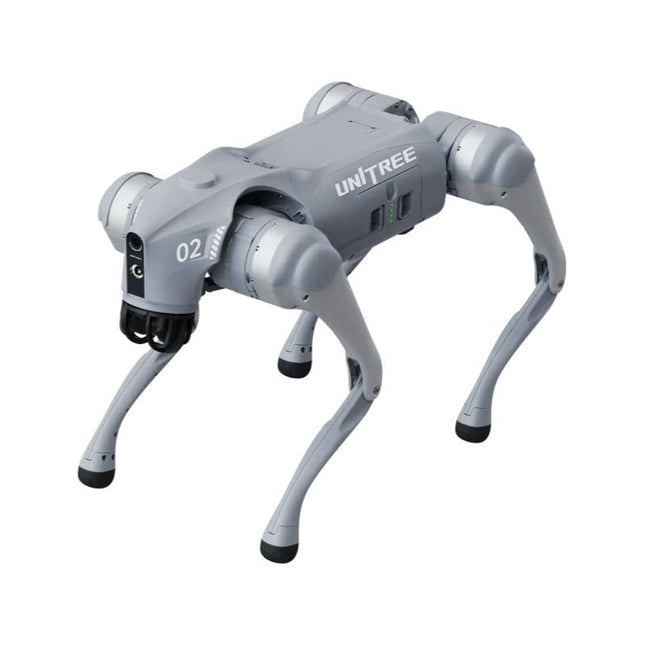
Unitree Unitree Go2 Pro Vierbeiniger Roboter
Vorübergehende Verzögerung bei der Lieferung von Unitree-Robotern Wie viele andere Lieferanten erleben auch wir derzeit Verzögerungen bei der Lieferung von Unitree-Robotern. Eine Sendung unseres Lieferanten steckt derzeit im Zoll fest, was leider zu späteren Lieferungen bereits aufgegebener Bestellungen führt. Wir arbeiten aktiv mit unserem Lieferanten daran, dieses Problem zu lösen, und erwarten in Kürze mehr Klarheit. Leider können wir derzeit jedoch keine festen Zusagen machen. Eine neue Lieferung ist bereits auf dem Weg, wird aber noch etwas Zeit in Anspruch nehmen. Da auch andere Lieferanten mit denselben Herausforderungen konfrontiert sind, ist ein Wechsel zu einem anderen Anbieter derzeit keine schnellere Lösung. Unsere oberste Priorität ist die Lieferung der bestehenden Bestellungen. Falls Sie Fragen haben oder Ihre Bestellung aktualisieren möchten, zögern Sie bitte nicht, unseren Kundenservice zu kontaktieren. Wir halten Sie über weitere Entwicklungen auf dem Laufenden. Die Unitree Go2-Serie besteht aus vierbeinigen Robotern für die Forschung und Entwicklung. Entwicklung autonomer Systeme in den Bereichen Mensch-Roboter-Interaktion (HRI), SLAM & Transport. Aufgrund der vier Beine und des 12DOF kann dieser Roboter eine Vielzahl unterschiedlicher Gelände bewältigen. Der Go2 verfügt über einen perfektionierten Antrieb & Power-Management-System, das eine Geschwindigkeit (je nach Ausführung) von bis zu 3,7 m/s oder 11,88 km/h bei einer Betriebszeit von bis zu 4 Stunden ermöglicht. Darüber hinaus verfügen die Motoren über ein Drehmoment von 45 N.m am Körper/Oberschenkel und an den Knien, was auch Sprünge oder Backflips ermöglicht. Features Super-Erkennungssystem: 4D LIDAR L1 Maximale Laufgeschwindigkeit: ca. 5 m/s Spitzengelenkdrehmoment: ca. 45 Nm Wireless-Modul: WiFi 6/Bluetooth/4G Extrem lange Akkulaufzeit: ca. 2-4 Stunden Intelligentes Side-Follow-System: ISS 2.0 Technische Daten Tracking-Modul: Ferngesteuertes oder automatisches Tracking Frontkamera: Bildübertragungsauflösung 1280 x 720, Sichtfeld 120°, Ultraweitwinkelobjektiv sorgt für satte Klarheit Frontlampe: Erhellt den Weg vor Ihnen hell 4D LiDAR L1: 360°x90° omnidirektionales Ultraweitwinkel-Scannen ermöglicht automatisches Ausweichen mit kleinem toten Winkel und stabilen Betrieb 12 Kniegelenkmotoren: Stark und kraftvoll, schön und einfach, Brandy neues visuelles Erlebnis Intercom-Mikrofon: Effektive Kommunikation ohne Szenario-Einschränkungen Selbstaufrollender Gurt: Einfaches Tragen und Laden von Gegenständen Stabiler, leistungsfähiger mit fortschrittlichen Geräten: 3D LiDAR, 4G-ESIM-Karte, WiFi 6 mit Dualband, Bluetooth 5.2 für stabile Verbindung und Fernsteuerung Leistungsstarker Rechenkern: Motion Controller, Hochleistungs-ARM-Prozessor, verbesserter Al-Algorithmus-Prozessor, externes ORIN NX/NANO Intelligenter Akku: Standard 8000-mAh-Akku, langlebiger 15000-mAh-Akku, Schutz vor Übertemperatur, Überladung und Kurzschluss. Lautsprecher für die Musikwiedergabe: Hören Sie Musik nach Lust und Laune Unitree Go2-Varianten Der Go2 überzeugt nicht nur durch seine technischen Fähigkeiten, sondern auch durch ein modernes und schlankes Design, das ihm einen futuristischen Look verleiht und ihn zu einem echten Hingucker macht. Der Go2 Air ist speziell für Demos und Präsentationen konzipiert. Mit seinen Grundmerkmalen bietet es eine solide Grundlage, um die Bewegungsfähigkeiten und Funktionalität eines vierbeinigen Roboters zu demonstrieren. Wichtig: Der Go2 Air wird ohne Controller geliefert. Dies kann optional erworben werden. Mit einer leistungsstarken 8-Core-Hochleistungs-CPU bieten Pro und Edu beeindruckende Rechenleistung, die für komplexe Aufgaben und anspruchsvolle Berechnungen erforderlich ist. Dies ermöglicht eine schnellere und effizientere Datenverarbeitung und macht den Pro und Edu zu einem zuverlässigen Partner für Ihre Projekte. Ab der Edu-Version ist der Go2 programmierbar und eröffnet endlose Möglichkeiten für die Entwicklung und Erforschung eigener Robotikanwendungen. Der Go2 ist außerdem in der Lage, eine Stufenhöhe von bis zu 14 cm zu bewältigen. Dies macht es zu einem idealen Werkzeug für Forschung, Ausbildung und den Einstieg in die Welt der Robotik. Der Go2 Edu wird mit einer Fernbedienung geliefert, die Ihnen eine einfache und intuitive Steuerung ermöglicht. Außerdem erhalten Sie eine Dockingstation mit beeindruckender Rechenleistung von 100 TOPS, die mit leistungsstarken KI-Algorithmen ausgestattet ist und Ihnen technischen Support bietet. Go2 Edu ist mit einem leistungsstarken 15000 mAh-Akku ausgestattet, der ihm eine beeindruckende Laufzeit von bis zu 4 Stunden ermöglicht. Diese lange Betriebszeit ermöglicht es dem Roboter, längere Erkundungsmissionen durchzuführen und anspruchsvolle Aufgaben zu erledigen. Modellvergleich Air Pro Edu/Edu Plus Abmessungen (stehend) 70 x 31 x 40 cm 70 x 31 x 40 cm 70 x 31 x 40 cm Abmessungen (hockend) 76 x 31 x 20 cm 76 x 31 x 20 cm 76 x 31 x 20 cm Material Aluminiumlegierung + hochfester Kunststoff Aluminiumlegierung + hochfester Kunststoff Aluminiumlegierung + hochfester Kunststoff Gewicht (mit Akku) ca. 15 kg ca. 15 kg ca. 15 kg Spannung 28~33,6 V 28~33,6 V 28~33,6 V Spitzenleistung ca. 3000 W ca. 3000 W ca. 3000 W Nutzlast ≈7 kg (MAX ~ 10 kg) ≈8 kg (MAX ~ 10 kg) ≈8 kg (MAX ~ 12 kg) Geschwindigkeit 0~2.5 m/s 0~3.5 m/s 0~3.7 m/s (MAX ~ 5 m/s) Max. Steigfallhöhe ca. 15 cm ca. 16 cm ca. 16 cm Max. Steigwinkel 30° 40° 40° Basisrechenleistung N/A 8-Kern-Hochleistungs-CPU 8-Kern-Hochleistungs-CPU Aluminium-Kniegelenkmotor 12 Satz 12 Satz 12 Satz Gelenkinterne Schaltung (Knie) ✓ ✓ ✓ Joint Heat Pipe Kühler ✓ ✓ ✓ Bewegungsbereich Körper: −48~48° Körper: −48~48° Körper: −48~48° Oberschenkel: −200°~90° Oberschenkel: −200°~90° Oberschenkel: −200°~90° Schaft: −156°~−48° Schaft: −156°~−48° Schaft: −156°~−48° Max. Drehmoment N/A ca. 45 N.m ca. 45 N.m Super-Weitwinkel 3D-LiDAR ✓ ✓ ✓ Wireless Vektorpositionierungs-Tracking-Modul N/A ✓ ✓ HD-Weitwinkelkamera ✓ ✓ ✓ Fußende-Kraftsensor N/A N/A ✓ Grundlegende Aktion ✓ ✓ ✓ Auto-Skalierband N/A ✓ N/A Aktualisiertes intelligentes OTA ✓ ✓ ✓ RTT 2.0 Bildübertragung ✓ ✓ ✓ App Basic Fernsteuerung ✓ ✓ ✓ App-Daten anzeigen ✓ ✓ ✓ App Grafisches Programm ✓ ✓ ✓ Frontlampe (3 W) ✓ ✓ ✓ WiFi 6 mit Dualband ✓ ✓ ✓ Bluetooth 5.2/4.2/2.1 ✓ ✓ ✓ 4G-Modul N/A CN/GB CN/GB Sprachunktion N/A ✓ ✓ Musikwiedergabe N/A ✓ ✓ ISS 2.0 Intelligentes Side-Follow-System N/A ✓ ✓ Intelligente Erkennung und Vermeidung ✓ ✓ ✓ Sekundäre Entwicklung N/A N/A ✓ Manuelle Steuerung Optional Optional ✓ Modul mit hoher Rechenleistung N/A N/A Edu: 40 TOPS Rechenleistung Edu Plus: 100 TOPS Rechenleistung NVIDIA Jetson Orin (optional) Intelligente Batterie Standard (8000 mAh) Standard (8000 mAh) Lange Lebensdauer (15000 mAh) Akkulaufzeit 1-2 Stunden 1-2 Stunden 2-4 Stunden Ladegerät Standard (33,6 V, 3,5 A) Standard (33,6 V, 3,5 A) Schnellladung (33,6 V, 9 A) Lieferumgang 1x Unitree Go2 Pro 1x Unitree Go2 Akku (8000 mAh) Downloads Documentation iOS/Android apps GitHub
€ 3.599,00
Bestpreis
-
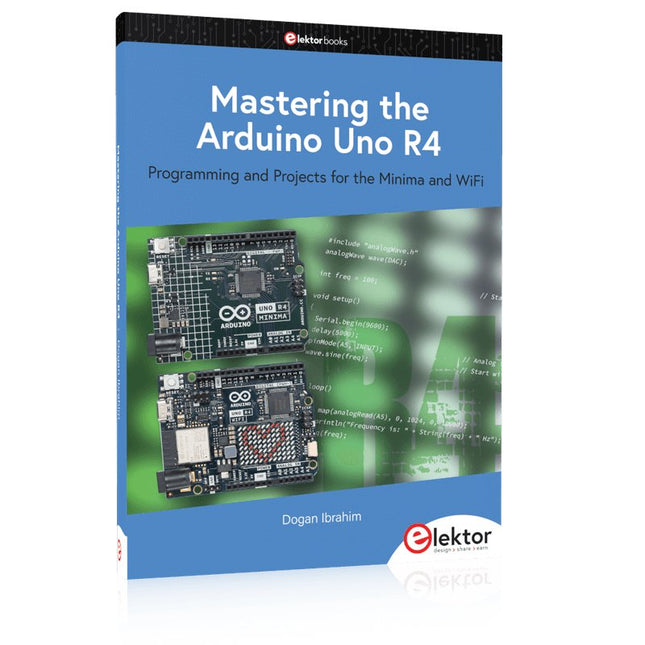
Elektor Publishing Mastering the Arduino Uno R4
Programming and Projects for the Minima and WiFi Based on the low-cost 8-bit ATmega328P processor, the Arduino Uno R3 board is likely to score as the most popular Arduino family member, and this workhorse has been with us for many years. Eleven years later, the long-overdue successor, the Arduino Uno R4, was released. It is built around a 48 MHz, 32-bit Arm Cortex-M4 microcontroller and provides significantly expanded SRAM and Flash memory. Additionally, a higher-precision ADC and a new DAC are added to the design. The Uno R4 board also supports the CAN Bus with an interface. Two versions of the board are available: Uno R4 Minima, and Uno R4 WiFi. This book is about using these new boards to develop many different and interesting projects with just a handful of parts and external modules. All projects described in the book have been fully tested on the Uno R4 Minima or the Uno R4 WiFi board, as appropriate. The project topics include the reading, control, and driving of many components and modules in the kit as well as on the relevant Uno R4 board, including LEDs 7-segment displays (using timer interrupts) LCDs Sensors RFID Reader 4x4 Keypad Real-time clock (RTC) Joystick 8×8 LED matrix Motors DAC (Digital-to-analog converter) LED matrix WiFi connectivity Serial UART CAN bus Infrared controller and receiver Simulators … all in creative and educational ways with the project operation and associated software explained in great detail.
€ 44,95
Mitglieder: € 40,46
-

Elektor Digital Programming Microcontrollers in C/C++ Using Arduino (E-book)
With Examples for Arduino UNO, Raspberry Pi Pico and ESP32 Programming small electronic systems has never been more accessible. Tasks that once demanded expensive tools, specialized hardware, and deep electrical engineering expertise can now be tackled with low-cost development boards and approachable software. At the centre of this shift is the Arduino environment, which provides a unified and familiar way to program a wide range of microcontroller platforms—from classic AVR boards like the Arduino UNO to modern ARM-based boards such as the Raspberry Pi Pico, and powerful Wi-Fi-enabled devices like the ESP32. This book introduces embedded programming through the core idea that defines all microcontrollers: reading inputs, processing information, and controlling outputs in a predictable loop. The Arduino environment abstracts much of the hardware complexity, allowing you to focus on behaviour rather than implementation details. With just a few lines of code, you can blink LEDs, read sensors, control motors, and communicate with other devices. While the Arduino UNO, Raspberry Pi Pico, and ESP32 boards differ greatly in performance and features, they share the same fundamental building blocks: digital and analog I/O, timers, serial communication, PWM, interrupts, and power management. Learning these concepts within the Arduino framework builds skills that transfer easily across platforms and scale toward more advanced applications. By exploring multiple boards while maintaining a consistent programming approach, this book helps you progress from simple experiments to confidently produce well-structured designs—showing that embedded development can be both practical and enjoyable.
€ 24,95
Mitglieder: € 22,46
-

Elektor Digital Controller Area Network Projects with ARM and Arduino (E-book)
This book details the use of the ARM Cortex-M family of processors and the Arduino Uno in practical CAN bus based projects. Inside, it gives a detailed introduction to the architecture of the Cortex-M family whilst providing examples of popular hardware and software development kits. Using these kits helps to simplify the embedded design cycle considerably and makes it easier to develop, debug, and test a CAN bus based project. The architecture of the highly popular ARM Cortex-M processor STM32F407VGT6 is described at a high level by considering its various modules. In addition, the use of the mikroC Pro for ARM and Arduino Uno CAN bus library of functions are described in detail. This book is written for students, for practising engineers, for hobbyists, and for everyone else who may need to learn more about the CAN bus and its applications. The book assumes that the reader has some knowledge of basic electronics. Knowledge of the C programming language will be useful in later chapters of the book, and familiarity with at least one microcontroller will be an advantage, especially if the reader intends to develop microcontroller based projects using CAN bus. The book should be useful source of reference to anyone interested in finding an answer to one or more of the following questions: What bus systems are available for the automotive industry? What are the principles of the CAN bus? What types of frames (or data packets) are available in a CAN bus system? How can errors be detected in a CAN bus system and how reliable is a CAN bus system? What types of CAN bus controllers are there? What are the advantages of the ARM Cortex-M microcontrollers? How can one create a CAN bus project using an ARM microcontroller? How can one create a CAN bus project using an Arduino microcontroller? How can one monitor data on the CAN bus?
€ 32,95
Mitglieder: € 29,66
-

Elektor Bundles Logic Analyzer im Einsatz (Bundle)
Buch: Logic Analyzer im Einsatz Schritt-für-Schritt-Anleitungen führen Sie in die Analyse moderner Protokolle von I²C, SPI, UART, RS-232, NeoPixel, WS28xx, HD44780 und 1-Wire ein. Anhand von zahlreichen Experimentierschaltungen mit dem Raspberry Pi Pico, Arduino Uno und dem Bus Pirate üben Sie die praxisnahe Anwendung gängiger USB-Logikanalysatoren ein. Alle in diesem Buch vorgestellten Experimentierschaltungen wurden vollständig getestet und sind funktionsfähig. Die notwendigen Programmlistings sind enthalten, es sind keine besonderen Programmier- oder Elektronikkenntnisse für diese Schaltungen notwendig. Es werden die Programmiersprachen MicroPython und C mit den Entwicklungsumgebungen Thonny und Arduino IDE eingesetzt. Dieses Buch verwendet mehrere Modelle flexibler und weit verbreiteter USB-Logikanalysatoren und zeigt die Stärken und Schwächen jeder Preisklasse. Sie werden kennenlernen, welche Kriterien für Ihre Arbeit wichtig sind und in der Lage sein, das für Sie passende Gerät zu finden. Egal ob Arduino, Raspberry Pi oder Raspberry Pi Pico: Die abgebildeten Beispielschaltungen ermöglichen einen schnellen Start in die Protokollanalyse und können auch als Grundlage für eigene weitere Experimente dienen. Sie werden alle wichtigen Begriffe und Zusammenhänge kennenlernen, eigene Experimente durchführen, selbstständig Protokolle analysieren und nach der Lektüre dieses Buches – im Bereich der digitalen Signale und Protokolle – ein umfassendes Wissen aufgebaut haben. USB Logic Analyzer (8 Kanäle, 24 MHz) Dieser USB Logic Analyzer ist ein 8-Kanal-Logikanalysator, bei dem jeder Eingang doppelt für die analoge Datenaufzeichnung dient. Es eignet sich perfekt zum Debuggen und Analysieren von Signalen wie I²C, UART, SPI, CAN und 1-Wire. Dabei wird ein digitaler Eingang, der mit einem zu testenden Gerät (DUT) verbunden ist, mit einer hohen Abtastrate abgetastet. Die Verbindung zum PC erfolgt via USB. Technische Daten Kanäle 8 digitale Kanäle Maximale Abtastrate 24 MHz Maximale Eingangsspannung 0 V ~ 5 V Betriebstemperatur 0°C ~ 70°C Eingangsimpedanz 1 MΩ || 10 pF Unterstützte Protokolle I²C, SPI, UART, CAN, 1-Wire etc. PC-Verbindung USB Abmessungen 55 x 28 x 14 mm Downloads Software Dieses Bundle enthält: Buch: Logic Analyzer im Einsatz (Einzelpreis: 40 €) USB Logic Analyzer (8 Kanäle, 24 MHz) (Einzelpreis: 20 €) USB-Kabel Jumper Wire Ribbon Kabel
€ 59,95€ 49,95Bestpreis
-

Elektor Digital Regelungstechnik mit Fuzzy Logic (PDF)
Praktische Anwendungen und Projekte mit Arduino, ESP32 und RP2040 Tauchen Sie ein in die faszinierende Welt der Regelungstechnik mit Arduino und ESP32! Dieses Buch bietet Ihnen einen praxisnahen Einstieg in die klassischen und modernen Methoden der Regelung, darunter PID-Regler, Fuzzy-Logik und Sliding-Mode-Regler. Im ersten Teil lernen Sie die Grundlagen der beliebten Arduino-Controller, wie den Arduino Uno und den ESP32, sowie die Integration von Sensoren für Temperatur- und pH-Messung (NTC, PT100, PT1000, pH-Sensor). Sie erfahren, wie diese Sensoren in verschiedenen Projekten eingesetzt werden und wie Sie Daten auf einem Nextion TFT-Display visualisieren. Weiter geht es mit der Einführung in Stellglieder wie MOSFET-Schalter, H-Brücken und Solid-State-Relais, die zur Steuerung von Motoren und Aktoren verwendet werden. Sie lernen, Regelstrecken zu analysieren und zu modellieren, einschließlich PT1- und PT2-Regelungen. Der Schwerpunkt des Buches liegt auf der Implementierung von Fuzzy- und PID-Reglern zur Regelung von Temperatur und DC-Motoren. Dabei werden sowohl der Arduino Uno als auch der ESP32 eingesetzt. Zudem wird der Sliding-Mode-Regler vorgestellt. Im vorletzten Kapitel erkunden Sie die Grundlagen neuronaler Netze und lernen, wie maschinelles Lernen auf einem Arduino eingesetzt werden kann. Im letzten Kapitel gibt es noch ein praktisches Beispiel für einen Fuzzy-Regler zur Stromeinspeisung ins Hausnetz. Dieses Buch ist die perfekte Wahl für Ingenieure, Studierende und Elektroniker, die ihre Projekte mit innovativen Regelungstechniken erweitern möchten.
€ 34,80
Mitglieder: € 31,32
-

Elektor Labs Elektor Arduino Nano MCCAB Trainingsboard
Das Elektor Arduino Nano MCCAB Trainingsboard enthält alle Bauteile (inkl. Arduino Nano), die für die Übungen des "Mikrocontroller-Praxiskurs für Arduino-Einsteiger" benötigt werden wie Leuchtdioden, Schalter, Taster, akustische Signalgeber usw. Auch externe Sensoren, Motoren oder Baugruppen können mit diesem Mikrocontroller-Übungssystem abgefragt oder gesteuert werden. Technische Daten (Arduino Nano Trainingsboard MCCAB) Stromversorgung Über die USB-Verbindung des zur Erstellung der Programme sowieso angeschlossenen PCs oder ein externes Netzteil (nicht im Lieferumfang enthalten) Betriebsspannung +5 Vcc Eingangsspannung Alle Eingänge 0 V bis +5 V VX1 und VX2 +8 V bis +12 V (nur bei Verwendung eines externen Netzteils) Mikrocontrollermodul Arduino Nano Hardwareperipherie LCD 2x16 Zeichen Potenziometer P1 & P2 JP3: Auswahl der Betriebsspannung von P1 & P2 Verteiler SV4: Verteiler für die BetriebsspannungenSV5, SV6: Verteiler für die Ein-/Ausgänge des Mikrocontrollers Schalter und Taster RESET-Taster auf dem Arduino Nano-Modul6x Tastschalter K1 … K66x Schiebeschalter S1 … S6JP2: Verbindung der Schalter mit den Eingängen des Mikrocontrollers Summer Piezo-Summer Buzzer1 mit Steckbrücke auf JP6 Leuchtanzeigen LED L auf dem Arduino Nano-Modul, verbunden mit GPIO D1311x LED: Zustandsanzeige für die Ein-/AusgängeJP6: Verbindung der LEDs LD10 … LD20 mit den GPIOs D2 … D12 Serielle SchnittstellenSPI & I²C JP4: Auswahl des Signals an Pin X der SPI-Steckerleiste SV12SV9 bis SV12: SPI-Interface (3,3 V/5 V) bzw. I²C-Interface Schaltausgang für externe Geräte SV1, SV7: Schaltausgang (maximal +24 V/160 mA, extern zugeführt)SV2: 2x13 Pins zum Anschluss externer Module 3x3 LED-Matrix (9 rote LEDs) SV3: Spalten der 3x3 LED-Matrix (Ausgänge D6 … D8)JP1: Verbindung der Reihen mit den GPIOs D3 … D5 Software Library MCCABLib Steuerung der Hardware-Komponenten (Schalter, Taster, Leuchtdioden, 3x3 LED-Matrix, Summer) auf dem MCCAB Trainingsboard Betriebstemperatur bis +40 °C Abmessungen 100 x 100 x 20 mm Technische Daten (Arduino Nano) Mikrocontroller ATmega328P Architektur AVR Betriebsspannung 5 V Flashspeicher 32 KB, davon 2 KB vom Bootloader belegt SRAM 2 KB Taktfrequenz 16 MHz Analoge IN-Pins 8 EEPROM 1 KB DC-Strom pro I/O-Pin 40 mA an einem I/O-Pin, insgesamt maximal 200 mA an allen Pins gemeinsam Eingangsspannung 7-12 V Digitale I/O-Pins 22 (6 davon sind PWM-fähig) PWM-Ausgänge 6 Stromverbrauch 19 mA Abmessungen 18 x 45 mm Gewicht 7 g Lieferumfang 1x Elektor Arduino Nano Trainingsboard (MCCAB) 1x Arduino Nano
€ 69,95
Bestpreis
-
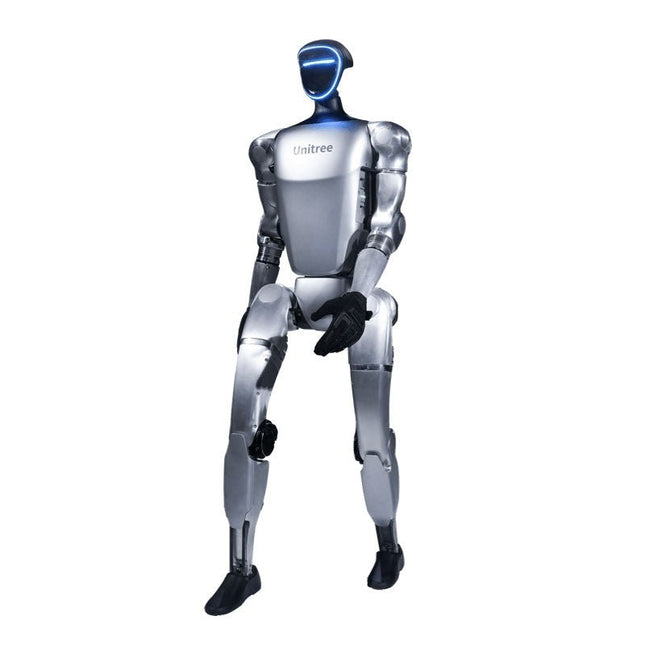
Unitree Unitree G1 Humanoider Roboter
Der Unitree G1 ist ein moderner humanoider Roboter, der durch seine bemerkenswerte Flexibilität und fortschrittliche Technologie beeindruckt. Mit einer außergewöhnlich großen Bandbreite an Gelenkbewegungen und bis zu 43 Gelenkmotoren übertrifft er die Agilität eines typischen Menschen. Seine Robotersysteme werden mit Hilfe von künstlicher Intelligenz durch Imitations- und Verstärkungslernen ständig weiterentwickelt und optimiert. Eine der beeindruckendsten Eigenschaften des G1 ist seine Fähigkeit, sich selbstständig in eine Gehposition zu begeben, sobald er den Boden berührt – ohne externe Hilfe! Er kann sich sofort in Bewegung setzen und beweist damit ein hohes Maß an Unabhängigkeit und Anpassungsfähigkeit. Der G1 ist außerdem mit einer kraftgesteuerten, sehr geschickten Hand ausgestattet, die dank der Kombination aus Kraft- und Positionssteuerung sowohl sensibel als auch präzise arbeitet. Diese Hand ahmt die menschlichen Bewegungen genau nach und ermöglicht eine präzise Handhabung von Objekten. Features Intel RealSense D435 Tiefenkamera Livox MID-360 3D-LiDAR Mikrofonarray (Rausch- und Echounterdrückung) 5 W Stereolautsprecher Extra großer Schnellwechsel-Akku Einzelarm-Freiheitsgrade (Schulter 2 + Ellenbogen 2) Hohlachsverkabelung der gesamten Maschine (keine externen Kabel) Maximales Drehmoment an den Gelenken 120 Nm Einzelbein-Freiheitsgrade (Hüfte 3, Knie 1, Knöchel 2) Bewegungsgeschwindigkeit von 2 m/s Technische Daten Höhe, Breite und Tiefe (stehend) 1320 x 450 x 200 mm Höhe, Breite und Tiefe (gefaltet) 690 x 450 x 300 mm Gewicht (mit Batterie) ca. 35 kg Gesamtfreiheitsgrade (Gemeinsame Freiheit) 23 Einzelbeinige Freiheitsgrade 6 Taillenfreiheitsgrade 1 Einarmige Freiheitsgrade 5 Gelenkabtriebslager Kreuzrollenlager in Industriequalität (hohe Präzision, hohe Belastbarkeit) Gelenkmotor Hochgeschwindigkeits-Innenrotor PMSM (Permanentmagnet-Synchronmotor mit geringer Trägheit – bessere Reaktionsgeschwindigkeit und Wärmeableitung) Maximales Drehmoment des Kniegelenks 90 Nm Maximale Armlast ca. 2 kg Waden- und Oberschenkellänge 0,6 m Armspanne ca. 0,45 m Extra großer Gelenkbewegungsraum • Taillengelenk: Z ±155°• Kniegelenk: 0~165°• Hüftgelenk: P ±154°, R -30~+170°, Y ±158° Vollständige hohle elektrische Leitungsführung Ja Gelenk-Encoder Dual-Encoder Kühlsystem Lokale Luftkühlung Stromversorgung 13-Strang-Lithiumbatterie Grundlegende Rechenleistung 8-Kern-Hochleistungs-CPU Erkennungssensor Tiefenkamera + 3D-LiDAR Mikrofone 4-Mikrofon-Array Lautsprecher 5 W Stereolautsprecher Drahtlos WiFi 6, Bluetooth 5.2 Intelligente Batterie (Schnellverschluss) 9000 mAh Ladegerät 54 V/5 A Manueller Controller Ja Akkulaufzeit ca. 2 Stunden Verbessertes intelligentes OTA Ja
€ 24.999,00
Bestpreis
-

Elektor Publishing MIT App Inventor for AI and IoT
Build Smart Applications with Raspberry Pi, Arduino, and ESP32 Discover how easy and exciting mobile app development can be with MIT App Inventor. This hands-on guide takes you from basic concepts to building real-world mobile applications using a simple visual programming approach—no prior coding experience required. You will create IoT and AI-powered apps for Android devices and explore how App Inventor can also be used with iPhones and iPads. Connect your applications to platforms such as Arduino UNO R4 WiFi, ESP32, Raspberry Pi Pico (2)W and Raspberry Pi 5, enabling you to build smart, connected systems. Inside the book, you will learn how to: Build interactive apps using buttons, images, sound, and multimedia Create text-to-speech and speech-recognition applications Develop camera-based and location-aware (GPS) apps Design useful tools such as calculators and educational apps Work with smartphone sensors like accelerometers and light sensors Build AI-powered applications, including voice assistants and image-generation features Send and receive messages, and create communication-based apps Connect mobile apps to hardware using Wi-Fi and Bluetooth Control real devices such as LEDs, motors, and sensors Designed for beginners, students, and hobbyists, this book focuses on learning by doing. By the end, you will have the skills and confidence to create your own innovative applications that interact with both the digital and physical worlds. Start building and turning your ideas into reality.
€ 44,95
Mitglieder: € 40,46
-
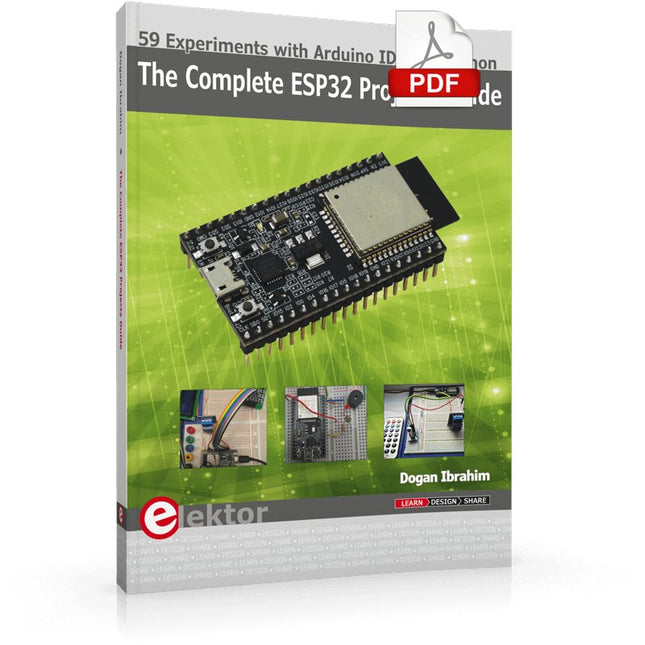
Elektor Digital The Complete ESP32 Projects Guide (E-book)
59 Experiments with Arduino IDE and Python The main aim of this book is to teach the Arduino IDE and MicroPython programming languages in ESP32 based projects, using the highly popular ESP32 DevKitC development board. Many simple, basic, and intermediate level projects are provided in the book using the Arduino IDE with ESP32 DevKitC. All projects have been tested and work. Block diagrams, circuit diagrams, and complete program listings of all projects are given with explanations. In addition, several projects are provided for programming the ESP32 DevKitC using MicroPython. The projects provided in this book are designed to teach the following features of the ESP32 processor: GPIOs Touch sensors External interrupts Timer interrupts I²C and I²S SPI PWM ADC DAC UART Hall sensor Temperature sensor Infrared controller Reading and writing to SD card Reading and writing to flash memory RTC timer Chip ID Security and encryption Wi-Fi and network programming Bluetooth BLE programming Communication mobile devices Low power design ESP-IDF programming The projects have been organized with increasing levels of difficulty. Readers are encouraged to tackle the projects in the order given. A specially prepared hardware kit (SKU 18305) is available from Elektor. With the help of this hardware, it should be easy and fun to build the projects in this book.
€ 34,95
Mitglieder: € 31,46
-
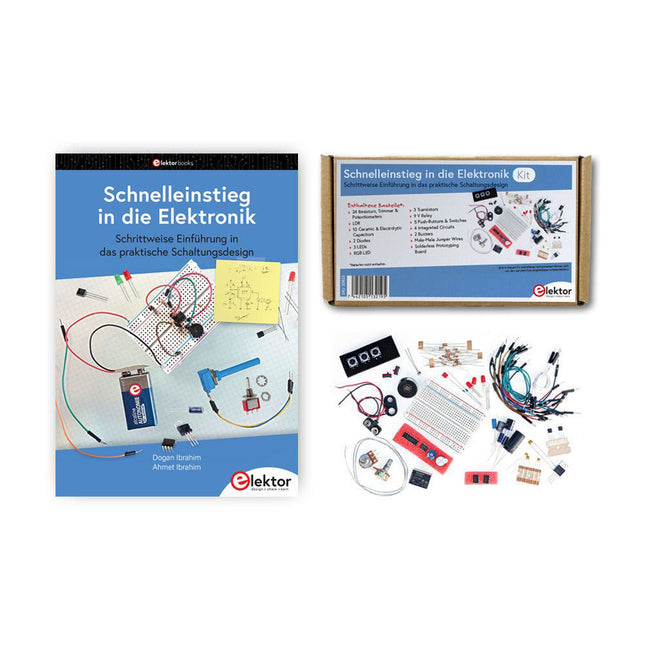
Elektor Bundles Schnelleinstieg in die Elektronik (Bundle)
Der Einstieg in die Elektronik ist einfacher, als Sie denken! Mit diesem Bundle – bestehend aus Buch und Experimentierkit – entdecken Sie die Grundlagen der Elektro- und Elektroniktechnik Schritt für Schritt. Anhand spannender Experimente lernen Sie praxisnah und verständlich, ganz ohne komplizierte Fachbegriffe oder langwierige Berechnungen. So sind Sie schon bald in der Lage, Ihre eigenen Elektronikprojekte umzusetzen! Das Kit enthält alle notwendigen Komponenten, um die meisten im Buch beschriebenen Schaltungen direkt auf dem Steckbrett aufzubauen und praktisch zu erproben. Das Kit kann selbstverständlich auch ohne das Buch zum Aufbau anderer Schaltkreise und zur Durchführung eigener Experimente verwendet werden. Inhalt des Kits 1x 39 Ω, 1 W Widerstand 1x 47 Ω Widerstand 1x 180 Ω Widerstand 1x 330 Ω Widerstand 3x 1 kΩ Widerstand 1x 2,2 kΩ Widerstand 1x 3,9 kΩ Widerstand 1x 6,8 kΩ Widerstand 1x 10 kΩ Widerstand 1x 15 kΩ Widerstand 1x 22 kΩ Widerstand 1x 33 kΩ Widerstand 1x 47 kΩ Widerstand 1x 56 kΩ Widerstand 1x 82 kΩ Widerstand 1x 120 kΩ Widerstand 1x 680 kΩ Widerstand 2x 100 kΩ Widerstand 1x 10 kΩ Trimmer 1x 10 kΩ Linearpotentiometer 1x 100 kΩ Linearpotentiometer 1x LDR 1x 1 nF Keramikkondensator 2x 10 nF Keramikkondensator 1x 100 nF Keramikkondensator 1x 1 µF, 25 V Aluminium-Elektrolytkondensator 2x 10 µF, 25 V Aluminium-Elektrolytkondensator 1x 100 µF, 25 V Aluminium-Elektrolytkondensator 1x 470 µF, 25 V Aluminium-Elektrolytkondensator 1x 1000 µF, 25 V Aluminium-Elektrolytkondensator 1x RGB-LED, Common-Cathode (CC) 1x 1N4148 Kleinsignaldiode 1x 1N4733A 5,1 V, 1 W Zenerdiode 3x LED, rot 2x BC337 NPN-Transistor 1x IRFZ44N N-Kanal-MOSFET 2x NE555-Timer 1x LM393-Komparator 1x 74HCT08 Quad-AND-Gatter 3x Tastschalter 2x SPDT-Schalter 1x Relais, SPDT, 9 VDC 1x Aktiver Summer 1x Passiver Summer 50 cm Massivdraht, 16 AWG, ohne Mantel 2x PP3 9 V Batterieclip 1x Steckbrett 20x Überbrückungskabel Dieses Bundle enthält: Buch: Schnelleinstieg in die Elektronik (Einzelpreis: 45 €) Kit: Schnelleinstieg in die Elektronik (Wert: 45 €)
€ 89,95€ 69,95Bestpreis
-

Elektor Digital MIT App Inventor for AI and IoT (E-book)
Build Smart Applications with Raspberry Pi, Arduino, and ESP32 Discover how easy and exciting mobile app development can be with MIT App Inventor. This hands-on guide takes you from basic concepts to building real-world mobile applications using a simple visual programming approach—no prior coding experience required. You will create IoT and AI-powered apps for Android devices and explore how App Inventor can also be used with iPhones and iPads. Connect your applications to platforms such as Arduino UNO R4 WiFi, ESP32, Raspberry Pi Pico (2)W and Raspberry Pi 5, enabling you to build smart, connected systems. Inside the book, you will learn how to: Build interactive apps using buttons, images, sound, and multimedia Create text-to-speech and speech-recognition applications Develop camera-based and location-aware (GPS) apps Design useful tools such as calculators and educational apps Work with smartphone sensors like accelerometers and light sensors Build AI-powered applications, including voice assistants and image-generation features Send and receive messages, and create communication-based apps Connect mobile apps to hardware using Wi-Fi and Bluetooth Control real devices such as LEDs, motors, and sensors Designed for beginners, students, and hobbyists, this book focuses on learning by doing. By the end, you will have the skills and confidence to create your own innovative applications that interact with both the digital and physical worlds. Start building and turning your ideas into reality.
€ 34,95
Mitglieder: € 31,46


