
Suchergebnisse für "elektor OR magazine OR nl OR maart OR april OR 2019 OR pdf"
-

Elektor Digital Vanderveen Trans Tube Amplifiers (E-book)
Menno van der Veen is well known for his research publications on tube amplifiers used in audio systems. In this book he describes one of his research projects which focuses on the question of whether full compensation for distortion in tubes and output transformers is possible. In the past, a variety of techniques have been developed. One of them has largely been forgotten: trans-conductance, which means converting current into voltage or voltage into current. Menno van der Veen has breathed new life into this technique with his research project titled “Trans”. This book discusses all aspects of this method and discusses its pitfalls. These pitfalls are addressed one by one. The end result is a set of stringent requirements for Trans amplifiers. Armed with these requirements, Menno then develops new Trans amplifiers, starting with Transie 1 and Transie 2. These DC-coupled, single-ended tube amplifiers have unusually good characteristics and are suitable for hobbyist construction. Next the Trans principle is applied to amplifiers with higher output power. A trial-and-error process ultimately leads to the Vanderveen Trans 30 amplifier, which optimizes the features of Trans. The characteristics of this amplifier are so special and unique that Menno believes he has struck gold. To ensure that variations in tube characteristics cannot interfere with optimal Trans behavior, Menno makes use of simulations and comparison with other amplifier types. This book reads like an adventure story, but it is much more – it is an account of solid research into new ways to achieve optimal audio reproduction.
€ 29,95
Mitglieder: € 26,96
-
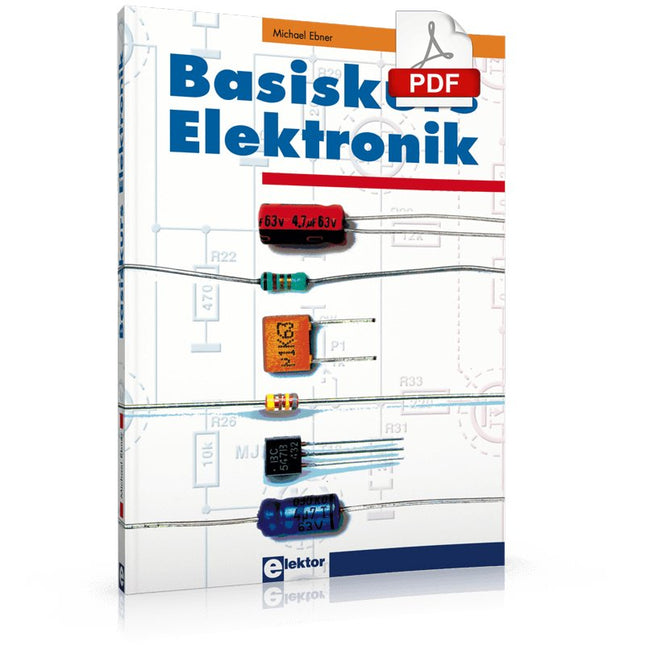
Elektor Digital Basiskurs Elektronik (E-book)
Auf dem Markt gibt es eine Reihe von Elektronik-Fachbüchern, die höchsten Ansprüchen genügen. Stellvertretend für alle sei hier nur die „Hohe Schule der Elektronik“ erwähnt (im Original „The Art of Electronics“), die in mehreren Bänden auch beim Elektor Verlag erschienen ist. Wer auf Elektronik-Kenntnisse für den täglichen Gebrauch Wert legt, muss nicht unbedingt den wissenschaftlichen Hintergrund bis ins letzte Detail studieren. So ist es auch nicht erforderlich, jedes „exotische“ Bauteil und jede mögliche Schaltungsvariante zu kennen. Wer sich mit den gemachten Aussagen identifizieren kann, hält mit diesem Buch das richtige Werk in Händen. Es ist geeignet für Einsteiger, für Auszubildende in den entsprechenden Berufen, für Hobby-Elektroniker und nicht zuletzt für diejenigen, für die Elektronik ein Thema unter vielen ist. Also alle, für die eine kurze, verständliche und auch bezahlbare Einleitung in den Themenbereich „Elektronik“ wichtig ist. „Basiskurs Elektronik“ ist ein Grundlagenbuch mit dem Schwerpunkt Analog-Niederfrequenztechnik – dem Einmaleins der gesamten Elektronik.
€ 24,90
Mitglieder: € 22,41
-
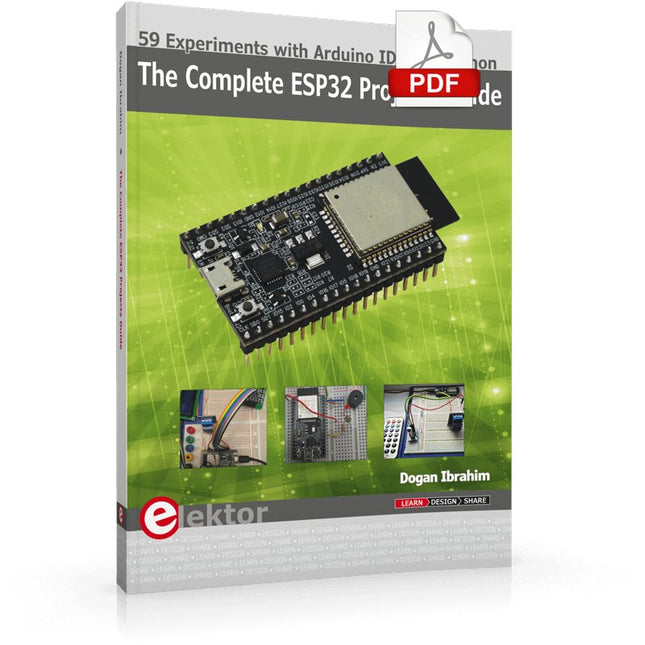
Elektor Digital The Complete ESP32 Projects Guide (E-book)
59 Experiments with Arduino IDE and Python The main aim of this book is to teach the Arduino IDE and MicroPython programming languages in ESP32 based projects, using the highly popular ESP32 DevKitC development board. Many simple, basic, and intermediate level projects are provided in the book using the Arduino IDE with ESP32 DevKitC. All projects have been tested and work. Block diagrams, circuit diagrams, and complete program listings of all projects are given with explanations. In addition, several projects are provided for programming the ESP32 DevKitC using MicroPython. The projects provided in this book are designed to teach the following features of the ESP32 processor: GPIOs Touch sensors External interrupts Timer interrupts I²C and I²S SPI PWM ADC DAC UART Hall sensor Temperature sensor Infrared controller Reading and writing to SD card Reading and writing to flash memory RTC timer Chip ID Security and encryption Wi-Fi and network programming Bluetooth BLE programming Communication mobile devices Low power design ESP-IDF programming The projects have been organized with increasing levels of difficulty. Readers are encouraged to tackle the projects in the order given. A specially prepared hardware kit (SKU 18305) is available from Elektor. With the help of this hardware, it should be easy and fun to build the projects in this book.
€ 34,95
Mitglieder: € 31,46
-

Elektor Digital Build Your Own Multifunctional 4-Axis CNC Machine (E-book)
Plot, Cut, Drill, Mill and Laser with the Z99 This book covers the construction, hardware, software, and operation of the Z99 – CNC machine. This is a multifunctional 4-axis machine for home construction. The capabilities of the Z99 machine include: large-format schematic plotting PCB plotting with etch-resist pens schematic plotting with conductive-ink pens letter cutting out of vinyl paper cutting PCB/substrate drilling PCB/substrate milling text milling laser engraving laser cutting of solder paste masks By making the support software available as freeware, readers of the book are challenged and encouraged to develop new applications for the Z99. The machine would not be of much use if the user has no option to create suitable files for the designs in mind. A large part of this book is dedicated to creating source files in a variety of freeware software packages, including Inkscape, DesignSpark PCB, KiCad, and FlatCAM. The book is also useful for readers keen to comprehend and then master the basic structure of HPGL, Gerber, Drill, and G-code files, as well as to have a go at deciphering them using software.
€ 29,95
Mitglieder: € 26,96
-

Elektor Digital CAN en EOBD in de autotechniek (E-book)
Elektronische systemen in een voertuig worden steeds belangrijker. Dit wordt mede veroorzaakt door de toenemende milieu- en veiligheidseisen en de wensen ten aanzien van het comfort. Dit leidt niet alleen tot een toename van het aantal regeleenheden (tot 80 stuks in een enkel voertuig) maar deze regeleenheden, die vaak van verschillende leveranciers zijn, moeten ook met elkaar communiceren. Vanaf 2008 is het voor nieuwe voertuigen die voor typegoedkeuring worden aangeboden, verplicht om ten aanzien van emissiegerelateerde storingen via de CAN-bus met een externe diagnosetester te communiceren, volgens een door Europese regelgeving vastgestelde norm. Er wordt uitgebreid aandacht besteed aan de opbouw en werking van het CAN-protocol, gezien vanuit zowel de software als de hardware. Onderwerpen die aan bod komen zijn onder andere de opbouw van een CAN-bericht, de prioriteitsregeling en de fysieke verbinding. Behalve de CAN-bus komt ook EOBD via de CAN-bus uitgebreid aan de orde: hoe werkt EOBD, en welke diagnostische gegevens zijn met behulp van een diagnosetester toegankelijk. De ‘rode draad’ wordt gevormd door de regelgeving van de Europese Unie en de internationale ISO- en SAE-normen. Deze regelgeving en normen moeten er voor zorgen dat de milieubelasting tot een minimum wordt beperkt en een milieugerelateerde storing snel gesignaleerd (en gerepareerd) wordt. Na het doorlezen en bestuderen van de inhoud wordt de CAN-bus en de diagnose via de CAN-bus voor iedereen inzichtelijk; de hobbyist die een CAN-bericht wil begrijpen en eventueel een eigen CAN-bussysteem wil opzetten, de sleutelaar die de storingen van zijn eigen voertuig wil uitlezen en repareren, maar ook de professionele diagnosetechnicus die een lastige fout moet opsporen. Daarnaast kunnen studenten en ontwikkelaars van CAN- en EOBD-applicaties door bestuderen en vooral experimenteren een basis leggen voor eigen toepassingen.
€ 34,95
Mitglieder: € 31,46
-

Elektor Digital PIC Cookbook for Virtual Instrumentation (E-book)
The software simulation of gauges, control-knobs, meters and indicators which behave just like real hardware components on a PC’s screen is known as virtual instrumentation. In this book, the Delphi program is used to create these mimics and PIC based external sensors are connected via a USB/RS232 converter communication link to a PC. Detailed case studies in this Book include a virtual compass displayed on the PC’s screen, a virtual digital storage oscilloscope, virtual -50 to +125 degree C thermometer, and FFT sound analyser, a joystick mouse and many examples detailing virtual instrumentation Delphi components. Arizona’s embedded microcontrollers – the PIC's are used in the projects and include PIC16F84A, PIC16C71, DSPIC30F6012A, PIC16F877, PIC12F629 and the PIC16F887. Much use is made of Microchip’s 44 pin development board (a virtual instrument ‘engine)’, equipped with a PIC16F887 with an onboard potentiometer in conjunction with the PIC’s ADC to simulate the generation of a variable voltage from a sensor/transducer, a UART to enable PC RS232 communications and a bank of 8 LED's to monitor received data is also equipped with an ISP connector to which the ‘PICKIT 2’ programmer may easily be connected. Full source code examples are provided both for several different PIC’s, both in assembler and C, together with the Pascal code for the Delphi programs which use different 3rd party Delphi virtual components.
€ 19,95
Mitglieder: € 17,96
-
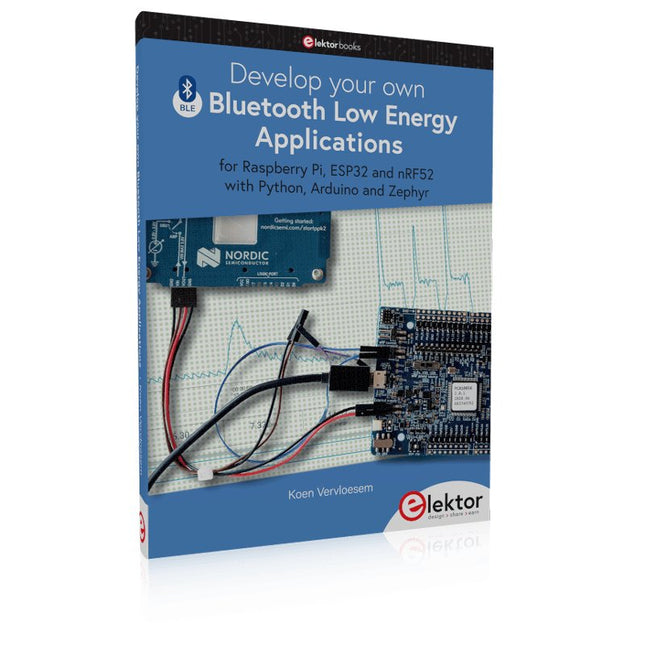
Elektor Publishing Develop your own Bluetooth Low Energy Applications
For Raspberry Pi, ESP32 and nRF52 with Python, Arduino and Zephyr Bluetooth Low Energy (BLE) radio chips are ubiquitous from Raspberry Pi to light bulbs. BLE is an elaborate technology with a comprehensive specification, but the basics are quite accessible. A progressive and systematic approach will lead you far in mastering this wireless communication technique, which is essential for working in low power scenarios. In this book, you’ll learn how to: Discover BLE devices in the neighborhood by listening to their advertisements. Create your own BLE devices advertising data. Connect to BLE devices such as heart rate monitors and proximity reporters. Create secure connections to BLE devices with encryption and authentication. Understand BLE service and profile specifications and implement them. Reverse engineer a BLE device with a proprietary implementation and control it with your own software. Make your BLE devices use as little power as possible. This book shows you the ropes of BLE programming with Python and the Bleak library on a Raspberry Pi or PC, with C++ and NimBLE-Arduino on Espressif’s ESP32 development boards, and with C on one of the development boards supported by the Zephyr real-time operating system, such as Nordic Semiconductor's nRF52 boards. Starting with a very little amount of theory, you’ll develop code right from the beginning. After you’ve completed this book, you’ll know enough to create your own BLE applications.
€ 39,95
Mitglieder: € 35,96
-

Elektor Publishing Control Engineering with Fuzzy Logic
Practical Applications and Project with Arduino, ESP32, and RP2040 Immerse yourself in the fascinating world of control engineering with Arduino and ESP32! This book offers you a practical introduction to classic and modern control methods, including PID controllers, fuzzy logic, and sliding-mode controllers. In the first part, you will learn the basics of the popular Arduino controllers, such as the Arduino Uno and the ESP32, as well as the integration of sensors for temperature and pH measurement (NTC, PT100, PT1000, and pH sensor). You will learn how to use these sensors in various projects and how to visualize data on a Nextion TFT display. The course continues with an introduction to actuators such as MOSFET switches, H-bridges, and solid-state relays, which are used to control motors and actuators. You will learn to analyze and model controlled systems, including PT1 and PT2 control. The book focuses on the implementation of fuzzy and PID controllers for controlling temperature and DC motors. Both the Arduino Uno and the ESP32 are used. The sliding-mode controller is also introduced. In the second-to-last chapter, you will explore the basics of neural networks and learn how machine learning can be used on an Arduino. In the last chapter, there is a practical example of a fuzzy controller for feeding electricity into the household grid. This book is the perfect choice for engineers, students, and electronics engineers who want to expand their projects with innovative control techniques.
€ 44,95
Mitglieder: € 40,46
-

Elektor Digital Ontwerpen van Buizenversterkers (E-book)
Ook in deze tijd klinken buizenversterkers nog steeds fantastisch, misschien wel mooier dan ooit. Nu hebben we immers de beschikking over moderne materialen als ringkern uitgangstransformatoren, uiterst hoogwaardige weerstanden en condensatoren en vele soorten goed klinkend draad. Ook de moderne geluidsbronnen als de CD speler en de nieuwste hoogwaardige luidsprekers laten beter dan ooit horen hoe goed de buizenversterker weergeeft. Dit boek van Menno van der Veen kijkt niet alleen theoretisch naar buizenversterkers, maar vooral ook naar de ontwerpfase waarin besluiten moeten worden genomen over de doelen en eisen van de versterker. Hoe hangen deze samen met subjectieve en objectieve criteria? Welke schakelingen klinken vooral prachtig en waarom doen ze dat? Stel dat je een versterker gaat ontwikkelen en in de handel wilt brengen, tegen welke problemen loop je dan aan? En wat te zeggen van het belang en de betekenis van metingen? Zeggen ze nu iets of zeggen ze niets? Dankzij de grote rekenkracht van de computer kunnen we tegenwoordig dieper meten dan ooit. Hoe pas je deze technieken toe bij buizenversterkers? Tot nu toe waren metingen over frequentiebereik en vermogen en vervorming voldoende om een beeld van de eigenschappen van een versterker te geven. Maar zijn zulke metingen voldoende of moeten we gaan meten zoals ons oor waarneemt, met echte muzieksignalen in plaats van meettoontjes? De auteur schetst een toekomst waarbij meten aan de versterker de eigenschappen van ons horen moet volgen om tot nieuwe inzichten te komen. Dit boek is meer op de praktijk gericht dan op de theorie en heeft een beschouwend karakter, alsof de auteur van bovenaf naar de buizenversterker kijkt. Kenniselementen worden geïntegreerd en in een breed overzichtelijk kader geplaatst.
€ 29,95
Mitglieder: € 26,96
-
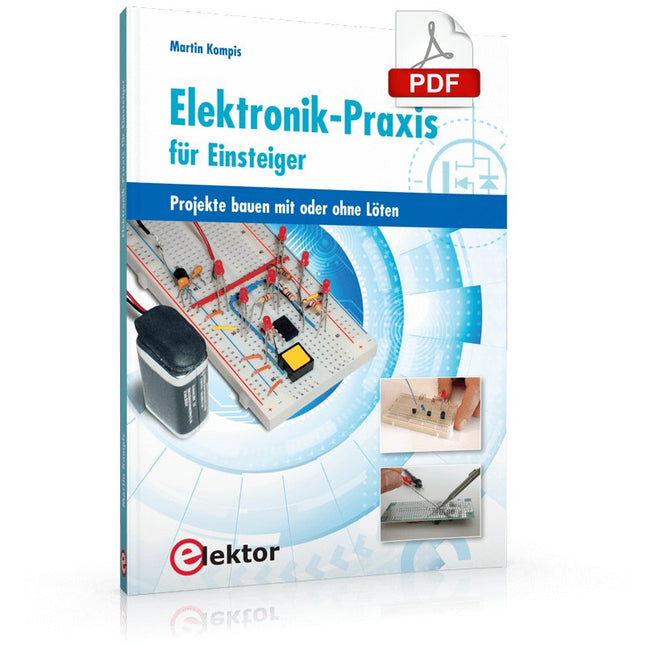
Elektor Digital Elektronik-Praxis für Einsteiger (PDF)
Wenn Sie nachbausichere Schaltungen suchen, die mit wenigen elektronischen Bauteilen auskommen, problemlos funktionieren und Spaß machen – dann liegen Sie mit diesem Buch richtig. Hier finden Sie beispielsweise Radioempfänger für UKW, Lang- und Mittelwelle, eine akustische Illusion, ein Mini-Oszilloskop zur grafischen Anzeige von Spannungsverläufen, elektronische Orgeln, einen elektronischen Würfel mit Mikrocontroller, Gegensprechanlagen, einen Generator für Sinus-, Rechteck- und Dreiecksignale und weitere funktionssichere Schaltungen.Wenn Sie elektronische Schaltungen bauen möchten, vorerst aber lieber bei bedrahteten Bauteilen und Steckbrettern bleiben, anstatt Platinen herzustellen und Bauteile zu löten – dann liegen Sie hier richtig. Für alle Bauprojekte wird ein Steckbrett-Aufbau gezeigt und bei vielen zusätzlich ein einfacher Aufbau auf einer Universal-Leiterplatte. Zahlreiche Fotos veranschaulichen das Vorgehen. Für alle Bauteile sind mindestens zwei aktuelle Lieferanten angegeben.Wenn Ihnen der reine Nachbau etwas zu wenig geworden ist und Sie anfangen möchten, Schaltungen selber zu entwerfen und zu berechnen – dann liegen Sie hier richtig. Von ganz einfach bis etwas schwerer erfahren Sie unter anderem, wie Sie Vorwiderstände berechnen, einen Schwingkreis oder eine Spule dimensionieren, wie man die Bauteile astabiler Multivibratoren mit 2 Transistoren berechnet, wie Operationsverstärker eingesetzt werden können und wie ein Mikrocontroller funktioniert und programmiert wird. Das alles mit einfachen Formeln und vielen Beispielen.Auch wenn Sie nur wenig oder keine Erfahrung mit Elektronik haben und neu einsteigen möchten – dann liegen Sie hier richtig. Sie erfahren das Wichtigste über den praktischen Aufbau von Schaltungen, ob nun auf dem Steckbrett oder auf einer Leiterplatte, die wichtigsten Werkzeuge und natürlich über die wichtigsten elektronischen Bauteile.
€ 32,80
Mitglieder: € 29,52
-

Elektor Digital Build Your Own Coffee Roaster with Raspberry Pi (E-book)
Designing, Wiring, and Controlling Build Your Own Coffee Roaster is a practical guide to constructing and operating the Cobra Smart Roaster and its companion Open Roaster Controller (ORC). The e-book walks the reader through every stage of the build, from assembling the powerhead and wiring the system to installing and configuring the controller. Along the way, you’ll learn how to use the Raspberry Pi to bring precision and flexibility to your roasting process. Clear, step-by-step chapters cover: Powerhead construction and required components Low- and high-voltage wiring Installing the ORC, network setup, and using the web interface Roasting coffee with the Cobra in different setups, including hand-stir and bread-machine roasting Advanced topics such as manual mode, fixed profiles, Artisan-Scope connections, and ORC system programming A complete parts list, practical guidance throughout, and concise explanations make this e-book a useful reference for anyone interested in building, modifying, or understanding their own coffee-roasting system.
€ 19,95
Mitglieder: € 17,96
-

Elektor Digital Programmierbare Taschenrechner selbst gebaut (E-book)
Wie addiert ein Taschenrechner Zahlen in Fließkommadarstellung? Wie kann er Quadratwurzeln ziehen? Kann man programmierbare Taschenrechner selber bauen und nach eigenen Vorstellungen erweitern? Es ist möglich, und zwar mit vertretbarem Aufwand und mit Resultaten, die sich durchaus sehen lassen können. Dieses E-Book zeigt wie.Zwei unterschiedliche Wege werden beschritten. Die Verwendung älterer, aber noch erhältlicher fertiger Taschenrechner-ICs führt zu einfachen Schaltungen, welche sich aber nur schwer abändern oder erweitern lassen. Der zweite Weg führt über die programmierung von Mikrocontrollern, was sehr viel flexiblere Designs erlaubt. Eigene Funktionen können definiert und die Hardware nach Bedarf ergänzt werden.Die in diesem E-Book vorgestellten programmierbaren Taschenrechner können mehrkanalig Spannungen messen und mit den Messergebnissen direkt weiter rechnen. Sie können Resultate grafisch darstellen und einfache Melodien wiedergeben. Die Taschenrechner basieren auf BASIC-Stamps, welche mit dem leicht zu erlernenden PBASIC programmiert werden. Die genaue Beschreibung der Soft- und Hardware erlaubt einen funktionssicheren Nachbau, die Software für Rechner mit umgekehrt polnischer Notation (UPN) und mit algebraischer Eingabe können direkt heruntergeladen werden. Ein Kapitel über Varianten und Erweiterungen erleichtert die Realisierung programmierbarer Taschenrechner nach eigenen Vorstellungen.
€ 29,80
Mitglieder: € 26,82


