Whatever the methods or even then financial means you have to make your circuits work, the power supply should rank high if not Number One in your considerations. The design block simply called “power supply” is hugely underrated both in electronics creation and repair. Yet, the “PSU” has enormous diversity and comes in wildly differing guises like AC/DC, generator, battery (rechargeable or not), PV panel, benchtop, linear or switch-mode, to mention but a few. The output ranges are also staggering like nano-amps to kiloamps and the same for voltages.This special covers the features and design aspects of power supplies.ContentsBasics
Battery ManagementWhat to be aware of when using (Lithium) batteries.
Fixed-Voltage Power Supply using Linear RegulatorsThe best result right after batteries.
Light Energy HarvestingA small solar panel is used in an energy harvesting project to manage and charge four AAA cells.
Mains Powered Adapter DesignBasic circuits and tips for transformers, rectification, filtering and stabilization.
LM317 Soft StartThe high inrush current pulse should be avoided.
Controllable RectifiersSome suggestions to keep the power loss in the linear regulator as low as possible.
Components
Worksheet: The LM117 / LM217 / LM317 Voltage Regulators
SupercapsLow voltage but lots of current… or not?
Reviews
JOY-iT RD6006 Benchtop Power Supply Kit
Siglent SDL1020X Programmable DC Electronic Load
Projects
Balcony Power PlantDIY solar balcony = speedy payback!
DIY LiPo Supercharger KitFrom handcrafted to mass market
Dual-Anode MOSFET ThyristorFaster and less wasteful than the old SCR
Battery JuicerDo not throw away, squeeze!
High-Voltage Power Supply with Curve TracerGenerate voltages up to 400 V and trace characteristics curves for valves and transistors
High Voltage Supply for RIAAFor RIAA tube preamps and other applications.
MicroSupplyA lab power supply for connected devices
Phantom Power Supply using Switched CapacitorsVoltage tripler using three ICs
The SMPS800RE Switch-Mode Supply for the Elektor Fortissimo-100Reliable, light and affordable
Soft Start for PSUBe nice to your power supply – and its load
UniLab 20-30 V, 3 A compact switch-mode lab power supply
Tips
Soft Start for Step-Down Switching Regulators
Low Loss Current Limit
Powerbank Surprise
A Virtual Ground
Battery Maintainer
Battery Pack Discharger
Connecting Voltage Regulators in Parallel
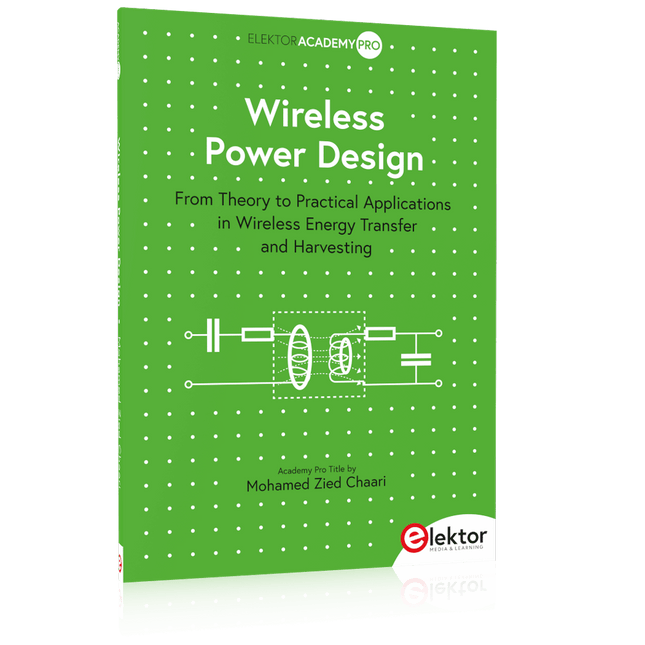
From Theory to Practical Applications in Wireless Energy Transfer and Harvesting
Wireless power transmission has gained significant global interest, particularly with the rise of electric vehicles and the Internet of Things (IoT). It’s a technology that allows the transfer of electricity without physical connections, offering solutions for everything from powering small devices over short distances to long-range energy transmission for more complex systems.
Wireless Power Design provides a balanced mix of theoretical knowledge and practical insights, helping you explore the potential of wireless energy transfer and harvesting technologies. The book presents a series of hands-on projects that cover various aspects of wireless power systems, each accompanied by detailed explanations and parameter listings.
The following five projects guide you through key areas of wireless power:
Project 1: Wireless Powering of Advanced IoT Devices
Project 2: Wireless Powered Devices on the Frontline – The Future and Challenges
Project 3: Wireless Powering of Devices Using Inductive Technology
Project 4: Wireless Power Transmission for IoT Devices
Project 5: Charging Robot Crawler Inside the Pipeline
These projects explore different aspects of wireless power, from inductive charging to wireless energy transmission, offering practical solutions for real-world applications. The book includes projects that use simulation tools like CST Microwave Studio and Keysight ADS for design and analysis, with a focus on practical design considerations and real-world implementation techniques.
Mit dem JOY-iT PS1440-C-Pro erhalten Sie ein programmierbares Labornetzteil, das Gleichspannungen von 0,01 bis 60 V und Gleichströme von 0,01 bis 24 A am Spannungsausgang liefert.
Über das intuitive Bedienfeld können Sie bis zu 9 verschiedene Gleichspannungseinstellungen programmieren, speichern und abrufen. Außerdem lassen sich individuelle Schutz- und Begrenzungsfunktionen konfigurieren – beispielsweise ein Überspannungsschutz. Alle Einstellungen lassen sich bequem über die Tastatur und/oder den Drehregler anpassen und werden übersichtlich auf dem hochauflösenden 2,4"-Farbdisplay angezeigt.
Für verbesserte Konnektivität verfügt das PS1440-C-Pro über eine RS485-Schnittstelle für robuste Kommunikation über große Entfernungen. Dadurch eignet es sich ideal für komplexe Setups, bei denen Signalstabilität, Störfestigkeit und zuverlässige Datenübertragung entscheidend sind. Der mitgelieferte Stecker gewährleistet eine sichere Verbindung und verbessert so die Zuverlässigkeit und Leistung Ihrer Laborausrüstung.
Features
Sofort einsetzbares Komplettgerät
RS485-Schnittstelle
Batterieladefunktion
Werteingabe bequem über Keypad möglich
Überstrom- & Überspannungsschutz einstellbar
Integrierte RTC, NTC-Temperatursensor
Beiliegende, detaillierte Dokumentation in Deutsch, Englisch & Französisch
Technische Daten
Eingangsspannung
230 V
Ausgangsspannung
0-60 V
Ausgangsstrom
0-24 A
Ausgangsleistung
0-1440 W
Genauigkeit der Eingangsspannung
±1% + 5 Ziffern
Genauigkeit der Ausgangsspannung
±0,3% + 3 Ziffern
Genauigkeit des Ausgangsstroms
±0,5% + 5 Ziffern
Batteriespannung
±0,5% + 3 Ziffern
Auflösung der Eingangsspannungsmessung
0,01 V
Auflösung der Ausgangsspannungsmessung
0,01 V
Aktuelle Messauflösung
0,01 V
Auflösung der Batteriespannungsmessung
0,01 V
Reaktionszeit im Konstantspannungsmodus
2 ms bei 0,1-5 A
Lastregelung im Konstantspannungsmodus
±0,1% + 2 Ziffern
Lastregelung im Konstantstrommodus
±0,1% + 3 Ziffern
Messbereich elektrische Ladung
0-9999,99 Ah
Messbereichsenergie
0-9999,99 Wh
Statistische Fehler bei der elektrischen Ladung & Energie
±2%
Ausgangswelligkeit
100 mV VPP bei 12 V150 mV VPP bei 24 V
Sensortemperatur-Erkennungsbereich
−10~+100 °C
Genauigkeit der Sensortemperaturerkennung
±3°C
Arbeitsmodus
Abwärtsbetrieb
Bildschirmhelligkeitseinstellung
Stufe 0-5, insgesamt 6 Stufen
Zulässige Arbeitstemperatur
−10~40°C
Abmessungen
170 x 93 x 340 mm
Lieferumfang
JOY-iT PS1440-C Netzteil
2-poliger Stecker für RS485-Schnittstelle
Netzkabel
Handbuch
Downloads
Datasheet
MODBUS Protocol
PC Software
Driver for Windows
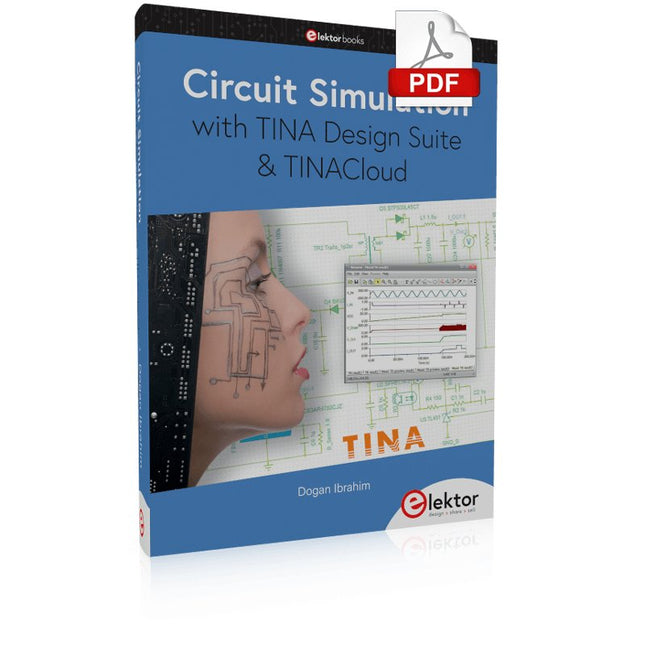
TINA Design Suite is a professional, powerful and affordable circuit simulator. It is a circuit designer and PCB design software package for analysing, designing, and real-time testing of analogue, digital, IBIS, VHDL, Verilog, Verilog AMS, SystemC, MCU, and mixed electronic circuits and their PCB layouts.
In this book, top-selling Elektor author, Prof. Dr. Dogan Ibrahim aims to teach the design and analysis of electrical and electronic circuits and develop PCB boards using both TINA and TINACloud. The book is aimed at electrical/electronic engineers, undergraduate electronic/electrical engineering students at technical colleges and universities, postgraduate and research students, teachers, and hobbyists. Many tested and working simulation examples are provided covering most fields of analogue and digital electrical/electronic engineering. These include AC and DC circuits, diodes, zener diodes, transistor circuits, operational amplifiers, ladder diagrams, 3-phase circuits, mutual inductance, rectifier circuits, oscillators, active and passive filter circuits, digital logic, VHDL, MCUs, switch-mode power supplies, PCB design, Fourier series, and spectrum. Readers do not need to have any programming experience unless they wish to simulate complex MCU circuits.
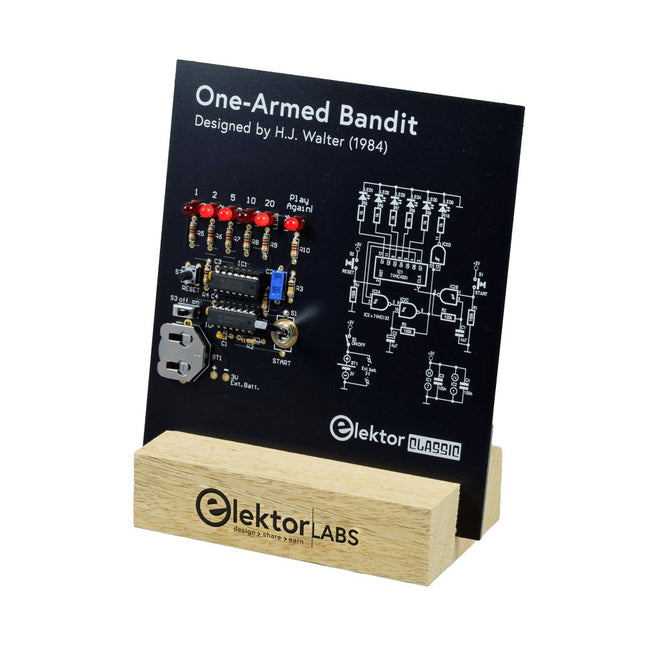
Ziehen Sie den Hebel nach unten, um die höchste Punktzahl zu erzielen!Dieser Elektor-Schaltungsklassiker aus dem Jahr 1984 zeigt eine spielerische Anwendung von Logik-ICs der CMOS-400x-Serie in Kombination mit LEDs, einer damals sehr beliebten Kombination. Das Projekt imitiert einen Spielautomaten mit rotierenden Ziffern.Das SpielUm das Spiel zu spielen, vereinbaren Sie zunächst die Anzahl der Runden. Spieler 1 betätigt den Schalthebel so lange wie gewünscht und lässt ihn los. Die LEDs zeigen dann die Punktzahl an, die sich aus der Summe der 50-20-10-5 aufleuchtenden Ziffern ergibt. Wenn die Play Again!-LED aufleuchtet, hat Spieler 1 eine weitere, „freie“ Runde. Wenn nicht, ist Spieler 2 am Zug. Die Spieler behalten ihre Punkte im Auge und der Spieler mit der höchsten Punktzahl gewinnt.FeaturesLEDs zeigen den Punktestand anMulti-Player und Play Again!Symbole des Elektor Heritage CircuitGetestet und geprüft von Elektor LabsEdukatives und geekiges ProjektNur Teile mit DurchgangslochLieferumfangPlatineAlle KomponentenHolzständerStücklisteWiderstände (5%, 250 mW)R1,R2,R3,R4 = 100kΩR5,R6,R7,R8,R9,R10 = 1kΩKondensatorenC1 = 4.7nF, 10%, 50V, 5mmC2 = 4.7μF, 10%, 63V, axialC3,C4 = 100nF, 10 %, 50V, Keramik X7R, 5mmHalbleiterLED1-LED6 = rot, 5mm (T1 3/4)IC1 = 74HC4024IC2 = 74HC132SonstigesS1 = Schalter, Kipphebel, 21-mm-Hebel, SPDT, tastendS2 = Schalter, taktil, 24V, 50mA, 6x6mmS3 = Schalter, Schieber, SPDTIC1,IC2 = IC-Sockel, DIP14BT1 = CR2032-Batteriehalteklammer für PlatinenmontageTischständerPCB 230098-1Nicht im Lieferumfang enthalten: BT1 = CR2032-Knopfzellenbatterie
ModbusRTU and ModbusTCP examples with the Arduino Uno and ESP8266
Introduction to PLC programming with OpenPLC, the first fully open source Programmable Logic Controller on the Raspberry Pi, and Modbus examples with Arduino Uno and ESP8266
PLC programming is very common in industry and home automation. This book describes how the Raspberry Pi 4 can be used as a Programmable Logic Controller. Before taking you into the programming, the author starts with the software installation on the Raspberry Pi and the PLC editor on the PC, followed by a description of the hardware.
You'll then find interesting examples in the different programming languages complying with the IEC 61131-3 standard. This manual also explains in detail how to use the PLC editor and how to load and execute the programs on the Raspberry Pi. All IEC languages are explained with examples, starting with LD (Ladder Diagram) over ST (Structured Control Language) to SFC (Special Function Chart). All examples can be downloaded from the author's website.
Networking gets thorough attention too. The Arduino Uno and the ESP8266 are programmed as ModbusRTU or ModbusTCP modules to get access to external peripherals, reading sensors and switching electrical loads. I/O circuits complying with the 24 V industry standard may also be of interest for the reader.
The book ends with an overview of commands for ST and LD. After reading the book, the reader will be able to create his own controllers with the Raspberry Pi.
Learn RC and RL Filters with Hands-On Circuits and Simulation
Introduction to Electronic Filters is your comprehensive guide to understanding, designing, and applying first-order electronic filters using resistors, capacitors, and inductors. Whether you are a student, maker, or educator, this book demystifies the theory behind RC and RL filters and bridges the gap between concepts and real-world applications through simulation and experimentation.
From the basics of frequency response and phase shift to hands-on breadboard builds and Python-based simulations, this book offers a deeply practical learning experience. You will learn to analyse filters using Bode plots and phasors, and explore applications in audio tone shaping, sensor signal conditioning, noise reduction, and power supply filtering.
As you progress, you’ll build, measure, simulate, and tune filters using modern tools like CircuitLab, Python, and the Analog Discovery 3. Each chapter includes thoughtfully crafted activities that reinforce learning by doing – designing filters for specific tasks, simulating dynamic behaviour, and observing how theory translates into performance.
Inside you’ll find:
A clear introduction to the fundamentals of electronic filters
Detailed explanations of RC and RL filters, cutoff frequency, and phase
Guided activities using both simulation and hardware tools
Real-life applications in audio, sensors, power supplies, and more
A beginner-friendly primer on Python and algebra for electronics
Whether you’re working through simulations or experimenting with real components on your workbench, this book will help you develop a solid understanding of electronic filters and their role in practical circuits.
Le téléchargement intégral de ce numéro est disponible pour nos membres GOLD et GREEN sur le site Elektor Magazine !
Pas encore membre ? Cliquez ici.
carte de développement MultiRFUne plateforme pour évaluer les protocoles sans fil à courte et longue portée
Elektor fête ses 65 ansAu cœur de l'électronique depuis 1961
détection de personnes par Wifi sur un ESP32Quand votre routeur devient un capteur de mouvement
balances sans filQuatre petites balances = une grande balance
Walter, le module IoT compactSoC ESP32-S3, modem 5G LTE-M/NB-IoT et récepteur GNSS
conditionnement des capteurs RTD à 3 et 4 filsAvec ajustement d’échelle et compensation des câbles
oscilloscope/générateur/multimètre à 2 voies 3-en-1Revue du Fnirsi 2D15P
electronica Fast Forward 2026 ouvre ses candidatures aux startups et partenaires industriels
EcologgingUne station IoT environnementale modulaire pour la recherche de terrain
la connectivité sans fil dans les applications médicalesAu rythme du pouls avec le Bluetooth LE
audiotroniqueRéduction du ronflement
optimiser les rendements agricoles grâce à la modélisation par IA et aux capteursAméliorer la productivité agricole
OPC UA : un aperçuÉchange de données indépendant des plateformes
redox-mètre
amplificateur d’instrumentation pour expériences de physique et d’ingénierie
filtres audio actifs différentielsPour les crossovers et plus encore
perspectives de la communauté Elektor sur l’IdO et les capteurs
module d’interface pour chauffe-eau piloté via TelegramUne solution basée sur un ESP32 et Arduino
2026 : une odyssée de l'IALa logique floue a-t-elle disparu ?
projet 2.0
injecteur de signal d’alarme plus secteuroutils pour localiser les coupures de fil