
Suchergebnisse für "elektor or 07 or 08 or 2019 or de"
-

Elektor Bundles Logic Analyzers in Practice (Bundle)
Book: Logic Analyzers in Practice Step-by-step instructions guide you through the analysis of modern protocols such as I²C, SPI, UART, RS-232, NeoPixel, WS28xx, HD44780 and 1-Wire. With the help of numerous experimental circuits based on the Raspberry Pi Pico, Arduino Uno and the Bus Pirate, you will learn the practical application of popular USB logic analyzers. All the experimental circuits presented in this book have been fully tested and are fully functional. The necessary program listings are included – no special programming or electronics knowledge is required for these circuits. The programming languages used are MicroPython and C along with the development environments Thonny and Arduino IDE. This book uses several models of flexible and widely available USB logic analyzers and shows the strengths and weaknesses of each price range. You will learn about the criteria that matter for your work and be able to find the right device for you. Whether Arduino, Raspberry Pi or Raspberry Pi Pico, the example circuits shown allow you to get started quickly with protocol analysis and can also serve as a basis for your own experiments. After reading this book, you will be familiar with all the important terms and contexts, conduct your own experiments, analyze protocols independently, culminating in a comprehensive knowledge set of digital signals and protocols. USB Logic Analyzer (8-ch, 24 MHz) This USB Logic Analyzer is an 8-channel logic analyzer with each input dual purposed for analog data recording. It is perfect for debugging and analyzing signals like I²C, UART, SPI, CAN and 1-Wire. It operates by sampling a digital input connected to a device under test (DUT) at a high sample rate. The connection to the PC is via USB. Specifications Channels 8 digital channels Maximum sampling rate 24 MHz Maximum input voltage 0 V ~ 5 V Operating temperature 0°C ~ 70°C Input impedance 1 MΩ || 10 pF Supported protocols I²C, SPI, UART, CAN, 1-Wire, etc. PC connection USB Dimensions 55 x 28 x 14 mm Downloads Software This bundle contains: Book 'Logic Analyzers in Practice' (normal price: €35) USB Logic Analyzer (8-ch, 24 MHz) (normal price: €20) USB Cable Jumper Wire Ribbon Cable
€ 54,95€ 44,95Bestpreis
-

Elektor Digital 311 Circuits (E-book)
311 Circuits is the twelfth book in Elektor’s celebrated ‘300’ series. An immense source of inspiration for all electronics enthusiasts and professionals, this book deserves a place not far from the workbench. This book contains circuits, design ideas, tips and tricks from all areas of electronics: audio & video, computers & microcontrollers, radio, hobby & modelling, home & garden, power supplies & batteries, test & measurement, software, not forgetting a section ‘miscellaneous’ for everything that doesn’t fit in one of the other categories. 311 Circuits presents complete solutions for numerous problems, as well as starting points for your own creations. 311 Circuits has been compiled from the 2009, 2010 and 2011 ‘Summer Circuits’ double editions of Elektor magazine. The book is mostly based on readers’ contributions, supplemented by circuits engineered and developed in the Elektor Labs.
€ 29,95
Mitglieder: € 26,96
-
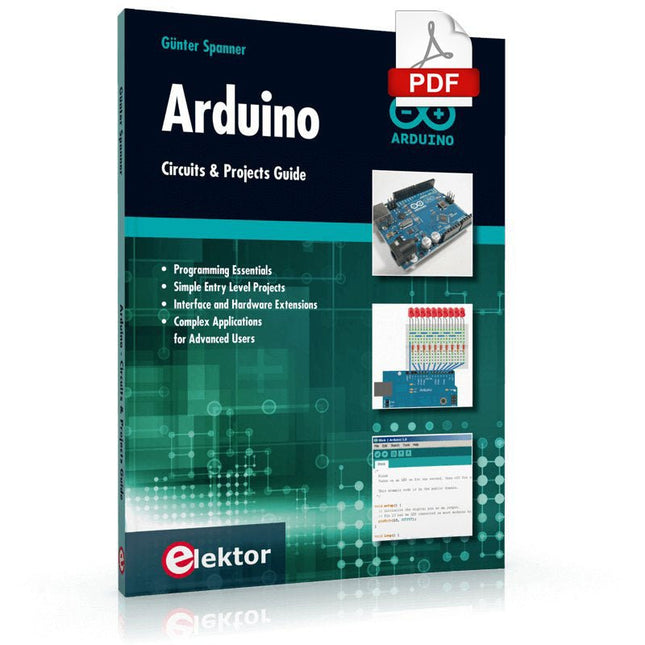
Elektor Digital Arduino – Circuits & Projects Guide (E-book)
Two reasons can be identified for the immense success of the Arduino platform. First, the cheap, ready to go processor board greatly simplifies the introduction to hardware. The second success factor is the free and open-source programming suite that does not require an installation procedure. Simple entry-level examples ensure rapid successes. Complex selection procedures for parameters like the microprocessor version or interface settings are not required. The first sample programs can be uploaded to the Arduino board, and tested, in a matter of minutes. The Arduino user is supported by an array of software libraries. However, the daily increasing volume of libraries poses initial problems to the newcomer, and the way ahead may be uncertain after a few entry-level examples. In many cases, detailed descriptions are missing, and poorly described projects tend to confuse rather than elucidate. Clear guidance and a single motto are missing, usually owing to the projects having been created by several different persons—all with different aims in mind. This book represents a different approach. All projects are presented in a systematical manner, guiding into various theme areas. In the coverage of must-know theory great attention is given to practical directions users can absorb, including essential programming techniques like A/D conversion, timers and interrupts—all contained in the hands-on projects. In this way readers of the book create running lights, a wakeup light, fully functional voltmeters, precision digital thermometers, clocks of many varieties, reaction speed meters, or mouse controlled robotic arms. While actively working on these projects the reader gets to truly comprehend and master the basics of the underlying controller technology.
€ 29,95
Mitglieder: € 26,96
-

Elektor Publishing Practical Electronics Crash Course
Learning circuit design the fun way Welcome to the world of electronics! Getting started in electronics is not as difficult as you may think. Using this book, you will explore and learn the most important electrical and electronics engineering concepts in a fun way by doing various experiments and by simulating circuits. It will teach you electronics practically without getting into complex technical jargon and long calculations. As a result, you will be creating your own projects soon. No prior knowledge of electronics is required, only some basic algebra is used in a few simple calculations. Many tested and working projects and simulations are presented to familiarise yourself with the construction of electronic circuits. Circuit simulation is introduced at an early stage to enable you to experiment with circuits easily without breaking anything. You will learn: The concepts of voltage, current, and power AC and DC Basic lamp circuits with switches Passive components: resistors, capacitors & inductors RC & RCL circuits Electromagnetism Loudspeakers, relays, buzzers, and transformers Active components: diodes & LEDs, bipolar transistors & MOSFETs Transistor-based switching circuits Optocoupler circuits Astable & monostable multivibrators Using the 555 timer IC The operational amplifier Digital logic Advanced examples: amplifiers, oscillators, filters, and sensors Test and measurement tools Microcontrollers: Arduino UNO, ESP32, Raspberry Pi Pico, and Raspberry Pi Reading datasheets and best practices for selecting components EMC & EMI and norms & regulations
€ 39,95
Mitglieder: € 35,96
-

Elektor Digital Automotive Sensors and Actuators (E-book)
Principles, Systems, and Electronics This handbook provides a detailed study of the sensors and actuators at the heart of modern vehicle electronics. It begins with basic electrical and electronic concepts, introducing the principles and terminology essential for understanding automotive systems. The book explores sensors and actuators on a system-by-system basis, including: Fundamentals of electrical engineering, electromagnetic phenomena, and motor principles Passive and active electronic components, integrated circuits, protection devices, and automotive-grade electronics Sensor characteristics, signal conditioning, ADCs, PWM and frequency outputs, and interface adaptation Automotive communication links and protocols, including LIN and SENT Engine sensors: air mass, pressure, temperature, speed, position, exhaust and emissions-related sensors Transmission sensors for manual and automatic systems Steering and suspension sensors for conventional and active systems Vehicle body and electrical system sensors for comfort, climate, access, and monitoring functions Engine actuators such as throttle bodies, injectors, turbo actuators, EGR systems, ignition components, and pumps Transmission, brake, steering, suspension, and body actuators Identification and coding of electronic components and packages commonly used in automotive applications The structure and operating principles of each component are explained, with relevant electronic circuitry illustrated. Its system-oriented organization and practical focus make it a valuable reference for understanding, testing, and troubleshooting automotive electronic systems.
€ 32,95
Mitglieder: € 29,66
-

Elektor Digital Röhren 1 (PDF)
Aus dem Inhalt Lieferbarkeit von Röhren Passive Übeltäter – Einfluss der Kondensatoren auf den Klang Übertragerwissen Theorie der Trioden Der richtige Einsatz von Gleichrichterröhren Line-Vorverstärker mit Klangsteller Vollverstärker mit 2 x 50 W oder 2 x 40 W HiFi-CD-Player mit Playstation 1 CD-Filter Nachlese In dem Artikel "Moderne Triodenendstufe mit der legendären 2A3" ab Seite 66 wurden bei den Platinenabbildungen die Maßangaben nicht abgedruckt. Hier die Maße der Originalgrößen: Netzteilplatine (S. 68) 123 x 80 mm Stabilisierung (S. 69) 70 x 85 mm Hauptplatine (S. 71) 295 x 135 mm
€ 15,90
Mitglieder: € 14,31
-

Elektor 11-12/2026 (DE)
Diese Ausgabe steht allen GOLD- und GREEN-Mitgliedern auf der ElektorMagazine-Website zum Download bereit! Sie sind noch kein Mitglied? Hier klicken!
€ 15,90
-

Elektor Digital The Book of 555 Timer Projects (E-book)
Over 45 Builds for the Legendary 555 Chip (and the 556, 558) The 555 timer IC, originally introduced by the Signetics Corporation around 1971, is sure to rank high among the most popular analog integrated circuits ever produced. Originally called the IC Time Machine, this chip has been used in many timer-related projects by countless people over decades. This book is all about designing projects based on the 555 timer IC. Over 45 fully tested and documented projects are presented. All projects have been fully tested by the author by constructing them individually on a breadboard. You are not expected to have any programming experiences for constructing or using the projects given in the book. However, it’s definitely useful to have some knowledge of basic electronics and the use of a breadboard for constructing and testing electronic circuits. Some of the projects in the book are: Alternately Flashing Two LEDs Changing LED Flashing Rate Touch Sensor On/Off Switch Switch On/Off Delay Light-Dependent Sound Dark/Light Switch Tone Burst Generator Long Duration Timer Chasing LEDs LED Roulette Game Traffic Lights Continuity Tester Electronic Lock Switch Contact Debouncing Toy Electronic Organ Multiple Sensor Alarm System Metronome Voltage Multipliers Electronic Dice 7-Segment Display Counter Motor Control 7-Segment Display Dice Electronic Siren Various Other Projects The projects given in the book can be modified or expanded by you for your very own applications. Electronic engineering students, people engaged in designing small electronic circuits, and electronic hobbyists should find the projects in the book instructive, fun, interesting, and useful.
€ 29,95
Mitglieder: € 26,96
-

Elektor Publishing Les oscilloscopes anciens & modernes pour les débutants
Ce qui se passe en électronique est par définition invisible à l'oeil nu. L'instrument qui permet précisément de rendre visibles les signaux électriques, celui par le truchement duquel les effets de l'électronique se manifestent à nous, c'est l'oscilloscope. Hélas, quand on commence à faire de l'électronique, c'est souvent sans oscilloscope. Et l'on en est réduit à tâtonner, aussi bien physiquement que mentalement. Le jour où l'on goûte à la visualisation des signaux sur un écran, c'est une révélation. Plus personne ne souhaite se priver de cet enchantement. Pas de retour en arrière. En électronique, si l'on veut progresser dans le plaisir et dans la compréhension, il faut un oscillo. Commence alors une période d'interrogation : comment choisir ? Et à peine cette question-là aura-t-elle trouvé sa réponse, il en viendra une ribambelle d'autres que l'on peut résumer en une seule : comment se servir de l'oscilloscope de telle sorte que ce qu'il affiche corresponde bien à la réalité des signaux ? Dans ce livre, Rémy Mallard, répond clairement à ces questions. Il donne aussi de nombreuses informations pour aider son lecteur à élucider lui-même de nouveaux mystères qui ne manqueront pas de surgir. Ceux qui le connaissent déjà comme l'auteur d'un livre sur l'électronique dont le titre est un programme à lui tout seul : L'électronique pour les débutants qui sèchent les cours mais soudent sans se brûler les doigts, ainsi que d'un livre d'initiation à la programmation des microcontrôleurs PIC, savent qu'ils trouveront ici un ouvrage utile, qu'ils rouvriront souvent.
€ 44,95
Mitglieder: € 40,46
-

Elektor Bundles Physical AI with Raspberry Pi (Bundle)
Dieses Bundle enthält das AI Fusion Lab Kit mit über 450 Komponenten sowie das Buch Physical AI mit Raspberry Pi und bietet einen umfassenden, praxisnahen Einstieg in KI, Elektronik und Python-Programmierung. Realisieren Sie praxisnahe Projekte, die Computer Vision, Sprachinteraktion, Sensoren, Motoren und Large Language Models miteinander verknüpfen. Das beiliegende Buch führt Sie Schritt für Schritt von der Einrichtung des Raspberry Pi und der Hardware-Steuerung bis hin zu fortgeschrittenen Anwendungen unter Einsatz von OpenCV, MediaPipe, YOLO, OpenAI-Diensten und lokalen Ollama-Modellen. SunFounder AI Fusion Lab Kit für Raspberry Pi (450+ Teile) Das AI Fusion Lab Kit verwandelt einen Raspberry Pi in eine umfassende Plattform zum Erlernen von künstlicher Intelligenz, Elektronik und Python-Programmierung. Es unterstützt die Modelle Raspberry Pi 5, 4B, 3B+, 3B und Zero 2 W sowie gängige KI-Modelle und -Dienste, darunter ChatGPT, Gemini, Grok, DeepSeek, Qwen, Doubao und Ollama. Dank Kamera, Pan-Tilt-HAT, 10-Achsen-Sensormodul, Mikrofon, Lautsprecher und elektronischen Komponenten ermöglicht das Kit den Bau interaktiver KI-Projekte, die Sprache, Bilderkennung, Bewegung und Sensordaten kombinieren. Es eignet sich für Anfänger, Schüler und Studierende, Maker sowie alle, die praktische KI-Anwendungen erkunden möchten. Multimodale KI-Projekte entwickeln Kombinieren Sie große Sprachmodelle (LLMs) mit Spracherkennung, Text-zu-Sprache-Ausgabe, Kamera-Bilderkennung, Sensoren und Breadboard-Schaltungen. Erstellen Sie Projekte, die hören, sprechen, sehen, reagieren und mit ihrer Umgebung interagieren können, während Sie gleichzeitig die Funktionsweise moderner KI-Systeme kennenlernen. KI-Bilderkennung und Objektverfolgung erkunden Nutzen Sie YOLO, OpenCV und MediaPipe, um Objekte, Farben, Gesichter und menschliche Bewegungen zu erkennen und zu verfolgen. Der motorisierte Pan-Tilt-HAT ermöglicht es der Kamera, Zielen automatisch zu folgen, und demonstriert so das Zusammenspiel von Computer Vision und Bewegungssteuerung. Sprach-KI mit dem Fusion HAT+ Das Fusion HAT+ vereinfacht die Hardware-Steuerung durch eine einheitliche Python-Bibliothek und unterstützt das sichere Herunterfahren des Raspberry Pi. Dank des integrierten Mikrofons und Lautsprechers lassen sich problemlos sprachgesteuerte Assistenten und andere KI-Anwendungen für die Mensch-Maschine-Interaktion entwickeln. Kompatibel mit Raspberry Pi 5, 4B, 3B+, 3B und Zero 2 W Unterstützt verschiedene cloudbasierte und lokale KI-Modelle Umfasst Kamera, Pan-Tilt-HAT, 10-DOF-Modul, Mikrofon und Lautsprecher Projekte zu den Themen Sprach-KI, Computer Vision, Sensorik und Elektronik Video-Tutorials, Dokumentation und Beispielcode Buch: Physical AI with Raspberry Pi Anhand des Raspberry Pi und des AI Fusion Lab Kits führt Sie dieses Buch Schritt für Schritt von den Grundlagen der Hardware-Anbindung bis hin zur Entwicklung intelligenter Systeme, die sehen, hören, sprechen und Entscheidungen treffen können. Ob Schüler, Lehrkraft, Maker oder Ingenieur – Sie sammeln wertvolle Erfahrungen durch Projekte, die darauf ausgelegt sind, sowohl Ihr Wissen als auch Ihr Selbstvertrauen zu stärken. Ausgehend von der Systemeinrichtung, der GPIO-Programmierung sowie dem Einsatz von Sensoren, Displays, Motoren und Automatisierungstechniken führt das Buch schrittweise in fortgeschrittene Themen ein, darunter Spracherkennung, Text-zu-Sprache-Synthese, dialogorientierte KI (Conversational AI), Objekterkennung und maschinelles Lernen. Dabei lernen Sie, sprachgesteuerte Geräte, intelligente Assistenten, Kamera-Tracking-Systeme, Lösungen zur Umweltüberwachung sowie KI-gestützte Embedded-Anwendungen zu entwickeln. Entdecken Sie moderne Technologien wie OpenAI-Dienste, lokale Large Language Models (via Ollama), OpenCV, MediaPipe und die Objekterkennung mit YOLO, während Sie praktische Erfahrungen mit realen Anwendungen aus den Bereichen Robotik, Industrieautomatisierung, Smart Devices und autonome Systeme sammeln. Sie erfahren, wie intelligente Software mit Sensoren, Kameras, Motoren und Displays interagieren kann, um Systeme zu schaffen, die auf natürliche Weise auf ihre Umgebung reagieren. Anstatt lediglich Code-Beispiele nachzuahmen, werden Sie dazu ermutigt, zu experimentieren sowie jedes Projekt individuell anzupassen und zu erweitern. Die in diesem Buch vermittelten Techniken und Fähigkeiten bilden eine solide Grundlage für zukünftige Innovationen, Rapid Prototyping, Forschung und Produktentwicklung. Wenn Sie bereit sind, über die klassische Elektronik hinauszugehen und die Zukunft intelligenter Embedded-Systeme zu erkunden, begleitet Sie dieses Buch auf jedem Schritt des Weges. Dieses Bundle enthält: SunFounder AI Fusion Lab Kit for Raspberry Pi (Einzelpreis: 100 €) Buch: Physical AI with Raspberry Pi (Einzelpreis: 45 €) Nicht enthalten Raspberry Pi
€ 144,95€ 129,95Bestpreis
-
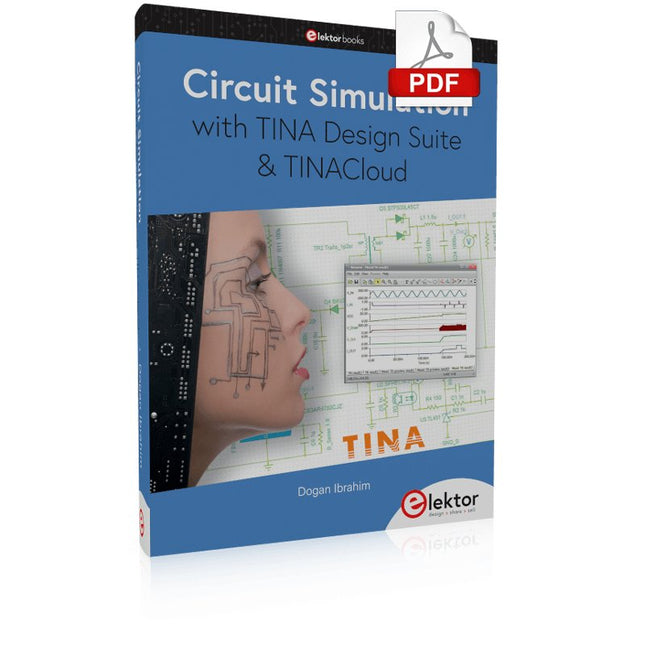
Elektor Digital Circuit Simulation with TINA Design Suite & TINACloud (E-book)
TINA Design Suite is a professional, powerful and affordable circuit simulator. It is a circuit designer and PCB design software package for analysing, designing, and real-time testing of analogue, digital, IBIS, VHDL, Verilog, Verilog AMS, SystemC, MCU, and mixed electronic circuits and their PCB layouts. In this book, top-selling Elektor author, Prof. Dr. Dogan Ibrahim aims to teach the design and analysis of electrical and electronic circuits and develop PCB boards using both TINA and TINACloud. The book is aimed at electrical/electronic engineers, undergraduate electronic/electrical engineering students at technical colleges and universities, postgraduate and research students, teachers, and hobbyists. Many tested and working simulation examples are provided covering most fields of analogue and digital electrical/electronic engineering. These include AC and DC circuits, diodes, zener diodes, transistor circuits, operational amplifiers, ladder diagrams, 3-phase circuits, mutual inductance, rectifier circuits, oscillators, active and passive filter circuits, digital logic, VHDL, MCUs, switch-mode power supplies, PCB design, Fourier series, and spectrum. Readers do not need to have any programming experience unless they wish to simulate complex MCU circuits.
€ 39,95
Mitglieder: € 35,96
-
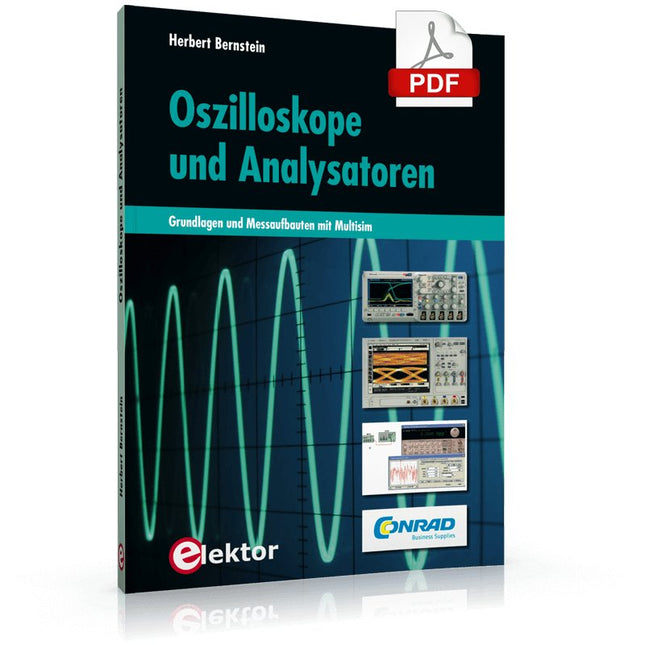
Elektor Digital Oszilloskope und Analysatoren (E-book)
Dieses Fachbuch beinhaltet alles über analoge Oszilloskope, digitale Speicheroszilloskope, Logikanalysatoren, Bode-Plotter, Spektrum- und Netzwerkanalysatoren mit praxisorientierten Fakten. Der Autor hat auch für die komplexen Vorgänge der elektronischen Messtechnik praktische kurze Erklärungen und zeigt viele Anwendungen aus der Messpraxis. Die sieben Kapitel vereinfachen das Erlernen für diese wichtigen Messgeräte und im Wesentlichen basiert das gesamte Buch auf der Simulation mit Multisim. Neben der Theorie finden Sie auch praxisnahe Messschaltungen. Analoges und digitales Oszilloskop mit zahlreichen Messübungen Messpraktikum für analoge 2- und 4-Kanal-Oszilloskope Arbeiten und Messen mit dem digitalen Speicheroszilloskop mit Analyse-Methoden (Fourier-Analyse, Rausch- und Rauschzahlanalyse, Monte-Carlo-Analyse, Worst-Case-Analyse, BER-Messung auf analoger und digitaler Basis) Logikanalysator, Anwendungen des simulierten Logikanalysators und Bitmustergenerator, Untersuchung eines 8-bit-D/A- und -A/D-Wandlers Bode-Plotter, Präzisions-Funktionsgenerator MAX038 mit Wobbler, aktive und passive Filterschaltungen Spektrumanalysator, Dezibel, logarithmische Bezugsgröße, Dämpfung und Verstärkung, Messung von Rauschsignalen, Verzerrungen und Klirrfaktor, Mittelwertbildung von Rauschsignalen, S-Parameter, Crestfaktor Netzwerkanalysator, Fehler des Netzwerkanalysators, Smith-Diagramm und Ortskurven, komplexe Widerstände, Analyseverfahren mit dem Netzwerkanalysator, S-, T-, M-, X-Parameter und S-Funktion, Leitungstheorie, Stehwellenverhältnis, Dämpfung, Gruppenlaufzeit, Anpassschaltung für HF-Transistoren Die Zielgruppen sind Techniker- und Meisterschulen Studierende an Fachhochschulen und technischen Akademien Praktiker in Industrie und Handwerk
€ 39,80
Mitglieder: € 35,82


