
Suchergebnisse für "elektor OR labs OR ruler"
-

Elektor Digital Elektor Juillet/Août 2024 (PDF)
Le téléchargement intégral de ce numéro est disponible pour nos membres GOLD et GREEN sur le site Elektor Magazine ! Pas encore membre ? Cliquez ici. petite caméra thermiqueréalisée avec un Arduino UNO mise à jour du projet #3 : compteur d'énergie basé sur l'ESP32intégration et test avec Home Assistant 2024 : l'odyssée de l'IAaméliorer la détection d'objets : intégration de techniques avancées Raspberry Pi se met à l'IAun nouveau kit comprenant un accélérateur IA matériel et un adaptateur M.2 HAT+ capteurs de stations météorologiqueslequel choisir ? Relevé des compteurs d'eau basé sur l'IA (1)intégrez votre ancien compteur dans l'IdO ! une alarme GSMun module GSM protège votre garage à distance optimisation et contrôle des appareils Thread à faible consommation d'énergiefaible consommation... peu d’effort ? sur le vifmontrez-moi là où ça fait mâle chambre à brouillard à faire soi-mêmevisualiser les rayonnements invisibles SparkFun Thing Plus Mattercarte de développement IdO polyvalente basée sur Matter Rétroéquipement IoTAdaptation des machines à interface RS232 à l'industrie 4.0 ajouter l’IoT grâce aux microcontrôleurs 8 bits la technologie au service du développement durableles avancées technologiques favorisent une utilisation plus efficace de l’énergie dans de nombreuses applications AWS pour Arduino et Cie. (1)utiliser AWS IoT ExpressLink en pratique détecteur de flux d'air Arduinoaucun capteur externe n'est nécessaire ! détecteur de fuite d'eauconnecté à l’Arduino Cloud le quartzdrôle de composant, la série enregistreur universel de données de jardinageun pas vers l’Intelligence Artificielle au Jardin. un générateur analogique 1 kHzondes sinusoïdales à faible distorsion Miletus : utiliser les applications Web hors ligneaccès aux fonctions de l’appareil et du système de la 4G à la 5Gest-ce une étape si facile à franchir ? démarrer en électronique…connexions symétriques
€ 10,95
-

Elektor Publishing ESP32 by Example
A Project-Based Introduction to Microcontrollers and Drone Control A Practical Introduction to Embedded Systems with the ESP32 This book is intended for readers who are new to embedded systems and looking for a structured, example-driven way to begin. If you’ve explored general-purpose electronics or Arduino-based resources but found them too broad or lacking in practical application, this guide offers a more focused alternative. With a small, affordable set of components – such as LEDs, sensors, an OLED screen and a motion sensor – you’ll build and work with the same hardware setup throughout the book. This allows you to focus on learning and experimenting without constant reconfiguration. Topics include: Understanding and programming the ESP32 microcontroller Using the Arduino IDE to write and deploy code Exploring cyber-physical systems, culminating in basic drone control No prior experience with Arduino or embedded development is required. Each section includes hands-on examples and mini-projects designed to reinforce core concepts and encourage deeper exploration. By the end, you’ll be equipped not only to reproduce the book’s examples, but also to extend them toward your own ideas and applications. Whether your interest is in learning embedded programming, building interactive systems, or exploring educational drone control, this book provides a clear and practical path to getting started.
€ 44,95
Mitglieder: € 40,46
-

Elektor Digital Elektor Magazine FR Mai/Juin 2020 (PDF)
Elektor Mai/Juin 2020 PDF FR
€ 10,95
-
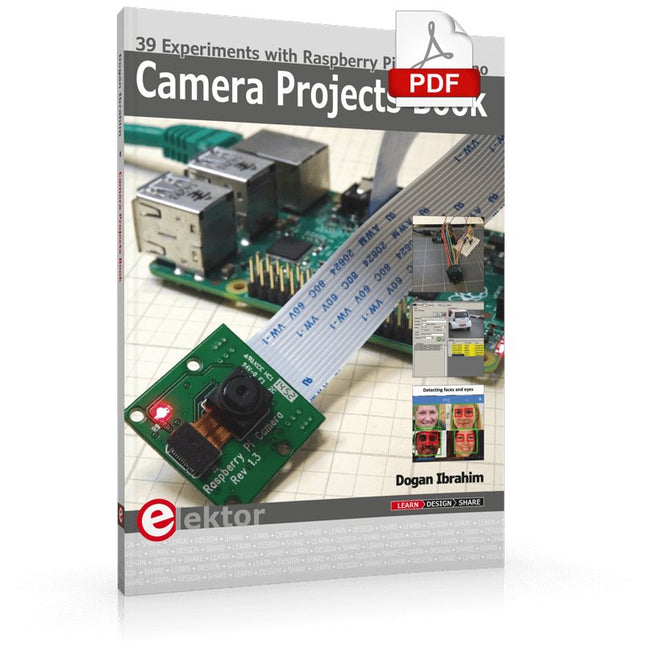
Elektor Digital Camera Projects Book (E-book)
39 Experiments with Raspberry Pi and Arduino This book is about Raspberry Pi 3 and Arduino camera projects. The book explains in simple terms and with tested and working example projects, how to configure and use a Raspberry Pi camera and USB based webcam in camera-based projects using a Raspberry Pi. Example projects are given to capture images, create timelapse photography, record video, use the camera and Raspberry Pi in security and surveillance applications, post images to Twitter, record wildlife, stream live video to YouTube, use a night camera, send pictures to smartphones, face and eye detection, colour and shape recognition, number plate recognition, barcode recognition and many more. Installation and use of popular image processing libraries and software including OpenCV, SimpleCV, and OpenALPR are explained in detail using a Raspberry Pi. The book also explains in detail how to use a camera on an Arduino development board to capture images and then save them on a microSD card. All projects given in this book have been fully tested and are working. Program listings for all Raspberry Pi and Arduino projects used in this book are available for download on the Elektor website.
€ 29,95
Mitglieder: € 26,96
-

Elektor Digital Mikrocontroller 2 (PDF)
Dieses Elektor-Sonderheft ist eine gelungene Mischung aus Information, Grundlagen und Praxis moderner Mikrocontroller-Technik. Die Themenvielfalt erstreckt sich von der humanoiden Robotik über die C-Programmierung, der Low-Power-Technik mit dem MSP430 bis hin zur Bilderkennung mit einer intelligenten Kamera. Mit verschiedenen Anwendungen zum R8C/13, AVR- und PSoC-Controllern sowie den 8051ern führen die Autoren den Leser in die Praxis ein, ohne sich zu sehr in theoretische Details zu verlieren. Viele Artikel sind speziell für dieses Sonderheft entstanden. Die Verfasser hiervon sind renommierte Fachbuchautoren, industrielle Soft- und Hardware-Entwickler sowie Dozenten und wissenschaftliche Mitarbeiter von Fachhochschulen und Universitäten.Weitere Hefte aus dieser Reihe: Mikrocontroller 7 (PDF) Mikrocontroller 6 (PDF) Mikrocontroller 5 (PDF) Mikrocontroller 4 (PDF) Mikrocontroller 3 (PDF) Mikrocontroller 1 (PDF)
€ 16,90
Mitglieder: € 15,21
-

Elektor Publishing Arduino for STM32
Learning Embedded Systems with STM32 Nucleo Boards Embedded programming has become more accessible than ever before. Development boards are inexpensive, software tools are easy to install, and the Arduino IDE provides a familiar environment for creating embedded applications. Combined with the STM32 Nucleo family of development boards, it offers an excellent platform for learning how modern microcontrollers interact with the physical world. This book introduces embedded programming using the Arduino environment on STM32 Nucleo boards. You will learn how a microcontroller continuously reads inputs, processes information, and controls outputs in a predictable real-time loop. Through practical examples, you will discover how to control LEDs, read switches and sensors, generate PWM signals, drive motors, and exchange data with other devices, all while becoming familiar with the capabilities of STM32 microcontrollers. Although the STM32 family includes devices with different performance levels, memory sizes, and peripheral sets, they all share the same architectural concepts. Digital and analog I/O, timers, interrupts, PWM, communication interfaces, and low-power operation are fundamental features found throughout the STM32 ecosystem. Understanding these building blocks will enable you to work confidently with a wide range of STM32 devices, from entry-level microcontrollers to more advanced applications. By focusing on practical programming techniques rather than hardware complexity, this book develops skills that remain useful well beyond the examples presented. Whether you are taking your first steps in embedded systems or expanding your experience with STM32 microcontrollers, you will gain a solid understanding of both the Arduino development environment and the principles that underpin embedded software design.
€ 27,95
Mitglieder: € 25,16
-

Elektor Digital Messtechnik für Niederfrequenzverstärker (PDF)
Messtechnik für Niederfrequenzverstärker (E-book)
€ 24,90
Mitglieder: € 22,41
-

Elektor March/April 2026 (EN)
Elektor GREEN and GOLD members can download their digital edition here. Not a member yet? Click here. PIO Programming on the Raspberry Pi PicoNine Instructions, Many Possibilities Breaking AI Out of the BrowserUsing AI CLIs to Code, Compile, and Validate Embedded Projects The Scrutiny DebuggerDebug, Visualize, and Test Embedded C/C++ Code Sigfox Breakout Board (1)A Self-Built Radio BoB Low-Noise Power Supply (2)Construction, Assembly, and Practical Implementation Simple Signal Generator Using the RP2040Analog and Digital Signals for Around €10 Navigating the Future of Smart Homes with Matter and Edge AIAre Matter’s Latest Updates and the Rise of Edge AI Finally Giving Engineers the Tools to Build the Intelligent, Seamless Smart Homes Users Have Been Promised? Differential Pressure SensorsPredictive Maintenance in HVAC-Systems Security by DesignEngineering Fundamentals Limit Failure Embedded Security Is No Longer Optional CRA and PQC Are Rewriting Embedded Security PrioritiesWhy Even Small IoT and Industrial Firms Need an Upgrade Plan embedded world 2026An Interview With Benedikt Weyerer, Executive Director of embedded world Hands on with I3CUsing Hardware from ST and Microchip The BLEnky ProjectRapid Prototyping of Bluetooth Low Energy Applications Pulse Width ModulationFrom a Simple On/Off Thermostat to a Smoothed DC Analog Signal AudiotronicsEar-Pleasing Electronics for DIY Construction From Life’s ExperienceRead The F...ing Manual! ESP32 Audio Transceiver Board (Part 4)Tuning the Clocks - And a Wired Option 2026: An AI OdysseyThe 2025 Vibe-Coding Hangover Symmetrical DC LoadDC Load, Static or Dynamic, and Symmetrical Counting Faces with MaixCAMAn Easy Way to Capture Audience Sizes
€ 14,90
-

Elektor Digital Elektor September/Oktober 2021 (PDF)
VOYAGE DANS LES RÉSEAUX NEURONAUX (1ÈRE PARTIE)Les neurones artificielsTEST DE PRÉCONFORMITÉ CEM POUR UN PROJET ALIMENTÉ EN COURANT CONTINUPartie 1 : RSIL double continuCHARGE ÉLECTRONIQUE EN CC ET CAJusqu'à 400 V et 10 A (crête)DÉMARRER EN ÉLECTRONIQUE (9)N'ayez pas peur du choc... un peu de « self control » suffit !TRAITEMENT D'IMAGES AVEC LE MODULE JETSON NANO DE NVIDIA (1ÈRE PARTIE)Matériel et logicielZOOM SUR LES TRANSFORMATEURS SECTEURComportement transitoire à l'allumage et l'extinction« YES WE CAN » AVEC PICAN 3Module de bus CAN pour le Raspberry Pi 4CENTRALE SOLAIRE SUR BALCONUn investissement vite amortiPRISE DE VUE ET DIFFUSION VIDÉO EN CONTINU AVEC UN RASPBERRY PI 4La caméra Raspberry Pi HQ en actionUTILISATION D'ÉCRANS DANS LES PROJETS RASPBERRY PIExtrait : écrans à diodes électroluminescentes organiques (OLED)PROPELLER 2 DE PARALLAX (4)Envoi de chaînes de caractères60 ANS D'ELEKTORRegard sur septembreDANS L'ANTRE DE…Menno van der Veen et de ses tubes amplificateursCIRCUITS HYBRIDESROSE DES VENTS AVEC LE CAPTEUR GY-271Ou pourquoi il faut faire des huit pour calibrer un capteurMESUREZ VOTRE EMPREINTEÉlectronique et émissions de gaz à effet de serreTHERMOSTAT CONNECTÉ À ESP32Conservez votre vin à la bonne température !LÉVITATION MAGNÉTIQUE, VERSION NUMÉRIQUEComparateur analogique remplacé par un ESP32 PicoULTIMATE ARDUINO UNO HARDWARE MANUAL - FR TRANSLATIONExtrait : chargeur d'amorçage du microcontrôleur principalMICROPYTHON POUR L'ESP32 ET SES COPAINSPartie 2 : piloter facilement les écrans matricielsCARTE MADMACHINE SWIFTIOUn langage récent pour du matériel tout nouveauSUR LE VIFPassions incertainesHEXADOKUCasse-tête pour elektorniciens
€ 10,95
-

Elektor Digital Sonderausgabe: Einladungsausgabe Espressif 2023 (PDF)
Der vollständige Download dieser Nummer ist für unsere GOLD- und GREEN-Mitglieder auf der Elektor Magazine- Site verfügbar! Nicht noch einmal Mitglied? Klicken Sie hier . IdO-Innovationsbeschleuniger Fotorahmen in verdunkelbarer elektronischer Farbe, Wi-Fi Anleitung ESP-Launchpad Mikrobiologisches Aufblitzen in wenigen Minuten ESP32 und ChatGPT zu einem Autoprogrammierungssystem ... Walkie-Talkie mit ESP-NOW Überhaupt kein WLAN, überhaupt kein Bluetooth, nicht mehr ... von der Schaltungsidee mit ESP32-S3 einen Prototyp mit den Puces von Espressif konstruieren Innovation der AIoT-Puces Unterhaltung mit Teo Swee-Ann, PDG d'Espressif ESP32 mit Wokwi simulieren der numerische Bildschirm Ihres Projekts Test der ESP32-S3-BOX-3 eine komplette AIoT-Entwicklungsplattform gut ausgestattet für meine arbeit Tipps und Tricks von Druckingenieuren Die Geschichte des ESP RainMaker Wie wir „Ihre“ IdO-Wolke konstruieren Bausatzzusammenstellung für Cloc 2.0 von Elektor ein von Espressif getestetes Elektor-Produkt die Lanze des ESP32-P4 das neue Zeitalter der Mikrocontroller Rost und blockierte Systeme Zwei leistungsstarke Tools für die Entwicklung Wer sind die Entwickler eingebetteter Rust-Lösungen? Wie Espressif die Sprache Rust für ESP32 entwickelt SoC Espressif-Serie eine API mit den Espressif-Lösungen mit den Fähigkeiten und Funktionen des ISOBUS-Protokolls VGA-Karte ESP32-S3 Bitlunis leidenschaftliche Reise zur Produktkonzeption Akustikmodul auf ESP32 Song-Identifizierung mit dem Open-Source-Projekt Olaf Runder Weihnachtsbaum 2023 High-Tech-Feier der Jahresendfeste ein komfortableres und einfacheres Leben ein Amateurprojekt basierend auf dem ESP8266 Espressif-Modul So erstellen Sie IoT-Anwendungen ohne Logik-Expertise mit der IoT-Plattform mit der IoT-Plattform Blynk und dem Espressif-Material Entwickeln Sie eine grafische Schnittstelle für ESP32 Schnelle und einfache IoT-Entwicklung mit M5Stack Prototyp eines Energierechners auf Basis von ESP32 ein Distributor mit Mehrwert für IdO-Lösungen und mehr Im Detail: Lernen Sie mit Arduino über den Nano ESP32 Alessandro Ranellucci und Martino Facchin beenden die Zusammenarbeit mit Espressif Innovation der Puces IdO die Ideen von Espressif Vereinfachen Sie die Entwicklung von Mikrocontrollern mit ESP-IDF Privilege Separation ein Open-Source-Wortsuchserver ... ...und die ESP BOX Es reflektiert Gesichtserkennung und mehr mithilfe von ESP32-S3-EYE. per Knopfdruck versorgter Umschalter, basierend auf einem ESP32-C2 Bewertung der Konzeption und der Leistungen Das intelligente Haus entwickelt sich mit Matter Das Potenzial von IdO für intelligente Häuser freisetzen der Besitzer des vernetzten intelligenten Hauses
€ 10,95
-

Elektor Digital Practical Microcontroller Cryptography (E-book)
From Simple Ciphers to Secure Systems Understanding how to apply cryptography on modern microcontrollers is essential for building secure, reliable, and trustworthy systems. This book explains cryptography in the context of embedded hardware, from classical ciphers that illustrate core principles to modern techniques such as AES for practical high-security applications. By combining mathematical theory with real-world microcontroller implementations, readers learn not only how cryptography works, but also how to implement it effectively on systems with limited processing power and memory. The book is intended for students starting out in cryptography, hobbyists securing personal projects, and engineers looking for a structured guide to embedded security. The book covers these key topics in applied cryptography: Classical ciphers on Arduino Uno and Raspberry Pi Pico, with full programs: Spartan Scytale, Hebrew Atbash, Caesar, ROT13, Alberti Disk, Vigenère, Affine, Polybius, Playfair, Beaufort, Ottoman Codebook, and One-Time Pad. Hacking classical ciphers using microcontrollers, with examples. Pseudo-random (PRNG) and true random number generation (TRNG) on microcontrollers. Symmetric-key cryptography with full programs: DES and AES-128/256. Memory and speed constraints of cryptography on microcontrollers. Asymmetric cryptography: public/private keys, digital signatures, key distribution and derivation (KDF), RSA, and SHA-256 implementations. A complete secure communication program using RSA and AES-256. A glossary of commonly used cryptography terms.
€ 29,95
Mitglieder: € 26,96
-

Elektor Digital Elektor 01-02/2020 (PDF)
GUI mit Touch – für ESP32, Raspi und Co.Grafische Benutzerschnittstellen mit der Bibliothek LittlevGL „Kein Projekt für jedermann“Interview mit Gábor Kiss-Vámosi, dem Entwickler von LittlevGL Capaci-MeterMit zweistelliger LED-Anzeige im Dekatron-Stil Gewusst wie: Entprellen eines mechanischen Kontakts oder SchaltersEin Schalter ist entweder offen oder geschlossen, oder nicht? Von Entwicklern für EntwicklerTipps & Tricks, Best Practice und andere nützliche Infos Erweiterbares System zur UmweltüberwachungVeröffentlicht Umweltparameter auf IoT-Plattformen Praktisches ESP32-MultitaskingTask-Programmierung mit FreeRTOS und der Arduino-IDE InteraktivKorrekturen & Updates || Fragen & Antworten Autoscheinwerfer tunenLegal, illegal, nicht egal! Review: Digitale Lötstation von Toolcraft Arduino-Pro-IDEErste Eindrücke Zwei Wärmebildkameras im Vergleich Aus dem Leben gegriffenDie Planung eines Labors und eines Arbeitsbereichs 7-Segment-LED-Anzeige Monsanto MAN1Bemerkenswerte Bauteile TeeuhrFingerübung in Sachen Energy-Harvesting Einstellbarer 1-kW-AC-MotortreiberSteuerung in drei Modi: Schwingungspakete, Phasenabschnitt oder Phasenanschnitt Schnelles 3,5“-Touch-Display für RPiMehr Leistung ohne Aufpreis Zutritt für Unbefugte verboten!Ein Blick ins Allerheiligste aller Elektroniker Erste Schritte mit RISC-VLoFive-Board ausprobiert LoRa-Tracker als HerausforderungProbleme und Lösungen bei der Elektronik-Entwicklung Mit dem Fuchs ins IoT (2)Anmeldung im Sigfox-Netz Aller Anfang...muss nicht schwer sein! Entwicklung analoger ElektronikFall Nr. 1 — MEMS-Mikrofon, Test 1-2-3 ! Von der Pike auf gelerntNeues aus der Elektor-Ideenkiste Kurzgefasst: Texte für MikrocontrollerSpeicher sparen durch Kompression Im Fokus: Autonomes FahrenStand der Technik im Überblick Start-up-Leader und Innovatoren sprechen in München über „Innovation 4.0“ Lego Electronic anno 1968Elektronisches Spielzeug kann auch nach 50 Jahren noch faszinieren Jenseits der ElektronikDie MX3D-Brücke überwacht die Stadt HexadokuSudoku für Elektroniker
€ 11,90
Mitglieder: € 10,71


