Commands and Applications
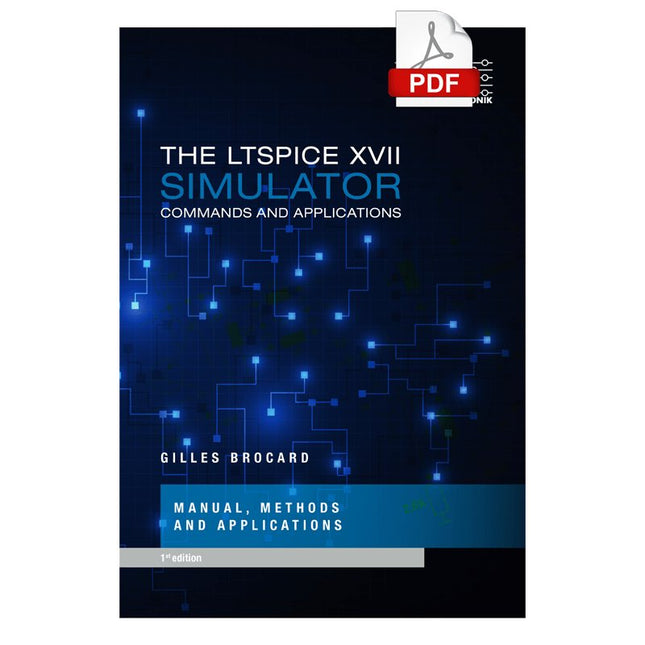
With more than 20 million users worldwide, LTspice XVII is the industry’s definitive electronic simulation software. The pure power, speed and accuracy of its simulations and its robustness make it an irreplaceable tool. This book is both an exhaustive operating manual for the latest version and an invaluable collection of examples and procedures with nearly 700 illustrations, covering everything from initially getting to grips with LTspice XVII to its exact application and extensive use. It will probably answer every question that’s likely to arise during training.
All commands and definitions are detailed and classified by topic to make referencing the LTSpice XVII knowledge fast and easy.
Elektor GREEN en GOLD leden kunnen deze uitgave hier downloaden.
Nog geen lid? Klik hier om een lidmaatschap af te sluiten.
OBD2-sensordashboardOude meters vormden het startpunt van een zoektocht naar echte gegevens
OBD2: voeg een toerenteller en schakelindicator toe aan je autoRetro, maar uiterst nuttig
LiDAR- en Visiesensoren voor Robotica
Sensor+Test 2025 en PCIM 2025
Contactloze E-Veldmetingen (1)Een Trillende Membraan voor het Detecteren van Gelijkspanningen of Statische Elektrische Velden
Draadloze brievenbusmeldervan optische sensoren tot radar: enkele mogelijkheden
Elektor Mini-Wheelieeen zelfbalancerende robot
ZonnecellenVreemde onderdelen, de serie
Aan de slag met een moderne radarsensorStaat een nauwkeurige meting op uw radar?
Uit het leven gegrepenpapierfabriek
CybersecurityZware tijden voor hackers
Infographics: IoT en sensoren 2025
Bluetooth 6.0 brengt verbeterde toepassingen voor afstandsbepalingNieuwe versie biedt betere apparaatpositionerings- en -locatieservices
Draadloze communicatie verkennen met BeagleY-AI
Err-lectronicsCorrecties, updates en lezerspost
Alle begin......sluit het thema opamps af
Een krachtige AI-codeerassistentsneller ontwikkelen met Continue en Visual Studio Code
Zonne-laadregelaar met MPPT (2)Het schema
Ultrasone obstakeldetectoreen eenvoudig project om slechtzienden te helpen
2025: Een AI-odysseeHalfjaaroverzicht
Raspberry Pi Standalone MIDI-synthesizer (3)Het slimmer maken en een gebruikersinterface toevoegen
Meshtastic: een demonstratieprojectEen slim netwerk van LoRa-radio's
Analoge audio-frequentiegeneratorHoogwaardige sinusgenerator met instelbare frequentie
Elektor GREEN and GOLD members can download their digital edition here.
Not a member yet? Click here.
DIY Solar Energy StorageBuild Your Own Energy Store for a PV Solar Array
Solar Module SimulatorA Solution for Testing and Optimizing MPP Trackers and Inverters
The STM32 Edge AI ContestExplore the new STM32N6 and Compete for a Share of €5,000 in Prizes!
Widening the BandgapWhy There Is So Much Interest in SiC and GaN
Notebook Power BankExtend the Life of Your Aged Laptop
Medical RobotsOvercoming Technical and Regulatory Hurdles
Frost Guard for Fruit Plants With Temperature Data Logger
The Analog ThingThe Arduino of Analog Computing?
Energy Saving Relay DriverSaves 90% of Relay Drive Power
Improving the ET5410A+ DC loadKeep Cool and Be Quiet, Please
electronica 2024 in Review
Electromagnetic CompatibilityEMC in a Nutshell!
Starting Out in Electronics……Filters Actively
Reducing Power Dissipation With Dropping CapacitorsA Clever Use of Capacitive Reactance
The Affordable MCP4725 12-Bit Digital-to-Analog ConverterAn EEPROM Feature Enables Safe Switch-On Behavior
Fnirsi LCR-ST1 Smart LCR SMD Tweezers
Raspberry Pi-Based Private Test & Measurement LabFirst Things First: The ADC
Electronic Load ResistorAn Out-of-the-Box Project
2025: An AI OdysseySome Projects to See in the New Year
AmpVolt v2.0 Project Update100 Amps and Beyond!
Err-lectronicsCorrections, Updates, and Readers’ Letters
Unveiling Ethical TransparencyInsights from Ethics in Electronics’s 2024 Survey
Elektor Audio DSP FX Processor Board (2)Creating Applications
The Siglent SDS814X HD digital storage oscilloscope is based on 2 GSa/s, 12-bit Analog-Digital Converters and front ends with excellent noise floor performance. With a 100 MHz bandwidth, and a maximum record length of 50 Mpts, and the capability to analyze 4 analog channels alongside 16 digital channels, the SDS814X HD is perfectly suited for mixed signal analysis.
Features
12-bit High Resolution
12-bit Analog-Digital Convertors with sample rate up to 2 GSa/s
Front ends with 70 μVrms noise floor @ 100 MHz bandwidth
2/4 analog channels, up to 700 MHz bandwidth
SPO technology
Waveform capture rate up to 80,000 wfm/s (normal mode), and 500,000 wfm/s (sequence mode)
Supports 256-level intensity grading and color temperature display modes.
Up to 50 Mpts record length
Digital trigger system
Intelligent trigger: Edge, Slope, Pulse width, Window, Runt, Interval, Dropout, Pattern, Video (HDTV supported), Qualified, Nth edge, Delay, Setup/Hold time.
Serial bus triggering and decoder, supports protocols I²C, SPI, UART, CAN, LIN.
Segmented acquisition (Sequence) mode, dividing the maximum record length into multiple segments (up to 80,000), according to trigger conditions set by the user, with a very small dead time between segments to capture the qualifying event.
History waveform record (History) function, the maximum recorded waveform length is 80,000 frames.
Automatic measurements on 50+ parameters, supports statistics with histogram, track, trend, Gating measurement, and measurements on Math, History and Ref.
4 Math traces (2 Mpts FFT, addition, subtraction, multiplication, division, integration, differential, square root, etc.), supports formula editor.
Abundant data analysis functions such as Search, Navigate, Counter, Bode plot and Power Analysis
High Speed hardware-based Mask Test function, with Mask Editor tool for creating user-defined masks
16 digital channels (optional)
25 MHz waveform generator (optional)
7" TFT-LCD display with 1024 x 600 resolution; Capacitive touch screen supports multi-touch gestures.
Interfaces include: USB Hosts, USB Device (USBTMC), LAN (VXI-11/Telnet/Socket), Pass/Fail, Trigger Out
Built-in web server supports remote control over the LAN port using a web browser. Supports SCPI remote control commands. Supports external mouse and keyboard. Supports NTP.
Technische Daten
Analog Channels
4
Bandwidth
100 MHz
Vertical resolution
12-bit
Sample rate (Max.)
One channel mode: 2 GSa/sTwo channel mode: 1 GSa/sFour channel mode: 500 MSa/s
Memory depth (Max.)
One channel mode: 50 Mpts/chTwo channel mode: 25 Mpts/chFour channel mode: 10Mpts/ch
Waveform capture rate (Max.)
Normal mode: 80,000 wfm/sSequence mode: 500,000 wfm/s
Trigger type
Edge, Slope, Pulse width, Window, Runt, Interval, Dropout, Pattern, Video, Qualified, Nth edge, Delay, Setup/Hold time, Serial
Serial trigger and decode (Standard)
I²C, SPI, UART, CAN, LIN
Measurement
50+ parameters, statistics, histogram, trend, and track supported
Math
4 traces 2 Mpts FFT, Filter, +, -, x, ÷, ∫dt, d/dt, √, Identity, Negation, Absolute, Sign, ex, 10x, ln, lg, Interpolation, MaxHold, MinHold, ERES, Average. Supports formula editor
Data analysis
Search, Navigate, History, Mask Test, Counter, Bode plot, and Power Analysis
Digital channel (optional)
16-channel; maximum sample rate up to 1 GSa/s; record length up to 10 Mpts
USB AWG module (option)
One channel, 25 MHz, sample rate of 125 MHz, wave length of 16 kpts, isolated output
I/O
2x USB 2.0 Host, USB 2.0 Device, 10/100 M LAN, Auxiliary output (TRIG OUT, PASS/FAIL), SBUS (Siglent MSO)
Probe (Standard)
Passive probe PB470 for each channel
Display
7 TFT-LCD with capacitive touch screen (1024x600)
Lieferumfang
1x Siglent SDS814X Oscilloscope
4x Passive probe (100 MHz) PP510
1x Power cord (EU)
1x USB cable
1x Certificate of calibration
1x Quick start
Downloads
Datasheet
Manual
Programming guide
An Introduction to Real and Reduced-Scale Autonomous Vehicles
Want to cut through the hype and get to the core of autonomous and connected vehicles? Then this book is your clear, accessible guide to a complex and fast-moving field. Starting with Intelligent Transport Systems (ITS), it walks you through the essential foundations, including Advanced Driver Assistance Systems (ADAS) – the stepping stones to full autonomy.
Explore how self-driving cars mimic human behavior through a loop of perception, analysis, decision, and action. Discover the key functions that make it possible: localization, obstacle detection, driver monitoring, cooperative awareness – and the most challenging of all, trajectory planning, across strategic, tactical, and operational levels.
Will vehicles be connected? The debate is on – but the standards are already here. Learn how connectivity, infrastructure, and vehicles can work in synergy through the innovative concept of floating car data (FCD).
Dive into real-world implementation: with embedded electronics account-ing for over 30% of a modern vehicle‘s cost, we unpack the architecture, coordination, and tools required to manage the complexity – brought to life with a hands-on case study.
To finish, we open the door to the future: building your own 1:10 scale autonomous vehicle. No plug-and-play solutions – just the foundations for a collaborative, creative, and geek-friendly challenge.
Let’s drive the future together.
Elektor GREEN en GOLD leden kunnen deze uitgave hier downloaden.
Nog geen lid? Klik hier om een lidmaatschap af te sluiten.
STM32 Wireless Innovation Design Contest: de winnaars
In-circuit LC-meteroverwegingen bij een prototype
AmpVolt: een modulaire DC-vermogensmeter (deel 1)meet gelijkstroom en energieverbruik tot 50 V en 5 A
embedded world 2024
Elektronische apparatuur reparerentools, technieken en tips
Alle begin... - NL TRANSLATION...gaat verder met de opamp-theorie
Eenvoudige DDS-signaalgeneratordirecte digitale synthese in zijn puurste vorm
Sparkplug bekekenspecificatie voor MQTT-data
De CRTCvreemde onderdelen
Radargestuurde verlichtingautomatische trapverlichting met personendetectie
Digitale waterpas en actieve stroboscoop voor draaitafelsregel je platenspeler perfect af met dit alles-in-één tool
Onderzoek naar de uitdagingen en commerciële waarde van open source-elektronica (2)
Ronde M12-connector met A-coderingvoorkeursoplossing voor industriële toepassingen
Het Arduino-Inside Measurement Labeen 8-in-1 test- en meetinstrument voor de elektronica-werkbank
Frequentie-, fase- en impedantieanalyse met een geluidskaartvoor frequenties van 100 Hz tot 90 kHz
Zuurgraad meten met de Arduino UNO R4controleer de waterkwaliteit
Uit het leven gegrepenpangpongbilletjes-lanceermachine
FNIRSI 1014D digitale geheugenoscilloscoopgoede prestaties voor weinig geld
2024: een AI-odysseeobjectdetectie aan de praat krijgen
10MHz-referentiegeneratorzeer nauwkeurig, met verdeler en galvanische isolatie
Project-update #2: ESP32-gebaseerde energiemeterenkele verbeteringen
Project 2.0correcties, updates en brieven van lezers
Een vraaggesprek met Eben Upton, CEO van Raspberry Pide Raspberry Pi 5 – en daarna
Dieser mehrachsige Roboter bringt Leistung und Größe perfekt in Einklang.
Features
5 Achsen
Nutzlast: 3 kg
Reichweite: 700 mm
Wiederholgenauigkeit: 0,1 mm
Maximale Geschwindigkeit 1000 mm/s
Anwendungen
Maschinenwartung
Bin Picking
Mobile Plattform
Laborautomatisierung
Roboterforschung
Langlebige kollaborative Roboter für Ihre Automatisierung
Harmonische Antriebe und Servomotoren in Industriequalität garantieren einen ununterbrochenen Betrieb rund um die Uhr.
Hergestellt aus Kohlefaser, 15 kg Gewicht ermöglichen einen einfacheren Einsatz.
Flexible Bereitstellung mit sicherer Funktion
Handprogrammierung, leicht, platzsparend und einfach für mehrere Anwendungen einsetzbar, ohne Ihr Produktionslayout zu ändern. Perfekt für wiederkehrende Aufgaben.
Kollisionserkennung ist für alle unsere Cobots verfügbar. Ihre Sicherheit hat immer oberste Priorität.
Grafische Oberfläche für einsteigerfreundliche Programmierung
Kompatibel mit verschiedenen Betriebssystemen, einschließlich macOS und Windows.
Webbasierte Technologie, kompatibel mit allen gängigen Browsern.
Drag & Drop, um Ihren Code in wenigen Minuten zu erstellen.
Leistungsstarkes und Open-Source-SDK immer zur Hand
Das voll funktionsfähige Open-Source-Python/C++-SDK bietet eine flexiblere Programmierung.
ROS/ROS2-Pakete sind einsatzbereit.
Beispielcodes helfen Ihnen, den Roboterarm reibungslos einzusetzen.
Technische Daten
UFactory 850
xArm 5
xArm 6
xArm 7
Nutzlast
5 kg
3 kg
5 kg
3,5 kg
Reichweite
850 mm
700 mm
700 mm
700 mm
Freiheitsgrade
6
5
6
7
Wiederholbarkeit
±0,02 mm
±0,1 mm
±0,1 mm
±0,1 mm
Maximale Geschwindigkeit
1 m/s
1 m/s
1 m/s
1 m/s
Gewicht (nur Roboterarm)
20 kg
11,2 kg
12,2 kg
13,7 kg
Maximale Geschwindigkeit
180°/s
180°/s
180°/s
180°/s
Joint 1
±360°
±360°
±360°
±360°
Joint 2
-132°~132°
-118°~120°
-118°~120°
-118°~120°
Joint 3
-242°~3.5°
-225°~11°
-225°~11°
±360°
Joint 4
±360°
-97°~180°
±360°
-11°~225°
Joint 5
-124°~124°
±360°
-97°~180°
±360°
Joint 6
±360°
±360°
-97°~180°
Joint 7
±360°
Hardware
Umgebungstemperaturbereich
0-50°C
Stromverbrauch
Min. 8,4 W, typisch 200 W, max. 400 W
Eingangsstromversorgung
24 V DC, 16,5 A
Fußabdruck
Ø 126 mm
Materialien
Aluminium, Kohlefaser
Basis-Connector-Typ
M5x5
Reinraum der ISO-Klasse
5
Robotermontage
Alle
Endeffektor-Kommunikationsprotokoll
Modbus RTU(rs485)
Endeffektor-E/A
2x DI/2x DO/2x AI/1x RS485
Kommunikationsmodus
Ethernet
Lieferumfang
1x xArm 5 Roboterarm
1x AC-Steuerbox
1x Roboterarm-Stromkabel
1x Roboterarm-Endeffektor-Adapterkabel
1x Roboterarm-Signalkabel
1x Steuerbox-Stromkabel
1x Netzwerkkabel
1x Montagewerkzeug
1x Kurzanleitung
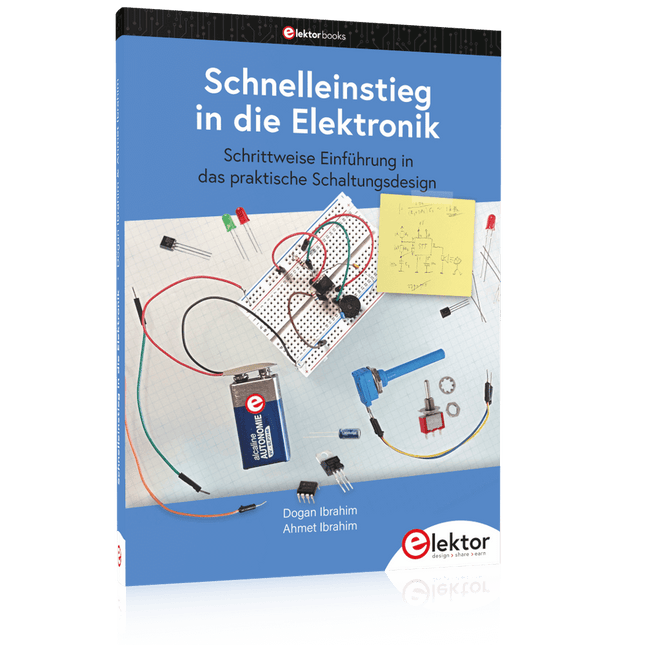
Schrittweise Einführung in das praktische Schaltungsdesign
Der Einstieg in die Elektronik ist nicht so schwierig, wie man vielleicht denkt. Mit diesem Buch werden die wichtigsten Konzepte der Elektrotechnik und Elektronik auf spielerische Weise erkundet, indem verschiedene Experimente durchgeführt und Schaltungen simuliert werden. Es vermittelt Elektronik praxisnah, ohne in komplexen Fachjargon oder lange Berechnungen einzutauchen. Dadurch werden schon bald eigene Projekte ermöglicht.
Es sind keine Vorkenntnisse in Elektronik erforderlich; lediglich einige grundlegende Algebra-Kenntnisse werden in wenigen einfachen Berechnungen verwendet. Viele getestete und funktionierende Projekte und Simulationen werden vorgestellt, um mit dem Aufbau elektronischer Schaltungen vertraut zu werden. Für problemloses Experimentieren – ohne die Gefahr, etwas zu beschädigen – werden zudem frühzeitig auch softwarebasierte Schaltungssimulationen vorgestellt.
Lernziele:
Konzepte von Spannung, Strom und Leistung
Wechselstrom (AC) und Gleichstrom (DC)
Grundlegende Lampenschaltungen mit Schaltern
Passive Bauteile: Widerstände, Kondensatoren und Induktivitäten
RC- und RCL-Schaltungen und Elektromagnetismus
Lautsprecher, Relais, Summer und Transformatoren
Aktive Bauteile: Dioden und LEDs, Bipolartransistoren und MOSFETs
Transistorbasierte Schaltungen
Optokoppler-Schaltungen
Astabile und monostabile Multivibratoren
Verwendung des 555-Timer-ICs
Operationsverstärkertechnik
Digitale Logik
Beispiele: Verstärker, Oszillatoren, Filter und Sensoren
Test- und Messwerkzeuge
Mikrocontroller: Arduino Uno, ESP32, Raspberry Pi Pico und Raspberry Pi
Datenblätter lesen und Auswahl von Komponenten
EMV & EMI sowie Normen & Vorschriften
Der Siglent SDG1032X Plus ist ein leistungsstarker Zweikanal-Funktions-/Arbiträr-Wellenformgenerator mit einer maximalen Frequenz von 30 MHz, einer Auflösung von 16 Bit und einer Abtastrate von 1 GSa/s für hervorragende Signaltreue.
Es verfügt über TrueArb für verzerrungsarme Wellenformen, EasyPulse für jitterfreie Impulse und eine robuste Sequenzwiedergabe. Mit einer Amplitude von ±10 V, einem 4,3"-Display und vielseitiger Modulation ist es eine zuverlässige Wahl für Ingenieure und Forscher.
Features
Zwei Kanäle: Unabhängiger Ausgang mit maximaler Frequenz von 30 MHz
Hohe Abtastrate: 1 GSa/s für präzise Wellenformerzeugung
Hohe vertikale Auflösung: 16-Bit-Auflösung für präzise Signalwiedergabe
TrueArb-Technologie: Erzeugt Arbiträrwellenformen mit geringer Verzerrung und hoher Wiedergabetreue
EasyPulse-Technologie: Erzeugt jitterfreie Rechteck- und Impulssignale mit feiner Steuerung der Anstiegs-/Abfallzeiten
Beliebige Wellenformlänge: Unterstützt bis zu 8 Mpts pro Kanal für komplexes Wellenformdesign
Großer Amplitudenbereich: ±10 V maximale Ausgangsamplitude
Eingebaute Modulationsfunktionen: AM, FM, PM, PWM, PSK, FSK, ASK und mehr
Mehrfachimpulsausgang: Ermöglicht die Messung von Schaltparametern von Leistungsgeräten
PRBS-Mustergenerierung: Unterstützt bis zu 40 Mbps für erweiterte Testanforderungen
Sweep- und Burst-Modi: Flexible Testmöglichkeiten mit anpassbaren Parametern
Sequenzwiedergabefunktion: Speichert und gibt komplexe Wellenformen effizient wieder
Frequenzzähler: Misst Frequenzen bis zu 200 MHz mit hoher Präzision
Benutzerfreundliches Display: 4,3" Farb-LCD mit übersichtlicher Oberfläche
Fernsteuerungsunterstützung: Integrierter Webserver zur Steuerung über einen Webbrowser
Kompaktes Design: Tragbarer und platzsparender Formfaktor
Technische Daten
Bandbreite
30 MHz
Kanäle
2
Abtastrate
1 GSa/s (4x Interpolation)
Vertikale Auflösung
16 Bit (pro Kanal)
Wellenformlänge
8 Mpts
Max. Amplitude
±10 V
Display
4,3" Farb-TFT-LCD (480 x 272)
Schnittstellen
USB-Host, USB-Gerät, LAN
Abmessungen
260 x 107 x 296 mm
Gewicht
4,35 kg
Lieferumfang
1x Siglent SDG1032X Plus Arbiträr-Wellenformgenerator
1x Netzkabel
1x USB-Kabel
1x Garantiekarte
1x Quick Start Guide
Downloads
Datasheet
User Manual
Programming Guide
Software
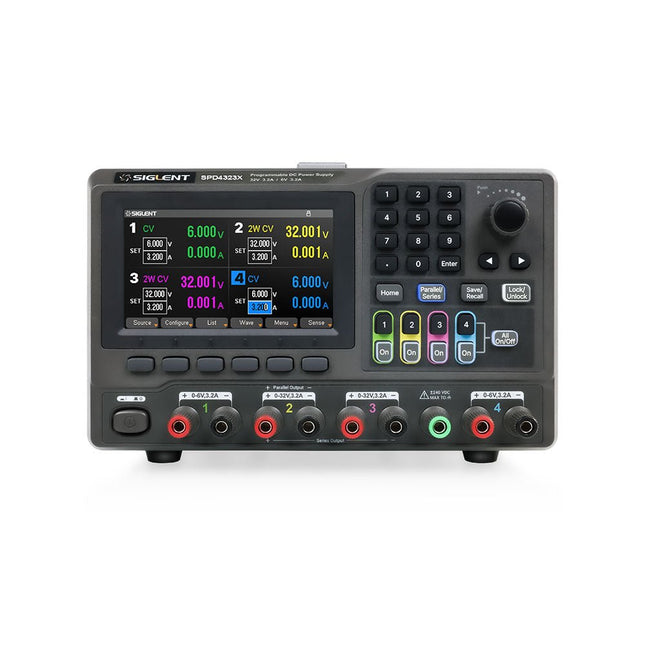
The Siglent SPD4323X is a 4-channel DC Linear Programmable Power Supply equipped with a 4.3-inch TFT-LCD display, friendly human-machine interface, and excellent performance indicators. Real-time waveform display provides engineers with an informative user interface.
SPD4323X offers a total output power of 240 W with a resolution of 1 mV/1 mA. The maximum voltage and current for each channel are as follows:
CH1: 6 V/3.2 A
CH2: 32 V/3.2 A
CH3: 32 V/3.2 A
CH4: 6 V/3.2 A
Features
Rated output power: 240 W
Rated voltage: 32 V, 12 V, 30 V
Up to four high-precision power supplies with independent controllable outputs, supporting CH2 and CH3 series and parallel connections
Clear graphical interface with waveform and timer display modes
5-digit voltage and current display with minimum resolution of 1 mV, 1 mA
Fast output response time: <50us
The high current channel support remote voltage compensation sense function. The maximum compensation voltage is 0.6 V
Overvoltage protection and overcurrent protection or safe and accurate operation
Equipped with a 4.3-inch TFT-LCD display (480 x 272 resolution)
USB and LAN standard communication
USB-GPIB module is optional
Excellent channel density with up to 4 channels in a 3U half rack package
Internal data storage for setups and parameters
Embedded Web Server with instrument communication that doesn’t require software installation
Fully SCPI programming command set support as well as a LabView driver for remote control and system automation
Technische Daten
SPD4323X
SPD4121X
SPD4306X
Channel Output
CH1: Voltage 0 to 6 V Current 0 to 3.2 ACH2: Voltage 0 to 32 V Current 0 to 3.2 ACH3: Voltage 0 to 32 V Current 0 to 3.2 ACH4: Voltage 0 to 6 V Current 0 to 3.2 A
CH1: Voltage 0 to 15 V Current 0 to 1.5 ACH2: Voltage 0 to 12 V Current 0 to 10 ACH3: Voltage 0 to 12 V Current 0 to 10 ACH4: Voltage 0 to 15 V Current 0 to 1.5 A
CH1: Voltage 0 to 15 V Current 0 to 1.5 ACH2: Voltage 0 to 30 V Current 0 to 6 ACH3: Voltage 0 to 30 V Current 0 to 6 ACH4: Voltage 0 to 15 V Current 0 to 1 A
Resolution
1 mV, 1 mA
1 mV, 1 mA
1 mV, 1 mA
Setting Accuracy
Voltage: ±(0.03% of reading+10) mV, Current: ±(0.3% of reading+10) mA
Voltage: ±(0.03% of reading+10) mV, Current: ±(0.3% of reading+10) mA
Voltage: ±(0.03% of reading+10) mV, Current: ±(0.3% of reading+10) mA
Readback Accuracy
Voltage: ±(0.03% of reading+10) mV, Current: ±(0.3% of reading+10) mA
Voltage: ±(0.03% of reading+10) mV, Current: ±(0.3% of reading+10) mA
Voltage: ±(0.03% of reading+10) mV, Current: ±(0.3% of reading+10) mA
Display
4.3" TFT-LCD 5-digit voltage and current display
4.3" TFT-LCD 5-digit voltage and current display
4.3" TFT-LCD 5-digit voltage and current display
Output power
240 W
285 W
400 W
Lieferumfang
1x Siglent SPD4323X Power Supply
1x Power cord (EU)
1x Output test cord (3 A)
1x USB cable
1x Quick start guide
Downloads
Datasheet
Manual
Quick start
Elektor GREEN and GOLD members can download their digital edition here.
Not a member yet? Click here.
PbMonitor v1.0A Battery-Monitoring System for UPS and Energy Storage Applications
Solar Charge Controller with MPPT (1)Basic Principles of a Solar Controller for Stand-Alone Systems
B-Field Integration Magnetometer With Home-Made Sensors
Precise or Accurate?Your Instruments Need to Be Both!
AD7124 A Precision ADC in PracticeFeatures for Sensor Signal Conditioning
PID Control ToolOptimize Your Parameters Easily
embedded world 2025
Starting Out in Electronics……Continues with Tone Control
Academy Pro BoxBook + Online Course + Hardware
Milliohmmeter AdapterUses the Precision of Your Multimeter
The Next Leap in SemiconductorsOnward Toward 1.4 nm
Through-Hole Technology ConnectorsThe Best of Two Worlds: THR
Frequency CounterPortable and Auto-Calibrating Via GPS
Analog MetersPeculiar Parts, the Series
Stand-Alone Crystal TesterHow Accurate Is Your Clock Source?
Low-Cost I²C TesterConnect I²C Devices Directly to Your PC
From Life’s ExperienceWho Doesn’t Honor the Small Things?
2025: An AI OdysseyThe Transformative Impact on Software Development
Err-lectronicsCorrections, Updates, and Readers’ Letters
Raspberry Pi Standalone MIDI Synthesizer (2)Enhancing Our Setup with Intelligence
Nortonized Wien Bridge OscillatorSmall Changes Yield Significant Improvements
Putting a $0.10 Controller to the TestThe CH32V003 RISC-V Microcontroller and MounRiver Studio in Practice
An FPGA-Based Audio Player with Equalizer (2)Adding Volume Control, Advanced Mixing, and a Web Interface
Dieser mehrachsige Roboter bringt Leistung und Größe perfekt in Einklang.
Features
5 Achsen
Nutzlast: 5 kg
Reichweite: 700 mm
Wiederholgenauigkeit: 0,1 mm
Maximale Geschwindigkeit 1000 mm/s
Anwendungen
Maschinenwartung
Bin Picking
Mobile Plattform
Laborautomatisierung
Roboterforschung
Langlebige kollaborative Roboter für Ihre Automatisierung
Harmonische Antriebe und Servomotoren in Industriequalität garantieren einen ununterbrochenen Betrieb rund um die Uhr.
Hergestellt aus Kohlefaser, 15 kg Gewicht ermöglichen einen einfacheren Einsatz.
Flexible Bereitstellung mit sicherer Funktion
Handprogrammierung, leicht, platzsparend und einfach für mehrere Anwendungen einsetzbar, ohne Ihr Produktionslayout zu ändern. Perfekt für wiederkehrende Aufgaben.
Kollisionserkennung ist für alle unsere Cobots verfügbar. Ihre Sicherheit hat immer oberste Priorität.
Grafische Oberfläche für einsteigerfreundliche Programmierung
Kompatibel mit verschiedenen Betriebssystemen, einschließlich macOS und Windows.
Webbasierte Technologie, kompatibel mit allen gängigen Browsern.
Drag & Drop, um Ihren Code in wenigen Minuten zu erstellen.
Leistungsstarkes und Open-Source-SDK immer zur Hand
Das voll funktionsfähige Open-Source-Python/C++-SDK bietet eine flexiblere Programmierung.
ROS/ROS2-Pakete sind einsatzbereit.
Beispielcodes helfen Ihnen, den Roboterarm reibungslos einzusetzen.
Technische Daten
UFactory 850
xArm 5
xArm 6
xArm 7
Nutzlast
5 kg
3 kg
5 kg
3,5 kg
Reichweite
850 mm
700 mm
700 mm
700 mm
Freiheitsgrade
6
5
6
7
Wiederholbarkeit
±0,02 mm
±0,1 mm
±0,1 mm
±0,1 mm
Maximale Geschwindigkeit
1 m/s
1 m/s
1 m/s
1 m/s
Gewicht (nur Roboterarm)
20 kg
11,2 kg
12,2 kg
13,7 kg
Maximale Geschwindigkeit
180°/s
180°/s
180°/s
180°/s
Joint 1
±360°
±360°
±360°
±360°
Joint 2
-132°~132°
-118°~120°
-118°~120°
-118°~120°
Joint 3
-242°~3.5°
-225°~11°
-225°~11°
±360°
Joint 4
±360°
-97°~180°
±360°
-11°~225°
Joint 5
-124°~124°
±360°
-97°~180°
±360°
Joint 6
±360°
±360°
-97°~180°
Joint 7
±360°
Hardware
Umgebungstemperaturbereich
0-50°C
Stromverbrauch
Min. 8,4 W, typisch 200 W, max. 400 W
Eingangsstromversorgung
24 V DC, 16,5 A
Fußabdruck
Ø 126 mm
Materialien
Aluminium, Kohlefaser
Basis-Connector-Typ
M5x5
Reinraum der ISO-Klasse
5
Robotermontage
Alle
Endeffektor-Kommunikationsprotokoll
Modbus RTU(rs485)
Endeffektor-E/A
2x DI/2x DO/2x AI/1x RS485
Kommunikationsmodus
Ethernet
Lieferumfang
1x xArm 5 Roboterarm
1x AC-Steuerbox
1x Roboterarm-Stromkabel
1x Roboterarm-Endeffektor-Adapterkabel
1x Roboterarm-Signalkabel
1x Steuerbox-Stromkabel
1x Netzwerkkabel
1x Montagewerkzeug
1x Kurzanleitung