
Suchergebnisse für "elektor or magazine or nl or september or oktober or 2018 or pdf"
-
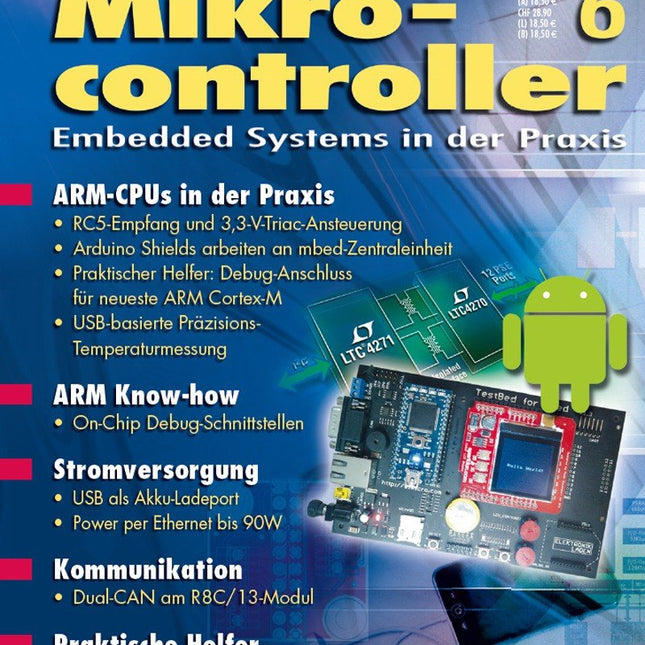
Elektor Digital Mikrocontroller 6 als PDF (DE)
Inhalt: Praxis Geisterhände – RC5-Empfang und 3,3-V-Triac-Ansteuerung mit ARM Cortex-M3 Als Vermählte grüßen … – Trägerboard für mbed-ARM-Zentraleinheit und Arduino Shields Cortex-M: Spionage-Port sucht Anschluss – Neuer Debug-Anschluss bei aktuellen ARM Cortex-M Mikrocontrollern Yes we CAN CAN – Dual-CAN-Port für das R8C/13-Board ARM-Thermometer – USB-basierte Temperaturüberwachung mit Kaltstellen-Kompensation Know-how Nie mehr Ladehemmung – USB als Akku-Ladeport Power up – Stromversorgung per Ethernet bis 90 W Reise ins Innere der ARM-MCU – ARM On-Chip Debug-Schnittstellen: Möglichkeiten und Grenzen Info Marktübersicht – Android-Applikationen für Elektroniker Aktuell – Companion-Chips, Eva-Kits, MCUs und Software Noch einfacher – RS-232-DB-9 wird USB-DB-9 Wenn nichts mehr geht – Hot-Swap-I²C-Bus-Puffer mit großer Low-Pegel-Toleranz Treibende Kraft – Energieeffiziente Motorsteuerungen skalierbar entwickeln Weitere Hefte aus dieser Reihe: Mikrocontroller 7 (PDF) Mikrocontroller 5 (PDF) Mikrocontroller 4 (PDF) Mikrocontroller 3 (PDF) Mikrocontroller 2 (PDF) Mikrocontroller 1 (PDF)
€ 16,90
Mitglieder: € 15,21
-

Elektor Digital Embedded in Embedded (E-book)
ARM Cortex-M Embedded Design from 0 to 1 Hobbyists can mash together amazing functional systems using platforms like Arduino or Raspberry Pi, but it is imperative that engineers and product designers understand the foundational knowledge of embedded design. There are very few resources available that describe the thinking, strategies, and processes to take an idea through hardware design and low-level driver development, and successfully build a complete embedded system. Many engineers end up learning the hard way, or never really learn at all. ARM processors are essentially ubiquitous in embedded systems. Design engineers building novel devices must understand the fundamentals of these systems and be able to break down large, complicated ideas into manageable pieces. Successful product development means traversing a huge amount of documentation to understand how to accomplish what you need, then put everything together to create a robust system that will reliably operate and be maintainable for years to come. This book is a case study in embedded design including discussion of the hardware, processor initialization, low‑level driver development, and application interface design for a product. Though we describe this through a specific application of a Cortex-M3 development board, our mission is to help the reader build foundational skills critical to being an excellent product developer. The completed development board is available to maximize the impact of this book, and the working platform that you create can then be used as a base for further development and learning. The Embedded in Embedded program is about teaching fundamental skill sets to help engineers build a solid foundation of knowledge that can be applied in any design environment. With nearly 20 years of experience in the industry, the author communicates the critical skill development that is demanded by companies and essential to successful design. This book is as much about building a great design process, critical thinking, and even social considerations important to developers as it is about technical hardware and firmware design. Downloads EiE Software Archive (200 MB) IAR ARM 8.10.1 (Recommended IDE version to use) (1.2 GB) IAR ARM 7.20.1 (Optional IDE version to use) (600 MB)
€ 44,95
Mitglieder: € 40,46
-

Elektor Publishing Automotive Sensors and Actuators
Principles, Systems, and Electronics This handbook provides a detailed study of the sensors and actuators at the heart of modern vehicle electronics. It begins with basic electrical and electronic concepts, introducing the principles and terminology essential for understanding automotive systems. The book explores sensors and actuators on a system-by-system basis, including: Fundamentals of electrical engineering, electromagnetic phenomena, and motor principles Passive and active electronic components, integrated circuits, protection devices, and automotive-grade electronics Sensor characteristics, signal conditioning, ADCs, PWM and frequency outputs, and interface adaptation Automotive communication links and protocols, including LIN and SENT Engine sensors: air mass, pressure, temperature, speed, position, exhaust and emissions-related sensors Transmission sensors for manual and automatic systems Steering and suspension sensors for conventional and active systems Vehicle body and electrical system sensors for comfort, climate, access, and monitoring functions Engine actuators such as throttle bodies, injectors, turbo actuators, EGR systems, ignition components, and pumps Transmission, brake, steering, suspension, and body actuators Identification and coding of electronic components and packages commonly used in automotive applications The structure and operating principles of each component are explained, with relevant electronic circuitry illustrated. Its system-oriented organization and practical focus make it a valuable reference for understanding, testing, and troubleshooting automotive electronic systems.
€ 39,95
Mitglieder: € 35,96
-
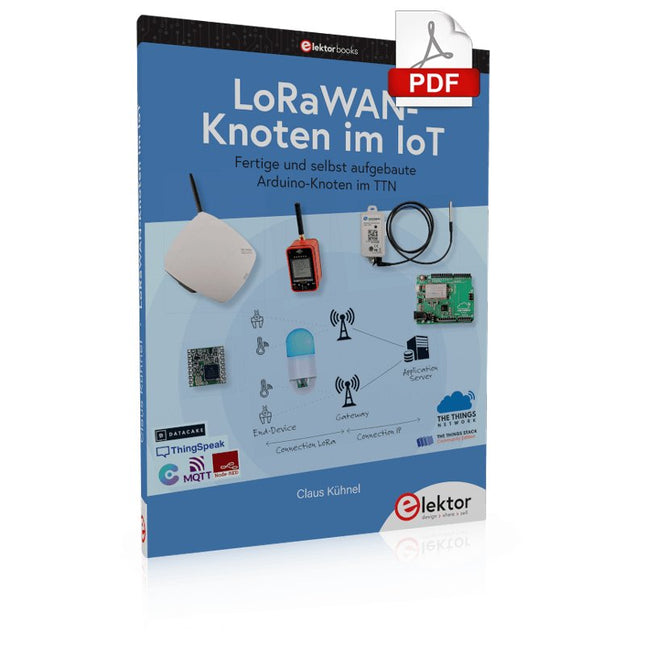
Elektor Digital LoRaWAN-Knoten im IoT (PDF)
Fertige und selbst aufgebaute Arduino-Knoten im TTN LoRaWAN hat sich als Kommunikationslösung im IoT hervorragend entwickelt. The Things Network (TTN) hat hierzu seinen Beitrag geleistet. Aktuell wird The Things Network auf The Things Stack Community Edition (TTS (CE)) aktualisiert. Die Cluster von TTN V2 werden gegen Ende 2021 geschlossen. Der Autor zeigt Ihnen die notwendigen Schritte, damit Sie in gewohnter Weise LoRaWAN-Knoten mit Hilfe von TTS (CE) betreiben und vielleicht auch das Netz der Gateways durch ein eigenes Gateway erweitern. Mittlerweile gibt es sogar für den mobilen Einsatz geeignete LoRaWAN-Gateways mit denen Sie über Ihr Mobiltelefon Verbindung zum TTN-Server aufbauen können. In diesem Buch werden eine Reihe kommerzieller und Arduino-basierter LoRaWAN-Knoten als auch neue, kostengünstige und für den Batteriebetrieb geeignete Hardware zum Aufbau autonomer LoRaWAN-Knoten vorgestellt. Die Registrierung von LoRaWAN-Knoten und Gateways im TTS (CE) sowie die Bereitstellung der erhobenen Daten über MQTT und die Visualisierung über Node-RED, Cayenne, Thingspeak und Datacake ermöglichen komplexe IoT-Projekte und völlig neue Anwendungen zu sehr geringen Kosten. Das vorliegende Buch versetzt Sie in die Lage, mit batteriebetriebenen Sensoren (LoRaWAN-Knoten) erfasste Daten drahtlos im Internet bereitzustellen und zu visualisieren. Sie lernen die Grundlagen für Smart-City- und IoT-Anwendungen, die beispielsweise die Messung von Luftqualität, Wasserständen, Schneehöhen, das Ermitteln von freien Parkfeldern (Smart Parking) und die intelligente Steuerung der Straßenbeleuchtung (Smart Lighting) u.a.m. ermöglichen.
€ 32,80
Mitglieder: € 29,52
-

Elektor Digital LPWAN Decoded (E-book)
LoRaWAN, Sigfox, NB-IoT & LTE-M Compared The Internet of Things depends on a critical question. How do you connect devices that must operate for years on tiny batteries, often miles from the nearest power outlet? This Elektor Technical Brief provides a practical guide to the technologies that have become the backbone of long-range, low-power IoT connectivity. Compiled by the Elektor Content Team, this concise technical brief examines the real engineering tradeoffs behind today’s leading Low-Power Wide-Area Network (LPWAN) technologies: LoRaWAN, Sigfox, NB-IoT, and LTE-M. By referencing a wide range of Elektor articles and other online content, this document explains why link budget, noise, bandwidth, and power consumption ultimately determine system performance. From there, it explores the architectures, strengths, limitations, and deployment realities of each major LPWAN technology, helping you understand not just how they work, but when and why to use them. Whether you’re designing smart meters, industrial sensors, agricultural monitoring systems, asset trackers, or connected infrastructure, this guide provides the insights needed to make informed connectivity decisions. Along the way, you’ll discover: Why LPWAN technologies emerged and where they fit in the IoT landscape The RF fundamentals that drive range, reliability, and battery life Details about LoRaWAN, Sigfox, NB-IoT, and LTE-M Practical comparisons of power, coverage, latency, cost, and deployment models Guidance for selecting the right LPWAN technology for your application Emerging trends shaping the future of long-range IoT connectivity Clear, accessible, and grounded in real engineering practice, this Technical Brief helps you move beyond specifications and marketing claims to understand what matters most. If you’re building connected products that need to survive in the field — not just in the lab — this is the LPWAN guide you’ll want at your side. Elektor helped launch the first wave of electronics makers in 1961. Since then, our global community has grown by hundreds of thousands of active members (comprising professional engineers, makers, and students) and more than 500 contributing experts. Every day, we inspire members to design and earn money with electronics.
€ 14,95
Mitglieder: € 13,46
-

Elektor Digital Elektronica Kunst & Kunde 2 (E-book)
In Elektronica Kunst & Kunde worden alle onderwerpen behandeld die ook in standaard elektronica-leerboeken aan de orde komen, plus een groot aantal belangrijke maar vaak veronachtzaamde zaken. In dit tweede deel aandacht voor onder meer de volgende onderwerpen: phase-locked loop-schakelingen, opto-elektronica, busschakelingen, capacitieve belasting, bekabeling, interfacing timing, naaldpulsen, klokvertraging, monostabiele multivibratoren de IBM-PC en de Intel-fanilie, RS232-kabels, seriële poorten, ASCII, modems, SCSI, IPI, GPIB, parallele poorten, local-area-networks de 68000-microprocessorfamilie, perifere LSI-chips, geheugen, programmeerbare instrumenten prototypering, het ontwerpen van printplaten, wire-wrap-technieken, CAD/CAM technieken, de bouw van schakelingen HF-modules, vereenvoudigd ontwerp van HF-versterkers en high-speed schakelaars batterijen, accu's en zonnecellen; micropower-regelaars, -opamps en -microprocessoren methoden om de bandbreedte te beperken, middeling van signalen, lock-in versterkers, pulshoogte-analyse, 'multichannel-scaling'
€ 29,95
Mitglieder: € 26,96
-
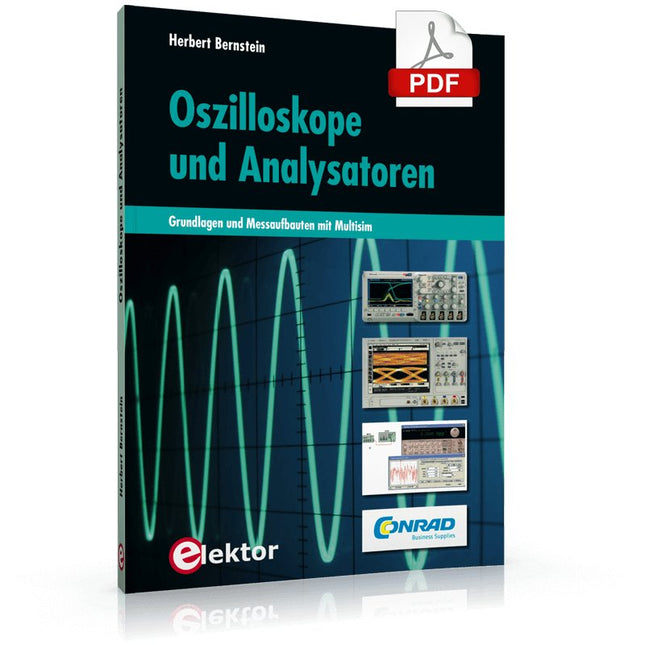
Elektor Digital Oszilloskope und Analysatoren (E-book)
Dieses Fachbuch beinhaltet alles über analoge Oszilloskope, digitale Speicheroszilloskope, Logikanalysatoren, Bode-Plotter, Spektrum- und Netzwerkanalysatoren mit praxisorientierten Fakten. Der Autor hat auch für die komplexen Vorgänge der elektronischen Messtechnik praktische kurze Erklärungen und zeigt viele Anwendungen aus der Messpraxis. Die sieben Kapitel vereinfachen das Erlernen für diese wichtigen Messgeräte und im Wesentlichen basiert das gesamte Buch auf der Simulation mit Multisim. Neben der Theorie finden Sie auch praxisnahe Messschaltungen. Analoges und digitales Oszilloskop mit zahlreichen Messübungen Messpraktikum für analoge 2- und 4-Kanal-Oszilloskope Arbeiten und Messen mit dem digitalen Speicheroszilloskop mit Analyse-Methoden (Fourier-Analyse, Rausch- und Rauschzahlanalyse, Monte-Carlo-Analyse, Worst-Case-Analyse, BER-Messung auf analoger und digitaler Basis) Logikanalysator, Anwendungen des simulierten Logikanalysators und Bitmustergenerator, Untersuchung eines 8-bit-D/A- und -A/D-Wandlers Bode-Plotter, Präzisions-Funktionsgenerator MAX038 mit Wobbler, aktive und passive Filterschaltungen Spektrumanalysator, Dezibel, logarithmische Bezugsgröße, Dämpfung und Verstärkung, Messung von Rauschsignalen, Verzerrungen und Klirrfaktor, Mittelwertbildung von Rauschsignalen, S-Parameter, Crestfaktor Netzwerkanalysator, Fehler des Netzwerkanalysators, Smith-Diagramm und Ortskurven, komplexe Widerstände, Analyseverfahren mit dem Netzwerkanalysator, S-, T-, M-, X-Parameter und S-Funktion, Leitungstheorie, Stehwellenverhältnis, Dämpfung, Gruppenlaufzeit, Anpassschaltung für HF-Transistoren Die Zielgruppen sind Techniker- und Meisterschulen Studierende an Fachhochschulen und technischen Akademien Praktiker in Industrie und Handwerk
€ 39,80
Mitglieder: € 35,82
-

Elektor Digital NI myDAQ in der Praxis (E-book)
Messen, Steuern und Regeln – diese Kerndisziplinen der klassischen Elektrotechnik bilden auch heute noch die wesentlichen Schwerpunkte in der elektrotechnischen Ausbildung. In diesen Bereichen kann das myDAQ-Modul von National Instruments (NI) praxisnah und kostengünstig eingesetzt werden. Das Messlabor in der Westentasche beinhaltet insgesamt acht leistungsfähige Mess- und Analysegeräte: Digital-Multimeter Oszilloskop Funktionsgenerator Bode-Plotter Spektrumanalysator Arbiträrgenerator Digital Reader Digital Writer Im vorliegenden Grundlagen-, Arbeits- und Experimental-Buch wird das myDAQ-Modul und seine Funktionen ausführlich und praxisgerecht beschrieben. Nach der Vorstellung der einzelnen Mess- und Analysegeräte werden Erweiterungsadapter und kleine Mini-Systeme entwickelt. Realisiert werden unter anderem eine Filterbank mit den klassischen Filtern der Nachrichtentechnik, deren Bode-Diagramme untersucht werden. Außerdem werden Temperaturmessungen und Temperaturregelung in einer geschlossenen Thermobox, der Aufbau eines Ohmmeters und der Anschluss einer Analog-Tastatur behandelt. Danach folgt die Einbindung des myDAQ in die LabVIEW-Entwicklungs- und Arbeitsumgebung. ELVIS-Express-VIs als auch der Einsatz des DAQ-Assistenten werden ausführlich mit vielen Beispielen beschrieben. Die Netzwerkfähigkeit des myDAQ-Moduls werden abschließend behandelt. Alle im Buch entwickelten LabVIEW-VIs, weitere vielfältige Zusatzinformationen und neue Applikationen mit dem myDAQ-Modul sind von der Website www.mydaq-praxis.com kostenfrei downloadbar.
€ 34,80
Mitglieder: € 31,32
-
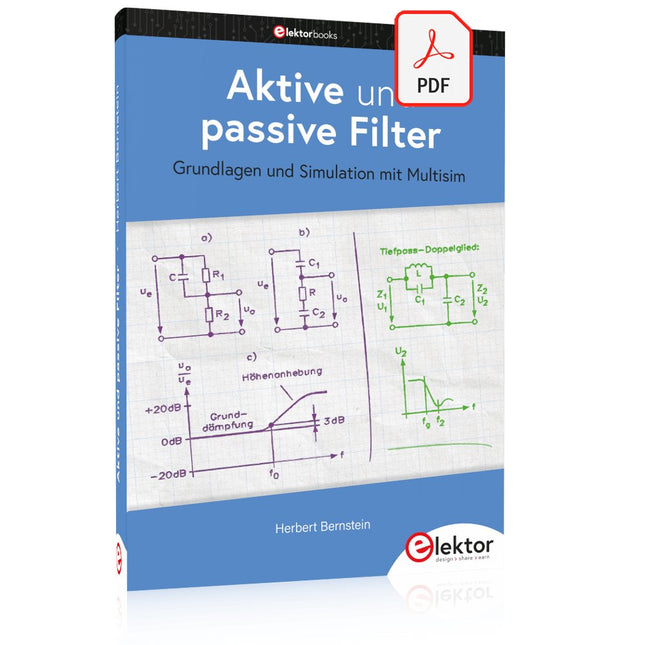
Elektor Digital Aktive und passive Filter (PDF)
Grundlagen und Simulation mit Multisim Analoge Filterschaltungen bilden die schaltungstechnischen Grundlagen in der Elektronik, Messtechnik, Nachrichtentechnik, Computertechnik usw. Die Bauelemente Widerstand, Kondensator und Spule sind die Grundlagen der passiven Filtertechnik. Filter haben Einfluss auf die Signalamplitude, die Signalform (zeitlicher Verlauf) und Signallaufzeit (Signalverlauf). Mit diesen Voraussetzungen werden Zweipole, Vierpole, Hoch- und Tiefpässe behandelt. Daraus resultieren Frequenz- und Phasengang, Dämpfung, Bandpass, Bandsperre und Doppel-T-Filter. Der Operationsverstärker arbeitet als Verstärker in der aktiven Filtertechnik. Erklärt werden in diesem Buch auch aktive Hoch- und Tiefpassfilter der 1., 2., 3. und höherer Ordnung, Unterschiede zwischen Gauß-, Bessel-, Butterworth- und Tschebyscheff-Funktionen, aktive Bandpass- und Bandsperrfilter, Allpassfilter und Universalfilter. Dieses Buch basiert auf dem bekannten Programm Multisim und Spice. Damit lassen sich alle Versuche simulieren.
€ 39,80
Mitglieder: € 35,82
-

Elektor Digital Digital Electronics (E-book)
The Basics, New Ideas & Applications Build digital electronics from the ground up—and take it all the way to practical circuits you can use. This book guides you through the core principles of digital technology with a strongly hands-on approach. You’ll begin with the essentials: signals, devices for working with them, and what "logic 0" and "logic 1" mean in real hardware. Simple demonstration setups made from easy-to-find parts (LEDs, diodes, resistors, switches) help you see how logic behaves, making the theory click before you move on. From there, you’ll explore a wide range of logic elements and how they’re implemented, including classic logic families such as TTL and CMOS. The fundamentals section covers the building blocks of digital systems: flip-flops, Schmitt triggers, registers, counters and dividers, encoders/ decoders, multiplexers/demultiplexers, plus A/D and D/A conversion and timing circuits. Next, the book invites you into "new ideas" in digital electronics—universal logic elements, unconventional approaches (including thyristor-based and fractional logic), and creative logic functions that can inspire original designs. Finally, a large, well-organized collection of application circuits turns knowledge into projects: electronic switches and selectors, pulse generators, PWM regulators, frequency multipliers/dividers, phase shifters, and digital filters. Study it deeply, and you’ll gain not only understanding—but the ability to design and debug digital circuits independently.
€ 32,95
Mitglieder: € 29,66
-

Elektor Digital Retronics (E-book)
Quite unintentionally a one-page story on an old Heathkit tube tester in the December 2004 edition of Elektor magazine spawned dozens of ‘Retronics’ tales appearing with a monthly cadence, and attracting a steady flow of reader feedback and contributions to the series. Since launching his Retronics columns, Elektor Editor Jan Buiting has never been short of copy to print, or vintage equipment to marvel at. This book is a compilation of about 80 Retronics installments published between 2004 and 2012. The stories cover vintage test equipment, prehistoric computers, long forgotten components, and Elektor blockbuster projects, all aiming to make engineers smile, sit up, object, drool, or experience a whiff of nostalgia. To reflect that our memories are constantly playing tricks on us, and honoring that “one man’s rubbish is another man’s gem”, the tales in the book purposely have no chronological order, and no bias in favor of transistor or tube, microprocessor or discrete part, audio or RF, DIY or professional, dry or narrative style. Although vastly diff erent in subject matter, all tales in the book are told with personal gusto because Retronics is about sentiment in electronics engineering, construction and repair, be it to reminisce about a 1960s Tektronix scope with a cleaning lady as a feature, or a 1928 PanSanitor box for dubious medical use. Owners of this book are advised to not exceed one Retronics tale per working day, preferably consumed in the evening hours under lamp light, in a comfortable chair, with a piece of vintage electronic equipment close and powered up.
€ 24,95
Mitglieder: € 22,46
-

Elektor Digital The Connected Autonomous Vehicle and its Environment (E-book)
An Introduction to Real and Reduced-Scale Autonomous Vehicles Want to cut through the hype and get to the core of autonomous and connected vehicles? Then this book is your clear, accessible guide to a complex and fast-moving field. Starting with Intelligent Transport Systems (ITS), it walks you through the essential foundations, including Advanced Driver Assistance Systems (ADAS) – the stepping stones to full autonomy. Explore how self-driving cars mimic human behavior through a loop of perception, analysis, decision, and action. Discover the key functions that make it possible: localization, obstacle detection, driver monitoring, cooperative awareness – and the most challenging of all, trajectory planning, across strategic, tactical, and operational levels. Will vehicles be connected? The debate is on – but the standards are already here. Learn how connectivity, infrastructure, and vehicles can work in synergy through the innovative concept of floating car data (FCD). Dive into real-world implementation: with embedded electronics account-ing for over 30% of a modern vehicle‘s cost, we unpack the architecture, coordination, and tools required to manage the complexity – brought to life with a hands-on case study. To finish, we open the door to the future: building your own 1:10 scale autonomous vehicle. No plug-and-play solutions – just the foundations for a collaborative, creative, and geek-friendly challenge. Let’s drive the future together.
€ 29,95
Mitglieder: € 26,96


