
Suchergebnisse für "wireless OR high OR power OR transmission"
-

Elektor Digital Linux PC-based Measurement Electronics (E-book)
This book is intended as a highly-practical guide for Hobbyists, Engineers and Scientists wishing to build measurement and control systems to be controlled by a local or remote Personal Computer running the Linux operating system. Both hardware and software aspects of designing typical embedded systems are covered in detail with schematics, code listings and full descriptions. Numerous examples have been designed to show clearly how straightforward it can be to create the interfaces between digital and analog electronics, with programming techniques for creating control software for both local and remote systems. Hardware developers will appreciate the variety of circuits, including a novel, low cost modulated wireless link and will discover how using Matlab® overcomes the need for specialist programming skills. Software developers will appreciate how a better understanding of circuits plus the freedom offered by Linux to directly control at the register level enables them to optimize related programs. There is no need to buy special equipment or expensive software tools in order to create embedded projects covered in this book. You can build such quality systems quickly using popular low-cost electronic components and free distributed or low-cost software tools. Some knowledge of basic electronics plus the very basics of C programming only is required. Many projects in this book are developed using Matlab® being a very popular worldwide computational tool for research in engineering and science. The book provides a detailed description of how to combine the power of Matlab® with practical electronics. With an emphasis on learning by doing, readers are encouraged by examples to program with ease; the book provides clear guidelines as to the appropriate programming techniques “on the fly”. Complete and well-documented source code is provided for all projects. If you want to learn how to quickly build Linux-based applications able to collect, process and display data on a PC from various analog and digital sensors, how to control circuitry attached to a computer, then even how to pass data via a network or control your embedded system wirelessly and more – then this is the book for you! Features of this Book Use the power, flexibility and control offered only by a Linux operating system on a PC. Use a free, distributed downloadable GNU C compiler Use (optional) a low-cost Student Version of Matlab®. Use low-cost electronic sub-assemblies for projects. Improve your skills in electronics, programming, networking and wireless design. A full chapter is dedicated to controlling your sound card for audio input and output purposes. Program sound using OSS and ALSA. Learn how to combine electronic circuits, software, networks and wireless technologies in the complete embedded system.
€ 29,95
Mitglieder: € 26,96
-
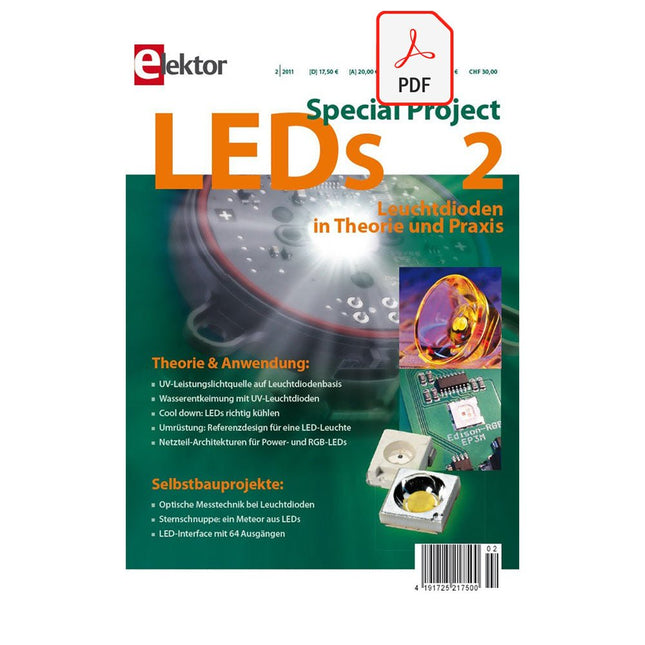
Elektor Digital LEDs 2 (PDF)
Inhalt: Theorie & Anwendung UV-Leistungslichtquelle auf Leuchtdiodenbasis Wasserentkeimung mit UV-Leuchtdioden Cool down: LEDs richtig kühlen Umrüstung: Referenzdesign für eine LED-Leuchte Netzteil-Architekturen für Power- und RGB-LEDs Selbstbauprojekte Optische Messtechnik bei Leuchtdioden Sternschnuppe: ein Meteor aus LEDs LED-Interface mit 64 Ausgängen
€ 17,50
Mitglieder: € 15,75
-
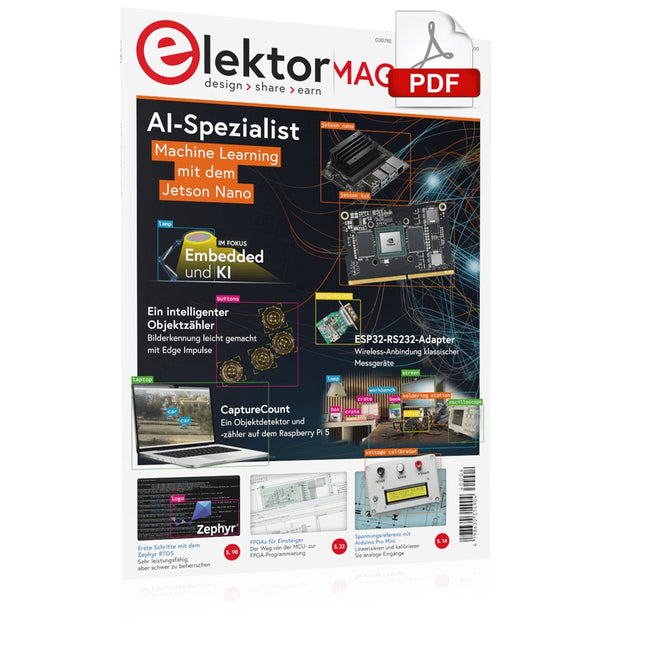
Elektor Digital Elektor 03-04/2024 PDF (DE)
Diese Ausgabe steht allen GOLD- und GREEN-Mitgliedern auf der ElektorMagazine-Website zum Download bereit! Sind Sie noch kein Mitglied? Hier klicken! Anzahl der Erfassungen Ein Objektdetektor und -zähler auf dem Raspberry Pi 5 Spannungsreferenz mit Arduino Pro Mini Linearisieren und kalibrieren Sie analoge Eingänge FPGAs für Einsteiger Der Weg vom Mikrocontroller zur FPGA-Programmierung Update: STM32 Wireless Innovation Design Contest 2024 Bluetooth LE mit MAUI Steuer-Apps für Android und Co. Breakout-Board für Port-Erweiterung Mehr I/Os für Ihr Entwicklungssystem AI-Spezialist Machine Learning mit dem Jetson Nano 2024: Eine Odyssee in die KI Erste Gehversuche mit TensorFlow 262.144 Wege, das Spiel des Lebens zu spielen Ein Leserprojekt in Kürze Aus dem Leben gegriffen Der Chinesische Drache Bringen Sie Ihren DC-Bürstenmotor zum Laufen! Beispielprojekte aus dem Motor Control Development Bundle von Elektor ESP32-RS232-Adapter Wireless-Anbindung klassischer Messgeräte Aller Anfang... ...muss nicht schwer sein: Mehr über Operationsverstärker Empfehlungen für ESP-Bibliotheken Piezoelektrische Bauelemente Bemerkenswerte Bauteile Ein intelligenter Objektzähler Bilderkennung leicht gemacht mit Edge Impulse Meistern Sie die kniffligsten Probleme Ihrer Embedded-Entwicklung! ESP32-Terminal Ein Handheld-Gerät mit Touch-Display Erste Schritte mit dem Zephyr RTOS Sehr leistungsfähig, aber schwer zu. Preisgekrönte Ethik Ein Gespräch mit CTO Alexander Gerfer von Würth Elektronik eiSos über die Ermöglichung von Innovation und achtsames Verhalten Projekt 2.0 Korrekturen, Updates und Leserbriefe
€ 11,90
-

Elektor Digital Design your own Embedded Linux Control Centre (E-book)
This book is all about building your own DIY home control system. It presents two innovative ways to assemble such a system: By recycling old PC hardware – possibly extending the life of an old PC, or by using Raspberry Pi. In both cases, the main system outlined in this book will consist of a computer platform, a wireless mains outlet, a controller and a USB webcam – All linked together by Linux. By using the Raspberry Pi in conjunction with Arduino (used as an advanced I/O system board), it is possible to construct a small, compact, embedded control system offering enhanced capacity for USB integration, webcams, thermal monitoring and communication with the outside world. The experience required to undertake the projects within this book are minimal exposure to PC hardware and software, the ability to surf the internet, burn a CD-ROM and assemble a small PCB.
€ 34,95
Mitglieder: € 31,46
-

€ 29,95
Mitglieder: € 26,96
-

Elektor Digital Elektor Special: LED's 1 PDF (NL)
Lichtgevende dioden in theorie en praktijk Door verbetering van de lichtopbrengst en goedkopere productiemethoden is het toepassingsgebied van de LED uitgebreid van optische indicator tot energiezuinige lichtbron. Deze speciale Elektor-uitgave biedt niet alleen theoretische informatie, maar laat ook zien hoe en waar LED’s tegenwoordig toegepast worden. Bovendien bevat deze uitgave enkele beproefde elektronische schakelingen voor zelfbouw, zodat elke (aspirant)elektronicus zelf met LED’s aan de slag kan gaan. Een greep uit de inhoud Theorie & Toepassingen Aansturing en koeling van LED-lampen De technologie achter LED-projectoren Constante-stroom-omzetters voor power-LED’s LED-stuur- en vermogenselektronica op één chip Zelfbouwprojecten Ambilight met Bluetooth Artistieke LED-dimmer Microcontrollergestuurde LED-kerstboom Vrij programmeerbare LED-lamp
€ 17,50
Mitglieder: € 15,75
-

€ 9,95
Mitglieder: € 8,96
-

Paggen Werkzeugtechnik SMD Starter I – Fertigungslinie für Prototypen
Die Prototypen-Fertigungslinie SMD Starter I besteht aus dem Schablonendrucker TSD240, dem SMD-Bestückungsgerät PlaceMAN und dem Reflow-Ofen 3LHR10. Schablonendrucker SD240 (+ Metallrakel 155 mm) Schablonengröße: max. 175 x 255 mm Platinengröße: max. 180 x 240 mm Gerätegröße: 410 x 270 x 110 mm Gewicht: 6,7 kg inkl. Metallrakel 155 mm inkl. 8 Magnete zum Halten der Leiterplatte, 6 davon mit M3-Madenschraube inkl. transparente Platzierhilfe und Faserschreiber Manuelles SMD-Bestückungsgerät PlaceMAN für Standardbauteile inkl. Vakuumpumpe (ohne Zuführungen, Kamera, Monitor und Dispenser) Ausgestattet mit leichtgängigem Bestückungsarm, Bestückungskopf mit Einhandbedienung, Rotation der Z-Achse und automatischer Vakuumabschaltung, inkl. Leiterplattenhalterung, Vakuumeinheit und 2 Bestückungsnadeln mit Gummisaugern. Kapazität an Feeder (nicht im Lieferumfang enthalten) 2x Feederkassette für 10 x 8 mm Rollen links 4x Feederkassette für Stangenfeeder für jeweils 5 Stangen weiter Zuführsysteme sind innerhalb des Bestückungsbereiches möglich, z. B. Strip-Feeder Stecksystem Abmessungen Grundgerät (LxBxH): 765 x 390 x 210 mm Mit Feederkassette für 10 x 8 mm Rollen (LxBxH): 765 x 390 x 210 mm Mit Feederkassette für 10 x 8 mm Rollen und Feederkassette für Stangenfeeder (LxBxH): 765 x 430 x 210 mm (Höhe kann durch die Stangenlänge variieren) Mit Feederkassette für 10 x 8 mm Rollen inkl. Halter für 10 Rollen und Feederkassette für Stangenfeeder (LxBxH): 765 x 430 x 210 mm (Höhe kann durch die Stangenlänge variieren) Technische Daten Gewicht Grundgerät: ca. 6 kg Verfahrweg der Achsen (x,y,z): 470 x 230 x 15 mm Max. Arbeitsbereich: 380 x 240 mm Max. PCB-Größe: 230 x 360 mm Stromversorgung Netzteil: 230/12 V, 800 mA Stromversorgung Vakuumpumpe: 230 V, 6 W 3LHR10 Reflow-Ofen (programmierbar für bleifreie Lötungen mit manueller Schublade und Tablet-Steuerung) Reflow-Ofen mit IR und Konvektionsheizung. Die erzwungene Heißluftkonvektion sorgt für ein gleichmäßiges Temperaturprofil in der gesamten Kammer. Nach dem manuellen Öffnen der Tür werden die Lüfter eingeschaltet und die gelötete Leiterplatte schnell abgekühlt. Kleiner Reflow-Ofen mit manueller Türöffnung Industrie 4.0 bereit, Bluetooth-Kommunikation + Tablet IR + Konvektionsheizung. Android-Anwendung zur Verbindung mit Tablet oder Smartphone 100 verschiedene Benutzerprogramme Lieferumfang: 3LHR10, Tablet mit App, Schutzhülle für Tablet, 4 Leiterplattenhalter, externes Thermoelement, Handbuch im Tablet Anwendung Schließen Sie den Ofen an die Stromversorgung an und schließen Sie die optional erhältliche Absaugung (3LFE10S) an den Abluftstutzen an. Nach dem ersten Einschalten sucht der Ofen nach einem Tablet oder Smartphone. Wenn beide in der Android-App verbunden sind, wählen Sie die Programmierung des Ofens. Hier sind programmierbare Temperatur und Vorheizzeit sowie Temperatur und andere Daten einzustellen. Registrieren Sie sich mit dem Tablet, um den vollen Umfang der Software nutzen zu können. Wenn der Ofen bereits programmiert ist, kann der Benutzer den Vorgang mit Tasten und Anzeige auf der Vorderseite steuern. Nach Abschluss des Reflow-Vorgangs ertönt ein akustisches Signal. Ein Signal wird auch auf dem Tablet/Smartphone angezeigt. Die Schublade muss nun manuell geöffnet werden. Die Android-Anwendung zeigt Prozessstatus, Zeit und Temperatur oder andere Informationen an. Technische Daten Netzanschluss: 230 V, 50 Hz Maximale Leistung: 3100 W Temperaturen: 50-260°C Abmessungen: 510 x 370 x 340 mm Maximales Gewicht: 16 kg Gitterabmessungen: 350 x 220 mm Maximale Abmessungen der Leiterplatte: 300 x 200 mm Maximale Komponentenhöhe auf der Leiterplatte: 50 mm oben, 30 mm unten Lieferumfang Schablonendrucker TSD240 SMD-Bestückungsgerät PlaceMAN Reflow-Ofen 3LHR10
€ 6.549,00
Bestpreis
-
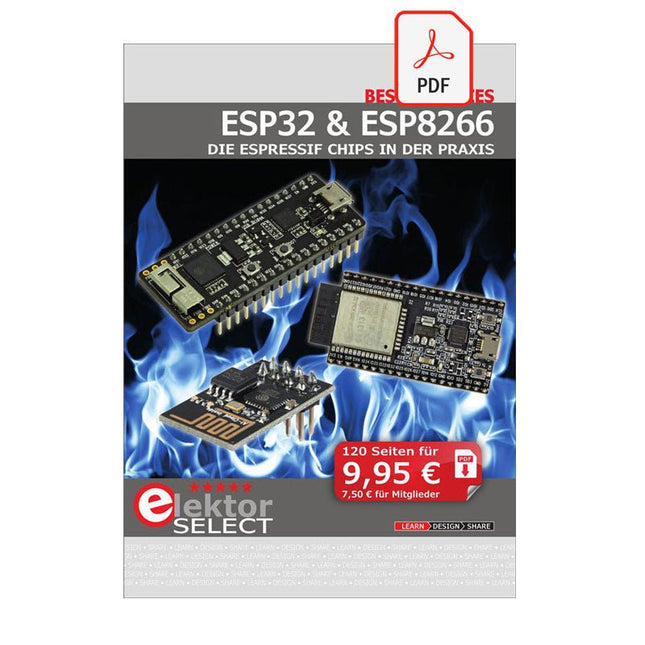
Elektor Digital ESP32 & ESP8266 Kompilation (DE) | E-book
Der ESP8266 von Espressif ist ein Wi-Fi-Mikrochip mit vollem TCP/IP-Stack und Mikrocontroller-Fähigkeit. Es hat mit seinem niedrigen Preis Wellen in der Herstellergemeinschaft geschlagen. Aber viele Entwickler waren unzufrieden mit dem hohen Stromverbrauch von ESP8266. Der ESP32, ausgestattet mit einem ULP (Ultra Low Power) Coprozessor, bietet eine Lösung. Dieses E-Book enthält eine Reihe von Projekten mit ESP32 & ESP8266 sowie ein Interview mit dem CEO von Espressif Teo Swee Ann. Artikel ESP32 für den Einsatz in Geräten der Industrie 4.0 Scrollende Nachrichtenanzeige, 512 LEDs per WLAN mit ESP-12F ansteuern Das vernetzte Treibhaus, IoT-Modellprojekt mit MQTT und Node-RED VFD-Röhren-Uhr mit ESP32, Internet-Zeit auf Vintage-Displays ESP32 stromsparend, die Programmierung des ULP-Coprozessors DCF77-Emulator mit ESP8266, DCF durch Internet-Zeit ersetzen Was steckt hinter dem berühmtem ESP8266? WLAN-Thermostat, flexible und programmierbare Temperatursteuerung Timer für den WLAN-Thermostat, sieben Kanäle mit atomarer Genauigkeit Schweizer Taschenmesser für Mikrocontroller, PlatformIO als universelles Programmier-Tool ESP32 für Power-User, native Programmierung Weather-Display, aktuelle Wetterdaten auf einem LC-Display darstellen GoNotify, ein flexibles IoT-Sensorinterface. Einfach in die Cloud. Der große Bruder des ESP8266, erste Schritte mit dem ESP32 und der Arduino-IDE MicroPython, Python für kleine Systeme RGBDigit Clock, farbenfrohe 7-Segment-Displays zeigen Zeit und Klima USB-Programmieradapter für die ESP-Module von Espressif Heizkesselmonitor mit ESP8266, Haustechnik für die Energiewende WLAN für Mikrocontroller, steuern mit dem ESP8266 Die Rückkehr des WLAN-Controller-Boards, Smartphone steuert IoT-Objekte WLAN kompakt und autonom, oder: Wie man den ESP8266 auch ohne MCU einsetzen kann
€ 9,95
Mitglieder: € 8,96
-
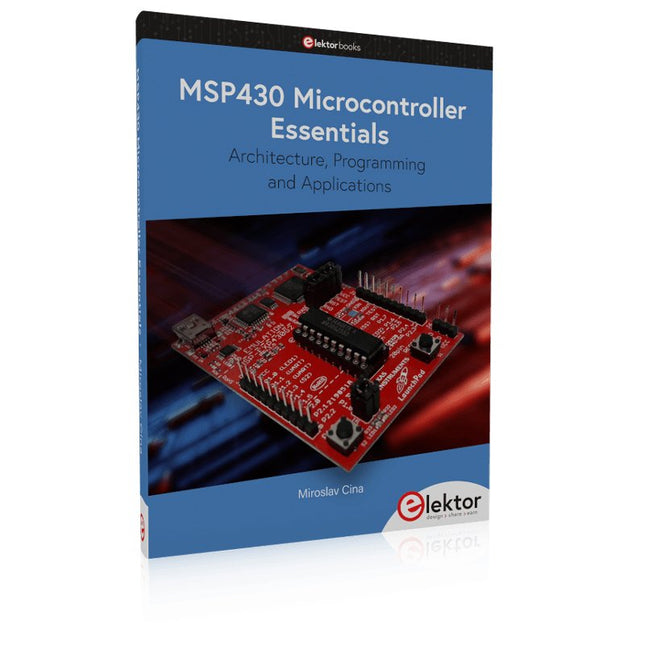
Elektor Publishing MSP430 Microcontroller Essentials
Architecture, Programming and Applications The MSP430 is a popular family of microcontrollers from Texas Instruments. In this book we will work with the smallest type, which is the powerful MSP430G2553. We will look at the capabilities of this microcontroller in detail, as it is well-suited for self-made projects because it is available in a P-DIP20 package. We will take a closer look at the microcontroller and then build, step by step, some interesting applications, including a 'Hello World' blinking LED and a nice clock application, which can calculate the day of the week based on the date. You also will learn how to create code for the MSP microcontroller in assembler. In addition to that, we will work with the MSP-Arduino IDE, which makes it quite easy to create fast applications without special in-depth knowledge of the microcontrollers. All the code used in the book is available for download from the Elektor website.
€ 39,95
Mitglieder: € 35,96
-

Elektor Digital Arduino Uno – 45 Projects for Beginners and Experts (E-book)
This book covers a series of exciting and fun projects for the Arduino, such as a silent alarm, people sensor, light sensor, motor control, internet and wireless control (using a radio link). Contrary to many free projects on the internet all projects in this book have been extensively tested and are guaranteed to work! You can use it as a projects book and build more than 45 projects for your own use. The clear explanations, schematics, and pictures of each project make this a fun activity. The pictures are taken of a working project, so you know for sure that they are correct. You can combine the projects in this book to make your own projects. To facilitate this, clear explanations are provided on how the project works and why it has been designed the way it has That way you will learn a lot about the project and the parts used, knowledge that you can use in your own projects. Apart from that, the book can be used as a reference guide. Using the index, you can easily locate projects that serve as examples for the C++ commands and Arduino functionality. Even after you’ve built all the projects in this book, it will still be a valuable reference guide to keep next to your PC.
€ 29,95
Mitglieder: € 26,96
-
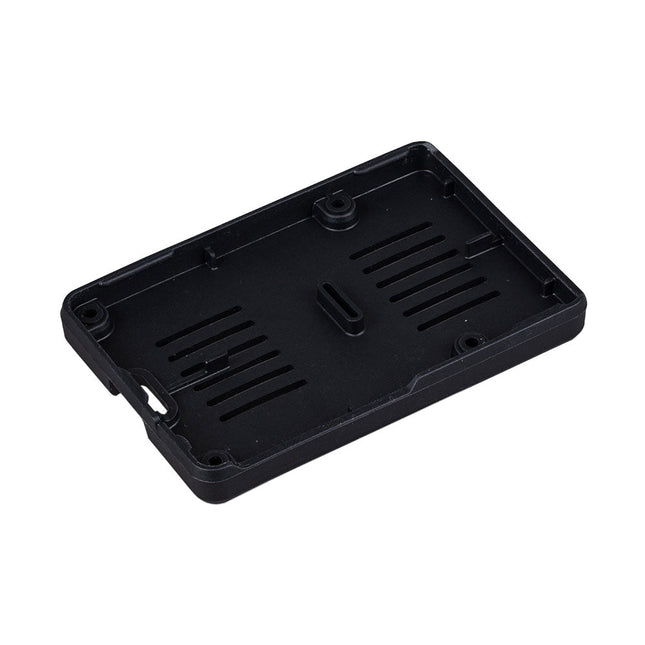
Raspberry Pi Foundation Bumper für Raspberry Pi 5
Der Raspberry Pi Bumper ist eine aufsteckbare Silikonabdeckung, die die Unterseite und die Kanten des Raspberry Pi 5 schützt. Features Einteiliger flexibler Bumper aus Silikonkautschuk Ermöglicht einfachen Zugriff auf den Power-Button Montagelöcher bleiben unter dem Bumper zugänglich Downloads Datasheet
€ 3,50€ 1,40Bestpreis


