
Suchergebnisse für "basic OR kit OR for OR raspberry OR pi OR pico OR incl OR pico"
-

Elektor Digital Elektor September/Oktober 2022 (PDF)
electronica Fast Forward Start- & Scale-Up AwardsLes préparatifs s'accélèrent !Bluetooth Low Energy avec ESP32-C3 et ESP32Vous n'avez pas toujours besoin de choisir le wifi !Renifleur BLEReconfiguration du dongle USB nRF52840 MDK de makerdiaryCube magique de LED RGBcircuit avec un RP2040Marche/arrêt automatique pour le compresseur de pâte à souderContenu vidéo d'ElektorLivestreams, webinaires et cours pour les ingénieurs et les fabricants professionnelsÉlectrification d'un véloUtilisation d'un kit de modification de vélo électriqueDémarer en électroniqueMultiplication de tensionsSur le vifTransmutationsTeensy 4.0 – comment cette carte peut-elle être aussi rapide ?Ou: La vitesse, ce n'est pas sorcier !Simulation d'amplificateur de puissance audio avec TINA« simuler avant de construire »Développer et utiliser vos nœuds LoRaWAN pour l'Internet des Objets (IdO)Exemple de chapitre : Modules LoRaWAN Dragino LHT65, LDS01 et LDS02Projet 2.0Corrections, mises à jour et courriers des lecteurs5G pour mon propre exploitMaîtrise totale du déploiement de la 5G avec les réseaux cellulaires privésInfographicsLes meilleurs conseils pour développer une interface WiFiComment mon appareil apprend-il à transmettre ?Horloge Tour du Rhin Mod 2Analyseur de spectre audio avec dekatronsUne nouvelle façon d'utiliser les tubes rétroEnvoi de données à TelegramAvec un ESP32 et quelques composantsFiltre coupe-bande de Fliege pour les mesures audioFaites de meilleures mesures avec un filtre coupe-bandeDémontage d'un CO2-mètrePeut-on le bidouiller pour vos projets ?Tout mis ensembleLe transistor unijonction programmable expliquéÉcran tactile rond pour Raspberry PiL'HyperPixel 2.1 Round de PimoroniTélémesure avec détection des pertes de connexionGrâce aux modules nRF24L01+Récepteur FM numérique avec Arduino et TEA5767Restez à l'écoute avec un Arduino NanoConvertir une interface OLED de SPI vers I²CHomeLab ToursUn passe-temps ne prend pas sa retraiteUne décennie d'éthique en électroniqueLe regard de Tessel Renzenbrink sur la société numérique.HexadokuThe Original Elektorized Sudoku
€ 10,95
-
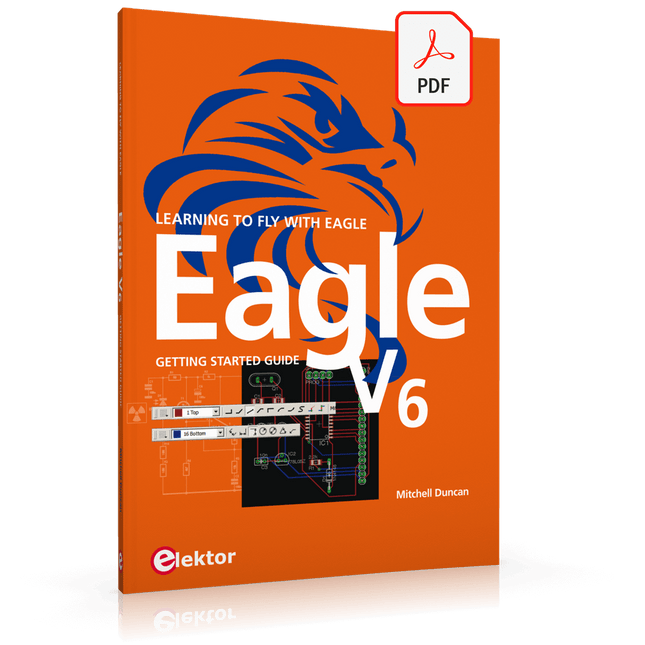
Elektor Digital EAGLE V6 Getting Started Guide (E-book)
Whether you are an electronics enthusiast or engineering professional, this book provides the reader with an introduction to the use of the CadSoft’s EAGLE PCB design software package. EAGLE is a user-friendly, powerful and affordable software package for the efficient design of printed circuit boards. It offers the same power and functionality to all users, at a smaller cost than its competitors. A free version of EAGLE is available to enthusiasts for their own use. EAGLE can be used on the main computing platforms including: Microsoft Windows (XP, Vista or Windows 7); Linux (based on kernel 2.6 or above) and Apple Mac OS X (Version 10.6 or higher). Any hardware that supports these software platforms will run the EAGLE application. The book is intended for anyone who wants an introduction to the capabilities of EAGLE. The reader may be a novice at PCB design or a professional wanting to learn about EAGLE, with the intention of migrating from another CAD package. This book will quickly allow you to: obtain an overview of the main modules of EAGLE: the schematic editor; layout editor and autorouter in one single interface; learn to use some of the basic commands in the schematic and layout editor modules of EAGLE; apply your knowledge of EAGLE commands to a small project; learn more about some of the advanced concepts of EAGLE and its capabilities; understand how EAGLE relates to the stages of PCB manufacture; create a complete project, from design through to PCB fabrication. The project discussed in the book is a popular, proven design from the engineering team at Elektor. After reading this book while practicing some of the examples, and completing the projects, the reader should feel confident about taking on more challenging endeavors.
€ 29,95
Mitglieder: € 26,96
-

Elektor Digital MicroPython für Mikrocontroller (PDF)
Die Programmiersprache „Python“ hat in den letzten Jahren einen enormen Aufschwung erlebt. Nicht zuletzt haben verschiedene Einplatinensysteme wie der Raspberry Pi zu deren Bekanntheitsgrad beigetragen. Aber auch in anderen Gebieten, wie der Künstlichen Intelligenz oder dem Machine Learning, hat Python weite Verbreitung gefunden. Es ist daher naheliegend, Python bzw. die Variante „MicroPython“ auch für den Einsatz in SoCs (Systems on Chip) zu verwenden. Leistungsfähige Controller wie der ESP32 der Firma Espressif Systems bieten eine hervorragende Performance sowie Wi-Fi- und Bluetooth-Funktionalität zu einem günstigen Preis. Mit diesen Eigenschaften wurde die Maker-Szene im Sturm erobert. Im Vergleich zu anderen Controllern weist der ESP32 einen deutlich größeren Flash und SRAM-Speicher, sowie eine wesentlich höhere CPU-Geschwindigkeit auf. Aufgrund dieser Leistungsmerkmale eignet sich der Chip nicht nur für klassische C-Anwendungen, sondern insbesondere auch für die Programmierung mit MicroPython. Das vorliegende Buch führt in die Anwendung der modernen Ein-Chip-Systeme ein. Neben den technischen Hintergründen steht vor allem MicroPython selbst im Vordergrund. Nach der Einführung in die Sprache werden die erlernten Programmierkenntnisse umgehend in die Praxis umgesetzt. Die einzelnen Projekte sind sowohl für den Einsatz im Labor als auch für Alltagsanwendungen geeignet. Neben dem eigentlichen Lerneffekt steht also auch die Freude am Aufbau kompletter und nützlicher Geräte im Vordergrund. Durch die Verwendung von Laborsteckboards können Schaltungen aller Art mit geringem Aufwand realisiert werden, sodass das Austesten der selbstgebauten Geräte zum lehrreichen Vergnügen wird. Durch die verschiedenen Anwendungen wie Wetterstationen, Digitalvoltmeter, Ultraschall-Entfernungsmesser, RFID-Kartenleser oder Funktionsgeneratoren sind die vorgestellten Projekte auch für Praktika oder Fach- und Studienarbeiten in den Naturwissenschaften bzw. im Natur- und Technikunterricht bestens geeignet.
€ 32,80
Mitglieder: € 29,52
-
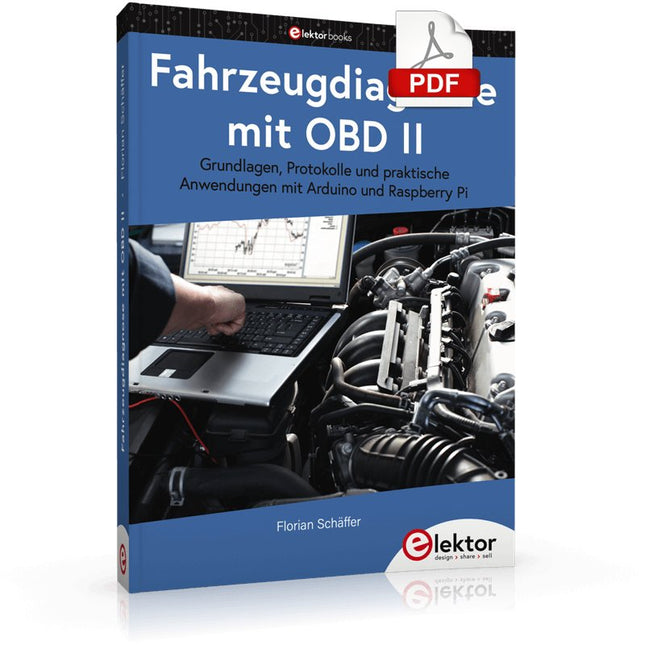
Elektor Digital Fahrzeugdiagnose mit OBD II (PDF)
Ungefähr seit dem Jahr 2000 bieten Fahrzeuge Zugriff auf Diagnosedaten, Messwerte und erkannte Fehler, die mit preiswerten Geräten ausgelesen werden können. Die Daten helfen Ihnen nicht nur bei der Fehlersuche, sondern auch beim Gebrauchtwagenkauf oder dem reibungslosen Bestehen der nächsten Hauptuntersuchung. Die zunehmende Komplexität und Vernetzung der integrierten elektronischen Kontroll- und Steuerungssysteme im Fahrzeug erfordert vom Kfz-Mechatroniker sowie dem ambitionierten Selbstschrauber ein tiefgreifendes Verständnis der Thematik. Dieses Sachbuch bietet Ihnen eine umfassende Einführung zu den in Kraftfahrzeugen vorhandenen genormten On-Board-Diagnosemöglichkeiten (OBD II), deren Ursprünge, Stand der Entwicklung, Protokollaufbau und Anwendung. Das Buch richtet sich an eine breite Leserschaft, die selbst die Möglichkeiten nutzen will, um nicht mehr auf kostspielige Werkstattbesuche angewiesen zu sein oder sich für eine Eigenentwicklung von Diagnosesystemen und eine praxisnahe Beschreibung der Protokolle interessiert. Durch den Einsatz günstiger Diagnoseadapter (ELM 327 etc.) können Sie sich auf dem Smartphone Live-Daten anzeigen lassen und Cockpitinstrumente nachrüsten oder eigene Anwendungssoftware für verschiedene Systeme erstellen. Themenauswahl Historische Entwicklung der Diagnosemöglichkeiten und Standards Funktionsumfang von OBD II mit allen zehn Diagnosemodi und Readinesscode World Wide Harmonized OBD (WWH-OBD) und HD OBD (Heavy Duty: Nutzfahrzeuge) Anschlüsse gemäß SAE J1962, SAE J1939, SAE J1708 und DoIP (ISO 13400) Protokollaufbau nach SAE J1850, ISO 9141, ISO 14230 und CAN Übersicht gängiger Diagnoselösungen für Hobbyanwender Eigenbau von Diagnosesystemen mit Arduino und Raspberry Pi Alle Parameter Identifier (Messwerte) für OBD II Umfangreiche Liste der Fehlercodes zum Nachschlagen
€ 34,80
Mitglieder: € 31,32
-

Elektor Septembre/Octobre 2026 (FR)
Le téléchargement intégral de ce numéro est disponible pour nos membres GOLD et GREEN sur le site Elektor Magazine ! Pas encore membre ? Cliquez ici. l'ESP-BLASTUn mini drone-fusée ESP32 qui vole à plus de 100 km/h atelier sans fil (1)Modules radio déverrouillés : émetteur-récepteur sub-GHz CC1101 433 MHz émetteur AMAvec le générateur d'ondes carrées/sinusoïdales sur Raspberry Pi Pico STM32Cube Innovation ChallengeParticipez avec votre meilleur projet STM32C5 CoffeeCallerComment une pause café a inspiré un PCB sur mesure audiotroniquesDistorsion harmonique totale Elektor à 65 ansProjets de septembre et octobre au fil des ans Bluetooth Channel Sounding pour le suivi des équipementsMesure de distance avec une précision centimétrique pour l’IoT de nouvelle génération 2026 : une Odyssée de l'IAL'informatique quantique n'est pas le prochain GPU protéger le cloud exige de sécuriser la périphérie premières expériences avec le HackRF ProTests pratiques avec le nouveau matériel SDR mise à niveau du modem de GPRS/2G vers LTE/4GExemple d'un panneau de contrôle d'alarme sans fil antenne en bouclePartie 1 : Une antenne ondes courtes à directivité réglable, à réaliser soi-même convertisseur de radio Internet en AMUn ESP32-S3 comme émetteur projet 2.0 mioty : aperçu généralL'approche de Fraunhofer pour les LPWAN sagesse d'atelierConseils pratiques d'experts Walter, le module IoT compactPartie 2 : Accéder aux services météorologiques et aux services de données
€ 16,50
-

SDRplay SDRplay RSP1B 14-Bit SDR-Empfänger (1 kHz bis 2 GHz)
Der SDRplay RSP1B ist eine verbesserte Version des beliebten RSP1A – ein leistungsstarker, breitbandiger und voll ausgestatteter 14-Bit-SDR, der das HF-Spektrum von 1 kHz bis 2 GHz abdeckt. Der RSP1B ist in einem robusten, schwarz lackierten Stahlgehäuse untergebracht und bietet eine deutlich verbesserte Rauschleistung. Für die hervorragende Empfangsfunktionalität benötigen Sie lediglich einen Computer und eine Antenne. Im Lieferumfang enthalten sind SDRuno für Windows und die plattformübergreifende Software SDRconnect für Windows, macOS und Linux (kostenlos von SDRplay bereitgestellt). Sie können bis zu 10 MHz Spektrum gleichzeitig überwachen. Eine dokumentierte API ermöglicht es Entwicklern, neue Demodulatoren oder Anwendungen für die Plattform zu erstellen. Features Deckt alle Frequenzen von 1 kHz über VLF, LF, MW, HF, VHF, UHF und L-Band bis 2 GHz lückenlos ab Empfang, Überwachung und Aufzeichnung von bis zu 10 MHz Spektrum auf einmal Kostenlose Nutzung der Windows-basierten SDRuno-Software, die eine ständig wachsende Anzahl von Funktionen bietet. Starkes und wachsendes Software-Support-Netzwerk Kalibrierte S-Meter/HF-Leistungs- und SNR-Messung mit SDRuno (einschließlich Datenprotokollierung in CSV-Dateien) Dokumentierte API für die Entwicklung von Demodulatoren und Anwendungen auf verschiedenen Plattformen Ausgezeichneter Dynamikbereich für schwierige Empfangsbedingungen Funktioniert mit gängiger SDR-Software von Drittanbietern (einschließlich HDSDR, SDR Console und Cubic SDR) ExtIO-basiertes Plugin verfügbar Software upgradefähig für zukünftige Standards Starkes und wachsendes Software-Support-Netzwerk API für die Entwicklung von Demodulatoren und Anwendungen Multiplattform-Treiber und API-Unterstützung, einschließlich Windows, Linux, Mac, Android und Raspberry Pi Bis zu 16 individuelle Empfänger in jedem 10-MHz-Spektrumbereich mit SDRuno Kalibrierte S-Meter und Leistungsmessungen mit SDRuno Eigenständige Windows-basierte Spektrumanalysator-Software verfügbar (mit Sweep-, Sample- und Hold-Funktionen) Ideal für die Überwachung von ISM/ IoT/ Telemetrie-Bändern <2 GHz Ideal für den portablen Betrieb Technische Daten Frequenzbereich 1 kHz – 2 GHz Antennenanschluss SMA Antennenimpedanz 50 Ohm Stromverbrauch (typisch) 185 mA (ohne Bias-T) USB-Anschluss USB Typ B Maximale Eingangsleistung +0 dBm kontinuierlich+10 dBm kurzzeitig ADC Abtastraten 2-10,66 MSPS ADC Anzahl der Bits 14 bit 2-6,048 MSPS12 bit 6,048-8,064 MSPS10 bit 8,064-9,216 MSPS8 bit >9,216 MSPS Bias-T 4,7 V100 mA garantiert Referenz 0,5ppm 24 MHz TCXO.Frequenzfehler auf 0,01ppm im Feld trimmbar. Betriebstemperatur -10˚C bis +60˚C Abmessungen 98 x 88 x 34 mm Gewicht 110 g Downloads Datasheet Software RSP1B vs RSPdx vs RSPduo RSP1B RSPdx RSPduo Kontinuierlicher Bereich von 1 kHz bis 2 GHz ✓ ✓ ✓ Bis zu 10 Mhz sichtbare Bandbreite ✓ ✓ ✓ 14-Bit-ADC-Siliziumtechnologie plus mehrere Hochleistungs-Eingangsfilter ✓ ✓ ✓ Per Software wählbare AM/FM- und DAB-Rundfunkband-Sperrfilter ✓ ✓ ✓ 4,7 V Bias-T für die Versorgung eines externen Antennenverstärkers ✓ ✓ ✓ Stromversorgung über das USB-Kabel mit einer einfachen Typ-B-Buchse ✓ ✓ ✓ 50Ω SMA-Antenneneingang(e) für 1 kHz bis 2 GHz Betrieb (per Software wählbar) 1 2 2 Zusätzlicher per Software wählbarer Hi-Z-Eingang für bis zu 30 Mhz-Betrieb ✓ Zusätzlicher per Software wählbarer 50-Ω-BNC-Eingang für den Betrieb mit bis zu 200 MHz ✓ Zusätzlicher LF/VLF-Filter für unter 500 kHz ✓ 24 MHz Referenztakt-Eingang (+ Ausgang auf RSPduo) ✓ ✓ Duale Tuner ermöglichen den Empfang auf 2 völlig unabhängigen 2-MHz-Bereichen ✓ Zwei Tuner ermöglichen Diversity-Empfang mit SDRuno ✓ Robustes und widerstandsfähiges Kunststoffgehäuse (mit interner RF-Abschirmungsschicht) ✓ Robustes schwarz lackiertes Stahlgehäuse ✓ ✓ Gesamtleistung unter 2 MHz für MW und LF + ++ + Mehrere gleichzeitige Anwendungen + + ++ Leistung unter schwierigen Fading-Bedingungen (*mit Diversity-Abstimmung) + + *++
€ 146,53
-

UFactory UFactory uArm Swift Pro
Der uArm Swift Pro ist ein hochwertiger Roboterarm, der in einer Vielzahl von Anwendungen eingesetzt werden kann. Der uArm Swift Pro wurde für den Einsatz in der Ausbildung entwickelt und optimiert, was bedeutet, dass viele Pakete bereits für Open-Source-Plattformen wie ROS verfügbar sind. Der uArm Swift Pro hat eine Positionswiederholgenauigkeit von 0,2 mm und ist zudem mit einem Schrittmotor und einem 12-Bit-Encoder ausgestattet. Dies sind nur einige Gründe, die den uArm Swift Pro zu einer ausgezeichneten Wahl für den Einsatz in der Ausbildung machen. Ein weiteres großartiges Merkmal ist das 3D Druck-Kit, das den uArm Swift Pro in weniger als 1 Minute in einen 3D Drucker verwandelt. Das uArm unterstützt die folgenden Entwicklungsplattformen/Systeme: UFACTORY SDK Arduino Python ROS GRABCAD OpenMV Smartphone-App Die Smartphone-App für iOS ist bereits im App Store erhältlich und ermöglicht eine einfache Steuerung und Überwachung des Roboterarms. Die App für Android befindet sich in der Entwicklung und wird bald verfügbar sein. An example of the Machine Vision Das folgende GIF zeigt den uArm in Kombination mit der OpenMV Machine Vision Cam M7 und den Gesichtserkennungsanwendungen, die in MicroPython implementiert werden können. Technische Daten Freiheitsgrade: 4 Wiederholbarkeit: Bis zu 0,2 mm Nutzlast: 500 g Arbeitsbereich: 50-320 mm Positioniergeschwindigkeit: 100 m/s Positionsrückmeldung: 12-Bit-Encoder Abmessungen: 150 x 140 x 281 mm Gewicht: 2,2 kg Lieferumfang UFactory uArm Swift Pro Bluetooth & Vakuumgreifer Downloads Datasheet
€ 939,00
Bestpreis
-

Elektor Special: Solar Power Systems and Photovoltaics
As demand for solar panel installation has risen sharply, especially for installations larger than balcony power plants, the order books of solar companies are full. If you ask for a quote today, you may have to wait a while, if your request isn't simply postponed indefinitely. Another consequence of the solar boom is that some companies are charging very high prices for installations. Yet there is an obvious and radical solution to the problem of excessive prices: Do it yourself, as the English say. The price of materials is currently affordable, and it's the ideal time for those who do the work themselves. They couldn't save more. Add to this the satisfaction of doing something useful, both economically and ecologically, and the pleasure of building yourself. In this special issue, you'll find a wide selection of Elektor assemblies, from solar panel controllers to solar water heaters and solar panel orientation systems. The issue also contains practical information on solar panel installation and the technology behind them. Finally, there are a number of articles on the subject of balcony power plants, from how to install them to how to connect them to the Internet... Contents BASICS Dimensioning Photovoltaic Panel ArraysAn introduction to photovoltaic energy and the commonest techniques,followed by simplified calculation models and setup guidelines. Light Sensor TechnologyMeasuring daylight using LEDs. Solar Power Made SimpleSolar charging with and without a controller. Cable Cross-sections and Energy Losses in Solar SystemsKey considerations on the minimum values to respect for electricalcurrent in solar panel cabling. Solar ModulesEverything you always wanted to know about solar panels... Ideal Diode ControllerDiode Circuits with Low Power Dissipation. TIPS Tracking for Solar Modules zBot Solar/Battery Power Supply Solar Cell Array Charger with Regulator Solar Cell Voltage Regulator Solar-Powered Night Light Alternative Solar Battery Charger PROJECTS Energy LoggerMeasuring and Recording Power Consumption. Tiny Solar SupplySunlight In, 3.3 V Out. A Do-It-Yourself DTURead Data from Small Inverters by μC. Solar ChargerPortable energy for people on the move. Solar Thermal Energy RegulatorMaximum power point tracking explored. 2-amp Maximum Power Tracking ChargerSolar Power To The Max. Computer-driven HeliostatFollow the sun or the stars. Garden LightingUsing solar cells. Solar Panel Voltage Converter for IoT DevicesYes we CAN exploit indoor lighting. Travel ChargerFree power in the mountains. Solar Cell Battery Charger/MonitorWith protection against deep discharge. Solar-powered Battery ChargerPIC12C671 avoids overcharging and deep charging. Converters for Photovoltaic PanelsContributed by TME (Transfer MultisortElektronik). Solar Charging RegulatorFor panels up to 53 watts. Solar-Powered ChargerFor lead-acid batteries. CAN Bus + Arduino for Solar PV Cell MonitoringDetect and locate serviceable panels in large arrays. Balcony Power Plant 2.0The latest: solar panels, installation and inverters
€ 19,95
Mitglieder: € 17,96
-

Elektor Digital Building Wireless Sensor Networks with OpenThread (E-book)
Developing CoAP applications for Thread networks with Zephyr This book will guide you through the operation of Thread, the setup of a Thread network, and the creation of your own Zephyr-based OpenThread applications to use it. You’ll acquire knowledge on: The capture of network packets on Thread networks using Wireshark and the nRF Sniffer for 802.15.4. Network simulation with the OpenThread Network Simulator. Connecting a Thread network to a non-Thread network using a Thread Border Router. The basics of Thread networking, including device roles and types, as well as the diverse types of unicast and multicast IPv6 addresses used in a Thread network. The mechanisms behind network discovery, DNS queries, NAT64, and multicast addresses. The process of joining a Thread network using network commissioning. CoAP servers and clients and their OpenThread API. Service registration and discovery. Securing CoAP messages with DTLS, using a pre-shared key or X.509 certificates. Investigating and optimizing a Thread device’s power consumption. Once you‘ve set up a Thread network with some devices and tried connecting and disconnecting them, you’ll have gained a good insight into the functionality of a Thread network, including its self-healing capabilities. After you’ve experimented with all code examples in this book, you’ll also have gained useful programming experience using the OpenThread API and CoAP.
€ 32,95
Mitglieder: € 29,66
-
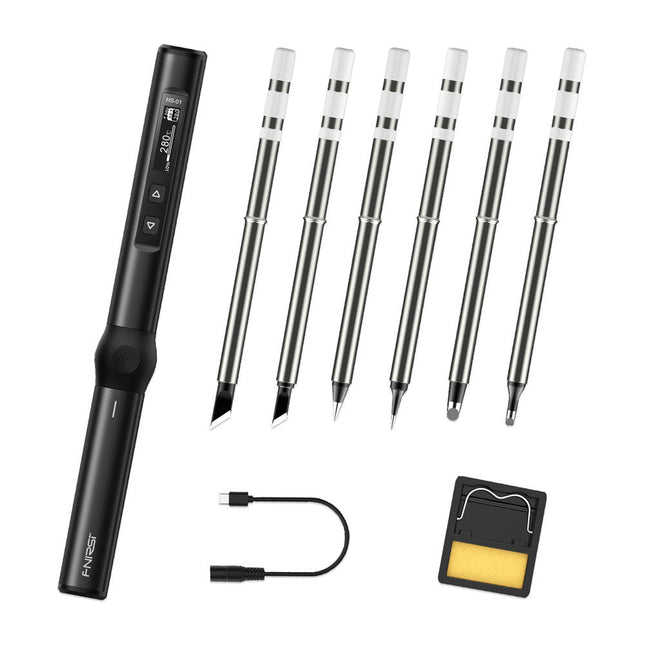
FNIRSI FNIRSI HS-01 Smart-Lötkolben (inkl. 6 Lötspitzen)
Das perfekte Werkzeug für schnelle Reparaturen Der HS-01 ist ein leistungsstarker, regulierbarer Smart-Lötkolben mit einem eingebauten 0,87"-OLED-Display, der schnell Temperaturen zwischen 80-420°C erreicht. Das Display zeigt alle wichtigen Informationen an, darunter den Status der Temperaturstufe, die eingestellte Temperatur, die Versorgungsspannung und den Leistungsanteil. Sie können die Eingangsspannung von 9-20 V direkt im Menü nach Ihren Bedürfnissen einstellen. Der integrierte Schlafmodus schaltet den Lötkolben nach 30 Minuten automatisch ab. Features 96 W Eingang (DC) 65 W PD-Leistung OLED-Display Konstante Temperatur & schnelles Aufheizen CNC-Metallintegralguss Intelligenter Sicherheits-Verbrühungsschutz Mini-Taschenformat Ergonomisches Design Aluminiummaterial Links-/Rechtsschalter Effiziente Wärmestrahlung Induktiver Schlaf Farbe: Schwarz Technische Daten Leistung 65 W Display 0,87" OLED Betriebsspannung 9-20 VDC Stromversorgung USB-C Temperaturbereich 80-420°C Schnellladeprotokoll PD-Trigger Abmessungen 184 x 20 x 20 mm Gewicht 56 g Spannungswahl Betriebsspannung 20 V 15 V 12 V 9 V Betriebsstrom ≥3,25 A ≥2,5 A ≥2 A ≥1,5 A Leistung 65 W 37,5 W 24 W 13,5 W Zinnschmelzzeit 8s 12s 17s 30s Lieferumfang 1x Smart Lötkolben FNRISI HS-01 6x Lötkolbenspitzen (HS01-BC2, HS01-KR, HS01-K65, HS01-B2, HS01-ILS, HS01-BC3) 1x DC-zu-USB-C-Kabel 1x Mini-Lötkolbenständer 1x Handbuch Erforderlich Netzteil USB-C Kabel Downloads Manual Firmware V0.3.s19
€ 80,64
-

Elektor Digital Linux PC-based Measurement Electronics (E-book)
This book is intended as a highly-practical guide for Hobbyists, Engineers and Scientists wishing to build measurement and control systems to be controlled by a local or remote Personal Computer running the Linux operating system. Both hardware and software aspects of designing typical embedded systems are covered in detail with schematics, code listings and full descriptions. Numerous examples have been designed to show clearly how straightforward it can be to create the interfaces between digital and analog electronics, with programming techniques for creating control software for both local and remote systems. Hardware developers will appreciate the variety of circuits, including a novel, low cost modulated wireless link and will discover how using Matlab® overcomes the need for specialist programming skills. Software developers will appreciate how a better understanding of circuits plus the freedom offered by Linux to directly control at the register level enables them to optimize related programs. There is no need to buy special equipment or expensive software tools in order to create embedded projects covered in this book. You can build such quality systems quickly using popular low-cost electronic components and free distributed or low-cost software tools. Some knowledge of basic electronics plus the very basics of C programming only is required. Many projects in this book are developed using Matlab® being a very popular worldwide computational tool for research in engineering and science. The book provides a detailed description of how to combine the power of Matlab® with practical electronics. With an emphasis on learning by doing, readers are encouraged by examples to program with ease; the book provides clear guidelines as to the appropriate programming techniques “on the fly”. Complete and well-documented source code is provided for all projects. If you want to learn how to quickly build Linux-based applications able to collect, process and display data on a PC from various analog and digital sensors, how to control circuitry attached to a computer, then even how to pass data via a network or control your embedded system wirelessly and more – then this is the book for you! Features of this Book Use the power, flexibility and control offered only by a Linux operating system on a PC. Use a free, distributed downloadable GNU C compiler Use (optional) a low-cost Student Version of Matlab®. Use low-cost electronic sub-assemblies for projects. Improve your skills in electronics, programming, networking and wireless design. A full chapter is dedicated to controlling your sound card for audio input and output purposes. Program sound using OSS and ALSA. Learn how to combine electronic circuits, software, networks and wireless technologies in the complete embedded system.
€ 29,95
Mitglieder: € 26,96
-

Elektor Digital Python 3 Programming and GUIs (E-book)
This is the second edition of a book aimed at engineers, scientists, and hobbyists who want to interface PCs with hardware projects using graphical user interfaces. Desktop and web-based applications are covered. The programming language used is Python 3, which is one of the most popular languages around: speed of programming being a key feature. The book has been revised and updated with an emphasis on getting the user to produce practical designs with ease – a text editor is all that is required to produce Python programs. Hardware interfacing is achieved using an Arduino Uno as a remote slave. A full description and source code of the communication interface is given in the book. The slave provides digital and analog input and outputs. Multiple Unos can be included in one project with all control code written in Python and running on a PC One project involves a PIC microcontroller with the code provided that can be loaded into the PIC using the Uno. The web applications and server are all implemented in Python, allowing you to access your electronic hardware over the Internet. The Raspberry Pi computer can be used as your web server. An introductory chapter is provided to get you started with using Linux. The book is written for use with Debian or variations including Mint or Ubuntu. All of the programs in the book are freely available, ready to use and experiment with by way of a download from Elektor.
€ 29,95
Mitglieder: € 26,96


