
Suchergebnisse für "technical OR modeling OR with OR openscad"
-
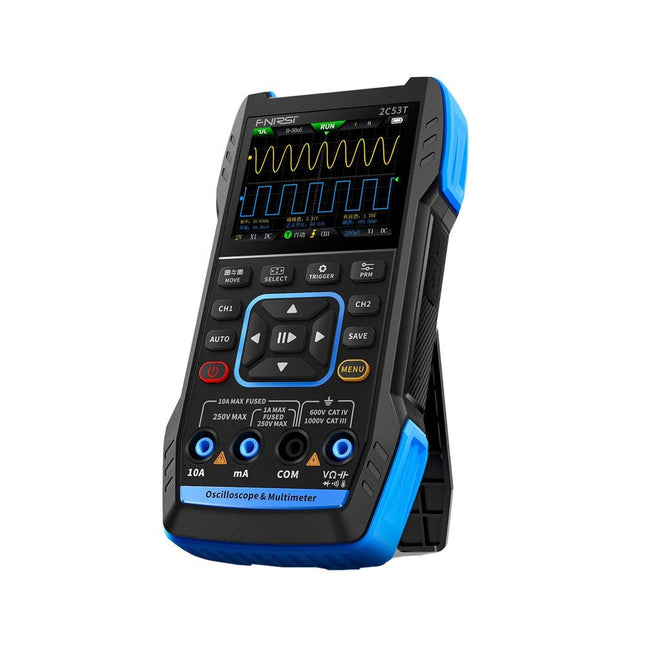
FNIRSI FNIRSI 2C53T (3-in-1) 2-Kanal Oszilloskop (50 MHz) + Multimeter + Signalgenerator
Der FNIRSI 2C53T, eine verbesserte Version seines 10 MHz-Vorgängers, ist ein kompaktes und vielseitiges 3-in-1-Gerät. Es kombiniert ein Zweikanal 50-MHz-Oszilloskop, ein 4,5-stelliges True-RMS-Multimeter und einen Signalgenerator mit 13 Wellenformtypen und ist damit ein unverzichtbares Werkzeug für Wartungs- und Forschungsexperten. Oszilloskop: Verfügt über 50 MHz Bandbreite, 250 MS/s Abtastrate, ±400 V-Schutz, FPGA + ARM + ADC-Architektur und Wellenformspeicherung für die Analyse. Multimeter: 4,5-stelliger True RMS mit 19999 Counts, unterstützt AC/DC-Spannungs-, Strom-, Kapazitäts-, Widerstands-, Dioden- und Durchgangsmessungen. Signalgenerator: Gibt 13 Signaltypen bis zu 50 KHz mit einstellbarer Frequenz, Amplitude und Arbeitszyklus aus. Mit einem 2,8" LCD, einem 3000-mAh-Akku (6 Stunden Laufzeit) und einem tragbaren Design bietet es leistungsstarke Funktionalität in einem benutzerfreundlichen Paket. Technische Daten Oszilloskop Kanäle 2 Analoge Bandbreite 50 MHz Echtzeit-Abtastrate 250 MS/s Speichertiefe 1 Kpts Impedanz 1 MΩ Zeitbasisbereich 10ns-20s Vertikale Empfindlichkeit 10 mV/div-10 V/div (x1) Maximal gemessene Spannung ±400 V Trigger-Modus Auto/Normal/Single Triggertyp Rising edge, Falling edge Anzeigemodus Y-T/Rolling/X-Y Kopplungsmethode AC/DC Persistenz AUS, 500ms, 1s, ∞ Mathe 8 Grundoperationen + FFT Unterstützt Wellenform-Screenshot speichern, Wellenformbild exportieren, Cursormessung, unendliches Nachleuchten Multimeter Gleichspannung 1.9999V/19.999V/199.99V/1000V ±(0.5%+3) Wechselspannung 1.9999V/19.999V/199.99V/750.0V ±(1%+3) Gleichstrom 19.999mA/199.99mA/1.9999A/9.999A ±(1.2%+3) Wechselstrom 19.999mA/199.99mA/1.9999A/9.999A ±(1.5%+3) Widerstand 19.999MΩ/1.9999MΩ/199.99KΩ/19.999KΩ ±(0.5%+3) 1.9999KΩ/199.99Ω ±(2.0%+3) Kapazität 999.9uF/99.99uF/9.999uF/999.9nF/99.99nF/9.999nF ±(2.0%+5) 9.999mF/99.99mF ±(5.0%+20) Temperatur −55~1300°C ±(2.5%+5) Kontinuitätstest Ja Diode Ja Signalgenerator 13 Signalwellenformen Sinuswelle, Rechteckwelle, Sägezahnwelle, Halbwelle, Vollwelle, positive Stufenwelle, umgekehrte Stufenwelle, exponentieller Anstieg, exponentieller Abfall, Gleichstrom, Multi-Audio, Sinker-Impuls, Lorentzwelle Ausgabefrequenz 0-50 KHz Ausgabeamplitude 0-3 V Ausgangs-Arbeitszyklus 0-100% Allgemein Display 2,8" HD-Farbbildschirm Auflösung 320 x 240 Aufladen USB-C (5 V/1 A) Batterie 3000 mAh Lithiumbatterie Standby-Zeit 6 Stunden Sprachen Englisch, Chinesisch Abmessungen 167 x 89 x 35 mm Gewicht 300 g Unterschiede zwischen neuer und alter Version Modell 2C53T Upgrade 2C53T Vorgänger Bandbreite 50 MHz 10 MHz Anzeigemodus Y-T/Rolling/X-Y Y-T/Rolling Mathe 8 Grundoperationen + FFT N/A Cursor-Funktion Ja N/A XY-Lissau-Diagramm Ja N/A Afterglow-Funktion Ja N/A Multimeter-Genauigkeit 19999 Counts 9999 Counts Signalgenerator 50 KHz 2 MHz Lieferumfang 1x FNIRSI 2C53T Oszilloskop (50 MHz) 2x P6100 Oszilloskop-Tastköpfe (10X) 1x Multimeter-Sonde 1x Krokodilklemmensonde 1x USB-C-Ladekabel 1x Aufbewahrungstasche 1x Manual Downloads Manual Firmware V1.2.0
€ 119,95€ 94,95Bestpreis
-

Elektor Bundles Universal Maker Sensor Bundle
Über 180 Projekte mit Raspberry Pi, Pico W, Arduino und ESP32 Dieses Bundle enthält das Universal Maker Sensor Kit mit zahlreichen Sensoren, Aktoren, Displays und Motoren. Es eignet sich perfekt für Umweltüberwachung, Smart-Home-Projekte, Robotik und Gamecontroller. Das neue Elektor-Buch beschreibt die Entwicklung zahlreicher Projekte mit dem Kit und den beliebten Entwicklungsboards Raspberry Pi, Raspberry Pi Pico W, Arduino Uno und der ESP32-Familie. Sie können jedes dieser Entwicklungsboards für Ihre Projekte auswählen und die bereitgestellten Programme entweder unverändert verwenden oder an Ihre Anwendungen anpassen. Dieses Bundle enthält: Buch: Universal Maker Sensor Kit (Einzelpreis: 45 €) Universal Maker Sensor Kit für Raspberry Pi, Pico W, Arduino, ESP32 (Einzelpreis: 70 €) Buch: Universal Maker Sensor Kit Lernen Sie, mehr als 35 Sensoren und Aktoren mit C++, Python und MicroPython zu verwenden Dieses Buch enthält über 180 Projekte für alle vier wichtigen Entwicklungsboards (Arduino, Raspberry Pi, Pico W und ESP32). Je nach Entwicklungsboard sind Projekte in den Programmiersprachen C, Python oder MicroPython verfügbar. Die Projekttitel, Kurzbeschreibungen, Schaltpläne und vollständigen Programmlisten sind zusammen mit ihren detaillierten Beschreibungen im Buch aufgeführt. Universal Maker Sensor Kit (für Raspberry Pi, Pico W, Arduino, ESP32) Entdecken Sie grenzenlose Kreativität mit dem Universal Maker Sensor Kit, das für Raspberry Pi, Pico W, Arduino und ESP32 entwickelt wurde. Dieses vielseitige Kit ist mit gängigen Entwicklungsplattformen kompatibel, darunter Arduino Uno R4 Minima/WiFi, Uno R3, Mega 2560, Raspberry Pi 5, 4, 3B+, 3B, Zero, Pico W und ESP32. Mit über 35 Sensoren, Aktoren und Displays eignet es sich perfekt für Projekte von Umweltüberwachung und Smart-Home-Automatisierung bis hin zu Robotik und interaktivem Gaming. Schritt-für-Schritt-Tutorials in C/C++, Python und MicroPython führen Anfänger und erfahrene Maker gleichermaßen durch 169 spannende Projekte. Features Umfassende Kompatibilität: Vollständige Unterstützung für Arduino (Uno R3, Uno R4 Minima/WiFi, Mega 2560), Raspberry Pi (5, 4, 3B+, 3B, Zero, Pico W) und ESP32. Dies ermöglicht umfassende Flexibilität auf zahlreichen Entwicklungsplattformen. Enthält Anleitungen für 169 Projekte. Umfassende Komponenten: Mehr als 35 Sensoren, Aktoren und Anzeigemodule für vielfältige Projekte wie Umweltüberwachung, Smart Home-Automatisierung, Robotik und interaktive Spielesteuerungen. Ausführliche Tutorials: Klare Schritt-für-Schritt-Anleitungen für Arduino, Raspberry Pi, Pico W, ESP32 und alle enthaltenen Komponenten. Es stehen Tutorials in C/C++, Python und MicroPython zur Verfügung, die sowohl für Anfänger als auch für erfahrene Maker geeignet sind. Für alle Kenntnisstufen geeignet: Bietet strukturierte Projekte, die Benutzer nahtlos vom Anfänger zum Fortgeschrittenen in Elektronik und Programmierung führen und so Kreativität und technisches Know-how fördern. Lieferumfang des Kits Breadboard Tastenmodul Kapazitives Bodenfeuchtemodul Flammensensormodul Gas-/Rauchsensormodul (MQ2) Gyroskop & Beschleunigungssensormodul (MPU6050) Hall-Sensormodul Infrarot-Geschwindigkeitssensormodul IR-Hindernisvermeidungssensormodul Joystickmodul PCF8591 ADC/DAC-Wandlermodul Fotowiderstandsmodul PIR-Bewegungssensormodul (HC-SR501) Potentiometermodul Pulsoximeter- und Herzfrequenzsensormodul (MAX30102) Regentropfenerkennungsmodul Echtzeituhrmodul (DS1302) Drehgebermodul Temperatursensormodul (DS18B20) Temperatur- und Feuchtigkeitssensormodul (DHT11) Temperatur, Luftfeuchtigkeit und Drucksensor (BMP280) Time-of-Flight-Mikro-LIDAR-Distanzsensor (VL53L0X) Berührungssensormodul Ultraschallsensormodul (HC-SR04) Vibrationssensormodul (SW-420) Wasserstandssensormodul I²C LCD 1602 OLED-Displaymodul (SSD1306) RGB-LED-Modul Ampelmodul 5-V-Relaismodul Kreiselpumpe L9110-Motortreibermodul Passives Summermodul Servomotor (SG90) TT-Motor ESP8266 Modul JDY-31 Bluetooth-Modul Stromversorgungsmodul Dokumentation Online-Tutorial
€ 114,95€ 94,95Bestpreis
-
Elektor Digital Get Started with the Raspberry Pi AI Kit (E-book)
A Beginner's Guide to AI and Edge Computing Artificial Intelligence (AI) is now part of our daily lives. With companies developing low-cost AI-powered hardware into their products, it is now becoming a reality to purchase AI accelerator hardware at comparatively very low costs. One such hardware accelerator is the Hailo module which is fully compatible with the Raspberry Pi 5. The Raspberry Pi AI Kit is a cleverly designed hardware as it bundles an M.2-based Hailo-8L accelerator with the Raspberry Pi M.2 HAT+ to offer high speed inferencing on the Raspberry Pi 5. Using the Raspberry Pi AI Kit, you can build complex AI-based vision applications, running in real-time, such as object detection, pose estimation, instance segmentation, home automation, security, robotics, and many more neural network-based applications. This book is an introduction to the Raspberry Pi AI Kit, and it is aimed to provide some help to readers who are new to the kit and wanting to run some simple AI-based visual models on their Raspberry Pi 5 computers. The book is not meant to cover the detailed process of model creation and compilation, which is done on an Ubuntu computer with massive disk space and 32 GB memory. Examples of pre-trained and custom object detection are given in the book. Two fully tested and working projects are given in the book. The first project explains how a person can be detected and how an LED can be activated after the detection, and how the detection can be acknowledged by pressing an external button. The second project illustrates how a person can be detected, and how this information can be passed to a smart phone over a Wi-Fi link, as well as how the detection can be acknowledged by sending a message from the smartphone to your Raspberry Pi 5.
€ 29,95
Mitglieder: € 26,96
-

Elektor Digital Arduino UNO Q and AI (E-book)
Learn to Build Intelligent Embedded Systems Build smarter embedded systems with Arduino UNO Q. This book gives you the tools, knowledge, and confidence to turn ideas into intelligent, working solutions using the Arduino UNO Q platform. Discover how to build intelligent embedded systems with the Arduino UNO Q and AI. Unlock the full potential of the Arduino UNO Q, a next-generation platform that combines the real-time power of the STM32U585 microcontroller with the flexibility of a Qualcomm Dragonwing QRB2210 microprocessor. Learn how to rapidly prototype real-world applications using the Arduino IDE for low-level embedded control and Python in Arduino App Lab for high-level development. Build confidence through hands-on projects that guide you step by step from basic board features to complete working systems. Explore ready-to-use, AI based Arduino App Lab examples and see how they can jump-start your development and reduce time to deployment. Step into the world of Edge AI with a clear, practical introduction to Edge Impulse Studio—no prior AI experience required. Follow a complete, real-world workflow to create a Keyword Spotting AI application, covering data collection, model training, optimization, and on-device inference using the Edge Impulse Studio. Bridge the gap between embedded systems and machine learning and learn how to bring intelligence directly onto your hardware. Perfect for embedded engineers, educators, students, and makers looking to stay ahead in AI-enabled product development.
€ 29,95
Mitglieder: € 26,96
-
Elektor Publishing LTspice Grundlagen
Eine Einführung in die Schaltungssimulation LTspice wurde von Mike Engelhardt entwickelt und gehört inzwischen zu Analog Devices. Es handelt sich dabei um ein Programm zur Schaltplanerstellung – einen leistungsstarken, schnellen und kostenlosen SPICE-Simulator sowie um ein Werkzeug zur Darstellung von Kurvenverläufen. Es bietet eine umfangreiche Bauteildatenbank, die weltweit durch SPICE-Modelle unterstützt wird. Mit LTspice kann man schnell und einfach Schaltpläne erstellen. Dank der leistungsfähigen grafischen Ausgabefunktionen lassen sich Spannungen und Ströme in einer Schaltung, die Leistungsaufnahme der Bauteile und viele weitere Parameter darstellen. Ziel dieses Buches ist es, den Entwurf und die Simulation elektronischer Schaltungen mit LTspice zu vermitteln. Es behandelt unter anderem folgende Themen: DC und AC-Schaltungen Kleinsignal- und Z-Dioden Transistorschaltungen inkl. Oszillatoren Tryristor-, Diac- und Triacschaltungen Operationsverstärkerschaltungen inkl. Oszillatoren Der 555 Timer-IC Filter Spannungsregler Optokoppler Erstellung von Spannungskurven Simulation von Logikschaltungen mit der 74HC-Familie SPICE-Modellierung LTspice ist ein äußerst vielseitiges Werkzeug zur Simulation elektronischer Schaltungen mit zahlreichen Funktionen und Anwendungsmöglichkeiten. Eine vollständige Behandlung aller Details würde jedoch den Rahmen dieses Buches sprengen. Daher konzentriert sich das Buch auf die gängigsten Themen wie DC- und AC-Analyse, Parametersweep, Übertragungsfunktionen, Oszillatoren, Diagramme und weitere grundlegende Anwendungen. Obwohl es sich um eine Einführung handelt, deckt dieses Buch dennoch die meisten Interessensgebiete all jener ab, die sich mit der Simulation elektronischer Schaltungen beschäftigen.
€ 39,80
Bestpreis
-

Peak Peak Atlas Pro Pack (LCR45 und DCA75)
Dieses Paket enthält den LCR45, perfekt für erfahrene Bastler und Experten. Es beinhaltet außerdem das sehr populäre DCA Pro (model DCA75), fantastisch für die Identifikation von Komponenten. Kompletiert wird das Paket durch ein USB-Kabel und einem USB-Stick mit der nötigen Software. DCA75 Der DCA75 unterstützt alle Komponenten die von PEAK Atlas DCA55 unterstützt werden und beinhaltet sogar noch weitere: Transistoren (BJT’s mit Darlingtons und “digitale” Transistoren), Silikon und Germanuim Typen. Misst den Verstärkungsfaktor, VBE, Ableitstrom und die Sättigungsspannung. Unijunctiontransistoren (UJT’s) werden nicht unterstützt. MOSFET‘s, Anreicherungstyp und Abreicherungstyp. Misst mit einem Ansprechwert (von ID=5 mA), einer geschätzten Transkonduktanz (in einer Spanne von 3 mA - 5 mA) und RDS(on) mit einer Auflösung von 1 Ω. JFETs, mit SiC-Typen. Misst mit pinch-off Spannung (ID=5μA), geschätzter Transkonduktanz (in einer Spanne von 3 mA – 5 mA) und RDS(on) bei einer Auflösung von 1 Ω. IGBTs (Biopolartransistor). Misst mit einem Ansprechwert (IC=5mA), geschätzter Transkonduktanz (in einer Spanne von 3 mA – 5 mA) und Sättigungsspannung. Dioden und Diodennetzwerke. Misst eine Durchlassspannung bei 5 mA. LED’s und zweifarbige LED’s (2 Leiter und 3 Leiter Typ). Misst Durchlassspannung von jedem LED-Element bei 5 mA. Zener Dioden mit einer gemessenen Zener Spannung bis zu 9 V bei 5 mA. Spannungsregulatoren (misst Spannungsregulierung von < 8 V, Abfallspannung, Ruhestrom). Triac’s und Thyristoren welche weniger als 10 mA von Steuerstrom und Haltestrom benötigen. Unabhängig oder mit PC funktionstüchtig Das ATLAS DCA75 PRO kann eigenständig arbeiten oder mit einem PC verbunden werden. Wie auch immer, das DCA Pro wird automatisch die Komponente und die Kontaktbelegung identifizieren. Außerdem misst es eine Reihe von Komponenteneigenschaften, wie den Transistorfaktor, Ableitungen, MOSFET und IGBT-Spannung. Curve Tracing Wenn das ATLAS DCA75 PRO mit einem PC mit dem beiliegenden USB-Kabel verbunden wird, hat man einen Überblick über eine Reihe von Schwachspannungskurven. Verschiedene Graphen sind nutzbar, weitere folgen: Bipolartransistor Ausgabekennlinie, IC vs VCE Bipolartransistor Verstärkungsfaktoren, hFE vs VCE Bipolartransistor Verstärkungsfaktoren, hFE vs IC MOSFET und IGBT Ausgabefunktion, ID vs VDS MOSFET und IGBT Transferfunktion, ID vs VGS JFET Ausgabefunktion, ID vs VDS JFET Transferfunktion, ID vs VGS Spannungsregulator, VOUT vs VIN Spannungsregulator, IQ vs VIN PN Anschluss I/V Kurven, vorwärts und rückwärts Optionen (für Zener Dioden). Beim Curve tracing werden Testparameter von +/- 12 V, +/- 12 mA eingestellt. Sämtliche curve-tracing Daten können direct in Excel© für weitere Grafikanalysen eingespeist werden. Die Software ist für die Betriebssysteme Windows XP, Vista, 7, 8 and 10 gemacht. LCR45 Ein großartiger LCR Analysator, welcher die passiven Komponenten (Spulen, Kondensatoren und Widerstände) messen kann.Das LCR45 bietet eine erhöhte Messauflösung (besser aks 0.1 uH!). Des Weiteren kann die Test-Frequenz DC manuel oder automatisch auf, 1 kHz, 15 kHz und 200 kHz verändert werden. Nicht hergestellt für schaltungsinterne Messungen. Automatische oder manuelle Komponenten Slektion: Spule, Kondensator oder Widerstand Automatische oder manuelle Test-Frequenz- Selektion: DC, 1 kHz, 15 kHz und 200 kHz Induktivitäten von 0.1 uH bis 10 H Kapazitäten von 0.1 pF bis 10,000 uF Widerstände von 0.1 Ohm bis 2 MOhm Induktivitäten Messung zeigt auch die Spulenwiderstände Zeigt "Component type and values", "Complex Impedance", "Magnitude/Phase" und "Admittance" Test-Frequenz wird für alle Messungen angezeigt Abweichung von 1,5% für Spulen und Kondensatoren (siehe Tabelle für weiterer Details) Abweichung von 1% für Widerständen Tastkopf wird mit 2 mm vergoldeten Steckern und Buchsen komplettiert Vergoldete Prüfspitzen sind austauschbar Lieferumfang LCR45 DCA75 Extra GP23 Batterie Extra AAA Zelle Dual Carry Gehäuse
€ 320,11
-

FNIRSI FNIRSI TDM-120P Wärmebild-Multimeter
Das FNIRSI TDM-120P ist ein Wärmebild-Multimeter, das Wärmebildtechnologie mit herkömmlichen Multimeter-Funktionen kombiniert und so umfassendere sowie intuitivere Messergebnisse für elektrische Prüfungen und verwandte Anwendungen liefert. Es findet breite Anwendung in Bereichen wie Elektrotechnik, industrieller Fertigung, Bauwesen und Sicherheitsüberwachung. Das TDM-120P bietet zuverlässige technische Unterstützung bei der Geräteprüfung, Fehlerdiagnose und Instandhaltung und trägt dazu bei, die Produktionseffizienz, die Produktqualität sowie die allgemeine Sicherheit zu steigern. Features 2-in-1: Wärmebildkamera + True-RMS-Multimeter (19.999 Counts) 120 x 90 HD-Bildauflösung | Hohe thermische Empfindlichkeit <60 mK Temperaturbereich -20°C bis 400°C | Einstellbarer Emissionsgrad (0,01–1,00) 2,8"-LCD-Touchscreen | 7 Farbpaletten | Speichern per Knopfdruck & USB-Export Umfassende Multimeter-Funktionen: AC/DC-Spannung, Widerstand und Kapazität Vielseitige Anwendung: HLK, Lecksuche, Elektro- und Kfz-Reparatur Technische Daten 7 Farbpaletten Arktis / Heißes Eisen / Eisen-Rot / Regenbogen / Lava / Schwarz-Heiß / Weiß-Heiß Detektortyp Vanadiumoxid Sichtfeld 50° Bildschirm 2,8-Zoll-LCD-Touchscreen Bildrate ≤25 Hz Infrarot-Auflösung 120 x 90 Temperaturanzeige Mittelpunkt, automatische Verfolgung von Höchst- und Tiefsttemperaturen Temperaturbereich -20°C bis 400°C Temperatureinheit °C / °F Genauigkeit ±2°C oder ±2% (maximaler Messwert) Alarm für hohe/niedrige Temperaturen Ja Emissionsgrad 0,01–1 einstellbar Sprachen Englisch, Chinesisch Multimeter Gleichspannung Bereich: 1,9999 V / 19,999 V / 199,99 V / 1000 V Genauigkeit: ±(0,5% +3) Wechselspannung Bereich: 1,9999 V / 19,999 V / 199,99 V / 750,0 V Genauigkeit: ±(1% +3) Widerstand Bereich: 19,999 MΩ / 1,9999 MΩ / 199,99 kΩ / 19,999 kΩ Genauigkeit: ±(0,5% +3) Bereich: 1,9999 kΩ / 199,99 Ω Genauigkeit: ±(2,0% +3) Kapazität Bereich: 999,9 μF / 99,99 μF / 9,999 μF / 999,9 nF / 99,99 nF / 9,999 nF Genauigkeit: ±(2,0% +5) Bereich: 9,999 mF / 99,99 mF Genauigkeit: ±(5,0% +20) Diode Ja Durchgangsprüfung Ja Lieferumfang 1x FNIRSI TDM-120P Wärmebild-Multimeter 2x Multimeter-Messleitungen 1x Aufbewahrungstasche 1x USB-Kabel 1x Manual Downloads Manual Firmware v1.2.6
€ 199,95€ 179,95Bestpreis
-

Elektor Bundles Logic Analyzers in Practice (Bundle)
Book: Logic Analyzers in Practice Step-by-step instructions guide you through the analysis of modern protocols such as I²C, SPI, UART, RS-232, NeoPixel, WS28xx, HD44780 and 1-Wire. With the help of numerous experimental circuits based on the Raspberry Pi Pico, Arduino Uno and the Bus Pirate, you will learn the practical application of popular USB logic analyzers. All the experimental circuits presented in this book have been fully tested and are fully functional. The necessary program listings are included – no special programming or electronics knowledge is required for these circuits. The programming languages used are MicroPython and C along with the development environments Thonny and Arduino IDE. This book uses several models of flexible and widely available USB logic analyzers and shows the strengths and weaknesses of each price range. You will learn about the criteria that matter for your work and be able to find the right device for you. Whether Arduino, Raspberry Pi or Raspberry Pi Pico, the example circuits shown allow you to get started quickly with protocol analysis and can also serve as a basis for your own experiments. After reading this book, you will be familiar with all the important terms and contexts, conduct your own experiments, analyze protocols independently, culminating in a comprehensive knowledge set of digital signals and protocols. USB Logic Analyzer (8-ch, 24 MHz) This USB Logic Analyzer is an 8-channel logic analyzer with each input dual purposed for analog data recording. It is perfect for debugging and analyzing signals like I²C, UART, SPI, CAN and 1-Wire. It operates by sampling a digital input connected to a device under test (DUT) at a high sample rate. The connection to the PC is via USB. Specifications Channels 8 digital channels Maximum sampling rate 24 MHz Maximum input voltage 0 V ~ 5 V Operating temperature 0°C ~ 70°C Input impedance 1 MΩ || 10 pF Supported protocols I²C, SPI, UART, CAN, 1-Wire, etc. PC connection USB Dimensions 55 x 28 x 14 mm Downloads Software This bundle contains: Book 'Logic Analyzers in Practice' (normal price: €35) USB Logic Analyzer (8-ch, 24 MHz) (normal price: €20) USB Cable Jumper Wire Ribbon Cable
€ 54,95€ 44,95Bestpreis
-

Elektor Publishing Apple Macintosh
20+ Macintosh Models, from 1984 to Today (History, Engineering, and Restoration) Apple is not like any other company. More than anyone else, it transformed technology into something people could desire, love, and even identify with—much like a luxury brand. Users were not only buying a tool; they were buying a vision, a way of life. At the center of this transformation stands the Macintosh. First introduced in 1984, it was radically different from everything before. With its graphical interface and mouse, it made computing approachable, even friendly. What now feels obvious—clicking on icons, dragging files, pointing instead of typing commands—was revolutionary at the time. The Macintosh not only changed the way people related to technology. The Macintosh forced the entire industry to rethink the way we use computers. This book tells that story through some of the most significant Macintosh models. Each one is presented not only in words but also in images, because these computers are more than technology—they are design icons, symbols of a unique vision. History, technical detail, and photography come together here, aiming to show each Macintosh as it truly deserves to be seen.
€ 79,95€ 64,95Bestpreis
-

Elektor Digital Introduction to Control Engineering (E-book)
This book is aimed at practising engineers, students and hobbyists. It is intended as a source of reference for hardware and software associated with instrumentation and control engineering. Examples are presented from a range of industries and applications. Throughout the book, circuit diagrams and software listings are described, typical of many measurement and control applications. The hardware and software designs may be used as a basis for application by the reader. The book contains examples of PIC, PLC, PAC and PC programming. All code samples are available to download free of charge from the support website. After an introductory section on control theory and modelling, the text focus is upon software for control system simulation and implementation, with appropriate reference to interfacing, electronic hardware and computing platforms. Introduction to Control Engineering is a sourcebook of solutions for control system applications!
€ 24,95
Mitglieder: € 22,46
-
Elektor Publishing Oscilloscopes (Book)
Understanding and Using Them Effectively What happens in electronics is invisible to the naked eye. The instrument that allows to accurately visualize electrical signals, the one through which the effects of electronics become apparent to us, is the oscilloscope. Alas, when one first ventures into electronics, it is often without an oscilloscope. And one is left fumbling, both physically and mentally. Observing an electrical signal on a screen for the first time is a revelation. Nobody wishes to forgo that marvel again. There is no turning back. In electronics, if one wishes to progress with both enjoyment and understanding, an oscilloscope is essential. This marks the beginning of a period of questioning: how to choose one? And no sooner is that question answered than a whole string of others arises, which can be summed up in just one: how does one use the oscilloscope in such a way that what it displays truly reflects the reality of the signals? Rémy Mallard is a passionate communicator with a gift for making complex technical subjects understandable and engaging. In this book, he provides clear answers to essential questions about using an oscilloscope and offers a wealth of guidance to help readers explore and understand the electrical signals behind electronic systems. With his accessible style and practical insights, this book is a valuable tool for anyone eager to deepen their understanding of electronics.
€ 44,95
Mitglieder: € 40,46
-

Elektor Digital Programming with Node-RED (E-book)
Design IoT Projects with Raspberry Pi, Arduino and ESP32 The Internet of Things (IoT) is becoming a major application area for embedded systems. As a result, more and more people are becoming interested in learning about embedded design and programming. Technical colleges and universities are moving away from legacy 8 and 16-bit microcontrollers and are introducing 32-bit embedded microcontrollers to their curriculums. Many IoT applications demand precision, high processing power, and low power consumption. Produced by IBM, Node-RED is an open-source visual editor for wiring the Internet of Things. Node-RED comes with a large number of nodes to handle a multitude of tasks. The required nodes are selected and joined together to perform a particular task. Node-RED is based on flow type programming where nodes are configured and joined together to form an application program. There are nodes for performing complex tasks, including web access, Twitter, E-mail, HTTP, Bluetooth, MQTT, controlling GPIO ports, etc. One particularly nice aspect of Node-RED is that the programmer does not need to learn how to write complex programs. For example, an email can be sent by simply joining nodes together and writing only a few lines of code. The aim of this book is to teach how Node-RED can be used in projects. The main hardware platform used with most of the projects in this book is Raspberry Pi 4. Chapters are included to show how Node-RED can be also be used with Arduino Uno, ESP32 DevKitC, and the ESP8266 NodeMCU microcontroller development boards.
€ 34,95
Mitglieder: € 31,46


