
Suchergebnisse für "maitrisez or les or microcontroleurs or a or l or aide or d or arduino"
-
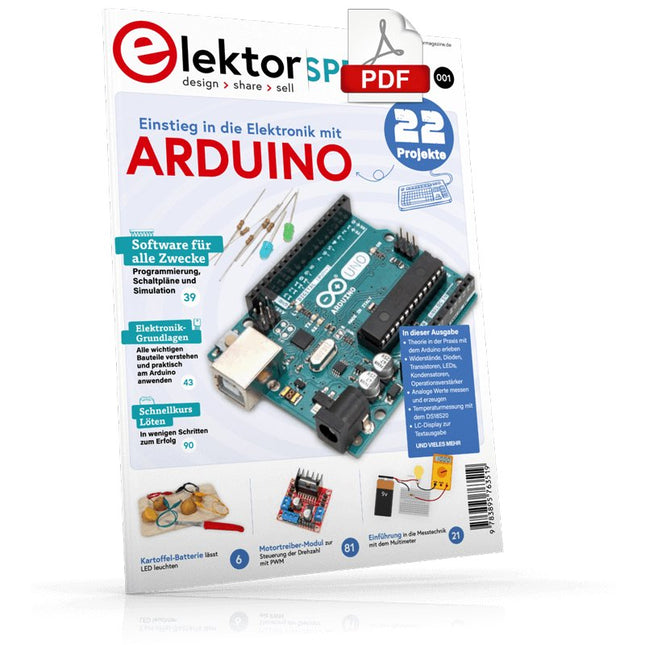
Elektor Digital Elektor Special: Einstieg in die Elektronik mit Arduino (PDF)
Der ideale Start für alle, die in die Welt der Elektronik und Mikrocontroller eintauchen möchten! Dieses Sonderheft vermittelt auf verständliche und praxisnahe Weise die Grundlagen der Elektronik – kombiniert mit spannenden Projekten rund um den beliebten Arduino. Statt trockener Theorie bietet dieses Heft viele leicht nachvollziehbare Experimente, die auf einem Steckboard und mit einem Arduino Uno umgesetzt werden können. So lernen Sie Schritt für Schritt, wie elektronische Bauteile funktionieren und wie Sie sie gezielt einsetzen, um eigene Projekte zu entwickeln. Enthaltene Projekte Strom & Spannung: Wie alles begann Arduino-Hardware Arduino-Programmierung Der Stromkreis Mit dem Multimeter messen Schaltpläne und Experimentier boards Schaltpläne erstellen Breadboard ansichten mit Fritzing Schaltungen online simulieren Unverzichtbar: Widerstände (Teil 1) Praxis mit Widerständen (Teil 2) Veränderliche Widerstände Dioden: Einbahnstraße für den Strom Der Transistor-Schalter Elektromagnetismus Relais und Motoren OpAmps: Operationsverstärker Kondensatoren Timer NE555 PWM und analoge Werte mit Arduino 7-Segment Temperatur anzeige Einführung ins Löten und LCDs
€ 11,90
Mitglieder: € 10,71
-

Elektor Publishing Arduino UNO Q and AI
Learn to Build Intelligent Embedded Systems Build smarter embedded systems with Arduino UNO Q. This book gives you the tools, knowledge, and confidence to turn ideas into intelligent, working solutions using the Arduino UNO Q platform. Discover how to build intelligent embedded systems with the Arduino UNO Q and AI. Unlock the full potential of the Arduino UNO Q, a next-generation platform that combines the real-time power of the STM32U585 microcontroller with the flexibility of a Qualcomm Dragonwing QRB2210 microprocessor. Learn how to rapidly prototype real-world applications using the Arduino IDE for low-level embedded control and Python in Arduino App Lab for high-level development. Build confidence through hands-on projects that guide you step by step from basic board features to complete working systems. Explore ready-to-use, AI based Arduino App Lab examples and see how they can jump-start your development and reduce time to deployment. Step into the world of Edge AI with a clear, practical introduction to Edge Impulse Studio—no prior AI experience required. Follow a complete, real-world workflow to create a Keyword Spotting AI application, covering data collection, model training, optimization, and on-device inference using the Edge Impulse Studio. Bridge the gap between embedded systems and machine learning and learn how to bring intelligence directly onto your hardware. Perfect for embedded engineers, educators, students, and makers looking to stay ahead in AI-enabled product development.
€ 34,95
Mitglieder: € 31,46
-

Elektor Publishing Programming Microcontrollers in C/C++ Using Arduino
With Examples for Arduino UNO, Raspberry Pi Pico and ESP32 Programming small electronic systems has never been more accessible. Tasks that once demanded expensive tools, specialized hardware, and deep electrical engineering expertise can now be tackled with low-cost development boards and approachable software. At the centre of this shift is the Arduino environment, which provides a unified and familiar way to program a wide range of microcontroller platforms—from classic AVR boards like the Arduino UNO to modern ARM-based boards such as the Raspberry Pi Pico, and powerful Wi-Fi-enabled devices like the ESP32. This book introduces embedded programming through the core idea that defines all microcontrollers: reading inputs, processing information, and controlling outputs in a predictable loop. The Arduino environment abstracts much of the hardware complexity, allowing you to focus on behaviour rather than implementation details. With just a few lines of code, you can blink LEDs, read sensors, control motors, and communicate with other devices. While the Arduino UNO, Raspberry Pi Pico, and ESP32 boards differ greatly in performance and features, they share the same fundamental building blocks: digital and analog I/O, timers, serial communication, PWM, interrupts, and power management. Learning these concepts within the Arduino framework builds skills that transfer easily across platforms and scale toward more advanced applications. By exploring multiple boards while maintaining a consistent programming approach, this book helps you progress from simple experiments to confidently produce well-structured designs—showing that embedded development can be both practical and enjoyable.
€ 29,95
Mitglieder: € 26,96
-

Elektor Digital Mastering the Arduino Uno R4 (E-book)
Programming and Projects for the Minima and WiFi Based on the low-cost 8-bit ATmega328P processor, the Arduino Uno R3 board is likely to score as the most popular Arduino family member, and this workhorse has been with us for many years. Eleven years later, the long-overdue successor, the Arduino Uno R4, was released. It is built around a 48 MHz, 32-bit Arm Cortex-M4 microcontroller and provides significantly expanded SRAM and Flash memory. Additionally, a higher-precision ADC and a new DAC are added to the design. The Uno R4 board also supports the CAN Bus with an interface. Two versions of the board are available: Uno R4 Minima, and Uno R4 WiFi. This book is about using these new boards to develop many different and interesting projects with just a handful of parts and external modules. All projects described in the book have been fully tested on the Uno R4 Minima or the Uno R4 WiFi board, as appropriate. The project topics include the reading, control, and driving of many components and modules in the kit as well as on the relevant Uno R4 board, including LEDs 7-segment displays (using timer interrupts) LCDs Sensors RFID Reader 4x4 Keypad Real-time clock (RTC) Joystick 8×8 LED matrix Motors DAC (Digital-to-analog converter) LED matrix WiFi connectivity Serial UART CAN bus Infrared controller and receiver Simulators … all in creative and educational ways with the project operation and associated software explained in great detail.
€ 34,95
Mitglieder: € 31,46
-

Elektor Digital Arduino in Control (3e versie) E-book
Physical Computing met het Arduino-platform Dit leerboek over het Arduino-platform is uniek en brengt u stap voor stap van beginner tot gevorderde Arduino-gebruiker. Er wordt duidelijk in uitgelegd waarom en waardoor toepassingen werken, ondersteund door gedetailleerde afbeeldingen in kleur. Er is slechts een geringe elektronische basiskennis vereist, omdat de benodigde hardware uitgebreid wordt besproken. Het laatste gedeelte van dit boek bevat een degelijke theoretische verdieping, zodat u een krachtig naslagwerk achter de hand houdt. Er bestond in het Nederlands nog geen lesboek over dit platform. De didactische opbouw is zodanig dat de vereiste abstracte kennis wordt uitgelegd aan de hand van toepasbare en actuele praktijkvoorbeelden. De meeste toepassingen zijn gericht op ‘physical computing’, dat is de interactie tussen sensoren, actoren, elektronica en software. Hierdoor is het boek ook geschikt voor technisch beroepsonderwijs, o.a. voor de richting mechatronica. De opbouw van het boek is als volgt: Algemene introductie microcontrollers. Informatie over het Arduino-platform. Oefeningen met uitleg aan de hand van 21 voorbeelden. Praktijkvoorbeelden met uitleg aan de hand van 5 voorbeelden. Theoretische verdieping van de software en hardware. Praktische elektronicaschema´s. Alle software-voorbeelden in het boek zijn als download beschikbaar.
€ 34,95
Mitglieder: € 31,46
-

Elektor Digital Mikrocontroller verstehen und anwenden (PDF)
Mit diesem Buch erweitert der Leser seine Mikrocontroller-Kenntnisse auf Grund eigener Erfahrungen und Erfolgserlebnisse und wird dazu noch ganz nebenbei in die Welt des Arduino und seiner Entwicklungsumgebung eingeführt. Am Ende dieses vergnüglichen und fast spielerischen Lehrgangs stellen Begriffe wie I/O, Speicherplatz, Interrupts, Kommunikationsstandards, A/D-Konverter (und vieles mehr) keine Geheimnisse mehr dar und der Leser ist in der Lage, auch andere Mikrocontroller zu programmieren. Mit anderen Worten: ein erstes Mikrocontroller-Buch mit Happy End. Dieses Buch ist für Sie geeignet, wenn Sie Anfänger auf dem Gebiet der Mikrocontroller sind, als Arduino-User bzw. -Enthusiast Ihre Kenntnisse vertiefen möchten, Elektronik studieren oder als Lehrer inspiriert werden möchten. Neues Konzept: Dieses Buch überrascht mit einem völlig neuen Konzept an Schaltungsbeispielen: Mit speziellen Arduino-Anwendungen vertreiben Sie störende Freunde und Familienmitglieder sicher und zuverlässig aus Ihrer Umgebung und machen so Schluss mit lästigen gesellschaftlichen Verpflichtungen, so dass Sie in Zukunft Ihre komplette Freizeit nur noch der Programmierung von Mikrocontrollern widmen können. Originelle Anwendungsbeispiele Geringe Hardware-Kosten Freie und offene Software (Open Source)
€ 39,80
Mitglieder: € 35,82
-

Elektor Digital Arduino & Co – Measure, Control, and Hack (E-book)
Clever Tricks with ATmega328 Pro Mini Boards With a simple Pro Mini board and a few other components, projects that 20 or 30 years ago were unthinkable (or would have cost a small fortune) are realized easily and affordably in this book: From simple LED effects to a full battery charging and testing station that will put a rechargeable through its paces, there’s something for everyone. All the projects are based on the ATmega328 microcontroller, which offers endless measuring, switching, and control options with its 20 input and output lines. For example, with a 7-segment display and a few resistors, you can build a voltmeter or an NTC-based thermometer. The Arduino platform offers the perfect development environment for programming this range of boards. Besides these very practical projects, the book also provides the necessary knowledge for you to create projects based on your own ideas. How to measure, and what? Which transistor is suitable for switching a certain load? When is it better to use an IC? How do you switch mains voltage? Even LilyPad-based battery-operated projects are discussed in detail, as well as many different motors, from simple DC motors to stepper motors. Sensors are another exciting topic: For example, a simple infrared receiver that can give disused remote controls a new lease on life controlling your home, and a tiny component that can actually measure the difference in air pressure between floor and table height!
€ 32,95
Mitglieder: € 29,66
-
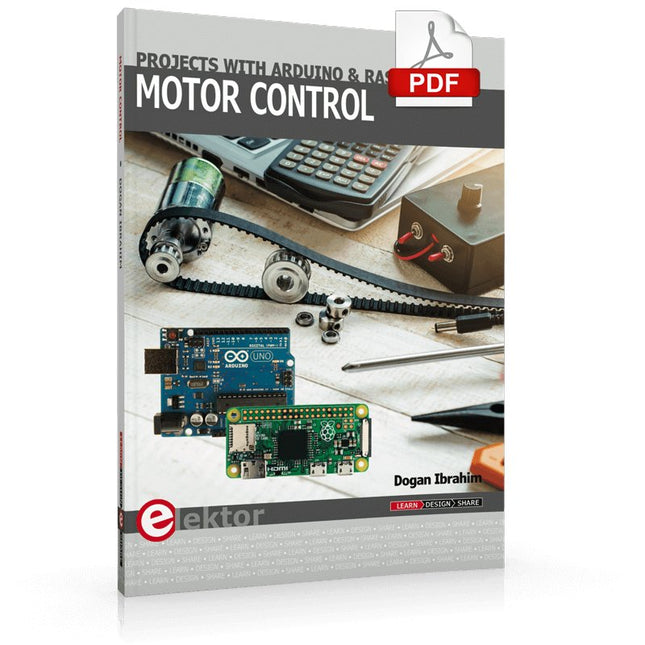
Elektor Digital Motor Control - Projects with Arduino & Raspberry Pi (E-book)
This book is about DC electric motors and their use in Arduino and Raspberry Pi Zero W based projects. The book includes many tested and working projects where each project has the following sub-headings: Title of the project Description of the project Block diagram Circuit diagram Project assembly Complete program listing of the project Full description of the program The projects in the book cover the standard DC motors, stepper motors, servo motors, and mobile robots. The book is aimed at students, hobbyists, and anyone else interested in developing microcontroller based projects using the Arduino Uno or the Raspberry Pi Zero W. One of the nice features of this book is that it gives complete projects for remote control of a mobile robot from a mobile phone, using the Arduino Uno as well as the Raspberry Pi Zero W development boards. These projects are developed using Wi-Fi as well as the Bluetooth connectivity with the mobile phone. Readers should be able to move a robot forward, reverse, turn left, or turn right by sending simple commands from a mobile phone. Full program listings of all the projects as well as the detailed program descriptions are given in the book. Users should be able to use the projects as they are presented, or modify them to suit to their own needs.
€ 29,95
Mitglieder: € 26,96
-

Elektor Academy Pro ESP32 by Example (Lernkurs)
Vollständiger ESP32-Mikrocontroller-Lernkurs mit speziell entwickelter MCU-Erweiterungsplatine, praxisorientierten Projekten und einem umfassenden Online-Guide – ideal, um Hardware, Programmierung und Konnektivität Schritt für Schritt zu erlernen. Praktische Einführung in eingebettete Systeme mit dem ESP32 Dieser Kurs richtet sich an Einsteiger in die Welt der eingebetteten Systeme, die einen strukturierten, beispielorientierten Einstieg suchen. Falls Sie sich bereits mit allgemeiner Elektronik oder Arduino-basierten Materialien beschäftigt haben, diese aber als zu allgemein oder zu wenig praxisnah empfunden haben, bietet dieser Kurs eine fokussiertere Alternative. Mit dem "ESP32 by Example Kit" (EEK) – einem kompakten und kostengünstigen Komponentensatz mit LEDs, Sensoren, einem OLED-Display und einem Bewegungsprozessor – arbeiten Sie während des gesamten Kurses mit einem einheitlichen Hardware-Setup. Nach dem Zusammenbau bleibt das EEK weitgehend unverändert, sodass Sie sich ganz auf das Lernen und Experimentieren konzentrieren können, ohne ständig neu konfigurieren zu müssen. Themen: Verstehen und Programmieren des ESP32-Mikrocontrollers Programmieren und Ausführen von Code mit der Arduino IIDE Erkunden von cyber-physischen Systemen, abschließend zur grundlegenden Drohnensteuerung Vorkenntnisse in Arduino oder Embedded-Entwicklung sind nicht erforderlich. Jeder Abschnitt enthält praktische Beispiele und Miniprojekte, die die wichtigsten Konzepte festigen und zu einer tiefergehenden Auseinandersetzung anregen. Am Ende des Kurses können Sie die Beispiele des Buches nicht nur nachvollziehen, sondern auch mit eigenen Ideen und Anwendungen erweitern. Ob Sie sich für Embedded-Programmierung, interaktive Systeme oder die Grundlagen der Drohnensteuerung interessieren – dieser Kurs bietet einen klaren und praxisorientierten Einstieg. Was Sie lernen werden Eingebettete Programmierung mit dem ESP32 mithilfe der Arduino IDE Echtzeit-Sensoreingabe und -steuerung über Tasten, LEDs und Displays Gestenbasierte Interaktion mit dem Bewegungssensor MPU6050 Integration von Bluetooth-Gamepads und Drohnensteuerungssimulation WLAN- und UDP-Netzwerke, lokale Webserver und NTP MQTT-Kommunikation mit Cloud-Plattformen wie AWS und Arduino IoT Aufbau und Bereitstellung voll funktionsfähiger IoT-Systeme Perfekt für Studierende und Autodidakten, die sich mit eingebetteten Systemen beschäftigen Bastler und IoT-Begeisterte, die ihre Hardwarekenntnisse verbessern möchten Lehrkräfte und Dozenten, die nach sofort einsetzbarem Unterrichtsmaterial suchen Entwickler, die über die Grundlagen von Raspberry Pi oder Arduino hinausgehen möchten Support, wenn Sie ihn brauchen Zugang zu Kursleitern über die Elektor Academy Hilfreiche Community-Foren und wichtige Dokumentation Was ist in der Box (Kurs)? Neues 384-seitiges Buch: "ESP32 by Example" (Wert: 45 €) Elektor ESP32 by Example Kit (EEK): Mikrocontroller-Erweiterungsplatine mit 6 LEDs und 6 Tasten + OLED-Display, MPU6050 3-Achsen Beschleunigungsmesser und Gyroskop-Modul (Wert: 40 €) Adafruit HUZZAH32 – ESP32 Feather MCU Board (Wert: 30 €) ESP32 Cheap Yellow Display Board (Wert: 25 €) DHT11 Feuchtigkeitssensor & Temperatursensor Breadboard Jumperkabel USB-C-Kabel Zugang zum vollständigen Kurs auf der Elektor Academy Pro Lernplattform Lehrvideos Herunterladbare Arduino-Projektdateien für jedes Modul Lernmaterial (dieser Box) ▶ Klicken Sie hier zum Öffnen Module 1 – Getting Started with the ESP32 & EEK Module 2 – Digital Output – LEDs and GPIO Module 3 – Switches and Input Handling Module 4 – EEK and PWM Module 5 – OLED and Display Output Module 6 – Motion Sensing with the MPU6050 Module 7 – Capstone Project (EEK in Action) Module 8 – WiFi and Web Control with ESP32 Module 9 – Cloud Concepts using EEK Module 10 – Hands-on: Arduino IoT Cloud and EEK Module 11 – BlueTooth and EEK GamePad Integration Module 12 – Why Drones? Module 13 – Drone Simulator Concepts Module 14 – Simple Drone Flight Control Module 15 – Real-Time Drone Flight Control Module 16 – Drone Control Mini-Projects Module 17 – Middleware and Python Scripting Module 18 – Python Applications for Drone Control Module 19 – Capstone EEK Control Project and Presentation Über den Autor Dr. Jim Solderitsch ist Dozent, Softwarearchitekt, Systementwickler und Cybersicherheitsforscher mit Schwerpunkt auf cyber-physischen Systemen. Derzeit ist er als Lehrbeauftragter für Informatik an der Villanova University in Pennsylvania tätig. Was ist Elektor Academy Pro? Elektor Academy Pro bietet maßgeschneiderte Lernlösungen für Fachkräfte, Ingenieurteams und technische Experten in der Elektronik- und Embedded-Systems-Branche. Sie unterstützt Einzelpersonen und Organisationen dabei, ihr praktisches Know-how zu vertiefen, ihre Skills gezielt auszubauen und dank hochwertiger Inhalte und praxisnaher Tools stets einen Schritt voraus zu sein. Von realen Projekten und spezialisierten Kursen bis hin zu fundierten technischen Insights – Elektor versetzt Ingenieure in die Lage, aktuelle Herausforderungen der Branche erfolgreich zu meistern. Unser Bildungsportfolio umfasst Academy-Bücher, Pro-Boxen, Webinare, Konferenzen und B2B-Fachmagazine – alles mit Blick auf praxisnahe Weiterbildung und berufliches Wachstum. Ob Ingenieur, F&E-Spezialist oder technischer Entscheider: Elektor Academy Pro schlägt die Brücke zwischen Theorie und Praxis – und hilft Ihnen, neue Technologien zu beherrschen und Innovationen in Ihrem Unternehmen gezielt voranzutreiben.
€ 269,00€ 219,00Bestpreis
-

Elektor Digital Arduino for Radio Amateur Applications (E-book)
Program and build Arduino-based ham station utilities, tools, and instruments In addition to a detailed introduction to the exciting world of the Arduino microcontroller and its many variants, this book introduces you to the shields, modules, and components you can connect to the Arduino. Many of these components are discussed in detail and used in the projects included in this book to help you understand how these components can be incorporated into your own Arduino projects. Emphasis has been placed on designing and creating a wide range of amateur radio-related projects that can easily be built in just a few days. This book is written for ham radio operators and Arduino enthusiasts of all skill levels, and includes discussions about the tools, construction methods, and troubleshooting techniques used in creating amateur radio-related Arduino projects. The book teaches you how to create feature-rich Arduino-based projects, with the goal of helping you to advance beyond this book, and design and build your own ham radio Arduino projects. In addition, this book describes in detail the design, construction, programming, and operation of the following projects: CW Beacon and Foxhunt Keyer Mini Weather Station RF Probe with LED Bar Graph DTMF Tone Encoder DTMF Tone Decoder Waveform Generator Auto Power On/Off Bluetooth CW Keyer Station Power Monitor AC Current Monitor This book assumes a basic knowledge of electronics and circuit construction. Basic knowledge of how to program the Arduino using its IDE will also be beneficial.
€ 32,95
Mitglieder: € 29,66
-
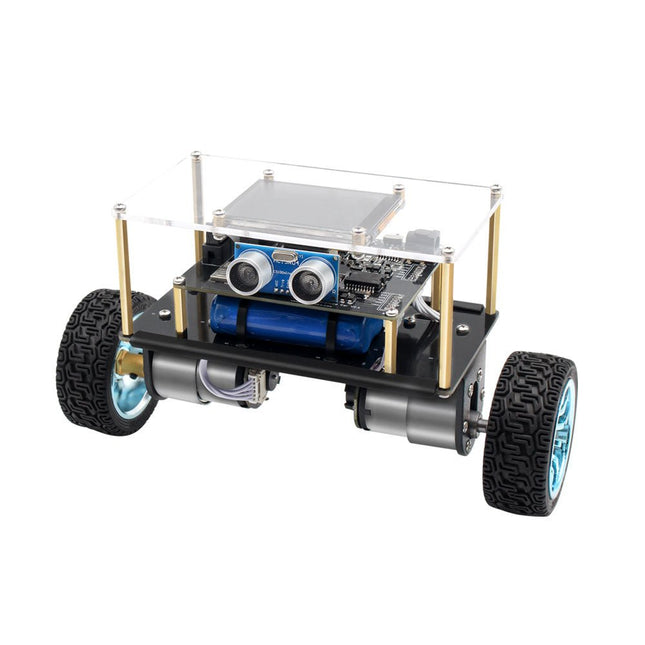
Elektor Labs Elektor Mini-Wheelie Selbstbalancierender Roboter
Der Elektor Mini-Wheelie ist eine experimentelle autonome selbstbalancierende Roboterplattform. Der selbstbalancierende Roboter basiert auf einem ESP32-S3-Mikrocontroller und ist mithilfe der Arduino-Umgebung und Open-Source-Bibliotheken vollständig programmierbar. Dank seiner drahtlosen Fähigkeiten kann er über WLAN, Bluetooth oder ESP-NOW ferngesteuert werden oder mit einem Benutzer oder sogar einem anderen Roboter kommunizieren. Zur Erkennung von Hindernissen steht ein Ultraschallwandler zur Verfügung. Über das Farbdisplay lassen sich niedliche Gesichtsausdrücke oder für den bodenständigeren Nutzer auch kryptische Debug-Meldungen darstellen. Der Roboter wird als Komplettbausatz mit Teilen geliefert, die Sie selbst zusammenbauen müssen. Alles ist dabei, sogar ein Schraubenzieher. Hinweis: Der Mini-Wheelie ist eine pädagogische Entwicklungsplattform, die zum Lernen, Experimentieren und zur Entwicklung von Robotern gedacht ist. Er ist nicht als Kinderspielzeug klassifiziert, und seine Funktionen, Dokumentation und Zielgruppe spiegeln diesen Zweck wider. Das Produkt richtet sich an Studenten, Dozenten und Entwickler, die Robotik, Programmierung und Hardware-Integration in einem pädagogischen Umfeld erforschen möchten. Technische Daten ESP32-S3 Mikrocontroller mit WLAN und Bluetooth MPU6050 6-achsige Inertial Measurement Unit (IMU) Zwei unabhängig gesteuerte 12 V-Elektromotoren mit Drehzahlmesser Ultraschallwandler 2,9" TFT-Farbdisplay (320 x 240) MicroSD-Kartensteckplatz Batterieleistungsmonitor 3S wiederaufladbarer Li-Po-Akku (11,1 V/2200 mAh) Batterieladegerät im Lieferumfang enthalten Arduino-basierte Open-Source-Software Abmessungen (B x L x H): 23 x 8 x 13 cm Lieferumfang 1x ESP32-S3 Mainboard + MPU6050 Modul 1x LCD-Board (2,9 Zoll) 1x Ultraschallsensor 1x Akku (2200 mAh) 1x Batterieladegerät 1x Motorreifen-Set 1x Gehäuseplatine 1x Acrylplatte 1x Schraubendreher 1x Schutzstreifen 1x Flexkabel B (8 cm) 1x Flexkabel A (12 cm) 1x Flexkabel C 4x Kupfersäule A (25 mm) 4x Kupfersäule B (55 mm) 4x Kupfersäule C (5 mm) 2x Kunststoff-Nylonsäule 8x Schrauben A (10 mm) 24x Schrauben B (M3x5) 8x Nüsse 24x Metallscheiben 2x Kabelbinder 1x MicroSD-Karte (32 GB) Downloads Documentation
€ 99,95€ 79,95Bestpreis
-

Elektor Digital Sonderausgabe: Einladungsausgabe Arduino 2022 (PDF)
Der vollständige Download dieser Nummer ist für unsere GOLD- und GREEN-Mitglieder auf der Elektor Magazine- Site verfügbar! Nicht noch einmal Mitglied? Klicken Sie hier . Arduino Portenta Machine Control und Arduino Portenta H7 Demonstration mit einem Übergang von CAN zu MQTT das 2 MHz LCR-Meter-Kit von Elektor Herzlich willkommen, David Cuartielles, Mitbegründer von Arduino, live! MicroPython in der Arduino-Welt Vereinfachte Verbindungsprojekte Tauchen Sie ein in die Arduino Cloud Einführung in TinyML Plus gros n?est pas toujours mieux Arduino K-Weg Arduino-Kreuzworträtsel im modernen Netz schreiben Arduino und Fragen Debüt mit dem Portenta X8 Sichere Verwaltung der Software mit den Inhalten Erstellen, Bereitstellen und Warten von sich entwickelnden und sicheren Anwendungen mit Arduino Portenta X8, ausgestattet mit dem Mini-Anwendungsprozessor i.MX 8M von NXP und dem Sicherheitselement EdgeLock SE050 wie wird mein Haus automatisiert Fabio Violante, PDG von Arduino, teilt seine Lösungen Simulator Altair 8800 Simulationsmaterial eines alten Computers MS-DOS auf Portenta H7 Ausführen von Old-School-Software auf moderner Hardware kultiviere dich selbst eine digitale Innengarten-Gärtnerei für alle Den Planeten mit der Domotik retten?? MQTT auf Arduino Nano RP2040 Connect Werden Sie zum Profi mit Arduino Pro Die Vier Intelligenten schaffen eine Bindung in der Zukunft Lernen Sie das Konzept sicherer Bauketten mit Arduino kennen Santagostino atmet leicht mit einer Fernüberwachung, die Teil der L?IA für eine vorausschauende Wartung ist Die Sicherheit der Benutzer wird durch die auf den MKR-Karten von RIoT Secure basierende Lösung gewährleistet Open-Source trägt zur Welt des Fortschritts im Wassermanagement bei Senso Erkennen Sie die Abholzung durch eine Klanganalyse Mozzi Arduino-Bibliothek für die Klangsynthese Der Standpunkt von Tim Barrass Die neuen Portenta X8 (mit Linux!) und Max Carrier haben das Maximum an Möglichkeiten neu definiert Wie die Nutzung von Arduino den Studierenden hilft, zukünftige Kompetenzen zu erwerben Gut ausgestattet für meine Mitarbeiter Die Bedeutung der Robotik in der Ausbildung LoRa macht IdO leistungsfähig la carte Portenta Maschinensteuerung im Detail Retro-Gaming mit Arduboy die Nutzung von Wasser auf Reitpisten verringern ein IdO zur permanenten Überwachung des Feuchtigkeitsniveaus und der Sonnentemperatur das Projekt Panettone System zur Verwaltung und Aufrechterhaltung eines Sauerteigs Unterstützung von Arduino-Wiederverkäufern Space Invaders mit Arduino künstlerische Schöpfung in der Arduino-Umgebung von Künstlern und Designern inspirierte Ideen Arduino Produktkatalog Arduino-Hilfe
€ 10,95


