
Suchergebnisse für "elektor or 40 or v or linear or voltage or regulator"
-

Elektor Digital The EAGLE Companion (E-book)
EAGLE – the “Easily Applicable Graphical Layout Editor“ is a professional-grade CAD (computer aided design) software package for the design and drafting of electronic schematics as well as the design and fabrication of printed circuit boards (PCBs). This Advanced User Guide provides the experienced EAGLE user with insight into using some of the more advanced features of EAGLE software. It is not a guide to teach the reader the basic concepts of EAGLE, nor does it discuss the ‘how to’ of the EAGLE interface and the simpler operations and commands of the software. That is the purpose of the author’s previous title EAGLE V6 Getting Started Guide also published by Elektor. This eBook is intended as an enduring document covering the more advanced modules, commands, and functions which make up EAGLE. It is hoped that this eBook will provide a quick, succinct reference to assist with more complex applications and uses of EAGLE – an ‘EAGLE User’s Companion’, if you like. Complementing the EAGLE Advanced User Guide, the EAGLE User Language manual is included in this eBook in unabridged form, reproduced with permission of CadSoft GmbH. At the time of writing, the material in this eBook covers version 7 of the EAGLE software suite.
€ 39,95
Mitglieder: € 35,96
-

Elektor Digital Hardware Projects for Raspberry Pi (E-book)
The Raspberry Pi is a $35 credit-card sized computer with many applications, such as in desktop computing, audio and video playback, and as a controller in many industrial, commercial and domestic applications. This book is about the Raspberry Pi computer and its use in control applications. The book explains in simple terms, with examples, how to configure the RPi, how to install and use the Linux operating system, how to write programs using the Python programming language and how to develop hardware based projects. The book starts with an introduction to the Raspberry Pi computer and covers the topics of purchasing all the necessary equipment and installing/using the Linux operating system in command mode. Use of the user-friendly graphical desktop operating environment is explained using example applications. The RPi network interface is explained in simple steps and demonstrates how the computer can be accessed remotely from a desktop or a laptop computer. The remaining parts of the book cover the Python programming language, hardware development tools, hardware interface details, and RPi based hardware projects. All the 23 projects given in the book have been tested and are working. The following headings are given for each project: Project title Project description Project block diagram Project circuit diagram Project program description using the Program Description Language (PDL) Complete program listing Description of the program The book is ideal for self-study, and is intended for electronic/electrical engineering students, practising engineers, research students, and hobbyists.
€ 34,95
Mitglieder: € 31,46
-

Elektor Digital Elektor November/December 2020 (PDF)
NIEUWE LCR-METER 50 HZ – 2 MHZautomatische impedantiemeetbrug meet weerstand, capaciteit en zelfinductie van componenten met een impedantie van 10 mΩ tot 100 MΩ VAN DINGDONG-DEURBEL NAAR IOT-DEURBELintegreer uw deurbel in Home Assistant met ESPHome ACCUMANAGEMENTwaar u bij het gebruik van (lithium-)accu's op moet letten ALLE BEGIN......hoeft niet zo moeilijk te zijn WIE HET KLEINE NIET EERTuit de ideeënbus van Elektor BREADBOARDEN MET FRITZING ANALOGE ELEKTRONICA ONTWERPENcase-study #2 – deel 2: actieve filters OOST WEST LAB BESTeen blik in het allerheiligste, waar interessante projecten worden geboren DEVELOPER'S ZONEtips & trucs, vakkunstigheden en andere nuttige informatie REVIEW: RIGOL DS1054Z 4-KANAALS OSCILLOSCOOP KERSTKAARS...blaas 'm uit! CONTINU AFSTEMBARE BUIZEN-SINUSGENERATORretro is in... REVIEW: RIGOL DG2072 GOLFVORMGENERATOR KICAD PLUGINS EN ADD-ONS DIFFERENTIËLE STROOMPROBE 2.0 VOOR OSCILLOSCOPENstroom meten met de oscilloscoop DE HEWLETT-PACKARD INTERFACE LOOPverbind de wereld! DE TOEKOMST VAN MACHINE LEARNINGvraaggesprek met Daniel Situnayake MOBIELE APPS VOOR ANDROID EN IOStegelijk geprogrammeerd UIT HET LEVEN GEGREPENde clash tussen alfa, bèta en gamma 5G: HOE INFRASTRUCTUUR ONZE SAMENLEVING VORMT MULTITASKING MET DE ESP32 (5)task event-notificaties HP 10811-OSCILLATORvreemde onderdelen LORA GPS-TRACKERmet open hard- en software PROGRAMMEREN VAN DE EINDIGE-TOESTANDSMACHINEmet 8-bit PIC's in assembler en C HEXADOKU
€ 9,95
-
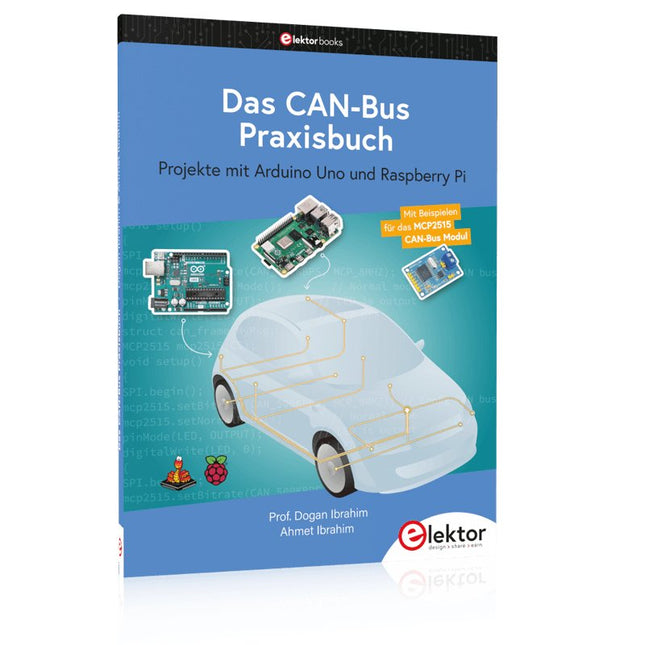
Elektor Publishing Das CAN-Bus Praxisbuch
Projekte mit Arduino Uno und Raspberry Pi In diesem Buch werden Anwendungen von Arduino Uno und Raspberry Pi 4 in praxisnahen Projekten auf Basis von CAN-Bus detailliert beschrieben. Durch den Einsatz von entweder Arduino Uno oder Raspberry Pi in Verbindung mit handelsüblichen CAN-Bus-Schnittstellenmodulen werden die Entwicklung, Fehlersuche und Fehlerbeseitigung sowie die Überprüfung von Projekten auf CAN-Bus-Basis erheblich erleichtert. Dieses Buch richtet sich an jeden, der mehr über den CAN-Bus lernen möchte und mit den Grundlagen der Elektronik vertraut ist. Hilfreich ist auch Erfahrung mit den Programmiersprachen C und Python sowie mit der Programmierung von Arduino Uno unter Verwendung seiner IDE und von Raspberry Pi zu haben. Das Buch ist eine nützliche Informationsquelle und ein Nachschlagewerk für jeden, der Antworten auf eine oder mehrere der folgenden Fragen sucht: Welche Bussysteme stehen für die Automobilindustrie zur Verfügung? Was sind die Grundprinzipien des CAN-Bus? Welche Arten von Frames (oder Datenpaketen) stehen in einem CAN-Bussystem zur Verfügung? Wie können Fehler in einem CAN-Bussystem erkannt werden, und wie zuverlässig ist ein CAN-Bussystem? Welche Arten von CAN-Bus-Controllern gibt es? Welches sind die Funktionsprinzipien des MCP2515 CAN-Bus-Controllers? Wie kann ich ein CAN-Bus-Projekt mit Arduino Uno realisieren? Wie kann ich Arduino oder Raspberry Pi CAN-Bus-Projekte mit 2 und 3 Knoten erstellen? Wie kann ich die Daten auf dem CAN-Bus analysieren? Wie kann ich ein CAN-Bus-Projekt mit Raspberry Pi ausführen?
€ 34,80
Bestpreis
-
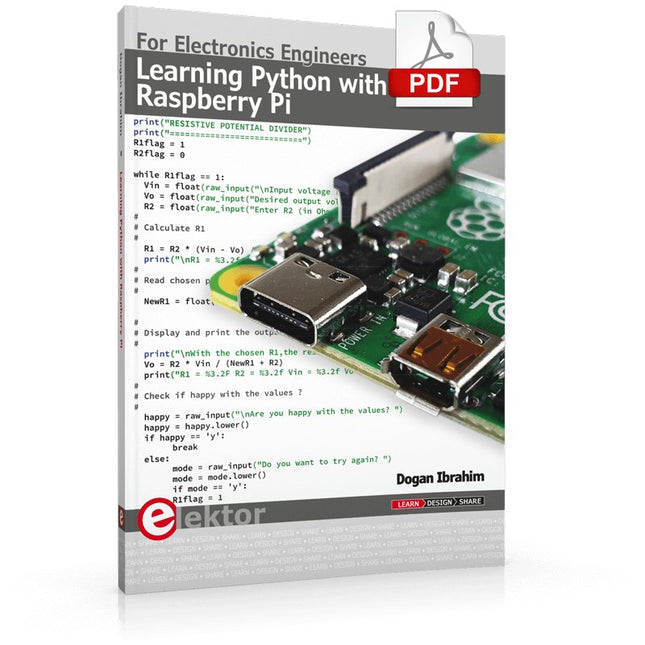
Elektor Digital Learning Python with Raspberry Pi (E-book)
This book is about teaching the Python programming language using the Raspberry Pi 4 computer. The book makes an introduction to Raspberry Pi 4 and then teaches Python with the topics: variables, strings, arrays, matrices, tuples, lists, dictionaries, user functions, flow of control, printing, keyboard input, graphics, GUI, object oriented programming and many more topics. The book is aimed for beginners, students, practising engineers, hobbyists, and for anyone else who may want to learn to program in Python. The book includes many example programs and case studies. All the example programs and case studies have been tested fully by the author and are all working. The example programs aim to teach the various programming concepts of Python. The case studies cover the use of Python in the analysis and design of electronic circuits. Some of the case study topics are: Resistor colour code identification Resistive potential divider circuits Resistive attenuator design Zener diode voltage regulator design RC and RLC transient circuits Circuit frequency response Saving data on external memory stick Mesh and node circuit analysis using matrices Resonance in RLC circuits Transistor Biasing analysis Transistor amplifier design Design of active filters Interfacing hardware with GPIO, I²C and SPI Using Wi-Fi with Python and TCP/IP and UDP programs Using Bluetooth from Python Full program listings of all the programs used in the book are available at the Elektor website of the book. Readers should be able just to copy and use these programs in their Raspberry Pi projects without any modifications.
€ 32,95
Mitglieder: € 29,66
-

Elektor Digital Elektor Januar/Februar 2024 (PDF)
Elektor GREEN- und GOLD-Mitglieder können diese Ausgabe hier herunterladen. Noch kein Mitglied? Klicken Sie hier , um eine Mitgliedschaft abzuschließen. Projektaktualisierung: ESP32-basierter Energiezähler Weiter geht es mit dem Prototyp Optimierung von Balkon-PV-Kraftwerken Überlegungen, interessante Fakten und Berechnungen ESP32 mit OpenDTU für Balkonbedienfelder Lesen Sie Daten von kleinen Wechselrichtern über MCUs Einstellbares lineares Labornetzteil 0...50 V / 0...2 A + doppelt symmetrische Stromversorgung Energiespeicher – heute und morgen ein Interview mit Simon Engelke 2024: eine KI-Odyssee es wird nicht so schnell enden Bluetooth LE auf dem STM32 Messwerte aus der Ferne ablesen Menschenfreundliches intelligentes Kücheninventarsystem MAUI: Programmierung für PC, Tablet und Smartphone die neuen Rahmenbedingungen in Theorie und Praxis ChatMagLev künstliche intelligente Levitation Einfacher PV-Controller Bauen Sie Ihr erstes, voll funktionsfähiges PV-Energiemanagementsystem Kaltkathodenröhren Fremde Aus dem Leben genommen Nostalgie Aller Anfang... ...sieht sich den FET an CAN-Bus für den Arduino UNO R4: ein Tutorial Zwei UNO R4 fahren mit dem Bus! Elektor-Infografik Ernährung und Energie Vergleich von Leistungsdichte und Leistungseffizienz Aluminium-Elektrolytkondensatoren Störpotenzial in der Audiotechnik USB-Prüfung und -Messung mit dem Fnirsi FNB58 Das Pick-and-Place-Tool von Pixel Pump einfachere manuelle Bestückung von SMT-Platinen East West Lab Best Vor nicht allzu langer Zeit, in einem sehr weit entfernten Land ... „In der Welt der Elektronikethik können selbst kleine Schritte große Auswirkungen haben.“ Ethik in der Elektronik den OECD-Leitsätzen und dem Lieferkettensorgfaltspflichtgesetz Chadèche: intelligentes NiMH-(Ent-)Ladegerät Leserprojekt in Kürze Projekt 2.0 Korrekturen, Aktualisierungen und Leserbriefe
€ 9,95
-
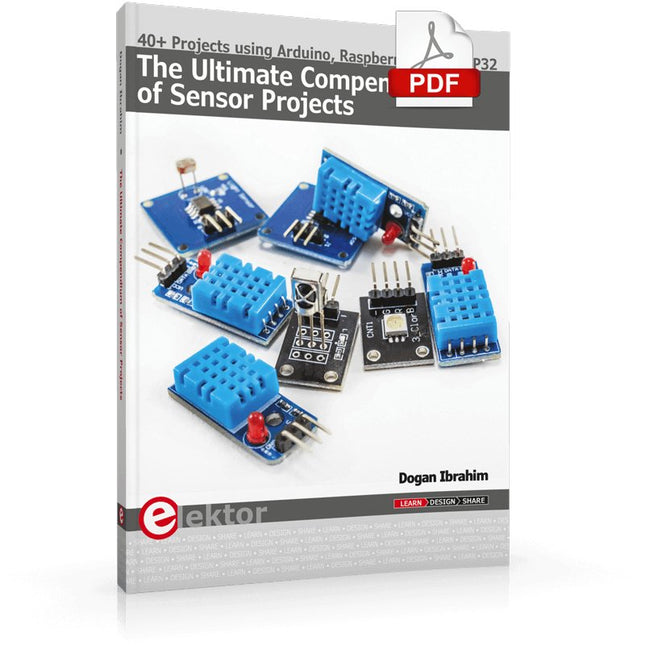
Elektor Digital The Ultimate Compendium of Sensor Projects (E-book)
40+ Projects using Arduino, Raspberry Pi and ESP32 This book is about developing projects using the sensor-modules with Arduino Uno, Raspberry Pi and ESP32 microcontroller development systems. More than 40 different sensors types are used in various projects in the book. The book explains in simple terms and with tested and fully working example projects, how to use the sensors in your project. The projects provided in the book include the following: Changing LED brightness RGB LEDs Creating rainbow colours Magic wand Silent door alarm Dark sensor with relay Secret key Magic light cup Decoding commercial IR handsets Controlling TV channels with IT sensors Target shooting detector Shock time duration measurement Ultrasonic reverse parking Toggle lights by clapping hands Playing melody Measuring magnetic field strength Joystick musical instrument Line tracking Displaying temperature Temperature ON/OFF control Mobile phone-based Wi-Fi projects Mobile phone-based Bluetooth projects Sending data to the Cloud The projects have been organized with increasing levels of difficulty. Readers are encouraged to tackle the projects in the order given. A specially prepared sensor kit is available from Elektor. With the help of this hardware, it should be easy and fun to build the projects in this book.
€ 34,95
Mitglieder: € 31,46
-

OWON OWON DGE3062 2-Kanal Funktionsgenerator (60 MHz)
Der OWON DGE3062 ist ein 14-Bit Funktionsgenerator mit einer Bandbreite von 60 MHz. Er verfügt über 5 Grundwellenformen, 160 eingebaute Arbiträr-Wellenformen und die folgenden umfassenden Modulationsfunktionen: AM, FM, PM, PWM, FSK, 3FSK, 4FSK, PSK, ASK, BPSK, OSK, DSBAM, QPSK, SUM, Sweep, Burst. Features Max. 60-MHz-Frequenzausgang, 300 MSa/s Abtastrate 14 Bit vertikale Auflösung, 100.000 Arb-Wellenformlänge Umfassende Wellenformausgabe: 5 grundlegende Wellenformen und 160 integrierte Arbiträrwellenformen Umfassende Modulationsfunktionen: AM, FM, PM, PWM, FSK, 3FSK, 4FSK, PSK, ASK, BPSK, OSK, DSBAM, QPSK, SUM, Sweep, Burst SCPI und LabVIEW werden unterstützt 3,6 Zoll LCD (480 x 272 Pixel) Technische Daten Kanäle 2 Frequenz-Ausgang 60 MHz Abtastrate 300 MSa/s Vertikale Auflösung 14 bits Wellenform Standard Waveform Sine, square, pulse, ramp, noise Arbitrary Waveform Exponential rise, exponential fall, sin(x)/x, step wave, and others, total 160 built-in waveforms Frequenz (Auflösung 1 μHz) Sine 1 μHz-60 MHz Square 1 μHz ~ 20 MHz Pulse 1 μHz ~ 20 MHz Ramp 1 μHz ~ 2 MHz Noise 20 MHz (-3 dB, typical) Arbitrary Waveform 1 μHz ~10 MHz Arbitrary Waveform Length 2 points – 100K points Sample Rate 300 MSa/s Amplitude Into 50Ω load 1mVpp ~ 10Vpp (≤10Hz), 1mVpp ~ 5Vpp (≤60 MHz) DC Offset Range (AD+DC ±(10 Vpk – Amplitude Vpp/2) high resistance±(5 Vpk – Amplitude Vpp/2) 50 Ω DC offset resolution 1 mV or 4 digits Load Impedance 50 Ω (typical) DC offset Accuracy ±(1% of |setting| + 1 mV + amplitude Vpp * 0.5%) Modulation Type AM,FM, PM, PWM, FSK, 3FSK, 4FSK, PSK, ASK, BPSK, OSK, DSB-AM, QPSK, SUM, Sweep, Burst Frequenzzähler Function Frequency, period Frequency Range 100 MHz ~ 100 MHz Frequency Resolution 6 digits Input/Output Display 3.6” LCD Input mode External modulation input, external trigger input, external reference clock input/output Communication Interface USB Host, USB Device Mechanische Spezifikationen Abmessungen 200 x 92 x 157 mm Gewicht 0,8 kg Lieferumfang 1x OWÒN DGE3062 Funktionsgenerator 1x Netzkabel 1x Kurzanleitung 1x USB-Kabel 1x Q9-Kabel 1x BNC auf Krokodilklemme Downloads Quick Guide Manual Software
€ 208,99
-

Rigol Rigol DG2052 Funktions-/Arbiträrwellenformgenerator (50 MHz)
Highlights Ausgangsfrequenz (Sinus): 50 MHz Ausgangsfrequenz (Rechteck): 15 MHz Kanäle: 2 Länge der beliebigen Wellenform: 16 Mpts Features Einzigartige SiFi II-Technologie (Signal Fidelity II): Generierung beliebiger Wellenformen Punkt für Punkt; Wiederherstellung des Signals ohne Verzerrung; genaue und anpassbare Abtastrate; Jitter aller Ausgangswellenformen (einschließlich Sinus, Puls usw.) nur 200 ps 16 Mpts Speichertiefe pro Kanal für beliebige Wellenformen Standardmäßiger Dual-Channel mit gleicher Leistung, entspricht zwei unabhängigen Signalquellen Hohe Frequenzstabilität: ±1 ppm; geringes Phasenrauschen: -105 dBc/Hz Eingebauter Harmonischengenerator höherer Ordnung (maximal Harmonische 8. Ordnung) Eingebauter Frequenzzähler mit 7 Ziffern/s und 240 MHz Bandbreite und vollem Funktionsumfang Bis zu 160 integrierte beliebige Wellenformen, die die gängigen Signale in technischen Anwendungen, der medizinischen Elektronik, der Autoelektronik, der mathematischen Verarbeitung und vielen anderen Bereichen abdecken Abtastrate bis zu 250 MSa/s, vertikale Auflösung 16 Bit Funktion zum Bearbeiten beliebiger Wellenformsequenzen verfügbar; beliebige Wellenformen können auch über die PC-Software generiert werden Verschiedene analoge und digitale Modulationsfunktionen: AM, FM, PM, ASK, FSK, PSK und PWM. Standardmäßige Wellenform-Kombinationsfunktion, die die Ausgabe bestimmter Wellenformen in Kombination mit den Basiswellenformen ermöglicht Standardmäßige Kanalverfolgungsfunktion. Wenn aktiviert, werden alle Parameter beider Kanäle basierend auf den Benutzerkonfigurationen aktualisiert. Standardschnittstelle: USB Host&Device und LAN (LXI Core 2011 Device); USB-GPIB-Funktion wird unterstützt 4,3-Zoll-TFT Lieferumfang 1x Rigol DG2052 Funktions-/Arbiträrwellenformgenerator 1x Netzkabel 1x USB-Kabel
€ 652,19
Bestpreis
-

Elektor Digital The BeagleY-AI Handbook (E-book)
A Practical Guide to AI, Python, and Hardware Projects Welcome to your BeagleY-AI journey! This compact, powerful, and affordable single-board computer is perfect for developers and hobbyists. With its dedicated 4 TOPS AI co-processor and a 1.4 GHz Quad-core Cortex-A53 CPU, the BeagleY-AI is equipped to handle both AI applications and real-time I/O tasks. Powered by the Texas Instruments AM67A processor, it offers DSPs, a 3D graphics unit, and video accelerators. Inside this handbook, you‘ll find over 50 hands-on projects that cover a wide range of topics—from basic circuits with LEDs and sensors to an AI-driven project. Each project is written in Python 3 and includes detailed explanations and full program listings to guide you. Whether you‘re a beginner or more advanced, you can follow these projects as they are or modify them to fit your own creative ideas. Here’s a glimpse of some exciting projects included in this handbook: Morse Code Exerciser with LED or BuzzerType a message and watch it come to life as an LED or buzzer translates your text into Morse code. Ultrasonic Distance MeasurementUse an ultrasonic sensor to measure distances and display the result in real time. Environmental Data Display & VisualizationCollect temperature, pressure, and humidity readings from the BME280 sensor, and display or plot them on a graphical interface. SPI – Voltmeter with ADCLearn how to measure voltage using an external ADC and display the results on your BeagleY-AI. GPS Coordinates DisplayTrack your location with a GPS module and view geographic coordinates on your screen. BeagleY-AI and Raspberry Pi 4 CommunicationDiscover how to make your BeagleY-AI and Raspberry Pi communicate over a serial link and exchange data. AI-Driven Object Detection with TensorFlow LiteSet up and run an object detection model using TensorFlow Lite on the BeagleY-AI platform, with complete hardware and software details provided.
€ 34,95
Mitglieder: € 31,46
-
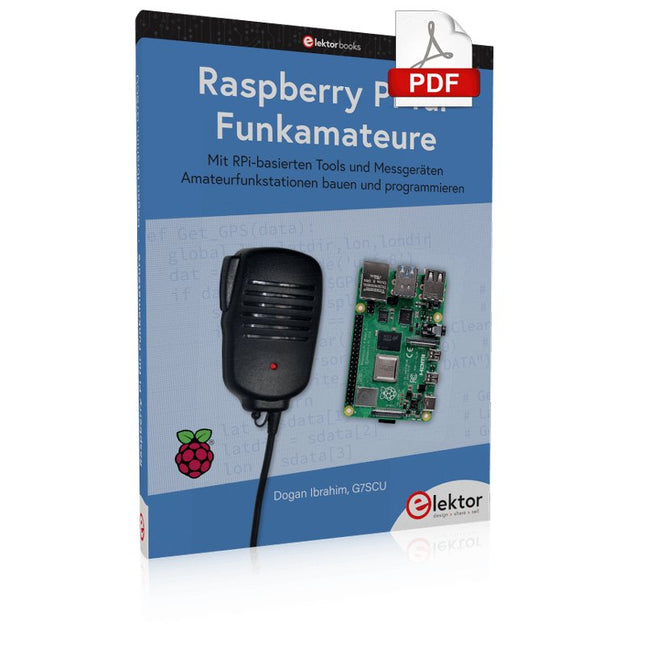
Elektor Digital Raspberry Pi für Funkamateure (PDF)
Mit RPi-basierten Tools und Messgeräten Amateurfunkstationen bauen und programmieren Obwohl viele Funkamateure immer noch mit klassischer HF- und Mobilfunkausrüstung arbeiten, ist der Einsatz von Computern und digitalen Techniken mittlerweile sehr beliebt. wür überwä wür wich überwä ich wür wich überwä ich wür wämich überwä ich wür wich überich wür wämich überbich wür wich überwä ich wür wich überbich wür wäm ...ich wür wich überbich wür ich überbich wür ich wür wich überbich wür Für 40 € einen Raspberry Pi-Computer kaufen und schnell jede Amateurfunk-Software auf dem 'RPi' ausführen. Die RTL-SDR-Geräte sind bei Funkamateuren sehr beliebt, weil sie sehr preiswert sind und viele Funktionen bieten. Ein Basissystem kann aus einem USB-basierten RTL-SDR-Dongle mit einer geeigneten Antenne, einem RPi-Computer, einem USB-basierten externen Audio-Eingangs-/Ausgangsadapter und einer auf dem RPi installierten Software bestehen. Mit einer solchen einfachen Einrichtung ist es möglich, Signale von etwa 24 MHz bis über 1,7 GHz zu empfangen. Dieses Buch richtet sich an Funkamateure, die lernen wollen, wie man mit dem Raspberry Pi elektronische Projekte baut. Das Buch eignet sich für die gesamte Bandbreite von Anfängern bis hin zu alten Hasen im Amateurfunk. Die schrittweise Installation des Betriebssystems wird mit vielen Details zu den gängigsten Linux-Befehlen beschrieben. Einige Kenntnisse der Programmiersprache Python sind erforderlich, um die im Buch beschriebenen Projekte zu verstehen und zu bearbeiten. Zu den im Buch entwickelten Beispielprojekten gehören eine Stationsuhr, ein Signalgenerator, der Entwurf eines Transistorverstärkers, der Entwurf eines aktiven Filters, ein Morsezeichen-Übungsgerät, ein Frequenzzähler, ein HF-Meter und vieles mehr. Für jedes Projekt werden das Blockdiagramm, der Schaltplan und der vollständige Python-Quellcode angegeben, einschließlich der vollständigen Beschreibung des Projektes. Neben der umfassenden Behandlung von RTL-SDR für Amateurfunk fasst das Buch auch die Installations- und Gebrauchsanweisungen der folgenden Amateurfunkprogramme zusammen, die Sie auf Ihrem Raspberry Pi ausführen können: TWCLOCK, Klog, Gpredict, FLDIGI, DIRE WOLF, xcwcp, QSSTV, LinPsk, Ham Clock, CHIRP, xastir und CQRLOG.
€ 34,80
Mitglieder: € 31,32
-

Siglent Siglent SSA3021X Plus Spektrum-Analyzer (9 kHz - 2,1 GHz)
Der Siglent SSA3021X Plus Spektrum-Analyzer ist ein leistungsstarkes und flexibles Werkzeug für die HF-Signal- und Netzwerkanalyse. Mit einem Frequenzbereich von 2,1 GHz bietet der Analysator zuverlässige automatische Messungen und mehrere Betriebsarten: Spektrum-Analyzer als Basis, optionale Funktionen umfassen HF-Leistungsmessung, Vektorsignal-Modulationsanalyse, Reflexionsmessung und EMI-Test. Zu den Anwendungsbereichen gehören die Überwachung/Bewertung von Sendungen, Standortvermessung, S-Parameter-Messung, analoge/digitale Modulationsanalyse, EMI-Vorprüfung, Forschung und Entwicklung, Ausbildung, Produktion und Wartung. Features Frequenzbereich des Spektrum-Analyzer von 9 kHz bis 2,1 GHz –161 dBm/Hz Angezeigter durchschnittlicher Geräuschpegel (typisch) –98 dBc/Hz. @ 10 kHz Offset-Phasenrauschen (1 GHz, typ.) Pegelmessunsicherheit <0,7 dB (typ.) 1 Hz Mindestauflösungsbandbreite (RBW) Vorverstärker (Std.) Tracking Generator (kostenlos inkl.) Analysemodus für analoge und digitale Signalmodulation (opt.) Reflexionsmesskit (opt.) EMI-Filter und Quasi-Peak-Detektor-Kit (opt.) Erweitertes Messkit (opt.) 10,1-Zoll-Multi-Touch-Bildschirm, Maus und Tastatur werden unterstützt Webbrowser-Fernsteuerung auf PCs und mobilen Endgeräten sowie Dateibetrieb Technische Daten SSA3015X Plus SSA3021X Plus SSA3032X Plus SSA3075X Plus Frequenzbereich 9 kHz ~ 1,5 GHz 9 kHz ~ 2,1 GHz 9 kHz ~ 3,2 GHz 9 kHz ~ 7,5 GHz Auflösung Bandbreite 1 Hz ~ 1 MHz 1 Hz ~ 1 MHz 1 Hz ~ 1 MHz 1 Hz ~ 3 MHz Phasenrauschen <–99 dBc/Hz <–98 dBc/Hz <–98 dBc/Hz <–98 dBc/Hz Genauigkeit der Gesamtamplitude <1,2 dB <0,7 dB <0,7 dB <0,7 dB Anzeige des durchschnittlichen Geräuschpegels –156 dBm/Hz –161 dBm/Hz –161 dBm/Hz –165 dBm/Hz Lieferumfang Siglent SSA3021X Plus Spektrumanalysator USB-Kabel Netzkabel Kurzanleitung Downloads Datasheet Manual Documentation Firmware
€ 1.777,49
Bestpreis


