
Suchergebnisse für "elektor OR 05 OR 06 OR 2020 OR de"
-
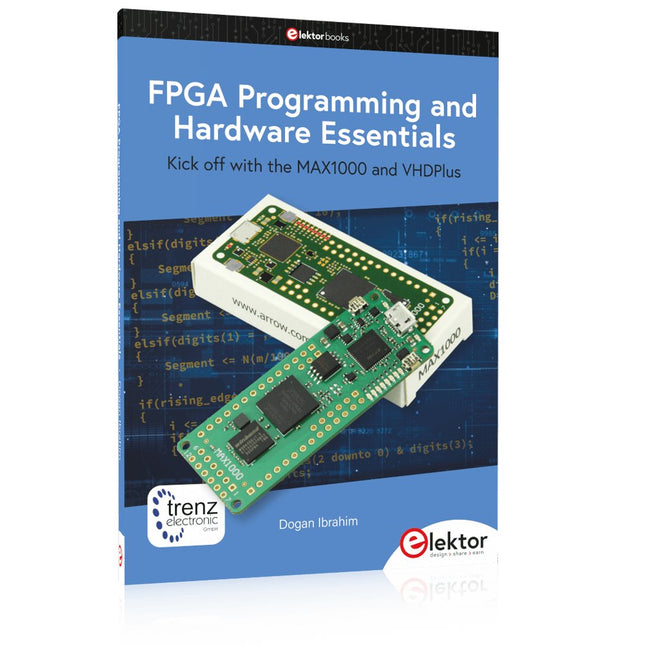
Elektor Publishing FPGA Programming and Hardware Essentials
Kick off with the MAX1000 and VHDPlus Ready to Master FPGA Programming? In this guide, we’re diving into the world of Field Programmable Gate Arrays (FPGAs) – a configurable integrated circuit that can be programmed after manufacturing. Imagine bringing your ideas to life, from simple projects to complete microcontroller systems! Meet the MAX1000: a compact and budget-friendly FPGA development board packed with features like memory, user LEDs, push-buttons, and flexible I/O ports. It’s the ideal starting point for anyone wanting to learn about FPGAs and Hardware Description Languages (HDLs). In this book, you’ll get hands-on with the VHDPlus programming language – a simpler version of VHDL. We’ll work on practical projects using the MAX1000, helping you gain the skills and confidence to unleash your creativity. Get ready for an exciting journey! You’ll explore a variety of projects that highlight the true power of FPGAs. Let’s turn your ideas into reality and embark on your FPGA adventure – your journey starts now! Exciting Projects You’ll Find in This Book Arduino-Driven BCD to 7-Segment Display Decoder Use an Arduino Uno R4 to supply BCD data to the decoder, counting from 0 to 9 with a one-second delay Multiplexed 4-Digit Event Counter Create an event counter that displays the total count on a 4-digit display, incrementing with each button press PWM Waveform with Fixed Duty Cycle Generate a PWM waveform at 1 kHz with a fixed duty cycle of 50% Ultrasonic Distance Measurement Measure distances using an ultrasonic sensor, displaying the results on a 4-digit 7-segment LED Electronic Lock Build a simple electronic lock using combinational logic gates with push buttons and an LED output Temperature Sensor Monitor ambient temperature with a TMP36 sensor and display the readings on a 7-segment LED Downloads Software
€ 39,95
Mitglieder: € 35,96
-

Elektor Digital Compilation Arduino (FR) | (E-book)
Cette compilation comprend des articles intégrés de l'actuel Elektor entre juillet 2012 et novembre 2014. Les documents suivants sont inclus dans le numéro de document (PDF) avec la fonction de navigation disponible et les articles sont intéressants.
€ 9,95
Mitglieder: € 8,96
-

Elektor Digital ESP32 & ESP8266 Compilatie (NL) | E-book
De ESP8266 van Espressif is een Wi-Fi microchip met volledige TCP/IP stack en functionaliteit van een microcontroller. Het heeft indruk gemaakt in de maker community met zijn lage prijs. Maar veel ontwikkelaars waren ontevreden over het hoge stroomverbruik van de ESP8266. De ESP32, uitgerust met een ULP (Ultra Low Power) coprocessor, biedt hiervoor een oplossing. Dit e-book bevat een aantal projecten met ESP32 & ESP8266 en een interview met de CEO Teo Swee Ann van Espressif. Artikelen Lichtkrant met ESP-12F, 512 LED’s via WiFi aansturen VFD-klok met ESP32, met nauwkeurige internettijd Zuinige ESP32, de programmering van de ULP-coprocessor DCF77-emulator met ESP8266, internettijd vervangt draadloze tijd WiFi desktop-thermostaat, flexibele en programmeerbare temperatuurregeling Timers voor de WiFi desktop-thermostaat, zeven kanalen met atoomprecisie Zwitsers zakmes voor microcontrollers, PlatformIO als universeel programmeertool ESP8266 USB-programmeer-adapter voor de Espressif-modules ESP-01 en ESP-012 De ESP8266 op het Android I/O-board, zelf nieuwe firmware flashen Weerdisplay, actuele weersinformatie op een kleuren-LCD GoNotify, een flexibele IoT sensor-interface. Join the bubble! CV-monitor met ESP8266, domotica voor de overgang naar duurzame energie MicroPython en het pyboard, van een knipperende LED naar … een knipperende LED aan een webserver De grote broer van de ESP8266, de eerste stappen met de ESP32 en de Arduino-IDE RGBDigit klok, een kleurrijk 7-segment-display voor uw data WLAN voor microcontrollers, besturen met de ESP8266 De terugkeer van de Wi-Fi-besturingskaart, apparatuur bedienen met uw smartphone Compact en autonoom WLAN, handig gebruik van de ESP8266 zonder MCU
€ 9,95
Mitglieder: € 8,96
-
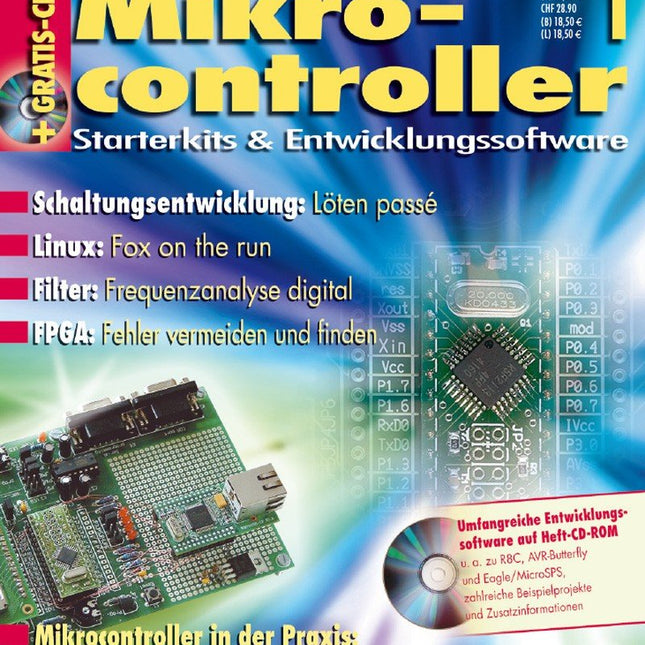
Elektor Digital Mikrocontroller 1 (PDF)
Die Artikel stellen Starterkits und Entwicklungssoftware verschiedener Hersteller anhand konkreter Aufgabenlösungen vor. Dabei lautet das Motto in den einzelnen Artikeln „Soviel Theorie wie nötig, soviel Praxis wie möglich“. Schritt für Schritt führen die Autoren in das Thema ein und führen den Leser bis zum gewünschten Erfolg.Inhalt:• TFH-System ONEModernes Mikrocontrollersystem für Lehre und Ausbildung; empfohlen von der PAL (Prüfungssaufgaben- und Lehrmittelentwicklungsstelle der IHK).• Elektronik „en bloc“Mit E-blocks lassen sich ohne Lötkolben und mit nur geringem Zeitaufwand Schaltungen entwickeln, programmieren und testen.• C-Control I Station 2.0BASIC zu programmierendes Computersystem mit einer Vielzahl Plug-an-Play-Module, auch für die professionelle Anwendung.• Das MicroSPS ProjektEAGLE bietet jetzt die Möglichkeit, Mikrocontrollerschaltungen durch Eingabe eines grafischen Funktionsplans zu entwickeln.• AT89LP EntwicklungsboardSteuerung und Programmierung erfolgen über die serielle Schnittstelle, gezeigt am Beispiel eines Elliptec-Piezo-Motors, die sich überall eignen, wo ein präziser, kleiner und leiser Antrieb nötig ist.• AVR-ButterflyLow-Cost-Tool mit dem ATmega169 für viele Anwendungen: u.a. für autonome Roboter, Wetterstation, Datenlogger.• PC-MCP2515-CAN-InterfaceEinfaches CAN-Interface für den PC mit umfangreichen Programmiermöglichkeiten.• Design-Rules für den FPGA-Entwurf in VHDLWas ist zu beachten, welche Methodik vermeidet Fehler und wie spürt man sie ggf. auf?• R8CVerschiedene Artikel befassen sich mit verschiedenen Themen: effiziente Programmierung, Verwendung in der Messtechnik, als DCF77-Funkuhr…• Einstieg in PSoCDie ersten Schritte mit dem PSoC-Starter-Kit von Cypress. Der Artikel vermittelt außerdem die Vorstellung davon, wo die Stärken der Mixed-Signal Controller liegen.Weitere Hefte aus dieser Reihe: Mikrocontroller 7 (PDF) Mikrocontroller 6 (PDF) Mikrocontroller 5 (PDF) Mikrocontroller 4 (PDF) Mikrocontroller 3 (PDF) Mikrocontroller 2 (PDF)
€ 16,90
Mitglieder: € 15,21
-
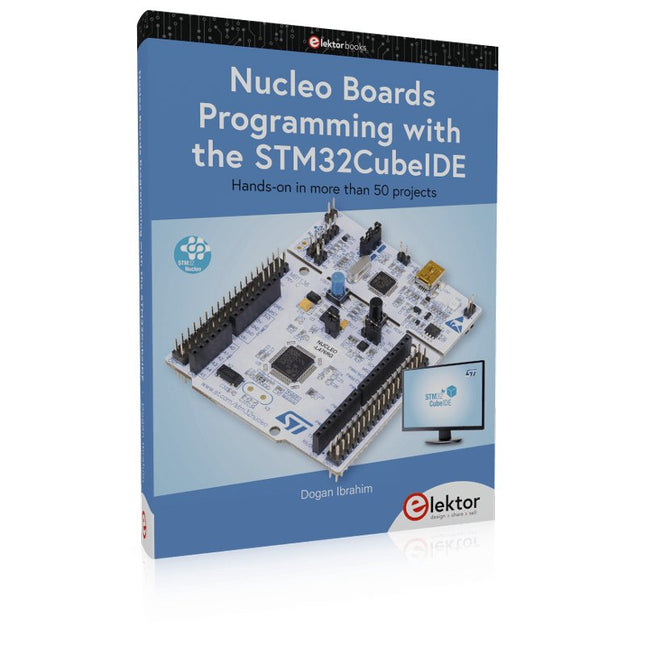
Elektor Publishing Nucleo Boards Programming with the STM32CubeIDE
Hands-on in more than 50 projects STM32 Nucleo family of processors are manufactured by STMicroelectronics. These are low-cost ARM microcontroller development boards. This book is about developing projects using the popular STM32CubeIDE software with the Nucleo-L476RG development board. In the early Chapters of the book the architecture of the Nucleo family is briefly described. The book covers many projects using most features of the Nucleo-L476RG development board where the full software listings for the STM32CubeIDE are given for each project together with extensive descriptions. The projects range from simple flashing LEDs to more complex projects using modules, devices, and libraries such as GPIO, ADC, DAC, I²C, SPI, LCD, DMA, analogue inputs, power management, X-CUBE-MEMS1 library, DEBUGGING, and others. In addition, several projects are given using the popular Nucleo Expansion Boards. These Expansion Boards plug on top of the Nucleo development boards and provide sensors, relays, accelerometers, gyroscopes, Wi-Fi, and many others. Using an expansion board together with the X-CUBE-MEMS1 library simplifies the task of project development considerably. All the projects in the book have been tested and are working. The following sub-headings are given for each project: Project Title, Description, Aim, Block Diagram, Circuit Diagram, and Program Listing for the STM32CubeIDE. In this book you will learn about STM32 microcontroller architecture; the Nucleo-L476RG development board in projects using the STM32CubeIDE integrated software development tool; external and internal interrupts and DMA; DEBUG, a program developed using the STM32CubeIDE; the MCU in Sleep, Stop, and in Standby modes; Nucleo Expansion Boards with the Nucleo development boards. What you need a PC with Internet connection and a USB port; STM32CubeIDE software (available at STMicroelectronics website free of charge) the project source files, available from the book’s webpage hosted by Elektor; Nucleo-L476RG development board; simple electronic devices such as LEDs, temperature sensor, I²C and SPI chips, and a few more; Nucleo Expansion Boards (optional).
€ 49,95
Mitglieder: € 44,96
-

€ 32,95
Mitglieder: € 29,66
-

Elektor Digital Geheimnisse der Elektronik erklärt (E-book)
Autor Robert Lacoste, ein hochrangiger Elektronikingenieur, hat für professionelle Elektronik-Zeitschriften eine Serie von Grundlagenartikeln geschrieben, die hier in einem Buch zusammengefasst sind. Wichtige Themen wie Taktgeber, Filter, analoge Signalverarbeitung, digitale Kommunikation und viele weitere werden verständlich erklärt. Der Autor zeigt Ihnen dabei, wie Sie die Thematik besser verstehen und Ihr Wissen erweitern können, ohne mathematischen Ballast. Mit einfachen Worten erklärt der Autor, wie es funktioniert, und warum es manchmal nicht so funktioniert, wie man es will. Damit stoßen Sie nicht nur an Ihre eigenen Grenzen, sondern wissen auch, wo die Grenzen der von Ihnen verwendeten Geräte liegen. So wird es Ihnen ermöglicht, den tatsächlichen technischen Fortschritt von rein kommerziellen Aussagen zu trennen. Woher kommt die Empfindlichkeit eines Funkwellenempfängers? Warum läuft das Herunterladen eines Videos auf ein Handy auf dem Land viel langsamer ab als in der Innenstadt? Wenn für Sie die technischen Antworten auf Fragen wie diese nicht offensichtlich sind, wird Ihnen dieses Buch helfen, die Dinge klarer zu sehen.
€ 32,80
Mitglieder: € 29,52
-

Elektor Digital Computer Vision (PDF)
Computer Vision ist das wohl spannendste Gebiet der Bildverarbeitung und die Zahl der Anwendungen in der Robotik, Automatisierungstechnik und Qualitätssicherung nimmt stetig zu. Leider gestaltet sich der Zugang zu diesem Forschungsbereich bisher nicht einfach. Interessierte müssen sich zunächst durch viele Bücher, Publikationen und Software-Bibliotheken arbeiten.Mit dem vorliegenden Buch dagegen fällt der Einstieg leicht. Die theoretisch fundierten Inhalte sind gut verständlich dargestellt und werden durch viele Beispiele aus der Praxis ergänzt. Die abgedruckten und online verfügbaren Implementierungen sind in der Programmiersprache C/C++ mit der am Lehrstuhl entwickelten, plattformunabhängigen Open-Source-Bibliothek IVT erstellt. Die Verwendung der IVT ist dabei keine Voraussetzung, erleichtert jedoch wesentlich den Einstieg und ermöglicht schnell erste eigene Entwicklungen.Die Autorenschaft setzt sich aus Mitarbeitern des Lehrstuhls von Herrn Prof. Dr.-Ing. Rüdiger Dillmann am Institut für Technische Informatik (ITEC) der Universität Karlsruhe (TH) zusammen, die in vielen Forschungs- und Industrieprojekten umfangreiche Erfahrung in der Bildverarbeitung sammeln konnten und auch in der Lehre gelernt haben, dieses Wissen weiterzugeben.Im Grundlagenteil des Buches werden u. a. behandelt: Beleuchtung, Optik, Kameratechnik, Übertragungsstandards, Kamerakalibrierung, Bildaufbereitung, Segmentierung, Filter, Korrelation und Stereosehen.Im Praxisteil wird die effiziente Implementierung der Algorithmen vermittelt, gefolgt von vielen interessanten und erprobten Anwendungen wie Barcode-Leser, Stereokamerasystem, Sicherheitstechnik, Objekterkennung, 3D-Scannen, 3D-Tracking und vieles mehr.Mehr Infos:http://wwwiaim.ira.uka.de/computer-vision/
€ 39,80
Mitglieder: € 35,82
-
Elektor Digital Elektronik für Einsteiger (PDF)
Ist ein solches Buch in Zeiten der Computer und Mikrocontroller noch aktuell? Die Antwort lautet eindeutig: Ja! Hierfür gibt es drei gewichtige Gründe.Einmal ist die Theorie und der Aufbau analoger und digitaler Schaltungen nicht nur sehr lehrreich, sondern vermittelt auch unschätzbare Erfahrungen und Elektronik-Grundkenntnisse.Auch wenn zum anderen durch den technischen Fortschritt sich fast alle Anwendungen per Computer und Mikrocontroller realisieren lassen, ist es in vielen Fällen einfach 'overdressed' (um es neudeutsch auszudrücken). Einfacher und preiswerter wäre dann die konventionelle Lösung.Schließlich sind Kenntnisse in der Elektronik Voraussetzung für den erfolgreichen Umgang mit der Mikrocontrollertechnik.Apropos Grundkenntnisse: Dieses Buch enthält nicht nur Schaltungsvorschläge, sondern auch eine Reihe Artikel, die die theoretischen Grundlagen einer Schaltung verständlich beschreiben. Somit ist das vorliegende Buch nicht nur für Elektronik-Laien geeignet, sondern auch für all diejenigen, die sich aus beruflichen Gründen in die Materie einarbeiten möchten.Aus dem Inhalt:Wissenswertes über Strom und Spannung • Elektrizität und Magnetismus • Kondensatoren und Spulen • Halbleiter • Praktische Schaltungen für Labor und Werkstatt • Oszillatoren • Synthetische Klänge • Musik-Elektronik • Audio-Schaltungen • Opto-Elektronik • Haus- und Hof-Elektronik • Hochfrequenz • Spezial-ICs
€ 34,80
Mitglieder: € 31,32
-

€ 9,95
Mitglieder: € 8,96
-

Elektor Digital CAN et CAN FD (E-book)
Tout sur les protocoles et leur mise en œuvre avec Arduino Initialement destiné aux véhicules routiers, le réseau CAN (« Controller Area Network ») et son successeur le réseau CAN FD (« Flexible Data ») ont vu leurs champs d’application s’élargir à de nouveaux domaines. L’industrie propose de nombreux modules microcontrôleurs dotés d’une interface CAN et/ou CAN FD. L’environnement de développement Arduino a démocratisé la programmation de ces modules et il existe des bibliothèques qui implémentent un pilote CAN et/ou un pilote CAN FD. La première partie dresse un rapide historique des réseaux CAN et CAN FD et expose la problématique des lignes de transmission en abordant succinctement leur théorie et présentant des résultats de simulation Spice. La deuxième partie est consacrée au réseau CAN, en détaillant successivement la fonction logique du réseau, les transcepteurs, les contrôleurs, la topologie la plus classique (le bus) et d’autres moins courantes, les répéteurs et les passerelles. Les aspects particuliers du protocole, tels que le bit stuffing, l’arbitrage, les trames d’erreur, la détection des erreurs sont exposés. La discussion de la fiabilité du protocole est illustrée par des exemples mettant en évidence ses faiblesses. La troisième partie présente le protocole CAN FD, ses deux variantes CAN FD ISO et CAN FD non ISO, leurs fiabilités, leurs faiblesses, mises en évidence par des exemples. Différents transcepteurs et contrôleurs CAN FD sont décrits. La quatrième partie est dédiée aux applications : comment utiliser les services d’un pilote, concevoir une messagerie, utiliser un analyseur logique. Deux exemples d’application terminent cette partie. Ce livre s’adresse aux amateurs et aux ingénieurs non spécialistes pour comprendre les possibilités qu’offre un réseau CAN et comment on le met en œuvre. Un enseignant trouvera des informations pour approfondir ses connaissances et pour concevoir des travaux pratiques. Une connaissance des microcontrôleurs, de leur programmation, de l’électronique numérique aidera à la lecture des schémas. La connaissance du langage C++ et du langage de simulation électronique Spice facilitera la compréhension des programmes qui sont décrits dans le livre. Tous les codes source sont disponibles sur le dépôt GitHub de l’auteur. Téléchargements GitHub
€ 34,95
Mitglieder: € 31,46
-

Elektor Publishing Tektronix 7000 Series Mainframes
The Most Iconic Oscilloscopes in Electronics History The 7000 Series was the most iconic family of oscilloscopes in the history of technology. Introduced in 1969 by Tektronix, the sector’s leader at the time, this remarkable line of instruments defined an era and became a benchmark for generations of engineers, researchers, and technicians. Throughout the 1970s and well beyond, 7000-Series oscilloscopes were a constant presence in laboratories, universities, and industrial facilities around the world. Their modular plug-in architecture, exceptional flexibility, and outstanding performance embodied the engineering philosophy that made Tektronix synonymous with accuracy, innovation, and reliability. This book offers an in-depth exploration of the 7000-Series oscilloscopes, combining historical context, technical analysis, and practical insight into their design and restoration. Conceived as a continuation of Tektronix Epic Oscilloscopes, this work expands the subject into two volumes: the first devoted to mainframes and core technologies, the second focused entirely on plug-ins.
€ 69,95€ 54,95Bestpreis


