
Suchergebnisse für "wireless OR high OR power OR transmission"
-

OWON OWON VDS1022I 2-ch USB Oscilloscope (25 MHz)
OWON VDS1022I 2-Kanal USB-Oszilloskop (25 MHz) ist ein Oszilloskop für die Verwendung mit einem Computer. Es wird über USB mit Strom versorgt und hat eine kleine Größe, was es leicht macht, es mitzunehmen. Das Oszilloskop ist sehr wirtschaftlich. Es verfügt über eine abgeschirmte USB-Verbindung, die Störungen reduziert und den Computer vor Überspannung schützt. Der Mehrfachport am Oszilloskop kann für externes Triggern, Triggerausgabe oder Pass/Fail-Ausgabe verwendet werden. Features 25 MHz Bandbreite und maximale Echtzeit-Abtastrate von 1 GS/s 10 Mio. Aufzeichnungslänge Benutzerfreundliche Oberfläche: FFT, X-Y und Wellenform-2-Ansichten werden auf demselben Bildschirm angezeigt Mehrere Triggeroptionen: Flanke, Video, Steigung, Puls und Alternativ USB-Isolierung - weniger Signalstörungen, mehr PC-Schutz USB-Bus-Stromversorgung und LAN-Fernsteuerung (optional) Ultra flaches Gehäusedesign für einfache Transportierbarkeit. Technische Daten Bandbreite 25 MHz Kanal 2+1 (mehrfach) Abtastrate 100 MSa/s Horizontale Skala (s/div) 5 ns/div~100s/div, Schrittweite 1~2~5 Datensatzlänge 5K Max. Eingangsspannung 400 V (PK - PK) (DC+AC, PK - PK) 40 V (PK - PK) (DC+AC, PK - PK) Vertikale Auflösung (A/D) 8 Bit (2 Kanäle gleichzeitig) Modell VDS1022I Vertikale Empfindlichkeit 5 mV/div~5 V/div Triggertyp Flanken-, Impuls-, Video-, Steilheits- und Wechselauslösung Auslösemodus Auto, Normal und Einzeln Aufnahmemodus Stichprobe, Spitzenwert-Erkennung und Durchschnitt Wellenform Mathematik +, -, ×, ÷, invertieren, FFT Kommunikationsschnittstelle USB 2.0 (Isolierung) Multifunktion Schnittstelle Signaltyp Pegel Standard TTL Stromversorgung 5,0 V/1 A Leistungsaufnahme ≤2,5 W Abmessungen (B × H × T) 170 x 120 x 18 mm Gewicht 0,26 kg Lieferumfang 1x OWON VDS1022I Oszilloskop 1x CD-ROM 1x Schnellstartanleitung 2x Oszilloskop-Tastkopf 1x Tastkopfwerkzeug 1x Netzteil 1x USB-Kabel 1x Silikonhüllen-Schutz 1x Stromkabel Downloads Datenblatt Benutzerhandbuch SCPI-Protokoll USB-Driver
€ 117,03
-

Elektor Digital LTspice Essentials (E-book)
An Introduction to Circuit Simulation LTspice, developed by Analog Devices, is a powerful, fast, and free SPICE simulator, schematic capture, and waveform viewer with a large database of components supported by SPICE models from all over the world. Drawing a schematic in LTspice is easy and fast. Thanks to its powerful graphing features, you can visualize the voltages and currents in a circuit, and also the power consumption of its components and much more. This book is about learning to design and simulate electronic circuits using LTspice. Among others, the following topics are treated: DC and AC circuits Signal diodes and Zener diodes Transistor circuits including oscillators Thyristor/SCR, diac, and triac circuits Operational amplifier circuits including oscillators The 555 timer IC Filters Voltage regulators Optocouplers Waveform generation Digital logic simulation including the 74HC family SPICE modeling LTspice is a powerful electronic circuit simulation tool with many features and possibilities. Covering them all in detail is not possible in a book of this size. Therefore, this book presents the most common topics like DC and AC circuit analysis, parameter sweeping, transfer functions, oscillators, graphing, etc. Although this book is an introduction to LTspice, it covers most topics of interest to people engaged in electronic circuit simulation. The book is aimed at electronic/electrical engineers, students, teachers, and hobbyists. Many tested simulation examples are given in the book. Readers do not need to have any computer programming skills, but it will help if they are familiar with basic electronic circuit design and operation principles. Readers who want to dive deeper can find many detailed tutorials, articles, videos, design files, and SPICE circuit models on the Internet. All the simulation examples used in the book are available as files at the webpage of this book. Readers can use these example circuits for learning or modify them for their own applications.
€ 32,95
Mitglieder: € 29,66
-

Sensepeek Sensepeek 6003 PCBite Kit inkl. 4x SQ10-Tastkopf und Prüfkabel
Die freihändigen PCBite-Tastköpfe der SQ-Serie von Sensepeek sind isoliert, werden mit farbcodierten Kabelhaltern geliefert und haben einen niedrigeren Schwerpunkt, wodurch sie im Vergleich zu den Sonden der ursprünglichen SP-Serie noch stabiler sind. Alle beliebten Funktionen der freihändigen Messung, die austauschbare Prüfnadel mit feiner Steigung und das minimalistische Design werden beibehalten, um herkömmliche und handgehaltene Sonden überflüssig zu machen. Features Alle freihändigen Tastköpfe von Sensepeek machen sofortige Messungen oder lange Triggersitzungen zum Kinderspiel. Keine Lötdrähte mehr zum Anschließen Ihres Tastkopfs oder komplizierte Werkzeuge zum Einrichten, sondern einfach die Sondennadel auf einem beliebigen Testpunkt oder einer beliebigen Komponente im Signalpfad positionieren und loslassen. Spart Zeit und Frust bei der Entwicklung, Überprüfung und Reparatur. Das minimalistische Design und die federbelastete Prüfnadel ermöglichen die gleichzeitige Messung von Fine-Pitch-Komponenten und nahegelegenen Signalen. Sowohl Länge als auch Gewicht der SQ-Tastköpfe sind perfekt ausbalanciert, um mit den mitgelieferten PCB-Haltern und der Grundplatte verwendet zu werden, was ein Muss für die Freisprechfunktion ist. Der Sondenhalter wird wie alle PCBite-tastköpfe und -Halter mit einem starken Magneten in der Basis geliefert, wodurch die Tastköpfe leicht zu platzieren und neu zu positionieren ist. Die Tastköpfe der SQ-Serie können ohne den Sondenhalter in der Hand verwendet werden, da sie einen isolierten Griff haben, aber ihr volles Potenzial wird beim Freihandmessen genutzt. Eine Seite der mitgelieferten Grundplatte ist matt und die andere hochglanzpoliert. Die hochglanzpolierte Oberfläche macht es einfach, Komponenten auf der Unterseite der Leiterplatte zu sehen. Für zusätzlichen Schutz während der Messung kann die mitgelieferte Isolierabdeckung auf einer der Oberflächen montiert werden. Lieferumfang 4x PCBite Platinenhalter 1x Satz gelbe Isolierscheiben für die Platinenhalter 1x große Grundplatte (A4) 1x Isolierabdeckung für die Bodenplatte (A4) 1x Mikrofasertuch 4x SQ10 Tastköpfe und Prüfnadeln mit Stiftspitze (schwarz) 2x Bananen-zu-Dupont-Prüfkabel (rot/schwarz) 5x Dupont-zu-Dupont-Prüfkabel 1x Kabelhalter-Set (4 Farben) 4x Extra Testnadeln Downloads User guide (PCBite kit) User guide (SQ10 probes)
€ 177,31
-

Speciale Elektor / E&M: 33 Progetti Top di Elettronica
Una ricca selezione di articoli dal Mondo Elektor! Gli articoli di questo libro sono una selezione accurata, il "meglio del meglio" di circuiti e progetti recenti, realizzati da tecnici di grande talento provenienti da tutto il mondo. Nel tipico stile di Elektor, questa raccolta offre qualcosa di interessante per tutti, dai progettisti esperti a coloro che praticano l'elettronica nel tempo libero. Sommario Super Servo TesterProva Fino a Quattro Servocomandi, Stand-Alone o in Sistema The TubeUn Insolito Amplificatore a Valvole Cloc 2.0La Sveglia che Avete Sempre Desiderato Stazione Meteo LoRa Low-PowerCostruitevi una Stazione Meteorologica “Long Range” Uscita Video con Microcontrollori (Parte 1)Video Composito Uscita Video con Microcontrollori (Parte 2)Uscita VGA e DVI Un Raspberry Pi Pico come Analizzatore di SpettroFFT su Base Hardware a Basso Costo PIC O’Clock – In Contatto col TempoProgettare un Ricevitore di Segnali Orari SDR Frequenzimetro di Rete ACMisura Frequenza e Tensione della Rete Elettrica Generatore di Funzioni con Arduino NanoNano + Codice = Generatore di Funzioni Monitor CO2Un Approccio Fai-Da-Te per Il Controllo della Qualità dell‘Aria ChatMagLevLa Levitazione Magnetica con AI Alimentatore Lineare Variabile Combinato0…50 V / 0…2 A con Struttura Simmetrica Duale Ricevitore Digitale FM con Arduino e TEA5767Restate in Ascolto con un Arduino Nano Protezione Antigelo per Piante da FruttoCon Registrazione della Temperatura Carico Elettronico con Generatore di clock IntegratoPer Collaudare Alimentatori, Convertitori di Tensione e Batterie 128 Termostato Web con ESP32Mantieni il Vino alla Giusta Temperatura Iniezione di Segnali e di Potenza......per Rilevare le Interruzioni nei Cavi DIY LiPo Supercharger KitDal Prototipo al Mercato di Massa Livella Digitale con Stroboscopio AttivoCalibra il Tuo giradischi con Questo Strumento "Tutto-in-Uno" The Game of Life – 262.144 Modi di GiocareDal Progetto di un Lettore Rilevatore di PerditeCollegato ad Arduino Cloud Orologio di LissajousL’Incedere del Tempo con le Figure di Lissajous Mastermind – Controllato da ArduinoUna Versione Moderna del Classico Gioco di Decifrazione Generatore Audio Analogico 1 kHzOnda Sinusoidale a Bassa Distorsione Aggiorna il tuo Caricabatteria (Parte 1)Non Buttarlo, Modificalo! Aggiorna il tuo Caricabatteria (Parte 2)Non Buttarlo, Modificalo! Sistemi GNSS RTK a Basso CostoCon Accuratezza a Livello Centimetrico Esperimenti a 10 GHz con LNB Satellitari ModificatiSbloccare la Banda X a Basso Costo Telecamera per FerromodellismoInstalla un Modulo ESP32 CAM a Bordo! Monitor di Tensione con MicrocontrolloreProtezione dalla Scarica Profonda per Batterie e Altro Nodo Sensore AutonomoTrasmissione Dati LoRa con Alimentazione a Batterie Solari Layout e Sicurezza sul PCBConsigli per un Progetto Sicuro e Durevole
€ 29,95
Mitglieder: € 26,96
-

Elektor Digital Elektor Espressif Guest Edition (PDF)
Elektor GREEN and GOLD members can download their digital edition here. Not a member yet? Click here. Accelerating IoT Innovation A Color E-Ink Wi-Fi Picture Frame ESP-Launchpad TutorialFrom Zero to Flashing in Minutes ESP32 and ChatGPTOn the Way to a Self-Programming System… Walkie-Talkie with ESP-NOWNot Quite Wi-Fi, Not Quite Bluetooth! From Idea to Circuit with the ESP32-S3A Guide to Prototyping with Espressif Chips AIoT Chip InnovationAn Interview With Espressif CEO Teo Swee-Ann Simulate ESP32 with WokwiYour Project’s Virtual Twin Trying Out the ESP32-S3-BOX-3A Comprehensive AIoT Development Platform Electronics Workspace EssentialsInsights and Tips From Espressif Engineers The ESP RainMaker StoryHow We Built “Your” IoT Cloud Assembling the Elektor Cloc 2.0 KitAn Elektor Product Unboxed by Espressif Unleashing the ESP32-P4The Next Era of Microcontrollers Rust + EmbeddedA Development Power Duo Who Are the Rust-Dacious Embedded Developers?How Espressif is Cultivating Embedded Rust for the ESP32 Espressif’s Series of SoCs Building a PLC with Espressif SolutionsWith the Capabilities and Functionality of the ISOBUS Protocol The ESP32-S3 VGA BoardBitluni’s Exciting Journey Into Product Design Acoustic Fingerprinting on ESP32Song Recognition With Open-Source Project Olaf Circular Christmas Tree 2023A High-Tech Way to Celebrate the Holiday Season A Simpler and More Convenient LifeAn Amateur Project Based on the Espressif ESP8266 Module How to Build IoT Apps without Software ExpertiseWith Blynk IoT Platform and Espressif Hardware Building a Smart User Interface on ESP32 Quick & Easy IoT Development with M5Stack Prototyping an ESP32-Based Energy Meter A Value-Added Distributor for IoT and More In-Depth Insights: Interview With Arduino on the Nano ESP32Alessandro Ranellucci and Martino Facchin Discuss Espressif Collaboration Your AIoT Solution ProviderInsights From Espressif Streamlining MCU Development With ESP-IDF Privilege Separation An Open-Source Speech Recognition Server……and the ESP BOX The Thinking EyeFacial Recognition and More Using the ESP32-S3-EYE ESP32-C2-Based Coin Cell SwitchDesign and Performance Evaluation The Smart Home Leaps Forward with MatterUnlocking Smart Home IoT Potential Tech the Future: Where Is Smart Home IoT Headed?
€ 7,50
-
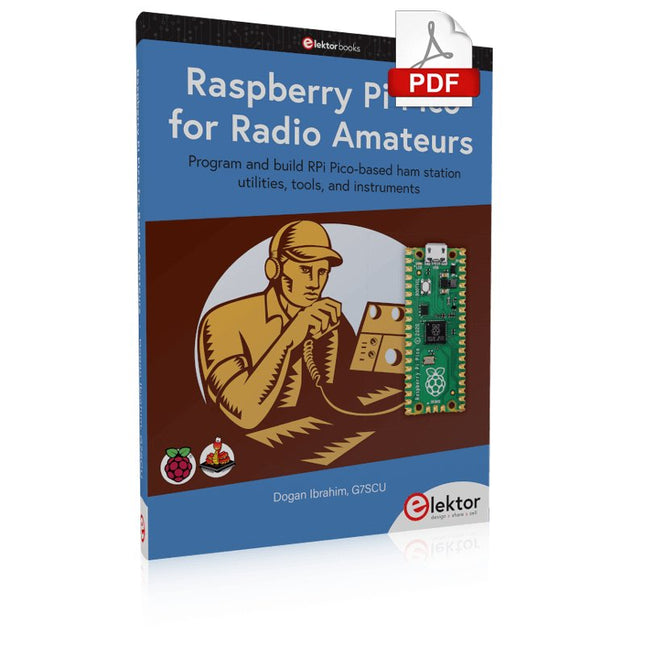
Elektor Digital Raspberry Pi Pico for Radio Amateurs (E-book)
Program and build RPi Pico-based ham station utilities, tools, and instruments Although much classical HF and mobile equipment is still in use by large numbers of amateurs, the use of computers and digital techniques has now become very popular among amateur radio operators. Nowadays, anyone can purchase a €5 Raspberry Pi Pico microcontroller board and develop many amateur radio projects using the “Pico” and some external components. This book is aimed at amateur radio enthusiasts, Electronic Engineering students, and anyone interested in learning to use the Raspberry Pi Pico to shape their electronic projects. The book is suitable for beginners in electronics as well as for those with wide experience. Step-by-step installation of the MicroPython programming environment is described. Some knowledge of the Python programming language is helpful to be able to comprehend and modify the projects given in the book. The book introduces the Raspberry Pi Pico and gives examples of many general-purpose, software-only projects that familiarize the reader with the Python programming language. In addition to the software-only projects tailored to the amateur radio operator, Chapter 6 in particular presents over 36 hardware-based projects for “hams”, including: Station mains power on/off control Radio station clock GPS based station geographical coordinates Radio station temperature and humidity Various waveform generation methods using software and hardware (DDS) Frequency counter Voltmeter / ammeter / ohmmeter / capacitance meter RF meter and RF attenuators Morse code exercisers RadioStation Click board Raspberry Pi Pico based FM radio Using Bluetooth and Wi-Fi with Raspberry Pi Pico Radio station security with RFID Audio amplifier module with rotary encoder volume control Morse decoder Using the FS1000A TX-RX modules to communicate with Arduino
€ 32,95
Mitglieder: € 29,66
-
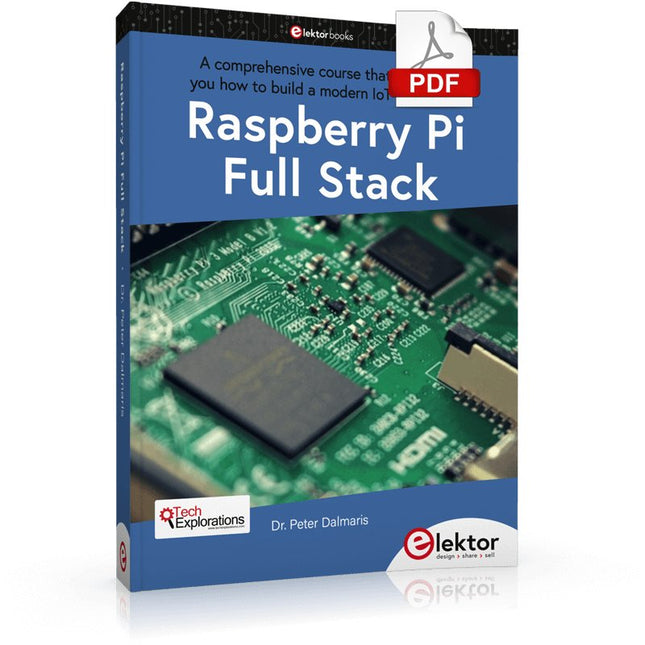
Elektor Digital Raspberry Pi Full Stack (E-book)
Dieses Buch nimmt Sie mit auf eine spannende Tour durch die Entwicklung von Full-Stack-Webanwendungen mit Raspberry Pi. Sie lernen, wie Sie eine Anwendung von Grund auf erstellen. Sie erwerben Erfahrung und Wissen über Technologien, darunter: Das Linux-Betriebssystem und die Befehlszeile. Die Programmiersprache Python. Die GPIOs (General Purpose Input Output Pins) des Raspberry Pi. Der Nginx-Webserver. Flask Python-Mikroframework für Webanwendungen. JQuery und CSS zum Erstellen von Benutzeroberflächen. Umgang mit Zeitzonen. Erstellen von Diagrammen mit Plotly und Google Charts. Datenerfassung mit Google Sheet. Entwickeln von Applets mit IFTTT. Sichern Sie Ihre Anwendung mit SSL. Empfangen Sie mit Twilio Textnachrichten auf Ihrem Telefon. In diesem Buch erfahren Sie außerdem, wie Sie einen drahtlosen Arduino-Sensorknoten aus der Ferne einrichten und Daten von ihm sammeln. Ihre Raspberry Pi-Webanwendung kann Arduino-Knotendaten auf die gleiche Weise verarbeiten, wie sie Daten von ihrem integrierten Sensor verarbeitet. Raspberry Pi Full Stack vermittelt Ihnen viele Fähigkeiten, die für die Erstellung von Web- und Internet-of-Things-Anwendungen unerlässlich sind. Die Anwendung, die Sie in diesem Projekt erstellen, ist eine Plattform, die Sie erweitern können. Dies ist nur der Anfang dessen, was Sie mit einem Raspberry Pi und den Software- und Hardwarekomponenten tun können, die Sie lernen werden. Dieses Buch wird vom Autor durch einen eigenen Diskussionsbereich unterstützt.
€ 34,95
Mitglieder: € 31,46
-

FNIRSI FNIRSI HT-P1B Pro Mini-Heizplatte (150 W)
Die FNIRSI HT-P1B Pro ist eine kompakte Mini-Heizplatte, die speziell für das Löten und Entlöten von Leiterplatten (PCBs) sowie für SMD-Nacharbeiten entwickelt wurde. Mit einer Heizleistung von bis zu 150 W, einer präzisen PID-Temperaturregelung und einem einstellbaren Temperaturbereich von 100 °C bis 350 °C ermöglicht sie ein schnelles und stabiles Aufheizen für Elektronikprojekte. Die 50 x 50 mm große Heizfläche ist ideal für kleine Leiterplatten und elektronische Bauteile geeignet. Zwei Betriebsmodi – Heizen mit konstanter Temperatur und simuliertes Reflow-Löten – bieten Flexibilität für verschiedene Anwendungen. Ein 1,44-Zoll-Farbdisplay, drei voreingestellte Temperaturstufen und integrierte Sicherheitsfunktionen sorgen für eine komfortable Bedienung. Dank der Unterstützung für DC-Stromversorgung und USB-C PD 3.1, dem kompakten Design sowie dem im Lieferumfang enthaltenen 100-W-USB-C-Netzteil ist die HT-P1B Pro ein praktisches Werkzeug für Maker, Elektronik-Enthusiasten und Reparaturprofis. Features Bis zu 150 W Heizleistung: Schnelles Aufheizen mit einstellbaren Leistungsstufen von 30 W bis 150 W. Präzise PID-Temperaturregelung: Einstellbarer Bereich von 100°C bis 350°C mit einer Temperaturstabilität von ±3°C. Zwei Betriebsmodi: Heizen mit konstanter Temperatur und Simulation von Reflow-Lötprozessen. 50 × 50 mm Heizfläche: Ideal für kleine Leiterplatten (PCBs), SMD-Löten und die Nachbearbeitung von Bauteilen. Flexible Stromversorgung: DC 12–28 V (bis zu 150 W) und USB-C PD 3.1 (bis zu 140 W). Drei Temperatur-Presets: Schneller Zugriff auf häufig verwendete Temperatureinstellungen. 1,44-Zoll-Farbdisplay: Zeigt Temperatur, Spannung, Leistung, Heizdauer und Betriebszustand an. Integrierte Sicherheitsfunktionen: Schutz vor Übertemperatur, Unterspannung, zu langer Heizdauer sowie Neigungserkennung. Technische Daten Stromversorgung DC 12–28 V / USB-C PD Leistungsbereich 30–150 W Standby-Leistungsaufnahme 1,6 W Temperaturbereich 100–350°C Temperaturstabilität ±3 °C Heizfläche 50 x 50 mm Display 1,44"-Farbbildschirm Neigungserkennung 20°–50° Protokoll PD 3.1 Abmessungen 68,8 x 81,8 x 44,5 mm Gewicht 157 g Lieferumfang 1x FNIRSI HT-P1B Vorheizstation 1x FNIRSI 100 W PD-GaN-Ladegerät (EU) 1x FNIRSI 100 W USB-C Schnellladekabel 1x Hitzebeständige Silikonabdeckung 1x Aufbewahrungstasche 1x Manual Downloads Manual
€ 99,95€ 84,95Bestpreis
-

Elektor Digital Internet of Things (E-book)
The Internet of Things (IoT) is a new concept in intelligent automation and intelligent monitoring using the Internet as the communications medium. The “Things” in IoT usually refer to devices that have unique identifiers and are connected to the Internet to exchange information with each other. Such devices usually have sensors and/or actuators that can be used to collect data about their environments and to monitor and control their environments. The collected data can be processed locally or it can be sent to centralized servers or to the cloud for remote storage and processing. For example, a small device at the size of a matchbox can be used to collect data about the temperature, relative humidity and the atmospheric pressure. This data can be sent and stored in the cloud. Anyone with a mobile device can then access and monitor this data at any time and from anywhere on Earth provided there is Internet connectivity. In addition, users can for example, adjust the central heating remotely using their mobile devices and accessing the cloud. This book is written for students, for practising engineers and for hobbyists who want to learn more about the building blocks of an IoT system and also learn how to setup an IoT system using these blocks. Chapter 1 is an introduction to the IoT systems. In Chapter 2, the basic concepts and possible IoT architectures are discussed. The important parts of any IoT system are the sensors and actuators and they are described briefly in Chapter 3. The devices in an IoT system usually communicate with each other and the important aspect of IoT communication is covered in Chapter 4. Chapter 5 proceeds with the features of some of the commonly used development kits. One of these, the Clicker 2 for PIC18FJ manufactured by mikroElektronika, can be used as a processor in IoT systems and its features are described in detail in Chapter 6. A popular microcontroller C language, mikroC Pro for PIC gets introduced in Chapter 7. Chapter 8 covers the use of a click board with the Clicker 2 for PIC18FJ development kit. Similarly, the use of a sensor click board is described as a project in Chapter 9, and an actuator board in Chapter 10. Chapters 11 and 12 cover Bluetooth and Wi-Fi technologies in microcontroller based systems, and the remaining chapters of the book demo the creation of a simple Wi-Fi based IoT system with cloud-based data storage. This book has been written with the assumption that the reader has taken a course on digital logic design and has been exposed to writing programs using at least one high-level programming language. Knowledge of the C programming language will be very useful. Also, familiarity with at least one member of the PIC series of microcontrollers (e.g. PIC16 or PIC18) will be an advantage. The knowledge of assembly language programming is not required because all the projects in the book are based on using the C language. If you are a total beginner in programming you can still access the e-book, but first you are advised to study introductory books on microcontrollers.
€ 34,95
Mitglieder: € 31,46
-

Siglent Siglent SDS1202X-E 2-Kanal Oszilloskop (200 MHz)
Die SDS1000X-E-Serie von SIGLENT ist ein Superphosphor-Oszilloskop und ist in einem Bandbreite von 200 MHz erhältlich. Es hat eine maximale Abtastrate von 1 GSa/s und eine Standardaufzeichnungslänge von 1 Mpts. Für eine einfache Bedienung können die am häufigsten verwendeten Funktionen über das benutzerfreundliche Frontpanel aufgerufen werden. Die SDS1000X-E-Serie verwendet eine neue Generation von SPO (Super Phosphor Oscilloscope)-Technologie, die eine ausgezeichnete Signalgenauigkeit und Leistung bietet. Das Systemrauschen ist auch niedriger als bei ähnlichen Produkten in der Branche. Es verfügt über einen minimalen vertikalen Eingangsbereich von 500 uV/div, ein innovatives digitales Trigger-System mit hoher Empfindlichkeit und geringem Jitter sowie eine Wellenform-Capture-Rate von 400.000 Frames/Sek. (Sequenzmodus). Die SDS1000X-E verfügt auch über eine 256-stufige Intensitätsgradierungsfunktion und einen Farbtemperatur-Display-Modus, die in anderen Modellen dieser Klasse nicht zu finden sind. Die neuesten Oszilloskope von Siglent bieten mehrere leistungsstarke Trigger-Modi, einschließlich serieller Bus-Triggerung. Die Decodierung ist standardmäßig konfiguriert, einschließlich IIC, SPI, UART, CAN, LIN. Die Aufzeichnung der Historien-Wellenform und die sequentielle Triggerung ermöglichen eine erweiterte Wellenform-Aufzeichnung und -Analyse. Eine weitere leistungsstarke Ergänzung ist die neue FFT-Mathematikfunktion mit 1 Million Punkten, die dem SDS1000X-E eine sehr hohe Frequenzauflösung bei der Beobachtung von Signal-Spektren verleiht. Das neue Design enthält auch einen Hardware-Koprozessor, der Messungen schnell und genau durchführt. Die Funktionen und Leistung des neuen SDS1000X-E von Siglent können in dieser Preisklasse nicht anderswo erreicht werden. Technische Daten Bandbreite 200 MHz Kanäle 2CH+1EXT Echtzeit-Abtastrate 1 GSa/s Speichertiefe 7 Mpts/CH (Dual-Channel); 14 Mpts/CH (Single-Channel) Wellenform-Capture-Rate (Max.) 100.000 wfm/s (Normalmodus); 400.000 wfm/s (Sequenzmodus) Serieller Trigger (Standard) IIC, SPI, UART/RS232, CAN, LIN Dekodierungstyp (Standard) IIC, SPI, UART/RS232, CAN, LIN Trigger-Typ Flanke, Steigung, Pulsbreite, Fenster, Runt, Intervall, Ausfall, Muster, Video Sonde (Std) 2 Stk. Passive Sonde PP215 Anzeige 7-Zoll-TFT-LCD (800x480) Gewicht Ohne Verpackung 2,5 kg; mit Verpackung 3,5 kg Downloads Datasheet Manual Programming Guide
€ 401,99
Bestpreis
-

Weller Weller WT1010 Digitale Lötstation (90 W)
High-quality soldering with the most important tools and consumables, ideal for universal soldering applications. Features Power unit, 1 channel 1-channel Soldering Station digital 90 W (95 W) WTP 90: The soldering iron for universal use with power response tips. Tip family XNT & THM (high mass tips) Lock function Specifications Dimensions W x D x H (mm): 149 x 138 x 101 Dimensions W x D x H (inch): 5.87 x 5.43 x 3.98 Weight (ca) in kg: 1.9 Channels: 1 Voltage: 230 V, 50/60 Hz Heating output: 90 W (95 W) Temperature accuracy °C: ±9 Display: Backlit LCD Temperature range: Adjustable from 50°C - 450°C (150°F - 850°C)Adjustable temperature range varies among tools Temperature stability °C: ±2 Temperature accuracy °F: ±17 Temperature stability °F: ±4 Temperature range (depends on tool) °C: 100-450 Temperature range (depends on tool) °F: 150-850 Equipotential balance: yes Fuse: 0,5 A WT compatible: yes ESD-safe: yes Power cord: EMEA
€ 529,55
-

Elektor Digital The Bottle Builder (E-book)
The author, Johan Basse Bergqvist, is an engineer, a musician, and an audiophile with a knack for building projects that produce the desired results. The combination of these skills leads to a uniquely valuable perspective on audio design that is routinely reflected in the book and passed on to the readers. Several design projects are provided, 40 in total. The designs are explained, and the unique features or methods he uses are described in further detail. Each design includes detailed schematics and a complete parts list. Many of the projects also include layout documentation in the form of CAD photos of the PCB layouts. The range of projects is very diverse and includes something that will appeal to everyone. Stereo amplifiers, guitar and bass amplifiers, preamplifiers for phono, and microphones are all covered. Several variants for each type are included, and the power amplifier designs range from a few watts to several hundred watts, which meet almost any power level you might tackle.
€ 64,95
Mitglieder: € 58,46


