
Suchergebnisse für "technical or modeling or with or openscad"
-

FNIRSI FNIRSI LCR-ST1 Smart SMD-Pinzette (LCR-/ESR-Tester)
Der FNIRSI LCR-ST1 ist ein kompakter, multifunktionaler und intelligenter LCR-Tester, der automatische Messungen von Widerstand, Kapazität, Induktivität, Diodentests und Durchgangsprüfung unterstützt. Sein 1,14" Farbdisplay kombiniert mit einer praktischen magnetischen Adsorptionsfunktion erhöht die Benutzerfreundlichkeit, während der eingebaute 250 mAh-Lithium-Akku für langanhaltende Leistung sorgt. Das Gerät unterstützt drei Frequenzbereiche (100 Hz, 1 kHz und 10 kHz) und bietet RMS-Testpegel von 0,3 V und 0,6 V für vielseitige Testanwendungen. Das einzigartige pinzettenförmige Design des LCR-ST1 ist ideal für heikle Aufgaben auf engstem Raum und ermöglicht eine schnelle und genaue Prüfung elektronischer Komponenten. Sein geringes Gewicht und sein tragbares Design machen es zu einem unschätzbar wertvollen Werkzeug sowohl für den Feld- als auch für den Laboreinsatz. Ganz gleich, ob Sie ein erfahrener Ingenieur sind oder gerade erst in die Elektronik einsteigen, der LCR-ST1 liefert zuverlässige und genaue Messergebnisse, sodass Sie Ihre Aufgaben effizienter und präziser erledigen können. Features Bietet 3 Testfrequenzen (100 Hz, 1 kHz, 10 kHz) und 2 Testspannungspegel Verfügt über eine automatische Komponentenidentifikation für schnellere und zuverlässigere Messungen Hochauflösendes 1,14" Farbdisplay für klare Anzeigen Unterstützt die automatische Datenaufzeichnung und -speicherung Pinzettenspitzen bestehen aus vergoldetem Messing für verbesserte Haltbarkeit und Leitfähigkeit Technische Daten Widerstandsbereich 10 mΩ – 10 MΩ Kapazitätsbereich 1 pF – 22 mF Induktivitätsbereich 1 μh – 10 H Diode Einschaltspannung 0,7 V Frequenztest 100 Hz, 1k Hz, 10 KHz Einstufungstest 0,3 V, 0,6 V RMS Parameteranzeige ESR, D-Wert, Q-Wert, Z-Wert, X-Wert Display 1,14" HD-Farbbildschirm Ladeschnittstelle USB-C, 5 V/1 A Stromversorgung Eingebauter 250 mAh Lithium-Akku Automatische Erkennungsmessung Ja Austauschbarer Pinzettenkopf Ja Automatische Abschaltung Ja Datenspeicherung Ja Verlaufsdatensatz Zum Anzeigen und Exportieren mit dem PC verbinden Abmessungen 28 x 19 x 150 mm Gewicht 41 g Lieferumfang 1x LCR-ST1 SMD-Pinzette 2x Hakenspitzen 1x Magnetischer Patch 1x USB-Kabel 1x Aufbewahrungstasche 1x Manual Downloads Manual Firmware V1.6
€ 34,37
-

Elektor Digital Python 3 Programming and GUIs (E-book)
This is the second edition of a book aimed at engineers, scientists, and hobbyists who want to interface PCs with hardware projects using graphical user interfaces. Desktop and web-based applications are covered. The programming language used is Python 3, which is one of the most popular languages around: speed of programming being a key feature. The book has been revised and updated with an emphasis on getting the user to produce practical designs with ease – a text editor is all that is required to produce Python programs. Hardware interfacing is achieved using an Arduino Uno as a remote slave. A full description and source code of the communication interface is given in the book. The slave provides digital and analog input and outputs. Multiple Unos can be included in one project with all control code written in Python and running on a PC One project involves a PIC microcontroller with the code provided that can be loaded into the PIC using the Uno. The web applications and server are all implemented in Python, allowing you to access your electronic hardware over the Internet. The Raspberry Pi computer can be used as your web server. An introductory chapter is provided to get you started with using Linux. The book is written for use with Debian or variations including Mint or Ubuntu. All of the programs in the book are freely available, ready to use and experiment with by way of a download from Elektor.
€ 29,95
Mitglieder: € 26,96
-

Elektor Publishing Programming Microcontrollers in C/C++ Using Arduino
With Examples for Arduino UNO, Raspberry Pi Pico and ESP32 Programming small electronic systems has never been more accessible. Tasks that once demanded expensive tools, specialized hardware, and deep electrical engineering expertise can now be tackled with low-cost development boards and approachable software. At the centre of this shift is the Arduino environment, which provides a unified and familiar way to program a wide range of microcontroller platforms—from classic AVR boards like the Arduino UNO to modern ARM-based boards such as the Raspberry Pi Pico, and powerful Wi-Fi-enabled devices like the ESP32. This book introduces embedded programming through the core idea that defines all microcontrollers: reading inputs, processing information, and controlling outputs in a predictable loop. The Arduino environment abstracts much of the hardware complexity, allowing you to focus on behaviour rather than implementation details. With just a few lines of code, you can blink LEDs, read sensors, control motors, and communicate with other devices. While the Arduino UNO, Raspberry Pi Pico, and ESP32 boards differ greatly in performance and features, they share the same fundamental building blocks: digital and analog I/O, timers, serial communication, PWM, interrupts, and power management. Learning these concepts within the Arduino framework builds skills that transfer easily across platforms and scale toward more advanced applications. By exploring multiple boards while maintaining a consistent programming approach, this book helps you progress from simple experiments to confidently produce well-structured designs—showing that embedded development can be both practical and enjoyable.
€ 29,95
Mitglieder: € 26,96
-
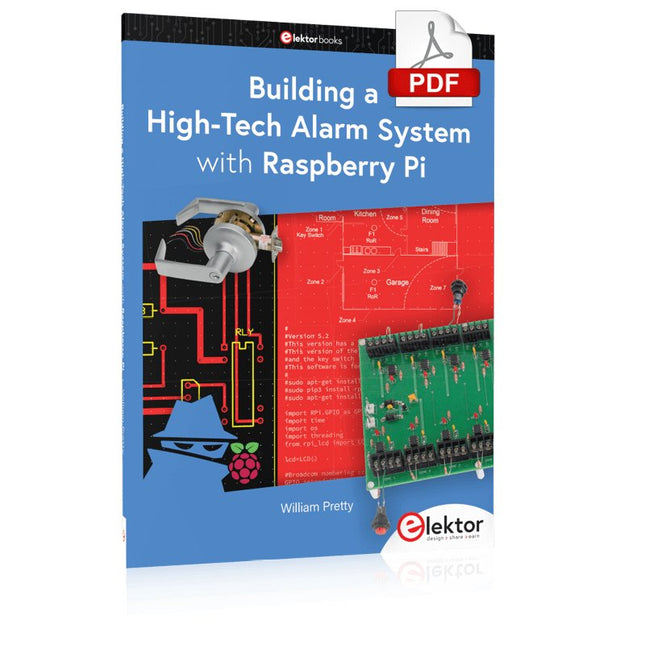
Elektor Digital Building a High-Tech Alarm System with Raspberry Pi (E-book)
This book discusses the basic components of any alarm system. All alarm systems have two basic functions. First, they monitor their environment looking for a change such as a door or window opening or someone moving about in the room. Second, they alert the legal owner or user to this change. The system described in this book uses a scanning type software to detect intruders. It behaves like a guard dog, pacing up and down the fence line on the lookout for either an intruder or a familiar person. If you have an alarm key, you can disarm the system and enter. With the scanning method, the software is easy to write and explain. It can scan eight alarm zones plus two special fire zones in about one second. You don’t have to be an electrical engineer to install an alarm system, just a decent carpenter, painter, and plasterer! Because this alarm system runs on 12 volts, you don’t have to be a licensed electrician either to install it. The alarm system presented here uses Python software on the Raspberry Pi combined with some elementary electronic circuits. The code described in the book, as well as CAD files and a bill of materials for the alarm panel, are available for free downloading. The book provides the reader with examples of typical configurations coming straight from the author‘s experience. After reviewing the hardware components typically used in common alarm systems, the author shows how to plan one yourself. To implement a modular alarm, no matter if it is for a single house or for a business or restaurant, the book shows how to skillfully combine a Raspberry Pi with small auxiliary electronic circuits. These are not installation instructions but food for thought that will enable readers to find a solution to their needs.
€ 24,95
Mitglieder: € 22,46
-

Elektor Digital Controller Area Network Projects with ARM and Arduino (E-book)
This book details the use of the ARM Cortex-M family of processors and the Arduino Uno in practical CAN bus based projects. Inside, it gives a detailed introduction to the architecture of the Cortex-M family whilst providing examples of popular hardware and software development kits. Using these kits helps to simplify the embedded design cycle considerably and makes it easier to develop, debug, and test a CAN bus based project. The architecture of the highly popular ARM Cortex-M processor STM32F407VGT6 is described at a high level by considering its various modules. In addition, the use of the mikroC Pro for ARM and Arduino Uno CAN bus library of functions are described in detail. This book is written for students, for practising engineers, for hobbyists, and for everyone else who may need to learn more about the CAN bus and its applications. The book assumes that the reader has some knowledge of basic electronics. Knowledge of the C programming language will be useful in later chapters of the book, and familiarity with at least one microcontroller will be an advantage, especially if the reader intends to develop microcontroller based projects using CAN bus. The book should be useful source of reference to anyone interested in finding an answer to one or more of the following questions: What bus systems are available for the automotive industry? What are the principles of the CAN bus? What types of frames (or data packets) are available in a CAN bus system? How can errors be detected in a CAN bus system and how reliable is a CAN bus system? What types of CAN bus controllers are there? What are the advantages of the ARM Cortex-M microcontrollers? How can one create a CAN bus project using an ARM microcontroller? How can one create a CAN bus project using an Arduino microcontroller? How can one monitor data on the CAN bus?
€ 32,95
Mitglieder: € 29,66
-
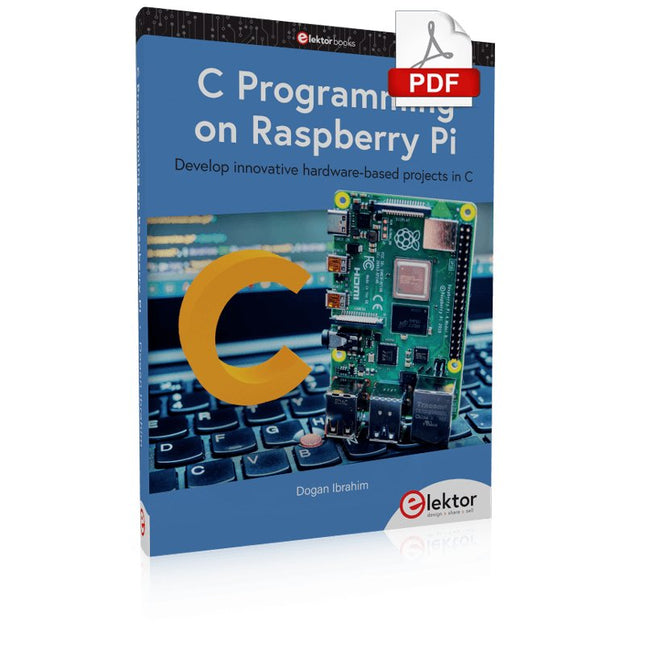
Elektor Digital C Programming on Raspberry Pi (E-book)
Develop innovative hardware-based projects in C The Raspberry Pi has traditionally been programmed using Python. Although this is a very powerful language, many programmers may not be familiar with it. C on the other hand is perhaps the most commonly used programming language and all embedded microcontrollers can be programmed using it. The C language is taught in most technical colleges and universities and almost all engineering students are familiar with using it with their projects. This book is about using the Raspberry Pi with C to develop a range of hardware-based projects. Two of the most popular C libraries, wiringPi and pigpio are used. The book starts with an introduction to C and most students and newcomers will find this chapter invaluable. Many projects are provided in the book, including using Wi-Fi and Bluetooth to establish communication with smartphones. Many sensor and hardware-based projects are included. Both wiringPi and pigpio libraries are used in all projects. Complete program listings are given with full explanations. All projects have been fully tested and work. The following hardware-based projects are provided in the book: Using sensors Using LCDs I²C and SPI buses Serial communication Multitasking External and timer interrupts Using Wi-Fi Webservers Communicating with smartphones Using Bluetooth Sending data to the cloud Program listings of all Raspberry Pi projects developed in this book are available on the Elektor website. Readers can download and use these programs in their projects. Alternatively, they can customize them to suit their applications.
€ 32,95
Mitglieder: € 29,66
-
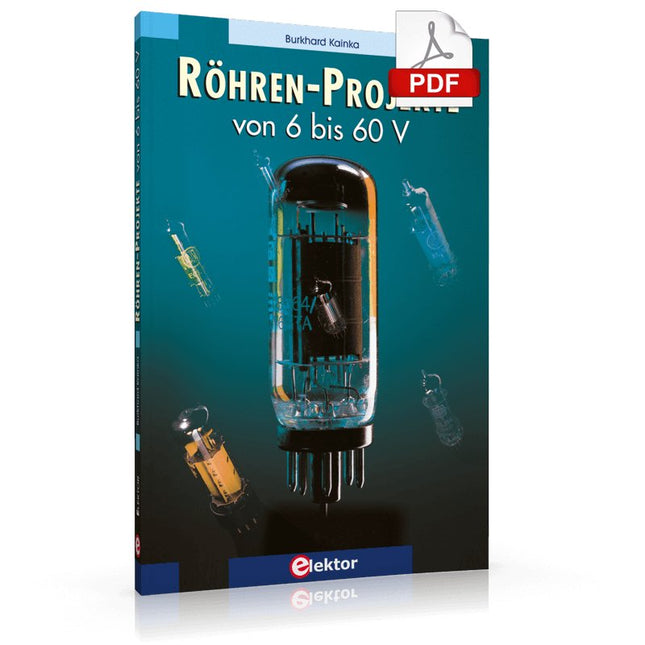
Elektor Digital Röhren-Projekte von 6 bis 60 V (E-book)
Röhren sind wieder „in". High-Tech-Audiogeräte wie MP3-Player, CD-Player oder der digitale Rundfunk kommen erst richtig zur Geltung, wenn ein Röhrenverstärker den perfekten Sound veredelt. Am Ausgang der PC-Soundkarte kann statt IC-bestückter Aktivboxen auch ein selbst gebautes Röhrengerät arbeiten. Der Einbau eigener Röhrenschaltungen in den PC selbst bringt den individuellen Geschmack erst richtig zur Geltung. Wenn statt einer LED das geheimnisvolle Glühen einer Röhrenkathode die Betriebsbereitschaft signalisiert, dann hebt sich das Gerät deutlich aus der Masse ab. In der Regel arbeiten Röhren mit hohen Spannungen, was nicht ganz ungefährlich ist. Eine Röhre, die ursprünglich für eine Anodenspannung von 250 Volt entwickelt wurde, kann durchaus aber auch bei 12 Volt arbeiten. So gilt für dieses Buch prinzipiell: Röhrenschaltungen funktionieren auch mit ungefährlichen Spannungen. Dieses Buch richtet sich an Leser, die technischen Abenteuern gegenüber aufgeschlossen sind. Teilweise handelt es sich um eine Reise zurück in die Geschichte der Röhrentechnik. Mehr als 50 Jahre alte Konzepte werden in einem neuen Gewand wieder entdeckt. Teilweise aber werden alte Röhren völlig neuartig eingesetzt. High-Tech und Tradition treffen hier aufeinander.
€ 29,80
Mitglieder: € 26,82
-

Elektor Digital Logic Analyzers in Practice (E-book)
PC USB Logic Analyzers with Arduino, Raspberry Pi, and Co. Step-by-step instructions guide you through the analysis of modern protocols such as I²C, SPI, UART, RS-232, NeoPixel, WS28xx, HD44780 and 1-Wire. With the help of numerous experimental circuits based on the Raspberry Pi Pico, Arduino Uno and the Bus Pirate, you will learn the practical application of popular USB logic analyzers. All the experimental circuits presented in this book have been fully tested and are fully functional. The necessary program listings are included – no special programming or electronics knowledge is required for these circuits. The programming languages used are MicroPython and C along with the development environments Thonny and Arduino IDE. This book uses several models of flexible and widely available USB logic analyzers and shows the strengths and weaknesses of each price range. You will learn about the criteria that matter for your work and be able to find the right device for you. Whether Arduino, Raspberry Pi or Raspberry Pi Pico, the example circuits shown allow you to get started quickly with protocol analysis and can also serve as a basis for your own experiments. After reading this book, you will be familiar with all the important terms and contexts, conduct your own experiments, analyze protocols independently, culminating in a comprehensive knowledge set of digital signals and protocols.
€ 29,95
Mitglieder: € 26,96
-

Elektor Digital Elektor Septembre/Octobre 2026 (PDF) FR
Le téléchargement intégral de ce numéro est disponible pour nos membres GOLD et GREEN sur le site Elektor Magazine ! Pas encore membre ? Cliquez ici. l'ESP-BLASTUn mini drone-fusée ESP32 qui vole à plus de 100 km/h atelier sans fil (1)Modules radio déverrouillés : émetteur-récepteur sub-GHz CC1101 433 MHz émetteur AMAvec le générateur d'ondes carrées/sinusoïdales sur Raspberry Pi Pico STM32Cube Innovation ChallengeParticipez avec votre meilleur projet STM32C5 CoffeeCallerComment une pause café a inspiré un PCB sur mesure audiotroniquesDistorsion harmonique totale Elektor à 65 ansProjets de septembre et octobre au fil des ans Bluetooth Channel Sounding pour le suivi des équipementsMesure de distance avec une précision centimétrique pour l’IoT de nouvelle génération 2026 : une Odyssée de l'IAL'informatique quantique n'est pas le prochain GPU protéger le cloud exige de sécuriser la périphérie premières expériences avec le HackRF ProTests pratiques avec le nouveau matériel SDR mise à niveau du modem de GPRS/2G vers LTE/4GExemple d'un panneau de contrôle d'alarme sans fil antenne en bouclePartie 1 : Une antenne ondes courtes à directivité réglable, à réaliser soi-même convertisseur de radio Internet en AMUn ESP32-S3 comme émetteur projet 2.0 mioty : aperçu généralL'approche de Fraunhofer pour les LPWAN sagesse d'atelierConseils pratiques d'experts Walter, le module IoT compactPartie 2 : Accéder aux services météorologiques et aux services de données
€ 10,95
-

Elektor Digital Elektor Januar/Februar 2024 (PDF)
Der vollständige Download dieser Nummer ist für unsere GOLD- und GREEN-Mitglieder auf der Elektor Magazine- Site verfügbar! Nicht noch einmal Mitglied? Klicken Sie hier . Projektupdate: Energierechner basierend auf ESP32 Nächste Schritte des Prototyps Optimierung der Solaranlagen auf dem Balkon Überlegungen, interessante Fakten und Berechnungen ESP32 mit OpenDTU für Balkonzentralen Daten von kleinen Wellenleitern mit Mikrocontrollern abrufen lineare Ernährung variabler Ensemble Stromversorgung 0-50 V / 0-2 A + symmetrische Doppelspannung die Energievorräte heute und in der Zukunft Interview von Simon Engelke 2024: Die Odyssee der I.A. ohne Wiederholung Bluetooth LE auf STM32 Ein Mittel zum Lesen der Entfernungsmaße Intelligente Aufbewahrungsbox für das menschliche Leben MAUI: Programmierung für PC, Tablets und Smartphones der neue theoretische und praktische Rahmen ChatMagLev Magnetschwebebahn? Version IA einfacher PV-Leistungsregler Realisieren Sie Ihr erstes voll funktionsfähiges Photovoltaik-Energiemanagementsystem die Bestandteile der kalten Kathode auf der Lebe Nostalgie elektronisch starten ?Die FET CAN-Bus-Tutorial für Arduino UNO R4 zwei UNO R4 mit Bus verbunden Infografik umfassende Unterstützung bei Konzeption und Entwicklung die technischen Dienste von Arrow Vergleich zwischen Leistungsdichte und Energieeffizienz Elektrolytkondensatoren aus Aluminium Quellen potentieller Verzerrungen in der Audiotechnologie Testen und Messen von USB le Fnirsi FNB58 das manuelle Pick-and-Place-Tool Pixel Pump Vereinfachen Sie die manuelle Zusammenstellung von CMS-Karten Besuch zu Hause naguère, in einem schwachen Land? „In der Welt der elektronischen Ethik können selbst die Kleinen einen bedeutenden Einfluss haben.“ » Ethik in der Elektronik die Richtlinien der OECD und das Deutsche Gesetz über die Sorgfaltspflicht in der Genehmigungskette Chadèche: Intelligentes Ladegerät/Entladegerät für NiMh-Akkus, Zusammenfassung eines Leseprojekts Projekt 2.0 Korrekturen, Aktualisierungen und Leserbriefe
€ 10,95
-

Siglent Siglent SDL1020X-E Elektronische DC-Last (200 W)
Der Siglent SDL1020X-E DC-Lastwiderstand verfügt über eine Messauflösung von 0,1 mV/0,1 mA, während die Basisserie SDL1000X-E eine Auflösung von 1 mV/1 mA bietet. Es sind einstellbare Stromanstiegszeiten von 0,001 A/μs bis 2,5 A/μs möglich. Für eine Fernkommunikation und Steuerung verfügt die SDL-Serie über Schnittstellentypen wie RS232/USB/LAN. Der SDL1020X-E bietet Stabilität für eine breite Palette von Anwendungen und erfüllt alle Arten von Testanforderungen, einschließlich: Stromversorgung, Batterie-/Handheld-Geräte-Design, Industrie, LED-Beleuchtung, Automobil-Elektronik und Luft- und Raumfahrt. Features SDL1020X-E (ein Kanal): DC 150 V/30 A, Gesamtleistung 200 W 4 statische Modi / dynamischer Modus: CC/CV/CR/CP CC-Dynamik-Modus: Kontinuierlich, gepulst, getoggelt CC-Dynamik-Modus: 25 kHz, CP-Dynamik-Modus: 12,5 kHz, CV-Dynamik-Modus: 0,5 Hz Messgeschwindigkeit von Spannung und Strom: bis zu 500 kHz Einstellbarer Stromanstiegszeitbereich: 0,001 A/μs bis 2,5 A/μs Minimale Ablesungsauflösung: 0,1 mV, 0,1 mA Funktionen für Kurzschluss-, Batterietest-, CR-LED-Modus und Werkstest 4-Draht-SENSE-Kompensationsmodus-Funktion List-Funktion unterstützt das Bearbeiten von bis zu 100 Schritten Programmfunktion unterstützt 50 Gruppen von Schritten OCP, OVP, OPP, OTP und LRV-Schutz Externe analoge Steuerung Spannungs-, Stromüberwachung über 0-10 V 3,5-Zoll-TFT-LCD-Display, das gleichzeitig mehrere Parameter und Zustände anzeigen kann Eingebauter RS232/USB/LAN-Kommunikationsschnittstelle, optional USB-GPIB-Modul Wellenform-Trenddiagramm und benutzerfreundliche Dateispeicherungs- und Abruffunktionen Enthält PC-Software: Unterstützt SCPI, LabView-Treiber Lieferumfang 1x Siglent SDL1020X-E Gleichstromprogrammierbare Last 1x Schnellstartanleitung 1x Garantiekarte 1x Netzkabel 1x USB-Kabel Downloads Datasheet Manual Programming Guide PC Software
€ 522,41
-

Elektor Digital Elektor Special: Sensors for Weather and the Environment (PDF)
Build your textbook weather station or conduct environmental research together with the whole world. With many practical projects for Arduino, Raspberry Pi, NodeMCU, ESP32, and other development boards. Weather stations have enjoyed great popularity for decades. Every current and even every long discontinued electronics magazine has regularly featured articles on building your own weather station. Over the years, they have become increasingly sophisticated and can now be fully integrated into an automated home — although this often requires loyalty to an (expensive) brand manufacturer across all components. With your own weather and environmental data, you can keep up and measure things that no commercial station can. It’s also fun: expand your knowledge of electronics, current microcontroller development boards and programming languages in a fun and meaningful way. For less than 10 euros you can get started and record your first environmental data — with time and growing interest, you will continue to expand your system. In this Edition Which Microcontroller Fits My Project? The Right Development Environment Tracking Wind and Weather Weather Display with OpenWeatherMap and Vacuum Fluorescent Display Volatile Organic Compounds in the Air We Breathe Working with MQ Sensors: Measuring Carbon Monoxide — Odorless but Toxic CO2 Traffic Light with ThingSpeak IoT Connection An Automatic Plant Watering System Good Indoor Climate: Temperature and Humidity are Important criteria Classy Thermometer with Vintage Tube Technology Nostalgic Weather House for the Whole Family Measuring Air Pressure and Temperature Accurately Sunburn Warning Device DIY Sensor for Sunshine Duration Simple Smartphone Says: Fog or Clear View? Identifying Earthquakes Liquid Level Measurement for Vessels and Reservoirs Water pH Value Measurement Detecting Radioactive Radiation GPS: Sensor Location Service Across the Globe Saving and Timestamping Log Files on SD Cards LoRaWAN, The Things Network, and ThingSpeak Operating a LoRaWAN Gateway for TTN Defying "Wind and Weather" Mega Display with Weather Forecasz
€ 14,95
Mitglieder: € 13,46


