
Suchergebnisse für "esp or 32s or pinboard or breakout or modules"
-

Elektor Digital Build Smart Projects with the XIAO ESP32-C3 Board (E-book)
The XIAO ESP32-C3 board combines the ultra-compact form factor of the XIAO series with the full capabilities of the ESP32-C3 chip, including integrated Wi-Fi and Bluetooth 5.0. This book is a comprehensive, hands-on guide to getting the most out of this powerful yet affordable development board. The author takes readers from the fundamentals to advanced projects. Starting with LED blinking and dimming, the book progresses to ADC and PWM for precise sensor interfacing and PWM-controlled lighting effects before moving on to building practical, real-world applications, including: A Wi-Fi weather station with an OLED display and real-time online weather data An ultrasonic parking assistant with audible feedback A refrigerator monitoring probe with climate sensing and Deep Sleep for years of battery operation A retro Pong game controlled by a touch-free sensor A microphone-based party app that responds to claps And much more: lighting control, reaction-time measurement, mains frequency analysis, soil moisture sensing, ambient LED lighting, and 7-segment displays
€ 29,95
Mitglieder: € 26,96
-
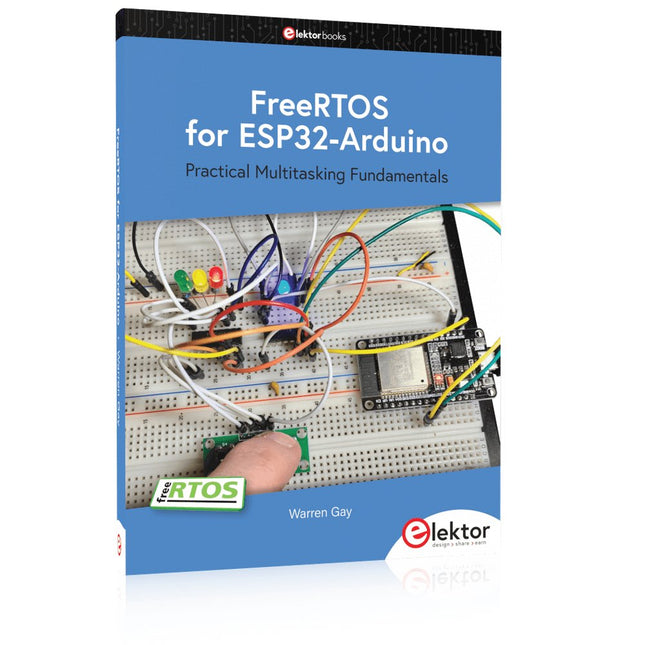
Elektor Publishing FreeRTOS for ESP32-Arduino
Practical Multitasking Fundamentals Programming embedded systems is difficult because of resource constraints and limited debugging facilities. Why develop your own Real-Time Operating System (RTOS) as well as your application when the proven FreeRTOS software is freely available? Why not start with a validated foundation? Every software developer knows that you must divide a difficult problem into smaller ones to conquer it. Using separate preemptive tasks and FreeRTOS communication mechanisms, a clean separation of functions is achieved within the entire application. This results in safe and maintainable designs. Practicing engineers and students alike can use this book and the ESP32 Arduino environment to wade into FreeRTOS concepts at a comfortable pace. The well-organized text enables you to master each concept before starting the next chapter. Practical breadboard experiments and schematics are included to bring the lessons home. Experience is the best teacher. Each chapter includes exercises to test your knowledge. The coverage of the FreeRTOS Application Programming Interface (API) is complete for the ESP32 Arduino environment. You can apply what you learn to other FreeRTOS environments, including Espressif’s ESP-IDF. The source code is available from GitHub. All of these resources put you in the driver’s seat when it is time to develop your next uber-cool ESP32 project. What you will learn: How preemptive scheduling works within FreeRTOS The Arduino startup “loopTask” Message queues FreeRTOS timers and the IDLE task The semaphore, mutex, and their differences The mailbox and its application Real-time task priorities and its effect Interrupt interaction and use with FreeRTOS Queue sets Notifying tasks with events Event groups Critical sections Task local storage The gatekeeper task
€ 49,95
Mitglieder: € 44,96
-

Elektor Digital FreeRTOS for ESP32-Arduino (E-book)
Practical Multitasking Fundamentals Programming embedded systems is difficult because of resource constraints and limited debugging facilities. Why develop your own Real-Time Operating System (RTOS) as well as your application when the proven FreeRTOS software is freely available? Why not start with a validated foundation? Every software developer knows that you must divide a difficult problem into smaller ones to conquer it. Using separate preemptive tasks and FreeRTOS communication mechanisms, a clean separation of functions is achieved within the entire application. This results in safe and maintainable designs. Practicing engineers and students alike can use this book and the ESP32 Arduino environment to wade into FreeRTOS concepts at a comfortable pace. The well-organized text enables you to master each concept before starting the next chapter. Practical breadboard experiments and schematics are included to bring the lessons home. Experience is the best teacher. Each chapter includes exercises to test your knowledge. The coverage of the FreeRTOS Application Programming Interface (API) is complete for the ESP32 Arduino environment. You can apply what you learn to other FreeRTOS environments, including Espressif’s ESP-IDF. The source code is available from GitHub. All of these resources put you in the driver’s seat when it is time to develop your next uber-cool ESP32 project. What you will learn: How preemptive scheduling works within FreeRTOS The Arduino startup “loopTask” Message queues FreeRTOS timers and the IDLE task The semaphore, mutex, and their differences The mailbox and its application Real-time task priorities and its effect Interrupt interaction and use with FreeRTOS Queue sets Notifying tasks with events Event groups Critical sections Task local storage The gatekeeper task
€ 39,95
Mitglieder: € 35,96
-
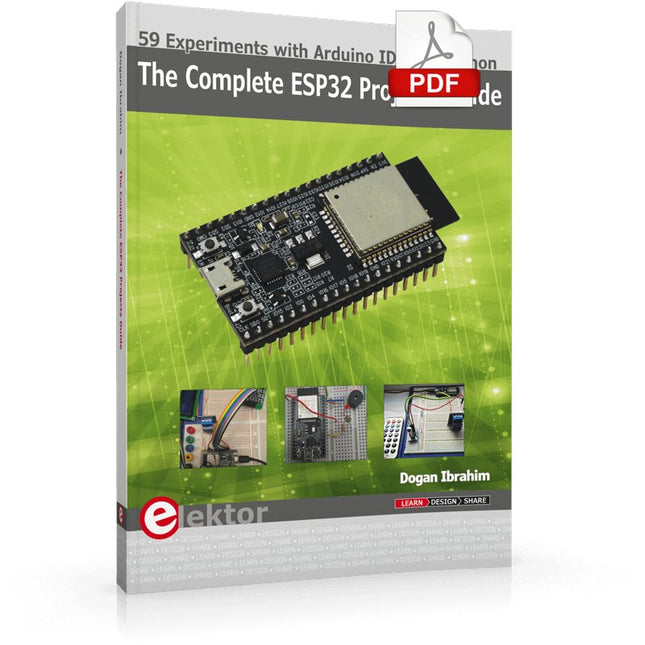
Elektor Digital The Complete ESP32 Projects Guide (E-book)
59 Experiments with Arduino IDE and Python The main aim of this book is to teach the Arduino IDE and MicroPython programming languages in ESP32 based projects, using the highly popular ESP32 DevKitC development board. Many simple, basic, and intermediate level projects are provided in the book using the Arduino IDE with ESP32 DevKitC. All projects have been tested and work. Block diagrams, circuit diagrams, and complete program listings of all projects are given with explanations. In addition, several projects are provided for programming the ESP32 DevKitC using MicroPython. The projects provided in this book are designed to teach the following features of the ESP32 processor: GPIOs Touch sensors External interrupts Timer interrupts I²C and I²S SPI PWM ADC DAC UART Hall sensor Temperature sensor Infrared controller Reading and writing to SD card Reading and writing to flash memory RTC timer Chip ID Security and encryption Wi-Fi and network programming Bluetooth BLE programming Communication mobile devices Low power design ESP-IDF programming The projects have been organized with increasing levels of difficulty. Readers are encouraged to tackle the projects in the order given. A specially prepared hardware kit (SKU 18305) is available from Elektor. With the help of this hardware, it should be easy and fun to build the projects in this book.
€ 34,95
Mitglieder: € 31,46
-
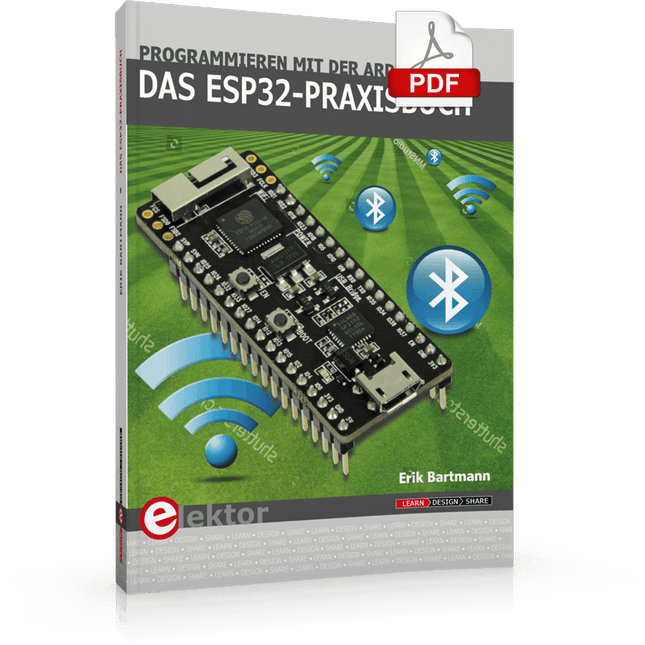
Elektor Digital Das ESP32-Praxisbuch (PDF)
Die WiFi-Module der chinesischen Firma Espressif haben schon längst die Maker-Community erobert, bieten sie doch zu einem konkurrenzlosen Preis MCU- und WiFi-Funktionalität. Mit einfachen Mitteln lässt sich ein Arduino mit einem ESP-Modul um WiFi erweitern. Die globale Bastler-Gemeinde ersetzte schon bald die integrierte Firmware mit eigener Firmware, sodass Entwickler ESP-Boards wie Arduino-Boards programmieren können. Der neue ESP32 geht einen Schritt weiter und ist in jeder Beziehung leistungsfähiger als der ESP8266. Zudem besitzt er nun Bluetooth-Funktionalität. Der ESP32 verfügt über einen 240-MHz-Zweikern-Mikroprozessor mit einer Performanz von 600 DMIPS. Neben 520 KByte SRAM befinden sich 16 MByte Flashspeicher an Board. Zur Kommunikation mit der Außenwelt enthält das System-on-a-Chip die 802.11-b/g/n-WiFi-Komponente HT40 und Bluetooth-Funktionalität. Als Sensoren bietet der ESP32 einen Hall-Sensor, eine zehnfache, kapazitive Touch-Schnittstelle, einen analogen Verstärker für niedrige Signale und einen 32-kHz-Kristallquartz. Der Bestseller-Autor Erik Bartmann hat sich ausführlich mit dem ESP32 beschäftigt. Heraus gekommen ist dabei Das ESP32-Praxisbuch, in dem er die Leser Schritt für Schritt in die Arbeit mit diesem preiswerten WiFi-Mikrocontroller einführt.
€ 34,80
Mitglieder: € 31,32
-

SunFounder SunFounder Kepler Kit (Ultimate Starter Kit für Raspberry Pi Pico W)
Ihr Einstieg in die IoT- und Mikrocontroller-Programmierung Mit über 450 Komponenten und 117 Online-Projekten beflügelt dieses umfassende Kit Ihre Kreativität. Die Tutorials von Paul McWhorter machen das Lernen sowohl für Anfänger als auch für Fortgeschrittene angenehm. Dieses Kit unterstützt MicroPython, C/C++ und Piper Make und bietet vielfältige Programmieroptionen. Entdecken Sie Sensoren, Aktoren, LEDs und LCDs für endlose Projektmöglichkeiten. Von der Heimautomation bis zur Robotik unterstützt dieses Kit Ihre technische Reise. Features IoT-Starterkit für Anfänger: Dieses Kit bietet eine reichhaltige IoT-Lernerfahrung für Anfänger. Mit über 450 Komponenten, 117 Projekten und von Experten geleiteten Videolektionen macht dieses Kit das Erlernen der Mikrocontroller-Programmierung und des IoT ansprechend und leicht zugänglich. Von Experten geleitete Video-Lektionen: Das Kit enthält 27 Video-Tutorials des renommierten Pädagogen Paul McWhorter. Sein engagierter Stil vereinfacht komplexe Konzepte und sorgt so für ein effektives Lernerlebnis in der Mikrocontroller-Programmierung. Große Auswahl an Hardware: Das Kit enthält eine Vielzahl von Komponenten wie Sensoren, Aktoren, LEDs, LCDs und mehr, sodass Sie mit dem Raspberry Pi Pico W experimentieren und eine Vielzahl von Projekten erstellen können. Unterstützt mehrere Sprachen: Das Kit bietet Vielseitigkeit mit Unterstützung für drei Programmiersprachen – MicroPython, C/C++ und Piper Make – und bietet so ein abwechslungsreiches Programmier-Lernerlebnis. Dedizierter Support: Profitieren Sie von unserer fortlaufenden Unterstützung, einschließlich eines Community-Forums und zeitnaher technischer Hilfe für ein nahtloses Lernerlebnis. Lieferumfang Raspberry Pi Pico W Breadboard Überbrückungsdrähte Widerstand Transistor Kondensator Diode Li-Po-Lademodul 74HC595 TA6586 – Motortreiberchip LED RGB-LED LED-Balkendiagramm 7-Segment-Anzeige 4-stellige 7-Segment-Anzeige LED-Punktmatrix I²C LCD1602 WS2812 RGB 8 LED-Streifen Summer Gleichstrommotor Servo DC-Wasserpumpe Relais Schaltfläche Mikroschalter Schiebeschalter Potentiometer Infrarotempfänger Joystick-Modul 4x4-Tastatur MPR121-Modul MFRC522-Modul Fotowiderstand Thermistor Neigungsschalter Reed-Schalter PIR-Bewegungssensormodul Wasserstandsensormodul Ultraschallmodul DHT11 Feuchtigkeitssensor MPU6050-Modul Dokumentation Online-Tutorials in 3 Sprachen (DE, EN und JP)


