
Suchergebnisse für "elektor or uno or r4"
-

Elektor Digital Elektor AI Guest Edition 2024 (PDF) FR
Le téléchargement intégral de ce numéro est disponible pour nos membres GOLD et GREEN sur le site Elektor Magazine ! Pas encore membre ? Cliquez ici. le système de sécurité IA AlertAlfredBasé sur un Raspberry Pi 5 et le module Hailo 8L l'IA en développement électroniqueune mise à jour après seulement un an intro aux algorithmes de l'IAPrompt: Quels algorithmes implémentent chaque outil d'IA ? ordinateurs monocartes pour les projets d'IAAperçu et contexte des données de capteurs aux modèles d'apprentissage automatiqueDétection de gestes avec Edge Impulse et un accéléromètre créez un neurone d’intégrationet-tir avec fuiteIntelligence artificielle sans logiciel ChatGPT pour la conception électroniqueGPT-4o fait-il mieux ? intégrer l'IA périphérique avec l'ESP32-P4 fonctions vocales sur le Raspberry Pi ZeroWhen Overclocking Gives Freedom of Speech le rôle croissant de l'IA périphériqueUne tendance qui structure l'avenir exploiter la puissance de l'IA en périphérieUn entretien avec François de Rochebouët de STMicroelectronics horloge en VHDL réalisée avec ChatGPT l'impact réel de l'IASayash Kapoor à propos des "faux miracles de l'IA" et plus encore les dernières nouveautés de BeagleBoardBeagleY-AI, BeagleV-Fire, BeagleMod, BeaglePlay et BeagleConnect Freedom détection des moustiques : avec Arduino Nicla Vision et des données open source l'IA d’aujourd'hui et de demain : les idées d'Espressif, d'Arduino et de SparkFun chronologie de l'intelligence artificielle BeagleY-AIThe Latest SBC for AI Applications lumière sur l’IALes perspectives de la communauté Elektor vision artificielle avec OpenMVCréer un détecteur de canettes de soda conversation avec l'esprit numériqueChatGPT vs Gemini "Skilling Me Softley with This Bot?"L'essor de l'IA dans le secteur électronique freiné par une absence de précision sociale ?
€ 10,95
-
Elektor Digital Elektor 11-12/2023 (PDF)
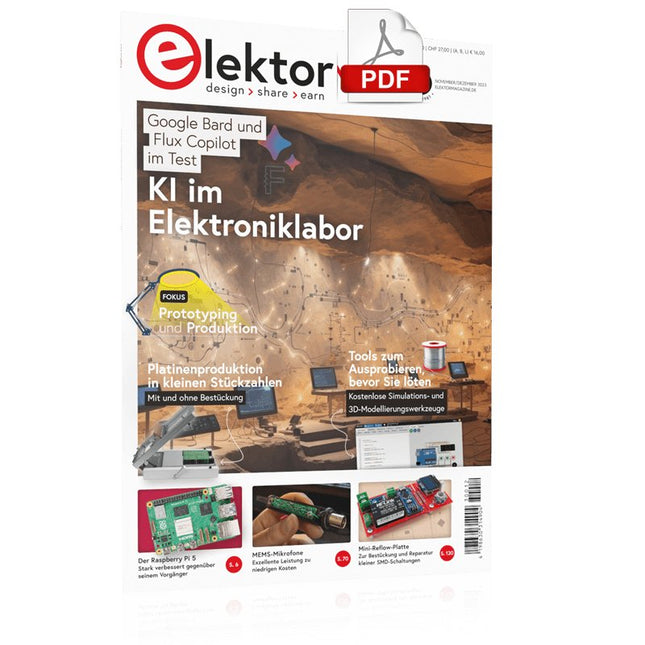
Diese Ausgabe steht allen GOLD- und GREEN-Mitgliedern auf der ElektorMagazine-Website zum Download bereit! Sind Sie noch kein Mitglied? Hier klicken! Der Raspberry Pi 5 Gegenüber diesem Vorgänger enormer Rückstand KI im Elektroniklabor Schaltungsdesign, Bauteil-Suche, Software Funktionsgenerator mit dem Arduino Nano Nano + Code = Funktionsgenerator Solarbetriebene Weihnachtsgirlande Eine umweltfreundliche Lösung für die Dekoration Ihres Balkons USB-Killer-Detektor Besser sicher als traurig Ein einfaches CNC-Gehäuse Schritt für Schritt mit Autodesk Fusion 360 Platinenproduktion in kleinen Stückzahlen Mit und ohne Bestückung IoT-Simulation vereinfacht mit Wokwi Entwickler Uri Shaked über Entwicklung, Software und mehr Eine Anleitung zur Bare-Metal-Programmierung Teil 3: CMSIS-Header, automatische Tests und ein Webserver LoRa, ein Schweizer Taschenmesser Teil 2: Hard- und Software MEMS-Mikrofon Entwurf und Konstruktion eines Messmikrofons Werkzeuge zum Ausprobieren, bevor Sie löten Simulations- und 3D-Modellierungstools, die kostenlos genutzt werden können Neue Tools von Microchip! Version 5 von PICkit und ICD jetzt erhältlich Rapid Prototyping von flexibler, dehnbarer Elektronik Wie Voltera NOVA Innovationen bei tragbaren elektronischen Systemen beschleunigen Galvanische Trennung Fototransistor-Optokoppler erfolgreich einsetzen Die komplexe Lösung oder die Lösung von Anybus? Embedded Industrial Ethernet als Kurzstrecke statt als Marathon Ihre essentielle DFM-Checkliste Wie Sie mit dem Entwurf für die Fertigung beginnen Filamente für den 3D-Druck Arten, Eigenschaften und Verwendung im Prototyping Spezialisten für eine grundlegende Signalauswertung von ELF bis EHF-Band Aaronias neuester Echtzeit-Spektrumanalyzer der SPECTRAN® V6-Serie Herausforderungen der DFM-Analyse für Flex- und Rigid-Flex-Design Einrichten einer SMT-Fertigungsstrecke Die richtige Kombination für die zuverlässige Baugruppe Revolution in der Industrie Der Aufstieg der Autonomen Mobilen Roboter (AMR) Für höchste Anforderungen weiterentwickelt R&S MXO 5 mit acht Kanälen ergänzt Oszilloskope der nächsten Generation Aller Anfang... ... muss nicht schwer sein: Verstärkung von Unterschieden Mini-Reflow-Platte Für die Bestückung und die Reparatur kleiner SMD-Schaltungen Starte nicht mit einem Prototyp – starte mit einem Pretotyp! Prüfe zunächst, ob es einen Markt für dein Produkt gibt, bevor du deinen Lötkolben vorwärmst 2023: Odyssee in die KI Hilfe beim Entwerfen eines physikalischen Projekts erhalten Innovationen aus Brüssel Unterstützung für die Spitzentechnologie
€ 11,90
-

Elektor Digital Elektor Special: Raspberry Pi and Pico (PDF)
Contents Projects PicoVoiceVoice alienation and sound effects with the Raspberry Pi Pico Navigation with Vibration Feedback POV Display Pulse Width Modulation (PWM) with the Raspberry Pi Pico Wi-Fi with the Raspberry Pi Pico 'Hello World' from the Raspberry Pi Pico and RP2040A look at the Raspberry Pi Foundation’s first microcontroller Simple On-Off Temperature Controller with Raspberry Pi HAT Multitasking with the Raspberry PiShowcase: a traffic lights controller The Raspberry Pi Ruler GadgetFun with a time-of-flight sensor Raspberry Pi Buffer Board (Mk. 1)Never blow up the I/O again FM radio with RDSA top HAT project for the Raspberry Pi LoRa with the Raspberry Pi PicoFun with MicroPython! Tutorials Qt for the Raspberry Pi Raspberry Pi Pico Programmingwith MicroPython and Thonny Raspberry Pi Full StackRPi and RF24 at the heart of a sensor network Raspberry Pi Bash Command Cheat Sheet Community Java on the Raspberry PiAn interview with Frank Delporte Reviews Introducing the New Raspberry Pi Pico W, H, and WH Secure Boot Solution for Raspberry PiRetrofit security at a reasonable price Review: SmartPi – Smart Meter Extension for Raspberry Pi Review: The Enviro+ Raspberry Pi HATMeasuring environmental data with Raspberry Pi and the HAT Enviro+ Review: Meet the Raspberry Pi 4All new but still good? Raspberry Pi Gets a Fast 3.5' Touch DisplayMore power at no extra charge Book Launch: Raspberry Pi for Radio Amateurs
€ 11,95
Mitglieder: € 10,76
-

Elektor Digital IoT GET-U-GOING (E-book)
In 35 Projects with the Raspberry Pi and Arduino The Internet of Things (IoT) is a trend with a strong technological impulse. At home, we want to do everything on our tablets, from browsing Facebook to watching TV, from operating lights to keeping an eye on the temperature. In 35 fun projects, this book will show you how to build your own Internet of Things system. We'll cover the hardware (primarily the Raspberry Pi and Arduino) and the software that makes control via Internet possible. We employ Wi-Fi and radio links so no requirement any longer to install cabling crisscross through your home. Assuming the projects in the book are finished, you have a complete Internet of Things system that allows you to control and view of everything in your home. For example, if there's something in the mail box or the car is securely in the garage. Also, you can switch on the lights and the alarm from your couch. The crisp explanations allow the projects to be customized with ease, for example, to turn on your coffee machine or TV remotely. The index gives easy access to creative projects that can serve as an example, enabling you to do all the connecting to the IoT independently. All project software can be downloaded free of charge from the Elektor website. In this unique book, Raspberry Pi, Arduino and HTML webpages with stylesheets and JavaScript come together in clearly-described, easy-to-build projects. This special book is an essential part of your collection!
€ 34,95
Mitglieder: € 31,46
-

Elektor Digital Elektor January/February 2023 (PDF)
Elektor GREEN and GOLD members can download their digital edition here. Not a member yet? Click here. For Eyes and Ears Video Output with Microcontrollers (1)Composite Video electronica 2022News from the world’s leading electronics trade show ESP32 CameraSo Simple, It Doesn’t Even Have to Use Wi-Fi ATX Power Supply for Raspberry Pi 32 Ω Headphone AmplifierSimple But High-Quality 3-Chip Solution SDR Radio-Controlled clocksFive Time Signals, Six Displays Starting Out in ElectronicsSpecial Diodes From Life's ExperienceMusings on the Quality of Things Reverse-Engineering a Bluetooth Low Energy LED BadgeHow to Control a BLE Device with a Python Script MakePython ESP32 Development KitEverything in a Box THD Measurement with an Oscilloscope and FFTEasily Calculate the Distortion Factor All-Seeing MachinesThe Technology Behind Today’s Industrial Vision Systems Infographics The Evolution of Voice and Audio Control for Electronic Devices WEEF 2022 in Review FFWD electronica 2022 in ReviewInnovators Did Not Fail to Impress The TubeAn Unusual Tube Amplifier Biomaterial in Electronics: Ready or Not Opera Cake Antenna Switch for HackRF OneConnect Up To Eight Antennas To Your SDR Engineering with Arduino and MoreAn Interview with Author Ashwin Pajankar LiDAR Precision GaugeMeasure up to 12 Meters Audio Signals and the ESP32The ESP-ADF Environment in Practice Elektor Fortissimo-100 Power Amplifier Kit Using Light for Sound EffectsLDR-Based Voltage-Controlled 24 dB/oct Synthesizer Filter Elektor High-Power AF AmplifierThe Loudest of Them All! HomeLab ToursA Volumetric Display Made in Canada Err-lectronicsCorrections, Updates and Readers’ Letters Hexadoku
€ 7,50
-

Elektor Digital Edge AI Made Practical (E-book)
AI Projects for the Raspberry Pi with the AI HAT+ Edge AI is transforming everyday devices by putting intelligence where it matters most: directly inside the hardware. With on-device inference, a camera can recognize a visitor instantly, a phone can translate speech without streaming audio to the cloud, and a wearable can detect anomalies in real time—fast, private, and reliable even when the network disappears. This book is your practical guide to building exactly those kinds of systems with the Raspberry Pi AI HAT+ and the Hailo-8L accelerator. You’ll start with clear foundations: core AI and machine-learning concepts, how neural networks work, and what truly distinguishes Edge AI from cloud AI—plus an honest look at ethical considerations and future impacts. Then it’s straight to hands-on physical computing. Step by step, you’ll set up Raspberry Pi OS, power and cooling, and develop in Python using the Thonny IDE. You’ll learn GPIO basics with lights and servos, mount the AI HAT+ hardware, install and verify the Hailo software stack, and connect the right camera—official modules or USB webcams, even multiple cameras. From your first pipeline to real projects, you’ll run person detection, pose estimation, segmentation, and depth estimation, then level up with YOLO object detection: smart alerts, guest counters, and custom extensions. You’ll even connect vision to motion by combining gesture recognition with servo-driven mechanisms, including a robotic arm. With troubleshooting tips, hardware essentials, and a practical Python refresher, this book turns Edge AI from buzzword into buildable reality.
€ 29,95
Mitglieder: € 26,96
-

SunFounder Universal Maker Sensor Kit (für Raspberry Pi, Pico W, Arduino, ESP32)
Entdecken Sie grenzenlose Kreativität mit dem Universal Maker Sensor Kit, das für Raspberry Pi, Pico W, Arduino und ESP32 entwickelt wurde. Dieses vielseitige Kit ist mit gängigen Entwicklungsplattformen kompatibel, darunter Arduino Uno R4 Minima/WiFi, Uno R3, Mega 2560, Raspberry Pi 5, 4, 3B+, 3B, Zero, Pico W und ESP32. Mit über 35 Sensoren, Aktoren und Displays eignet es sich perfekt für Projekte von Umweltüberwachung und Smart-Home-Automatisierung bis hin zu Robotik und interaktivem Gaming. Schritt-für-Schritt-Tutorials in C/C++, Python und MicroPython führen Anfänger und erfahrene Maker gleichermaßen durch 169 spannende Projekte. Features Umfassende Kompatibilität: Vollständige Unterstützung für Arduino (Uno R3, Uno R4 Minima/WiFi, Mega 2560), Raspberry Pi (5, 4, 3B+, 3B, Zero, Pico W) und ESP32. Dies ermöglicht umfassende Flexibilität auf zahlreichen Entwicklungsplattformen. Enthält Anleitungen für 169 Projekte. Umfassende Komponenten: Mehr als 35 Sensoren, Aktoren und Anzeigemodule für vielfältige Projekte wie Umweltüberwachung, Smart Home-Automatisierung, Robotik und interaktive Spielesteuerungen. Ausführliche Tutorials: Klare Schritt-für-Schritt-Anleitungen für Arduino, Raspberry Pi, Pico W, ESP32 und alle enthaltenen Komponenten. Es stehen Tutorials in C/C++, Python und MicroPython zur Verfügung, die sowohl für Anfänger als auch für erfahrene Maker geeignet sind. Für alle Kenntnisstufen geeignet: Bietet strukturierte Projekte, die Benutzer nahtlos vom Anfänger zum Fortgeschrittenen in Elektronik und Programmierung führen und so Kreativität und technisches Know-how fördern. Lieferumfang Breadboard Tastenmodul Kapazitives Bodenfeuchtemodul Flammensensormodul Gas-/Rauchsensormodul (MQ2) Gyroskop & Beschleunigungssensormodul (MPU6050) Hall-Sensormodul Infrarot-Geschwindigkeitssensormodul IR-Hindernisvermeidungssensormodul Joystickmodul PCF8591 ADC/DAC-Wandlermodul Fotowiderstandsmodul PIR-Bewegungssensormodul (HC-SR501) Potentiometermodul Pulsoximeter- und Herzfrequenzsensormodul (MAX30102) Regentropfenerkennungsmodul Echtzeituhrmodul (DS1302) Drehgebermodul Temperatursensormodul (DS18B20) Temperatur- und Feuchtigkeitssensormodul (DHT11) Temperatur, Luftfeuchtigkeit und Drucksensor (BMP280) Time-of-Flight-Mikro-LIDAR-Distanzsensor (VL53L0X) Berührungssensormodul Ultraschallsensormodul (HC-SR04) Vibrationssensormodul (SW-420) Wasserstandssensormodul I²C LCD 1602 OLED-Displaymodul (SSD1306) RGB-LED-Modul Ampelmodul 5-V-Relaismodul Kreiselpumpe L9110-Motortreibermodul Passives Summermodul Servomotor (SG90) TT-Motor ESP8266 Modul JDY-31 Bluetooth-Modul Stromversorgungsmodul Dokumentation Online-Tutorial
€ 69,95
Mitglieder: € 62,96
-

Elektor Digital Elektor September/Oktober 2026 (PDF) NL
Elektor GREEN en GOLD leden kunnen deze uitgave hier downloaden. Nog geen lid? Klik hier om een lidmaatschap af te sluiten. De ESP-BLASTEen mini ESP32 raketdrone die ruim 100 km/u vliegt STM32Cube Innovation-ChallengeDoe mee met je beste STM32C5-ontwerp Wireless workshop (1)Radiomodules uitgelegd: 433 MHz CC1101 sub-GHz-transceiver AM-zenderMet sinus- en blokgolfgenerator op Raspberry Pi Pico AudiotronicaDe vervormingsfactor CoffeeCallerOmroepsysteem met mesh-netwerk en Zephyr gebaseerde software Elektor wordt 65Projecten uit voorgaande september- en oktobermaanden Bluetooth Channel Sounding voor het volgen van objectenAfstandsmeting met centimeterprecisie voor het IoT van de volgende generatie 2026: Een AI-odysseeKwantumcomputing is geen volgende GPU Om de cloud te beveiligen, is edge-beveiliging nodig Eerste ervaringen met de HackRF ProPraktische tests met de nieuwe SDR-hardware Modemupgrade van GPRS/2G naar LTE/4GEen draadloos alarmsysteem als voorbeeld Lusvormige antenne met RF-bouwstenenDeel 1: Een zelfbouw kortegolfantenne met instelbare richtingsgevoeligheid Internetradio naar AM-converterMet een ESP32-S3 als zender Err-lectronics Mioty, een overzichtFraunhofer's aanpak van LPWAN WerkbankwijsheidPraktische tips van experts Walter, de compacte IoT-moduleDeel 2: Toegang tot weer- en datadiensten
€ 9,95
-

Elektor Digital Elektor AI Guest Edition 2024 (PDF) EN
Elektor GREEN and GOLD members can download their digital edition here. Not a member yet? Click here. The AlertAlfred AI Security SystemPowered by a Raspberry Pi 5 and the Hailo 8L Module AI in Electronics DevelopmentAn Update After Only One Year Intro to AI AlgorithmsPrompt: Which Algorithms Implement Each AI Tool? Single-Board Computers for Artificial Intelligence ProjectsBackground and Overview From Sensor Data to Machine Learning ModelsGesture Detection with an Accelerometer and Edge Impulse Build a Leaky Integrate-and-Fire Spiking NeuronArtificial Intelligence Without Software ChatGPT for Electronic DesignDoes GPT-4o Do It Any Better? Bringing AI to the Edge with ESP32-P4 Exploring Speech Functions on Raspberry Pi ZeroWhen Overclocking Gives Freedom of Speech The Growing Role of Edge AIA Trend Shaping the Future Unlocking the Power of Edge AIA Conversation with François de Rochebouët of STMicroelectronics A VHDL Clock Made with ChatGPT AI’s Real ImpactSayash Kapoor on “AI Snake Oil” and More The Latest Stuff From BeagleBoardBeagleY-AI, BeagleV-Fire, BeagleMod, BeaglePlay and BeagleConnect Freedom Mosquito Detection Using Open Datasets and Arduino Nicla Vision AI Today and Tomorrow: Insights from Espressif, Arduino, and SparkFun Artificial Intelligence Timeline BeagleY-AIThe Latest SBC for AI Applications AI in FocusPerspectives from the Elektor Community Machine Vision with OpenMVCreate a Soda Can Detector A Conversation with the Digital MindChatGPT vs Gemini Skilling Me Softly with This Bot?Is the AI Revolution in the Electronic Field Failing Due to a Lack of Social Precision?
€ 7,50
-

Elektor Digital Röhren 8 (PDF)
Aus dem Inhalt Sieben Jahre Elektor Röhren-Sonderhefte Der Kompressionseffekt oder das Geheimnis des Schirmgitters Phasenumkehrstufen Gitterwiderstand und Gitterstrom Eintakt-A-Endstufe mit der 6C33 Single-Ended-Endstufe mit der legendären Röhre 300B Eintaktverstärker: Eine Handvoll gutklingender Watt Parallel-Push-Pull-Monoblock mit 140 Watt Ruhestromsteuerung von Röhrenendstufen mithilfe eines Mikrocontrollers Kompakter Stereo-Röhrenverstärker mit der ECL 85 2-V-1-Audion für Mittel- und Kurzwelle Hi-Fi-Röhren-Endstufe Das Klanggeheimnis von sauerstofffreiem Kupferkabel Stereo-Basisbreite Röhrendaten mit Sockelschaltungen
€ 17,50
Mitglieder: € 15,75
-

Elektor Digital Röhren 6 (PDF)
Aus dem Inhalt Neues von den Röhrenherstellern Dem Klang auf der Spur Wirkung und Anwendung von Gettermaterialien für Vakuum-Röhren Klanghersteller und Klang beeinflussende Elemente im NF-Verstärker Eintakt-A-Endstufe mit EL 156 in Trioden- und Pentodenschaltung Kopfhörerverstärker mit Ausgangübertrager Mehr Sound My first Super Netzfilter Messfilter Messergebnisse relativ, absolut und interpretiert Welche Röhre klingt besser? Moderne HiFi-Technik und DIN 45 500 Röhrenverstärker, Energieverbrauch und Recycling Röhrendaten mit Sockelschaltungen
€ 16,90
Mitglieder: € 15,21
-
Elektor Publishing Grundschaltungen der Elektronik
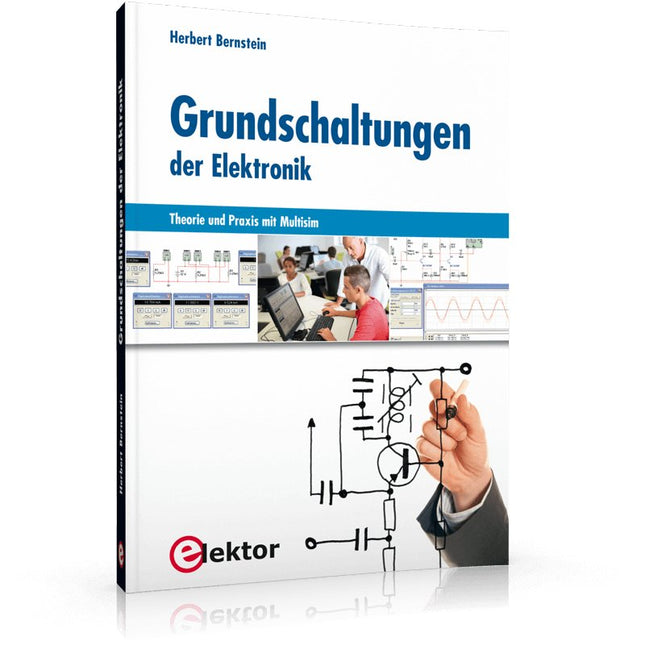
Dieses Buch ist ein Nachschlagewerk mit praxisorientierten Fakten und ausführlichen Erklärungen. Der Autor hat selbst für komplexe Vorgänge oder Formeln praktische kurze Erklärungen und Näherungsrechnungen entwickelt, ohne die Darstellungen zu simplifizieren. Als Ausgangspunkt wurde das Simulationsprogramm Multisim gewählt, das zahlreiche Bauelemente und umfangreiche Messinstrumente zur Verfügung stellt. Damit hat man ein praxisnahes Fachbuch und Nachschlagewerk für Schule, Studium und Weiterbildung im Beruf. Das Buch ist in sechs Kapitel gegliedert: Messgeräte: Arbeiten mit Multimeter, Funktionsgenerator und Zweikanal-Oszilloskop Dioden: Einweg-, Brückengleichrichter, Schalter, Spannungsbegrenzer, Z-Diode, Leuchtdioden, 7-Segment-, Bargraf-Anzeige und Optokoppler Verstärkerschaltungen: Kleinsignalverstärker, ein- und zweistufige Verstärker, Leistungsverstärker für A-, B- und AB-Betrieb, Wechselstromverstärker, Differenzverstärker, FET-Verstärker und Arbeiten mit dem Operationsverstärker Transistoren: Als Schalter eingesetzt, Schaltungen mit komplementären Transistoren, astabile und monostabile Kippschaltung, Flipflops Signalgeneratoren: Rechteckgenerator, Sägezahngenerator, Dreieck-Rechteck-Generator, Sinusgenerator, LC-Oszillator, Phasenschiebergenerator, Wien-Robinson-Generator, Oszillator mit Quarz Impulsformer mit Schmitt-Trigger und Komparator: Schmitt-Trigger mit Transistoren und FET, Dämmerungsschalter, Temperaturüberwachung, TTL-Baustein 74132, Amplitudenbegrenzer, Differenzier- und Integrierschaltung Der in mehrere Hauptkapitel gegliederte Inhalt ist so aufbereitet, dass Nachschlagen und Finden der gewünschten Themen sehr einfach ist. Neben den passiven Bauelementen (Widerständen, Kondensatoren und Spulen) nehmen die Halbleiterelemente (Dioden, Transistoren und Feldeffekttransistoren) sowie Operationsverstärker und digitale Schaltkreise einen breiten Raum ein.
€ 49,00
Bestpreis


