
Suchergebnisse für "rfid OR starter OR kit OR for OR arduino OR uno"
-
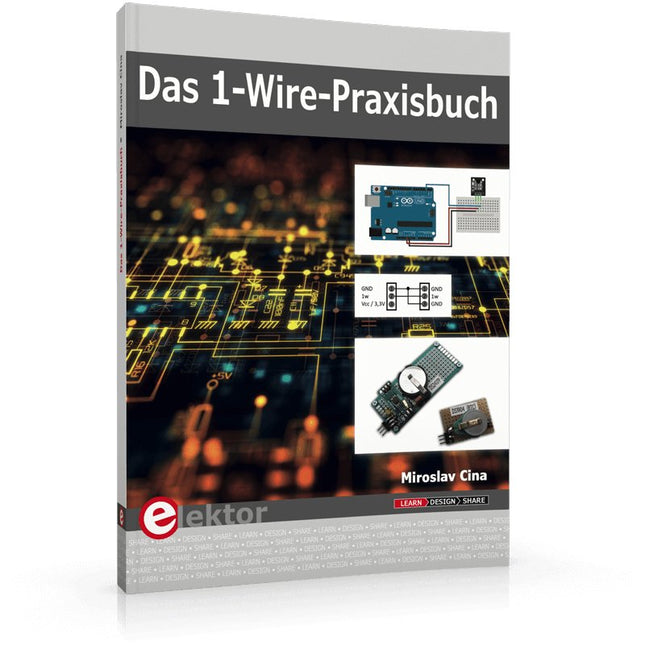
Elektor Publishing Das 1-Wire-Praxisbuch
1-Wire ist die Bezeichnung für eine serielle Schnittstelle, die mit nur einer Datenader auskommt. Es ist ein Master-Multi-Slave-Kommunikationsprotokoll. Verfügbar sind integrierte Bausteine zur Temperaturmessung, Akkuüberwachung, Echtzeituhr und beispielsweise Hotelschließanlagen. Eine Besonderheit von 1-Wire-Geräten ist die Spannungsversorgung aus der Gegenstation, hierbei erfolgt die Versorgung der Slaves über die Datenleitung. Der Leser erhält mit „Das 1-Wire-Praxisbuch“ eine umfassende Einführung in die 1-Wire-Technologie. Das Buch zeigt anhand praktischer Projekte zum Nachbauen, wie man verschiedene verfügbare 1-Wire-Chips in eigene Mikrocontroller-gesteuerte Anwendungen integrieren kann, und zwar mit Assembler-Software-Implementierungen für PIC-Mikrocontroller und mit Sketches für den Arduino. Die 1-Wire-Technik kommt in dem Buch praxisnah bei einem elektronischen Schloss zum Einsatz, das von einem PIC-Mikrocontroller gesteuert wird. Ein weiteres Praxisprojekt erläutert Schritt für Schritt, wie beispielsweise eine ständige Temperaturmessung mit 1-Wire-Bausteinen möglich ist.
€ 39,80
Bestpreis
-
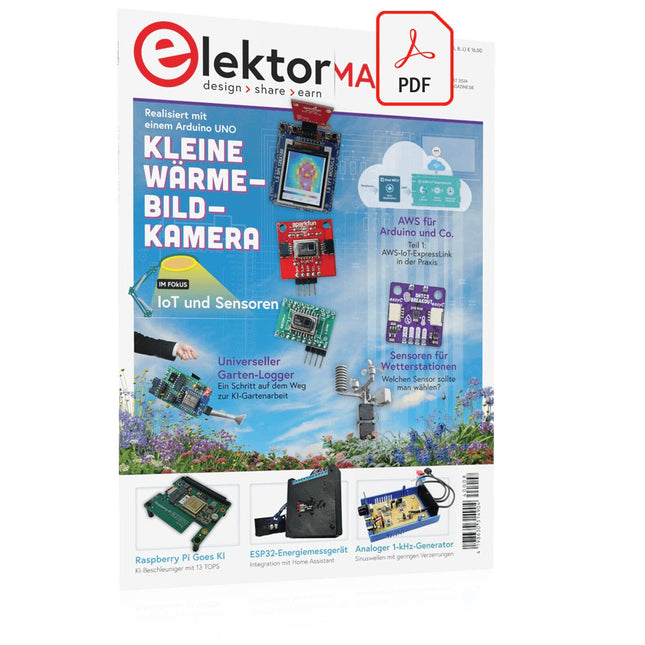
Elektor Digital Elektor 07-08/2024 (PDF)
Diese Ausgabe steht allen GOLD- und GREEN-Mitgliedern auf der ElektorMagazine-Website zum Download bereit! Sie sind noch kein Mitglied? Hier klicken! Kleine WärmebildkameraRealisiert mit einem Arduino UNO Projekt-Update #3: Energiemessgerät mit ESP32Integration und Test mit Home Assistant 2024: Eine Odyssee in die KIVerbessern der Objekterkennung: Nutzung verfeinerter Techniken Raspberry Pi Goes KINeues Kit enthält M.2-HAT mit KI-Beschleuniger Sensoren für WetterstationenWelchen Sensor sollte man wählen? KI-gestützter WasserzählerTeil 1: Bringen Sie Ihren alten Zähler ins IoT! Ein GSM-AlarmNutzung der GSM-Technologie für die Fernüberwachung von Garagen Low-Power-Thread-Geräte optimiert und getestetNiedriger Energiebedarf ... Niedrige Leistung? Aus dem Leben gegriffenDer Gender-Gap Nebelkammer selbstgebautUnsichtbare Strahlung sichtbar machen SparkFun Thing Plus MatterEin vielseitiges Matter-basiertes IoT-Entwicklungsboard IoT-RetrofittingRS232-Geräte fit für Industrie 4.0 machen IoT mit 8-Bit-Mikrocontrollern Technologie als Motor der NachhaltigkeitNeuerungen führen zu Energieeffizienz in vielen Applikationen AWS für Arduino und Co.Teil 1: AWS-IoT-ExpressLink in der Praxis Luftstromdetektor (nur) mit ArduinoKeine externen Sensoren erforderlich! WasserleckdetektorVerbunden mit der Arduino-Cloud QuarzeBemerkenswerte Bauteile Universeller Garten-LoggerEin Schritt auf dem Weg zur KI-gestützten Gartenarbeit Analoger 1-kHz-GeneratorSinuswellen mit geringen Verzerrungen Miletus: Web-Apps offline nutzenSystem- und Gerätezugriff inklusive Von 4G zu 5GIst es wirklich so einfach? Aller Anfang...muss nicht schwer sein: Der Ausgleich
€ 11,90
-
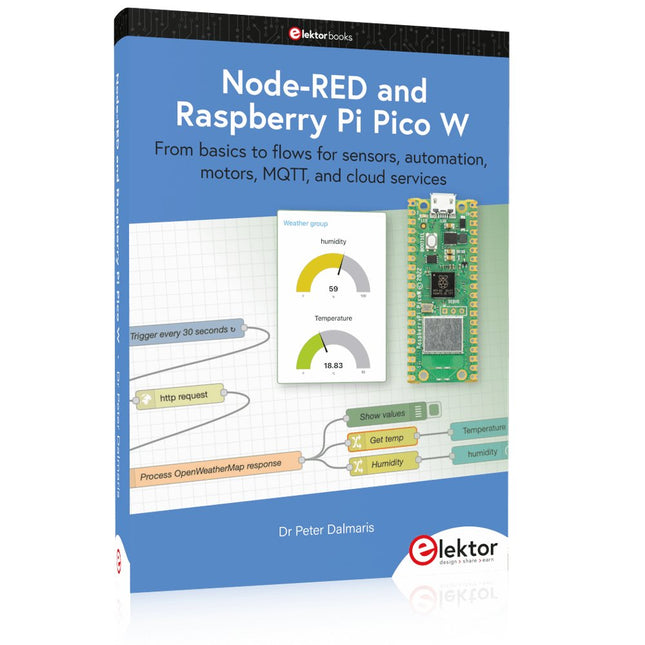
Elektor Publishing Node-RED and Raspberry Pi Pico W
From basics to flows for sensors, automation, motors, MQTT, and cloud services This book is a learning guide and a reference. Use it to learn Node-RED, Raspberry Pi Pico W, and MicroPython, and add these state-of-the-art tools to your technology toolkit. It will introduce you to virtual machines, Docker, and MySQL in support of IoT projects based on Node-RED and the Raspberry Pi Pico W. This book combines several elements into a platform that powers the development of modern Internet of Things applications. These elements are a flow-based server, a WiFi-enabled microcontroller, a high-level programming language, and a deployment technology. Combining these elements gives you the tools you need to create automation systems at any scale. From home automation to industrial automation, this book will help you get started. Node-RED is an open-source flow-based development tool that makes it easy to wire together devices, APIs, and online services. Drag and drop nodes to create a flowchart that turns on your lights at sunset or sends you an email when a sensor detects movement. Raspberry Pi Pico W is a version of the Raspberry Pi Pico with added 802.11n Wi-Fi capability. It is an ideal device for physical computing tasks and an excellent match to the Node-RED. Quick book facts Project-based learning approach. Assumes no prior knowledge of flow-based programming tools. Learn to use essential infrastructure tools in your projects, such as virtual machines, Docker, MySQL and useful web APIs such as Google Sheets and OpenWeatherMap. Dozens of mini-projects supported by photographs, wiring schematics, and source code. Get these from the book GitHub repository. Step-by-step instructions on everything. All experiments are based on the Raspberry Pi Pico W. A Wi-Fi network is required for all projects. Hardware (including the Raspberry Pi Pico W) is available as a kit. Downloads GitHub
€ 49,95
Mitglieder: € 44,96
-

€ 9,95
Mitglieder: € 8,96
-

Elektor Digital Elektor September/Oktober 2023 PDF (NL)
Elektor GREEN- und GOLD-Mitglieder können diese Ausgabe hier herunterladen. Noch kein Mitglied? Klicken Sie hier , um eine Mitgliedschaft abzuschließen. Raspberry Pi Pico als Spektrumanalysator FFTs mit billiger Hardware ±40 V linearer Spannungsregler alternatives Netzteil für die Fortissimo-100 Endstufe... und andere! Flexible drahtlose Kommunikation mit einer MCU EEPROM eröffnet Vernetzungsmöglichkeiten für drahtlose MCUs 5.000 € zu gewinnen! Nehmen Sie am STM32 Wireless Innovation Design Contest teil 2023: eine KI-Odyssee Beginnen Sie mit Code Interpreter von ChatGPT LoRa – ein Schweizer Taschenmesser Teil 1: Das LoRa-Protokoll und seine Vorteile Einstellbare Stromsenke mit integriertem Taktgenerator Testen Sie Netzteile, Spannungswandler und Batterien Zwei neue Arduino UNO R4-Boards: Minima und WiFi Logarithmische Potentiometer sie sind exponentiell! Motortreiber-Breakout-Board ein BoB für einen 5 A DC-Motortreiber von 3×3 mm Elektronik aus Life Periculosa Bietet Mobilfunk den niedrigsten Stromverbrauch für IoT? Energiebedarf von LTE-M und NB-IoT in LPWAN-Bereitstellungen Drahtlose Kommunikation in IoT-Systemen mit Arduino MKR-Modulen das richtige Board für WiFi, LoRa und andere Standards Wechselstromverluste in magnetischen Bauteilen Vermeiden Sie heiße Spulen! Maßnahmen für optimale Cloud-Konnektivität Matter-Implementierung: Was ist für die Bereitstellung von Matter-Geräten erforderlich? YARD Stick Eins Sub-1-GHz-Wireless-Testgerät Halterelais Fremde PIC vor zehn – pünktlich Entwurf eines SDR-Zeitsignalempfängers Sorgfaltspflichtrichtlinie „Business as Usual“ wird nicht funktionieren Aller Anfang... ...verstärkt Spannungen Infraschallrekorder mit dem Arduino Pro Mini ein Beispielprojekt aus der Elektor-Publikation „Arduino & Co“ Cloudbasierter Energiezähler mit einem ESP32-Modul und einem PZEM-004T Spannungs-/Stromsensor Ein Leitfaden zur puristischen Programmierung (Teil 2) genaues Timing, UART und Debugging
€ 9,95
-

Elektor Digital Elektor Juli/Augustus 2020 (PDF)
ELEKTOR AIDE L'électronique dans des temps difficiles AFFICHAGE D'INFORMATION POUR LA MAISON avec Windows sur le Raspberry Pi DÉMARRER AVEC NODE-RED un outil de programmation open source basé sur des blocs visuels LA tombola d'ÉTÉ d'ELEKTOR GREATSCOTT ! CONSTRUIRE UN SYSTÈME D'ALARME LORA REVUE : ALIMENTATION DE LABORATOIRE JOY-IT RD6006 (KIT) REVUE : INTERFACEBOARD GREATFET ONE QUI N'HONNE PAS LES PETITS – XXL de la boîte à suggestions d'Elektor ANTENNE WIFI EXTERNE 2,4 GHZ POORLUIS CONTRÔLE FACILE DE LA TEMPÉRATURE MARCHE/ARRÊT AVEC CHAPEAU RASPBERRY PI COMMENT PRENDRE DE (BONNES) PHOTOS DÈS L'IMPRESSION... ...et les composants électroniques ? REVUE : NOYAU I2CDRIVER ÉCRAN TACTILE JOY-VIEW 13 DE JOY-IT BOOSTER LED POUR MICROCONTRÔLEURS avec un seul composant ! MACHINE À LAVER À ULTRASONS EXPÉRIMENTALE REVUE : GÉNÉRATEUR DE SIGNAUX JOY-IT JDS2915 générateur de signaux doubles avec compteur de fréquence dans un boîtier métallique PROGRAMMATION DES FEUX DE SIGNALISATION EN LANGAGE PIC ASSEMBLY LED CLIGNOTANT PERMANENT CAPTEUR DE HALL EXPÉRIMENTAL DÉTECTER LES COURT-CIRCUITS AVEC UN MILLIOHM OU ESR MÈTRE KIT PRATIQUE ÉLECTRIQUE SDR PIPELINE DE LABORATOIRES ÉLECTRIQUES KICK-STARTER ÉLECTRIQUE ....eh bien, vous voyez ce que nous voulons dire. AVEZ-VOUS VRAIMENT BESOIN DE TOUT ÇA ??? ici, je passe de nombreuses heures sur des projets électroniques... LABORATOIRE EST OUEST MEILLEUR un aperçu du plus saint des saints, où naissent des projets intéressants BONJOUR LE MONDE! NOUS SOMMES ELEKTOR ET NOUS SOMMES SOCIAUX M4 + A7 + GPU : UNE ÉQUIPE DE RÊVE INÉGALE le nouveau SoC STM32MP1 pour les travaux plus lourds CONFIGURATION DE TEST POUR LE 16F18877 ET AUTRES GRANDES PHOTOS COMMUNICATION INTER-ΜC AVEC LE BUS SPI ET ATMEGA328P SIX VARIANTES DE L'OSCILLATEUR LF/AF (et la capacité de M. Miller) BBC MICRO:BIT oscilloscope absolument minimaliste avec affichage LED FEU DE RUNNING À LED 'KNIGHT RIDER' AVEC ESP32 GÉNÉRATEUR DE SIGNAUX AM LW/MW AVEC ATTINY13 DIPMÈTRE ABSOLUMENT MINIMALISTE SCOOTERS ÉLECTRIQUES BON MARCHÉ quelle est la qualité d'un scooter électrique « homologué » à 300 euros de Lidl ? AIDE AU STATIONNEMENT À ULTRASONS AVEC ARDUINO UNO PÉDALE DE DISTORSION AVEC AMPLI OP ET TUBES DE CHARGE SPATIALE INDISPENSABLE POUR CHAQUE LABORATOIRE D'ÉLECTRONIQUE HEXADOKU IA POUR DÉBUTANTS (2) réseaux de neurones avec Linux et Python
€ 9,95
-

Elektor Digital Design your own Embedded Linux Control Centre (E-book)
This book is all about building your own DIY home control system. It presents two innovative ways to assemble such a system: By recycling old PC hardware – possibly extending the life of an old PC, or by using Raspberry Pi. In both cases, the main system outlined in this book will consist of a computer platform, a wireless mains outlet, a controller and a USB webcam – All linked together by Linux. By using the Raspberry Pi in conjunction with Arduino (used as an advanced I/O system board), it is possible to construct a small, compact, embedded control system offering enhanced capacity for USB integration, webcams, thermal monitoring and communication with the outside world. The experience required to undertake the projects within this book are minimal exposure to PC hardware and software, the ability to surf the internet, burn a CD-ROM and assemble a small PCB.
€ 34,95
Mitglieder: € 31,46
-

Elektor Publishing Control Engineering with Fuzzy Logic
Practical Applications and Project with Arduino, ESP32, and RP2040 Immerse yourself in the fascinating world of control engineering with Arduino and ESP32! This book offers you a practical introduction to classic and modern control methods, including PID controllers, fuzzy logic, and sliding-mode controllers. In the first part, you will learn the basics of the popular Arduino controllers, such as the Arduino Uno and the ESP32, as well as the integration of sensors for temperature and pH measurement (NTC, PT100, PT1000, and pH sensor). You will learn how to use these sensors in various projects and how to visualize data on a Nextion TFT display. The course continues with an introduction to actuators such as MOSFET switches, H-bridges, and solid-state relays, which are used to control motors and actuators. You will learn to analyze and model controlled systems, including PT1 and PT2 control. The book focuses on the implementation of fuzzy and PID controllers for controlling temperature and DC motors. Both the Arduino Uno and the ESP32 are used. The sliding-mode controller is also introduced. In the second-to-last chapter, you will explore the basics of neural networks and learn how machine learning can be used on an Arduino. In the last chapter, there is a practical example of a fuzzy controller for feeding electricity into the household grid. This book is the perfect choice for engineers, students, and electronics engineers who want to expand their projects with innovative control techniques.
€ 44,95
Mitglieder: € 40,46
-

Elektor Digital Elektor September/October 2022 (PDF)
Elektor GREEN and GOLD members can download their digital edition here. Not a member yet? Click here. electronica fast forward 2022 Start- & Scale-Up AwardsPreparations Speeding Up! Bluetooth Low Energy with ESP32-C3 and ESP32You Don’t Always Need to Choose Wi-Fi! Bluetooth Low Energy SnifferHacking a makerdiary nRF52840 MDK USB Dongle Magic RGB LED CubeHardware Design Around an RP2040 Auto On/Off for Solder Paste Compressor Elektor Video ContentLivestreams, Webinars, and Courses for Engineers and Pro Makers Bicycle ElectrificationHands-On with an E-Bike Retrofit Kit Starting Out in ElectronicsMultiplying Voltages From Life’s ExperienceSidelines Teensy 4.0Why Is This Board So Fast? Audio Power Amplifier Simulation with TINAThe Try-Before-You-Build Approach Develop and Operate Your LoRaWAN IoT NodesSample Chapter: Dragino LHT65, LDS01, and LDS02 LoRaWAN Modules Err-lectronicsCorrections, Updates and Readers’ Letters 5G Just for MeGaining Complete Control of 5G Deployments with Private Cellular Networks Infographics 7-8/2022 How Does My Device Learn to Transmit?Applications with Wi-Fi Interfaces Smartphones are the Heart of the IoT Audio Spectrum Analyzer with DekatronsA New Way to Use Vintage Tubes Sending Data to TelegramGet It Done with an ESP32 and a Few Parts A Fliege Notch Filter for Audio MeasurementsMake Better Measurements with a Notch Filter CO2 Meter TeardownIs It Hackable for Your Projects? PUT-ting It All TogetherThe Programmable Unijunction Transistor Explained Round Touchscreen for Raspberry PiHyperPixel 2.1 Round from Pimoroni Remote Sensing with Connection Loss DetectionUsing nRF24L01+ Modules Digital FM Receiver with Arduino and TEA5767Stayed Tuned with an Arduino Nano Changing an OLED Interface from SPI to I²C HomeLab ToursA Hobby Does Not Retire A Decade of Ethics in ElectronicsTessel Renzenbrink Reflects on the Digital Society and More HexadokuThe Original Elektorized Sudoku
€ 7,50
-
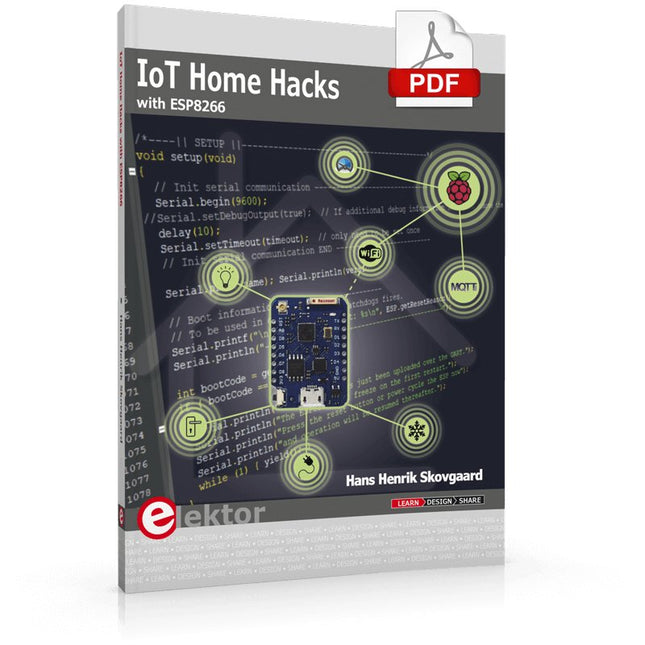
Elektor Digital IoT Home Hacks with ESP8266 (E-book)
There are many so-called 'Arduino compatible' platforms on the market. The ESP8266 – in the form of the WeMos D1 Mini Pro – is one that really stands out. This device includes WiFi Internet access and the option of a flash file system using up to 16 MB of external flash memory. Furthermore, there are ample in/output pins (though only one analogue input), PWM, I²C, and one-wire. Needless to say, you are easily able to construct many small IoT devices! This book contains the following builds: A colourful smart home accessory refrigerator controller 230 V power monitor door lock monitor and some further spin-off devices. All builds are documented together with relevant background information for further study. For your convenience, there is a small PCB for most of the designs; you can also use a perf board. You don’t need to be an expert but the minimum recommended essentials include basic experience with a PC, software, and hardware, including the ability to surf the Internet and assemble PCBs. And of course: A handle was kept on development costs. All custom software for the IoT devices and PCB layouts are available for free download from at Elektor.com.
€ 34,95
Mitglieder: € 31,46
-

Elektor Digital De basis van elektronica (E-book)
Analoge schakelingen, sensors en microcontrollers Elektronica is spannend. Het is een hobby die zowel leuk als leerzaam is. Het stelt je in staat om thuis of op het werk nieuwe en nuttige vaardigheden te leren. Een ervaren elektronicus ontwerpt zijn eigen schakelingen, en brengt zijn projecten tot leven. Maar voordat je zover bent, moet je eerst de basis onder de knie krijgen. Daarom brengt dit boek een groot aantal inleidende artikelen samen die in het elektronicatijdschrift Elektor zijn gepubliceerd. Het is je metgezel bij het leerproces in de wereld van de elektronica. Het begint allemaal met analoge elektronica. Je zult de eenvoudigste componenten en circuits ontdekken om te begrijpen hoe ze werken, hoe ze op elkaar inwerken en de mogelijke problemen. De beste manier om vooruitgang te boeken is door echte experimenten uit te voeren, want theorie is niet genoeg. Dit boek begeleid je in een groot aantal praktische projecten voor beginners. Door ze te maken, doe je veel ervaring en kennis op. Het tweede deel van het boek neemt je mee in de wereld van de digitale elektronica. De auteur bespreekt het gebruik van microcontrollers. Taken die voorheen werden uitgevoerd door discrete componenten of conventionele geïntegreerde schakelingen worden nu uitgevoerd door microcontrollers. De programmeertaal BASCOM, maar ook platforms als Arduino, BBC micro:bit en andere, maken dit leerproces veel gemakkelijker. Dit boek beschrijft in detail vele toepassingen van microcontrollers, die betaalbaar zijn voor de beginner. Hier gaan programmeren en solderen hand in hand!
€ 32,95
Mitglieder: € 29,66
-

Paggen Werkzeugtechnik SMD Starter I – Fertigungslinie für Prototypen
Die Prototypen-Fertigungslinie SMD Starter I besteht aus dem Schablonendrucker TSD240, dem SMD-Bestückungsgerät PlaceMAN und dem Reflow-Ofen 3LHR10. Schablonendrucker SD240 (+ Metallrakel 155 mm) Schablonengröße: max. 175 x 255 mm Platinengröße: max. 180 x 240 mm Gerätegröße: 410 x 270 x 110 mm Gewicht: 6,7 kg inkl. Metallrakel 155 mm inkl. 8 Magnete zum Halten der Leiterplatte, 6 davon mit M3-Madenschraube inkl. transparente Platzierhilfe und Faserschreiber Manuelles SMD-Bestückungsgerät PlaceMAN für Standardbauteile inkl. Vakuumpumpe (ohne Zuführungen, Kamera, Monitor und Dispenser) Ausgestattet mit leichtgängigem Bestückungsarm, Bestückungskopf mit Einhandbedienung, Rotation der Z-Achse und automatischer Vakuumabschaltung, inkl. Leiterplattenhalterung, Vakuumeinheit und 2 Bestückungsnadeln mit Gummisaugern. Kapazität an Feeder (nicht im Lieferumfang enthalten) 2x Feederkassette für 10 x 8 mm Rollen links 4x Feederkassette für Stangenfeeder für jeweils 5 Stangen weiter Zuführsysteme sind innerhalb des Bestückungsbereiches möglich, z. B. Strip-Feeder Stecksystem Abmessungen Grundgerät (LxBxH): 765 x 390 x 210 mm Mit Feederkassette für 10 x 8 mm Rollen (LxBxH): 765 x 390 x 210 mm Mit Feederkassette für 10 x 8 mm Rollen und Feederkassette für Stangenfeeder (LxBxH): 765 x 430 x 210 mm (Höhe kann durch die Stangenlänge variieren) Mit Feederkassette für 10 x 8 mm Rollen inkl. Halter für 10 Rollen und Feederkassette für Stangenfeeder (LxBxH): 765 x 430 x 210 mm (Höhe kann durch die Stangenlänge variieren) Technische Daten Gewicht Grundgerät: ca. 6 kg Verfahrweg der Achsen (x,y,z): 470 x 230 x 15 mm Max. Arbeitsbereich: 380 x 240 mm Max. PCB-Größe: 230 x 360 mm Stromversorgung Netzteil: 230/12 V, 800 mA Stromversorgung Vakuumpumpe: 230 V, 6 W 3LHR10 Reflow-Ofen (programmierbar für bleifreie Lötungen mit manueller Schublade und Tablet-Steuerung) Reflow-Ofen mit IR und Konvektionsheizung. Die erzwungene Heißluftkonvektion sorgt für ein gleichmäßiges Temperaturprofil in der gesamten Kammer. Nach dem manuellen Öffnen der Tür werden die Lüfter eingeschaltet und die gelötete Leiterplatte schnell abgekühlt. Kleiner Reflow-Ofen mit manueller Türöffnung Industrie 4.0 bereit, Bluetooth-Kommunikation + Tablet IR + Konvektionsheizung. Android-Anwendung zur Verbindung mit Tablet oder Smartphone 100 verschiedene Benutzerprogramme Lieferumfang: 3LHR10, Tablet mit App, Schutzhülle für Tablet, 4 Leiterplattenhalter, externes Thermoelement, Handbuch im Tablet Anwendung Schließen Sie den Ofen an die Stromversorgung an und schließen Sie die optional erhältliche Absaugung (3LFE10S) an den Abluftstutzen an. Nach dem ersten Einschalten sucht der Ofen nach einem Tablet oder Smartphone. Wenn beide in der Android-App verbunden sind, wählen Sie die Programmierung des Ofens. Hier sind programmierbare Temperatur und Vorheizzeit sowie Temperatur und andere Daten einzustellen. Registrieren Sie sich mit dem Tablet, um den vollen Umfang der Software nutzen zu können. Wenn der Ofen bereits programmiert ist, kann der Benutzer den Vorgang mit Tasten und Anzeige auf der Vorderseite steuern. Nach Abschluss des Reflow-Vorgangs ertönt ein akustisches Signal. Ein Signal wird auch auf dem Tablet/Smartphone angezeigt. Die Schublade muss nun manuell geöffnet werden. Die Android-Anwendung zeigt Prozessstatus, Zeit und Temperatur oder andere Informationen an. Technische Daten Netzanschluss: 230 V, 50 Hz Maximale Leistung: 3100 W Temperaturen: 50-260°C Abmessungen: 510 x 370 x 340 mm Maximales Gewicht: 16 kg Gitterabmessungen: 350 x 220 mm Maximale Abmessungen der Leiterplatte: 300 x 200 mm Maximale Komponentenhöhe auf der Leiterplatte: 50 mm oben, 30 mm unten Lieferumfang Schablonendrucker TSD240 SMD-Bestückungsgerät PlaceMAN Reflow-Ofen 3LHR10
€ 6.549,00
Bestpreis


