
Suchergebnisse für "official OR micro OR usb OR power OR supply OR for OR raspberry OR pi OR black"
-

FNIRSI FNIRSI TDM-120P Wärmebild-Multimeter
Das FNIRSI TDM-120P ist ein Wärmebild-Multimeter, das Wärmebildtechnologie mit herkömmlichen Multimeter-Funktionen kombiniert und so umfassendere sowie intuitivere Messergebnisse für elektrische Prüfungen und verwandte Anwendungen liefert. Es findet breite Anwendung in Bereichen wie Elektrotechnik, industrieller Fertigung, Bauwesen und Sicherheitsüberwachung. Das TDM-120P bietet zuverlässige technische Unterstützung bei der Geräteprüfung, Fehlerdiagnose und Instandhaltung und trägt dazu bei, die Produktionseffizienz, die Produktqualität sowie die allgemeine Sicherheit zu steigern. Features 2-in-1: Wärmebildkamera + True-RMS-Multimeter (19.999 Counts) 120 x 90 HD-Bildauflösung | Hohe thermische Empfindlichkeit <60 mK Temperaturbereich -20°C bis 400°C | Einstellbarer Emissionsgrad (0,01–1,00) 2,8"-LCD-Touchscreen | 7 Farbpaletten | Speichern per Knopfdruck & USB-Export Umfassende Multimeter-Funktionen: AC/DC-Spannung, Widerstand und Kapazität Vielseitige Anwendung: HLK, Lecksuche, Elektro- und Kfz-Reparatur Technische Daten 7 Farbpaletten Arktis / Heißes Eisen / Eisen-Rot / Regenbogen / Lava / Schwarz-Heiß / Weiß-Heiß Detektortyp Vanadiumoxid Sichtfeld 50° Bildschirm 2,8-Zoll-LCD-Touchscreen Bildrate ≤25 Hz Infrarot-Auflösung 120 x 90 Temperaturanzeige Mittelpunkt, automatische Verfolgung von Höchst- und Tiefsttemperaturen Temperaturbereich -20°C bis 400°C Temperatureinheit °C / °F Genauigkeit ±2°C oder ±2% (maximaler Messwert) Alarm für hohe/niedrige Temperaturen Ja Emissionsgrad 0,01–1 einstellbar Sprachen Englisch, Chinesisch Multimeter Gleichspannung Bereich: 1,9999 V / 19,999 V / 199,99 V / 1000 V Genauigkeit: ±(0,5% +3) Wechselspannung Bereich: 1,9999 V / 19,999 V / 199,99 V / 750,0 V Genauigkeit: ±(1% +3) Widerstand Bereich: 19,999 MΩ / 1,9999 MΩ / 199,99 kΩ / 19,999 kΩ Genauigkeit: ±(0,5% +3) Bereich: 1,9999 kΩ / 199,99 Ω Genauigkeit: ±(2,0% +3) Kapazität Bereich: 999,9 μF / 99,99 μF / 9,999 μF / 999,9 nF / 99,99 nF / 9,999 nF Genauigkeit: ±(2,0% +5) Bereich: 9,999 mF / 99,99 mF Genauigkeit: ±(5,0% +20) Diode Ja Durchgangsprüfung Ja Lieferumfang 1x FNIRSI TDM-120P Wärmebild-Multimeter 2x Multimeter-Messleitungen 1x Aufbewahrungstasche 1x USB-Kabel 1x Manual Downloads Manual Firmware v1.2.6
€ 179,95
Bestpreis
-

FNIRSI FNIRSI SG-003A Signalgenerator
Der FNIRSI SG-003A ist ein kleiner, hochpräziser Signalgenerator mit einem 2,4' TFT-Farbdisplay mit einem Frequenzbereich von bis zu 10 kHz und einem aktiven und passiven Stromausgang von 24 mA. Die maximale Ausgangsspannung beträgt 24 V. Die eingebaute 3000-mAh-Lithiumbatterie hat eine Laufzeit von 10 Stunden. FNIRSI SG-003A wird hauptsächlich für die Fehlersuche in industriellen SPS, Prozessinstrumenten, elektrischen Ventilen usw. verwendet. Features Genauigkeit (Spannung/Strom) 0,1% ±0,005 Auflösung (aktuell) 0,01 mA Frequenz 0-10 kHz Auflösung 5 Ziffern Ausgangsleistung 24 V Display 2,4" TFT-LCD (320 x 240) Abmessungen 92 x 72 x 30 mm Gewicht 165 g Technische Daten Signal Bereich Genauigkeit Auflösung Maximale Belastung Externe Stromversorgung Aktiver Stromausgang 0~24 mA ±(0,1% + 0,005) 0,01 mA 750 Ω Passiver Stromausgang (XMT) 0~24 mA ±(0,1% + 0,005) 0,01 mA 0~30 V Spannungsausgang 0~24 V ±(0,1% + 0,005) 0,01 V 24-V-Schleife 0~24 mA ±(0,1% + 0,005) 0,01 mA Frequenzausgang 0~9999 Hz ±2% 5 Ziffern Stromeingang 0~24 mA ±(0,1% + 0,005) 0,01 mA Spannungseingang 0~30 V ±(0,1% + 0,005) 0,01 V Lieferumfang 1x FNIRSI SG-003A Signalgenerator 4x Testclips 1x USB-Ladegerät 1x USB-C Kabel 1x Manual Downloads Manual Firmware V4.3
€ 68,79
-
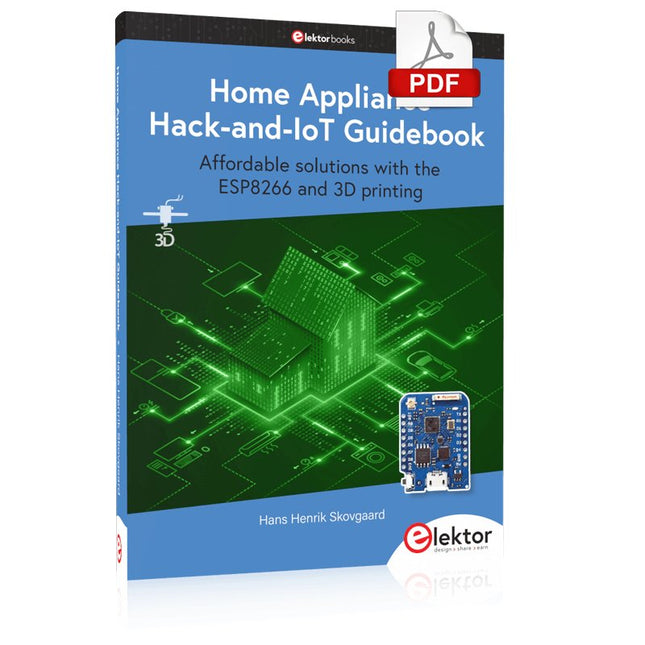
Elektor Digital Home Appliance Hack-and-IoT Guidebook (E-book)
Affordable solutions with the ESP8266 and 3D printing If you are looking for a small yet powerful IoT device, you are likely to come across the ESP8266 and compatible products on the market today. One of these, the Wemos/Lolin D1 Mini Pro board strikes a remarkable balance between cost and performance. A small and very affordable prototype board, the D1 Mini Pro stands out with its WiFi functionality and a 16-Mbytes flash memory for easy creation of a flash file system. In addition, there are sufficient input and output pins (only one analog input though) to support PWM, I²C, and One-Wire systems to mention but a few. The book describes the operation, modding, construction, and programming of home appliances including a colorful smart home accessory, a refrigerator/greenhouse controller, an AC powerline monitor, a door lock monitor, and an IKEA Trådfri controller. As a benefit, all firmware developed for these DIY, "IoT-ized" devices can be updated over-the-air (OTA). For most of the designs in the book, a small printed circuit board (PCB) and an enclosure are presented so readers can have a finished and attractive-looking product. Readers having – or with access to! – a 3D printer can "print" the suggested enclosures at home or in a shop. Some of the constructions benefit from a Raspberry Pi configured as a gateway or cms server. This is also described in detail with all the necessary configuring. You don’t need to be an expert but the prerequisites to successful replication of the projects include basic skills with PC software including the ability to surf the Internet. In terms of hardware, you should be comfortable with soldering and generally assembling the PCBs presented in the book. All custom software written for the IoT devices, the PCB layouts, and 3D print files described in the book are available for free downloading.
€ 34,95
Mitglieder: € 31,46
-

Elektor Digital Raspberry Pi Select (PDF) NL
61 pagina's met de beste Raspberry Pi artikelen en projecten uit Elektor Magazine: Windows op de Raspberry Pi (1) Windows op de Raspberry Pi (2) Windows op de Raspberry Pi (3) Raspberry Pi wobbulator Raspberry-Pi-emulator Raspberry-Pi-voltmeter Raspberry Pi prototyping-board Visual Basic op de Raspberry Pi RPi meet energieverbruik Voor Linux-board en Raspberry Pi Maak uw eigen I2C-device voor de Raspberry Pi SD-kaart-upgrade voor RPi model 2 Mini-workshop GestIC & 3D-touchpad (2) Surfen op de golven van de RPi ATmega op het web (1) ATmega op het web (2)
€ 9,50
Mitglieder: € 8,55
-

Elektor Digital Practical Electronics Crash Course (E-book)
Learning circuit design the fun way Welcome to the world of electronics! Getting started in electronics is not as difficult as you may think. Using this book, you will explore and learn the most important electrical and electronics engineering concepts in a fun way by doing various experiments and by simulating circuits. It will teach you electronics practically without getting into complex technical jargon and long calculations. As a result, you will be creating your own projects soon. No prior knowledge of electronics is required, only some basic algebra is used in a few simple calculations. Many tested and working projects and simulations are presented to familiarise yourself with the construction of electronic circuits. Circuit simulation is introduced at an early stage to enable you to experiment with circuits easily without breaking anything. You will learn: The concepts of voltage, current, and power AC and DC Basic lamp circuits with switches Passive components: resistors, capacitors & inductors RC & RCL circuits Electromagnetism Loudspeakers, relays, buzzers, and transformers Active components: diodes & LEDs, bipolar transistors & MOSFETs Transistor-based switching circuits Optocoupler circuits Astable & monostable multivibrators Using the 555 timer IC The operational amplifier Digital logic Advanced examples: amplifiers, oscillators, filters, and sensors Test and measurement tools Microcontrollers: Arduino UNO, ESP32, Raspberry Pi Pico, and Raspberry Pi Reading datasheets and best practices for selecting components EMC & EMI and norms & regulations
€ 32,95
Mitglieder: € 29,66
-

Elektor May/June 2025 (EN)
Elektor GREEN and GOLD members can download their digital edition here. Not a member yet? Click here. PbMonitor v1.0A Battery-Monitoring System for UPS and Energy Storage Applications Solar Charge Controller with MPPT (1)Basic Principles of a Solar Controller for Stand-Alone Systems B-Field Integration Magnetometer With Home-Made Sensors Precise or Accurate?Your Instruments Need to Be Both! AD7124 A Precision ADC in PracticeFeatures for Sensor Signal Conditioning PID Control ToolOptimize Your Parameters Easily embedded world 2025 Starting Out in Electronics……Continues with Tone Control Academy Pro BoxBook + Online Course + Hardware Milliohmmeter AdapterUses the Precision of Your Multimeter The Next Leap in SemiconductorsOnward Toward 1.4 nm Through-Hole Technology ConnectorsThe Best of Two Worlds: THR Frequency CounterPortable and Auto-Calibrating Via GPS Analog MetersPeculiar Parts, the Series Stand-Alone Crystal TesterHow Accurate Is Your Clock Source? Low-Cost I²C TesterConnect I²C Devices Directly to Your PC From Life’s ExperienceWho Doesn’t Honor the Small Things? 2025: An AI OdysseyThe Transformative Impact on Software Development Err-lectronicsCorrections, Updates, and Readers’ Letters Raspberry Pi Standalone MIDI Synthesizer (2)Enhancing Our Setup with Intelligence Nortonized Wien Bridge OscillatorSmall Changes Yield Significant Improvements Putting a $0.10 Controller to the TestThe CH32V003 RISC-V Microcontroller and MounRiver Studio in Practice An FPGA-Based Audio Player with Equalizer (2)Adding Volume Control, Advanced Mixing, and a Web Interface
€ 10,95
-
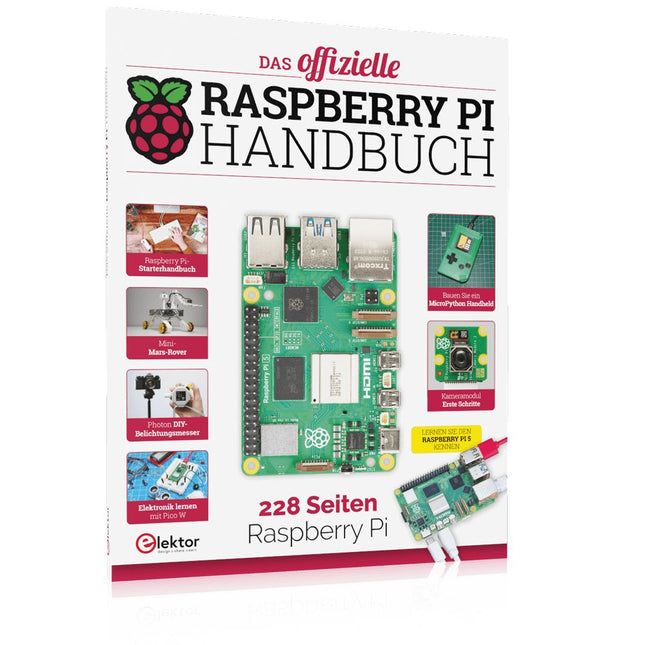
Elektor Publishing Das offizielle Raspberry Pi Handbuch
Von den Machern von MagPi, dem offiziellen Raspberry Pi Magazin Starten Sie jetzt mit dem Raspberry Pi 5, dem neuesten und besten Minicomputer von Raspberry Pi – und lernen Sie, mit diesem unglaublichen Computer zu programmieren und Projekte zu erstellen. In diesem Buch finden Sie außerdem jede Menge kreative Ideen und Tipps, die Sie mit dem Raspberry Pi 4, dem Raspberry Pi Zero 2 W und dem Raspberry Pi Pico W umsetzen können. Mit den neuesten Reviews, Tutorials, Projekten, Anleitungen und mehr ist dies Ihre ultimative Ressource für den Raspberry Pi! 228 Seiten über Raspberry Pi Alles, was Sie über den Raspberry Pi 5 wissen müssen Erste Schritte für jeden Raspberry Pi Viel Spaß mit Elektronik und dem Pico W Inspirierende Projekte für Ihre nächste Bauidee Lernen Sie MicroPython, indem Sie ein Handheld bauen Erste Schritte mit dem Raspberry Pi Kamera Modul Künstliche Intelligenz: Bauen Sie Ihren eigenen GPT Chatbot
€ 34,80
Bestpreis
-
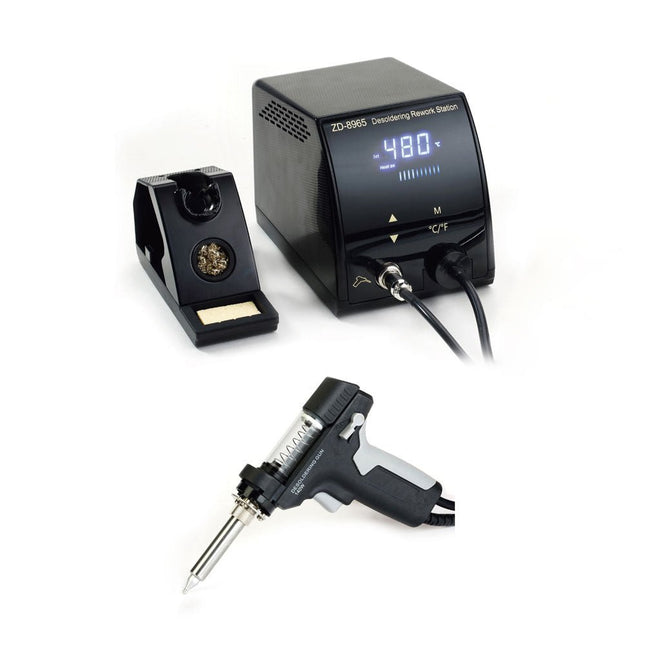
Zhongdi ZD-8965 Entlötstation
Die ZD-8965 ist eine digitale temperaturgesteuerte Entlötstation, die mit Erdungsschutz und einem LCD-Display zur Temperaturanzeige ausgestattet ist. Trotz ihres kompakten und robusten Designs lässt sich diese Hochleistungs-Entlötstation einfach mit nur einer Hand bedienen. Die ZD-8965 verfügt über eine Lötpistole mit integriertem Filter, der jegliches abgesaugte Material auffängt und einen kontinuierlichen Betrieb durch einfaches Austauschen der Filter ermöglicht. Darüber hinaus ist in der Spitze ein Temperatursensor eingebettet, der eine schnelle Reaktion auf Temperaturschwankungen für eine konstante Leistung ermöglicht. Features Stellen Sie die Temperatur mühelos zwischen 160°C und 480°C ein, indem Sie die praktischen Auf-/Ab-Tasten auf der Vorderseite verwenden. LED-Anzeige zur Anzeige der Temperatur in °C/°F Verfügt über einen ergonomischen Pistolengriff mit Auslöser für eine schnelle und effiziente Entfernung von Lötzinnabfällen. Die verbesserte Lötpistole verfügt über einen hinteren Abzug, wodurch sie besonders praktisch zum Austauschen und Reinigen von Komponenten ist. Wird mit einer hochwertigen Lötpistole und einer stabilen Halterung geliefert. Ausgestattet mit einer Hochleistungsheizung, die jedes Mal eine optimale Entlötleistung gewährleistet. Technische Daten Station Spannungsversorgung 220-240 V Leistung 140 W Vakuumdruck 600 mm HG Entlötpistole Leistung 140 W (18 V DC)Aufheizleistung: 140 W Temperatur 160-480°C Heizelement Keramikheizung Lieferumfang 1x ZD-8965 Entlötstation 2x Ersatzlötspitze 3x Reinigungsnadel für Entlötspitzen 3x Ersatzfilter für Entlötpistole 1x Ersatzfilter für Lötstation 1x Manual
€ 97,36
-

Elektor Digital The ESP32 Cheap Yellow Display Book (PDF)
Projects Using Arduino IDE and the LVGL Graphics Library The ESP32 is probably one of the most popular microcontrollers used by many people, including students, hobbyists, and professional engineers. Its low cost, coupled with rich features makes it a popular device to use in many projects. Recently, a board called the ESP32 Cheap Yellow Display (CYD for short) is available from its manufacturers. The board includes a standard ESP32 microcontroller together with a 320x240 pixel TFT display. Additionally, the board provides several connectors for interfaces such as GPIO, serial port (TX/RX), power and Ground. The inclusion of a TFT display is a real advantage as it enables users to design complex graphics-based projects without resorting to an external LCD or graphics displays. The book describes the basic hardware of the ESP32 CYD board and provides details of its on-board connectors. Many basic, simple, and intermediate-level projects are given in the book based on the ESP32 CYD, using the highly popular Arduino IDE 2.0 integrated development environment. The use of both the basic graphics functions and the use of the popular LVGL graphics library are discussed in the book and projects are given that use both types of approaches. All the projects given in the book have been tested and are working. The block diagram, circuit diagram, and the complete program listings and program descriptions of all the projects are given with explanations. Readers can use the LVGL graphics library to design highly popular eye-catching full-color graphics projects using widgets such as buttons, labels, calendars, keypads, keyboards, message boxes, spinboxes, sliders, charts, tables, menus, bars, switches, drop-down lists, animations, and many more widgets.
€ 29,95
Mitglieder: € 26,96
-
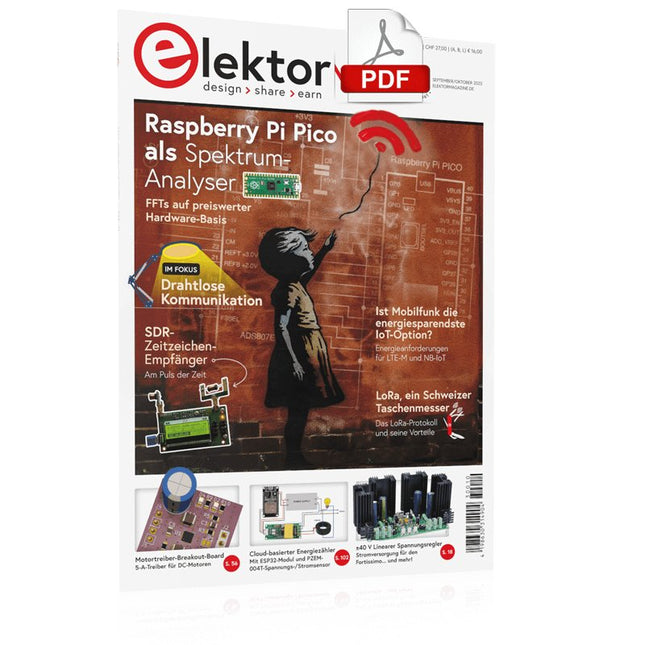
Elektor Digital Elektor 09-10/2023 (PDF)
Diese Ausgabe steht allen GOLD- und GREEN-Mitgliedern auf der ElektorMagazine-Website zum Download bereit! Sind Sie noch kein Mitglied? Hier klicken! Raspberry Pi Pico als Spektrum-Analyser FFTs auf preiswerter Hardware-Basis ±40 V linearer Spannungsregler Eine alternative Stromversorgung für die Fortissimo-100-Endstufe ... und andere! Drahtlose MCU-Kommunikation flexibel gemacht EEPROM eröffnet Netzwerk-Perspektiven für drahtlose MCUs 5.000 € zu gewinnen! Machen Sie mit beim STM32 Wireless Innovation Design Contest! 2023: Odyssee in der KI Loslegen mit dem Code-Interpreter von ChatGPT LoRa, ein Schweizer Taschenmesser Teil 1: Das LoRa-Protokoll und seine Vorteile Einstellbare Stromsenke mit integriertem Taktgeber Zum Testen von Netzteilen, Spannungswandlern und Batterien Zwei neue Arduino UNO R4 Boards: Minima und WiFi Logarithmische Potentiometer Sie sind exponentiell! Motortreiber-Breakout-Board Ein BoB für einen 5-A-Treiber für DC-Motoren mit einer Größe von 3×3 mm Aus dem Leben gegriffen Gefährliche Elektronik Ist Mobilfunk die energiesparendste Option für das IoT? LTE-M und NB-IoT: Energieanforderungen in LPWAN-Implementierungen Kabellose Kommunikation in IoT-Systemen mit MKR Modulen von Arduino Kommunikationsstandards des Arduino-Moduls für IoT AC-Verluste in magnetischen Bauteilen Erhalten Sie heiße Induktivitäten! Messungen für eine optimale Cloud-Implementierung Matter-Implementierung: Was braucht es, um Matter-Geräte einzusetzen? Neue 2,4 GHz-Funkeinheiten von Circuit Design Prädestiniert für Fernsteuerung und Überwachung PIC o'Clock – am Puls der Zeit Design eines SDR-Zeitzeichen-Empfängers Sorgfaltspflichtrichtlinie „Weiter so“ ist nicht genug Aller Anfang... Ist gar nicht schwer: Spannungsverstärkung Infraschall-Rekorder mit dem Arduino Pro Mini Ein Beispielprojekt aus dem Elektor-Buch „Arduino & Co.“ Cloud-basierter Energiezähler Mit ESP32-Modul und PZEM-004T-Spannungs-/Stromsensor Eine Anleitung zur Bare-Metal-Programmierung Teil 2: Exaktes Timing, UART und Debugging
€ 11,90
-

Elektor Digital Elektor July/August 2021 (PDF) EN
LoRa with the Raspberry Pi PicoFun with MicroPython What Is RISC-V?And Why the Industry Is So Excited About a New Processing Core! Elektor @ 60Circuits of Summer Past Versatile Power Supply for BreadboardsPositive and Negative Voltages Out of 5 V from USB Raspberry Pi Pico EssentialsSample Chapter: Wi-Fi with the Raspberry Pi Pico Magnetic Levitation the Easy Way Hands On the Parallax Propeller 2Part 3: Smart Pins and Serial Data (UART) Nucleo Boards Programming with the STM32CubeIDESample Chapter: FreeRTOS for the STM32 MCU Developer's ZoneTips & Tricks, Best Practices and Other Useful Information Miniware DT71 Digital Tweezers Wearable Wi-Fi Gadget: ESPHome Does the Job Again Starting out in ElectronicsEasier Than Imagined! This Concludes the Subject of “Capacitors” Simple Sketches Using the Qwiic Ecosystem Java on the Raspberry Pi (Part 2)Controlling GPIOs with a Spring REST Service Raspberry Pi Compute Module 4A Raspberry Pi for Industry Portable, Stand-Alone Air Quality Display for 2.5 µm ParticlesKeep(s) an Eye on Your Health From Life’s ExperienceThe Future Was Better in the Past MicroPython for the ESP32 and FriendsPart 1: Installation and Our First Programs Charge-Coupled Devices in OscilloscopesPeculiar Parts, the series ESD – The Invisible DestroyerComponents Trashed by a Bolt from the Blue Solar Power for Mowing RobotsEcological, Inexpensive, Simple! Europe’s Efforts to Tame Big Tech HexadokuThe Original Elektorized Sudoku
€ 7,50
-

OWON OWON XDM1241 True RMS Multimeter
Das OWON XDM1241 ist ein schnelles, hochpräzises digitales True RMS Tisch-Multimeter mit einem hochauflösenden 3,5-Zoll-LCD und 50.000 Counts. Seine Gleichspannungsgenauigkeit beträgt bis zu 0,05% und es kann bis zu 65 Werte pro Sekunde messen. Features 3,5" hochauflösendes LCD (480x320 Pixel) 55.000 Counts DC-Spannungsgenauigkeit bis zu 0,05% Bis zu 65 Messwerte pro Sekunde Zweizeilige Anzeige unterstützt Trendanalyse im Diagrammmodus zugänglich AC True RMS-Messungen (Bandbreite: 20 Hz – 1 kHz) SCPI-Unterstützung: Fernsteuerung des Multimeters über PC-Software über USB-Anschluss Datenaufzeichnungsfunktion: Sie können die gemessenen Daten im internen Speicher aufzeichnen und die aufgezeichneten Daten dann mit Ihrem Computer lesen und verarbeiten. Technische Daten Messbereich Auflösung Genauigkeit Gleichspannung 50.000 mV 0,001 mV 0,1% +10 500,00 mV 0,01 mV 0,05% +5 5,0000 V 0,0001 V 0,05% +5 50.000 V 0,001 V 0,05% +5 500,00 V 0,01 V 0,1% +5 1000,0 V 0,1 V 0,1% +10 Wechselspannung 500 mV ~ 750 V 20 Hz ~ 45 Hz 1% +30 45 Hz ~ 65 Hz 0,5% +30 65 Hz ~ 1 kHz 0,7% +30 Gleichstrom 500 uA 0,01 uA 0,15% +20 5000 uA 0,1 uA 0,15% +10 50 mA 0,001 mA 0,15% +20 500 mA 0,01 mA 0,15% +10 5 A 0,0001 A 0,5% +10 10 A 0,001 A 0,5% +10 Wechselstrom 500 uA ~ 500 mA 20 Hz ~ 1 KHz 0,5% +20 5 A ~ 10 A 1,5% +20 Widerstand 500 Ω 0,01 Ω 0,15% +10 5 KΩ 0,0001 KΩ 0,15% +5 50 KΩ 0,001 KΩ 0,15% +5 500 kΩ 0,01 kΩ 0,15% +5 5 MΩ 0,0001 MΩ 0,3% +5 50 MΩ 0,001 MΩ 1% +10 Häufigkeit 10.000 Hz ~ 60 MHz / ±(0,2% +10) Kapazität 50nF ~ 500uF / 2,5% +10 5mF ~ 50mF 5% +10 Diode 3,0000 V 0,0001 V / Kontinuität 1000 Ω 0,1 Ω Einstellbarer Schwellenwert Temperatur Typ K, PT100 Max. Anzeige 55.000 Counts Datenprotokollierungsfunktion Protokollierungsdauer 15 ms ~ 9999,999 s Protokollierungslänge 1.000 Punkte Anzeige 3,5" TFT LCD (480x320 Pixel) Stromversorgung Lithium-Akku über USB-C oder 5 V DC Eingang Abmessungen 200 x 88 x 150 mm Gewicht ca. 0,5 kg Lieferumfang 1x OWON XDM1241 Multimeter 2x Messleitungen 1x USB-Kabel 1x USB auf DC Kabel 1x Manual Downloads Programming Manual PC Software
€ 107,10


