
Suchergebnisse für "linear OR circuit OR design OR handbook"
-

Elektor Digital Raspberry Pi 5 for Radio Amateurs (E-book)
Program and Build Raspberry Pi 5 Based Ham Station Utilities with the RTL-SDR The RTL-SDR devices (V3 and V4) have gained popularity among radio amateurs because of their very low cost and rich features. A basic system may consist of a USB based RTL-SDR device (dongle) with a suitable antenna, a Raspberry Pi 5 computer, a USB based external audio input-output adapter, and software installed on the Raspberry Pi 5 computer. With such a modest setup, it is possible to receive signals from around 24 MHz to over 1.7 GHz. This book is aimed at amateur radio enthusiasts and electronic engineering students, as well as at anyone interested in learning to use the Raspberry Pi 5 to build electronic projects. The book is suitable for both beginners through experienced readers. Some knowledge of the Python programming language is required to understand and eventually modify the projects given in the book. A block diagram, a circuit diagram, and a complete Python program listing is given for each project, alongside a comprehensive description. The following popular RTL-SDR programs are discussed in detail, aided by step-by-step installation guides for practical use on a Raspberry Pi 5: SimpleFM GQRX SDR++ CubicSDR RTL-SDR Server Dump1090 FLDIGI Quick RTL_433 aldo xcwcp GPredict TWCLOCK CQRLOG klog Morse2Ascii PyQSO Welle.io Ham Clock CHIRP xastir qsstv flrig XyGrib FreeDV Qtel (EchoLink) XDX (DX-Cluster) WSJT-X The application of the Python programming language on the latest Raspberry Pi 5 platform precludes the use of the programs in the book from working on older versions of Raspberry Pi computers.
€ 32,95
Mitglieder: € 29,66
-
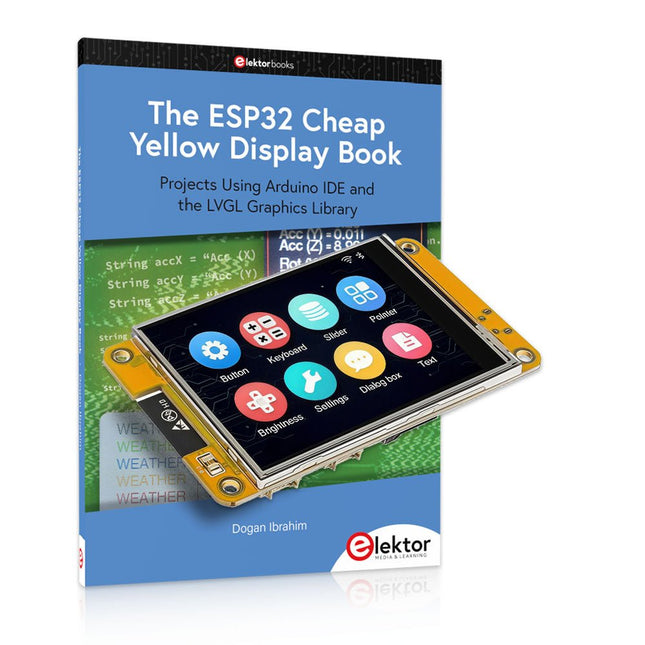
Elektor Bundles The ESP32 Cheap Yellow Display Bundle
Über 40 vollständig getestete ESP32-Projekte mit Arduino IDE und der LVGL-Grafikbibliothek Dieses Bundle enthält das ESP32 Cheap Yellow Display (CYD) – ein kompaktes Entwicklungsboard, das einen Standard-ESP32-Mikrocontroller mit einem 320 x 240 Pixel großen TFT-Farbdisplay kombiniert. Das Board verfügt außerdem über mehrere Anschlüsse für GPIO, serielle Kommunikation (TX/RX), Strom und Masse. Das integrierte Display ist ein großer Vorteil und ermöglicht die Erstellung komplexer, grafikbasierter Projekte ohne externe LCDs oder Displays. Das Begleitbuch stellt die Hardware und die integrierten Anschlüsse des CYD-Boards detailliert vor. Es bietet eine Reihe von Projekten für Anfänger und Fortgeschrittene, die mit der beliebten Arduino IDE 2.0 entwickelt wurden. Sowohl grundlegende Grafikfunktionen als auch die leistungsstarke LVGL-Grafikbibliothek werden behandelt, und praktische Projekte veranschaulichen jeden Ansatz. Alle enthaltenen Projekte wurden vollständig getestet und sind sofort einsatzbereit. Das Buch enthält Blockdiagramme, Schaltpläne, vollständige Codelisten und Schritt-für-Schritt-Erklärungen. Mit der LVGL-Bibliothek können Leser moderne, vollfarbige grafische Benutzeroberflächen mit Widgets wie Schaltflächen, Beschriftungen, Schiebereglern, Kalendern, Tastaturen, Diagrammen, Tabellen, Menüs, Animationen und mehr erstellen. ESP32 Cheap Yellow Display Board Dieses Entwicklungsboard (auch bekannt als "Cheap Yellow Display") wird vom ESP-WROOM-32 angetrieben, einem Dual-Core-MCU mit integrierten Wi-Fi- und Bluetooth-Funktionen. Es arbeitet mit einer Hauptfrequenz von bis zu 240 MHz, mit 520 KB SRAM, 448 KB ROM und einem 4 MB Flash-Speicher. Das Board verfügt über ein 2,8" Display mit einer Auflösung von 240x320 und Resistive Touch. Darüber hinaus enthält die Platine einen Steuerkreis für die Hintergrundbeleuchtung, einen Schaltkreis für die Berührungssteuerung, einen Schaltkreis für die Lautsprecheransteuerung, einen lichtempfindlichen Schaltkreis und einen RGB-LED-Steuerschaltkreis. Es bietet außerdem einen TF-Kartensteckplatz, eine serielle Schnittstelle, eine DHT11-Schnittstelle für Temperatur- und Feuchtigkeitssensoren und zusätzliche E/A-Anschlüsse. Das Modul unterstützt die Entwicklung in Arduino IDE, ESP-IDE, MicroPython und Mixly. Anwendungen Bildübertragung für Smart Home-Gerät Drahtlose Überwachung Intelligente Landwirtschaft QR-Funkerkennung Signal des drahtlosen Positionierungssystems Und andere IoT-Anwendungen Technische Daten Mikrocontroller ESP-WROOM-32 (Dual-Core-MCU mit integriertem WLAN und Bluetooth) Frequenz Bis zu 240 MHz (Rechenleistung bis zu 600 DMIPS) SRAM 520 KB ROM 448 KB Flash 4 MB Betriebsspannung 5 V Stromverbrauch ca. 115 mA Display 2,8" TFT-Farbbildschirm (240 x 320) Touch Resistive Touch Treiberchip ILI9341 Abmessungen 50 x 86 mm Gewicht 50 g Downloads GitHub Dieses Bundle enthält: The ESP32 Cheap Yellow Display Book (Einzelpreis: 35 €) ESP32 Cheap Yellow Display Board (Einzelpreis: 25 €) 1x ESP32 Dev-Board mit 2,8" Display und Acrylgehäuse 1x Touch-Stift 1x Verbindungskabel 1x USB-Kabel
€ 59,95€ 49,95Bestpreis
-

Elektor Digital Mastering the Arduino Uno R4 (E-book)
Programming and Projects for the Minima and WiFi Based on the low-cost 8-bit ATmega328P processor, the Arduino Uno R3 board is likely to score as the most popular Arduino family member, and this workhorse has been with us for many years. Eleven years later, the long-overdue successor, the Arduino Uno R4, was released. It is built around a 48 MHz, 32-bit Arm Cortex-M4 microcontroller and provides significantly expanded SRAM and Flash memory. Additionally, a higher-precision ADC and a new DAC are added to the design. The Uno R4 board also supports the CAN Bus with an interface. Two versions of the board are available: Uno R4 Minima, and Uno R4 WiFi. This book is about using these new boards to develop many different and interesting projects with just a handful of parts and external modules. All projects described in the book have been fully tested on the Uno R4 Minima or the Uno R4 WiFi board, as appropriate. The project topics include the reading, control, and driving of many components and modules in the kit as well as on the relevant Uno R4 board, including LEDs 7-segment displays (using timer interrupts) LCDs Sensors RFID Reader 4x4 Keypad Real-time clock (RTC) Joystick 8×8 LED matrix Motors DAC (Digital-to-analog converter) LED matrix WiFi connectivity Serial UART CAN bus Infrared controller and receiver Simulators … all in creative and educational ways with the project operation and associated software explained in great detail.
€ 34,95
Mitglieder: € 31,46
-

Elektor Digital ESP32 by Example (E-book)
A Project-Based Introduction to Microcontrollers and Drone Control A Practical Introduction to Embedded Systems with the ESP32 This book is intended for readers who are new to embedded systems and looking for a structured, example-driven way to begin. If you’ve explored general-purpose electronics or Arduino-based resources but found them too broad or lacking in practical application, this guide offers a more focused alternative. With a small, affordable set of components – such as LEDs, sensors, an OLED screen and a motion sensor – you’ll build and work with the same hardware setup throughout the book. This allows you to focus on learning and experimenting without constant reconfiguration. Topics include: Understanding and programming the ESP32 microcontroller Using the Arduino IDE to write and deploy code Exploring cyber-physical systems, culminating in basic drone control No prior experience with Arduino or embedded development is required. Each section includes hands-on examples and mini-projects designed to reinforce core concepts and encourage deeper exploration. By the end, you’ll be equipped not only to reproduce the book’s examples, but also to extend them toward your own ideas and applications. Whether your interest is in learning embedded programming, building interactive systems, or exploring educational drone control, this book provides a clear and practical path to getting started.
€ 34,95
Mitglieder: € 31,46
-
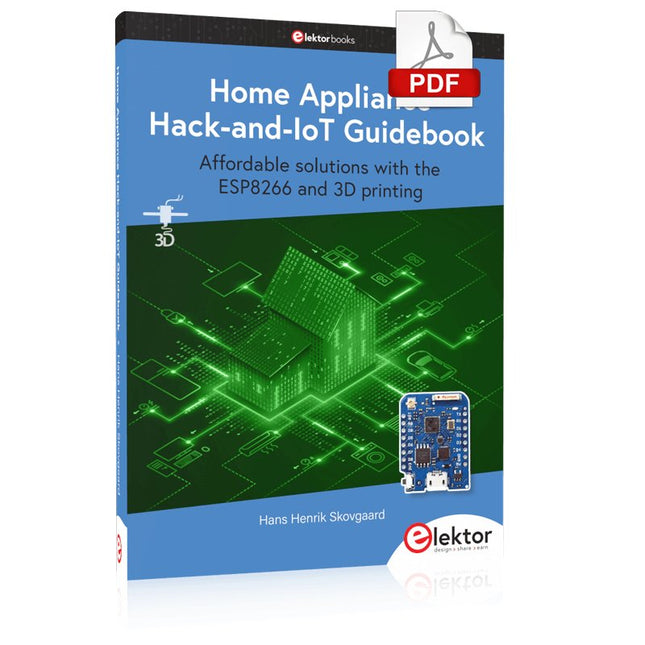
Elektor Digital Home Appliance Hack-and-IoT Guidebook (E-book)
Affordable solutions with the ESP8266 and 3D printing If you are looking for a small yet powerful IoT device, you are likely to come across the ESP8266 and compatible products on the market today. One of these, the Wemos/Lolin D1 Mini Pro board strikes a remarkable balance between cost and performance. A small and very affordable prototype board, the D1 Mini Pro stands out with its WiFi functionality and a 16-Mbytes flash memory for easy creation of a flash file system. In addition, there are sufficient input and output pins (only one analog input though) to support PWM, I²C, and One-Wire systems to mention but a few. The book describes the operation, modding, construction, and programming of home appliances including a colorful smart home accessory, a refrigerator/greenhouse controller, an AC powerline monitor, a door lock monitor, and an IKEA Trådfri controller. As a benefit, all firmware developed for these DIY, "IoT-ized" devices can be updated over-the-air (OTA). For most of the designs in the book, a small printed circuit board (PCB) and an enclosure are presented so readers can have a finished and attractive-looking product. Readers having – or with access to! – a 3D printer can "print" the suggested enclosures at home or in a shop. Some of the constructions benefit from a Raspberry Pi configured as a gateway or cms server. This is also described in detail with all the necessary configuring. You don’t need to be an expert but the prerequisites to successful replication of the projects include basic skills with PC software including the ability to surf the Internet. In terms of hardware, you should be comfortable with soldering and generally assembling the PCBs presented in the book. All custom software written for the IoT devices, the PCB layouts, and 3D print files described in the book are available for free downloading.
€ 34,95
Mitglieder: € 31,46
-

Elektor Digital Elektor Special: Solar Power Systems and Photovoltaics (PDF)
As demand for solar panel installation has risen sharply, especially for installations larger than balcony power plants, the order books of solar companies are full. If you ask for a quote today, you may have to wait a while, if your request isn't simply postponed indefinitely. Another consequence of the solar boom is that some companies are charging very high prices for installations. Yet there is an obvious and radical solution to the problem of excessive prices: Do it yourself, as the English say. The price of materials is currently affordable, and it's the ideal time for those who do the work themselves. They couldn't save more. Add to this the satisfaction of doing something useful, both economically and ecologically, and the pleasure of building yourself. In this special issue, you'll find a wide selection of Elektor assemblies, from solar panel controllers to solar water heaters and solar panel orientation systems. The issue also contains practical information on solar panel installation and the technology behind them. Finally, there are a number of articles on the subject of balcony power plants, from how to install them to how to connect them to the Internet... Contents BASICS Dimensioning Photovoltaic Panel ArraysAn introduction to photovoltaic energy and the commonest techniques,followed by simplified calculation models and setup guidelines. Light Sensor TechnologyMeasuring daylight using LEDs. Solar Power Made SimpleSolar charging with and without a controller. Cable Cross-sections and Energy Losses in Solar SystemsKey considerations on the minimum values to respect for electricalcurrent in solar panel cabling. Solar ModulesEverything you always wanted to know about solar panels... Ideal Diode ControllerDiode Circuits with Low Power Dissipation. TIPS Tracking for Solar Modules zBot Solar/Battery Power Supply Solar Cell Array Charger with Regulator Solar Cell Voltage Regulator Solar-Powered Night Light Alternative Solar Battery Charger PROJECTS Energy LoggerMeasuring and Recording Power Consumption. Tiny Solar SupplySunlight In, 3.3 V Out. A Do-It-Yourself DTURead Data from Small Inverters by μC. Solar ChargerPortable energy for people on the move. Solar Thermal Energy RegulatorMaximum power point tracking explored. 2-amp Maximum Power Tracking ChargerSolar Power To The Max. Computer-driven HeliostatFollow the sun or the stars. Garden LightingUsing solar cells. Solar Panel Voltage Converter for IoT DevicesYes we CAN exploit indoor lighting. Travel ChargerFree power in the mountains. Solar Cell Battery Charger/MonitorWith protection against deep discharge. Solar-powered Battery ChargerPIC12C671 avoids overcharging and deep charging. Converters for Photovoltaic PanelsContributed by TME (Transfer MultisortElektronik). Solar Charging RegulatorFor panels up to 53 watts. Solar-Powered ChargerFor lead-acid batteries. CAN Bus + Arduino for Solar PV Cell MonitoringDetect and locate serviceable panels in large arrays. Balcony Power Plant 2.0The latest: solar panels, installation and inverters
€ 14,95
Mitglieder: € 13,46
-

Elektor Digital Alimentation électrique autonome (PDF)
ÉLECTRICITÉ PHOTOVOLTAÏQUE = ÉLECTRICITÉ GRATUITE Nous sommes désormais plus qu'heureux de poursuivre nos recherches sur notre propre autonomie et de veiller à ce que notre production électrique photovoltaïque soit appropriée ! D'abord on en rêve, puis vient l'étape du calcul : comparer le coût du kilowattheure d'origine du nucléaire (environnement à partir de centimes d'euro) et le calcul du kilowattheure d'origine photovoltaïque (l'environnement de 22 centimes de l'euro*), et nous saurons où en sont nos motivations d'écocitoyens. Gérard Guihéneuf, l'auteur de ce nouveau livre, pense qu'il ne faut pas se contenter d'aligner chiffres et idées. La nouvelle approche du processus de création d'entreprise se base sur la compréhension et les dimensions des installations des bâtiments domestiques dans le domaine public en 2009 et sur l'actualité des techniques et pratiques de réponse aux questions qui se posent lors de l'électrification des le site isolé ! La conception de projets simples, comme un contexte domestique, et d'un commentaire électrique standard, comme un système d'énergie photovoltaïque, trois emplacements réguliers : un abri dans le jardin, un garage et un mobil-home. L'économie est spectaculaire lorsqu'il s'agit de composants électroniques et d'assemblages de certains constituants essentiels, car les régulateurs de charge, les onduleurs et les panneaux solaires ne suffisent pas à l'entretien autonome du site. Si vous souhaitez en savoir plus sur l'électrification professionnelle de votre chantier, vous pouvez en savoir plus sur les dimensions des éléments constitutifs sans sacrifier l'efficacité ! Vous pouvez également utiliser la copie du Gerber et du Sprint Layout pour les circuits imprimés de la livrée. *avec les batteries en cours de reconditionnement lors de la panne photovoltaïque en cours et dans les vingt-cinq
€ 24,95
Mitglieder: € 22,46
-

€ 32,95
Mitglieder: € 29,66
-

Elektor Bundles Physical AI with Raspberry Pi (Bundle)
Dieses Bundle enthält das AI Fusion Lab Kit mit über 450 Komponenten sowie das Buch Physical AI mit Raspberry Pi und bietet einen umfassenden, praxisnahen Einstieg in KI, Elektronik und Python-Programmierung. Realisieren Sie praxisnahe Projekte, die Computer Vision, Sprachinteraktion, Sensoren, Motoren und Large Language Models miteinander verknüpfen. Das beiliegende Buch führt Sie Schritt für Schritt von der Einrichtung des Raspberry Pi und der Hardware-Steuerung bis hin zu fortgeschrittenen Anwendungen unter Einsatz von OpenCV, MediaPipe, YOLO, OpenAI-Diensten und lokalen Ollama-Modellen. SunFounder AI Fusion Lab Kit für Raspberry Pi (450+ Teile) Das AI Fusion Lab Kit verwandelt einen Raspberry Pi in eine umfassende Plattform zum Erlernen von künstlicher Intelligenz, Elektronik und Python-Programmierung. Es unterstützt die Modelle Raspberry Pi 5, 4B, 3B+, 3B und Zero 2 W sowie gängige KI-Modelle und -Dienste, darunter ChatGPT, Gemini, Grok, DeepSeek, Qwen, Doubao und Ollama. Dank Kamera, Pan-Tilt-HAT, 10-Achsen-Sensormodul, Mikrofon, Lautsprecher und elektronischen Komponenten ermöglicht das Kit den Bau interaktiver KI-Projekte, die Sprache, Bilderkennung, Bewegung und Sensordaten kombinieren. Es eignet sich für Anfänger, Schüler und Studierende, Maker sowie alle, die praktische KI-Anwendungen erkunden möchten. Multimodale KI-Projekte entwickeln Kombinieren Sie große Sprachmodelle (LLMs) mit Spracherkennung, Text-zu-Sprache-Ausgabe, Kamera-Bilderkennung, Sensoren und Breadboard-Schaltungen. Erstellen Sie Projekte, die hören, sprechen, sehen, reagieren und mit ihrer Umgebung interagieren können, während Sie gleichzeitig die Funktionsweise moderner KI-Systeme kennenlernen. KI-Bilderkennung und Objektverfolgung erkunden Nutzen Sie YOLO, OpenCV und MediaPipe, um Objekte, Farben, Gesichter und menschliche Bewegungen zu erkennen und zu verfolgen. Der motorisierte Pan-Tilt-HAT ermöglicht es der Kamera, Zielen automatisch zu folgen, und demonstriert so das Zusammenspiel von Computer Vision und Bewegungssteuerung. Sprach-KI mit dem Fusion HAT+ Das Fusion HAT+ vereinfacht die Hardware-Steuerung durch eine einheitliche Python-Bibliothek und unterstützt das sichere Herunterfahren des Raspberry Pi. Dank des integrierten Mikrofons und Lautsprechers lassen sich problemlos sprachgesteuerte Assistenten und andere KI-Anwendungen für die Mensch-Maschine-Interaktion entwickeln. Kompatibel mit Raspberry Pi 5, 4B, 3B+, 3B und Zero 2 W Unterstützt verschiedene cloudbasierte und lokale KI-Modelle Umfasst Kamera, Pan-Tilt-HAT, 10-DOF-Modul, Mikrofon und Lautsprecher Projekte zu den Themen Sprach-KI, Computer Vision, Sensorik und Elektronik Video-Tutorials, Dokumentation und Beispielcode Buch: Physical AI with Raspberry Pi Anhand des Raspberry Pi und des AI Fusion Lab Kits führt Sie dieses Buch Schritt für Schritt von den Grundlagen der Hardware-Anbindung bis hin zur Entwicklung intelligenter Systeme, die sehen, hören, sprechen und Entscheidungen treffen können. Ob Schüler, Lehrkraft, Maker oder Ingenieur – Sie sammeln wertvolle Erfahrungen durch Projekte, die darauf ausgelegt sind, sowohl Ihr Wissen als auch Ihr Selbstvertrauen zu stärken. Ausgehend von der Systemeinrichtung, der GPIO-Programmierung sowie dem Einsatz von Sensoren, Displays, Motoren und Automatisierungstechniken führt das Buch schrittweise in fortgeschrittene Themen ein, darunter Spracherkennung, Text-zu-Sprache-Synthese, dialogorientierte KI (Conversational AI), Objekterkennung und maschinelles Lernen. Dabei lernen Sie, sprachgesteuerte Geräte, intelligente Assistenten, Kamera-Tracking-Systeme, Lösungen zur Umweltüberwachung sowie KI-gestützte Embedded-Anwendungen zu entwickeln. Entdecken Sie moderne Technologien wie OpenAI-Dienste, lokale Large Language Models (via Ollama), OpenCV, MediaPipe und die Objekterkennung mit YOLO, während Sie praktische Erfahrungen mit realen Anwendungen aus den Bereichen Robotik, Industrieautomatisierung, Smart Devices und autonome Systeme sammeln. Sie erfahren, wie intelligente Software mit Sensoren, Kameras, Motoren und Displays interagieren kann, um Systeme zu schaffen, die auf natürliche Weise auf ihre Umgebung reagieren. Anstatt lediglich Code-Beispiele nachzuahmen, werden Sie dazu ermutigt, zu experimentieren sowie jedes Projekt individuell anzupassen und zu erweitern. Die in diesem Buch vermittelten Techniken und Fähigkeiten bilden eine solide Grundlage für zukünftige Innovationen, Rapid Prototyping, Forschung und Produktentwicklung. Wenn Sie bereit sind, über die klassische Elektronik hinauszugehen und die Zukunft intelligenter Embedded-Systeme zu erkunden, begleitet Sie dieses Buch auf jedem Schritt des Weges. Dieses Bundle enthält: SunFounder AI Fusion Lab Kit for Raspberry Pi (Einzelpreis: 100 €) Buch: Physical AI with Raspberry Pi (Einzelpreis: 45 €) Nicht enthalten Raspberry Pi
€ 129,95
Bestpreis
-

Elektor Publishing Programming Microcontrollers in MicroPython
With Examples for Raspberry Pi Pico and ESP32 Creating and programming small electronic systems is now easier than ever before. With inexpensive development boards and modern software tools, anyone curious about embedded design can quickly move from an idea to a working piece of hardware. At the heart of this change is MicroPython—a clear, interactive, and beginner-friendly way to program microcontrollers while still remaining closely connected to the underlying electronics. This book introduces embedded programming through MicroPython on popular platforms such as the Raspberry Pi Pico and the ESP32. You will discover how to use microcontrollers for reading inputs, processing data, and controlling outputs in a predictable, real-time loop. With just a few lines of code, you can blink LEDs, read sensors, drive motors, and communicate with the outside world. The interactive REPL programming interface encourages experimentation and fast learning, making concepts tangible from the very first chapter. While different boards offer different capabilities, they all share the same core principles. Timers, GPIO, analog I/O, PWM, interrupts, and communication interfaces form the foundation of every embedded system. By focusing on these universal building blocks, this book helps you build skills that transfer across platforms and scale naturally toward more advanced development. Whether you are a beginner or an experienced programmer entering embedded systems, you will find that working with MicroPython is both practical and genuinely enjoyable.
€ 29,95
Mitglieder: € 26,96
-

Elektor Digital Elektor Schaltungs-Spezial 2023 (PDF)
Der vollständige Download dieser Nummer ist für unsere GOLD- und GREEN-Mitglieder auf der Elektor Magazine- Site verfügbar! Nicht noch einmal Mitglied? Klicken Sie hier . kleine Sonneneinstrahlung Sonnenlicht im Eingang, 3,3 V im Auslauf Stereo-Audioumschalter ohne Klicks oder Handyteile große RGB-Leuchte mit LED-Durchlichtlampen vom Typ WS2812 Mikrofonvorverstärker mit 48 V Phantomspeisung ideal für Podcasting und professionelle Tonwiedergabe Kreiselgeneratoren mit zyklischer Takt- und Frequenzsteuerung einfache Montagen mit CI CMOS und TTL Einfacher dynamischer Kompressor mit sanfter Kontrolle und einem Sohn Hitze einfache elektronische Sperre aktiver Wiedergutmacher von 2 bis 40 V bis 3 A mit Unterdrückung des Rückstroms Umstellung auf Zufahrt/Arretierung für aktive Teile Symmetrischer/asymmetrischer Umrechner mit RFI-Filter und CC-Schutz 2023: Die Odyssee der IA Ursprung und Entwicklung Drehzahlregler für Ventilator oder Belüfter mit manuellen Modi und Thermostat Arduino-Projektplattform?: neueste Nachrichten Neue Projekte der Gemeinschaft Zuschlagsmonitor Überwachen Sie die elektrischen Leitungen, um Überströme zu erkennen clignotement nocturne sans transistors ein Oszillator erkennt nicht, dass die Komponenten zweier Filamente sind Morsecode-Generator verwenden Sie es als Ballast oder Lerngerät! CNA Video programmierbar Behandeln Sie alle Formate nur für RGB888 ein ganz kleines Klavier ohne Handyteile Doppel-Dé-électronique ohne Mikrocontroller zwei auf einem einzigen gedruckten Kreis? plus quelques astuces de conception elektronischer Effaroucheur Schaltungen, die unterhaltsam, inspirierend und aufregend sind Thermometer LC-LP-HA genaue Maße und binäre Anzeige Harmonischer Verzerrungsgenerator freiwillige Erzeugung der Verzerrung Thyristor-Überhitzungsanzeiger nicht konventionelle Verwendung von elektronischen Bauteilen eine CTP-Klappliege ein Vogelscheuchen ein Klassiker von Elektor, der Gasflaschen enthält Neonlampe mit Mikrocontroller Quelle stabiler Strömung bei gleichbleibender Temperatur Temperaturabweichungen von CI-Stromquellen vermeiden Korrektur der Reihenfolge 2, einstellbar Hörkorrektur für ältere Menschen Edwin Revient nach 53 Jahren Abwesenheit Unterarm-Hebemaschine ein Klassiker von Elektor, einfach, unterhaltsam, nostalgisch und lehrreich einfacher variabler Widerstand zur numerischen Steuerung Schutz vor Wasserschäden Schutz und Alarm gegen Wassermangel Sparsame Minuterie mit automatischer Sperrung benötigt 0,0 mW im eingeschalteten Zustand! ChatGPT von Arduino ZD-Meter Messung der Wicklungsspannung der Z-Dioden? 100 V Servotester Windows ESP32-Controller mit kostenloser Software analoge und gemischte Schaltkreise von Microchip Energiesparmanagement und Signalverarbeitung Schnittstellenstandards Filterung und Schutz gegen Fremdspannungen für den I²C-Bus Li-Ion-Batteriemonitor Der Restladeanzeiger liefert eine visuelle Informationsrückgabe PS/2-Slot als rotierender Code (und mehr?) einfacher Dämmerungsschalter zur Modernisierung Ihrer Leuchten oder Installationen Befehl für Wasserpumpe Schützen Sie sich vor dem Wasserfluss Sonnen-Weihnachtskugel mit FM-Radio alles, was Sie zu Weihnachten wollen, das ist es Vibrationssensor mit Relais tippen oder klopfen, um zu klopfen Kontinuitätsprüfer vernünftig und diskret Knopfleiste/Haltestelle Mini-Durchsuchgerät-Controller 2023 Überarbeitung eines Projekts von 1980 numerischer Vibrationsdetektor wandelt Schwingungen in präzise Impulse um Schutz gegen Polaritätsumkehr mit schwachem Spannungswandler Pegel der Frequenz leicht abweichend kleiner Simulator DCF77 eine genaue Referenz für Fake-Time der Lilygo T-PicoC3 Kombinieren Sie einen RP2040 und einen ESP32-C3 mit einem TFT-Farbbildschirm Hexadoku
€ 10,95
-

Elektor Digital Microcontroller Basics (E-book)
Microcontrollers have become an indispensable part of modern electronics. They make things possible that vastly exceed what could be done previously. Innumerable applications show that almost nothing is impossible. There’s thus every reason to learn more about them, but that raises the question of where to find a good introduction to this fascinating technology. The answer is easy: this Microcontroller Basics book, combined with the 89S8252 Flash Board project published by Elektor Electronics. However, this book offers more than just a basic introduction. It clearly explains the technology using various microcontroller circuits and programs written in several different programming languages. Three microcontrollers from the 8051 family are used in the sample applications, ranging from the simple 89C2051 to the AN2131, which is designed to support USB applications. The programming tools include assemblers, Basic-52 and BASCOM-51, and several C compilers. Every reader can thus find the programming environment most suitable to his or her needs. In the course of the book, the reader gradually develops increased competence in converting his or her ideas into microcontroller circuitry. All of the sample programs can be downloaded from the Elektor Electronics website or the author’s website. That has the added advantage that the latest versions are always available.
€ 19,95
Mitglieder: € 17,96


