
Suchergebnisse für "usbninja OR cable OR usb OR a OR to OR micro OR usb"
-

Elektor Digital Edge AI Made Practical (E-book)
AI Projects for the Raspberry Pi with the AI HAT+ Edge AI is transforming everyday devices by putting intelligence where it matters most: directly inside the hardware. With on-device inference, a camera can recognize a visitor instantly, a phone can translate speech without streaming audio to the cloud, and a wearable can detect anomalies in real time—fast, private, and reliable even when the network disappears. This book is your practical guide to building exactly those kinds of systems with the Raspberry Pi AI HAT+ and the Hailo-8L accelerator. You’ll start with clear foundations: core AI and machine-learning concepts, how neural networks work, and what truly distinguishes Edge AI from cloud AI—plus an honest look at ethical considerations and future impacts. Then it’s straight to hands-on physical computing. Step by step, you’ll set up Raspberry Pi OS, power and cooling, and develop in Python using the Thonny IDE. You’ll learn GPIO basics with lights and servos, mount the AI HAT+ hardware, install and verify the Hailo software stack, and connect the right camera—official modules or USB webcams, even multiple cameras. From your first pipeline to real projects, you’ll run person detection, pose estimation, segmentation, and depth estimation, then level up with YOLO object detection: smart alerts, guest counters, and custom extensions. You’ll even connect vision to motion by combining gesture recognition with servo-driven mechanisms, including a robotic arm. With troubleshooting tips, hardware essentials, and a practical Python refresher, this book turns Edge AI from buzzword into buildable reality.
€ 29,95
Mitglieder: € 26,96
-

Elektor Digital Elektor Circuit Special 2025 (PDF) FR
Le téléchargement intégral de ce numéro est disponible pour nos membres GOLD et GREEN sur le site Elektor Magazine ! Pas encore membre ? Cliquez ici. adaptateur de mesure USBTest du courant et des signaux des ports USB sortie boucle de courant 4-20 mA pour Arduino UnoUne interface de boucle de courant fiable et insensible aux interférences électromagnétiques commande automatique pour aspirateurGardez votre établi propre générateur DDS avec ATtiny testeur d'ampli-op V2Nouveau circuit imprimé – désormais compatible avec les CMS amplificateur audio à tube 550 mWson chaleureux des tubes à vide surveillance des fusiblesavec une LED clignotante préamplificateur RIAA HQExploitez tout le potentiel sonore de vos disques vinyles ! Outil de réglage pour platines vinylesGénérateur de lumière stroboscopique 100–120 Hz basé sur Arduino Elektor Classics : ampli vidéo gradateur à télécommande infrarougeContrôlez votre éclairage avec confort et précision comment utiliser switch…case avec des chaînes de caractères en C++/EDI Arduino détecteur d’aimantsAvec un simple capteur à effet Hall bouton de mise sous tension intelligent pour Raspberry PiUne solution pour Raspberry Pi jusqu’au modèle 4 astuces clés pour makersDes conseils pros pour vos projets projets pratiques avec le timer 555Commande de moteur CC et jeux de rapidité moniteur de charge CA simpleÉconomisez de l'énergie grâce à un appareil simple batteries externes en parallèleTrois jours d’autonomie VFO jusqu’à 15 MHzRéalisation avec un Raspberry Pi Pico accordeur de violon avec ATtiny202 Elektor Classics : ampli vidéo pour TV N&B capacimètre20 pF à 600 nF horloge quasi analogique Mk IIDeux anneaux LED pour les heures et les minutes concevez sans limites(grâce à l’écosystème complet d’Arduino) dé à lampes néon Elektor Classics : indicateur d'accord RTTY solutions matérielles inspirantes pour vos projets ESP Elektor Classics : alimentation 3 A LED RGB avec circuit de commande intégréLumière de précision : les ICLED établissent de nouvelles normes expérience : un Thérémine analogico-numérique ?Combiner des capteurs numériques modernes avec l’intemporel générateur analogique XR2206 carte émetteur-récepteur audio ESP32 (1)Démo : lecture de fichiers WAV depuis une carte SD infographies : Circuits et conception de circuits 2025 petit mixeur audioUne conception polyvalente et modulable minuteur intelligent pour éclairage d’escalierÉconomisez encore plus sur votre facture d’énergie ! modernisez vos voletsContrôlez les systèmes Velux avec un ESP32 et MQTT chauffe-pieds à transistorsConfort économe en énergie le quadricoptère M5Stamp Fly est-il le prochain drone Tello ? (Revue) optimiser la portée Wi-Fi de l’ESP32-C3 SuperMiniUne modification d’antenne simple et efficace station de soudage à air chaud ZD-8968Un outil de travail économique ou uniquement de l'air chaud ? testeur de radar de reculDétecter les pannes du système d’aide au stationnement d’un véhicule
€ 10,95
-

Édition spéciale : Installations solaires et photovoltaïques
Comme la demande pour la pose de panneaux solaires a fortement augmenté, surtout pour les installations plus vastes que les centrales de balcon, les carnets de commandes des entreprises dans le domaine du solaire sont pleins. Si vous demandez aujourd’hui un devis, vous risquez d’attendre un moment, si votre demande n’est pas tout simplement renvoyée à une date indéterminée. Une autre conséquence de cette explosion du solaire est que certaines entreprises pratiquent des prix très élevés pour réaliser des installations. Il y a pourtant une solution évidente et radicale contre les prix excessifs : Do it yourself comme le disent les Anglais. Le prix du matériel est actuellement abordable, c’est la période idéale pour ceux qui font le travail eux-mêmes. Ils ne pourraient pas réaliser davantage d’économies. À cela s’ajoutent la satisfaction de faire quelque chose d’utile, tant sur le plan économique qu’écologique, et le plaisir de construire soi-même. Dans ce numéro spécial, vous trouverez une large sélection de montages d’Elektor, du régulateur pour panneaux solaires à celui pour chauffe-eau solaire, en passant par le système d’orientation pour panneaux solaires. Ce numéro contient également des informations pratiques sur l’installation des panneaux solaires ainsi que la technologie qu’ils renferment. Enfin plusieurs articles abordent le sujet des centrales de balcon, par exemple comment les installer, comment les connecter à l’internet… Sommaire LES BASES Calculs et principes de mise en oeuvre de panneaux photovoltaïques Analyse sensorielle de la lumière Des LED pour la mesure de la lumière diurne Hélio-courant, un jeu d’enfant Charger en solaire avec/sans régulateur Sections de câbles et pertes dans les câbles pour les installations solaires Panneaux solaires Tout ce que vous avez toujours voulu savoir sur les panneaux solaires... Contrôleur de diode idéale Circuits à diodes à faible dissipation de puissance TRUCS ET ASTUCES Chargeur solaire à haut η Détecteur d’humidité solaire Régulateur shunt pour panneau solaire Système d’orientation simple Chargeur et régulateur à cellules solaires zBot : alimentation piles/solaire Témoin de tension pour panneau solaire Veilleuse solaire Chargeur solaire vert PROJETS Enregistreur de données énergétiquesMesurer et enregistrer la consommation d’énergie Petite alimentation solaireLumière du soleil en entrée, 3,3 V en sortie Unité de transfert de données (DTU) de fabrication maisonLecture des données de petits onduleurs avec une carte à microcontrôleur Chargeur solaire portableÀ accumulateur lithium-ion Régulation solaire thermiqueÀ la recherche du point de puissance maximale Chargeur 2 A avec régulateur MPPPresse le soleil jusqu’au dernier rayon Héliostat piloté par PCÀ la poursuite des étoiles Lampe solaireMême l’éclairage de jardin se met au sans fil Convertisseur de tension de panneau solairePour éclairage intérieur et IdO Chargeur en voyageÉnergie gratuite sur les cimes Chargeur solaire/moniteur Chargeur de batteries à panneaux solaires Convertisseurs de tension pour panneaux photovoltaïques Régulateur de charge solairePour panneaux solaires de ≤53 W Cure de soleil pour batterieChargeur de batterie solaire Bus CAN + Arduino pour la surveillance des cellules solairesDétecter et localiser les panneaux défectueux dans les grands réseaux photovoltaïques
€ 15,50
Mitglieder: € 13,95
-

OWON OWON SPS6051 Lüfterloses DC-Netzteil (150 W)
Das lüfterlose programmierbare DC-Netzteil OWON SPS6051 (150 W) bietet extrem leise, hochpräzise Leistung mit einer Genauigkeit von 10 mV/1 mA und fortschrittlicher Wärmeableitung für langfristige Zuverlässigkeit. Mit umfassendem Schutz, einer USB-Schnittstelle mit SCPI-Unterstützung für die Fernbedienung und einem 2,8-Zoll-TFT-LCD-Bildschirm ist es die perfekte Wahl für Labore, Elektroniktests und Forschung. Features Lüfterloses Design: Extrem leiser Betrieb, reduziert Vibrationsgeräusche und minimiert die potenziellen Ausfallrisiken, die mit herkömmlichen Kühlventilatoren verbunden sind. Hervorragendes Wärmeableitungsdesign: Gewährleistet einen kontrollierten Temperaturanstieg, ermöglicht einen langfristigen Betrieb unter Volllastbedingungen und verlängert die Lebensdauer der internen Komponenten. Leichtes und ultradünnes Design. Ausgabegenauigkeit bis zu 10 mV/1 mA Unterstützt die Bearbeitung und Ausgabe von Listenwellenformen mit vier Speicherverknüpfungsparametern für schnellen und bequemen Zugriff. Zu den integrierten Schutzfunktionen gehören Überspannungs-, Überstrom-, Übertemperatur- und Eingangsunterspannungsschutz für mehr Sicherheit. Eingebauter Entladekreis verhindert Restrisiken durch Hochspannung, wenn der Strom ausgeschaltet ist. USB-Kommunikationsschnittstelle mit SCPI-Protokollunterstützung, die PC-Programmierung und Fernsteuerung für eine vereinfachte Benutzerverwaltung ermöglicht. 2,8-Zoll-TFT-LCD-Bildschirm Technische Daten Modell SPS6051 SPS3081 Nennleistung (0°C-40°C) Spannung 0-61 V 0-31 V Strom 0-5,1 A 0-8,1 A Leistung 150 W 120 W Lastregulierung Spannung ≤30 mV Strom ≤20 mA Leistungsregulierung Spannung ≤30 mV Strom ≤20 mA Auflösung festlegen Spannung 10 mV Strom 1 mA Readback-Auflösung Spannung 10 mV Strom 1 mA Einstellgenauigkeit (25°C ±5°C) Spannung ≤0,05% ±20 mV ≤0,1% ±20 mV Strom ≤0,05% ±20 mA ≤0,2% ±20 mA Readback-Genauigkeit (25°C ±5°C) Strom ≤0,05% ±20 mV ≤0,1% ±20 mV Spannung ≤0,05% ±20 mV ≤0,2% ±20 mA Welligkeit/Rauschen Spannung ≤30 mVp-p ≤30 mVp-p Spannung ≤4 mVrms ≤5 mVrms Strom ≤10 mAP-p ≤30 mAP-p Ausgangstemperaturkoeffizient (0°C-40°C) Spannung 100 ppm/°C Strom 200 ppm/°C Readback-Temperaturkoeffizient Spannung 100 ppm/°C Strom 200 ppm/°C Reaktionszeit (50-100% Nennlast) ≤1,0 ms Speicher 4 Datengruppen Betriebsstemperatur 0-40°C Display 2,8" Farb-LCD-Display Schnittstelle USB Abmessungen (B x H x T) 82 x 142 x 226 mm Gewicht 1,8 kg Lieferumfang 1x OWON SPS6051 Netzteil 2x Messleitungen 1x Netzkabel 1x Manual Downloads Datasheet User Manual (German) Programming Manual PC Software
€ 132,09
-

Siglent Siglent SDS1204X-E 4-Kanal Oszilloskop (200 MHz)
Das Siglent SDS1204X-E ist ein leistungsstarkes 200-MHz-Vierkanal-Oszilloskop, das auf der gleichen Plattform wie das sehr beliebte SDS1202X-E basiert, jedoch mehrere wesentliche Verbesserungen aufweist, darunter zwei 1-GSa/s-ADCs und zwei 14-Mpt-Speichermodule. Die Wellenform-Erfassungsraten betragen bis zu 100.000 Wfms/s im Normalmodus und 400.000 Wfms/s im Sequenzmodus. Die SDS1000X-E-Zielfernrohre verfügen über ein großes 7-Zoll-Farbdisplay mit 256 Stufen und Funktionen zur Intensitätsabstufung und Farbtemperatur. Technische Daten Bandbreite 200 MHz Abtastrate (max.) 1 GSa/s Kanäle 2CH+EXT 4CH Speichertiefe (max.) 7 Mpts/CH (kein Interleave-Modus); 14 Mpts/CH (Interleave-Modus) Wellenform-Erfassungsrate (max.) 100.000 Wfms/s (Normalmodus), 400.000 Wfms/s (Sequenzmodus) Triggertypen Flanke, Steigung, Impulsbreite, Fenster, Runt, Intervall, Dropout, Muster, Video Serieller Trigger (Standard) I 2 C, SPI, UART/RS232, CAN, LIN Dekodierungstyp (Standard) I 2 C, SPI, UART/RS232, CAN, LIN 16 digitale Kanäle (nur Vierkanalserie, Option) Maximale Wellenform-Erfassungsrate bis zu 1 GSa/s, Aufzeichnungslänge bis zu 14 Mpts/CH USB-AWG-Modul (nur Vierkanalserie, Option) Ein Kanal, 25 MHz, Abtastrate 125 MHz, Wellenlänge 16 kpts Bode-Diagramm (nur Vierkanalserie) Mindeststartfrequenz 10 Hz, Mindestscanbandbreite 500 Hz, maximale Scan-Bandbreite von 120 MHz (abhängig von Oszilloskop und AWG-Bandbreite), 500 maximale Scanfrequenzpunkte USB-WLAN-Adapter (nur Vierkanalserie, Option) 802.11b/g/b, WPA-PSK, der Adapter muss von Siglent geliefert werden, um eine ordnungsgemäße Funktion zu gewährleisten Downloads Datasheet Manual Programming Guide
€ 781,44
Bestpreis
-
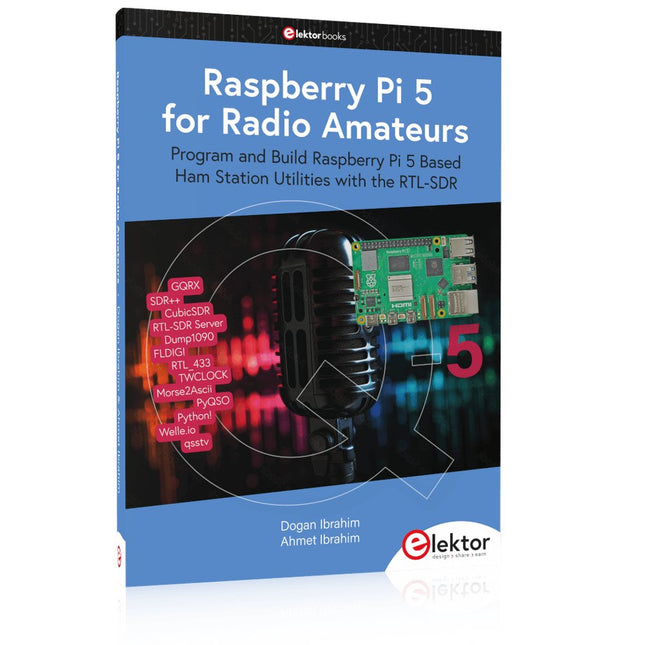
Elektor Publishing Raspberry Pi 5 for Radio Amateurs
Program and Build Raspberry Pi 5 Based Ham Station Utilities with the RTL-SDR The RTL-SDR devices (V3 and V4) have gained popularity among radio amateurs because of their very low cost and rich features. A basic system may consist of a USB based RTL-SDR device (dongle) with a suitable antenna, a Raspberry Pi 5 computer, a USB based external audio input-output adapter, and software installed on the Raspberry Pi 5 computer. With such a modest setup, it is possible to receive signals from around 24 MHz to over 1.7 GHz. This book is aimed at amateur radio enthusiasts and electronic engineering students, as well as at anyone interested in learning to use the Raspberry Pi 5 to build electronic projects. The book is suitable for both beginners through experienced readers. Some knowledge of the Python programming language is required to understand and eventually modify the projects given in the book. A block diagram, a circuit diagram, and a complete Python program listing is given for each project, alongside a comprehensive description. The following popular RTL-SDR programs are discussed in detail, aided by step-by-step installation guides for practical use on a Raspberry Pi 5: SimpleFM GQRX SDR++ CubicSDR RTL-SDR Server Dump1090 FLDIGI Quick RTL_433 aldo xcwcp GPredict TWCLOCK CQRLOG klog Morse2Ascii PyQSO Welle.io Ham Clock CHIRP xastir qsstv flrig XyGrib FreeDV Qtel (EchoLink) XDX (DX-Cluster) WSJT-X The application of the Python programming language on the latest Raspberry Pi 5 platform precludes the use of the programs in the book from working on older versions of Raspberry Pi computers.
€ 39,95
Mitglieder: € 35,96
-

OWON OWON HDS2202s 2-Kanal Oszilloskop (200 MHz) + Multimeter + Signalgenerator
Der OWON HDS2202s ist ein tragbarer 3-in-1-Multifunktionstester, der als 2-Kanal-Oszilloskop mit einer Bandbreite von 200 MHz, Multimeter und Signalgenerator verwendet werden kann. Es verfügt über ein kontrastreiches 3,5-Zoll-Farbdisplay, das sich für die Wartung von Außenanlagen, schnelle Messungen vor Ort, die Wartung von Kraftfahrzeugen und die Stromerkennung eignet. usw.Funktionen Oszilloskop + Multimeter + Wellenformgenerator, Multifunktion in einem 3,5 Zoll hochauflösendes, kontrastreiches Farb-LCD-Display, geeignet für den Außenbereich 18650-Lithiumbatterie, kann 3–6 Stunden lang ununterbrochen arbeiten USB-Typ-C-Schnittstelle, unterstützt Powerbank, unterstützt PC-Software-Verbindung Selbstkalibrierungsfunktion SCPI unterstützt, erleichtert die sekundäre Entwicklung Technische Daten Bandwidth 100 MHz Channels 2-ch Oscilloscope + 1-ch Generator Sample Rate 1 GSa/s Acquisition Model Normal, Peak detect Record Length 8K Display 3.5-inch LCD Waveform Refresh Rate 10,000 wfrms/s Input Coupling DC, AC, and Ground Input Impedance 1 MΩ ±2%, in parallel with 16pF ±10pF Probe Attenuation Factors 1X,10X,100X,1000X,10000X Max. input Voltage 400 V (DC+AC, PK-PK, 1MΩ input impedance) (10:1 probe attenuation) Bandwidth Limit (typical) 20 MHz Horizontal Scale 2ns/div - 1000s/div, step by 1 - 2 - 5 Vertical Sensitivity 10mV/div - 10V/div Vertical Resolution 8 bits Trigger Type Edge Trigger Modes Auto, Normal, single Automatic Measurement Frequency, Period, Amplitude, Max, Min, Mean, PK-PK Cursor Measurement ΔV, ΔT, ΔT&ΔV between cursors Communication Interface USB Type-C Multimeter Specifications Max. Resolution 20,000 counts Testing Mode Voltage, Current, Resistance, Capacitance, Diode, and Continuity test Input Impedance 10 MΩ Max Input Voltage AC 750 V, DC 1000 V Max Input Current DC: 10 A, AC: 10 A Diode 0-2 V Waveform Generator Specifications Frequency Output Sine 0.1 Hz - 25 MHz Square 0.1 Hz - 5MHz Ramp 0.1 Hz - 1 MHz Pulse 0.1 Hz - 5 MHz Arbitrary 0.1 Hz - 5 MHz Sampling Rate 125 MSa/s Channel 1-ch Amplitude Range (high impedance) 20 mVpp - 5 Vpp Waveform Length 8K Vertical Resolution 14 bits Output Impedance 50Ω Lieferumfang 1x OWON HDS2202s 1x Netzteil 1x USB-Kabel 1x Passive Sonden 2x Krokodilklemmenkabel 1x Satz Multimeter-Sonden (eine rote und eine schwarze) 1x Manual 1x Sondenkorrektur-Einstellmesser Downloads User Manual Specifications SCPI Protocol Quick Guide Software
€ 238,00
-

OWON OWON XDG2035 2-Kanal Funktionsgenerator (35 Mhz)
Der 2-Kanal OWON XDG2035 ist ein Funktions-/Wellenformgenerator, der Signale mit einer maximalen Frequenz von 35 MHz erzeugen kann. Der Generator hat eine Auflösung von 1 µHz und eine Abtastrate von 500 MSa/s.Der OWON XDG2035 ist in der Lage, 6 Standardwellenformen und 150 Arbiträrwellenformen zu erzeugen. Mit der mitgelieferten Software können Sie erweiterte Funktionen bis zu 10 Millionen Punkte schreiben. Wellenformen können mit einem PC über USB oder LAN im internen Speicher des Funktionsgenerators gespeichert werden.Der OWON XDG2035 unterstützt auch SCPI-Befehle und LabView. Der Funktionsgenerator verfügt über einen integrierten hochwertigen Frequenzzähler, der von 100 bis 200 MHz arbeiten kann.FeaturesMax. 35 MHz Frequenzausgang500 MSa/s Abtastrate, vertikale Auflösung 1 μHz14 Bit vertikale Auflösung, 10 Marb WellenformlängeUmfassende Wellenformausgabe: 6 Grundwellenformen und 150 integrierte ArbiträrwellenformenUmfassende Modulationsfunktionen: AM, FM, PM, FSK, 3FSK, 4FSK, PSK, OSK, ASK, BPSK, PWM, Sweep und BurstHochpräziser Frequenzzähler integriert, unterstützter Bereich 100-200 MHzSCPI und LabVIEW werden unterstützt7 Zoll Multi-Touch-Bildschirm (800 x 480 Pixel)Technische DatenKanäle2Frequenzausgang35 MHzAbtastrate500 MSa/sVertikale Auflösung14 bitsWellenform Standard WaveformSine, square, pulse, ramp, noise, and harmonicArbitrary WaveformExponential rise, exponential fall, sin(x)/x, step wave, and others, total 150 built-in waveforms, and user-defined arbitrary waveformFrequenz (Auflösung 1 μHz) Sine1 μHz-100 MHzSquare1 μHz ~ 30 MHzPulse1 μHz ~ 25 MHzRamp1 μHz ~ 3 MHzNoise (-3 dB, typical)100 MHzArbitrary Waveform1 μHz ~ 15 MHzHarmonic1 μHz ~ 50 MHzAccuracy±2ppm, 25°C ±5°CWaveform Length2 points - 10M pointsAmplitude Into 50Ω load1mVpp ~ 10Vpp (≤25 MHz); 1mVpp ~ 5Vpp (≤60 MHz); 1mVpp ~ 2.5Vpp (≤100 MHz)Modulation TypeAM, DSB-AM, FM, PM, ASK, FSK, PSK, BPSK, QPSK, 3FSK, 4FSK, OSK, PWM, SUMFrequenzzähler FunctionFrequency, period, +width, -width, +duty, and -dutyFrequency Range100 ~ 200 MHzFrequency Resolution7 digitsInput/Output Input modefrequency counter, external modulation input, external trigger input, internal clock output, external reference clock input/outputCommunication InterfaceUSB Host, USB Device, LAN, RS232 (optional)Mechanische Spezifikationen Abmessungen340 x 177 x 90 mmGewicht2,3 kgLieferumfang1x OWON XDG20351x Netzkabel1x CD-ROM1x Kurzanleitung1x USB-Kabel1x BNC-BNC-KabelDownloadsQuick Guide
€ 333,40
-

Elektor Digital Elektor July/August 2021 (PDF) EN
LoRa with the Raspberry Pi PicoFun with MicroPython What Is RISC-V?And Why the Industry Is So Excited About a New Processing Core! Elektor @ 60Circuits of Summer Past Versatile Power Supply for BreadboardsPositive and Negative Voltages Out of 5 V from USB Raspberry Pi Pico EssentialsSample Chapter: Wi-Fi with the Raspberry Pi Pico Magnetic Levitation the Easy Way Hands On the Parallax Propeller 2Part 3: Smart Pins and Serial Data (UART) Nucleo Boards Programming with the STM32CubeIDESample Chapter: FreeRTOS for the STM32 MCU Developer's ZoneTips & Tricks, Best Practices and Other Useful Information Miniware DT71 Digital Tweezers Wearable Wi-Fi Gadget: ESPHome Does the Job Again Starting out in ElectronicsEasier Than Imagined! This Concludes the Subject of “Capacitors” Simple Sketches Using the Qwiic Ecosystem Java on the Raspberry Pi (Part 2)Controlling GPIOs with a Spring REST Service Raspberry Pi Compute Module 4A Raspberry Pi for Industry Portable, Stand-Alone Air Quality Display for 2.5 µm ParticlesKeep(s) an Eye on Your Health From Life’s ExperienceThe Future Was Better in the Past MicroPython for the ESP32 and FriendsPart 1: Installation and Our First Programs Charge-Coupled Devices in OscilloscopesPeculiar Parts, the series ESD – The Invisible DestroyerComponents Trashed by a Bolt from the Blue Solar Power for Mowing RobotsEcological, Inexpensive, Simple! Europe’s Efforts to Tame Big Tech HexadokuThe Original Elektorized Sudoku
€ 7,50
-

Elektor Digital Design your own Embedded Linux Control Centre (E-book)
This book is all about building your own DIY home control system. It presents two innovative ways to assemble such a system: By recycling old PC hardware – possibly extending the life of an old PC, or by using Raspberry Pi. In both cases, the main system outlined in this book will consist of a computer platform, a wireless mains outlet, a controller and a USB webcam – All linked together by Linux. By using the Raspberry Pi in conjunction with Arduino (used as an advanced I/O system board), it is possible to construct a small, compact, embedded control system offering enhanced capacity for USB integration, webcams, thermal monitoring and communication with the outside world. The experience required to undertake the projects within this book are minimal exposure to PC hardware and software, the ability to surf the internet, burn a CD-ROM and assemble a small PCB.
€ 34,95
Mitglieder: € 31,46
-

UFactory UFactory xArm 5 Lite
Dieser mehrachsige Roboter bringt Leistung und Größe perfekt in Einklang. Features 5 Achsen Nutzlast: 3 kg Reichweite: 700 mm Wiederholgenauigkeit: 0,1 mm Maximale Geschwindigkeit 1000 mm/s Anwendungen Maschinenwartung Bin Picking Mobile Plattform Laborautomatisierung Roboterforschung Langlebige kollaborative Roboter für Ihre Automatisierung Harmonische Antriebe und Servomotoren in Industriequalität garantieren einen ununterbrochenen Betrieb rund um die Uhr. Hergestellt aus Kohlefaser, 15 kg Gewicht ermöglichen einen einfacheren Einsatz. Flexible Bereitstellung mit sicherer Funktion Handprogrammierung, leicht, platzsparend und einfach für mehrere Anwendungen einsetzbar, ohne Ihr Produktionslayout zu ändern. Perfekt für wiederkehrende Aufgaben. Kollisionserkennung ist für alle unsere Cobots verfügbar. Ihre Sicherheit hat immer oberste Priorität. Grafische Oberfläche für einsteigerfreundliche Programmierung Kompatibel mit verschiedenen Betriebssystemen, einschließlich macOS und Windows. Webbasierte Technologie, kompatibel mit allen gängigen Browsern. Drag & Drop, um Ihren Code in wenigen Minuten zu erstellen. Leistungsstarkes und Open-Source-SDK immer zur Hand Das voll funktionsfähige Open-Source-Python/C++-SDK bietet eine flexiblere Programmierung. ROS/ROS2-Pakete sind einsatzbereit. Beispielcodes helfen Ihnen, den Roboterarm reibungslos einzusetzen. Technische Daten UFactory 850 xArm 5 xArm 6 xArm 7 Nutzlast 5 kg 3 kg 5 kg 3,5 kg Reichweite 850 mm 700 mm 700 mm 700 mm Freiheitsgrade 6 5 6 7 Wiederholbarkeit ±0,02 mm ±0,1 mm ±0,1 mm ±0,1 mm Maximale Geschwindigkeit 1 m/s 1 m/s 1 m/s 1 m/s Gewicht (nur Roboterarm) 20 kg 11,2 kg 12,2 kg 13,7 kg Maximale Geschwindigkeit 180°/s 180°/s 180°/s 180°/s Joint 1 ±360° ±360° ±360° ±360° Joint 2 -132°~132° -118°~120° -118°~120° -118°~120° Joint 3 -242°~3.5° -225°~11° -225°~11° ±360° Joint 4 ±360° -97°~180° ±360° -11°~225° Joint 5 -124°~124° ±360° -97°~180° ±360° Joint 6 ±360° ±360° -97°~180° Joint 7 ±360° Hardware Umgebungstemperaturbereich 0-50°C Stromverbrauch Min. 8,4 W, typisch 200 W, max. 400 W Eingangsstromversorgung 24 V DC, 16,5 A Fußabdruck Ø 126 mm Materialien Aluminium, Kohlefaser Basis-Connector-Typ M5x5 Reinraum der ISO-Klasse 5 Robotermontage Alle Endeffektor-Kommunikationsprotokoll Modbus RTU(rs485) Endeffektor-E/A 2x DI/2x DO/2x AI/1x RS485 Kommunikationsmodus Ethernet Lieferumfang 1x xArm 5 Roboterarm 1x AC-Steuerbox 1x Roboterarm-Stromkabel 1x Roboterarm-Endeffektor-Adapterkabel 1x Roboterarm-Signalkabel 1x Steuerbox-Stromkabel 1x Netzwerkkabel 1x Montagewerkzeug 1x Kurzanleitung
€ 7.285,00
Bestpreis
-

Elektor Digital Microcontroller Basics (E-book)
Microcontrollers have become an indispensable part of modern electronics. They make things possible that vastly exceed what could be done previously. Innumerable applications show that almost nothing is impossible. There’s thus every reason to learn more about them, but that raises the question of where to find a good introduction to this fascinating technology. The answer is easy: this Microcontroller Basics book, combined with the 89S8252 Flash Board project published by Elektor Electronics. However, this book offers more than just a basic introduction. It clearly explains the technology using various microcontroller circuits and programs written in several different programming languages. Three microcontrollers from the 8051 family are used in the sample applications, ranging from the simple 89C2051 to the AN2131, which is designed to support USB applications. The programming tools include assemblers, Basic-52 and BASCOM-51, and several C compilers. Every reader can thus find the programming environment most suitable to his or her needs. In the course of the book, the reader gradually develops increased competence in converting his or her ideas into microcontroller circuitry. All of the sample programs can be downloaded from the Elektor Electronics website or the author’s website. That has the added advantage that the latest versions are always available.
€ 19,95
Mitglieder: € 17,96


