
Suchergebnisse für "sipeed OR maixduino OR kit OR for OR risc OR v OR ai OR iot"
-

Elektor Digital Elektor Juli/Augustus 2023 PDF (NL)
Elektor GREEN en GOLD leden kunnen deze uitgave hier downloaden.Nog geen lid? Klik hier om een lidmaatschap af te sluiten. Kiesschijftelefoon als afstandsbedieningvoor licht kies 1; voor koffie kies 2 GPS-gebaseerde snelheidsmeternooit meer bekeuringen RGB-stroboscoop met Arduinokleurige toepassing van een nuttig instrument Draadloze nooddrukknopmeer veiligheid met LoRa Alle begin......volgt de emitter Vrij te kiezen onafhankelijke hystereseniveaus voor comparatorenmet simulaties, spreadsheets en algebra Impedantie-analyzer op basis van een ESP32simpel, weinig onderdelen en goedkoop! Oost West Lab Bestzelfbouw moet gestimuleerd! Het MCCAB Arduino Nano Training Boardalle hardware voor de “Microcontrollers Hands-On Course” Uit het leven gegrepenmodern luddisme Sensor-ABC: de DS18B20 temperatuursensoraansluiting op de 1-Wire bus Gaan Matter en Thread het Smart Home redden?nieuwe standaarden om het slimme huis te vereenvoudigen Een kwestie van samenwerkingontwikkelen met het Thing Plus Matter Board en Simplicity Studio Elektor IIIIinfographicIoT en sensoren Matter, ExpressLink, Rainmaker – waar hebben we het over?vraaggesprek met Amey Inamdar van Espressif De juiste keuze van microcontroller-ontwikkelkitsvoor IoT- en IIoT-toepassingen Condensatoren gedragen zich niet altijd capacitief! Een NTP-klok met CircuitPythonwaarom zou je deze programmeertaal gebruiken? Bouw een cool IoT-display'met de Phambili Newt De doppler-bewegingssensor HB100theorie en praktijk Een gids voor puristisch programmeren (deel 1)voor STM32 en andere controllers Siglent SDM3045X-multimeter Microprocessoren voor embedded systemenvreemde onderdelen Microcontroller-documentatie verklaarddeel 3: blokschema’s en meer Low-power LoRa-weerstationbouw zelf een weerstation met een groot bereik Transverter voor de 70cm-band Klimaat aan ingenieurssnelheid is geboden! Hexadoku
€ 9,95
-

Peak Peak Atlas Pro Pack (LCR45 und DCA75)
Dieses Paket enthält den LCR45, perfekt für erfahrene Bastler und Experten. Es beinhaltet außerdem das sehr populäre DCA Pro (model DCA75), fantastisch für die Identifikation von Komponenten. Kompletiert wird das Paket durch ein USB-Kabel und einem USB-Stick mit der nötigen Software. DCA75 Der DCA75 unterstützt alle Komponenten die von PEAK Atlas DCA55 unterstützt werden und beinhaltet sogar noch weitere: Transistoren (BJT’s mit Darlingtons und “digitale” Transistoren), Silikon und Germanuim Typen. Misst den Verstärkungsfaktor, VBE, Ableitstrom und die Sättigungsspannung. Unijunctiontransistoren (UJT’s) werden nicht unterstützt. MOSFET‘s, Anreicherungstyp und Abreicherungstyp. Misst mit einem Ansprechwert (von ID=5 mA), einer geschätzten Transkonduktanz (in einer Spanne von 3 mA - 5 mA) und RDS(on) mit einer Auflösung von 1 Ω. JFETs, mit SiC-Typen. Misst mit pinch-off Spannung (ID=5μA), geschätzter Transkonduktanz (in einer Spanne von 3 mA – 5 mA) und RDS(on) bei einer Auflösung von 1 Ω. IGBTs (Biopolartransistor). Misst mit einem Ansprechwert (IC=5mA), geschätzter Transkonduktanz (in einer Spanne von 3 mA – 5 mA) und Sättigungsspannung. Dioden und Diodennetzwerke. Misst eine Durchlassspannung bei 5 mA. LED’s und zweifarbige LED’s (2 Leiter und 3 Leiter Typ). Misst Durchlassspannung von jedem LED-Element bei 5 mA. Zener Dioden mit einer gemessenen Zener Spannung bis zu 9 V bei 5 mA. Spannungsregulatoren (misst Spannungsregulierung von < 8 V, Abfallspannung, Ruhestrom). Triac’s und Thyristoren welche weniger als 10 mA von Steuerstrom und Haltestrom benötigen. Unabhängig oder mit PC funktionstüchtig Das ATLAS DCA75 PRO kann eigenständig arbeiten oder mit einem PC verbunden werden. Wie auch immer, das DCA Pro wird automatisch die Komponente und die Kontaktbelegung identifizieren. Außerdem misst es eine Reihe von Komponenteneigenschaften, wie den Transistorfaktor, Ableitungen, MOSFET und IGBT-Spannung. Curve Tracing Wenn das ATLAS DCA75 PRO mit einem PC mit dem beiliegenden USB-Kabel verbunden wird, hat man einen Überblick über eine Reihe von Schwachspannungskurven. Verschiedene Graphen sind nutzbar, weitere folgen: Bipolartransistor Ausgabekennlinie, IC vs VCE Bipolartransistor Verstärkungsfaktoren, hFE vs VCE Bipolartransistor Verstärkungsfaktoren, hFE vs IC MOSFET und IGBT Ausgabefunktion, ID vs VDS MOSFET und IGBT Transferfunktion, ID vs VGS JFET Ausgabefunktion, ID vs VDS JFET Transferfunktion, ID vs VGS Spannungsregulator, VOUT vs VIN Spannungsregulator, IQ vs VIN PN Anschluss I/V Kurven, vorwärts und rückwärts Optionen (für Zener Dioden). Beim Curve tracing werden Testparameter von +/- 12 V, +/- 12 mA eingestellt. Sämtliche curve-tracing Daten können direct in Excel© für weitere Grafikanalysen eingespeist werden. Die Software ist für die Betriebssysteme Windows XP, Vista, 7, 8 and 10 gemacht. LCR45 Ein großartiger LCR Analysator, welcher die passiven Komponenten (Spulen, Kondensatoren und Widerstände) messen kann.Das LCR45 bietet eine erhöhte Messauflösung (besser aks 0.1 uH!). Des Weiteren kann die Test-Frequenz DC manuel oder automatisch auf, 1 kHz, 15 kHz und 200 kHz verändert werden. Nicht hergestellt für schaltungsinterne Messungen. Automatische oder manuelle Komponenten Slektion: Spule, Kondensator oder Widerstand Automatische oder manuelle Test-Frequenz- Selektion: DC, 1 kHz, 15 kHz und 200 kHz Induktivitäten von 0.1 uH bis 10 H Kapazitäten von 0.1 pF bis 10,000 uF Widerstände von 0.1 Ohm bis 2 MOhm Induktivitäten Messung zeigt auch die Spulenwiderstände Zeigt "Component type and values", "Complex Impedance", "Magnitude/Phase" und "Admittance" Test-Frequenz wird für alle Messungen angezeigt Abweichung von 1,5% für Spulen und Kondensatoren (siehe Tabelle für weiterer Details) Abweichung von 1% für Widerständen Tastkopf wird mit 2 mm vergoldeten Steckern und Buchsen komplettiert Vergoldete Prüfspitzen sind austauschbar Lieferumfang LCR45 DCA75 Extra GP23 Batterie Extra AAA Zelle Dual Carry Gehäuse
€ 320,11
-

Elektor Digital The Maker’s Guide to AI Coding (E-book)
If you can describe it, you can build it AI coding assistants are changing what makers and solopreneurs can build. Tasks that once demanded weeks of learning a new language, framework, or software stack can now be delegated to an AI—provided you know how to describe the job, judge the result, and keep control of the process. The Maker’s Guide to AI Coding is a practical guide to doing exactly that. It explains how to work with AI coding tools as collaborators rather than vending machines, how much to delegate, how to write specifications that produce useful results, and how to recognise hallucinations, context drift, overconfidence, and code that runs but is still wrong. The book is built around four increasingly ambitious projects. You begin with a browser-based RC filter analyser, then develop a live serial data plotter for Arduino and other microcontrollers. Next comes a datasheet questionand- answer tool using retrieval-augmented generation (RAG), followed by a complete multi-user resource booking system with authentication, a database, external services, background jobs, and deployment. No advanced programming background is required. The emphasis is on thinking clearly, guiding the AI, testing what it produces, and preserving the skills needed to evaluate its work. Along the way, you learn development workflow designed to remain useful as tools evolve. If you can describe what you want to build, this book shows you how to turn that description into working software.
€ 29,95
Mitglieder: € 26,96
-

Elektor September/Oktober 2026 (NL)
Elektor GREEN en GOLD leden kunnen deze uitgave hier downloaden. Nog geen lid? Klik hier om een lidmaatschap af te sluiten. De ESP-BLASTEen mini ESP32 raketdrone die ruim 100 km/u vliegt STM32Cube Innovation-ChallengeDoe mee met je beste STM32C5-ontwerp Wireless workshop (1)Radiomodules uitgelegd: 433 MHz CC1101 sub-GHz-transceiver AM-zenderMet sinus- en blokgolfgenerator op Raspberry Pi Pico AudiotronicaDe vervormingsfactor CoffeeCallerOmroepsysteem met mesh-netwerk en Zephyr gebaseerde software Elektor wordt 65Projecten uit voorgaande september- en oktobermaanden Bluetooth Channel Sounding voor het volgen van objectenAfstandsmeting met centimeterprecisie voor het IoT van de volgende generatie 2026: Een AI-odysseeKwantumcomputing is geen volgende GPU Om de cloud te beveiligen, is edge-beveiliging nodig Eerste ervaringen met de HackRF ProPraktische tests met de nieuwe SDR-hardware Modemupgrade van GPRS/2G naar LTE/4GEen draadloos alarmsysteem als voorbeeld Lusvormige antenne met RF-bouwstenenDeel 1: Een zelfbouw kortegolfantenne met instelbare richtingsgevoeligheid Internetradio naar AM-converterMet een ESP32-S3 als zender Err-lectronics Mioty, een overzichtFraunhofer's aanpak van LPWAN WerkbankwijsheidPraktische tips van experts Walter, de compacte IoT-moduleDeel 2: Toegang tot weer- en datadiensten
€ 15,95
-
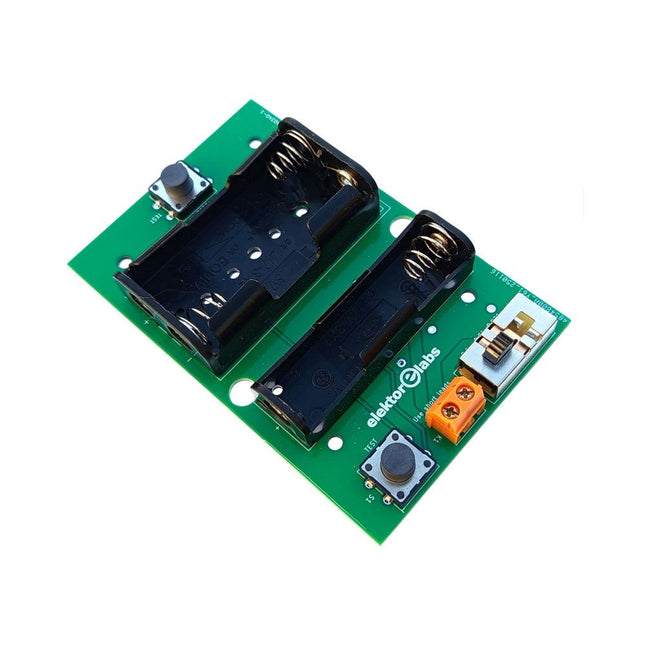
Elektor Labs Elektor Milliohmmeter-Adapter
Der Elektor Milliohmmeter-Adapter nutzt die Präzision eines Multimeters zur Messung sehr niedriger Widerstandswerte. Er wandelt einen Widerstand in eine Spannung um, die mit einem Standardmultimeter gemessen werden kann. Der Elektor Milliohmmeter-Adapter misst Widerstände unter 1 mΩ mit der 4-Leiter-Methode (Kelvin). Er eignet sich zum Auffinden von Kurzschlüssen auf Leiterplatten. Der Adapter bietet drei Messbereiche – 1 mΩ, 10 mΩ und 100 mΩ –, die über einen Schiebeschalter ausgewählt werden können. Integrierte Kalibrierwiderstände sind ebenfalls enthalten. Der Elektor Milliohmmeter-Adapter wird mit drei 1,5-V-AA-Batterien betrieben (nicht im Lieferumfang enthalten). Technische Daten Messbereiche 1 mΩ, 10 mΩ, 100 mΩ, 0,1% Stromversorgung 3x 1,5 V AA-Batterien (nicht im Lieferumfang enthalten) Abmessungen 103 x 66 x 18 mm (kompatibel mit Hammond 1593N-Gehäuse, nicht im Lieferumfang enthalten) Besonderheit Integrierte Kalibrierwiderstände Downloads Documentation
€ 34,95
Mitglieder: € 31,46
-
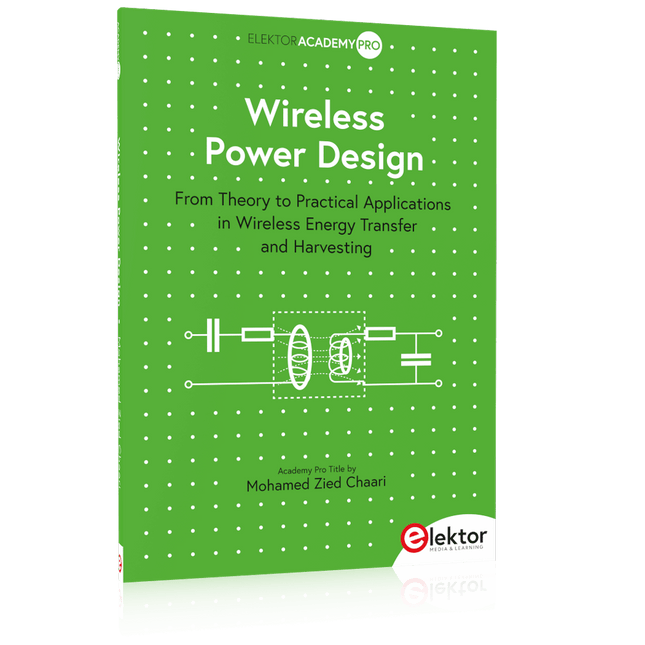
Elektor Publishing Wireless Power Design
From Theory to Practical Applications in Wireless Energy Transfer and Harvesting Wireless power transmission has gained significant global interest, particularly with the rise of electric vehicles and the Internet of Things (IoT). It’s a technology that allows the transfer of electricity without physical connections, offering solutions for everything from powering small devices over short distances to long-range energy transmission for more complex systems. Wireless Power Design provides a balanced mix of theoretical knowledge and practical insights, helping you explore the potential of wireless energy transfer and harvesting technologies. The book presents a series of hands-on projects that cover various aspects of wireless power systems, each accompanied by detailed explanations and parameter listings. The following five projects guide you through key areas of wireless power: Project 1: Wireless Powering of Advanced IoT Devices Project 2: Wireless Powered Devices on the Frontline – The Future and Challenges Project 3: Wireless Powering of Devices Using Inductive Technology Project 4: Wireless Power Transmission for IoT Devices Project 5: Charging Robot Crawler Inside the Pipeline These projects explore different aspects of wireless power, from inductive charging to wireless energy transmission, offering practical solutions for real-world applications. The book includes projects that use simulation tools like CST Microwave Studio and Keysight ADS for design and analysis, with a focus on practical design considerations and real-world implementation techniques.
€ 39,95
Mitglieder: € 35,96
-

Elektor Publishing PLC Programming with the Raspberry Pi and the OpenPLC Project
ModbusRTU and ModbusTCP examples with the Arduino Uno and ESP8266 Introduction to PLC programming with OpenPLC, the first fully open source Programmable Logic Controller on the Raspberry Pi, and Modbus examples with Arduino Uno and ESP8266 PLC programming is very common in industry and home automation. This book describes how the Raspberry Pi 4 can be used as a Programmable Logic Controller. Before taking you into the programming, the author starts with the software installation on the Raspberry Pi and the PLC editor on the PC, followed by a description of the hardware. You'll then find interesting examples in the different programming languages complying with the IEC 61131-3 standard. This manual also explains in detail how to use the PLC editor and how to load and execute the programs on the Raspberry Pi. All IEC languages are explained with examples, starting with LD (Ladder Diagram) over ST (Structured Control Language) to SFC (Special Function Chart). All examples can be downloaded from the author's website. Networking gets thorough attention too. The Arduino Uno and the ESP8266 are programmed as ModbusRTU or ModbusTCP modules to get access to external peripherals, reading sensors and switching electrical loads. I/O circuits complying with the 24 V industry standard may also be of interest for the reader. The book ends with an overview of commands for ST and LD. After reading the book, the reader will be able to create his own controllers with the Raspberry Pi.
€ 39,95
Mitglieder: € 35,96
-
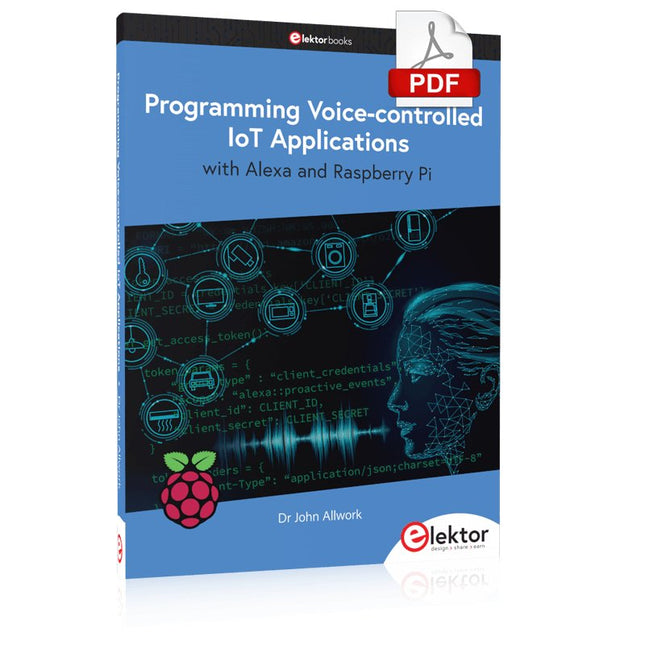
Elektor Digital Programming Voice-controlled IoT Applications with Alexa and Raspberry Pi (E-book)
Learn programming for Alexa devices, extend it to smart home devices and control the Raspberry Pi The book is split into two parts: the first part covers creating Alexa skills and the second part, designing Internet of Things and Smart Home devices using a Raspberry Pi. The first chapters describe the process of Alexa communication, opening an Amazon account and creating a skill for free. The operation of an Alexa skill and terminology such as utterances, intents, slots, and conversations are explained. Debugging your code, saving user data between sessions, S3 data storage and Dynamo DB database are discussed. In-skill purchasing, enabling users to buy items for your skill as well as certification and publication is outlined. Creating skills using AWS Lambda and ASK CLI is covered, along with the Visual Studio code editor and local debugging. Also covered is the process of designing skills for visual displays and interactive touch designs using Alexa Presentation Language. The second half of the book starts by creating a Raspberry Pi IoT 'thing' to control a robot from your Alexa device. This covers security issues and methods of sending and receiving MQTT messages between an Alexa device and the Raspberry Pi. Creating a smart home device is described including forming a security profile, linking with Amazon, and writing a Lambda function that gets triggered by an Alexa skill. Device discovery and on/off control is demonstrated. Next, readers discover how to control a smart home Raspberry Pi display from an Alexa skill using Simple Queue Service (SQS) messaging to switch the display on and off or change the color. A node-RED design is discussed from the basic user interface right up to configuring MQTT nodes. MQTT messages sent from a user are displayed on a Raspberry Pi. A chapter discusses sending a proactive notification such as a weather alert from a Raspberry Pi to an Alexa device. The book concludes by explaining how to create Raspberry Pi as a stand-alone Alexa device.
€ 32,95
Mitglieder: € 29,66
-

Elektor Digital Elektor Juli/Augustus 2026 (PDF) NL
Elektor GREEN en GOLD leden kunnen deze uitgave hier downloaden. Nog geen lid? Klik hier om een lidmaatschap af te sluiten. MultiRF ontwikkelboardEen platform voor het evalueren van draadloze protocollen op korte en lange afstand Elektor wordt 65Baanbrekend op het gebied van elektronica sinds 1961 Persoonsdetectie via wifi op een ESP32Wanneer uw router een bewegingssensor wordt Draadloze weegschalenVier kleine weegschalen maken een grote weegschaal Walter, de compacte IoT-moduleESP32-S3 SoC, LTE-M/NB-IoT 5G-modem en GNSS-ontvanger 3- en 4-draads RTD-sensorconditioneringMet volledige afstelling en kabelcompensatie 3-in-1 2-kanaals oscilloscoop/generator/multimeterEen review van de Fnirsi 2D15P electronica Fast Forward 2026 nodigt start-ups en partners uit de industrie uit EcologgingEen modulair IoT-milieustation voor onderzoek in het veld Draadloze connectiviteit in medische toepassingenAltijd op de hoogte met Bluetooth LE AudiotronicaBromonderdrukking De efficiëntie in de landbouw verhogen met AI-modellen en sensorenDe landbouwproductiviteit verhogen OPC UA, een overzichtPlatform-onafhankelijke gegevensuitwisseling Redoxmeter Instrumentation amplifier voor fysica- en techniekexperimenten Actieve differentiële audiofiltersVoor professionele cross-overs en meer Communityperspectieven van Elektor op IoT & sensoren Telegramgestuurde interface module voor een boilerEen oplossing op basis van een ESP32 en Arduino software 2026: An AI OdysseyWat is er gebeurd met fuzzy logic? Err-lectronics Alarmsignaalinjector en bruut geweldHulpmiddelen om kabelbreuken op te sporen
€ 9,95
-

Elektor Digital Elektor Mai/Juni 2023 (PDF)
Der vollständige Download dieser Nummer ist für unsere GOLD- und GREEN-Mitglieder auf der Elektor Magazine- Site verfügbar! Nicht noch einmal Mitglied? Klicken Sie hier . Super Servo Tester Testen Sie nur vier Servos, isoliert oder vor Ort analoge Signale und Mikrocontroller CA/N, CN/A, aktuelle Maße und mehr Messe München 2023 die praktische Sub-Nyquist-Verzauberung zuverlässige Erfassung hoher Frequenzen mithilfe der Unterstimme Ein Android-Smartphone mit einem ESP32 verbinden? Praktisches Projekt mit der WLAN-API von Android 1 kHz aktiver Filter zur Messung der Verzerrung Durch die Optimierung des Messsignals verbesserte Maßnahmen elektronisch starten ... Multivibrationen Projekt 2.0 Korrekturen, Aktualisierungen und Lesernachrichten das neue I3C-Protokoll Wirkung von Ankündigung oder echtem Fortschritt BlueRC: IR-Fernsteuerung mit Smartphone und ESP32 adaptiv und universell die Dokumentation der Mikrocontroller ohne Stift (2) Register und Grundschemata Automatisierung von Tests und Messungen Programmierung der Testausrüstung, um herauszufinden, was Sie möchten Infografik: Test und Messung Immunität gegen Überspannungen Schutz für CC/CC Leistungsmodule nicht isoliert Maßgerät Wiha Tester und Computer zur Installation auf diesen Geräten, damit Sie sie installieren können Automatisierung der Tests und Weitergabe der Ergebnisse auf der Lebendigkeit der elektronischen Blöcke Registriergerät für Energiedaten Energieverbrauch messen und registrieren Montage des Rover MARS-Bausatzes von 4tronix Stationäre Diskette mit E-Papier-Anzeige eine innovative Informationsversion eCO? Telegramm-Bot Messung der Luftqualität mit Benachrichtigung durch Telegram die Kulissen des Top-Audio-Sortiments von Home Ton Giesberts von Elektor im Interview zur Kunst des Analogkonzepts Besuch zu Hause neue Cible Einführung in RFID-Etiketten und RFID-Türverriegelung Beispiele für ausgereifte Projekte aus dem Experimentierhandbuch für Arduino von Elektor HF-Stromsonden für Oszilloskope Die RF-Laufzeitmessung ohne Stift pas pour les mauviettes - Roboter-BH-Set mit Raspberry Pi Pico und MicroPython Generative IA Aber was ist passiert? Hexadoku
€ 10,95
-

Elektor Digital Elektor Special: Sensors for Weather and the Environment (PDF)
Build your textbook weather station or conduct environmental research together with the whole world. With many practical projects for Arduino, Raspberry Pi, NodeMCU, ESP32, and other development boards. Weather stations have enjoyed great popularity for decades. Every current and even every long discontinued electronics magazine has regularly featured articles on building your own weather station. Over the years, they have become increasingly sophisticated and can now be fully integrated into an automated home — although this often requires loyalty to an (expensive) brand manufacturer across all components. With your own weather and environmental data, you can keep up and measure things that no commercial station can. It’s also fun: expand your knowledge of electronics, current microcontroller development boards and programming languages in a fun and meaningful way. For less than 10 euros you can get started and record your first environmental data — with time and growing interest, you will continue to expand your system. In this Edition Which Microcontroller Fits My Project? The Right Development Environment Tracking Wind and Weather Weather Display with OpenWeatherMap and Vacuum Fluorescent Display Volatile Organic Compounds in the Air We Breathe Working with MQ Sensors: Measuring Carbon Monoxide — Odorless but Toxic CO2 Traffic Light with ThingSpeak IoT Connection An Automatic Plant Watering System Good Indoor Climate: Temperature and Humidity are Important criteria Classy Thermometer with Vintage Tube Technology Nostalgic Weather House for the Whole Family Measuring Air Pressure and Temperature Accurately Sunburn Warning Device DIY Sensor for Sunshine Duration Simple Smartphone Says: Fog or Clear View? Identifying Earthquakes Liquid Level Measurement for Vessels and Reservoirs Water pH Value Measurement Detecting Radioactive Radiation GPS: Sensor Location Service Across the Globe Saving and Timestamping Log Files on SD Cards LoRaWAN, The Things Network, and ThingSpeak Operating a LoRaWAN Gateway for TTN Defying "Wind and Weather" Mega Display with Weather Forecasz
€ 14,95
Mitglieder: € 13,46
-
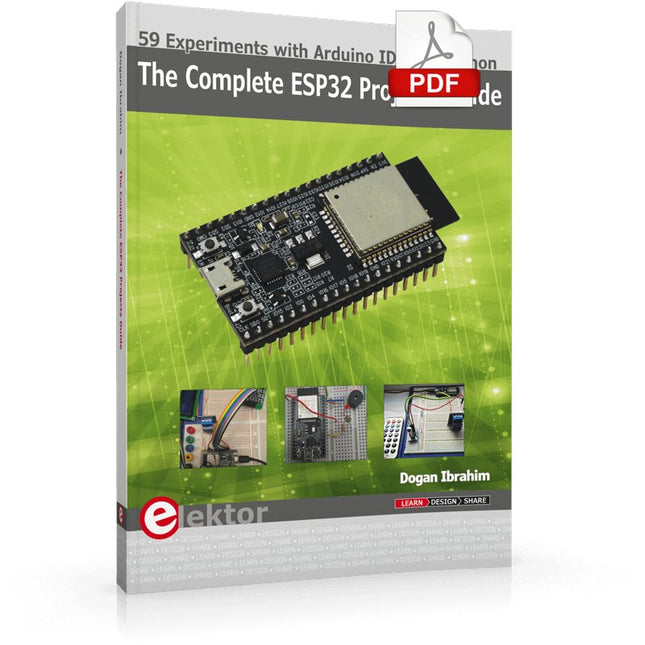
Elektor Digital The Complete ESP32 Projects Guide (E-book)
59 Experiments with Arduino IDE and Python The main aim of this book is to teach the Arduino IDE and MicroPython programming languages in ESP32 based projects, using the highly popular ESP32 DevKitC development board. Many simple, basic, and intermediate level projects are provided in the book using the Arduino IDE with ESP32 DevKitC. All projects have been tested and work. Block diagrams, circuit diagrams, and complete program listings of all projects are given with explanations. In addition, several projects are provided for programming the ESP32 DevKitC using MicroPython. The projects provided in this book are designed to teach the following features of the ESP32 processor: GPIOs Touch sensors External interrupts Timer interrupts I²C and I²S SPI PWM ADC DAC UART Hall sensor Temperature sensor Infrared controller Reading and writing to SD card Reading and writing to flash memory RTC timer Chip ID Security and encryption Wi-Fi and network programming Bluetooth BLE programming Communication mobile devices Low power design ESP-IDF programming The projects have been organized with increasing levels of difficulty. Readers are encouraged to tackle the projects in the order given. A specially prepared hardware kit (SKU 18305) is available from Elektor. With the help of this hardware, it should be easy and fun to build the projects in this book.
€ 34,95
Mitglieder: € 31,46


