
Suchergebnisse für "doorbell OR memory OR 140092 OR 1"
-

Raspberry Pi Foundation FPC Kamera-Kabel für Raspberry Pi 5 (300 mm)
Der Raspberry Pi 5 verfügt über zwei vierspurige MIPI-Anschlüsse, von denen jeder entweder eine Kamera oder ein Display unterstützen kann. Diese Anschlüsse verwenden dasselbe 22-polige "Mini"-FPC-Format mit 0,5 mm Raster wie das Compute Module Development Kit und erfordern Adapterkabel für den Anschluss an die 15-poligen "Standard"-Anschlüsse mit 1 mm Raster an aktuellen Raspberry Pi Kamera- und Display-Produkten. Diese Mini-zu-Standard-Adapterkabel für Kameras und Displays (beachten Sie, dass ein Kamerakabel nicht mit einem Display verwendet werden sollte und umgekehrt) sind in den Längen 200 mm, 300 mm und 500 mm erhältlich.
€ 2,95€ 1,18Bestpreis
-
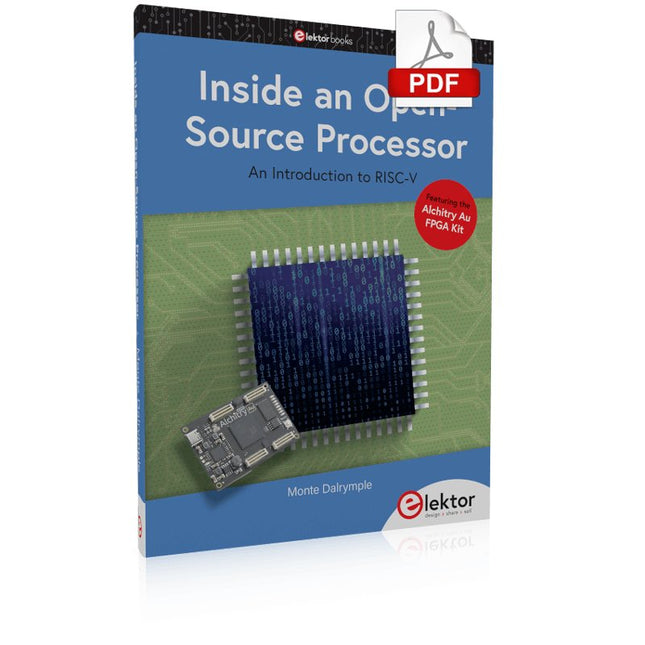
Elektor Digital Inside an Open-Source Processor (E-book)
An Introduction to RISC-V RISC-V is an Instruction Set Architecture (ISA) that is both free and open. This means that the RISC-V ISA itself does not require a licensing fee, although individual implementations may do so. The RISC-V ISA is curated by a non-profit foundation with no commercial interest in products or services that use it, and it is possible for anyone to submit contributions to the RISC-V specifications. The RISC-V ISA is suitable for applications ranging from embedded microcontrollers to supercomputers. This book will first describe the 32-bit RISC-V ISA, including both the base instruction set as well as the majority of the currently-defined extensions. The book will then describe, in detail, an open-source implementation of the ISA that is intended for embedded control applications. This implementation includes the base instruction set as well as a number of standard extensions. After the description of the CPU design is complete the design is expanded to include memory and some simple I/O. The resulting microcontroller will then be implemented in an affordable FPGA development board (available from Elektor) along with a simple software application so that the reader can investigate the finished design.
€ 32,95
Mitglieder: € 29,66
-

Elektor Digital FPGA Programming and Hardware Essentials (E-book)
Kick off with the MAX1000 and VHDPlus Ready to Master FPGA Programming? In this guide, we’re diving into the world of Field Programmable Gate Arrays (FPGAs) – a configurable integrated circuit that can be programmed after manufacturing. Imagine bringing your ideas to life, from simple projects to complete microcontroller systems! Meet the MAX1000: a compact and budget-friendly FPGA development board packed with features like memory, user LEDs, push-buttons, and flexible I/O ports. It’s the ideal starting point for anyone wanting to learn about FPGAs and Hardware Description Languages (HDLs). In this book, you’ll get hands-on with the VHDPlus programming language – a simpler version of VHDL. We’ll work on practical projects using the MAX1000, helping you gain the skills and confidence to unleash your creativity. Get ready for an exciting journey! You’ll explore a variety of projects that highlight the true power of FPGAs. Let’s turn your ideas into reality and embark on your FPGA adventure – your journey starts now! Exciting Projects You’ll Find in This Book Arduino-Driven BCD to 7-Segment Display Decoder Use an Arduino Uno R4 to supply BCD data to the decoder, counting from 0 to 9 with a one-second delay Multiplexed 4-Digit Event Counter Create an event counter that displays the total count on a 4-digit display, incrementing with each button press PWM Waveform with Fixed Duty Cycle Generate a PWM waveform at 1 kHz with a fixed duty cycle of 50% Ultrasonic Distance Measurement Measure distances using an ultrasonic sensor, displaying the results on a 4-digit 7-segment LED Electronic Lock Build a simple electronic lock using combinational logic gates with push buttons and an LED output Temperature Sensor Monitor ambient temperature with a TMP36 sensor and display the readings on a 7-segment LED Downloads Software
€ 32,95
Mitglieder: € 29,66
-

Elektor Digital ARM Microcontrollers 1 (NL) | E-book
Dit is een ideaal boek voor hobbyisten, studenten en ingenieurs die op een eenvoudige manier C en het gebruik van een mbed ARM microcontroller willen leren, rechtstreeks op internet zonder ingewikkelde software installatie. ARM mbed microcontroller NXP LPC1768 De projecten in dit boek zijn bedoeld voor beginners op het gebied van ARM microcontrollers of de programmeertaal C. Dat wil niet zeggen dat de projecten allemaal eenvoudig zijn, maar wel dat ze gemakkelijk te begrijpen zijn. We maken bijvoorbeeld gebruik van USB communicatie, een onderwerp dat door de mbed zo eenvoudig wordt gemaakt dat het geschikt is voor een beginners boek. Cloud technologie De mbed NXP LPC1768 maakt gebruik van cloud technologie, een revolutionair concept voor software ontwikkeling. Dit houdt in dat u geen software hoeft te installeren om de mbed te kunnen programmeren! Het enige dat u nodig heeft is een internet browser zoals Microsoft Internet Explorer, en een USB poort op uw PC. U kunt vanaf elke willekeurige PC waar dan ook ter wereld toegang krijgen tot uw project en er aan verder werken. Wanneer u klaar bent kunt u met een paar eenvoudige klikjes met uw muis het programma overzetten naar uw mbed hardware. Uiteraard kunt u de projecten ook downloaden en op uw eigen PC opslaan wanneer u dat liever heeft. Onderwerpen die aan de orde komen Leer het programmeren van een ARM microcontroller via cloud technologie. Geen moeilijke software installatie op uw eigen PC. Leer de programmeertaal C door leuke en interessante projecten uit te voeren. Geen ervaring of kennis noodzakelijk. Voorbeelden van projecten in dit boek: knipperlicht, tijdschakelaar, donkerschakelaar, digitale thermometer, mensen detector, USB communicatie, pratende microcontroller, fout zoeken, geluidsschakelaar, en nog veel meer - totaal 35 projecten. Voorbeelden van C onderwerpen in dit boek: variabelen, opdrachten, functies, programmaverloop, pointers (inleidend).
€ 29,95
Mitglieder: € 26,96
-

OWON OWON ADS924A 4-Kanal Oszilloskop (250 MHz)
Die OWON ADS900A-Serie ist ein kompaktes 12-Bit-Digitaloszilloskop mit bis zu 2 GSa/s, 100 MPTS Speicher und 125/250 MHz Bandbreite. Mit seinem 7"-Multitouch-Display, FFT, Protokolldekodierung und integriertem Logikanalysator ermöglicht es eine präzise Signalanalyse für Labor-, Werkstatt- und Feldanwendungen. Technische Daten ADS914A ADS924A Bandwidth (-3 dB) 125 MHz 250 MHz Channels 4 Max. sample rate 2 GSa/s (single-channel) 1 GSa/s (dual-channel) 500 MSa/s (full-channel) DC Gain Accuracy 3% (≤1 mV) 2% (≥2 mV) Max memory depth 100M Vertical resolution 12 bits Relay time accuracy ±25 ppm (typical) Input Impedance 1 MΩ±2%, parallel with20 pF±5 pF Probe Attenuation Coefficient 1.00μX-1M.00X,step by 1-2-5, support custom Trigger type Edge, Video, Pulse, Slope, Runt, Windows, Timeout, Nth, Logic, RS232/UART, I²C, SPI CAN, LIN Bus decoding RS232/UART, I²C, SPI, CAN, LIN Auto measurement Period, Frequency, +Width, -Width, Rise Time, Fall Time, Scr Duty, +Duty,-Duty, Vavg, Vpp, VRMS, Overshoot, Vmax, Vmin, Vtop, CycRms, Vbase, Vamp, Preshoot, Std Dev, +Pulse Cnt, -Pulse Cnt, Rise Cnt, Fall Cnt, Area, Cyc Area, Delay(A↑-B↑), Delay(A↑-B↓), Delay(A↓-B↑), Delay(A↓-B↓), Phase(A↑-B↑) Phase(A↑-B↓), Phase(A↓-B↑), Phase(A↓-B↓), FRR(A↑-B↑), FRF(A↑-B↓) FFR(A↓-B↑), FFF(A↓-B↓), LRR(A↑-B↑), LRF(A↑-B↓), LFR(A↓-B↑), LFF(A↓-B↓) Waveform Math +, -, *, /, &&, ||, ^, !, Intg, Diff, Sqrt, Function operation (Lg / Ln / Exp / Abs / Sine / Cosine / Tan), FFT, FFT rms, User Defined, digital filter (low pass, high pass, band pass, band reject) Frequency counter 6-digit frequency counter Maximum frequency: maximum analog bandwidth of oscilloscope Voltmeter Support DC, AC+DCrms, ACrms, Resolution: 4 digits (ACV/DCV) Logical Analyzer Specifications Number of channels 16 input channels (D0-D15) (D0 to D7, D8 to D15) Max. input voltage ±40V peak CAT I, transient overvoltage 800Vpk Input Impedance 100kΩ, 8 pF Vertical resolution 1 bit Other Communication Interface HDMI, USB device, USB Host, Trig Out (P/F), LAN Display 7 inch (1024x600), capacitive multi-touch screen Power supply interface USB-C Dimensions 260 x 160 x 78 mm Weight 1.5 kg Lieferumfang 1x OWON ADS924A Oszilloskop 1x Netzteil 1x Netzkabel 1x USB-Kabel 1x Sonde 1x Quick Guide Downloads Manual Quick Guide PC Software
€ 677,11
-

OWON OWON HDS242 2-Kanal-Oszilloskop (40 MHz) + Multimeter
Der HDS242 ist ein tragbares 2-in-1-Multifunktionsmessgerät, das als 2-Kanal-Oszilloskop und Multimeter verwendet werden kann. Es verfügt über ein kontrastreiches 3,5-Zoll-Farbdisplay und eignet sich für die Wartung von Außenanlagen, schnelle Vor-Ort-Messungen, die Wartung von Kraftfahrzeugen, die Erkennung von Energie usw.FeaturesOszilloskop + MultimeterHochauflösendes, kontrastreiches 3,5-Zoll-LCD-Farbdisplay – für den Außeneinsatz geeignet18650 Lithium Batterie – bis zu 6 Stunden Dauerbetrieb möglichUSB Typ-C-Schnittstelle – unterstützt Powerbank und PC-VerbindungSelbst-KalibrierungsfunktionSCPI unterstützt für sekundäre EntwicklungTechnische DatenOszilloskopBandbreite40 MHzKanäle2-Kanal-OszilloskopAbtastrate250 MSa/sAkquisitionsmodellNormal, Spitzenwert erkennenDatensatzlänge8KAnzeigen3,5-Zoll-LCDWellenform-Aktualisierungsrate10.000 wfrms/sEingangskopplungDC, AC und ErdeEingangsimpedanz1 MΩ ±2%, parallel zu 16 pF ±10 pFSondendämpfungsfaktoren1X, 10X, 100X, 1000X, 10000XMax. Eingangsspannung400 V (DC+AC, PK-PK, 1 MΩ Eingangsimpedanz) (10:1 Sondendämpfung)Bandbreitenbegrenzung (typisch)20 MHzHorizontale Skala5 ns/div - 1000 s/div, schrittweise 1 - 2 - 52 ns/div - 1000 s/div, schrittweise 1 - 2 - 55 ns/div - 1000 s/div, schrittweise um 1 - 2 - 52ns/div - 1000s/div, schrittweise um 1 - 2 - 5Vertikale Empfindlichkeit10 mV/div - 10 V/divVertikale Auflösung8 BitTriggertypRandTrigger-ModiAuto, Normal, EinzelAutomatische MessungFrequenz, Periode, Amplitude, Max, Min, Mittelwert, PK-PKCursor-MessungΔV, ΔT, ΔT & ΔV zwischen CursornMultimeterMax. Auflösung20.000 CountsTestmodusSpannungs-, Strom-, Widerstands-, Kapazitäts-, Dioden- und DurchgangsprüfungEingangsimpedanz10 MΩMax. EingangsspannungWechselspannung: 750 V | Gleichstrom: 1000 VMax. EingangsstromGleichstrom: 10 A | Wechselstrom: 10 ADiode0-2 VAndereKonnektivitätUSB-CAbmessungen198 x 96 x 38 mmGewicht600 g (ohne Batterien)Lieferumfang1x OWON HDS242 Oszilloskop1x Tasche1x Tastkopf1x Netzkabel1x Tastkopfjustierung1x USB-Kabel1x Netzadapter1x Paar Sondenkabel für Multimeter (rot und schwarz)1x Paar Oszilloskop-Tastkopfkabel (BNC auf Krokodilklemme)1x Benutzerhandbuch (Englisch)DownloadsUser Manual für HDS200 Serie (Deutsch)SCPI Protocol for HDS200 SeriesQuick Guide for HDS200 SeriesPC Software for OWON HDS200 Series
€ 111,00
-

OWON OWON HDS160 (2-in-1) True RMS Multimeter & Oszilloskop
Das OWON HDS160 ist ein präzises 4½-stelliges True RMS Multimeter (60000 Counts), ideal für Elektronikprofis, Maker und Studenten. Es bietet eine intelligente Sondenerkennung, automatische Wellenformmessungen (Vmax, Vmin, Vp-p, Vavg, Vrms und Frequenz) und ein voll ausgestattetes Handoszilloskop (1 MHz). Features Multifunktionales Messgerät: 4½-stelliges Multimeter + Oszilloskop Automatische Wellenformmessungen: Einschließlich Vmax, Vmin, Vp-p, Vavg, Vrms und Frequenz. Benutzerfreundliches Design: Klar beschriftete Tasten für einfache Bedienung und längere Gerätelebensdauer. Intelligente Sondenerkennung: Schaltet automatisch die Messfunktionen basierend auf dem Einführen der Sonde um und verhindert so effektiv Geräteschäden durch falsche Bedienung. Effizientes Energiemanagement: Angetrieben durch 18650-Lithiumbatterien, die längere Betriebszeit und verbesserte Zuverlässigkeit für erweiterte Messaufgaben gewährleisten. Sichere Hochspannungsmessung: Entspricht den CAT Ⅲ 1000 V-Standards und ermöglicht eine sichere und direkte Messung von Hochspannungswellenformen bis zu 1000 V, erweitert die Anwendungsmöglichkeiten. Hochauflösendes Display: Verfügt über einen 2,8" IPS-Bildschirm mit weitem Betrachtungswinkel, der eine klare Lesbarkeit aus jeder Perspektive gewährleistet. Adaptives Umgebungsdisplay: Dual-Theme-Displaymodi mit hoher Helligkeit und hohem Kontrast bieten optimale Sichtbarkeit bei hellen und schlechten Lichtverhältnissen und verbessern die allgemeine Benutzerfreundlichkeit. Multimeter (Technische Daten) Messbereich Genauigkeit Gleichspannung (V) 60.000mV / 600.00mV / 6.0000V / 60.000V / 600.00V / 1000.0V ±(0.05%+5 dig) Wechselspannung (V) 60.000mV / 600.00mV / 6.0000V / 60.000V / 600.00V / 750.00V ±(0.1%+30dig) Gleichstrom (A) 600.00uA / 6000.0uA / 60.000mA / 600.00mA / 6.0000A / 10.000A ±(0.15%+10dig) Wechselstrom (A) 600.00uA / 6000.0uA / 60.000mA / 600.00mA / 6.0000A / 10.000A ±(0.5%+20dig) Widerstand (Ω) 600.00Ω / 6.0000kΩ / 60.000kΩ / 600.00KΩ / 6.0000MΩ / 60.000MΩ ±(0.15%+10dig) Kapazität (F) 6.000nF / 60.00nF / 600.0nF / 6.000μF / 60.00μF / 600.0μF / 6.000mF / 60.00mF ±(2.0%+20dig) Frequenz (Hz) 60.00Hz / 600.00Hz / 6.0000kHz / 60.000kHz / 600.00kHz / 6.0000MHz / 60.000MHz ±(0.2%+10dig) Arbeitszyklus 0.1%~99.9% (typischer Wert: Vrms=1V, f=100Hz) ±(1.2%+3dig) 0.1%~99.9% (≥1kHz) ±(2.5%+10dig) Diode 3.0000V ±(1.0%+10dig) On-Off 1000.0Ω Display 60000 Oszilloskop (Technische Daten) Analoge Bandbreite 1 MHz (nur ACV-Skala) Kanal 1 Zeitbasisbereich 2,5 µs~10 s/Raster Vertikaler Spannungsempfindlichkeitsbereich 30 mV~500 V/Raster Vertikale Amplitudengenauigkeit ±(5%+0,2 div) Maximale Spannungsgrenze 1000 V DC+AC Peak Wert Triggermodus Auto/Normal/Single Automatische Einstellung Zeitbasis/Vertikale Amplitude/Triggerwert Maximale Abtastung 5,0 MSa/s Eingangsimpedanz ≈10 MΩ Zeitbasisgenauigkeit ±(0,01% + 0,1 div) Aktueller vertikaler Empfindlichkeitsbereich 100 μA~5 A/Gitter Messfunktion Vmax, Vmin, Vp-p, Vavg, Vrms, Hz Maximale Strombegrenzung 15 A DC+AC Spitzenwert Triggerflanke Rise edge/Fall edge Allgemein (Technische Daten) Display 2,8" LCD (320 x 240) Batteriestandsanzeige Ja Hintergrundbeleuchtung Ja Ruhemodus Ja Eingangsschutz Ja Relative Messung Ja Eingangsimpedanz ≥10 MΩ Batterie 18650 Lithium Sicherheitskonformität CAT III 1000 V Abmessungen 93 x 41,5 x 188 mm Gewicht 0,35 kg Lieferumfang 1x OWON HDS160 Multimeter & Oszilloskop 2x Multimeterkabel 1x USB-Kabel 1x Aufbewahrungstasche 1x Manual Downloads Datasheet Manual
€ 83,60
-

Elektor Digital Retronics (E-book)
Quite unintentionally a one-page story on an old Heathkit tube tester in the December 2004 edition of Elektor magazine spawned dozens of ‘Retronics’ tales appearing with a monthly cadence, and attracting a steady flow of reader feedback and contributions to the series. Since launching his Retronics columns, Elektor Editor Jan Buiting has never been short of copy to print, or vintage equipment to marvel at. This book is a compilation of about 80 Retronics installments published between 2004 and 2012. The stories cover vintage test equipment, prehistoric computers, long forgotten components, and Elektor blockbuster projects, all aiming to make engineers smile, sit up, object, drool, or experience a whiff of nostalgia. To reflect that our memories are constantly playing tricks on us, and honoring that “one man’s rubbish is another man’s gem”, the tales in the book purposely have no chronological order, and no bias in favor of transistor or tube, microprocessor or discrete part, audio or RF, DIY or professional, dry or narrative style. Although vastly diff erent in subject matter, all tales in the book are told with personal gusto because Retronics is about sentiment in electronics engineering, construction and repair, be it to reminisce about a 1960s Tektronix scope with a cleaning lady as a feature, or a 1928 PanSanitor box for dubious medical use. Owners of this book are advised to not exceed one Retronics tale per working day, preferably consumed in the evening hours under lamp light, in a comfortable chair, with a piece of vintage electronic equipment close and powered up.
€ 24,95
Mitglieder: € 22,46
-
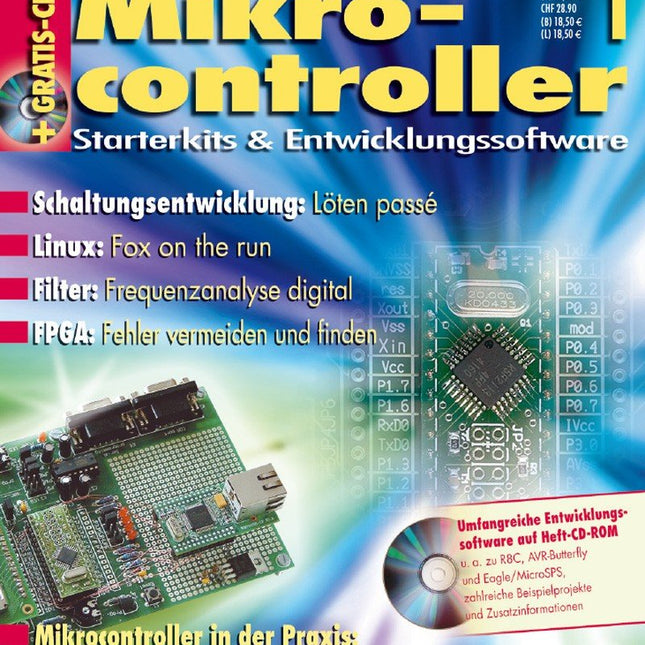
Elektor Digital Mikrocontroller 1 (PDF)
Die Artikel stellen Starterkits und Entwicklungssoftware verschiedener Hersteller anhand konkreter Aufgabenlösungen vor. Dabei lautet das Motto in den einzelnen Artikeln „Soviel Theorie wie nötig, soviel Praxis wie möglich“. Schritt für Schritt führen die Autoren in das Thema ein und führen den Leser bis zum gewünschten Erfolg.Inhalt:• TFH-System ONEModernes Mikrocontrollersystem für Lehre und Ausbildung; empfohlen von der PAL (Prüfungssaufgaben- und Lehrmittelentwicklungsstelle der IHK).• Elektronik „en bloc“Mit E-blocks lassen sich ohne Lötkolben und mit nur geringem Zeitaufwand Schaltungen entwickeln, programmieren und testen.• C-Control I Station 2.0BASIC zu programmierendes Computersystem mit einer Vielzahl Plug-an-Play-Module, auch für die professionelle Anwendung.• Das MicroSPS ProjektEAGLE bietet jetzt die Möglichkeit, Mikrocontrollerschaltungen durch Eingabe eines grafischen Funktionsplans zu entwickeln.• AT89LP EntwicklungsboardSteuerung und Programmierung erfolgen über die serielle Schnittstelle, gezeigt am Beispiel eines Elliptec-Piezo-Motors, die sich überall eignen, wo ein präziser, kleiner und leiser Antrieb nötig ist.• AVR-ButterflyLow-Cost-Tool mit dem ATmega169 für viele Anwendungen: u.a. für autonome Roboter, Wetterstation, Datenlogger.• PC-MCP2515-CAN-InterfaceEinfaches CAN-Interface für den PC mit umfangreichen Programmiermöglichkeiten.• Design-Rules für den FPGA-Entwurf in VHDLWas ist zu beachten, welche Methodik vermeidet Fehler und wie spürt man sie ggf. auf?• R8CVerschiedene Artikel befassen sich mit verschiedenen Themen: effiziente Programmierung, Verwendung in der Messtechnik, als DCF77-Funkuhr…• Einstieg in PSoCDie ersten Schritte mit dem PSoC-Starter-Kit von Cypress. Der Artikel vermittelt außerdem die Vorstellung davon, wo die Stärken der Mixed-Signal Controller liegen.Weitere Hefte aus dieser Reihe: Mikrocontroller 7 (PDF) Mikrocontroller 6 (PDF) Mikrocontroller 5 (PDF) Mikrocontroller 4 (PDF) Mikrocontroller 3 (PDF) Mikrocontroller 2 (PDF)
€ 16,90
Mitglieder: € 15,21
-

OWON OWON HDS2102s (3-in-1) 2-Kanal Oszilloskop (100 MHz) + Multimeter + Signalgenerator
Der OWON HDS2102s ist ein tragbarer 3-in-1-Multifunktionstester, der als 2-Kanal-Oszilloskop mit einer Bandbreite von 100 MHz, Multimeter und Signalgenerator verwendet werden kann. Es verfügt über ein kontrastreiches 3,5-Zoll-Farbdisplay, das sich für die Wartung von Außenanlagen, schnelle Messungen vor Ort, die Wartung von Kraftfahrzeugen und die Stromerkennung eignet. usw. Features Oszilloskop + Multimeter + Wellenformgenerator, Multifunktion in einem 3,5 Zoll hochauflösendes, kontrastreiches Farb-LCD-Display, geeignet für den Außenbereich 18650-Lithiumbatterie, kann 3–6 Stunden lang ununterbrochen arbeiten USB-Typ-C-Schnittstelle, unterstützt Powerbank, unterstützt PC-Software-Verbindung Selbstkalibrierungsfunktion SCPI unterstützt, erleichtert die sekundäre Entwicklung Technische Daten Bandwidth 100 MHz Channels 2-ch Oscilloscope + 1-ch Generator Sample Rate 500 MSa/s Acquisition Model Normal, Peak detect Record Length 8K Display 3.5-inch LCD Waveform Refresh Rate 10,000 wfrms/s Input Coupling DC, AC, and Ground Input Impedance 1 MΩ ±2%, in parallel with 16pF ±10pF Probe Attenuation Factors 1X,10X,100X,1000X,10000X Max. input Voltage 400 V (DC+AC, PK-PK, 1MΩ input impedance) (10:1 probe attenuation) Bandwidth Limit (typical) 20 MHz Horizontal Scale 2ns/div - 1000s/div, step by 1 - 2 - 5 Vertical Sensitivity 10mV/div - 10V/div Vertical Resolution 8 bits Trigger Type Edge Trigger Modes Auto, Normal, single Automatic Measurement Frequency, Period, Amplitude, Max, Min, Mean, PK-PK Cursor Measurement ΔV, ΔT, ΔT&ΔV between cursors Communication Interface USB-C Multimeter (Technische Daten) Max. Resolution 20,000 counts Testing Mode Voltage, Current, Resistance, Capacitance, Diode, and Continuity test Input Impedance 10 MΩ Max Input Voltage AC 750 V, DC 1000 V Max Input Current DC: 10 A, AC: 10 A Diode 0-2 V Signalgenerator (Technische Daten) Frequency Output Sine 0.1 Hz - 25 MHz Square 0.1 Hz - 5MHz Ramp 0.1 Hz - 1 MHz Pulse 0.1 Hz - 5 MHz Arbitrary 0.1 Hz - 5 MHz Sampling Rate 125 MSa/s Channel 1-ch Amplitude Range (high impedance) 20 mVpp - 5 Vpp Waveform Length 8K Vertical Resolution 14 bits Output Impedance 50Ω Lieferumfang 1x OWON HDS2102s 1x Netzteil 1x USB-Kabel 1x Passive Sonden 2x Krokodilklemmenkabel 1x Satz Multimeter-Sonden (eine rote und eine schwarze) 1x Manual 1x Sondenkorrektur-Einstellmesser Downloads User Manual Specifications SCPI Protocol Quick Guide Software
€ 184,47
-

Elektor March/April 2025 (EN)
Elektor GREEN and GOLD members can download their digital edition here. Not a member yet? Click here. The RISC-V Open-Source Processor Architecture16 Boards and MCUs You Should Know An FPGA-Based Audio Player with Equalizer (1)Mixing Digital Audio with an Arduino MKR Vidor 4000 Laser Head for Pico-Based Sand ClockDrawing with Light Enter the STM32 Edge AI Contest A Multi-Sensor Environmental Monitoring System for PlantsWireless Measurement of Water Supply and Light Conditions Maixduino AI-Powered Automatic DoormanFace Detection with a Camera Embedded Electronics 2024AI Is Set to Redefine the Industry Charge-Based In-Memory Compute at EnCharge AI AI Inferencing at 10 Times Lower Power and 20 Fold Lower Cost Click Board Helps Develop and Train ML Models for Vibration Analysis The Elektor Mini-WheelieA Self-Balancing Robot Kit MCU, I See YouMCUViewer Open-Source Multiplatform Debugging Tool USB 2.0 IsolatorElectrically Isolated Connections for USB Devices Intervention Before DamagePredictive Maintenance in Practice SPoE – Electromagnetic CompatibilitySingle-Pair with Power-Over-Ethernet Through the Eyes of EMC Color TV: A Wonder of Its TimeCreating a New World ECG Graph MonitoringAn Implementation with Hexabitz Modules and an STM32CubeMonitor The Battle for AI at the Edge HaLow Hits Record 16-km Wi-Fi Distance at 900 MHz First CHERI RISC-V Embedded Chip and Early Access Programme Third-Generation Wildfire Detection Uses Satellite Links From Life’s ExperienceChoice Overload Starting Out in Electronics……Continues Filtering and Controls Tone Quasi-Analog ClockworkA Remake of an Elektor Classic A Modular Approach to Sensor TestingThe ESP32-S3-Based Sensor Evaluation Board 2025: An AI OdysseyThe Rise of Foundation Models and Their Role in Democratizing AI Raspberry Pi Standalone MIDI Synthesizer (1)Preparing a Platform for Some Edge AI Experiments Err-lectronicsCorrections, Updates, and Readers’ Letters Universal AI RISC-V Processor Does It All — CPU, GPU, DSP, FPGA CEO Interview: Ventiva’s Thin and Cool Tech Dual-Core Programming with a Raspberry Pi PicoVenture Into the World of Parallel Programming
€ 10,95
-

Elektor Publishing The Connected Autonomous Vehicle and its Environment
An Introduction to Real and Reduced-Scale Autonomous Vehicles Want to cut through the hype and get to the core of autonomous and connected vehicles? Then this book is your clear, accessible guide to a complex and fast-moving field. Starting with Intelligent Transport Systems (ITS), it walks you through the essential foundations, including Advanced Driver Assistance Systems (ADAS) – the stepping stones to full autonomy. Explore how self-driving cars mimic human behavior through a loop of perception, analysis, decision, and action. Discover the key functions that make it possible: localization, obstacle detection, driver monitoring, cooperative awareness – and the most challenging of all, trajectory planning, across strategic, tactical, and operational levels. Will vehicles be connected? The debate is on – but the standards are already here. Learn how connectivity, infrastructure, and vehicles can work in synergy through the innovative concept of floating car data (FCD). Dive into real-world implementation: with embedded electronics account-ing for over 30% of a modern vehicle‘s cost, we unpack the architecture, coordination, and tools required to manage the complexity – brought to life with a hands-on case study. To finish, we open the door to the future: building your own 1:10 scale autonomous vehicle. No plug-and-play solutions – just the foundations for a collaborative, creative, and geek-friendly challenge. Let’s drive the future together.
€ 34,95
Mitglieder: € 31,46


