
Suchergebnisse für "camera or projects or book"
-

Elektor Digital Build Your Own Multifunctional 4-Axis CNC Machine (E-book)
Plot, Cut, Drill, Mill and Laser with the Z99 This book covers the construction, hardware, software, and operation of the Z99 – CNC machine. This is a multifunctional 4-axis machine for home construction. The capabilities of the Z99 machine include: large-format schematic plotting PCB plotting with etch-resist pens schematic plotting with conductive-ink pens letter cutting out of vinyl paper cutting PCB/substrate drilling PCB/substrate milling text milling laser engraving laser cutting of solder paste masks By making the support software available as freeware, readers of the book are challenged and encouraged to develop new applications for the Z99. The machine would not be of much use if the user has no option to create suitable files for the designs in mind. A large part of this book is dedicated to creating source files in a variety of freeware software packages, including Inkscape, DesignSpark PCB, KiCad, and FlatCAM. The book is also useful for readers keen to comprehend and then master the basic structure of HPGL, Gerber, Drill, and G-code files, as well as to have a go at deciphering them using software.
€ 29,95
Mitglieder: € 26,96
-

Elektor Digital Radio-Baubuch (E-book)
Radios selber bauen ist zwar ein altes, aber auch heute ein immer noch aktuelles Thema. Lange Zeit war das Radiobasteln der Einstieg in die Elektronik. Inzwischen gibt es zwar auch andere Wege, vor allem über Computer, Mikrocontroller und die Digitaltechnik. Allerdings kommen die analogen Wurzeln der Elektronik oft zu kurz. Die Radiotechnik eignet sich besonders gut als Lernfeld der Elektronik, weil man hier mit den einfachsten Grundlagen beginnen kann. Aber auch die Verbindung zur modernen Digitaltechnik liegt auf der Hand, wenn es z. B. um digitales Radio geht.Die Hochfrequenztechnik ist eines der Gebiete, auf denen man auch heute noch eigene Ideen relativ leicht in die Tat umsetzen kann. Unzählige Schaltungsvarianten mit besonderen Zielsetzungen geben Raum für sinnvolle Experimente und Projekte. Vieles kann man eben nicht einfach kaufen. Detektorradios ohne eigene Energiequelle, einfache Röhrenempfänger mit dem besonders angenehmen Klang, die ersten Empfangsversuche mit dem digitalen Rundfunk DRM oder Spezialempfänger für den Amateurfunk, all dies lässt sich mit wenig Aufwand realisieren.Neben dem alten Detektorempfänger sind vor allem Röhrengeräte und das moderne digitale Radio DRM interessante Themen; erst recht, wenn man einen leistungsfähigen Röhrenempfänger für DRM baut. Aber auch der Bau eines Audioempfängers oder einfacher Transistorradios für Mittel- und Kurzwelle ist unkompliziert und bringt eine Menge Spaß. Nicht zuletzt spielt auch hier der PC mit entsprechender Software bei der Abstimmung digital gesteuerter Oszillatoren eine entscheidende Rolle. Die Quelltexte der verwendeten Programme sind vollständig abgedruckt.
€ 29,80
Mitglieder: € 26,82
-
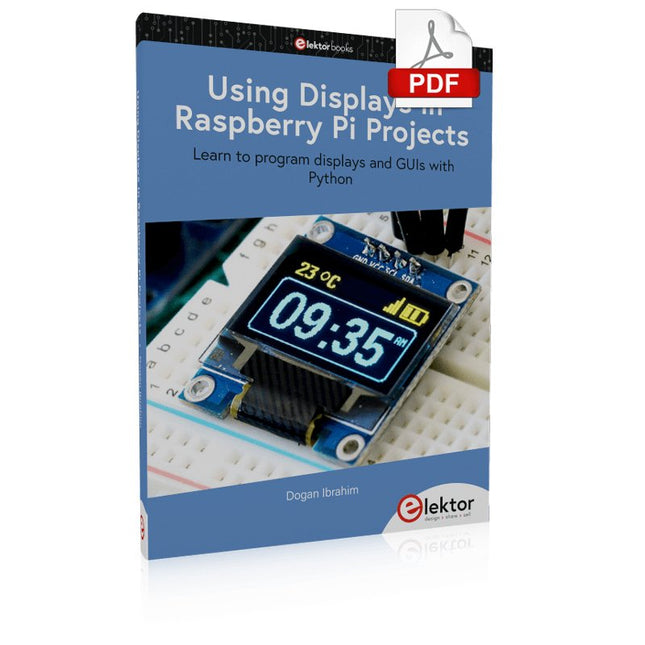
Elektor Digital Using Displays in Raspberry Pi Projects (E-book)
Learn to program displays and GUIs with Python This book is about Raspberry Pi 4 display projects. The book starts by explaining how to install the latest Raspbian operating system on an SD card, and how to configure and use the GPIO ports. The core of the book explains the following topics in simple terms with fully tested and working example projects: Simple LED projects Bar graph LED projects Matrix LED projects Bitmap LED projects LED strips LCDs OLED displays E-paper displays TFT displays 7-inch touch screen GUI Programming with Tkinder One unique feature of this book is that it covers almost all types of display that readers will need to use in their Raspberry Pi based projects. The operation of each project is fully given, including block diagrams, circuit diagrams, and commented full program listings. It is therefore an easy task to convert the given projects to run on other popular platforms, such as Arduino or PIC microcontrollers. Python program listings of all Raspberry Pi projects developed in this book are available for download at Elektor.com. Readers can use these programs in their projects. Alternatively, they can modify the programs to suit their applications.
€ 32,95
Mitglieder: € 29,66
-

Elektor Digital Practical Electronics Crash Course (E-book)
Learning circuit design the fun way Welcome to the world of electronics! Getting started in electronics is not as difficult as you may think. Using this book, you will explore and learn the most important electrical and electronics engineering concepts in a fun way by doing various experiments and by simulating circuits. It will teach you electronics practically without getting into complex technical jargon and long calculations. As a result, you will be creating your own projects soon. No prior knowledge of electronics is required, only some basic algebra is used in a few simple calculations. Many tested and working projects and simulations are presented to familiarise yourself with the construction of electronic circuits. Circuit simulation is introduced at an early stage to enable you to experiment with circuits easily without breaking anything. You will learn: The concepts of voltage, current, and power AC and DC Basic lamp circuits with switches Passive components: resistors, capacitors & inductors RC & RCL circuits Electromagnetism Loudspeakers, relays, buzzers, and transformers Active components: diodes & LEDs, bipolar transistors & MOSFETs Transistor-based switching circuits Optocoupler circuits Astable & monostable multivibrators Using the 555 timer IC The operational amplifier Digital logic Advanced examples: amplifiers, oscillators, filters, and sensors Test and measurement tools Microcontrollers: Arduino UNO, ESP32, Raspberry Pi Pico, and Raspberry Pi Reading datasheets and best practices for selecting components EMC & EMI and norms & regulations
€ 32,95
Mitglieder: € 29,66
-
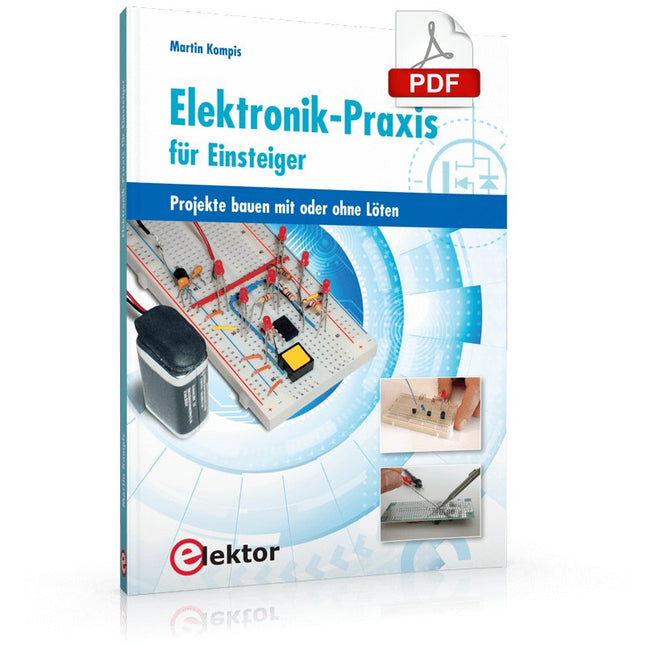
Elektor Digital Elektronik-Praxis für Einsteiger (PDF)
Wenn Sie nachbausichere Schaltungen suchen, die mit wenigen elektronischen Bauteilen auskommen, problemlos funktionieren und Spaß machen – dann liegen Sie mit diesem Buch richtig. Hier finden Sie beispielsweise Radioempfänger für UKW, Lang- und Mittelwelle, eine akustische Illusion, ein Mini-Oszilloskop zur grafischen Anzeige von Spannungsverläufen, elektronische Orgeln, einen elektronischen Würfel mit Mikrocontroller, Gegensprechanlagen, einen Generator für Sinus-, Rechteck- und Dreiecksignale und weitere funktionssichere Schaltungen.Wenn Sie elektronische Schaltungen bauen möchten, vorerst aber lieber bei bedrahteten Bauteilen und Steckbrettern bleiben, anstatt Platinen herzustellen und Bauteile zu löten – dann liegen Sie hier richtig. Für alle Bauprojekte wird ein Steckbrett-Aufbau gezeigt und bei vielen zusätzlich ein einfacher Aufbau auf einer Universal-Leiterplatte. Zahlreiche Fotos veranschaulichen das Vorgehen. Für alle Bauteile sind mindestens zwei aktuelle Lieferanten angegeben.Wenn Ihnen der reine Nachbau etwas zu wenig geworden ist und Sie anfangen möchten, Schaltungen selber zu entwerfen und zu berechnen – dann liegen Sie hier richtig. Von ganz einfach bis etwas schwerer erfahren Sie unter anderem, wie Sie Vorwiderstände berechnen, einen Schwingkreis oder eine Spule dimensionieren, wie man die Bauteile astabiler Multivibratoren mit 2 Transistoren berechnet, wie Operationsverstärker eingesetzt werden können und wie ein Mikrocontroller funktioniert und programmiert wird. Das alles mit einfachen Formeln und vielen Beispielen.Auch wenn Sie nur wenig oder keine Erfahrung mit Elektronik haben und neu einsteigen möchten – dann liegen Sie hier richtig. Sie erfahren das Wichtigste über den praktischen Aufbau von Schaltungen, ob nun auf dem Steckbrett oder auf einer Leiterplatte, die wichtigsten Werkzeuge und natürlich über die wichtigsten elektronischen Bauteile.
€ 32,80
Mitglieder: € 29,52
-
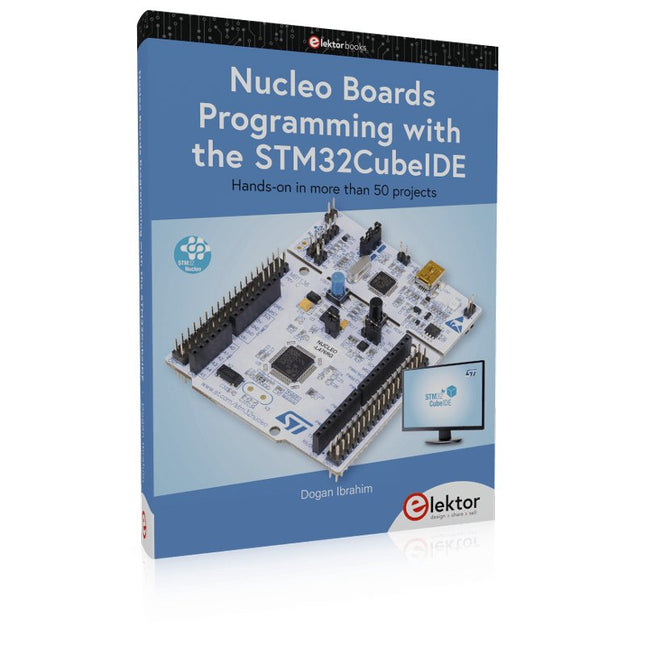
Elektor Publishing Nucleo Boards Programming with the STM32CubeIDE
Hands-on in more than 50 projects STM32 Nucleo family of processors are manufactured by STMicroelectronics. These are low-cost ARM microcontroller development boards. This book is about developing projects using the popular STM32CubeIDE software with the Nucleo-L476RG development board. In the early Chapters of the book the architecture of the Nucleo family is briefly described. The book covers many projects using most features of the Nucleo-L476RG development board where the full software listings for the STM32CubeIDE are given for each project together with extensive descriptions. The projects range from simple flashing LEDs to more complex projects using modules, devices, and libraries such as GPIO, ADC, DAC, I²C, SPI, LCD, DMA, analogue inputs, power management, X-CUBE-MEMS1 library, DEBUGGING, and others. In addition, several projects are given using the popular Nucleo Expansion Boards. These Expansion Boards plug on top of the Nucleo development boards and provide sensors, relays, accelerometers, gyroscopes, Wi-Fi, and many others. Using an expansion board together with the X-CUBE-MEMS1 library simplifies the task of project development considerably. All the projects in the book have been tested and are working. The following sub-headings are given for each project: Project Title, Description, Aim, Block Diagram, Circuit Diagram, and Program Listing for the STM32CubeIDE. In this book you will learn about STM32 microcontroller architecture; the Nucleo-L476RG development board in projects using the STM32CubeIDE integrated software development tool; external and internal interrupts and DMA; DEBUG, a program developed using the STM32CubeIDE; the MCU in Sleep, Stop, and in Standby modes; Nucleo Expansion Boards with the Nucleo development boards. What you need a PC with Internet connection and a USB port; STM32CubeIDE software (available at STMicroelectronics website free of charge) the project source files, available from the book’s webpage hosted by Elektor; Nucleo-L476RG development board; simple electronic devices such as LEDs, temperature sensor, I²C and SPI chips, and a few more; Nucleo Expansion Boards (optional).
€ 49,95
Mitglieder: € 44,96
-
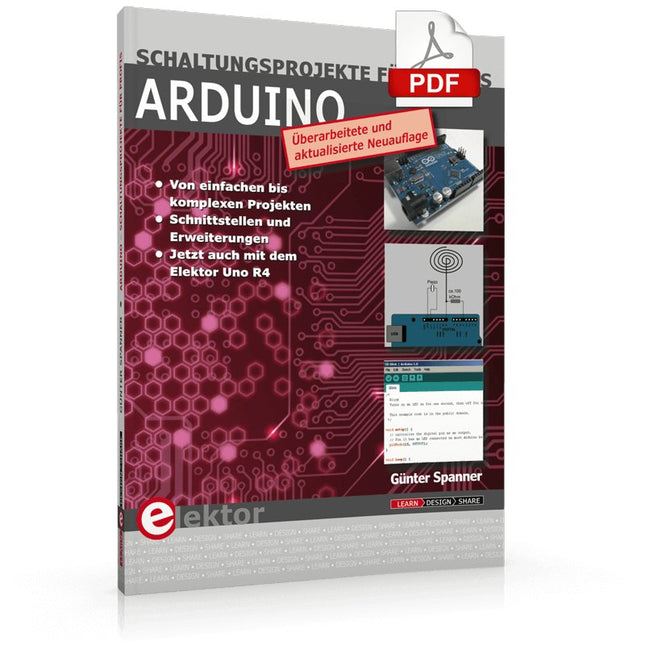
Elektor Digital Arduino – Schaltungsprojekte für Profis (PDF)
Mit Arduino – Schaltungsprojekte für Profis wird der Leser umfassend in die Hardware und Software der Arduino-Plattform eingeführt. Einfache, leicht verständliche Projekte am Anfang des Buches führen Schritt für Schritt in die Open-Source-Plattform ein. Die Projekte werden dann zunehmend komplexer, um dem Leser möglichst viele konkrete Lösungsmöglichkeiten aufzuzeigen, die mit dem Arduino-Mikrocontroller auch für angehende Profis zur Verfügung stehen. Dabei wird neben den erforderlichen theoretischen Grundlagen stets größter Wert auf eine praxisorientierte Ausrichtung gelegt. So werden wichtige Techniken wie AD-Wandlung, Timer oder Interrupts stets in Praxisprojekte eingebettet. Es entstehen Lauflichteffekte, ein Aufwachlicht, voll funktionsfähige Voltmeter, präzise Digitalthermometer, Uhren in allen Variationen, Reaktionszeitmesser oder mausgesteuerte Roboterarme. Und ganz nebenbei hat der Leser die Grundlagen der zugehörigen Controller-Technik verstanden und im wahrsten Sinne des Wortes begriffen.
€ 34,80
Mitglieder: € 31,32
-

Elektor Publishing Initiation au langage CircuitPython et à la puce nRF52840
En moins de 100 lignes de code par projet avec les cartes Feather Sense et Clue Express d'Adafruit Le langage de programmation Python est apprécié par les pédagogues parce que sa syntaxe le rend facile à comprendre. Il s'est également imposé chez les informaticiens expérimentés. La société Adafruit a développé une version spéciale de Python pour l'embarquer sur les microcontrôleurs à 32 bits : CircuitPython. Ce livre permettra au lecteur de s'initier à la programmation en CircuitPython sur deux cartes : Feather BlueFruit Sense (également appelée Feather nRF52840 Sense) et CLUE nRF52840 Express. Chacune est animée par le SoC nRF52840 de NORDIC avec une architecture à 32 bits. Pour ce voyage dans le monde de la programmation embarquée, l'auteur sort du chemin classique, à savoir un cours complet sur la programmation orientée objet appliquée à ce langage. Il préfère emmener le lecteur directement sur le terrain avec des projets qui mettent en oeuvre les cartes et différents périphériques. Plus d'une quarantaine d'exemples et de montages permettent de découvrir la richesse de CircuitPython. Toutefois l'auteur s'est imposé une limite pour ne pas décourager les novices : le code de chaque projet ne dépasse jamais la centaine de lignes. Pour ce qui est du matériel, là aussi la simplicité domine : aucun programmateur, un simple PC suffit ; aucun soudage grâce au câblage sur platine d'essai. Les cartes d'extension FeatherWing à enficher sur la Feather nRF52840 Sense permettent de démultiplier ses fonctions : matrice de LED, enregistreur de données, écran à encre électronique, écran OLED, écran TFT, commande de moteurs, audio, relais… Toutes les étapes (assemblage des différents composants, installation des bibliothèques requises, programmation, tests…) sont expliquées en détail. Le code des différents exemples et projets est disponible sur Github. Le résultat de chaque projet est même présenté sur de courtes vidéos disponibles sur YouTube. À la fin de sa lecture, le nouveau Pythonien pourra facilement approfondir les notions abordées et donner vie à ses propres projets grâce aux outils qu'il aura essayés. Ce livre s'adresse aux lycéens et étudiants ainsi qu'à toute la communauté des makers. Chaîne YouTube de l'auteur : YouTube (Michaël Bottin)
€ 44,95
Mitglieder: € 40,46
-
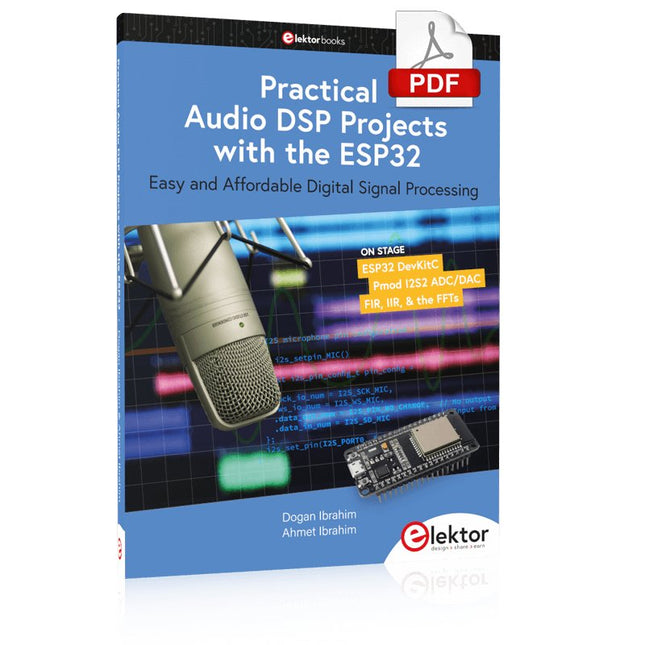
Elektor Digital Practical Audio DSP Projects with the ESP32 (E-book)
Einfache und kostengünstige digitale Signalverarbeitung Ziel dieses Buches ist es, die Grundprinzipien der digitalen Signalverarbeitung (DSP) zu vermitteln und sie unter Verwendung eines Minimums an Mathematik aus praktischer Sicht einzuführen. Es wird nur das Grundniveau der Theorie zeitdiskreter Systeme vermittelt, das ausreicht, um DSP-Anwendungen in Echtzeit zu implementieren. Die praktischen Umsetzungen werden in Echtzeit mithilfe des beliebten Mikrocontroller-Entwicklungsboards ESP32 DevKitC beschrieben. Mit dem kostengünstigen und äußerst beliebten ESP32-Mikrocontroller sollten Sie in der Lage sein, grundlegende DSP-Projekte mit Abtastfrequenzen im Audiobereich zu entwerfen. Die gesamte Programmierung erfolgt mit der beliebten Arduino IDE in Verbindung mit dem C-Sprachcompiler. Nachdem das Buch eine solide Grundlage der DSP-Theorie und relevante Diskussionen über die wichtigsten DSP-Softwaretools auf dem Markt gelegt hat, werden die folgenden audiobasierten Sound- und DSP-Projekte vorgestellt: Verwendung eines I²S-basierten digitalen Mikrofons zur Audioaufnahme Verwendung eines I²S-basierten Klasse-D-Audioverstärkers und Lautsprechers Wiedergabe von auf einer SD-Karte gespeicherter MP3-Musik über einen I²S-basierten Verstärker und Lautsprecher Wiedergabe von im ESP32-Flash-Speicher gespeicherten MP3-Musikdateien über einen I²S-basierten Verstärker und Lautsprecher Mono- und Stereo-Internetradio mit I²S-basierten Verstärkern und Lautsprechern Text-zu-Sprache-Ausgabe mit einem I²S-basierten Verstärker und Lautsprecher Verwendung der Lautstärkeregelung in I²S-basierten Verstärker- und Lautsprechersystemen Ein sprechender Veranstaltungszähler mit einem I²S-basierten Verstärker und Lautsprecher Ein einstellbarer Sinusgenerator mit I²S-basiertem Verstärker und Lautsprecher Verwendung des schnellen 24-Bit-ADC/DAC-Moduls Pmod I²S2 Digitales Tiefpass- und Bandpass-Echtzeit-FIR-Filterdesign mit externer und interner A/D- und D/A-Wandlung Digitales Tiefpass- und Bandpass-Echtzeit-IIR-Filterdesign mit externer und interner A/D- und D/A-Wandlung Schnelle Fourier-Transformationen (FFT)
€ 32,95
Mitglieder: € 29,66
-

Elektor Publishing Logic Analyzers in Practice
PC USB Logic Analyzers with Arduino, Raspberry Pi, and Co. Step-by-step instructions guide you through the analysis of modern protocols such as I²C, SPI, UART, RS-232, NeoPixel, WS28xx, HD44780 and 1-Wire. With the help of numerous experimental circuits based on the Raspberry Pi Pico, Arduino Uno and the Bus Pirate, you will learn the practical application of popular USB logic analyzers. All the experimental circuits presented in this book have been fully tested and are fully functional. The necessary program listings are included – no special programming or electronics knowledge is required for these circuits. The programming languages used are MicroPython and C along with the development environments Thonny and Arduino IDE. This book uses several models of flexible and widely available USB logic analyzers and shows the strengths and weaknesses of each price range. You will learn about the criteria that matter for your work and be able to find the right device for you. Whether Arduino, Raspberry Pi or Raspberry Pi Pico, the example circuits shown allow you to get started quickly with protocol analysis and can also serve as a basis for your own experiments. After reading this book, you will be familiar with all the important terms and contexts, conduct your own experiments, analyze protocols independently, culminating in a comprehensive knowledge set of digital signals and protocols.
€ 34,95
Mitglieder: € 31,46
-
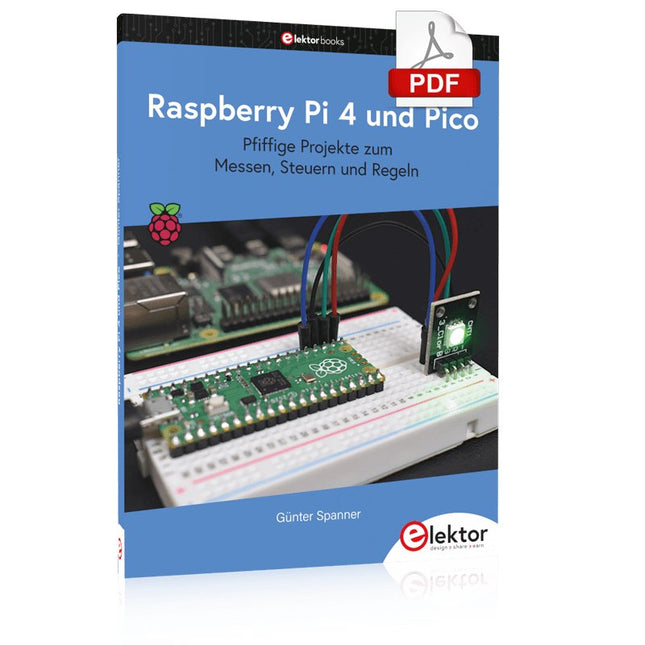
Elektor Digital Raspberry Pi 4 und Pico (PDF)
Pfiffige Projekte zum Messen, Steuern und Regeln Der Raspberry Pi dominiert seit vielen Jahren die Maker-Szene. Frei verfügbare I/O-Pins erfordern ihn aller Zeiten zu einem der beliebtesten Prozessorboards. Allerdings verfügt der klassische Raspberry Pi über keinerlei Analogeingänge. Eine direkte Messung analoger Werte ist damit nicht möglich. So können weder Photodioden noch NTCs oder Hallsensoren etc. unmittelbar ausgelesen werden. Zudem sind die Pins direkt, d. H. ohne Treiber oder Schutzschaltung, mit den freiliegenden Kontakten verbunden. Dadurch kann der zentrale Controller und damit der gesamte Raspberry Pi schnell zerstört werden. Mit dem Pico können diese Probleme elegant gelöst werden. Er kann als sogenanntes „Frontend“ problemlos verschiedene Messaufgaben übernehmen. Zudem ist der Pico deutlich preisgünstiger als ein klassischer Raspberry Pi 4. Falls eine Fehlbeschaltung zur Zerstörung des Pico führt, ist dies vor allem für nicht-professionelle Anwender relativ leicht zu verkraften. Der klassische Raspberry Pi und der Pico werden so zum idealen Duo. Das Buch führt entsprechend in das weite und hochaktuelle Gebiet der modernen Controllertechnik anhand der beiden Boards „Raspberry Pi 4“ und „Raspberry Pi Pico“ ein. Neben einer tiefergehenden Einführung in die Arbeits- und Funktionsweise des Controllerboards selbst wird insbesondere auch auf die Messwerterfassung und -verarbeitung mit digitalen Prozessoren eingegangen. Insbesondere die Kombination beider Systeme bietet vielfältige und hochinteressante Möglichkeiten. Praktische Projekte aus dem Inhalt: USB-Verbindung zwischen Raspberry Pi 4 und Pico I²C-Kommunikation und Pico als I²C-Device Voltmeter und Computerthermometer Pico W als Web-Server und WLAN-Scanner Frequenzmesser und -generatoren OLED-Displays an Pico und Raspberry Pi 4 Energiesparmonitor Welche Astronauten sind im Orbit? Mini-Monitor für den aktuellen Bitcoin-Kurs
€ 32,80
Mitglieder: € 29,52
-
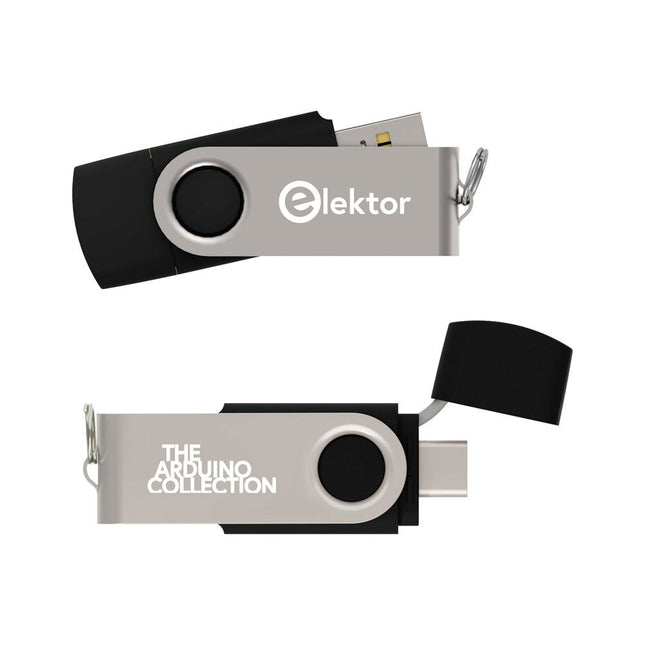
Elektor Classics The Elektor Arduino Collection (USB-Stick)
Dieser USB-Stick enthält eine Auswahl von über 300 Arduino-bezogenen Artikeln, die im Elektor-Magazin veröffentlicht wurden. Der Inhalt umfasst sowohl Hintergrundartikel als auch Projekte zu folgenden Themen: Software- und Hardware-Entwicklung: Tutorials zur Arduino-Softwareentwicklung mit der Arduino IDE, Atmel Studio, verschiedenen Shields und grundlegenden Programmierkonzepten. Lernen: Das Mikrocontroller-Bootcamp bietet einen strukturierten Einstieg in die Programmierung eingebetteter Systeme. Datenerfassung und -messung: Projekte wie ein 16-Bit-Datenlogger, ein Drehbank-Tachometer und ein AC-Netzanalyzer ermöglichen die Erfassung und Analyse von Echtzeitsignalen. Drahtlose Kommunikation: Erfahren Sie, wie man drahtlose Netzwerke implementiert, eine Android-Schnittstelle erstellt und effektiv mit Mikrocontrollern kommuniziert. Robotik und Automatisierung: Lernen Sie den Arduino Nano Robot Controller, unterstützende Automatisierungs-Boards sowie diverse Arduino-Shields zur Funktionserweiterung kennen. Selbstbauprojekte: Einzigartige DIY-Projekte wie Laserprojektion, eine Numitron-Uhr mit Thermometer, ein ELF-Empfänger, Theremino-Module und Touch-LED-Schnittstellen zeigen kreative Einsatzmöglichkeiten auf. Egal, ob Sie Einsteiger oder erfahrener Maker sind – diese Sammlung ist eine wertvolle Ressource zum Lernen, Experimentieren und Erweitern der Möglichkeiten mit Arduino.
€ 49,95€ 34,95Bestpreis


