
Suchergebnisse für "can OR et OR can OR fd"
-

Raspberry Pi Foundation FPC Kamera-Kabel für Raspberry Pi 5 (500 mm)
Der Raspberry Pi 5 verfügt über zwei vierspurige MIPI-Anschlüsse, von denen jeder entweder eine Kamera oder ein Display unterstützen kann. Diese Anschlüsse verwenden dasselbe 22-polige "Mini"-FPC-Format mit 0,5 mm Raster wie das Compute Module Development Kit und erfordern Adapterkabel für den Anschluss an die 15-poligen "Standard"-Anschlüsse mit 1 mm Raster an aktuellen Raspberry Pi Kamera- und Display-Produkten. Diese Mini-zu-Standard-Adapterkabel für Kameras und Displays (beachten Sie, dass ein Kamerakabel nicht mit einem Display verwendet werden sollte und umgekehrt) sind in den Längen 200 mm, 300 mm und 500 mm erhältlich.
€ 3,95€ 1,95Bestpreis
-

Elektor Publishing PLC Programming with the Raspberry Pi and the OpenPLC Project
ModbusRTU and ModbusTCP examples with the Arduino Uno and ESP8266 Introduction to PLC programming with OpenPLC, the first fully open source Programmable Logic Controller on the Raspberry Pi, and Modbus examples with Arduino Uno and ESP8266 PLC programming is very common in industry and home automation. This book describes how the Raspberry Pi 4 can be used as a Programmable Logic Controller. Before taking you into the programming, the author starts with the software installation on the Raspberry Pi and the PLC editor on the PC, followed by a description of the hardware. You'll then find interesting examples in the different programming languages complying with the IEC 61131-3 standard. This manual also explains in detail how to use the PLC editor and how to load and execute the programs on the Raspberry Pi. All IEC languages are explained with examples, starting with LD (Ladder Diagram) over ST (Structured Control Language) to SFC (Special Function Chart). All examples can be downloaded from the author's website. Networking gets thorough attention too. The Arduino Uno and the ESP8266 are programmed as ModbusRTU or ModbusTCP modules to get access to external peripherals, reading sensors and switching electrical loads. I/O circuits complying with the 24 V industry standard may also be of interest for the reader. The book ends with an overview of commands for ST and LD. After reading the book, the reader will be able to create his own controllers with the Raspberry Pi.
€ 39,95
Mitglieder: € 35,96
-

Elektor Publishing Logic Analyzers in Practice
PC USB Logic Analyzers with Arduino, Raspberry Pi, and Co. Step-by-step instructions guide you through the analysis of modern protocols such as I²C, SPI, UART, RS-232, NeoPixel, WS28xx, HD44780 and 1-Wire. With the help of numerous experimental circuits based on the Raspberry Pi Pico, Arduino Uno and the Bus Pirate, you will learn the practical application of popular USB logic analyzers. All the experimental circuits presented in this book have been fully tested and are fully functional. The necessary program listings are included – no special programming or electronics knowledge is required for these circuits. The programming languages used are MicroPython and C along with the development environments Thonny and Arduino IDE. This book uses several models of flexible and widely available USB logic analyzers and shows the strengths and weaknesses of each price range. You will learn about the criteria that matter for your work and be able to find the right device for you. Whether Arduino, Raspberry Pi or Raspberry Pi Pico, the example circuits shown allow you to get started quickly with protocol analysis and can also serve as a basis for your own experiments. After reading this book, you will be familiar with all the important terms and contexts, conduct your own experiments, analyze protocols independently, culminating in a comprehensive knowledge set of digital signals and protocols.
€ 34,95
Mitglieder: € 31,46
-

Elektor Digital Programming the Finite State Machine (E-book)
Programming the Finite State Machine with 8-Bit PICs in Assembly and C Andrew Pratt provides a detailed introduction to programming PIC microcontrollers, as well as a thorough overview of the Finite State Machine (FSM) approach to programming. Most of the book uses assembly programming, but do not be deterred. The FSM gives a structure to a program, making it easy to plan, write, and modify. The last two chapters introduce programming in C, so you can make a direct comparison between the two techniques. The book references the relevant parts of the Microchip datasheet as familiarity with it is the best way to discover detailed information. This book is aimed at Microsoft Windows and Linux users. To keep your costs to a minimum and to simplify the toolchain, specific applications are provided as a free download to enable you to use an FTDI serial lead as the programmer. The assembler used is the open-source "gpasm". All programming can be done in a text editor. There are detailed instructions on how to perform the necessary installations on Windows, Linux Debian, and derivatives such as Ubuntu and Fedora. For programming in C, Microchip's XC8 compiler is used from the command line. In addition to the programming applications, two serial read and serial write applications can be used for communicating with the PICs from a computer. A voltmeter project including practical instructions on building a circuit board from scratch is included. All theory is covered beforehand, including how to do integer arithmetic in assembly. Two PICs are covered: the PIC12F1822 and the PIC16F1823. Both can run at 32 MHz with an internal oscillator. You do not need to buy a factory-made development board and programmer. With relatively inexpensive parts including a serial lead, microcontroller, a few resistors, and LEDs, you can get started exploring embedded programming. Links Updated Programmer
€ 32,95
Mitglieder: € 29,66
-

Uni-Trend UNI-T UPO1202CS 2-Kanal Oszilloskop (200 MHz)
UNI-T UPO1202CS ist ein multifunktionales, kostengünstiges 2-Kanal-Digital-Phosphor-Oszilloskop mit 200 MHz Bandbreite und 1 GSa/s Abtastrate. Es kann in großem Umfang in den Bereichen elektronisches und elektrisches Design, Debugging, Bildung und Industriedesign eingesetzt werden. Die UPO1000CS-Serie nutzt parallele digitale Signalverarbeitungstechnologie, die die Datenverarbeitungsgeschwindigkeit und die Wellenformerfassungsrate erheblich verbessert. Die ursprüngliche Ultra Phosphor-Technologie kann den kumulativen Effekt des getesteten Signals als vielschichtiges Nachleuchten darstellen. Im Vergleich zu herkömmlichen digitalen Speicheroszilloskopen können digitale Phosphor-Oszilloskope dreidimensionale Wellenformdaten zu Amplitude, Zeit und Signalintensität darstellen. Die Fast Acquire-Technologie kann ungewöhnliche Ereignisse wie Video, Jitter, Rauschen und Runt-Signale genau erfassen. Technische Daten UPO1102CS UPO1202CS Bandbreite 100 MHz 200 MHz Analoge Kanäle 2 2 Abtastrate 1 GSa/s 1 GSa/s Speichertiefe 56 Mpts pro Kanal 56 Mpts pro Kanal Anstiegszeit ≤3,5ns ≤1,8ns Erfassungsrate 500.000 wfms/s 500.000 wfms/s Wellenform-Aufzeichnung 100.000 Bilder 100.000 Bilder Features 7' WVGA (800 x 480) TFT-LCD Ultra-Phosphor-Superfluoreszenz-Display-Effekt, bis zu 256 Graustufen der Anzeige Unterstützt RS232-, I²C-, SPI-, CAN- und LIN-Trigger Innovative RS232-, I²C-, SPI-, CAN- und LIN-Hardware-Dekodierung Vertikale Skala: 1 mV/Teilung-20 V/Teilung Geringes Hintergrundrauschen: Erweiterte FFT-Funktion mit 1M Punkten. Unterstützt Frequenzeinstellung, Wasserfalldiagramm, Erkennungseinstellung und Marker-Messung etc. 36 Arten von Wellenformparametern können automatisch gemessen werden Umfangreiche Triggerfunktionen (Flanke, Pulsbreite, Video, Steigung, Lauf, Überschwingen, Verzögerung, Timeout, Dauer, Setup und Hold, Nth Edge und Pattern Trigger) Multi-Scopes unterstützen unabhängige Zweikanal-Trigger-Fluoreszenzanzeige Unabhängiger 7-Bit-Hardware-Frequenzzähler mit mehreren Kanälen DVM unterstützt unabhängige Zweikanal-AC- und DC-Echt-Effektivwertmessungen Arithmetische Funktionen für Wellenformen (FFT, +, -, ×, ÷, digitale Filterung, logische Operationen und erweiterte Operationen) Umfangreiche Schnittstellen: USB-Host, USB-Gerät, LAN, EXT Trig, AUX Out (Trig Out, Pass/Fail) Unterstützt SCPI-programmierbare Instrumenten-Standardbefehle Unterstützung von WEB-Zugang und Steuerung Downloads Datasheet Programming Manual User's Manual Quick Start Guide Software
€ 362,90
-

OWON OWON ADS924A 4-Kanal Oszilloskop (250 MHz)
Die OWON ADS900A-Serie ist ein kompaktes 12-Bit-Digitaloszilloskop mit bis zu 2 GSa/s, 100 MPTS Speicher und 125/250 MHz Bandbreite. Mit seinem 7"-Multitouch-Display, FFT, Protokolldekodierung und integriertem Logikanalysator ermöglicht es eine präzise Signalanalyse für Labor-, Werkstatt- und Feldanwendungen. Technische Daten ADS914A ADS924A Bandwidth (-3 dB) 125 MHz 250 MHz Channels 4 Max. sample rate 2 GSa/s (single-channel) 1 GSa/s (dual-channel) 500 MSa/s (full-channel) DC Gain Accuracy 3% (≤1 mV) 2% (≥2 mV) Max memory depth 100M Vertical resolution 12 bits Relay time accuracy ±25 ppm (typical) Input Impedance 1 MΩ±2%, parallel with20 pF±5 pF Probe Attenuation Coefficient 1.00μX-1M.00X,step by 1-2-5, support custom Trigger type Edge, Video, Pulse, Slope, Runt, Windows, Timeout, Nth, Logic, RS232/UART, I²C, SPI CAN, LIN Bus decoding RS232/UART, I²C, SPI, CAN, LIN Auto measurement Period, Frequency, +Width, -Width, Rise Time, Fall Time, Scr Duty, +Duty,-Duty, Vavg, Vpp, VRMS, Overshoot, Vmax, Vmin, Vtop, CycRms, Vbase, Vamp, Preshoot, Std Dev, +Pulse Cnt, -Pulse Cnt, Rise Cnt, Fall Cnt, Area, Cyc Area, Delay(A↑-B↑), Delay(A↑-B↓), Delay(A↓-B↑), Delay(A↓-B↓), Phase(A↑-B↑) Phase(A↑-B↓), Phase(A↓-B↑), Phase(A↓-B↓), FRR(A↑-B↑), FRF(A↑-B↓) FFR(A↓-B↑), FFF(A↓-B↓), LRR(A↑-B↑), LRF(A↑-B↓), LFR(A↓-B↑), LFF(A↓-B↓) Waveform Math +, -, *, /, &&, ||, ^, !, Intg, Diff, Sqrt, Function operation (Lg / Ln / Exp / Abs / Sine / Cosine / Tan), FFT, FFT rms, User Defined, digital filter (low pass, high pass, band pass, band reject) Frequency counter 6-digit frequency counter Maximum frequency: maximum analog bandwidth of oscilloscope Voltmeter Support DC, AC+DCrms, ACrms, Resolution: 4 digits (ACV/DCV) Logical Analyzer Specifications Number of channels 16 input channels (D0-D15) (D0 to D7, D8 to D15) Max. input voltage ±40V peak CAT I, transient overvoltage 800Vpk Input Impedance 100kΩ, 8 pF Vertical resolution 1 bit Other Communication Interface HDMI, USB device, USB Host, Trig Out (P/F), LAN Display 7 inch (1024x600), capacitive multi-touch screen Power supply interface USB-C Dimensions 260 x 160 x 78 mm Weight 1.5 kg Lieferumfang 1x OWON ADS924A Oszilloskop 1x Netzteil 1x Netzkabel 1x USB-Kabel 1x Sonde 1x Quick Guide Downloads Manual Quick Guide PC Software
€ 677,11
-
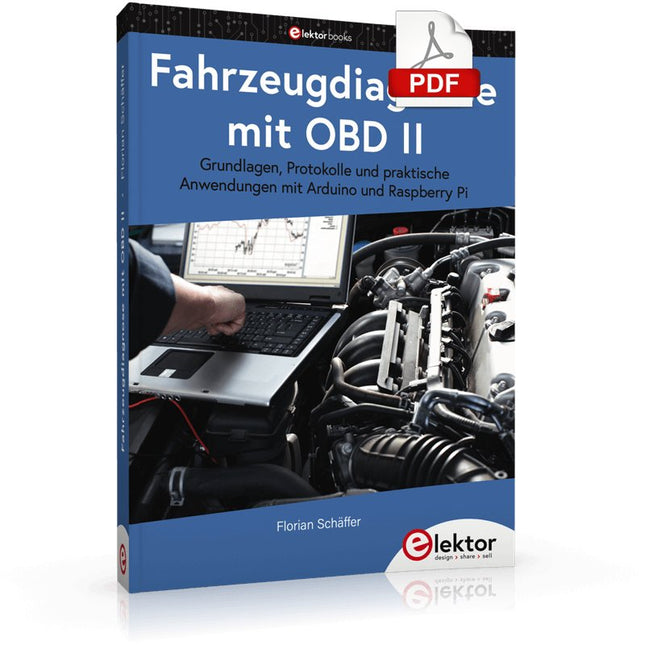
Elektor Digital Fahrzeugdiagnose mit OBD II (PDF)
Ungefähr seit dem Jahr 2000 bieten Fahrzeuge Zugriff auf Diagnosedaten, Messwerte und erkannte Fehler, die mit preiswerten Geräten ausgelesen werden können. Die Daten helfen Ihnen nicht nur bei der Fehlersuche, sondern auch beim Gebrauchtwagenkauf oder dem reibungslosen Bestehen der nächsten Hauptuntersuchung. Die zunehmende Komplexität und Vernetzung der integrierten elektronischen Kontroll- und Steuerungssysteme im Fahrzeug erfordert vom Kfz-Mechatroniker sowie dem ambitionierten Selbstschrauber ein tiefgreifendes Verständnis der Thematik. Dieses Sachbuch bietet Ihnen eine umfassende Einführung zu den in Kraftfahrzeugen vorhandenen genormten On-Board-Diagnosemöglichkeiten (OBD II), deren Ursprünge, Stand der Entwicklung, Protokollaufbau und Anwendung. Das Buch richtet sich an eine breite Leserschaft, die selbst die Möglichkeiten nutzen will, um nicht mehr auf kostspielige Werkstattbesuche angewiesen zu sein oder sich für eine Eigenentwicklung von Diagnosesystemen und eine praxisnahe Beschreibung der Protokolle interessiert. Durch den Einsatz günstiger Diagnoseadapter (ELM 327 etc.) können Sie sich auf dem Smartphone Live-Daten anzeigen lassen und Cockpitinstrumente nachrüsten oder eigene Anwendungssoftware für verschiedene Systeme erstellen. Themenauswahl Historische Entwicklung der Diagnosemöglichkeiten und Standards Funktionsumfang von OBD II mit allen zehn Diagnosemodi und Readinesscode World Wide Harmonized OBD (WWH-OBD) und HD OBD (Heavy Duty: Nutzfahrzeuge) Anschlüsse gemäß SAE J1962, SAE J1939, SAE J1708 und DoIP (ISO 13400) Protokollaufbau nach SAE J1850, ISO 9141, ISO 14230 und CAN Übersicht gängiger Diagnoselösungen für Hobbyanwender Eigenbau von Diagnosesystemen mit Arduino und Raspberry Pi Alle Parameter Identifier (Messwerte) für OBD II Umfangreiche Liste der Fehlercodes zum Nachschlagen
€ 34,80
Mitglieder: € 31,32
-
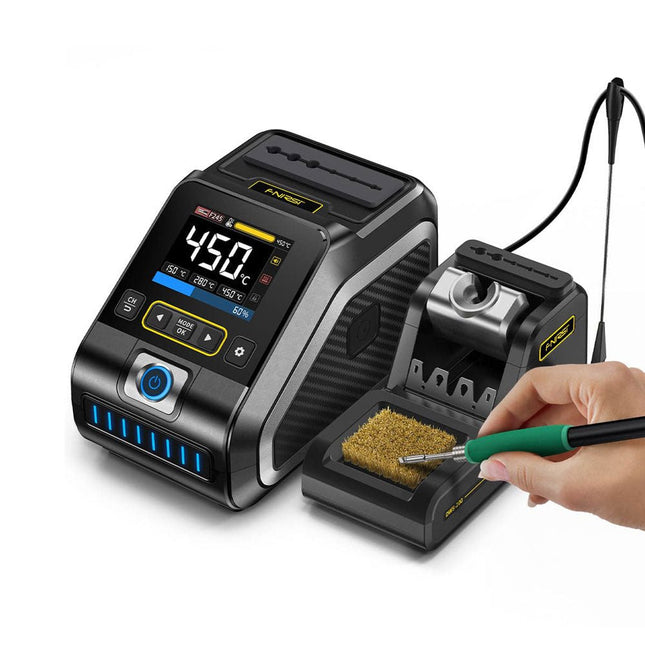
FNIRSI FNIRSI DWS-200 Intelligente Lötstation (mit F245-Lötgriff + 6 Lötspitzen)
Die FNIRSI DWS-200 ist eine leistungsstarke 200 W Smart-Lötstation, ideal für elektronische Lötanwendungen. Die Stromversorgung erfolgt über ein Schaltnetzteil, das mit einem weiten Spannungseingangsbereich von 100-240 V problemlos arbeitet. Die Station bietet einen einstellbaren Temperaturbereich von 100°C bis 450°C und ermöglicht einen einfachen Wechsel zwischen °C und °F. Zur Steigerung der Effizienz unterstützt es bis zu drei voreingestellte Temperaturwerte und kann zur Aktivierung des Standby-Modus an einen Lötkolbenständer angeschlossen werden. Die Station verfügt außerdem über einen dynamischen Temperaturkurvenmodus zur Datenüberwachung in Echtzeit, der eine präzise und konstante Leistung bei anspruchsvollen Lötaufgaben gewährleistet. Features Maximale Ausgangsleistung von 200 W für schnelles Aufheizen Breiter adaptiver Spannungseingang von 100-240 V 2,8" HD-Farb-TFT-Display mit intelligenter Steuerung Mehrere voreingestellte Gruppen, um schnell zwischen verschiedenen Einstellungen zu wechseln Unterstützt die Lötgrifftypen F245 und F210 und bietet so Flexibilität für verschiedene Lötanwendungen Echtzeit-Schlafmodus zur Verlängerung der Lebensdauer der Lötspitze Multimodus-Echtzeitüberwachung des Leistungs- und Temperaturstatus für mehr Sicherheit und Präzision Technische Daten Spitzenleistung 200 W (maximal) Temperaturbereich 100°C~450°C Display 2,8" TFT-HD-Farbbildschirm Heizzeit 1 Sekunde Schmelzzeit 3 Sekunden Eingangsspannung 100-240 V (Wechselstrom) Eingangssicherung 3 A Lötgrifftyp F245 Abmessungen (Station) 156 x 96 x 103 mm Gewicht (Station) 475 g Lieferumfang 1x FNIRSI DWS-200 Lötstation 1x Lötgriff F245 6x Lötspitzen (B, KU, K, C2, I, JS) 1x Verbindungskabel 2x Helfende Hände 1x Stromkabel (EU) Downloads Manual Firmware V1.3
€ 176,04
-

Elektor Publishing Arduino UNO Q and AI
Learn to Build Intelligent Embedded Systems Build smarter embedded systems with Arduino UNO Q. This book gives you the tools, knowledge, and confidence to turn ideas into intelligent, working solutions using the Arduino UNO Q platform. Discover how to build intelligent embedded systems with the Arduino UNO Q and AI. Unlock the full potential of the Arduino UNO Q, a next-generation platform that combines the real-time power of the STM32U585 microcontroller with the flexibility of a Qualcomm Dragonwing QRB2210 microprocessor. Learn how to rapidly prototype real-world applications using the Arduino IDE for low-level embedded control and Python in Arduino App Lab for high-level development. Build confidence through hands-on projects that guide you step by step from basic board features to complete working systems. Explore ready-to-use, AI based Arduino App Lab examples and see how they can jump-start your development and reduce time to deployment. Step into the world of Edge AI with a clear, practical introduction to Edge Impulse Studio—no prior AI experience required. Follow a complete, real-world workflow to create a Keyword Spotting AI application, covering data collection, model training, optimization, and on-device inference using the Edge Impulse Studio. Bridge the gap between embedded systems and machine learning and learn how to bring intelligence directly onto your hardware. Perfect for embedded engineers, educators, students, and makers looking to stay ahead in AI-enabled product development.
€ 34,95
Mitglieder: € 31,46
-
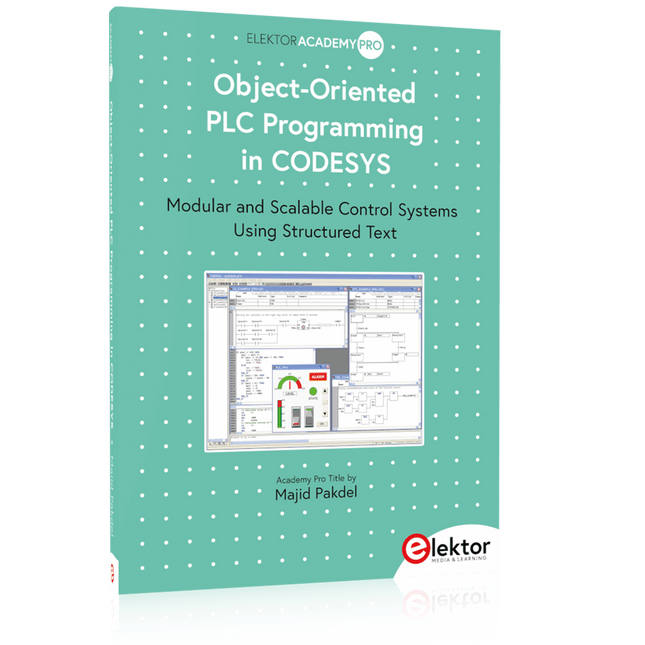
Elektor Publishing Object-Oriented PLC Programming in CODESYS
Modular and Scalable Control Systems Using Structured Text This book offers a structured and practical approach to modern PLC development using object-oriented principles. It is a guide for engineers, programmers, and students seeking to harness the power of object-oriented programming (OOP) in the context of industrial automation with PLCs. The content focuses on the CODESYS development environment and Structured Text (ST), both of which support modern programming techniques while maintaining compatibility with real-time automation requirements. Through step-by-step demos and instructional examples, it demonstrates how modular, reusable code can enhance development efficiency, simplify ongoing maintenance, and enable scalable and flexible control system architectures. Key topics include: Structured Text fundamentals: conditions, loops, arrays, and functions Object-oriented concepts: classes, methods, and inheritance Advanced techniques: polymorphism, interfaces, and access control Modular design with reusable components and structured program flow Implementation of finite state machines and scalable application design Built around instructional demos and clear explanations, this book helps readers develop maintainable and modern control software in the CODESYS environment using proven programming techniques.
€ 34,95
Mitglieder: € 31,46
-

Elektor Digital Initiation au langage CircuitPython et à la puce nRF52840 (E-book)
En moins de 100 lignes de code par projet avec les cartes Feather Sense et Clue Express d'Adafruit Le langage de programmation Python est apprécié par les pédagogues parce que sa syntaxe le rend facile à comprendre. Il s'est également imposé chez les informaticiens expérimentés. La société Adafruit a développé une version spéciale de Python pour l'embarquer sur les microcontrôleurs à 32 bits : CircuitPython. Ce livre permettra au lecteur de s'initier à la programmation en CircuitPython sur deux cartes : Feather BlueFruit Sense (également appelée Feather nRF52840 Sense) et CLUE nRF52840 Express. Chacune est animée par le SoC nRF52840 de NORDIC avec une architecture à 32 bits. Pour ce voyage dans le monde de la programmation embarquée, l'auteur sort du chemin classique, à savoir un cours complet sur la programmation orientée objet appliquée à ce langage. Il préfère emmener le lecteur directement sur le terrain avec des projets qui mettent en oeuvre les cartes et différents périphériques. Plus d'une quarantaine d'exemples et de montages permettent de découvrir la richesse de CircuitPython. Toutefois l'auteur s'est imposé une limite pour ne pas décourager les novices : le code de chaque projet ne dépasse jamais la centaine de lignes. Pour ce qui est du matériel, là aussi la simplicité domine : aucun programmateur, un simple PC suffit ; aucun soudage grâce au câblage sur platine d'essai. Les cartes d'extension FeatherWing à enficher sur la Feather nRF52840 Sense permettent de démultiplier ses fonctions : matrice de LED, enregistreur de données, écran à encre électronique, écran OLED, écran TFT, commande de moteurs, audio, relais… Toutes les étapes (assemblage des différents composants, installation des bibliothèques requises, programmation, tests…) sont expliquées en détail. Le code des différents exemples et projets est disponible sur Github. Le résultat de chaque projet est même présenté sur de courtes vidéos disponibles sur YouTube. À la fin de sa lecture, le nouveau Pythonien pourra facilement approfondir les notions abordées et donner vie à ses propres projets grâce aux outils qu'il aura essayés. Ce livre s'adresse aux lycéens et étudiants ainsi qu'à toute la communauté des makers. Chaîne YouTube de l'auteur : YouTube (Michaël Bottin)
€ 34,95
Mitglieder: € 31,46
-

JOY-iT JOY-iT PS1440-C-Pro Programmierbares Labornetzteil mit RS485 (1440 W)
Mit dem JOY-iT PS1440-C-Pro erhalten Sie ein programmierbares Labornetzteil, das Gleichspannungen von 0,01 bis 60 V und Gleichströme von 0,01 bis 24 A am Spannungsausgang liefert. Über das intuitive Bedienfeld können Sie bis zu 9 verschiedene Gleichspannungseinstellungen programmieren, speichern und abrufen. Außerdem lassen sich individuelle Schutz- und Begrenzungsfunktionen konfigurieren – beispielsweise ein Überspannungsschutz. Alle Einstellungen lassen sich bequem über die Tastatur und/oder den Drehregler anpassen und werden übersichtlich auf dem hochauflösenden 2,4"-Farbdisplay angezeigt. Für verbesserte Konnektivität verfügt das PS1440-C-Pro über eine RS485-Schnittstelle für robuste Kommunikation über große Entfernungen. Dadurch eignet es sich ideal für komplexe Setups, bei denen Signalstabilität, Störfestigkeit und zuverlässige Datenübertragung entscheidend sind. Der mitgelieferte Stecker gewährleistet eine sichere Verbindung und verbessert so die Zuverlässigkeit und Leistung Ihrer Laborausrüstung. Features Sofort einsetzbares Komplettgerät RS485-Schnittstelle Batterieladefunktion Werteingabe bequem über Keypad möglich Überstrom- & Überspannungsschutz einstellbar Integrierte RTC, NTC-Temperatursensor Beiliegende, detaillierte Dokumentation in Deutsch, Englisch & Französisch Technische Daten Eingangsspannung 230 V Ausgangsspannung 0-60 V Ausgangsstrom 0-24 A Ausgangsleistung 0-1440 W Genauigkeit der Eingangsspannung ±1% + 5 Ziffern Genauigkeit der Ausgangsspannung ±0,3% + 3 Ziffern Genauigkeit des Ausgangsstroms ±0,5% + 5 Ziffern Batteriespannung ±0,5% + 3 Ziffern Auflösung der Eingangsspannungsmessung 0,01 V Auflösung der Ausgangsspannungsmessung 0,01 V Aktuelle Messauflösung 0,01 V Auflösung der Batteriespannungsmessung 0,01 V Reaktionszeit im Konstantspannungsmodus 2 ms bei 0,1-5 A Lastregelung im Konstantspannungsmodus ±0,1% + 2 Ziffern Lastregelung im Konstantstrommodus ±0,1% + 3 Ziffern Messbereich elektrische Ladung 0-9999,99 Ah Messbereichsenergie 0-9999,99 Wh Statistische Fehler bei der elektrischen Ladung & Energie ±2% Ausgangswelligkeit 100 mV VPP bei 12 V150 mV VPP bei 24 V Sensortemperatur-Erkennungsbereich −10~+100 °C Genauigkeit der Sensortemperaturerkennung ±3°C Arbeitsmodus Abwärtsbetrieb Bildschirmhelligkeitseinstellung Stufe 0-5, insgesamt 6 Stufen Zulässige Arbeitstemperatur −10~40°C Abmessungen 170 x 93 x 340 mm Lieferumfang JOY-iT PS1440-C Netzteil 2-poliger Stecker für RS485-Schnittstelle Netzkabel Handbuch Downloads Datasheet MODBUS Protocol PC Software Driver for Windows
€ 499,00
Mitglieder: € 449,10


