
Suchergebnisse für "portable or smart or wifi or weather or station"
-

Elektor Juli/Augustus 2026 (NL)
Elektor GREEN en GOLD leden kunnen deze uitgave hier downloaden. Nog geen lid? Klik hier om een lidmaatschap af te sluiten. MultiRF ontwikkelboardEen platform voor het evalueren van draadloze protocollen op korte en lange afstand Elektor wordt 65Baanbrekend op het gebied van elektronica sinds 1961 Persoonsdetectie via wifi op een ESP32Wanneer uw router een bewegingssensor wordt Draadloze weegschalenVier kleine weegschalen maken een grote weegschaal Walter, de compacte IoT-moduleESP32-S3 SoC, LTE-M/NB-IoT 5G-modem en GNSS-ontvanger 3- en 4-draads RTD-sensorconditioneringMet volledige afstelling en kabelcompensatie 3-in-1 2-kanaals oscilloscoop/generator/multimeterEen review van de Fnirsi 2D15P electronica Fast Forward 2026 nodigt start-ups en partners uit de industrie uit EcologgingEen modulair IoT-milieustation voor onderzoek in het veld Draadloze connectiviteit in medische toepassingenAltijd op de hoogte met Bluetooth LE AudiotronicaBromonderdrukking De efficiëntie in de landbouw verhogen met AI-modellen en sensorenDe landbouwproductiviteit verhogen OPC UA, een overzichtPlatform-onafhankelijke gegevensuitwisseling Redoxmeter Instrumentation amplifier voor fysica- en techniekexperimenten Actieve differentiële audiofiltersVoor professionele cross-overs en meer Communityperspectieven van Elektor op IoT & sensoren Telegramgestuurde interface module voor een boilerEen oplossing op basis van een ESP32 en Arduino software 2026: An AI OdysseyWat is er gebeurd met fuzzy logic? Err-lectronics Alarmsignaalinjector en bruut geweldHulpmiddelen om kabelbreuken op te sporen
€ 15,95
-

Elektor Digital Elektor July/August 2022 (PDF)
Measuring Does Not Have to be Expensive Low-Cost Audio TesterUsing PC-Based Software and a USB Audio Interface AC Grid Frequency MeterMonitor Mains Frequency and Voltage A Modest Inductance MeterAn Affordable Solution for Your Workbench Acoustic Wave HoveringA Look at the Makerfabs Acoustic Levitation Kit Starting Out in ElectronicsRectifiers E-FFWD: Looking Ahead Again! Get Started With Your OscilloscopeFind Your Way Through the Knobs and Buttons Raspberry Pi Pico Makes an MSF-SDRDecode a Time Signal with a Pi Pico SDR Moisture Sensors for Watering SystemsAutomatic Watering Disruption in Test and Measurement EquipmentInnovation from the Smaller Players Infographics 7-8/2022 Inspiration, That’s What It’s All AboutInterview with Entrepreneur Walter Arkesteijn, InnoFaith Beauty Sciences Minimizing EMC Interference from Storage Chokes GUIs with Python (Part 5)Tic-Tac-Toe Reed RelaysPeculiar Parts, the series Simple Analog ESR Meter With Moving-Coil Meter Precision Sigfox CO2 Traffic LightNo Wi-Fi Network Needed! Women in Tech“It's All About Merit Until Merit Has Tits” Low-Budget Tablet Oscilloscope ADS1013DGood Value for Money? Smart Plug TeardownWhich Ones Are Hacker-Friendly? Skin Impedance and Skin CapacitanceSmall Experiments From Life’s ExperienceNo Local Business Pokit Meter ReviewA Swiss army knife of test gear HexadokuThe Original Elektorized Sudoku
€ 7,50
-
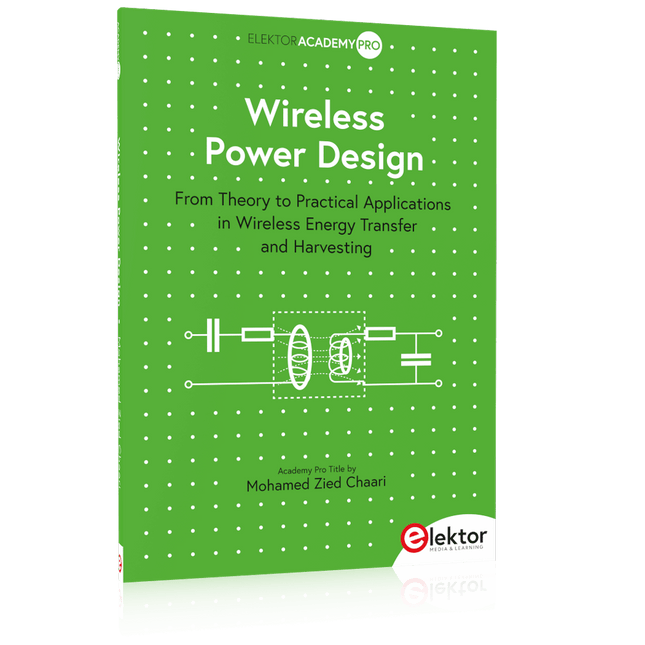
Elektor Publishing Wireless Power Design
From Theory to Practical Applications in Wireless Energy Transfer and Harvesting Wireless power transmission has gained significant global interest, particularly with the rise of electric vehicles and the Internet of Things (IoT). It’s a technology that allows the transfer of electricity without physical connections, offering solutions for everything from powering small devices over short distances to long-range energy transmission for more complex systems. Wireless Power Design provides a balanced mix of theoretical knowledge and practical insights, helping you explore the potential of wireless energy transfer and harvesting technologies. The book presents a series of hands-on projects that cover various aspects of wireless power systems, each accompanied by detailed explanations and parameter listings. The following five projects guide you through key areas of wireless power: Project 1: Wireless Powering of Advanced IoT Devices Project 2: Wireless Powered Devices on the Frontline – The Future and Challenges Project 3: Wireless Powering of Devices Using Inductive Technology Project 4: Wireless Power Transmission for IoT Devices Project 5: Charging Robot Crawler Inside the Pipeline These projects explore different aspects of wireless power, from inductive charging to wireless energy transmission, offering practical solutions for real-world applications. The book includes projects that use simulation tools like CST Microwave Studio and Keysight ADS for design and analysis, with a focus on practical design considerations and real-world implementation techniques.
€ 39,95
Mitglieder: € 35,96
-

Elektor Digital Elektor May/June 2021 (PDF) EN
Elektor Magazine DE Mai/Juni 2021 (PDF)
€ 7,50
-

Elektor September/Oktober 2025 (NL)
Elektor GREEN en GOLD leden kunnen deze uitgave hier downloaden. Nog geen lid? Klik hier om een lidmaatschap af te sluiten. ESP32 Audio Transceiver Board (Deel 2)Draadloze audio-overdracht Inductieve AM-zenderGebruikt Pico's PIO in een Arduino-sketch Navigeren door draadloze protocollen navigerenEen technische gids Satelliettracking met behulp van LoRaHet TinyGS-netwerk brengt gegevens uit de ruimte naar de aarde. 4G-Compatibele SMS afstandsbedieningBedien je apparatuur op afstand Hogesnelheids-probeIngangen met hoge impedantie voor signalen tot 200 MHz Uit het leven gegrepenKafka KrakenSDR Prestatietests met de RP2350Is een upgrade van Raspberry Pi Pico 1 naar versie 2 de moeite waard? Contactloze E-veldmetingen (2)Een laservibrometer voor het beoordelen van de trillingen van het membraan Kristallen en oscillatorenVerbetering van de kristalnauwkeurigheid door gerichte keuze van condensatoren Alle begin......gaat audio! Zelf firmware coderen voor embedded projecten SPECTRAN® V6 MobileModulaire, configureerbare realtime-spectrumanalyzer voor betrouwbare metingen over alle frequentiebereiken De toekomst van AI wordt gesmeed in siliciumEen interview met Anastasiia Nosova Autonome Sensor-Node v2.0 (Systeemarchitectuur)Zonne-energieplatform met geïntegreerde GPS, LoRaWAN en meer Precieze positioneringBluetooth channel sounding getest Testgestuurd ontwikkelen bij het schrijven van firmware Telefoon gestuurde modelautoWi-Fi + ESP32 + Smartphone = Afstandsbediening 2025: Een AI-odysseeAI-redeneermodellen: De gedachtegang-revolutie Zonne-laadregelaar met MPP-tracking (3)Software en Inbedrijfstelling Raspberry Pi Zero Web Streaming CameraDe ZeroTier VPN gebruiken Beste soldeerder van de Beneluxvakmanschap in de schijnwerpers Seminaroverzicht Electronics & ApplicationsLeer, ontdek en netwerk op E&A 2025 Eurocircuits at E&A 2025 E&A gadget 2025: racen over de beursvloer met slimme printplaat op wielenVijf vragen aan Casper van Doorne, ontwerper van de beursgadget Beursgadget E&A bekendontwerp en bestuur je eigen raceauto Vakbeurs E&A is het elektronicaparadijs van de Benelux“Techneuten blijven kinderen” Rohde & SchwarzPioneering Innovation in Test & Measurement Diederik Jekel opent Electronics & Applications
€ 15,95
-

Elektor Digital Wireless Power Design (E-book)
From Theory to Practical Applications in Wireless Energy Transfer and Harvesting Wireless power transmission has gained significant global interest, particularly with the rise of electric vehicles and the Internet of Things (IoT). It’s a technology that allows the transfer of electricity without physical connections, offering solutions for everything from powering small devices over short distances to long-range energy transmission for more complex systems. Wireless Power Design provides a balanced mix of theoretical knowledge and practical insights, helping you explore the potential of wireless energy transfer and harvesting technologies. The book presents a series of hands-on projects that cover various aspects of wireless power systems, each accompanied by detailed explanations and parameter listings. The following five projects guide you through key areas of wireless power: Project 1: Wireless Powering of Advanced IoT Devices Project 2: Wireless Powered Devices on the Frontline – The Future and Challenges Project 3: Wireless Powering of Devices Using Inductive Technology Project 4: Wireless Power Transmission for IoT Devices Project 5: Charging Robot Crawler Inside the Pipeline These projects explore different aspects of wireless power, from inductive charging to wireless energy transmission, offering practical solutions for real-world applications. The book includes projects that use simulation tools like CST Microwave Studio and Keysight ADS for design and analysis, with a focus on practical design considerations and real-world implementation techniques.
€ 32,95
Mitglieder: € 29,66
-

Elektor Digital Elektor November/Dezember 2021 (PDF)
TRAITEMENT D'IMAGES AVEC LE KIT JETSON NANO DE NVIDIA2e partie : reconnaissance d'imagesELEKTOR JUMPSTARTER – DU NOUVEAUCampagnes à venirTRACEUR GPS À CODE SOURCE OUVERTTraccar cartographie les déplacements de véhicules, sans recours à un serveur tiers du nuageTESTEUR MULTIFONCTION LCR-T7 DE JOY-ITTest de semi-conducteurs passifs, discrets et de télécommandes IRSYNTHÉTISEUR DE BRUITDu bruit à la musique avec le PRBSynth1DÉMARRER EN ÉLECTRONIQUE…Easier than Imagined! ... Continuing with the CoilVOYAGE DANS LES RÉSEAUX NEURONAUX (2E PARTIE)Les neurones logiquesPROBLÈMES DE SÉCURITÉ ? COMBATTEZ LE FEU PAR LE FEU !Extension à mémoire analogique, protégée par ampoule de flash, pour la boîte à témoin d'effractionKIT DU LCR-MÈTRE 2 MHZ D'ELEKTORBALISES BLUETOOTH : LA PRATIQUEGéolocalisation intra murosC PROGRAMMING ON RASPBERRY PIExtrait : communiquer par Wi-FiTEST DE PRÉCONFORMITÉ CEM POUR UN PROJET ALIMENTÉ EN COURANT CONTINUPartie 2 : le matériel et son utilisationPROPELLER 2 DE PARALLAX (5)La fonction de « broche intelligente »MODBUS SANS FIL (PARTIE 1)Matériel et programmationJUNIOR COMPUTEREn forme après 40 ans de sommeilCONSTRUIRE SON PROPRE ÉTALONNEUR DE HAUTE PRÉCISION−10 V à +10 V, 0 à 40 mA, 0,001 %ARDUINO NANO RP2040 CONNECT EN DÉTAILRaspberry Pi RP2040 + Wi-Fi + BluetoothLE CORPS PHYSIQUE DE L'INTELLIGENCE ARTIFICIELLEPROJET 2.0corrections, mises à jour et courriers des lecteursCRÉATION D'INTERFACES GRAPHIQUES EN PYTHON AVEC GUIZEROInstallez la bibliothèque Python guizero et créez vos propres interfaces graphiques.KIT DE MESURE DU CO2 POUR SALLE DE CLASSEMontage à base d'ESP8266, conçu par l'Université des Sciences Appliquées d'Aix-la-ChapelleMK484, RADIORÉTRO PO/GO...Toujours le plaisir de construire !60 ANS D'ELEKTORQue la lumière soit !HEXADOKUThe Original Elektorized Sudoku
€ 10,95
-
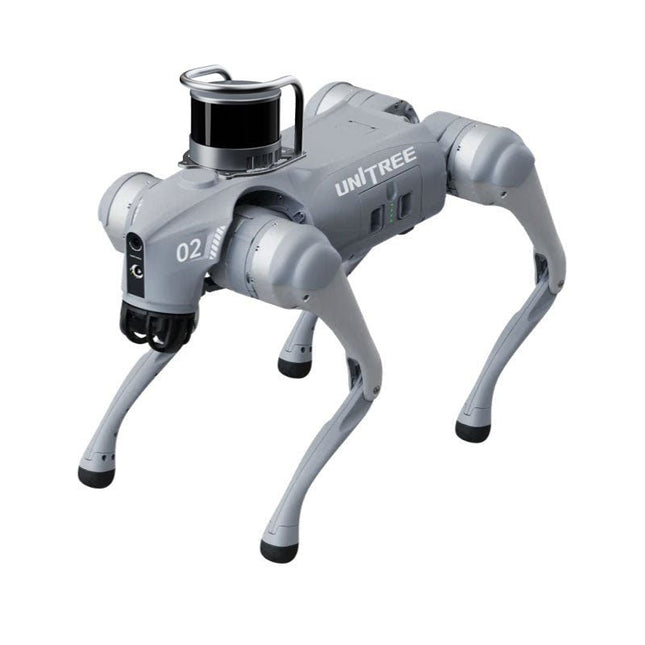
Unitree Unitree Go2 Edu Plus 3D LiDAR Vierbeiniger Roboter
Vorübergehende Verzögerung bei der Lieferung von Unitree-Robotern Wie viele andere Lieferanten erleben auch wir derzeit Verzögerungen bei der Lieferung von Unitree-Robotern. Eine Sendung unseres Lieferanten steckt derzeit im Zoll fest, was leider zu späteren Lieferungen bereits aufgegebener Bestellungen führt. Wir arbeiten aktiv mit unserem Lieferanten daran, dieses Problem zu lösen, und erwarten in Kürze mehr Klarheit. Leider können wir derzeit jedoch keine festen Zusagen machen. Eine neue Lieferung ist bereits auf dem Weg, wird aber noch etwas Zeit in Anspruch nehmen. Da auch andere Lieferanten mit denselben Herausforderungen konfrontiert sind, ist ein Wechsel zu einem anderen Anbieter derzeit keine schnellere Lösung. Unsere oberste Priorität ist die Lieferung der bestehenden Bestellungen. Falls Sie Fragen haben oder Ihre Bestellung aktualisieren möchten, zögern Sie bitte nicht, unseren Kundenservice zu kontaktieren. Wir halten Sie über weitere Entwicklungen auf dem Laufenden. Die Unitree Go2-Serie besteht aus vierbeinigen Robotern für die Forschung und Entwicklung. Entwicklung autonomer Systeme in den Bereichen Mensch-Roboter-Interaktion (HRI), SLAM & Transport. Aufgrund der vier Beine und des 12DOF kann dieser Roboter eine Vielzahl unterschiedlicher Gelände bewältigen. Der Go2 verfügt über einen perfektionierten Antrieb & Power-Management-System, das eine Geschwindigkeit (je nach Ausführung) von bis zu 3,7 m/s oder 11,88 km/h bei einer Betriebszeit von bis zu 4 Stunden ermöglicht. Darüber hinaus verfügen die Motoren über ein Drehmoment von 45 N.m am Körper/Oberschenkel und an den Knien, was auch Sprünge oder Backflips ermöglicht. Features Super-Erkennungssystem: 4D LIDAR L1 Maximale Laufgeschwindigkeit: ca. 5 m/s Spitzengelenkdrehmoment: ca. 45 Nm Wireless-Modul: WiFi 6/Bluetooth/4G Extrem lange Akkulaufzeit: ca. 2-4 Stunden Intelligentes Side-Follow-System: ISS 2.0 Technische Daten Tracking-Modul: Ferngesteuertes oder automatisches Tracking Frontkamera: Bildübertragungsauflösung 1280 x 720, Sichtfeld 120°, Ultraweitwinkelobjektiv sorgt für satte Klarheit Frontlampe: Erhellt den Weg vor Ihnen hell 4D LiDAR L1: 360°x90° omnidirektionales Ultraweitwinkel-Scannen ermöglicht automatisches Ausweichen mit kleinem toten Winkel und stabilen Betrieb 12 Kniegelenkmotoren: Stark und kraftvoll, schön und einfach, Brandy neues visuelles Erlebnis Intercom-Mikrofon: Effektive Kommunikation ohne Szenario-Einschränkungen Selbstaufrollender Gurt: Einfaches Tragen und Laden von Gegenständen Stabiler, leistungsfähiger mit fortschrittlichen Geräten: 3D LiDAR, 4G-ESIM-Karte, WiFi 6 mit Dualband, Bluetooth 5.2 für stabile Verbindung und Fernsteuerung Leistungsstarker Rechenkern: Motion Controller, Hochleistungs-ARM-Prozessor, verbesserter Al-Algorithmus-Prozessor, externes ORIN NX/NANO Intelligenter Akku: Standard 8000-mAh-Akku, langlebiger 15000-mAh-Akku, Schutz vor Übertemperatur, Überladung und Kurzschluss. Lautsprecher für die Musikwiedergabe: Hören Sie Musik nach Lust und Laune Unitree Go2-Varianten Der Go2 überzeugt nicht nur durch seine technischen Fähigkeiten, sondern auch durch ein modernes und schlankes Design, das ihm einen futuristischen Look verleiht und ihn zu einem echten Hingucker macht. Der Go2 Air ist speziell für Demos und Präsentationen konzipiert. Mit seinen Grundmerkmalen bietet es eine solide Grundlage, um die Bewegungsfähigkeiten und Funktionalität eines vierbeinigen Roboters zu demonstrieren. Wichtig: Der Go2 Air wird ohne Controller geliefert. Dies kann optional erworben werden. Mit einer leistungsstarken 8-Core-Hochleistungs-CPU bieten Pro und Edu beeindruckende Rechenleistung, die für komplexe Aufgaben und anspruchsvolle Berechnungen erforderlich ist. Dies ermöglicht eine schnellere und effizientere Datenverarbeitung und macht den Pro und Edu zu einem zuverlässigen Partner für Ihre Projekte. Ab der Edu-Version ist der Go2 programmierbar und eröffnet endlose Möglichkeiten für die Entwicklung und Erforschung eigener Robotikanwendungen. Der Go2 ist außerdem in der Lage, eine Stufenhöhe von bis zu 14 cm zu bewältigen. Dies macht es zu einem idealen Werkzeug für Forschung, Ausbildung und den Einstieg in die Welt der Robotik. Der Go2 Edu wird mit einer Fernbedienung geliefert, die Ihnen eine einfache und intuitive Steuerung ermöglicht. Außerdem erhalten Sie eine Dockingstation mit beeindruckender Rechenleistung von 100 TOPS, die mit leistungsstarken KI-Algorithmen ausgestattet ist und Ihnen technischen Support bietet. Go2 Edu ist mit einem leistungsstarken 15000 mAh-Akku ausgestattet, der ihm eine beeindruckende Laufzeit von bis zu 4 Stunden ermöglicht. Diese lange Betriebszeit ermöglicht es dem Roboter, längere Erkundungsmissionen durchzuführen und anspruchsvolle Aufgaben zu erledigen. Go2 Edu Plus 3D LiDAR wird mit einem leistungsstarken Hesai XT16 3D LiDAR ausgeliefert. Dieser LiDAR-Sensor ermöglicht dem Roboter eine präzise dreidimensionale Wahrnehmung seiner Umgebung und ermöglicht so eine reibungslose Navigation und intelligente Hindernisvermeidung. Modellvergleich Air Pro Edu/Edu Plus Abmessungen (stehend) 70 x 31 x 40 cm 70 x 31 x 40 cm 70 x 31 x 40 cm Abmessungen (hockend) 76 x 31 x 20 cm 76 x 31 x 20 cm 76 x 31 x 20 cm Material Aluminiumlegierung + hochfester Kunststoff Aluminiumlegierung + hochfester Kunststoff Aluminiumlegierung + hochfester Kunststoff Gewicht (mit Akku) ca. 15 kg ca. 15 kg ca. 15 kg Spannung 28~33,6 V 28~33,6 V 28~33,6 V Spitzenleistung ca. 3000 W ca. 3000 W ca. 3000 W Nutzlast ≈7 kg (MAX ~ 10 kg) ≈8 kg (MAX ~ 10 kg) ≈8 kg (MAX ~ 12 kg) Geschwindigkeit 0~2.5 m/s 0~3.5 m/s 0~3.7 m/s (MAX ~ 5 m/s) Max. Steigfallhöhe ca. 15 cm ca. 16 cm ca. 16 cm Max. Steigwinkel 30° 40° 40° Basisrechenleistung N/A 8-Kern-Hochleistungs-CPU 8-Kern-Hochleistungs-CPU Aluminium-Kniegelenkmotor 12 Satz 12 Satz 12 Satz Gelenkinterne Schaltung (Knie) ✓ ✓ ✓ Joint Heat Pipe Kühler ✓ ✓ ✓ Bewegungsbereich Körper: −48~48° Körper: −48~48° Körper: −48~48° Oberschenkel: −200°~90° Oberschenkel: −200°~90° Oberschenkel: −200°~90° Schaft: −156°~−48° Schaft: −156°~−48° Schaft: −156°~−48° Max. Drehmoment N/A ca. 45 N.m ca. 45 N.m Super-Weitwinkel 3D-LiDAR ✓ ✓ ✓ Wireless Vektorpositionierungs-Tracking-Modul N/A ✓ ✓ HD-Weitwinkelkamera ✓ ✓ ✓ Fußende-Kraftsensor N/A N/A ✓ Grundlegende Aktion ✓ ✓ ✓ Auto-Skalierband N/A ✓ N/A Aktualisiertes intelligentes OTA ✓ ✓ ✓ RTT 2.0 Bildübertragung ✓ ✓ ✓ App Basic Fernsteuerung ✓ ✓ ✓ App-Daten anzeigen ✓ ✓ ✓ App Grafisches Programm ✓ ✓ ✓ Frontlampe (3 W) ✓ ✓ ✓ WiFi 6 mit Dualband ✓ ✓ ✓ Bluetooth 5.2/4.2/2.1 ✓ ✓ ✓ 4G-Modul N/A CN/GB CN/GB Sprachunktion N/A ✓ ✓ Musikwiedergabe N/A ✓ ✓ ISS 2.0 Intelligentes Side-Follow-System N/A ✓ ✓ Intelligente Erkennung und Vermeidung ✓ ✓ ✓ Sekundäre Entwicklung N/A N/A ✓ Manuelle Steuerung Optional Optional ✓ Modul mit hoher Rechenleistung N/A N/A Edu: 40 TOPS Rechenleistung Edu Plus: 100 TOPS Rechenleistung NVIDIA Jetson Orin (optional) Intelligente Batterie Standard (8000 mAh) Standard (8000 mAh) Lange Lebensdauer (15000 mAh) Akkulaufzeit 1-2 Stunden 1-2 Stunden 2-4 Stunden Ladegerät Standard (33,6 V, 3,5 A) Standard (33,6 V, 3,5 A) Schnellladung (33,6 V, 9 A) Lieferumgang 1x Unitree Go2 Edu Plus 1x Hesai XT16 3D LiDAR 1x Unitree Go2 Fernbedienung 1x Unitree Go2 Akku (15000 mAh) 1x Unitree Dockingstation mit 100 TOPS Rechenleistung Downloads Documentation iOS/Android apps GitHub
€ 20.599,00
Bestpreis
-
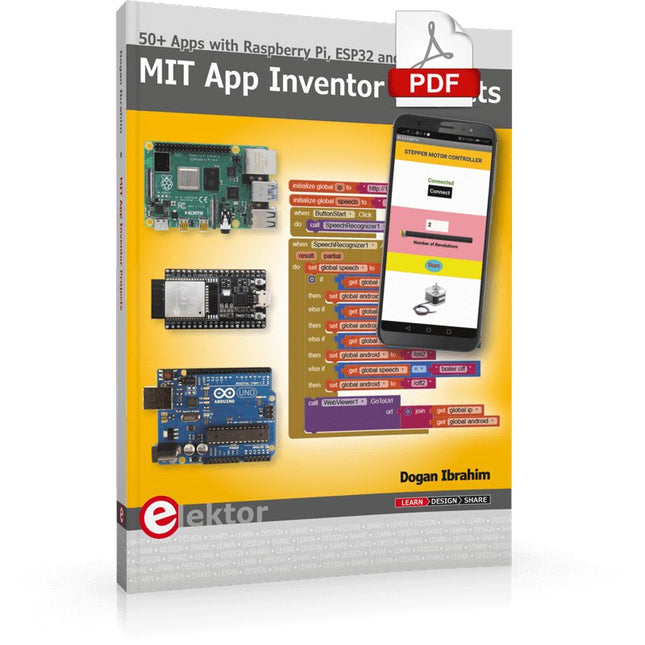
Elektor Digital MIT App Inventor Projects (E-book)
50+ Android Apps with Raspberry Pi, ESP32 and Arduino This book is about developing apps for Android compatible mobile devices using the MIT App Inventor online development environment. MIT App Inventor projects can be in either standalone mode or use an external processor. In standalone mode, the developed application runs only on the mobile device (e.g. Android). In external processor-based applications, the mobile device communicates with an external microcontroller-based processor, such as Raspberry Pi, Arduino, ESP8266, ESP32, etc. In this book, many tested and fully working projects are given both in standalone mode and using an external processor. Full design steps, block programs, circuit diagrams, QR codes and full program listings are given for all projects. The projects developed in this book include: Using the text-to-speech component Intonating a received SMS message Sending SMS messages Making telephone calls using a contacts list Using the GPS and Pin-pointing our location on a map Speech recognition and speech translation to another language Controlling multiple relays by speech commands Projects for the Raspberry Pi, ESP32 and Arduino using Bluetooth and Wi-Fi MIT APP Inventor and Node-RED projects for the Raspberry Pi The book is unique in that it is currently the only book that teaches how to develop projects using Wi-Fi and Node-RED with MIT App Inventor. The book is aimed at students, hobbyists, and anyone interested in developing apps for mobile devices. All projects presented in this book have been developed using the MIT App Inventor visual programming language. There is no need to write any text-based programs. All projects are compatible with Android-based mobile devices. Full program listings for all projects as well as detailed program descriptions are given in the book. Users should be able to use the projects as they are presented, modifying them to suit their own needs.
€ 32,95
Mitglieder: € 29,66
-

Elektor Digital Elektor September/October 2022 (PDF)
Elektor GREEN and GOLD members can download their digital edition here. Not a member yet? Click here. electronica fast forward 2022 Start- & Scale-Up AwardsPreparations Speeding Up! Bluetooth Low Energy with ESP32-C3 and ESP32You Don’t Always Need to Choose Wi-Fi! Bluetooth Low Energy SnifferHacking a makerdiary nRF52840 MDK USB Dongle Magic RGB LED CubeHardware Design Around an RP2040 Auto On/Off for Solder Paste Compressor Elektor Video ContentLivestreams, Webinars, and Courses for Engineers and Pro Makers Bicycle ElectrificationHands-On with an E-Bike Retrofit Kit Starting Out in ElectronicsMultiplying Voltages From Life’s ExperienceSidelines Teensy 4.0Why Is This Board So Fast? Audio Power Amplifier Simulation with TINAThe Try-Before-You-Build Approach Develop and Operate Your LoRaWAN IoT NodesSample Chapter: Dragino LHT65, LDS01, and LDS02 LoRaWAN Modules Err-lectronicsCorrections, Updates and Readers’ Letters 5G Just for MeGaining Complete Control of 5G Deployments with Private Cellular Networks Infographics 7-8/2022 How Does My Device Learn to Transmit?Applications with Wi-Fi Interfaces Smartphones are the Heart of the IoT Audio Spectrum Analyzer with DekatronsA New Way to Use Vintage Tubes Sending Data to TelegramGet It Done with an ESP32 and a Few Parts A Fliege Notch Filter for Audio MeasurementsMake Better Measurements with a Notch Filter CO2 Meter TeardownIs It Hackable for Your Projects? PUT-ting It All TogetherThe Programmable Unijunction Transistor Explained Round Touchscreen for Raspberry PiHyperPixel 2.1 Round from Pimoroni Remote Sensing with Connection Loss DetectionUsing nRF24L01+ Modules Digital FM Receiver with Arduino and TEA5767Stayed Tuned with an Arduino Nano Changing an OLED Interface from SPI to I²C HomeLab ToursA Hobby Does Not Retire A Decade of Ethics in ElectronicsTessel Renzenbrink Reflects on the Digital Society and More HexadokuThe Original Elektorized Sudoku
€ 7,50
-

Elektor Digital Elektor Juillet/Août 2025 (PDF) FR
Le téléchargement intégral de ce numéro est disponible pour nos membres GOLD et GREEN sur le site Elektor Magazine ! Pas encore membre ? Cliquez ici. tableau de bord OBD2Des cadrans anciens aux données en temps réel OBD2 : ajoutez un compte-tours et un indicateur de changement de vitesse à votre voitureRétro, mais extrêmement utile capteurs de vision et LiDAR pour la robotique Sensor+Test 2025 et PCIM 2025 mesures sans contact du champ électrique (1)Membrane vibrante pour mesurer des tensions continues ou des champs électriques statiques détecteur de courrier sans filCapteurs optiques, radars… quelques options à explorer Elektor Mini-WheelieUn robot auto-équilibré cellules solairesDrôles de composants, la série premiers pas avec un capteur radar moderneUn capteur précis qui ne passe pas inaperçu sur le vifUsine de papier CybersécuritéDes temps difficiles pour les hackers Infographie : IdO et capteurs le Bluetooth 6.0 pour des applications de télémétrie amélioréesCette nouvelle version offre des fonctions de localisation améliorées découvrez la communication sans fil avec BeagleY-AI Projet 2.0Corrections, mises à jour et courrier des lecteurs démarrer en électronique……Conclusion sur les ampli-op un puissant assistant de codage de l'IAAccélérez votre développement avec Continue et Visual Studio Code contrôleur de charge solaire avec MPPT (2)Le circuit détecteur d'obstacles à ultrasonsUn projet simple pour aider les malvoyants une odyssée de l'IABilan du premier semestre synthétiseur MIDI autonome Raspberry Pi (3)plus intelligent avec une interface utilisateur Meshtastic : un projet de démoUn réseau intelligent de noeuds LoRa générateur analogique de fréquences audioGénérateur de signaux sinusoïdaux de haute qualité à fréquence réglable
€ 10,95
-

Elektor Digital Elektor Juli/Augustus 2023 PDF (NL)
Elektor GREEN en GOLD leden kunnen deze uitgave hier downloaden.Nog geen lid? Klik hier om een lidmaatschap af te sluiten. Kiesschijftelefoon als afstandsbedieningvoor licht kies 1; voor koffie kies 2 GPS-gebaseerde snelheidsmeternooit meer bekeuringen RGB-stroboscoop met Arduinokleurige toepassing van een nuttig instrument Draadloze nooddrukknopmeer veiligheid met LoRa Alle begin......volgt de emitter Vrij te kiezen onafhankelijke hystereseniveaus voor comparatorenmet simulaties, spreadsheets en algebra Impedantie-analyzer op basis van een ESP32simpel, weinig onderdelen en goedkoop! Oost West Lab Bestzelfbouw moet gestimuleerd! Het MCCAB Arduino Nano Training Boardalle hardware voor de “Microcontrollers Hands-On Course” Uit het leven gegrepenmodern luddisme Sensor-ABC: de DS18B20 temperatuursensoraansluiting op de 1-Wire bus Gaan Matter en Thread het Smart Home redden?nieuwe standaarden om het slimme huis te vereenvoudigen Een kwestie van samenwerkingontwikkelen met het Thing Plus Matter Board en Simplicity Studio Elektor IIIIinfographicIoT en sensoren Matter, ExpressLink, Rainmaker – waar hebben we het over?vraaggesprek met Amey Inamdar van Espressif De juiste keuze van microcontroller-ontwikkelkitsvoor IoT- en IIoT-toepassingen Condensatoren gedragen zich niet altijd capacitief! Een NTP-klok met CircuitPythonwaarom zou je deze programmeertaal gebruiken? Bouw een cool IoT-display'met de Phambili Newt De doppler-bewegingssensor HB100theorie en praktijk Een gids voor puristisch programmeren (deel 1)voor STM32 en andere controllers Siglent SDM3045X-multimeter Microprocessoren voor embedded systemenvreemde onderdelen Microcontroller-documentatie verklaarddeel 3: blokschema’s en meer Low-power LoRa-weerstationbouw zelf een weerstation met een groot bereik Transverter voor de 70cm-band Klimaat aan ingenieurssnelheid is geboden! Hexadoku
€ 9,95


