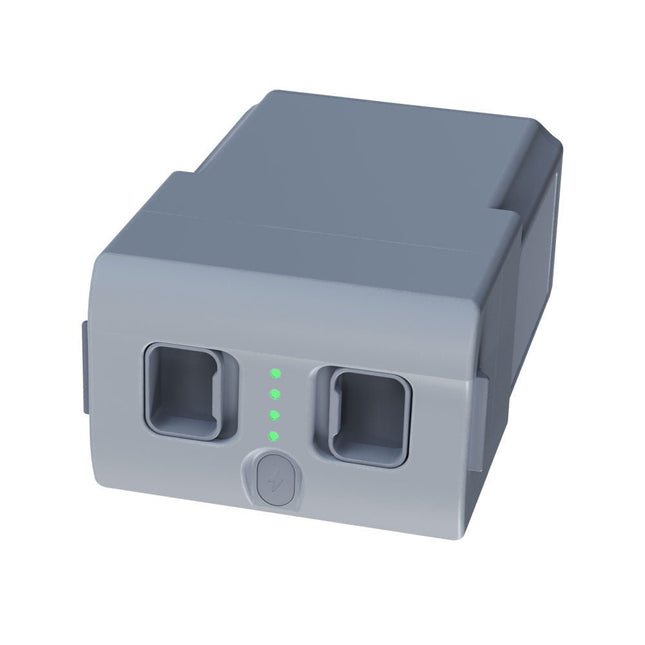
Mit einer Kapazität von 15.000 mAh stellt der Unitree Go2-Akku eine robuste Stromquelle dar, mit der Ihr Roboter Aufgaben problemlos erledigen kann. Ob für komplexe Erkundungen, Forschungsprojekte oder lustige Ausflüge, dieser leistungsstarke Akku liefert die Energie, die Ihr Roboter braucht.
Die Laufzeit des Unitree Go2-Akkus variiert je nach Anwendung und Nutzung. Abhängig von den eingesetzten Funktionen und Aktivitäten kann der Akku eine Betriebsdauer von 2 bis 4 Stunden bieten. Diese Flexibilität ermöglicht es Ihnen, den Roboter nach Bedarf anzupassen und so längere Erkundungsmissionen oder umfangreichere Projekte zu ermöglichen.
Der Unitree Go2-Akku ist ein zuverlässiger Begleiter für Ihre Robotik-Abenteuer. Mit seiner beeindruckenden Kapazität und anpassbaren Laufzeit sorgt es dafür, dass Ihr Roboter kraftvoll und ausdauernd arbeitet, ohne dass er häufig aufgeladen werden muss.
Ganz gleich, ob Sie den Unitree Go2-Akku als Ersatz oder Upgrade für Ihren Roboter benötigen, diese leistungsstarke Energiespeicherlösung bietet die perfekte Balance aus Leistung und Zuverlässigkeit.
Technische Daten
Nennspannung: DC 28,8 V
Begrenzte Ladespannung: DC 33,6 V
Ladestrom: 9 A
Nennkapazität: 15.000 mAh, 432 Wh
Standard: IS 16046 (Teil 2) / IEC 62133-2
Selbst entwickeltes Batteriemanagementsystem (BMS)
Abmessungen: 120 x 80 x 182 mm
Features:
Stromanzeige
Selbstentladungsschutz von Batteriespeichern
Gleichgewichtsladungsschutz
Überladeschutz
Entladeschutz
Kurzschlussschutz
Schutz der Batterieladeerkennung
Über 50 Schaltungen und Projekte
Sirène im amerikanischen Stil
Zwei rotierende Codes auf einem einzigen analogen Eingang
Bauen Sie mit Arduino einen 220-V-CA-Zähler
Stromquelle für LED
Vier Kontakte mit nur einer Brosche erkennen
Kleiner Ein-/Ausschalter mit Batterieschutz
DIY-Desinfektionsmittelspender für zu Hause
Eine einfache elektronische Orgel
Ultrasimple Stereo-Verstärker
Durch den Ton aktivierter Schalter für Verstärker
Symmetrischer/unsymmetrischer Konverter
Externer Filter für elektrisches Netzwerk
Bequeme Fernbedienung
Direkt-Box für Smartphone
Amüsieren Sie sich mit dem Feuer der Zirkulation
Thyristorsteuerung mit nur einer Taste
Quasi-analoger Poser für schwarzes Zimmer
Freiwillige Netzwerke der Hackster.io-Community
Analoges Minutenmessgerät zur Bronzeveredelung
Fügen Sie eine LCD-Schnittstelle zu einem einzigen Kabel hinzu
Einfacher PWM-Generator mit AVR ATtiny13
Ein zweiter Versuch für die Stapel
Taktiler Schalter für LED-Lampen
LED- und DIP-Unterbrechertester
IR Go/No-Go-Steuerungstester
Leistungshalbleitertester
SPI für LED WS2812(B)
Messung der Leistungsinduktivität
Ein einziger Preis für RPi und CN/A Audio
DIY-Testzubehör für den LCR-Computer
Arduino-Amperemeter
Orgel für zwei Hände
CAN-Kalibrator für schwaches Rauschen
Höhenverstellbarer DC/DC-Wandler
Zwei Potentiometer auf einem numerischen Eingang
Akustischer Näherungssensor
Kühlerlüfter ohne Heizkörper
Erkennen von Mikros und Kameras ohne Kabel
Minuteur zur Innenraumbeleuchtung von Autos
Kerzensimulator
Küchen-Zähler
Milliohmmeter
Minute zur Herstellung von Warmwasser
Einfaches Ladegerät für 2S 18650 Batterien
Frequenzreferenz mit ATtiny
IR-Umschalter mit schwacher Leistung
Recyceln Sie das Ladegerät Ihres Autotelefons
Mikrofon-Vorverstärker für Arduino
IEM DIY-Filter
Elektronik ohne Mikrocontroller
Digitaler Kondensator
Automatisch aufladbarer LED-Blinker
Auch in dieser Nummer
KiCad 6? Fünf Funktionen, die Sie im Konto nutzen können
Rückblende? SC/MP-Computer von Elektor
Interview ? Kunst mit Elektrizität verbinden
Mein erster gedruckter Schaltkreis? Mit KiCad starten
Minimieren Sie den Materialverbrauch mithilfe einer intelligenten Software
Infografik ? Fakten und Fakten
Neue analoge Geräte
Rückblende? Der Metalldetektor von Elektor
Hexadoku? Kassettenkopf für Elektroniker
Elektor GREEN and GOLD members can download their digital edition here.
Not a member yet? Click here.
MultiRF Dev BoardA Platform for Evaluating Short- and Long-Range Wireless Protocols
Elektor at 65Disrupting Electronics Since 1961
Wi-Fi-Based Person Detection on an ESP32When Your Router Becomes a Motion Sensor
Wireless ScalesFour Small Scales = One Big Scale
Walter, the Compact IoT ModuleESP32-S3 SoC, LTE-M/NB-IoT 5G Modem, and GNSS Receiver
3- and 4-Wire RTD Sensors ConditioningWith Full-Scale Adjustment and Cable Compensation
3-in-1 2-Channel Oscilloscope/Generator/MultimeterA Review of The Fnirsi 2D15P
electronica Fast Forward 2026 Invites Startups and Industry Partners
EcologgingA Modular Environmental IoT Station for Field Research
Wireless Connectivity in Medical ApplicationsAlways on the Pulse with Bluetooth LE
AudiotronicsHum Reduction
Increasing Agricultural Efficiency with AI Modeling and SensorsBoosting Agricultural Productivity
OPC UA — An OverviewPlatform-Independent Data Exchange
Redox Meter
Instrumentation Amplifier for Physics and Engineering Experiments
Active Differential Audio FiltersFor Professional Crossovers and More
Elektor Community Perspectives on IoT & Sensors
Telegram-Controlled Water Heater Interface ModuleA Solution Based on an ESP32 and Arduino Software
2026: An AI OdysseyWhatever Happened to Fuzzy Logic?
Err-lectronics
Alarm Signal Injector Plus PowerTools for Finding Broken Wires
Clever Tricks with ATmega328 Pro Mini Boards
With a simple Pro Mini board and a few other components, projects that 20 or 30 years ago were unthinkable (or would have cost a small fortune) are realized easily and affordably in this book: From simple LED effects to a full battery charging and testing station that will put a rechargeable through its paces, there’s something for everyone.
All the projects are based on the ATmega328 microcontroller, which offers endless measuring, switching, and control options with its 20 input and output lines. For example, with a 7-segment display and a few resistors, you can build a voltmeter or an NTC-based thermometer. The Arduino platform offers the perfect development environment for programming this range of boards.
Besides these very practical projects, the book also provides the necessary knowledge for you to create projects based on your own ideas. How to measure, and what? Which transistor is suitable for switching a certain load? When is it better to use an IC? How do you switch mains voltage? Even LilyPad-based battery-operated projects are discussed in detail, as well as many different motors, from simple DC motors to stepper motors.
Sensors are another exciting topic: For example, a simple infrared receiver that can give disused remote controls a new lease on life controlling your home, and a tiny component that can actually measure the difference in air pressure between floor and table height!
Bei der SPD3000X-Serie handelt es sich um lineare und programmierbare Labornetzteile mit 4,3’’-TFT-LCD. Seine Programmierbarkeit und sein Echtzeit-Display bieten einen besonderen Bedienkomfort. Die Netzteile verfügen über drei isolierte Ausgänge: zwei für kontinuierlich einstellbare und einer für umschaltbare Spannungen von 2,5, 3,3 und 5,0 V. Die Ausgänge sind zudem gegen Kurzschluss und Überlastung geschützt. Die Labornetzteile eignen sich für den Einsatz in der Entwicklung und in der Produktion.
Features
3 unabhängige und isolierte Ausgänge, 2 x 0...32 V / 3,2 A, 1 x 2,5/3,3/5,0 V / 3,2 A
Gesamtleistung: maximal 220 W
Anzeige: Spannung 4 Digits, Strom 3 Digits, Auflösung: min. 10 mV, 10 mA
Unterstützt zeitgesteuerte Ausgangsfunktionen
4,3’’-Farb-TFT-LCD mit einer Auflösung von 480 x 272 Pixel
3 Betriebsmodi: unabhängig, seriell und parallel
Netzspannung 100/120/220/230 für den Betrieb an unterschiedlichen Netzen
Intelligenter temperaturgesteuerter Lüfter für geringes Betriebsgeräusch
Klares grafisches Interface mit Anzeigemöglichkeit für Kurvenformen
Interne Speichermöglichkeit für 5 Sätze an System-Parametern
Unterstützt Erweiterung des Datenspeichers
Im Lieferumfang: PC-Software Easypower, Unterstützung für SCPI, LabVIEW-Treiber
Hochauflösender und präziser Ausgang
Die hohe Auflösung von 10 mV/10 mA erleichtert die genaue Einstellung und die leichte Ablesbarkeit der Werte. Die Elektronik garantiert minimalste Abweichungen bei Spannung und Strom.
Funktionen für unabhängigen, seriellen und parallelen Betrieb
Die drei Ausgänge können dank Isolation völlig unabhängig voneinander genutzt werden. Darüber hinaus können zwei Ausgänge für mehr Spannung in Serie oder für mehr Strom parallelgeschaltet werden, was den Einsatzbereich des Labornetzteils deutlich erweitert. Weiter kann jeder der drei Ausgänge individuell oder auch gemeinsam ein- und ausgeschaltet werden.
Anzeige des zeitlichen Verlaufs
Es können fünf Gruppen für das Timing bzw. die Ausgangssteuerung angezeigt werden, was eine einfache Programmiermöglichkeit der Verläufe ergibt. Das Labornetzteil kann auch mit der PC-Software EasyPower von Siglent gesteuert werden, was die Möglichkeiten nochmals erweitert.
Speicherung von Parametern
Die programmierbare SPD3000X-Labornetzteil-Serie ist dazu in der Lage, bis zu 5 Parameter-Gruppen im internen Speicher abzulegen und wieder aufzurufen. Zudem wird eine Speichererweiterung unterstützt. Auf diese Weise hat man jederzeit die benötigten Einstellungen per Knopfdruck zur Verfügung.
The Seeed Studio RF Explorer 3G Combo is a handheld digital spectrum analyzer and an affordable tool for working across a wide range of popular frequency bands. It is based on a highly integrated frequency synthesizer and a double-balanced mixer, providing high performance, compact dimensions, low power consumption, and excellent value.
Designed for both indoor and outdoor use, the RF Explorer 3G Combo can also be connected to a PC via a standard Mini-USB 2.0 connector for additional functionality.
This model combines a WSUB1G base unit with an RFEMWSUB3G expansion module, supplied fully assembled and tested. It features two SMA connectors and includes two antennas: a dual-band 144/430 MHz telescopic antenna for sub-GHz frequencies and a helical whip antenna for the 2.4 GHz band. Additional frequency-specific antennas may be required for optimal performance in certain supported frequency ranges.
This combination provides the wide frequency coverage of the WSUB3G module together with the high sensitivity and fast response of the WSUB1G unit in the commonly used sub-1 GHz frequency range.
Features
Pocket size and light weight
Solid aluminum metal case
Includes a transport EVA carry case for RF Explorer
Spectrum Analyzer mode with Peak Max and Hold, Normal, Overwrite and Averaging modes
Lifetime free firmware upgrades available, open to community requested features
High capacity Lipo for 16+ hours of continuous run, rechargeable by USB
Windows PC client Open Source
Can be extended with internal Expansion Modules for additional band and functionality
Wide band coverage to all popular RF frequencies, starting at 15 MHz and going up to 2.7 GHz. This includes very interesting frequency areas such as 2 m HAM radio, all VHF and UHF, FM radio, GPS, WiFi and WiMax, Bluetooth, etc.
Firmware: RF Explorer 3G Combo is delivered with upgraded firmware v1.09. Note some of the features and operation accuracy will be improved in upcoming free firmware revisions.
Technische Daten
Battery
Lithium Cells / Batteries contained in equipment UN3481 - PI967
Frequency band
15-2700 MHz
Frequency span
112 KHz - 600 MHz
Graphics LCD
128 x 64 pixels, great visibility outdoors
PC Windows client
Supports Windows (32 and 64 bits)
Backlight
For great indoor visibility
2 standard SMA 50 ohms connector,
One for Sub-GHz wideband Nagoya NA-773 telescopic antenna included and another 2.4 GHz one for 15-2700 MHz band with helical antenna included.
Amplitude resolution
0.5 dBm
Dynamic range
Left SMA port (WSUB1G)
-115 dBm to 0 dBm
Right SMA port (WSUB3G)
-110 dBm to -10 dBm
Absolute Max input power
Left SMA port (WSUB1G)
+5 dBm
Right SMA port (WSUB3G)
+30 dBm
Average noise level (typical)
-110 dBm
Frequency stability and accuracy (typical)
±10 ppm
Amplitude stability and accuracy (typical)
±6 dBm
Frequency resolution
1 KHz
Resolution bandwidth (RBW)
Automatic 3 KHz to 600 KHz
Weight
185 g
Dimensions
113 x 70 x 25 mm
Lieferumfang
Seeed Studio RF Explorer 3G Combo Spectrum Analyzer
Nagoya NA-773 wideband telescopic antenna
2.4 GHz band antenna
EVA Case
Dokumentation
For more info and to get started with your RF Explorer, visit the start page.
For questions and support, please visit https://support.rf-explorer.com
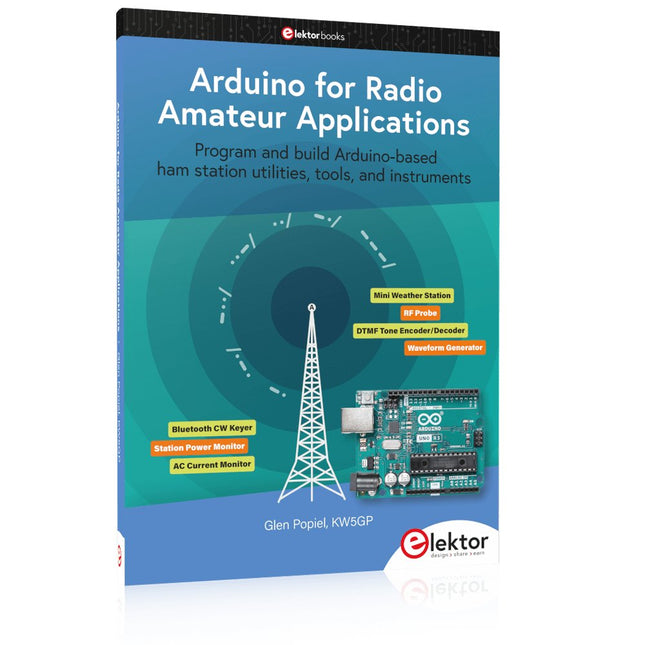
Program and build Arduino-based ham station utilities, tools, and instruments
In addition to a detailed introduction to the exciting world of the Arduino microcontroller and its many variants, this book introduces you to the shields, modules, and components you can connect to the Arduino. Many of these components are discussed in detail and used in the projects included in this book to help you understand how these components can be incorporated into your own Arduino projects. Emphasis has been placed on designing and creating a wide range of amateur radio-related projects that can easily be built in just a few days.
This book is written for ham radio operators and Arduino enthusiasts of all skill levels, and includes discussions about the tools, construction methods, and troubleshooting techniques used in creating amateur radio-related Arduino projects. The book teaches you how to create feature-rich Arduino-based projects, with the goal of helping you to advance beyond this book, and design and build your own ham radio Arduino projects.
In addition, this book describes in detail the design, construction, programming, and operation of the following projects:
CW Beacon and Foxhunt Keyer
Mini Weather Station
RF Probe with LED Bar Graph
DTMF Tone Encoder
DTMF Tone Decoder
Waveform Generator
Auto Power On/Off
Bluetooth CW Keyer
Station Power Monitor
AC Current Monitor
This book assumes a basic knowledge of electronics and circuit construction. Basic knowledge of how to program the Arduino using its IDE will also be beneficial.
Elektor GREEN en GOLD leden kunnen deze uitgave hier downloaden.
Nog geen lid? Klik hier om een lidmaatschap af te sluiten.
OBD2-sensordashboardOude meters vormden het startpunt van een zoektocht naar echte gegevens
OBD2: voeg een toerenteller en schakelindicator toe aan je autoRetro, maar uiterst nuttig
LiDAR- en Visiesensoren voor Robotica
Sensor+Test 2025 en PCIM 2025
Contactloze E-Veldmetingen (1)Een Trillende Membraan voor het Detecteren van Gelijkspanningen of Statische Elektrische Velden
Draadloze brievenbusmeldervan optische sensoren tot radar: enkele mogelijkheden
Elektor Mini-Wheelieeen zelfbalancerende robot
ZonnecellenVreemde onderdelen, de serie
Aan de slag met een moderne radarsensorStaat een nauwkeurige meting op uw radar?
Uit het leven gegrepenpapierfabriek
CybersecurityZware tijden voor hackers
Infographics: IoT en sensoren 2025
Bluetooth 6.0 brengt verbeterde toepassingen voor afstandsbepalingNieuwe versie biedt betere apparaatpositionerings- en -locatieservices
Draadloze communicatie verkennen met BeagleY-AI
Err-lectronicsCorrecties, updates en lezerspost
Alle begin......sluit het thema opamps af
Een krachtige AI-codeerassistentsneller ontwikkelen met Continue en Visual Studio Code
Zonne-laadregelaar met MPPT (2)Het schema
Ultrasone obstakeldetectoreen eenvoudig project om slechtzienden te helpen
2025: Een AI-odysseeHalfjaaroverzicht
Raspberry Pi Standalone MIDI-synthesizer (3)Het slimmer maken en een gebruikersinterface toevoegen
Meshtastic: een demonstratieprojectEen slim netwerk van LoRa-radio's
Analoge audio-frequentiegeneratorHoogwaardige sinusgenerator met instelbare frequentie
TRAITEMENT D'IMAGES AVEC LE KIT JETSON NANO DE NVIDIA2e partie : reconnaissance d'imagesELEKTOR JUMPSTARTER – DU NOUVEAUCampagnes à venirTRACEUR GPS À CODE SOURCE OUVERTTraccar cartographie les déplacements de véhicules, sans recours à un serveur tiers du nuageTESTEUR MULTIFONCTION LCR-T7 DE JOY-ITTest de semi-conducteurs passifs, discrets et de télécommandes IRSYNTHÉTISEUR DE BRUITDu bruit à la musique avec le PRBSynth1DÉMARRER EN ÉLECTRONIQUE…Easier than Imagined! ... Continuing with the CoilVOYAGE DANS LES RÉSEAUX NEURONAUX (2E PARTIE)Les neurones logiquesPROBLÈMES DE SÉCURITÉ ? COMBATTEZ LE FEU PAR LE FEU !Extension à mémoire analogique, protégée par ampoule de flash, pour la boîte à témoin d'effractionKIT DU LCR-MÈTRE 2 MHZ D'ELEKTORBALISES BLUETOOTH : LA PRATIQUEGéolocalisation intra murosC PROGRAMMING ON RASPBERRY PIExtrait : communiquer par Wi-FiTEST DE PRÉCONFORMITÉ CEM POUR UN PROJET ALIMENTÉ EN COURANT CONTINUPartie 2 : le matériel et son utilisationPROPELLER 2 DE PARALLAX (5)La fonction de « broche intelligente »MODBUS SANS FIL (PARTIE 1)Matériel et programmationJUNIOR COMPUTEREn forme après 40 ans de sommeilCONSTRUIRE SON PROPRE ÉTALONNEUR DE HAUTE PRÉCISION−10 V à +10 V, 0 à 40 mA, 0,001 %ARDUINO NANO RP2040 CONNECT EN DÉTAILRaspberry Pi RP2040 + Wi-Fi + BluetoothLE CORPS PHYSIQUE DE L'INTELLIGENCE ARTIFICIELLEPROJET 2.0corrections, mises à jour et courriers des lecteursCRÉATION D'INTERFACES GRAPHIQUES EN PYTHON AVEC GUIZEROInstallez la bibliothèque Python guizero et créez vos propres interfaces graphiques.KIT DE MESURE DU CO2 POUR SALLE DE CLASSEMontage à base d'ESP8266, conçu par l'Université des Sciences Appliquées d'Aix-la-ChapelleMK484, RADIORÉTRO PO/GO...Toujours le plaisir de construire !60 ANS D'ELEKTORQue la lumière soit !HEXADOKUThe Original Elektorized Sudoku
Clever Tricks with ATmega328 Pro Mini Boards
With a simple Pro Mini board and a few other components, projects that 20 or 30 years ago were unthinkable (or would have cost a small fortune) are realized easily and affordably in this book: From simple LED effects to a full battery charging and testing station that will put a rechargeable through its paces, there’s something for everyone.
All the projects are based on the ATmega328 microcontroller, which offers endless measuring, switching, and control options with its 20 input and output lines. For example, with a 7-segment display and a few resistors, you can build a voltmeter or an NTC-based thermometer. The Arduino platform offers the perfect development environment for programming this range of boards.
Besides these very practical projects, the book also provides the necessary knowledge for you to create projects based on your own ideas. How to measure, and what? Which transistor is suitable for switching a certain load? When is it better to use an IC? How do you switch mains voltage? Even LilyPad-based battery-operated projects are discussed in detail, as well as many different motors, from simple DC motors to stepper motors.
Sensors are another exciting topic: For example, a simple infrared receiver that can give disused remote controls a new lease on life controlling your home, and a tiny component that can actually measure the difference in air pressure between floor and table height!
ELEKTOR AIDE L'électronique dans des temps difficiles
AFFICHAGE D'INFORMATION POUR LA MAISON avec Windows sur le Raspberry Pi
DÉMARRER AVEC NODE-RED un outil de programmation open source basé sur des blocs visuels
LA tombola d'ÉTÉ d'ELEKTOR
GREATSCOTT ! CONSTRUIRE UN SYSTÈME D'ALARME LORA
REVUE : ALIMENTATION DE LABORATOIRE JOY-IT RD6006 (KIT)
REVUE : INTERFACEBOARD GREATFET ONE
QUI N'HONNE PAS LES PETITS – XXL de la boîte à suggestions d'Elektor
ANTENNE WIFI EXTERNE 2,4 GHZ POORLUIS
CONTRÔLE FACILE DE LA TEMPÉRATURE MARCHE/ARRÊT AVEC CHAPEAU RASPBERRY PI
COMMENT PRENDRE DE (BONNES) PHOTOS DÈS L'IMPRESSION... ...et les composants électroniques ?
REVUE : NOYAU I2CDRIVER
ÉCRAN TACTILE JOY-VIEW 13 DE JOY-IT
BOOSTER LED POUR MICROCONTRÔLEURS avec un seul composant !
MACHINE À LAVER À ULTRASONS EXPÉRIMENTALE
REVUE : GÉNÉRATEUR DE SIGNAUX JOY-IT JDS2915 générateur de signaux doubles avec compteur de fréquence dans un boîtier métallique
PROGRAMMATION DES FEUX DE SIGNALISATION EN LANGAGE PIC ASSEMBLY
LED CLIGNOTANT PERMANENT
CAPTEUR DE HALL EXPÉRIMENTAL
DÉTECTER LES COURT-CIRCUITS AVEC UN MILLIOHM OU ESR MÈTRE
KIT PRATIQUE ÉLECTRIQUE SDR
PIPELINE DE LABORATOIRES ÉLECTRIQUES
KICK-STARTER ÉLECTRIQUE ....eh bien, vous voyez ce que nous voulons dire.
AVEZ-VOUS VRAIMENT BESOIN DE TOUT ÇA ??? ici, je passe de nombreuses heures sur des projets électroniques...
LABORATOIRE EST OUEST MEILLEUR un aperçu du plus saint des saints, où naissent des projets intéressants
BONJOUR LE MONDE! NOUS SOMMES ELEKTOR ET NOUS SOMMES SOCIAUX
M4 + A7 + GPU : UNE ÉQUIPE DE RÊVE INÉGALE le nouveau SoC STM32MP1 pour les travaux plus lourds
CONFIGURATION DE TEST POUR LE 16F18877 ET AUTRES GRANDES PHOTOS
COMMUNICATION INTER-ΜC AVEC LE BUS SPI ET ATMEGA328P
SIX VARIANTES DE L'OSCILLATEUR LF/AF (et la capacité de M. Miller)
BBC MICRO:BIT oscilloscope absolument minimaliste avec affichage LED
FEU DE RUNNING À LED 'KNIGHT RIDER' AVEC ESP32
GÉNÉRATEUR DE SIGNAUX AM LW/MW AVEC ATTINY13
DIPMÈTRE ABSOLUMENT MINIMALISTE
SCOOTERS ÉLECTRIQUES BON MARCHÉ quelle est la qualité d'un scooter électrique « homologué » à 300 euros de Lidl ?
AIDE AU STATIONNEMENT À ULTRASONS AVEC ARDUINO UNO
PÉDALE DE DISTORSION AVEC AMPLI OP ET TUBES DE CHARGE SPATIALE
INDISPENSABLE POUR CHAQUE LABORATOIRE D'ÉLECTRONIQUE
HEXADOKU
IA POUR DÉBUTANTS (2) réseaux de neurones avec Linux et Python
Diese Ausgabe steht allen GOLD- und GREEN-Mitgliedern auf der ElektorMagazine-Website zum Download bereit!
Sie sind noch kein Mitglied? Hier klicken!
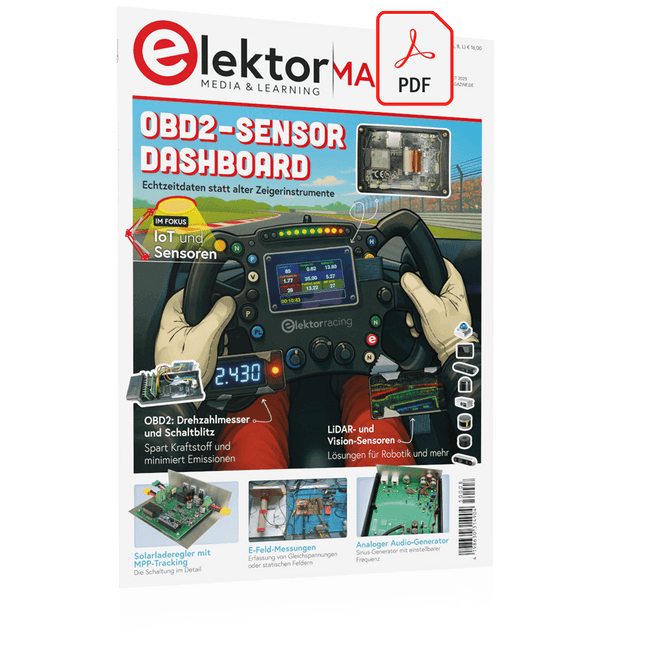
OBD2-Sensor-DashboardEchtzeitdaten statt alter Zeigerinstrumente
OBD2: Drehzahlmesser und Schaltblitz nachrüstenRetro, aber praktisch
LiDAR- und Vision-Sensoren für die Robotik
Sensor+Test 2025 und PCIM 2025
Berührungslose E-Feld-MessungenTeil 1. Eine vibrierende Membran zur Erfassung von Gleichspannungen oder statischen elektrischen Feldern
Drahtloser Benachrichtigungsdienst für den BriefkastenVon optischen Sensoren bis zu Empfängern: Entdecken Sie verschiedene Optionen
Elektor Mini-WheelieEin selbst-balancierender Roboter
SolarzellenBemerkenswerte Bauteile
Erste Schritte mit einem modernen RadarsensorPräzise Messungen auf Ihrem Radar?
Aus dem Leben gegriffenPapierfabrik
CybersecuritySchwere Zeiten für Hacker
Siglent präsentiert seine neuen Multi-Kanal-OszilloskopeFür den Einsatz in Leistungselektronik und Embedded Design
Bluetooth 6.0 verbessert Distance-Ranging-ApplikationenNeue Version bietet bessere Positionsbestimmungs- und Ortungsdienste für Geräte
Kommunikation mit dem BeagleY-AI erkunden
Projekt 2.0Korrekturen, Updates und Leserbriefe
Aller Anfang ...ist nicht schwer: Das Ende der Operationsverstärker
Ein mächtiger KI-Code-AssistentCode-Entwicklung mit Continue und Visual Studio Code
Solarladeregler mit MPP-TrackingTeil 2: Die Schaltung
Hinderniserkennung mit UltraschallEin einfaches Projekt zur Unterstützung von Menschen mit Sehbehinderungen
2025: Odyssee in die KIHalbjahresrückblick
Standalone-MIDI-Synthesizer mit Raspberry PiTeil 3. Mit künstlicher Intelligenz und einer Benutzeroberfläche
Meshtastic: Ein DemonstrationsprojektIntelligentes Mesh-Netzwerk auf Basis von LoRa-Funkmodulen
Analoger Audio-GeneratorSinus-Generator mit einstellbarer Frequenz