
Suchergebnisse für "hard OR disk OR selector"
-
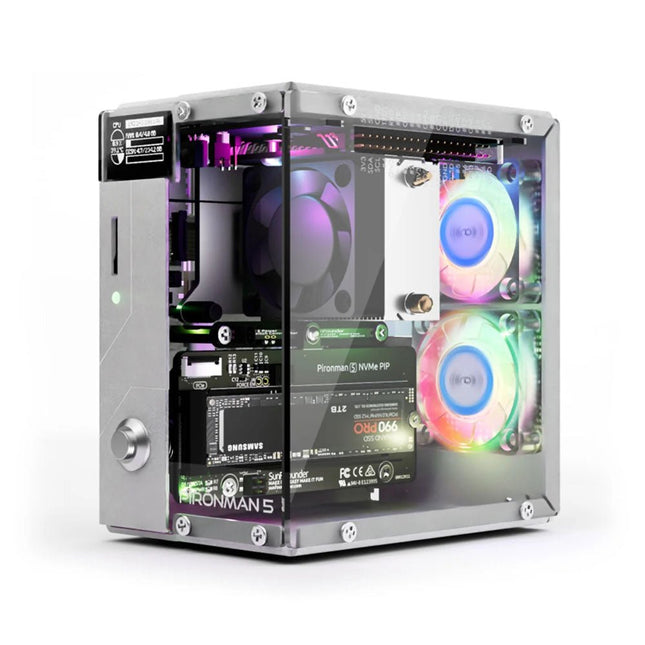
SunFounder Pironman 5 NVMe M.2 SSD PCIe Mini-PC-Gehäuse für Raspberry Pi 5
Verbessern Sie Ihren Raspberry Pi 5 mit dem Pironman 5, der aus robustem Aluminium, hervorragender Kühlung, NVMe M.2 SSD-Unterstützung, OLED-Display, RGB-Beleuchtung, Standard-HDMI-Anschlüssen x2 und einem sicheren Netzschalter besteht. Es ist perfekt für NAS, Home Assistant, Medien- und Game Center. Der Pironman 5 ist nicht nur ein Gehäuse, sondern ein Upgrade, das Ihren Raspberry Pi 5 in ein leistungsstarkes, effizientes und elegantes Gerät verwandelt. Der Pironman 5 enthält das Pi 5 NVMe PIP (PCIe Peripheral Board), eine PCIe-Adapterplatine, die speziell für NVMe-Solid-State-Laufwerke entwickelt wurde. Dieses Board unterstützt vier Größen von NVMe-SSDs: 2230, 2242, 2260 und 2280, die alle in einem M.2-M Key-Steckplatz installiert werden können. Die Verbindung ist für Gen 2.0-Geschwindigkeiten (5 GT/Sek.) zertifiziert, kann jedoch für eine schnellere Leistung auf Gen 3.0 (10 GT/Sek.) erzwungen werden. Erweiterbarer NVMe M.2 SSD-Steckplatz Steigern Sie die Leistung Ihres Raspberry Pi 5 mit dem NVMe M.2 SSD-Steckplatz des Pironman 5, der mehrere Größen (2230, 2242, 2260, 2280) für mehr Speicher und schnellere Systemreaktionen unterstützt. Erweitertes Kühlsystem Halten Sie Ihren Raspberry Pi 5 kühl und stilvoll mit dem Tower-Kühler und den zwei RGB-Lüftern des Pironman 5, der mit Staubfiltern für einen langlebigen, wartungsarmen Betrieb ausgestattet ist. OLED-Display für sofortige Einblicke Der Pironman 5 verfügt über ein 0,96" OLED-Display, das sofortige Updates zu CPU- und RAM-Auslastung, Temperatur, IP-Adresse und mehr bietet. Verbesserte Funktionalität und Sicherheit Der Pironman 5 sichert Ihren Raspberry Pi 5 mit Funktionen wie sicherem Herunterfahren, anpassbaren RGB-LEDs, HDMI-Anschlüssen, einem IR-Empfänger und einem externen GPIO-Extender und verbessert so die Funktionalität und Konnektivität. Features Raspberry Pi 5 Mini-PC 0,96-Zoll-OLED-Display, das CPU-Auslastung, Temperatur, Festplattennutzung, IP-Adresse, RAM-Auslastung usw. des Raspberry Pi anzeigt. Der Tower-Kühler kann einen Pi mit 100% CPU-Last auf 39°C bei 25°C Raumtemperatur kühlen. 2 RGB-Lüfter mit GPIO-Steuerung 1 PWM-Lüfter am Tower Cooler wird vom Raspberry Pi-System gesteuert. Unterstützt vier (PCIe Gen 2.0 / PCIe Gen 3.0) NVMe M.2 SSD-Größen: 2230, 2242, 2260 und 2280. 4 adressierbare WS2812 RGB-LEDs beleuchten das gesamte Gehäuse mit einem coolen Lichteffekt IR-Empfänger für Multimedia-Center wie Kodi oder Volumio Retro-Einschaltknopf aus Metall für sicheres Ausschalten Externer GPIO-Extender mit Pin-Namensschild für einfachen Zugriff Ausgestattet mit einem federbelasteten Sockel zum einfachen Entfernen der Karte Aluminium-Hauptgehäuse mit durchsichtiger Acryl-Seitenwand Verfügt über zwei Standard-HDMI-Anschlüsse Downloads Dokumentation
€ 79,95
Mitglieder: € 71,96
-

FNIRSI FNIRSI GC-03 Multifunktionaler Strahlungsdetektor
Das FNIRSI GC-03 ist ein multifunktionales Strahlungsmessgerät, das für die professionelle Messung ionisierender Strahlung in alltäglichen Umgebungen – wie etwa zu Hause, im Büro, im Auto oder im Freien – konzipiert wurde. Ausgestattet mit einem hochauflösenden 2,4-Zoll-Farbdisplay, ermöglicht es die Echtzeitüberwachung von ionisierender Strahlung sowie der elektrischen und magnetischen Feldstärke. Für zusätzliche Sicherheit verfügt das Gerät über drei Alarmmodi: akustisches Signal, Vibration und optische Warnung. Features 3-in-1-Erfassung: Überwacht elektrische, magnetische und ionisierende Strahlung mit einem einzigen Gerät. Hochpräzises Geiger-Müller-Zählrohr: Erfasst präzise Gamma-, Röntgen- und harte Betastrahlung bei geringem Stromverbrauch. Echtzeit-Kurvendarstellung & 50 Alarmprotokolle: Verfolgt Strahlungstrends und speichert die Alarmhistorie zur einfachen Überprüfung. Individuelle dreifache Alarmierung: Unterstützt visuelle, akustische und Vibrationsalarme mit einstellbaren Schwellenwerten. Lange Akkulaufzeit: 1500-mAh-Akku für einen ausdauernden und zuverlässigen Einsatz im Außendienst. Technische Daten Kernstrahlung Messbereich: 0,01 μSv/h – 999,99 μSv/h Genauigkeit: 0,01 μSv/h Elektrisches Feld Messbereich: 1 V/m – 1999 V/m Genauigkeit: 1 V/m Magnetfeld Messbereich: 0,01 μT – 99,99 μT Genauigkeit: 0,01 μT Strahlungsleistung 0,2 – 1000 mW/m² Erfasste Strahlungsart Ionisierende Strahlung (Gammastrahlung usw.) Detektor Energiekompensiertes GM-Zählrohr (Geiger-Müller-Zählrohr) Dosisleistungsrate 0,00 – 10000 μSv/h (10 mSv/h) Kumulierte Dosis 0,00 μSv – 500,0 mSv Energiebereich 48 keV – 1,5 MeV ≤ ±30% (für 137Cs) Empfindlichkeit 80 CPM/μSv Dosiseinheit μSv/h, μGy/h, mR/h, CPS, CPM Alarmmodus Licht, Vibration, Ton Display 2,4-Zoll-Farbbildschirm Hintergrundbeleuchtung Helligkeit einstellbar Stromversorgung USB-C (5 V / 1 A) Akku 1500 mAh Sprachen Englisch, Chinesisch Abmessungen 138 x 63 x 32 mm Gewicht 141 g Lieferumfang 1x FNIRSI GC-03 Strahlungsdetektor 1x USB-Kabel 1x Manual Downloads Manual Firmware v1.0.4
€ 99,95€ 84,95Bestpreis
-

Elektor Publishing Digital Electronics
The Basics, New Ideas & Applications Build digital electronics from the ground up—and take it all the way to practical circuits you can use. This book guides you through the core principles of digital technology with a strongly hands-on approach. You’ll begin with the essentials: signals, devices for working with them, and what "logic 0" and "logic 1" mean in real hardware. Simple demonstration setups made from easy-to-find parts (LEDs, diodes, resistors, switches) help you see how logic behaves, making the theory click before you move on. From there, you’ll explore a wide range of logic elements and how they’re implemented, including classic logic families such as TTL and CMOS. The fundamentals section covers the building blocks of digital systems: flip-flops, Schmitt triggers, registers, counters and dividers, encoders/ decoders, multiplexers/demultiplexers, plus A/D and D/A conversion and timing circuits. Next, the book invites you into "new ideas" in digital electronics—universal logic elements, unconventional approaches (including thyristor-based and fractional logic), and creative logic functions that can inspire original designs. Finally, a large, well-organized collection of application circuits turns knowledge into projects: electronic switches and selectors, pulse generators, PWM regulators, frequency multipliers/dividers, phase shifters, and digital filters. Study it deeply, and you’ll gain not only understanding—but the ability to design and debug digital circuits independently.
€ 39,95
Mitglieder: € 35,96
-

Elektor Digital Digital Electronics (E-book)
The Basics, New Ideas & Applications Build digital electronics from the ground up—and take it all the way to practical circuits you can use. This book guides you through the core principles of digital technology with a strongly hands-on approach. You’ll begin with the essentials: signals, devices for working with them, and what "logic 0" and "logic 1" mean in real hardware. Simple demonstration setups made from easy-to-find parts (LEDs, diodes, resistors, switches) help you see how logic behaves, making the theory click before you move on. From there, you’ll explore a wide range of logic elements and how they’re implemented, including classic logic families such as TTL and CMOS. The fundamentals section covers the building blocks of digital systems: flip-flops, Schmitt triggers, registers, counters and dividers, encoders/ decoders, multiplexers/demultiplexers, plus A/D and D/A conversion and timing circuits. Next, the book invites you into "new ideas" in digital electronics—universal logic elements, unconventional approaches (including thyristor-based and fractional logic), and creative logic functions that can inspire original designs. Finally, a large, well-organized collection of application circuits turns knowledge into projects: electronic switches and selectors, pulse generators, PWM regulators, frequency multipliers/dividers, phase shifters, and digital filters. Study it deeply, and you’ll gain not only understanding—but the ability to design and debug digital circuits independently.
€ 32,95
Mitglieder: € 29,66
-

Elektor Publishing Practical Microcontroller Cryptography
From Simple Ciphers to Secure Systems Understanding how to apply cryptography on modern microcontrollers is essential for building secure, reliable, and trustworthy systems. This book explains cryptography in the context of embedded hardware, from classical ciphers that illustrate core principles to modern techniques such as AES for practical high-security applications. By combining mathematical theory with real-world microcontroller implementations, readers learn not only how cryptography works, but also how to implement it effectively on systems with limited processing power and memory. The book is intended for students starting out in cryptography, hobbyists securing personal projects, and engineers looking for a structured guide to embedded security. The book covers these key topics in applied cryptography: Classical ciphers on Arduino Uno and Raspberry Pi Pico, with full programs: Spartan Scytale, Hebrew Atbash, Caesar, ROT13, Alberti Disk, Vigenère, Affine, Polybius, Playfair, Beaufort, Ottoman Codebook, and One-Time Pad. Hacking classical ciphers using microcontrollers, with examples. Pseudo-random (PRNG) and true random number generation (TRNG) on microcontrollers. Symmetric-key cryptography with full programs: DES and AES-128/256. Memory and speed constraints of cryptography on microcontrollers. Asymmetric cryptography: public/private keys, digital signatures, key distribution and derivation (KDF), RSA, and SHA-256 implementations. A complete secure communication program using RSA and AES-256. A glossary of commonly used cryptography terms.
€ 34,95
Mitglieder: € 31,46
-
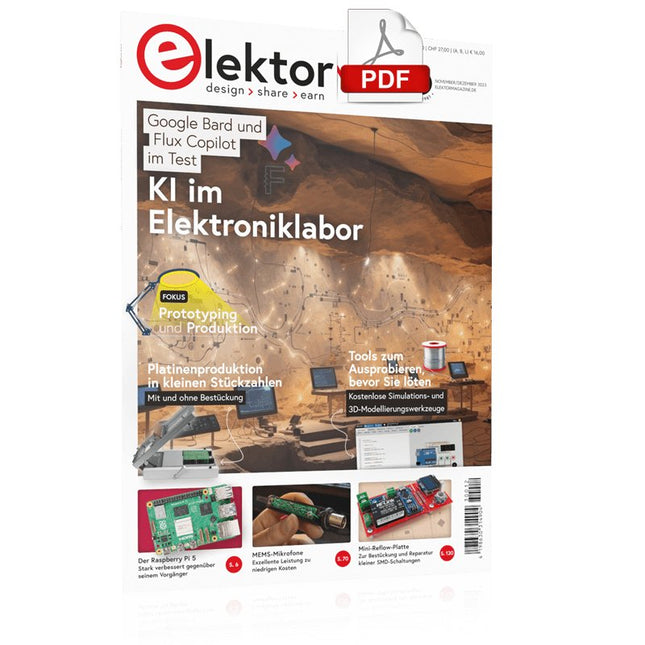
Elektor Digital Elektor 11-12/2023 (PDF)
Diese Ausgabe steht allen GOLD- und GREEN-Mitgliedern auf der ElektorMagazine-Website zum Download bereit! Sind Sie noch kein Mitglied? Hier klicken! Der Raspberry Pi 5 Gegenüber diesem Vorgänger enormer Rückstand KI im Elektroniklabor Schaltungsdesign, Bauteil-Suche, Software Funktionsgenerator mit dem Arduino Nano Nano + Code = Funktionsgenerator Solarbetriebene Weihnachtsgirlande Eine umweltfreundliche Lösung für die Dekoration Ihres Balkons USB-Killer-Detektor Besser sicher als traurig Ein einfaches CNC-Gehäuse Schritt für Schritt mit Autodesk Fusion 360 Platinenproduktion in kleinen Stückzahlen Mit und ohne Bestückung IoT-Simulation vereinfacht mit Wokwi Entwickler Uri Shaked über Entwicklung, Software und mehr Eine Anleitung zur Bare-Metal-Programmierung Teil 3: CMSIS-Header, automatische Tests und ein Webserver LoRa, ein Schweizer Taschenmesser Teil 2: Hard- und Software MEMS-Mikrofon Entwurf und Konstruktion eines Messmikrofons Werkzeuge zum Ausprobieren, bevor Sie löten Simulations- und 3D-Modellierungstools, die kostenlos genutzt werden können Neue Tools von Microchip! Version 5 von PICkit und ICD jetzt erhältlich Rapid Prototyping von flexibler, dehnbarer Elektronik Wie Voltera NOVA Innovationen bei tragbaren elektronischen Systemen beschleunigen Galvanische Trennung Fototransistor-Optokoppler erfolgreich einsetzen Die komplexe Lösung oder die Lösung von Anybus? Embedded Industrial Ethernet als Kurzstrecke statt als Marathon Ihre essentielle DFM-Checkliste Wie Sie mit dem Entwurf für die Fertigung beginnen Filamente für den 3D-Druck Arten, Eigenschaften und Verwendung im Prototyping Spezialisten für eine grundlegende Signalauswertung von ELF bis EHF-Band Aaronias neuester Echtzeit-Spektrumanalyzer der SPECTRAN® V6-Serie Herausforderungen der DFM-Analyse für Flex- und Rigid-Flex-Design Einrichten einer SMT-Fertigungsstrecke Die richtige Kombination für die zuverlässige Baugruppe Revolution in der Industrie Der Aufstieg der Autonomen Mobilen Roboter (AMR) Für höchste Anforderungen weiterentwickelt R&S MXO 5 mit acht Kanälen ergänzt Oszilloskope der nächsten Generation Aller Anfang... ... muss nicht schwer sein: Verstärkung von Unterschieden Mini-Reflow-Platte Für die Bestückung und die Reparatur kleiner SMD-Schaltungen Starte nicht mit einem Prototyp – starte mit einem Pretotyp! Prüfe zunächst, ob es einen Markt für dein Produkt gibt, bevor du deinen Lötkolben vorwärmst 2023: Odyssee in die KI Hilfe beim Entwerfen eines physikalischen Projekts erhalten Innovationen aus Brüssel Unterstützung für die Spitzentechnologie
€ 11,90
-

Elektor Digital Practical Microcontroller Cryptography (E-book)
From Simple Ciphers to Secure Systems Understanding how to apply cryptography on modern microcontrollers is essential for building secure, reliable, and trustworthy systems. This book explains cryptography in the context of embedded hardware, from classical ciphers that illustrate core principles to modern techniques such as AES for practical high-security applications. By combining mathematical theory with real-world microcontroller implementations, readers learn not only how cryptography works, but also how to implement it effectively on systems with limited processing power and memory. The book is intended for students starting out in cryptography, hobbyists securing personal projects, and engineers looking for a structured guide to embedded security. The book covers these key topics in applied cryptography: Classical ciphers on Arduino Uno and Raspberry Pi Pico, with full programs: Spartan Scytale, Hebrew Atbash, Caesar, ROT13, Alberti Disk, Vigenère, Affine, Polybius, Playfair, Beaufort, Ottoman Codebook, and One-Time Pad. Hacking classical ciphers using microcontrollers, with examples. Pseudo-random (PRNG) and true random number generation (TRNG) on microcontrollers. Symmetric-key cryptography with full programs: DES and AES-128/256. Memory and speed constraints of cryptography on microcontrollers. Asymmetric cryptography: public/private keys, digital signatures, key distribution and derivation (KDF), RSA, and SHA-256 implementations. A complete secure communication program using RSA and AES-256. A glossary of commonly used cryptography terms.
€ 29,95
Mitglieder: € 26,96
-

Elektor Digital Get Started with the Raspberry Pi AI Kit (E-book)
A Beginner's Guide to AI and Edge Computing Artificial Intelligence (AI) is now part of our daily lives. With companies developing low-cost AI-powered hardware into their products, it is now becoming a reality to purchase AI accelerator hardware at comparatively very low costs. One such hardware accelerator is the Hailo module which is fully compatible with the Raspberry Pi 5. The Raspberry Pi AI Kit is a cleverly designed hardware as it bundles an M.2-based Hailo-8L accelerator with the Raspberry Pi M.2 HAT+ to offer high speed inferencing on the Raspberry Pi 5. Using the Raspberry Pi AI Kit, you can build complex AI-based vision applications, running in real-time, such as object detection, pose estimation, instance segmentation, home automation, security, robotics, and many more neural network-based applications. This book is an introduction to the Raspberry Pi AI Kit, and it is aimed to provide some help to readers who are new to the kit and wanting to run some simple AI-based visual models on their Raspberry Pi 5 computers. The book is not meant to cover the detailed process of model creation and compilation, which is done on an Ubuntu computer with massive disk space and 32 GB memory. Examples of pre-trained and custom object detection are given in the book. Two fully tested and working projects are given in the book. The first project explains how a person can be detected and how an LED can be activated after the detection, and how the detection can be acknowledged by pressing an external button. The second project illustrates how a person can be detected, and how this information can be passed to a smart phone over a Wi-Fi link, as well as how the detection can be acknowledged by sending a message from the smartphone to your Raspberry Pi 5.
€ 29,95
Mitglieder: € 26,96
-
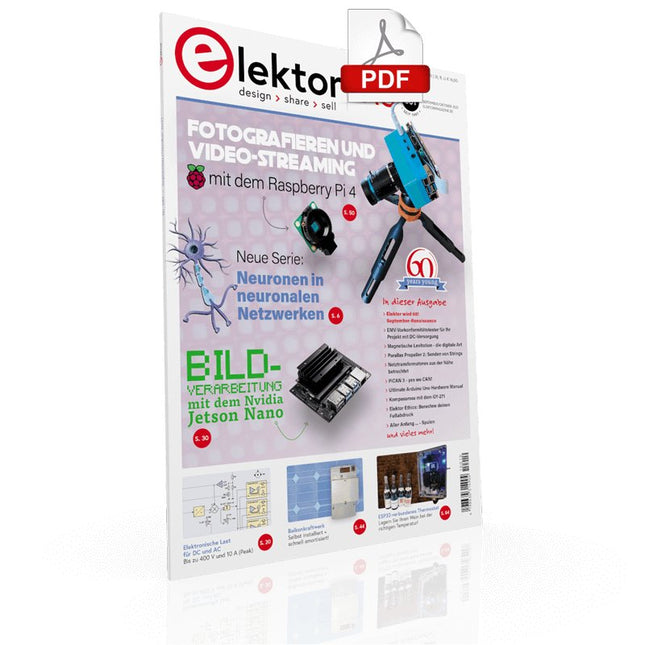
Elektor Digital Elektor 09-10/2021 (PDF)
DIE NEURONEN IN NEURONALEN NETZWERKEN VERSTEHEN Teil 1. Künstliche Neuronen EMV-VOR-KONFORMITÄTSTESTER FÜR IHR PROJEKT MIT DC-VERSORGUNG Teil 1: Was ist eine Netznachbildung? ELEKTRONISCHE LAST FÜR DC UND AC Bis zu 400 V und 10 A ALLER ANFANG … ist gar nicht schwer! NVIDIA JETSON NANO - BILDVERARBEITUNG FÜR EINSTEIGER Teil 1: Hard- und Software im Überblick NETZTRANSFORMATOREN AUS DER NÄHE BETRACHTET Wie verhalten Sie sich beim Ein- und Ausschalten? PICAN 3 – JA, DAS KÖNNEN WIR! CAN-Zusatzboard für Raspberry Pi 4 BALKONKRAFTWERK Selbst installiert = schnell amortisiert! FOTOGRAFIEREN UND VIDEO-STREAMING MIT DEM RASPBERRY PI 4 Die High-Quality-Kamera des Raspberry Pi in der Praxis VERWENDUNG VON DISPLAYS IN RASPBERRY-PI-PROJEKTEN Beispiel-Kapitel: Organische Leuchtdioden-Displays (OLED) PARALLAX-PROPELLER 2 Teil 4: Senden von Strings 60 JAHRE ELEKTOR: SEPTEMBER-RENAISSANCE Der Plan, der Plan, ein leerer Wahn ... ZUTRITT FÜR UNBEFUGE VERBOTEN ERWÜNSCHT In Friesland, wo die Röhren blühen ... HYBRIDE SCHALTUNGEN Bemerkenswerte Bauteile KOMPASSROSE MIT DEM GY-271 Oder, warum man mit dem Handy aufpassen muss… KENNEN SIE IHREN FUSSABDRUCK Berechnen Sie die CO2-Bilanz Ihrer Elektronik ESP32-VERBUNDENES THERMOSTAT Lagern Sie Ihren Wein bei der richtigen Temperatur! MAGNETISCHE LEVITATION DIE DIGITALE ART Ein ESP32 Pico ersetzt den analogen Komparator ULTIMATE ARDUINO UNO HARDWAREHANDBUCH Ein beispielhaftes Kapitel: Bootloader für den Haupt-Mikrocontroller MICROPYTHON FÜR DEN ESP32 UND CO. Teil 2. Matrix-Displays einfach ansteuern MADMACHINE SWIFTIO-KARTE Moderne Sprache trifft moderne Hardware AUS DEM LEBEN GEGRIFFEN Eine elektronische On/Off-Beziehung HEXADOKUS Sudoku für Elektroniker
€ 11,90
-

Elektor Digital Embedded in Embedded (E-book)
ARM Cortex-M Embedded Design from 0 to 1 Hobbyists can mash together amazing functional systems using platforms like Arduino or Raspberry Pi, but it is imperative that engineers and product designers understand the foundational knowledge of embedded design. There are very few resources available that describe the thinking, strategies, and processes to take an idea through hardware design and low-level driver development, and successfully build a complete embedded system. Many engineers end up learning the hard way, or never really learn at all. ARM processors are essentially ubiquitous in embedded systems. Design engineers building novel devices must understand the fundamentals of these systems and be able to break down large, complicated ideas into manageable pieces. Successful product development means traversing a huge amount of documentation to understand how to accomplish what you need, then put everything together to create a robust system that will reliably operate and be maintainable for years to come. This book is a case study in embedded design including discussion of the hardware, processor initialization, low‑level driver development, and application interface design for a product. Though we describe this through a specific application of a Cortex-M3 development board, our mission is to help the reader build foundational skills critical to being an excellent product developer. The completed development board is available to maximize the impact of this book, and the working platform that you create can then be used as a base for further development and learning. The Embedded in Embedded program is about teaching fundamental skill sets to help engineers build a solid foundation of knowledge that can be applied in any design environment. With nearly 20 years of experience in the industry, the author communicates the critical skill development that is demanded by companies and essential to successful design. This book is as much about building a great design process, critical thinking, and even social considerations important to developers as it is about technical hardware and firmware design. Downloads EiE Software Archive (200 MB) IAR ARM 8.10.1 (Recommended IDE version to use) (1.2 GB) IAR ARM 7.20.1 (Optional IDE version to use) (600 MB)
€ 44,95
Mitglieder: € 40,46


-

, von Burkhard Kainka Erste Erfahrungen mit dem HackRF One (Review)
Als ich den HackRF One zum ersten Mal in meinen Händen hielt, wusste ich fast nichts über das Gerät, außer dass es ein SDR-Empfänger und...
-
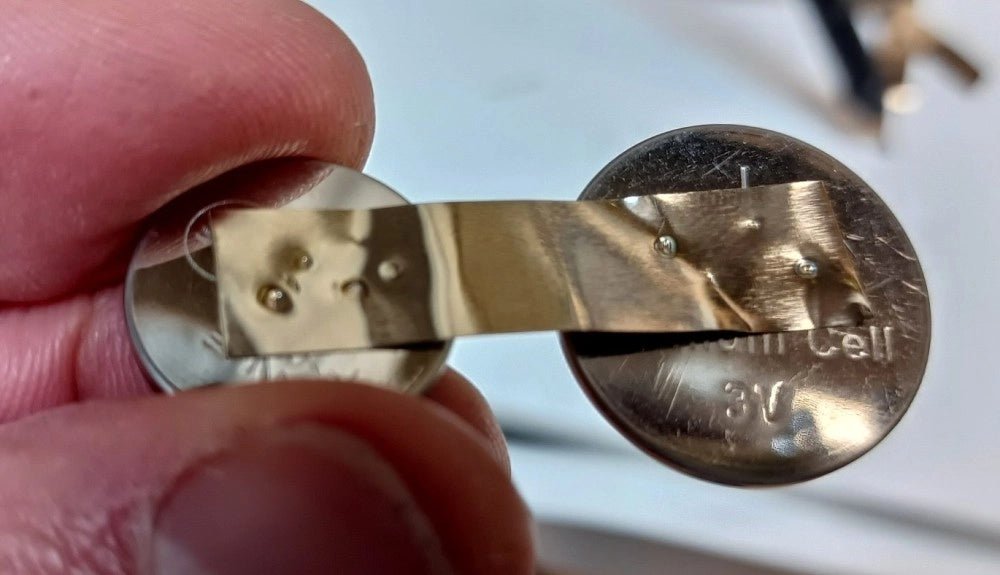
, von Clemens Valens Fnirsi SWM-10 - Reparieren Sie Batteriepacks mit diesem tragbaren intelligenten Punktschweißgerät (review)
Mit dem Aufkommen von kabellosen elektrischen Gartengeräten, elektrische Fahrräder, Motorrollern, Autos und vielem mehr haben Akkus unsere Welt erobert. Die Zellen in Akkupacks werden mit...

