
Suchergebnisse für "red OR pitaya OR case"
-

Elektor Digital Experimenting with Red Pitaya STEMlab Gen 2 (E-book)
Practical Projects and Programs With Experimenting with Red Pitaya STEMlab Gen 2, Red Pitaya goes beyond a versatile board. It becomes a powerful laboratory instrument for precision measurement, analysis, and control. From the fundamentals of electronic project development, monitoring, control, and design to testing, this book walks you step-by-step through everything you need to know to harness the full potential of Red Pitaya hardware and software. The book presents real-time, FPGA-based projects that are developed on a PC using the Vivado environment, then transferred to the Red Pitaya for execution and testing. You will learn about enhanced performance, expanded I/O capabilities, improved FPGA features, and advanced connectivity options that open up new frontiers for precision measurement, monitoring, and control in your embedded applications. Inside the book you will discover: A deep dive into Red Pitaya architecture and hardware design Electronic experiments using Red Pitaya for measurement and monitoring Hands-on projects using the Python programming language Practical guidance for FPGA programming using Red Pitaya Red Pitaya FPGA projects using the Verilog HDL under Vivado IDE Practical design of electronic projects including measurement and testing Step-by-step examples that bridge theory and real-world implementation Whether you are designing your own electronic circuits, developing signal analysis tools, or creating real-time control or monitoring systems, this book provides you the knowledge and confidence you need to fully learn and customize the Red Pitaya platform.
€ 32,95
Mitglieder: € 29,66
-

Elektor Publishing Experimenting with Red Pitaya STEMlab Gen 2
Practical Projects and Programs With Experimenting with Red Pitaya STEMlab Gen 2, Red Pitaya goes beyond a versatile board. It becomes a powerful laboratory instrument for precision measurement, analysis, and control. From the fundamentals of electronic project development, monitoring, control, and design to testing, this book walks you step-by-step through everything you need to know to harness the full potential of Red Pitaya hardware and software. The book presents real-time, FPGA-based projects that are developed on a PC using the Vivado environment, then transferred to the Red Pitaya for execution and testing. You will learn about enhanced performance, expanded I/O capabilities, improved FPGA features, and advanced connectivity options that open up new frontiers for precision measurement, monitoring, and control in your embedded applications. Inside the book you will discover: A deep dive into Red Pitaya architecture and hardware design Electronic experiments using Red Pitaya for measurement and monitoring Hands-on projects using the Python programming language Practical guidance for FPGA programming using Red Pitaya Red Pitaya FPGA projects using the Verilog HDL under Vivado IDE Practical design of electronic projects including measurement and testing Step-by-step examples that bridge theory and real-world implementation Whether you are designing your own electronic circuits, developing signal analysis tools, or creating real-time control or monitoring systems, this book provides you the knowledge and confidence you need to fully learn and customize the Red Pitaya platform.
€ 39,95€ 32,95Bestpreis
-

Elektor Digital Red Pitaya for Test and Measurement (E-book)
The Red Pitaya (STEMlab) is a credit card-sized, open-source test and measurement board that can be used to replace most measurement instruments used in electronics laboratories. With a single click, the board can transform into a web-based oscilloscope, spectrum analyser, signal generator, LCR meter, Bode plotter, and microcontroller. The Red Pitaya (STEMlab) can replace the many pieces of expensive measurement equipment found at professional research organisations and teaching laboratories. The device, that based on Linux, includes an FPGA, digital signal processing (DSP), dual core ARM Cortex processor, signal acquisition and generation circuitry, micro USB socket, microSD card slot, RJ45 socket for Ethernet connection, and USB socket – all powered from an external mains adaptor. This book is an introduction to electronics. It aims to teach the principles and applications of basic electronics by carrying out real experiments using the Red Pitaya (STEMlab). The book includes many chapters on basic electronics and teaches the theory and use of electronic components including resistors, capacitors, inductors, diodes, transistors, and operational amplifiers in electronic circuits. Many fun and interesting Red Pitaya (STEMlab) experiments are included in the book. The book also makes an introduction to visual programming environment. The book is written for college level and first year university students studying electrical or electronic engineering.
€ 29,95
Mitglieder: € 26,96
-
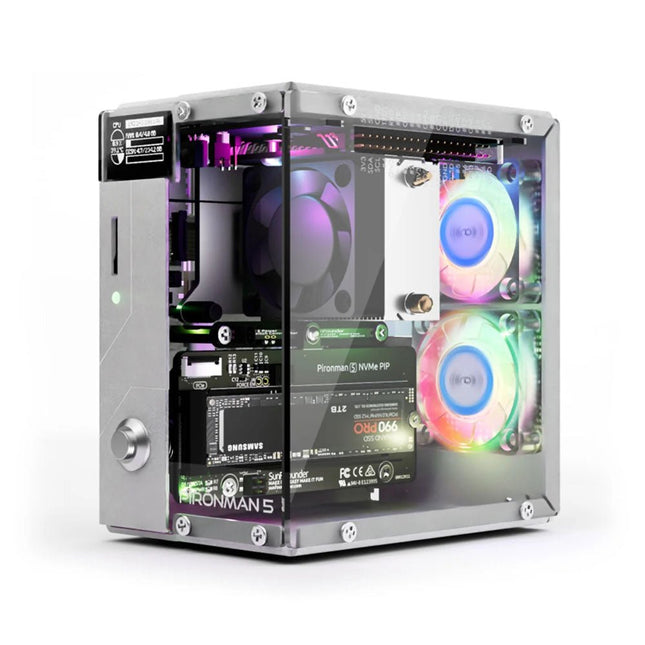
SunFounder Pironman 5 NVMe M.2 SSD PCIe Mini-PC-Gehäuse für Raspberry Pi 5
Verbessern Sie Ihren Raspberry Pi 5 mit dem Pironman 5, der aus robustem Aluminium, hervorragender Kühlung, NVMe M.2 SSD-Unterstützung, OLED-Display, RGB-Beleuchtung, Standard-HDMI-Anschlüssen x2 und einem sicheren Netzschalter besteht. Es ist perfekt für NAS, Home Assistant, Medien- und Game Center. Der Pironman 5 ist nicht nur ein Gehäuse, sondern ein Upgrade, das Ihren Raspberry Pi 5 in ein leistungsstarkes, effizientes und elegantes Gerät verwandelt. Der Pironman 5 enthält das Pi 5 NVMe PIP (PCIe Peripheral Board), eine PCIe-Adapterplatine, die speziell für NVMe-Solid-State-Laufwerke entwickelt wurde. Dieses Board unterstützt vier Größen von NVMe-SSDs: 2230, 2242, 2260 und 2280, die alle in einem M.2-M Key-Steckplatz installiert werden können. Die Verbindung ist für Gen 2.0-Geschwindigkeiten (5 GT/Sek.) zertifiziert, kann jedoch für eine schnellere Leistung auf Gen 3.0 (10 GT/Sek.) erzwungen werden. Erweiterbarer NVMe M.2 SSD-Steckplatz Steigern Sie die Leistung Ihres Raspberry Pi 5 mit dem NVMe M.2 SSD-Steckplatz des Pironman 5, der mehrere Größen (2230, 2242, 2260, 2280) für mehr Speicher und schnellere Systemreaktionen unterstützt. Erweitertes Kühlsystem Halten Sie Ihren Raspberry Pi 5 kühl und stilvoll mit dem Tower-Kühler und den zwei RGB-Lüftern des Pironman 5, der mit Staubfiltern für einen langlebigen, wartungsarmen Betrieb ausgestattet ist. OLED-Display für sofortige Einblicke Der Pironman 5 verfügt über ein 0,96" OLED-Display, das sofortige Updates zu CPU- und RAM-Auslastung, Temperatur, IP-Adresse und mehr bietet. Verbesserte Funktionalität und Sicherheit Der Pironman 5 sichert Ihren Raspberry Pi 5 mit Funktionen wie sicherem Herunterfahren, anpassbaren RGB-LEDs, HDMI-Anschlüssen, einem IR-Empfänger und einem externen GPIO-Extender und verbessert so die Funktionalität und Konnektivität. Features Raspberry Pi 5 Mini-PC 0,96-Zoll-OLED-Display, das CPU-Auslastung, Temperatur, Festplattennutzung, IP-Adresse, RAM-Auslastung usw. des Raspberry Pi anzeigt. Der Tower-Kühler kann einen Pi mit 100% CPU-Last auf 39°C bei 25°C Raumtemperatur kühlen. 2 RGB-Lüfter mit GPIO-Steuerung 1 PWM-Lüfter am Tower Cooler wird vom Raspberry Pi-System gesteuert. Unterstützt vier (PCIe Gen 2.0 / PCIe Gen 3.0) NVMe M.2 SSD-Größen: 2230, 2242, 2260 und 2280. 4 adressierbare WS2812 RGB-LEDs beleuchten das gesamte Gehäuse mit einem coolen Lichteffekt IR-Empfänger für Multimedia-Center wie Kodi oder Volumio Retro-Einschaltknopf aus Metall für sicheres Ausschalten Externer GPIO-Extender mit Pin-Namensschild für einfachen Zugriff Ausgestattet mit einem federbelasteten Sockel zum einfachen Entfernen der Karte Aluminium-Hauptgehäuse mit durchsichtiger Acryl-Seitenwand Verfügt über zwei Standard-HDMI-Anschlüsse Downloads Dokumentation
€ 79,95
Mitglieder: € 71,96
-
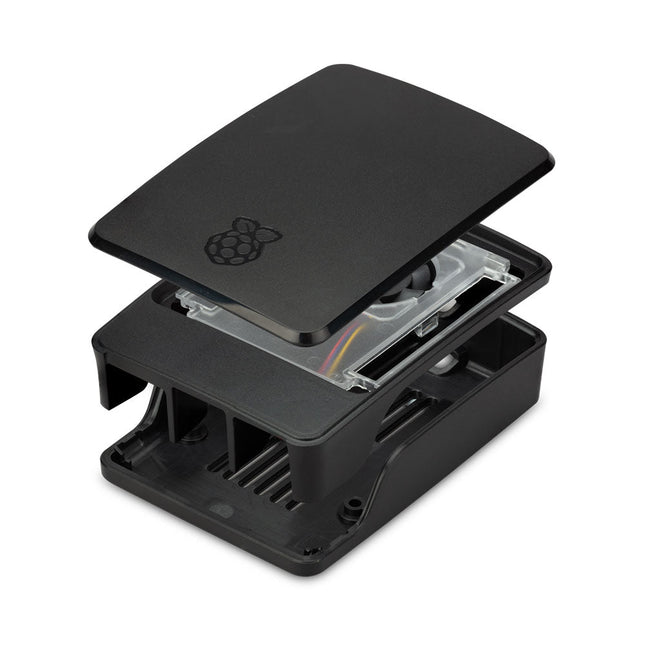
Raspberry Pi Foundation Offizielles Gehäuse für Raspberry Pi 5 (schwarz/grau)
Das Raspberry Pi 5-Gehäuse ist eine Weiterentwicklung des Raspberry Pi 4-Gehäuses mit verbesserten thermischen Eigenschaften zur Unterstützung des höheren Spitzenstromverbrauchs des Raspberry Pi 5. Es verfügt über einen Lüfter mit variabler Geschwindigkeit, der über einen speziellen Anschluss am Raspberry Pi 5 mit Strom versorgt und gesteuert wird.
€ 11,95€ 6,95Bestpreis
-

Great Scott Gadgets Acrylgehäuse für HackRF SDR
Dieses durchsichtige Acrylgehäuse ist das offizielle Gehäuse für das HackRF One/Pro Board. Es kann das schwarze Standard-Kunststoffgehäuse des HackRF One/Pro ersetzen. Montageanleitung Verwenden Sie einen Gitarrenpick oder einen Spudger, um die HackRF One/Pro Platine aus dem schwarzen Kunststoffgehäuse zu ziehen. Setzen Sie eine lange Schraube in jede Ecke der unteren Acrylplatte ein. Sichern Sie jede lange Schraube mit einem kurzen (5 mm) Abstandshalter auf der gegenüberliegenden Seite der Platte. Legen Sie die HackRF One/Pro Platine (mit der Oberseite nach oben) auf die untere Platte und führen Sie die Enden der langen Schrauben durch die Befestigungslöcher in den Ecken der Leiterplatte. Sichern Sie die Platine mit einem langen (6 mm) Abstandshalter in jeder Ecke. Legen Sie die obere Acrylplatte auf die Leiterplatte und richten Sie die Ausschnitte mit den Erweiterungsleisten der Leiterplatte aus. Sichern Sie jede Ecke mit einer kurzen Schraube. Wichtig: Bei jedem Schritt nur handfest (nicht zu fest) anziehen.
€ 19,95
Mitglieder: € 17,96
-

FNIRSI FNIRSI LC1020E Hochpräzisions-LCR-Meter
Das FNIRSI LC1020E Hochpräzisions-LCR-Meter mit ESR-Tester ist eine tragbare und intelligente Lösung zum Testen elektronischer Bauteile und bietet eine Grundgenauigkeit von bis zu 0,3%. Es eignet sich ideal für Ingenieure, Techniker und Maker. Das Gerät unterstützt L/Q-, C/D- und R/D-Messungen unter Verwendung von seriellen und parallelen Ersatzschaltbildmodellen und verfügt über ein 2,8-Zoll-TFT-Farbdisplay. Mit voreingestellten Schwellenwerten und audiovisuellen Warnmeldungen ermöglicht es eine schnelle Pass/Fail-Bewertung und eignet sich somit perfekt für Serientests und die Qualitätskontrolle. Da es Testfrequenzen bis zu 100 kHz unterstützt, ist es gut für die Hochfrequenzanalyse von Induktivitäten, Kondensatoren und Widerständen geeignet. Features Genauigkeit von ±0,05% bei einer Auflösung von 4,5 Stellen Automatische R/L/C-Erkennung für schnelle Messungen 5 Prüf-Frequenzen (100 Hz–100 kHz) und 3 Spannungspegel (0,1–0,6 V) Doppelte Anzeige: L/C/R/Z + X/D/Q/θ/ESR Sortiermodus & Vorspannung für Serienprüfungen Zwei Anschlüsse (3-/5-polig) mit 4-Leiter-Kelvin-Unterstützung Datenhaltefunktion und Protokollierung für einen effizienten Arbeitsablauf Kompakt, wiederaufladbar (3000 mAh) – ideal für den Einsatz im Labor und vor Ort Technische Daten Allgemeines Prüffrequenz 100 Hz, 120 Hz, 1 kHz, 10 kHz, 100 kHz Grundgenauigkeit 0,3% Display 2,8 Zoll TFT-LCD-Display Anzeigestellen Hauptparameter: 4,5 Stellen Nebenparameter: 4,5 Stellen Messparameter Hauptparameter: AUTO/R/C/L/Z Sekundärparameter: X/D/Q/θ/ESR Messbereich L: 0–100 H C: 0–100 mF R: 0–10 M Interne Vorspannung 0,0 V, 0,5 V Prüfspannung 0,1 V, 0,3 V, 0,6 V Kalibrierungsfunktionen Leerlaufkalibrierung, Kurzschlusskalibrierung Vergleichsfunktion Dient zur Berechnung des relativen Fehlers zwischen dem Messwert des Bauteils und dem Nennwert, wird als Prozentsatz angezeigt und liefert Filterergebnisse, Nennwerte und Toleranz können eingestellt werden, wobei der Toleranzbereich von 0,1% bis 99,9% einstellbar ist Funktionsprotokoll Prüft, ob die gemessenen Bauteildaten den eingestellten Nennwert und die Toleranz erfüllen, und zeichnet die Anzahl der erfolgreichen und fehlgeschlagenen Messungen auf Konfiguration der Testanschlüsse Dreipolig, Fünfpolig Ausgangsimpedanz 100 Ω Schnittstelle USB-C (virtueller serieller Anschluss) Sonstiges Spracheinstellungen, Bildschirmhelligkeit, Toneinstellungen, Automatische Abschaltung, Kalibrierungseinstellungen, Systeminformationen Akku 3000 mAh Lithium-Akku Abmessungen 18,5 x 8,5 x 3,5 cm Gewicht 680 g Kapazität (C) Bereich: 1mF-100mF 100 Hz: 5% ±5 digits 1 kHz: 3% ±5 digits 10 kHz: / 100 kHz: / Bereich: 1uF-1mF 100 Hz: 1% ±4 digits 1 kHz: 0,5% ±5 digits 10 kHz: 2% ±5 digits 100 kHz: 3% ±4 digits Bereich: 1nF-1uF 100 Hz: / 1 kHz: 0,3% ±2 digits 10 kHz: 0,4% ±2 digits 100 kHz: 1% ±4 digits Bereich: 1pF-1nF 100 Hz: / 1 kHz: 2% ±2 digits 10 kHz: 1,5% ±2 digits 100 kHz: 2% ±4 digits Induktivität (L) Bereich: 1H-100H 100 Hz: 2% ±5 digits 1 kHz: 2% ±5 digits 10 kHz: / 100 kHz: / Bereich: 1mH-1H 100 Hz: 0,4% ±5 digits 1 kHz: 0,3% ±2 digits 10 kHz: 0,4% ±3 digits 100 kHz: 2,5% ±5 digits Bereich: 10uH-1mH 100 Hz: 3% ±5 digits 1 kHz: 0,5% ±4 digits 10 kHz: 0,5% ±3 digits 100 kHz: 1,5% ±5 digits Bereich: 1uH-10uH 100 Hz: / 1 kHz: 2% ±5 digits 10 kHz: 2% ±5 digits 100 kHz: 4% ±5 digits Widerstand (R) Bereich: 1MΩ-10MΩ 100 Hz: 5% ±4 digits 1 kHz: 3% ±3 digits 10 kHz: / 100 kHz: / Bereich: 1KΩ-1MΩ 100 Hz: 0,4% ±4 digits 1 kHz: 0,2% ±2 digits 10 kHz: 0,3% ±3 digits 100 kHz: 0,6% ±5 digits Bereich: 1Ω-1KΩ 100 Hz: 1,5% ±4 digits 1 kHz: 0,3% ±2 digits 10 kHz: 0,3% ±3 digits 100 kHz: 0,6% ±5 digits Bereich: 10mΩ-1Ω 100 Hz: 4% ±4 digits 1 kHz: 2% ±5 digits 10 kHz: 2% ±5 digits 100 kHz: 5% ±5 digits Lieferumfang 1x FNIRSI LC1020E LCR-Messgerät 1x Kelvin-Messklemme 2x Messleitungen (1x schwarz, 1x rot) 1x Kurzschlussplatte 1x USB-C Kabel 1x Manual Downloads Manual Firmware V1.1
€ 84,95€ 69,95Bestpreis
-
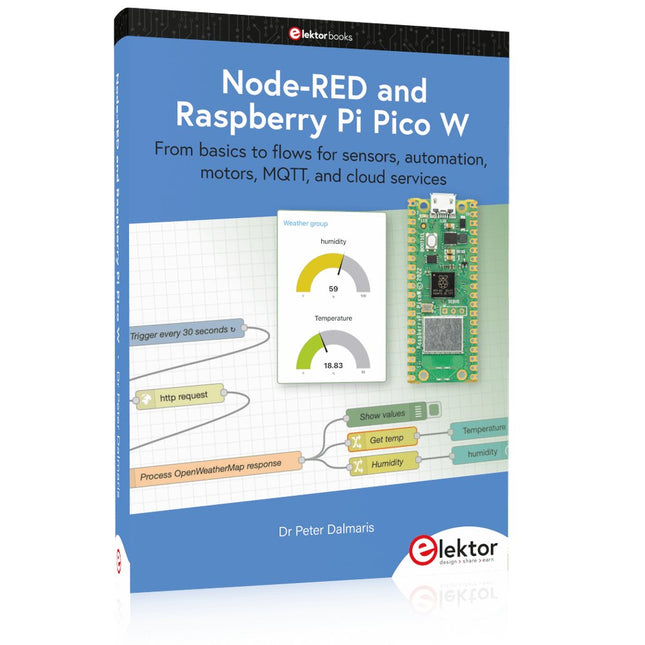
Elektor Publishing Node-RED and Raspberry Pi Pico W
From basics to flows for sensors, automation, motors, MQTT, and cloud services This book is a learning guide and a reference. Use it to learn Node-RED, Raspberry Pi Pico W, and MicroPython, and add these state-of-the-art tools to your technology toolkit. It will introduce you to virtual machines, Docker, and MySQL in support of IoT projects based on Node-RED and the Raspberry Pi Pico W. This book combines several elements into a platform that powers the development of modern Internet of Things applications. These elements are a flow-based server, a WiFi-enabled microcontroller, a high-level programming language, and a deployment technology. Combining these elements gives you the tools you need to create automation systems at any scale. From home automation to industrial automation, this book will help you get started. Node-RED is an open-source flow-based development tool that makes it easy to wire together devices, APIs, and online services. Drag and drop nodes to create a flowchart that turns on your lights at sunset or sends you an email when a sensor detects movement. Raspberry Pi Pico W is a version of the Raspberry Pi Pico with added 802.11n Wi-Fi capability. It is an ideal device for physical computing tasks and an excellent match to the Node-RED. Quick book facts Project-based learning approach. Assumes no prior knowledge of flow-based programming tools. Learn to use essential infrastructure tools in your projects, such as virtual machines, Docker, MySQL and useful web APIs such as Google Sheets and OpenWeatherMap. Dozens of mini-projects supported by photographs, wiring schematics, and source code. Get these from the book GitHub repository. Step-by-step instructions on everything. All experiments are based on the Raspberry Pi Pico W. A Wi-Fi network is required for all projects. Hardware (including the Raspberry Pi Pico W) is available as a kit. Downloads GitHub
€ 49,95
Mitglieder: € 44,96
-
Elektor Digital Node-RED and Raspberry Pi Pico W (E-book)
From basics to flows for sensors, automation, motors, MQTT, and cloud services This book is a learning guide and a reference. Use it to learn Node-RED, Raspberry Pi Pico W, and MicroPython, and add these state-of-the-art tools to your technology toolkit. It will introduce you to virtual machines, Docker, and MySQL in support of IoT projects based on Node-RED and the Raspberry Pi Pico W. This book combines several elements into a platform that powers the development of modern Internet of Things applications. These elements are a flow-based server, a WiFi-enabled microcontroller, a high-level programming language, and a deployment technology. Combining these elements gives you the tools you need to create automation systems at any scale. From home automation to industrial automation, this book will help you get started. Node-RED is an open-source flow-based development tool that makes it easy to wire together devices, APIs, and online services. Drag and drop nodes to create a flowchart that turns on your lights at sunset or sends you an email when a sensor detects movement. Raspberry Pi Pico W is a version of the Raspberry Pi Pico with added 802.11n Wi-Fi capability. It is an ideal device for physical computing tasks and an excellent match to the Node-RED. Quick book facts Project-based learning approach. Assumes no prior knowledge of flow-based programming tools. Learn to use essential infrastructure tools in your projects, such as virtual machines, Docker, MySQL and useful web APIs such as Google Sheets and OpenWeatherMap. Dozens of mini-projects supported by photographs, wiring schematics, and source code. Get these from the book GitHub repository. Step-by-step instructions on everything. All experiments are based on the Raspberry Pi Pico W. A Wi-Fi network is required for all projects. Hardware (including the Raspberry Pi Pico W) is available as a kit. Downloads GitHub
€ 39,95
Mitglieder: € 35,96
-

Elektor Bundles Elektor Raspberry Pi Pico Advanced Kit (Bundle)
Comprehensive Book-Hardware Bundle for the RP2040 Microcontroller with over 80 Projects Unlock the potential of modern controller technology with the Raspberry Pi Pico in this bundle. Perfect for both beginners and experienced users, the easy-to-follow guide takes you from the basics of electronics to the complexities of digital signal processing. With the Raspberry Pi Pico, the dedicated hardware kit and MicroPython programming, you will learn the key principles of circuit design, data collection, and processing. Get hands-on with over 80 projects like a stopwatch with an OLED display, a laser distance meter, and a servo-controlled fan. These projects are designed to help you apply what you've learned in real-world scenarios. The book also covers advanced topics like wireless RFID technology, object detection, and sensor integration for robotics. Whether you're looking to build your skills in electronics or dive deeper into embedded systems, this bundle is the perfect resource to help you explore the full potential of the Raspberry Pi Pico. Contents of the Bundle 1x Project Book (273 pages) 1x Smart Car Kit Electronic Parts 2x Solderless breadboard (400 holes) 1x Solderless breadboard (170 holes) 5x Colorful 5 mm LEDs (green, red, blue, yellow and white) 1x Laser transmitter 1x Passive buzzer 1x Micro USB cable (30 cm) 1x 65 Jumper wires 1x 20 cm male to female Dupont wire 1x Clear case 1x Magnet (diameter: 8 mm, thickness: 5 mm) 1x Rotary potentiometer 10x 2 KΩ resistors 2x M2.5x30 mm copper pillars 10x Phillips pan head screws 10x M2.5 nickel hex nuts 1x 2-inch dual-purpose screwdriver Modules 1x RGB module 1x 9G servo 1x Dual-axis XY joystick module 1x RC522 RFID module 1x 4 Bits digital LED display module 1x Traffic light display module 1x Rotary Encoder module 1x 1602 LCD Display module (Blue) 1x Photoresistor module 1x DC motor with male Dupont wire 1x Fan blade 1x Raindrops module 1x OLED module 1x Membrane switch keyboard 1x Mini magnetic spring module 1x Infrared remote control 1x Infrared receiver module 1x DC stepper motor driver board 1x Button Sensors 1x Vibration sensor 1x Soil moisture sensor 1x Sound sensor 1x Mini PIR motion sensor 1x Temperature & Humidity sensor 1x Flame sensor 2x Crash sensor 2x Tracking sensor 1x Ultrasonic sensor
€ 99,95€ 79,95Bestpreis









-

, von Udo Bormann Ist das Pironman 5 Gehäuse das beste Raspberry Pi 5 Gehäuse für Kühlung und Leistung?
Der Raspberry Pi 5 ist ein wahres Kraftpaket im Mini-Format. Doch wie bei jeder leistungsstarken Platine sind Kühlung und Erweiterbarkeit entscheidende Faktoren, um sein volles...
-
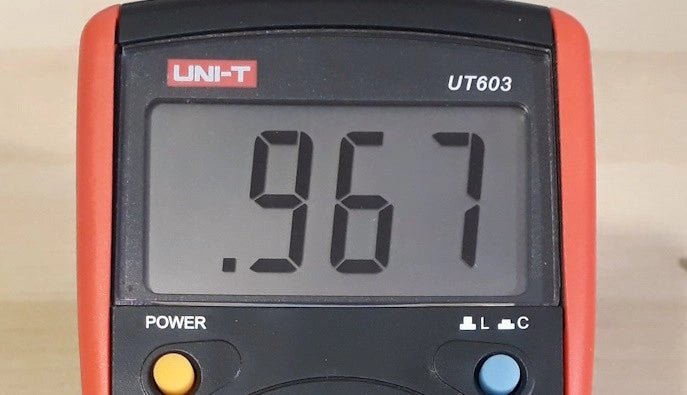
, von Jean-François Simon LCR-Messgerät: Das UNI-T UT603 (Review)
Suchen Sie ein tragbares LCR-Messgerät? Informieren Sie sich über die Funktionen und Einsatzmöglichkeiten des UNI-T UT603 LCR-Meters in unserem ausführlichen Testbericht!

