Suchergebnisse für "mlx90393 OR triaxis OR micropower OR magnetometer"
-
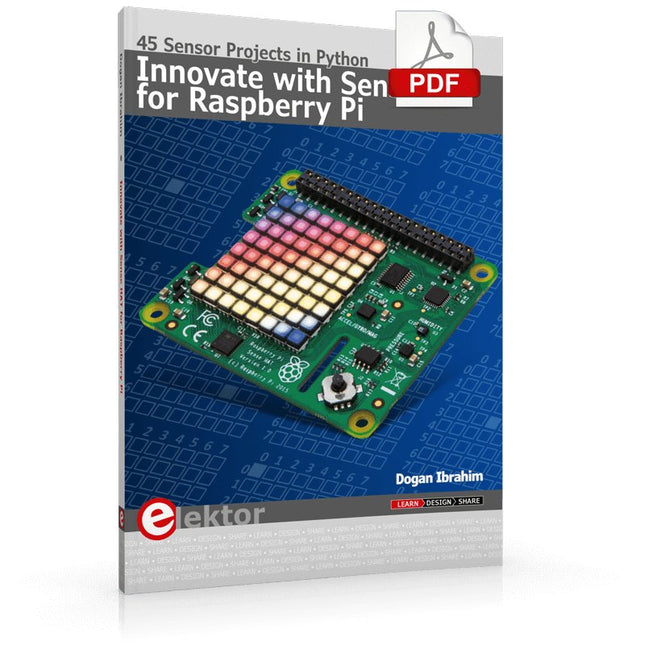
Elektor Publishing Innovate with Sense HAT for Raspberry Pi
Ready to explore the world around you? By attaching the Sense HAT to your Raspberry Pi, you can quickly and easily develop a variety of creative applications, useful experiments, and exciting games. The Sense HAT contains several helpful environmental sensors: temperature, humidity, pressure, accelerometer, magnetometer, and gyroscope. Additionally, an 8x8 LED matrix is provided with RGB LEDs, which can be used to display multi-color scrolling or fixed information, such as the sensor data. Use the small onboard joystick for games or applications that require user input. In Innovate with Sense HAT for Raspberry Pi, Dr. Dogan Ibrahim explains how to use the Sense HAT in Raspberry Pi Zero W-based projects. Using simple terms, he details how to incorporate the Sense HAT board in interesting visual and sensor-based projects. You can complete all the projects with other Raspberry Pi models without any modifications. Exploring with Sense HAT for Raspberry Pi includes projects featuring external hardware components in addition to the Sense HAT board. You will learn to connect the Sense HAT board to the Raspberry Pi using jumper wires so that some of the GPIO ports are free to be interfaced to external components, such as to buzzers, relays, LEDs, LCDs, motors, and other sensors. The book includes full program listings and detailed project descriptions. Complete circuit diagrams of the projects using external components are given where necessary. All the projects were developed using the latest version of the Python 3 programming language. You can easily download projects from the book’s web page. Let’s start exploring with Sense HAT.
€ 34,95
Mitglieder € 31,46
-
Elektor Digital Innovate with Sense HAT for Raspberry Pi (E-book)
Ready to explore the world around you? By attaching the Sense HAT to your Raspberry Pi, you can quickly and easily develop a variety of creative applications, useful experiments, and exciting games. The Sense HAT contains several helpful environmental sensors: temperature, humidity, pressure, accelerometer, magnetometer, and gyroscope. Additionally, an 8x8 LED matrix is provided with RGB LEDs, which can be used to display multi-color scrolling or fixed information, such as the sensor data. Use the small onboard joystick for games or applications that require user input. In Innovate with Sense HAT for Raspberry Pi, Dr. Dogan Ibrahim explains how to use the Sense HAT in Raspberry Pi Zero W-based projects. Using simple terms, he details how to incorporate the Sense HAT board in interesting visual and sensor-based projects. You can complete all the projects with other Raspberry Pi models without any modifications. Exploring with Sense HAT for Raspberry Pi includes projects featuring external hardware components in addition to the Sense HAT board. You will learn to connect the Sense HAT board to the Raspberry Pi using jumper wires so that some of the GPIO ports are free to be interfaced to external components, such as to buzzers, relays, LEDs, LCDs, motors, and other sensors. The book includes full program listings and detailed project descriptions. Complete circuit diagrams of the projects using external components are given where necessary. All the projects were developed using the latest version of the Python 3 programming language. You can easily download projects from the book’s web page. Let’s start exploring with Sense HAT.
€ 29,95
Mitglieder € 23,96
-
Elektor Digital BBC micro:bit (E-book)
35 Touch Develop & MicroPython Projects The BBC micro:bit is a credit sized computer based on a highly popular and high performance ARM processor. The device is designed by a group of 29 partners for use in computer education in the UK and will be given free of charge to every secondary school student in the UK. The device is based on the Cortex-M0 processor and it measures 4 x 5 cm. It includes several important sensors and modules such as an accelerometer, magnetometer, 25 LEDs, 2 programmable push-button switches, Bluetooth connectivity, micro USB socket, 5 ring type connectors, and a 23-pin edge connector. The device can be powered from its micro USB port by connecting it to a PC, or two external AAA type batteries can be used. This book is about the use of the BBC micro:bit computer in practical projects. The BBC micro:bit computer can be programmed using several different programming languages, such as Microsoft Block Editor, Microsoft Touch Develop, MicroPython, and JavaScript. The book makes a brief introduction to the Touch Develop programming language and the MicroPython programming language. It then gives 35 example working and tested projects using these language. Readers who learn to program in Touch Develop and MicroPython should find it very easy to program using the Block Editor or any other languages. The following are given for each project: Title of the project Description of the project Aim of the project Touch Develop and MicroPython program listings Complete program listings are given for each project. In addition, working principles of the projects are described briefly in each section. Readers are encouraged to go through the projects in the order given in the book.
€ 24,95
Mitglieder € 19,96
-
Elektor Publishing BBC micro:bit (Book)
35 Touch Develop & MicroPython Projects The BBC micro:bit is a credit sized computer based on a highly popular and high performance ARM processor. The device is designed by a group of 29 partners for use in computer education in the UK and will be given free of charge to every secondary school student in the UK. The device is based on the Cortex-M0 processor and it measures 4 x 5 cm. It includes several important sensors and modules such as an accelerometer, magnetometer, 25 LEDs, 2 programmable push-button switches, Bluetooth connectivity, micro USB socket, 5 ring type connectors, and a 23-pin edge connector. The device can be powered from its micro USB port by connecting it to a PC, or two external AAA type batteries can be used. This book is about the use of the BBC micro:bit computer in practical projects. The BBC micro:bit computer can be programmed using several different programming languages, such as Microsoft Block Editor, Microsoft Touch Develop, MicroPython, and JavaScript. The book makes a brief introduction to the Touch Develop programming language and the MicroPython programming language. It then gives 35 example working and tested projects using these language. Readers who learn to program in Touch Develop and MicroPython should find it very easy to program using the Block Editor or any other languages. The following are given for each project: Title of the project Description of the project Aim of the project Touch Develop and MicroPython program listings Complete program listings are given for each project. In addition, working principles of the projects are described briefly in each section. Readers are encouraged to go through the projects in the order given in the book.
€ 29,95€ 11,98
Mitglieder identisch
-
Arduino Arduino Pro Nicla Sense ME
Das Nicla Sense ME ist ein winziges, stromsparendes Werkzeug, das einen neuen Standard für intelligente Sensorlösungen setzt. Mit der einfachen Integration und Skalierbarkeit des Arduino-Ökosystems kombiniert das Board vier hochmoderne Sensoren von Bosch Sensortec: BHI260AP Bewegungssensorsystem mit integrierter KI BMM150 Magnetometer Drucksensor BMP390 BME688 4-in-1-Gassensor mit KI und integrierter Hochlinearität sowie hochpräzisen Druck-, Feuchtigkeits - und Temperatursensoren. Der Arduino Nicla Sense ME ist der bisher kleinste Arduino mit einer Reihe von Sensoren in Industriequalität, die auf einer winzigen Grundfläche untergebracht sind. Messen Sie Prozessparameter wie Temperatur, Feuchtigkeit und Bewegung. Mit einer 9-Achsen-Trägheitsmesseinheit und der Nutzung von Bluetooth Low Energy-Verbindungen kann es Ihnen helfen, Ihr nächstes Bluetooth Low Energy-fähiges Projekt zu erstellen. Entwickeln Sie Ihr eigenes industrietaugliches drahtloses Sensornetzwerk mit den integrierten Bosch-Sensoren BHI260AP, BMP390, BMM150 und BME688. Funktionen Winzige Größe, vollgepackt für diverse Anwendungen Geringer Stromverbrauch Hinzufügen diverser Sensorfunktionen zu bereits bestehenden Projekten Batteriebetrieb zur Nutzung als Standalone-Platine Leistungsstarker Prozessor, der in der Lage ist, Intelligenz am Edge zu betreiben Messen von Bewegungs- und Umgebungsparameter Robuste Hardware, einschließlich industrietauglicher Sensoren mit integrierter KI BLE-Standard zur Verbindung mit professioneller Ausstattung und Unterhaltungselektronik 24/7 ständig aktive Sensordatenverarbeitung bei extrem niedrigem Stromverbrauch Leistungsbeschreibung Mikrocontroller 64 MHz ARM Cortex-M4 (nRF52832) Sensoren BHI260AP – Selbstlernender KI-Smartsensor mit integriertem Beschleunigungssensor und Gyroskop BMP390 – Digitaler Drucksensor BMM150 – Geomagnetischer Sensor BME688 – Digitaler Low-Power-Gas-, Druck-, Temperatur- und Feuchtigkeitssensor mit KI E/A Eingebaute Pins mit folgenden Eigenschaften: 1x I²C-Bus (mit ext. ESLOV-Anschluss) 1x serielle Schnittstelle 1x SPI 2x ADC, programmierbare E/A-Spannung von 1,8-3,3 V Konnektivität Bluetooth 4.2 Spannungsversorgung Micro USB (USB-B), Stecker, 3,7 V Li-Po Akku mit integriertem Ladegerät Memory 512 KB Flash / 64 KB RAM 2 MB SPI Flash als Speicher 2 MB QSPI dediziert für BHI260AP Schnittstelle USB-Schnittstelle mit Debug-Funktionalität Abmessungen 22,86 x 22,86 mm Gewicht 2 g Downloads Datenblatt
€ 84,95€ 33,98
Mitglieder identisch
-
Arduino Arduino Nano 33 BLE Rev2 (mit Header)
Der Arduino Nano 33 BLE Rev2 steht an der Spitze der Innovation und nutzt die erweiterten Funktionen des nRF52840-Mikrocontrollers. Diese 32-Bit-Arm Cortex-M4-CPU, die mit beeindruckenden 64 MHz arbeitet, ermöglicht Entwicklern eine Vielzahl von Projekten. Die zusätzliche Kompatibilität mit MicroPython erhöht die Flexibilität des Boards und macht es einer breiteren Entwicklergemeinschaft zugänglich. Das herausragende Merkmal dieses Entwicklungsboards ist seine Bluetooth Low Energy (Bluetooth LE)-Fähigkeit, die eine mühelose Kommunikation mit anderen Bluetooth LE-fähigen Geräten ermöglicht. Dies eröffnet den Entwicklern eine Fülle von Möglichkeiten und ermöglicht ihnen den nahtlosen Datenaustausch und die Integration ihrer Projekte in eine Vielzahl vernetzter Technologien. Der Nano 33 BLE Rev2 wurde im Hinblick auf Vielseitigkeit entwickelt und ist mit einer integrierten 9-Achsen-Trägheitsmesseinheit (IMU) ausgestattet. Diese IMU ist bahnbrechend und bietet präzise Messungen von Position, Richtung und Beschleunigung. Ganz gleich, ob Sie Wearables oder Geräte entwickeln, die Echtzeit-Bewegungsverfolgung erfordern, die integrierte IMU sorgt für beispiellose Genauigkeit und Zuverlässigkeit. Im Wesentlichen bietet der Nano 33 BLE Rev2 die perfekte Balance zwischen Größe und Funktionen und ist damit die ultimative Wahl für die Herstellung tragbarer Geräte, die nahtlos mit Ihrem Smartphone verbunden sind. Egal, ob Sie ein erfahrener Entwickler oder ein Bastler sind, der sich auf ein neues Abenteuer in der vernetzten Technologie einlässt, dieses Entwicklungsboard eröffnet eine Welt voller Möglichkeiten für Innovation und Kreativität. Erweitern Sie Ihre Projekte mit der Leistung und Flexibilität des Nano 33 BLE Rev2. Technische Daten Mikrocontroller nRF52840 USB-Anschluss Micro-USB Pins Eingebaute LED-Pins 13 Digitale I/O-Pins 14 Analoge Eingangspins 8 PWM-Pins Alle digitalen Pins (4 gleichzeitig) Externe Interrupts Alle digitalen Pins Konnektivität Bluetooth u-blox NINA-B306 Sensoren IMU BMI270 (3-Achsen-Beschleunigungsmesser + 3-Achsen-Gyroskop) + BMM150 (3-Achsen-Magnetometer) Kommunikation UART RX/TX I²C A4 (SDA), A5 (SCL) SPI D11 (COPI), D12 (CIPO), D13 (SCK). Verwenden Sie einen beliebigen GPIO für Chip Select (CS) LStromversorgung I/O-Spannung 3,3 V Eingangsspannung (nominal) 5-18 V Gleichstrom pro I/O-Pin 10 mA Taktgeschwindigkeit Prozessor nRF52840 64 MHz Speicher nRF52840 256 KB SRAM, 1 MB Flash Abmessungen 18 x 45 mm Downloads Datasheet Schematics
€ 29,95€ 11,98
Mitglieder identisch
-
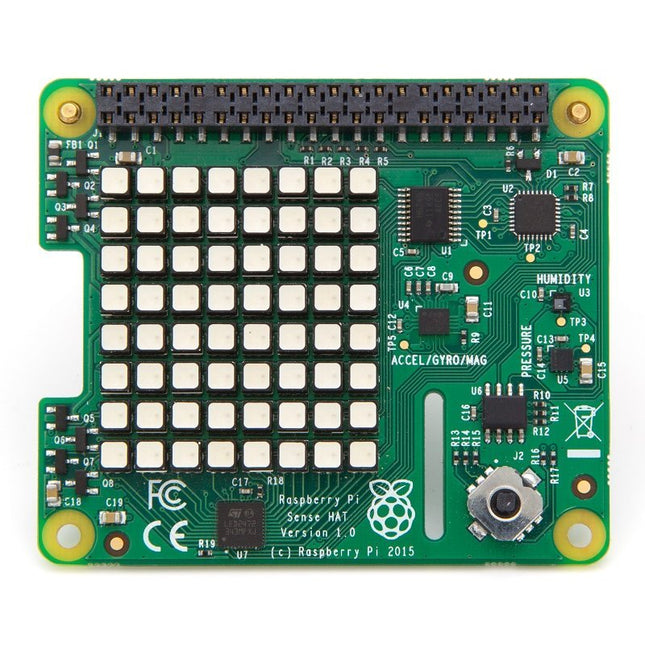
Raspberry Pi Foundation Raspberry Pi Sense HAT
Beim offiziellen Sense HAT der Raspberry Pi Foundation handelt es sich um ein Add-on-Board für Raspberry Pi (4, 3, 2, B+ und A+). Das Sense HAT verfügt über die folgenden Sensoren: 8x8 RGB-LED-Matrix-Display Accelerometer Gyroskop Magnetometer Luftdruck-Sensor Temperatur-Sensor Luftfeuchtigkeits-Sensor Joystick mit 5 Tastern