
Suchergebnisse für "dds OR rf OR signal OR generator OR pcb OR measure OR transmitter"
-

FNIRSI FNIRSI 2D15P (3-in-1) 2-Kanal Oszilloskop (100 MHz) + Multimeter + Signalgenerator
Das FNIRSI 2D15P ist ein kompaktes 3-in-1 Prüfgerät, das ein 2-Kanal-Oszilloskop, ein True-RMS-Multimeter und einen Funktionsgenerator in einem Gerät vereint. Mit einem 4,3-Zoll-kapazitiven Touchscreen, 100 MHz Bandbreite, 500 MSa/s Abtastrate und einer Aufnahmegeschwindigkeit von bis zu 1200 Bildern pro Sekunde eignet es sich ideal für schnelle Fehlersuche, Signalanalyse und Elektroniktests. Features Zweikanal-Eingang (100 MHz Einkanal, 50 MHz Zweikanalbetrieb) Wählbare Speichertiefen Bandbreitenbegrenzung: 20 MHz Graustufen- und Farbtemperaturvisualisierung Mathematische Operationen (Addition, Subtraktion, Multiplikation, Division usw.) XY-Modus und unendliche Nachleuchtdauer Cursorfunktion und 13 automatische Messungen Auto / Normal / Single Triggermodi True-RMS-Multimeter (19.999 Counts) 10-MHz-DDS-Signalgenerator Technische Daten Allgemein Display 4,3" IPS-Touchscreen (kapazitiv) Bedienung Touch + Drehknopf + Tasten Laden USB-C (12 V/1 A Fast Charging) Akku 5000 mAh Lithium-Akku Abmessungen 19,6 x 12,9 x 5,7 cm Gewicht 1,1 kg Oszilloskop Kanäle 2 Analoge Bandbreite 100 MHz Abtastrate 500 MSa/s Speichertiefe 10 kΩ, 100 kΩ, 1 MΩ Eingangsimpedanz 1 MΩ Zeitbasisbereich 5 ns – 50 s Vertikale Empfindlichkeit 10 mV – 10 V/div Maximale Eingangsspannung 800 V (x10-Sonde) Triggermodus Auto, Normal, Single Triggertyp Ansteigend, Abfallend, Beide Flanken Kopplung AC/DC Nachlaufzeit min / 2s / 5s / 10s / 20s / 50s / ∞ Mathematik Operationen Ja Wellenformerfassung Ja Wellenformexport Ja Cursormessung Ja Multimeter Gleichspannung 1.9999V / 19.999V / 199.99V / 1000V Wechselspannung 1.9999V / 19.999V / 199.99V / 750.0V Gleichstrom 19.999mA / 199.99mA / 1.9999A / 9.999A Wechselstrom 19.999mA / 199.99mA / 1.9999A / 9.999A Widerstand 19.999MΩ / 1.9999MΩ / 199.99KΩ / 19.999KΩ / 1.9999KΩ / 199.99Ω Kapazität 999.9uF / 99.99uF / 9.999uF / 999.9nF / 99.99nF / 9.999nF / 9.999mF / 99.99mF Diode Ja Durchgang Ja Signalgenerator Kanäle 1 Frequenz 0–10 MHz Amplitude 0,1–3,0 Vpp Tastverhältnis 0–100% Lieferumfang 1x FNIRSI 2D15P Oszilloskop 2x P6100 Oszilloskop-Tastköpfe 1x Multimeter-Sonde 1x Krokodilklemmensonde 1x USB-Datenkabel 1x Manual Downloads Manual Firmware V2.7.0.7
€ 209,00€ 179,95Bestpreis
-
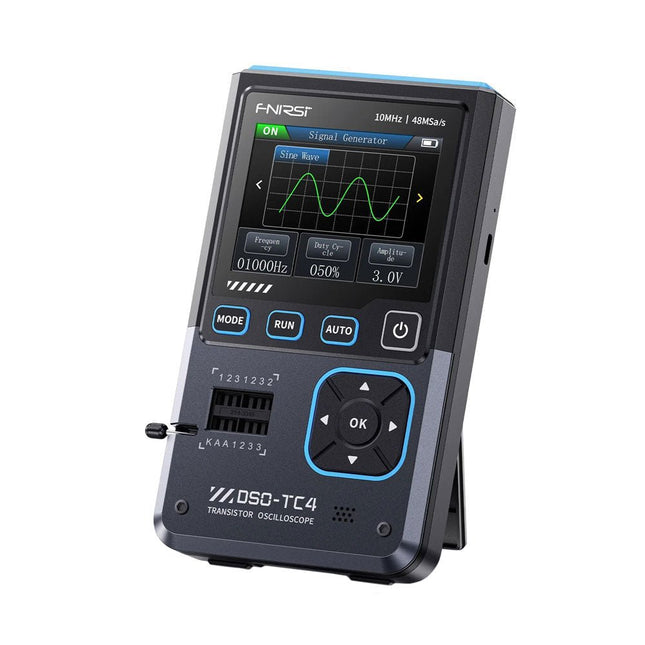
FNIRSI FNIRSI DSO-TC4 (3-in-1) Oszilloskop (10 MHz) + Transistortester + Signalgenerator
Das FNIRDSI DSO-TC4 ist ein multifunktionales Transistor-Oszilloskop, das sowohl umfassend als auch praktisch ist. Es wurde für den Einsatz in Wartungs- und Forschungsanwendungen entwickelt und vereint Oszilloskop, Transistortester und Signalgenerator in einem Gerät. Features Ausgestattet mit einem 2,8-Zoll-TFT-Farbdisplay für eine klare und intuitive Anzeige Eingebauter Lithium-Akku mit hoher Kapazität (1500 mAh) und einer Standby-Zeit von bis zu 4 Stunden Kompakt und leicht, ideal für den mobilen Einsatz Technische Daten Oszilloskop Analoge Bandbreite 10 MHz Echtzeit-Abtastrate 48 MSa/s Eingangsimpedanz 1 MΩ Kopplungsmodus AC/DC Prüfspannungsbereich 1:1-Tastkopf: 80 Vpp (+40 V) 10:1-Tastkopf: 800 Vpp (+400 V) Vertikale Empfindlichkeit 10 mV/div~10 V/div (X1-Bereich) Vertikale Auslenkung Einstellbar mit Anzeige Zeitbasisbereich 50 ns~20 s Triggermodus Auto/Normal/Single Triggertyp Rising edge, Falling edge Triggerpegel Einstellbar mit Anzeige Wellenform einfrieren Ja (HOLD-Funktion) Automatische Messung Max, Min, Avg, RMS, Vpp, Frequency, Cycle, Duty Cycle Transistortester Transistor Verstärkungsfaktor "hfe"; Basis-Emitter-Spannung „Ube“, Ic/Ie, Kollektor-Emitter-Sperrstrom „Iceo“, Ices, Durchlassspannungsabfall der Schutzdiode „Uf“ Diode Durchlassspannungsabfall <5 V (Durchlassspannungsabfall, Sperrschichtkapazität, Rückwärtsleckstrom) Zenerdiode 0,01-32 V Rückwärtsdurchbruchspannung (K-A-A-Testbereich) Feldeffekttransistor (FET) JFET: Gatekapazität „Cg“, Drainstrom Id unter „Vgs“, Durchlassspannungsabfall der Schutzdiode "Uf" IGBT: Drainstrom Id unter Vgs, Durchlassspannungsabfall der Schutzdiode Uf MIOSTET: Schwellenspannung "Vt", Gatekapazität "Cg", Drain-Source-Widerstand "Rds", Durchlassspannungsabfall der Schutzdiode "Uf" Unidirektionaler Thyristor Triggerspannung <5 V, Gatepegel (Gate-Spannung) Bidirektionaler Thyristor Triggerstrom <6 mA (Gate-Spannung) Kondensator 25 pF–100 mF, Kapazitätswert, Verlustfaktor "Vloss" Widerstand 0,01 Ω-50 MΩ Induktivität 10 μH-1000 μH, Gleichstromwiderstand DS18B20 Temperatursensor, Pins: GND, DQ, VDD DHT11 Temperatur- und Feuchtigkeitssensor, Pins: VDD, DATA, GND Signalgenerator Ausgangswellenform Unterstützt 13 Wellenformausgänge Wellenformfrequenz 0-50 kHz Rechteckwellen-Tastverhältnis 0-100% Wellenformamplitude 0,1-3,0 V Allgemein Display 2,8" TFT-Farbbildschirm Hintergrundbeleuchtung Helligkeit einstellbar Stromversorgung USB-C (5 V/1 A) Akku 3,7 V/1500 mAh Sprachen Englisch, Deutsch, Spanisch, Portugiesisch, Russisch, Chinesisch, Japanisch, Koreanisch Abmessungen 90 x 142 x 27,5 mm Gewicht 186 g Lieferumfang 1x FNIRSI DSO-TC4 (3-in-1) Oszilloskop (10 MHz) 1x P6100 Oszilloskop-Tastkopf (10x) 1x Krokodilklemmensonde 3x Testhaken 1x Adapter 1x USB-C-Ladekabel 1x Manual Downloads Manual Firmware V0.0.7 (+V1.0.9)
€ 89,95€ 74,95Bestpreis
-

FNIRSI FNIRSI TMP-610S (3-in-1) Multimeter (60.000 Counts) + Oszilloskop + Signalgenerator
Das FNIRSI TMP-610S ist ein kompaktes 3-in-1-Messgerät, das ein True-RMS-Multimeter, ein 10-MHz-Oszilloskop und einen 50-kHz-DDS-Signalgenerator vereint. Es wurde für die Fehlersuche in der Elektronik, das Testen von Schaltkreisen sowie für Entwicklungsarbeiten im Labor oder im Außeneinsatz konzipiert. Das Multimeter bietet eine Auflösung von 60.000 Counts und unterstützt Messungen von Spannung, Strom, Widerstand, Kapazität, Frequenz und Temperatur sowie Dioden- und Durchgangsprüfungen. Das integrierte Oszilloskop ermöglicht eine Echtzeit-Signalformanalyse mit bis zu 48 MSa/s, während der Signalgenerator 13 Signalformen mit einstellbarer Frequenz, Amplitude und Tastverhältnis (Duty Cycle) bereitstellt. Ein 3,5-Zoll-IPS-Touchscreen, eine intelligente Auto-Scan-Funktion, Bluetooth-Konnektivität für die DMM-Funktionen, Signalformspeicherung, USB-Export sowie ein 3.000-mAh-Akku machen das TMP-610S zu einem vielseitigen All-in-One-Werkzeug für Elektronik-Profis und Enthusiasten. Features 3-in-1-Design: Digitalmultimeter + Oszilloskop + Signalgenerator Hochpräzise True-RMS-Messung mit 60.000 Counts 10-MHz-Oszilloskop mit 48 MSa/s Abtastrate Bluetooth-App-Synchronisierung (nur Multimeter-Funktion) 3,5-Zoll-Smart-Touchscreen mit verschiedenen Anzeigemodi 50-kHz-DDS-Signalgenerator mit 13 Signalformen Integrierte Sicherung für einfachen Austausch Technische Daten Multimeter Funktion Messbereich Genauigkeit DC voltage 600mV/6V/60V/600V/1000V ±(0.03%+5d) AC voltage 600mV/6V/60V /600V/750V ±(0.3%+15d) DC current 600uA/6000uA/60mA/600mA ±(0.15%+5d) 6A/10A ±(0.2%+5d) AC current 600uA/6000uA/60mA/600mA ±(0.5%+15d) 6A/10A ±(0.75%+15d) Resistance 600Ω/6KΩ/60KΩ/600KΩ/6MΩ ±(0.1%+5d) 60MΩ ±(0.2%+10d) Capacitance 60nF/600nF/6uF/60uF ±(2.5%+30d) 600uF/6mF/60mF ±(3.5%+30d Frequency 10 Hz~60 MHz ±(0.01%+5d) Temperature -40℃~1000℃ ±(1.0%+5℃) Continuity 0Ω~1KΩ ±(0.2%+5d) Diode 0V~3.0V, 0Ω~1 Ω ±(1%+5d) AC frequency response 10KHz / Oszilloskop Real-time Sampling Rate 48 MSa/s Analog Bandwidth 10 MHz Input Impedance 1MΩ Coupling Mode AC/DC Test Voltage Range 1:1 Probe - 80Vpp (±40V) 10:1 Probe - 800Vpp (±400V) Vertical Sensitivity 10mV/div~10V/div Vertical Displacement Adjustable with indication Horizontal Time Base Range 50 ns ~ 20 s Trigger Mode Auto, Normal, Single Trigger Type Rising, Falling, 50% Trigger Level Adjustable with indication Measurement Parameters Freq, Period, +Duty, ‒Duty, +Width, ‒Width, Max, Min, P‒P, Amp, RMS, Avg Persistence Off / 500ms / 1s / ∞ Cursor Measurement Yes Waveform Screenshot Saving Yes Signalgenerator Output Waveform Supports 13 waveform types Frequency 0~50kHz Amplitude 0.0V~3.0V Duty Cycle 0~100%, adjustable for Square and Sawtooth waves Lieferumfang 1x FNIRSI TMP-610S Multimeter + Oszilloskop + Signalgenerator 1x P6100 Sonde 1x Adapter 2x Krokodilklemmen 2x Multimeter-Sonden Sondenzubehör 1x Aufbewahrungstasche 1x USB-C Kabel 1x Manual Downloads Manual
€ 179,95€ 149,95Bestpreis
-

FNIRSI FNIRSI SG-003A Signalgenerator
Der FNIRSI SG-003A ist ein kleiner, hochpräziser Signalgenerator mit einem 2,4' TFT-Farbdisplay mit einem Frequenzbereich von bis zu 10 kHz und einem aktiven und passiven Stromausgang von 24 mA. Die maximale Ausgangsspannung beträgt 24 V. Die eingebaute 3000-mAh-Lithiumbatterie hat eine Laufzeit von 10 Stunden. FNIRSI SG-003A wird hauptsächlich für die Fehlersuche in industriellen SPS, Prozessinstrumenten, elektrischen Ventilen usw. verwendet. Features Genauigkeit (Spannung/Strom) 0,1% ±0,005 Auflösung (aktuell) 0,01 mA Frequenz 0-10 kHz Auflösung 5 Ziffern Ausgangsleistung 24 V Display 2,4" TFT-LCD (320 x 240) Abmessungen 92 x 72 x 30 mm Gewicht 165 g Technische Daten Signal Bereich Genauigkeit Auflösung Maximale Belastung Externe Stromversorgung Aktiver Stromausgang 0~24 mA ±(0,1% + 0,005) 0,01 mA 750 Ω Passiver Stromausgang (XMT) 0~24 mA ±(0,1% + 0,005) 0,01 mA 0~30 V Spannungsausgang 0~24 V ±(0,1% + 0,005) 0,01 V 24-V-Schleife 0~24 mA ±(0,1% + 0,005) 0,01 mA Frequenzausgang 0~9999 Hz ±2% 5 Ziffern Stromeingang 0~24 mA ±(0,1% + 0,005) 0,01 mA Spannungseingang 0~30 V ±(0,1% + 0,005) 0,01 V Lieferumfang 1x FNIRSI SG-003A Signalgenerator 4x Testclips 1x USB-Ladegerät 1x USB-C Kabel 1x Manual Downloads Manual Firmware V4.3
€ 68,79
-

FNIRSI FNIRSI DPOS350P (4-in-1) 2-Kanal Tablet-Oszilloskop (350 MHz) + Signalgenerator + Frequenzganganalyzer + Spektrum Analyzer
2 Kanäle • 350 MHz • 1 GSa/s • 50.000 wfm/s • 7 Zoll Touchscreen Das FNIRSI DPOS350P ist ein elegantes 4-in-1-Kraftpaket im Tablet-Format! Dieses kompakte und tragbare Gerät bietet umfangreiche Funktionen: Es vereint ein 2-Kanal Oszilloskop (350 MHz), einen Signalgenerator (50 MHz), einen Frequenzganganalyzer (50 MHz) und einen Spektrum-Analyzer (200 kHz–350 MHz) in einem Gerät. Ob in Forschung und Entwicklung, Fehlersuche oder Feldtests – das DPOS350P bietet Ihnen die Werkzeuge, die Sie zum präzisen und klaren Messen, Generieren, Analysieren und Visualisieren elektronischer Signale benötigen. Der reaktionsschnelle, hochauflösende Touchscreen und die intuitiven Bedienelemente machen die Signalanalyse schnell, flexibel und effizient. Features Leistungsstarke Multifunktionsintegration 350 MHz 2-Kanal-Oszilloskop mit 1 GSa/s Echtzeit-Abtastung 50 MHz Signalgenerator mit 14 Standard- und benutzerdefinierten Wellenformen Spektrumanalysator (200 kHz–350 MHz): Ideal für EMI, HF und HF-Tests Frequenzganganalysator (FRA) bis 50 MHz Hochleistungs-Wellenformerfassung 50.000 wfm/s Bildwiederholrate für klare Signale in Echtzeit 350 MHz Bandbreite (Einzelkanalmodus) Erkennt seltene und unwahrscheinliche Anomalien Scharfes Display & Reibungsloser Betrieb 7-Zoll-IPS-Touchscreen (Auflösung 1024 x 600 Pixel) Umschalten zwischen Graustufen- und Farbtemperaturanzeige Einfache Bedienung in verschiedenen Testumgebungen Zuverlässig, geschützt und schnell ladend Hochspannungsschutz bis 400 V Schnellladen mit QC 18 W (vollständige Ladung in 2 Stunden) Für stabilen Langzeitbetrieb konzipiert Datenspeicherung und -export Speichern Sie bis zu 500 Wellenformaufzeichnungen + 90 Screenshots USB-Export für einfache Berichterstellung und Offline-Analyse Technische Daten Allgemein Display 7 Zoll (IPS, voller Betrachtungswinkel) Auflösung 1024 x 600 Pixel Interaktionsmodus Kapazitiver Touchscreen Gesamtstromverbrauch 10 W Einschaltkonfiguration 5 Voreinstellungen Laden QC 18 W, 12 V/1,5 A (USB-C) Akku 3,7 V, 8000 mAh Lithium-Akku Akkulaufzeit ca. 3 Stunden Betrieb, 5 Stunden Standby Wärmeableitung Luftkühlung Erweiterungsschnittstelle USB-Datenanschluss Automatische Abschaltung 15-60 Minuten / Aus Firmware-Upgrade Unterstützung für ISO-Image-Upgrades Sprachen Englisch / Portugiesisch / Russisch / Chinesisch Abmessungen 190 x 128 x 37 mm Oszilloskop Analogkanäle 2 Analogbandbreite 350 MHz Anstiegszeit 1 ns Echtzeit-Abtastrate 1 GSa/s Speichertiefe 60 Kpts Eingangsimpedanz 1 MΩ / 14 pF Zeitbasis Bereich 5 ns ~ 50 s Rollzeitbasis 50 ms ~ 50 s Vertikale Empfindlichkeit 2 mV ~ 20 V (1X) Vertikaler Bereich 16 mV ~ 160 V (1X) DC-Genauigkeit ±2% Zeitgenauigkeit ±0,01% Eingangskopplung DC / AC Sondendämpfung 1x / 10x / 100x Hardware-Bandbreitenlimit 150 M / 20 M Hochauflösender Modus 8-16 Bit Parametermessungen 12 Typen Cursormessung Zeit, Periode, Frequenz, Pegel, Spannung Triggererkennung Digitaler Trigger Triggerkanal CH1 / CH2 Triggermodus Auto / Einzeln / Normal Triggerflanke Rising edge / Falling edge Triggerunterdrückung L1 ~ L3 Triggerpegel Manuell / Automatisch 10% ~ 90% Screenshot-Speicher 90 Bilder Wellenform-Speicher 500 Gruppen Hintergrundraster Ein-/Ausblenden Wellenform-Bewegung Grobeinstellung/Feineinstellung Überspannungsschutz Spannungsfestigkeit 400 V Wellenform-Helligkeit Einstellbar Einfache FFT-Anzeige Ja Digitale Fluoreszenz Ja Farbtemperaturanzeige Ja X-Y-Modus Ja ZOOM-Zeitbasis Ja Automatische Justierung per Tastendruck Ja Nullrückstellung per Tastendruck Ja Daten Browser Ja Signalgenerator Wellenformtypen 14 Standardfunktionen + erfasste Wellenform Frequenz 0-50 MHz (nur Sinuswelle, andere Wellenformen bis 10M/5M/3M) Amplitude 0–5 VPP Offset -2,5 V ~ +2,5 V Tastverhältnis 0,1-99,9% Frequenz Auflösung 1 Hz Amplitudenauflösung 1 mV Offsetauflösung 1 mV Tastverhältnisauflösung 0,1% Anpassbare erfasste Wellenform 500 Gruppen Frequenzganganalyzer (FRA) Frequenz des Anregungssignals 100 Hz ~ 50 MHz Amplitude des Anregungssignals 0~5 VPP Offset des Anregungssignals -2,5 V ~ +2,5 V Anzahl der Anregungsfrequenzen 20~500 Cursormessung Frequenz / Verstärkung / Phase Betrieb Modus Einzeln / Zyklisch Systemkalibrierung Ja Spektrum Analyzer Konvertierungsmethode FFT FFT-Länge 4K ~ 32K Frequenzbereich 200 KHz ~ 350 MHz Pegelbereich -60 dBmV ~ +260 dBmV Cursormessung Frequenz / Amplitude Markierungsparameter Maximale Energie-Oberschwingungen Wasserfalldiagramm Ja 3D-Wasserfalldiagramm Ja Automatische Anpassung Ja Systemkalibrierung Ja Lieferumfang 1x FNIRSI DPOS350P (4-in-1) 2x 350 MHz Tastköpfe 1x QC 18 W Schnellladegerät (EU) 1x USB-Datenkabel 1x Krokodilklemme 1x Aufbewahrungstasche 1x Manual Downloads Manual Firmware
€ 309,00€ 259,00Bestpreis
-
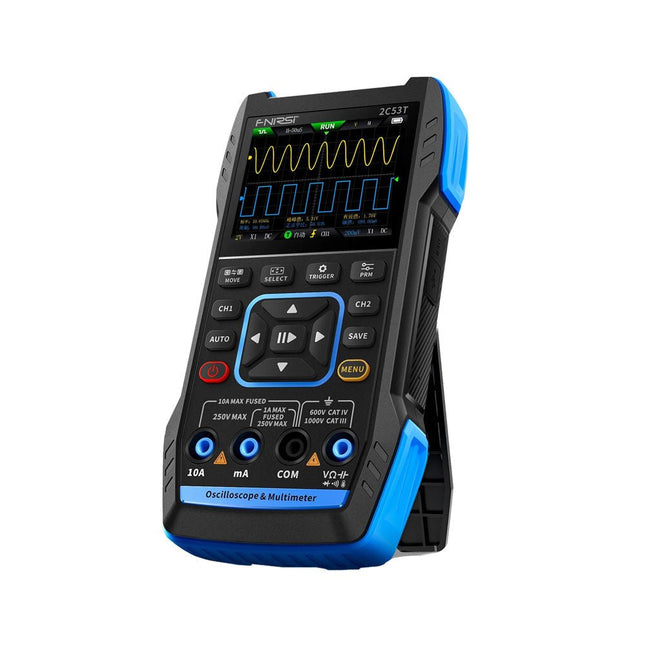
FNIRSI FNIRSI 2C53T (3-in-1) 2-Kanal Oszilloskop (50 MHz) + Multimeter + Signalgenerator
Der FNIRSI 2C53T, eine verbesserte Version seines 10 MHz-Vorgängers, ist ein kompaktes und vielseitiges 3-in-1-Gerät. Es kombiniert ein Zweikanal 50-MHz-Oszilloskop, ein 4,5-stelliges True-RMS-Multimeter und einen Signalgenerator mit 13 Wellenformtypen und ist damit ein unverzichtbares Werkzeug für Wartungs- und Forschungsexperten. Oszilloskop: Verfügt über 50 MHz Bandbreite, 250 MS/s Abtastrate, ±400 V-Schutz, FPGA + ARM + ADC-Architektur und Wellenformspeicherung für die Analyse. Multimeter: 4,5-stelliger True RMS mit 19999 Counts, unterstützt AC/DC-Spannungs-, Strom-, Kapazitäts-, Widerstands-, Dioden- und Durchgangsmessungen. Signalgenerator: Gibt 13 Signaltypen bis zu 50 KHz mit einstellbarer Frequenz, Amplitude und Arbeitszyklus aus. Mit einem 2,8" LCD, einem 3000-mAh-Akku (6 Stunden Laufzeit) und einem tragbaren Design bietet es leistungsstarke Funktionalität in einem benutzerfreundlichen Paket. Technische Daten Oszilloskop Kanäle 2 Analoge Bandbreite 50 MHz Echtzeit-Abtastrate 250 MS/s Speichertiefe 1 Kpts Impedanz 1 MΩ Zeitbasisbereich 10ns-20s Vertikale Empfindlichkeit 10 mV/div-10 V/div (x1) Maximal gemessene Spannung ±400 V Trigger-Modus Auto/Normal/Single Triggertyp Rising edge, Falling edge Anzeigemodus Y-T/Rolling/X-Y Kopplungsmethode AC/DC Persistenz AUS, 500ms, 1s, ∞ Mathe 8 Grundoperationen + FFT Unterstützt Wellenform-Screenshot speichern, Wellenformbild exportieren, Cursormessung, unendliches Nachleuchten Multimeter Gleichspannung 1.9999V/19.999V/199.99V/1000V ±(0.5%+3) Wechselspannung 1.9999V/19.999V/199.99V/750.0V ±(1%+3) Gleichstrom 19.999mA/199.99mA/1.9999A/9.999A ±(1.2%+3) Wechselstrom 19.999mA/199.99mA/1.9999A/9.999A ±(1.5%+3) Widerstand 19.999MΩ/1.9999MΩ/199.99KΩ/19.999KΩ ±(0.5%+3) 1.9999KΩ/199.99Ω ±(2.0%+3) Kapazität 999.9uF/99.99uF/9.999uF/999.9nF/99.99nF/9.999nF ±(2.0%+5) 9.999mF/99.99mF ±(5.0%+20) Temperatur −55~1300°C ±(2.5%+5) Kontinuitätstest Ja Diode Ja Signalgenerator 13 Signalwellenformen Sinuswelle, Rechteckwelle, Sägezahnwelle, Halbwelle, Vollwelle, positive Stufenwelle, umgekehrte Stufenwelle, exponentieller Anstieg, exponentieller Abfall, Gleichstrom, Multi-Audio, Sinker-Impuls, Lorentzwelle Ausgabefrequenz 0-50 KHz Ausgabeamplitude 0-3 V Ausgangs-Arbeitszyklus 0-100% Allgemein Display 2,8" HD-Farbbildschirm Auflösung 320 x 240 Aufladen USB-C (5 V/1 A) Batterie 3000 mAh Lithiumbatterie Standby-Zeit 6 Stunden Sprachen Englisch, Chinesisch Abmessungen 167 x 89 x 35 mm Gewicht 300 g Unterschiede zwischen neuer und alter Version Modell 2C53T Upgrade 2C53T Vorgänger Bandbreite 50 MHz 10 MHz Anzeigemodus Y-T/Rolling/X-Y Y-T/Rolling Mathe 8 Grundoperationen + FFT N/A Cursor-Funktion Ja N/A XY-Lissau-Diagramm Ja N/A Afterglow-Funktion Ja N/A Multimeter-Genauigkeit 19999 Counts 9999 Counts Signalgenerator 50 KHz 2 MHz Lieferumfang 1x FNIRSI 2C53T Oszilloskop (50 MHz) 2x P6100 Oszilloskop-Tastköpfe (10X) 1x Multimeter-Sonde 1x Krokodilklemmensonde 1x USB-C-Ladekabel 1x Aufbewahrungstasche 1x Manual Downloads Manual Firmware V1.2.0
€ 119,95€ 94,95Bestpreis
-

Great Scott Gadgets Great Scott Gadgets HackRF Pro SDR (100 kHz – 6 GHz) + GRATIS E-Book
AKTION: HackRF Pro bestellen und das neue E-Book "SDR mit HackRF One & HackRF Pro" im Wert von 20 € gratis sichern! HackRF Pro ist das neueste Software Defined Radio (SDR) von Great Scott Gadgets und der leistungsstarke Nachfolger des legendären HackRF One. Mit einem Frequenzbereich von 100 kHz bis 6 GHz deckt es ein enormes Spektrum zum Senden und Empfangen von Funksignalen ab. Als Open-Source-Hardware-Plattform konzipiert, ist das HackRF Pro das ideale Werkzeug für die Analyse und Entwicklung moderner Funktechnologien. Es lässt sich flexibel als USB-Peripheriegerät nutzen oder für den Standalone-Betrieb programmieren. Technische Daten Frequenz: 100 kHz bis 6 GHz Einstellbar von 0 Hz bis 7,1 GHz Halbduplex-Transceiver Bis zu 20 Millionen Abtastungen pro Sekunde 8-Bit-Quadraturabtastung (8-Bit-I und 8-Bit-Q) Kompatibel mit GNU Radio, SDR# und mehr Softwarekonfigurierbare RX- und TX-Verstärkung sowie Basisbandfilter Softwaregesteuerte HF-Port-Leistung (50 mA bei 3,3 V) SMA-HF-Anschluss SMA-Takt-Ein- und -Ausgang für Synchronisation und Triggerung Praktische Tasten zur Programmierung Interne Stiftleisten für Erweiterung High-Speed USB 2.0 mit USB-C Anschluss USB-Stromversorgung Open-Source-Hardware Im Vergleich zu seinem Vorgänger bietet HackRF Pro eine Vielzahl neuer Funktionen, darunter: Erweiterter Betriebsfrequenzbereich Verbesserte HF-Leistung mit flacherem Frequenzgang USB-C Anschluss Integrierter TCXO-Quarzoszillator für überlegene Timingstabilität Logik-Upgrade von einem CPLD zu einem energieeffizienten FPGA Beseitigung von Gleichspannungsspitzen Modus mit erweiterter Präzision und 16-Bit-Abtastwerten für niedrige Abtastraten (typische ENOB: 9-11) Modus mit halber Präzision und 4-Bit-Abtastwerten bei bis zu 40 MS/s Mehr RAM und Flash-Speicher für benutzerdefinierte Firmware Abschirmung des Funkmoduls Trigger-Ein- und -Ausgang über Taktanschlüsse zugänglich Aussparung in der Leiterplatte bietet Platz für zukünftige Erweiterungen Verbessert Energiemanagement Verbesserter HF-Portschutz Funktion zum hardwareseitigen Deaktivieren des Sendemodus Volle Kompatibilität: Dank der bewährten Architektur kann bestehende Software für das HackRF One direkt auch mit dem HackRF Pro genutzt werden. Das HackRF Pro bietet nahtlose Abwärtskompatibilität bei gleichzeitig deutlich gesteigerter Performance. Hinweis: Eine Antenne ist nicht im Lieferumfang enthalten. Wir empfehlen die ANT500 für den optimalen Einstieg. Lieferumfang HackRF Pro SDR mit Kunststoffgehäuse Neues E-Book: SDR mit HackRF One & HackRF Pro (Normalpreis: 20 €) Downloads Documentation GitHub
€ 489,00€ 429,00Bestpreis
-
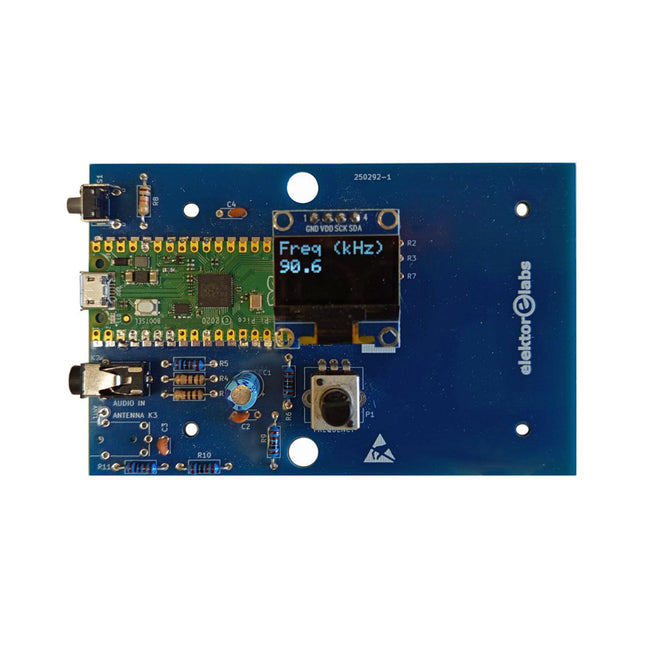
Elektor Labs Elektor AM-Sender-Kit
Bauen Sie Ihren eigenen Vintage-Radiosender Das Elektor AM-Sender-Kit ermöglicht das Streamen von Audio auf Vintage-AM-Radioempfänger. Basierend auf einem Raspberry Pi Pico Mikrocontroller-Modul kann der AM-Sender auf 32 Frequenzen im AM-Band senden, von 500 kHz bis 1,6 MHz in 32 Schritten von ca. 35 kHz. Die Frequenz wird mit einem Potentiometer gewählt und auf einem 0,96" OLED-Display angezeigt. Eine Taste ermöglicht das Umschalten des Sendemodus zwischen Ein und Aus. Die Reichweite des Senders hängt von der Antenne ab. Die integrierte Antenne bietet eine Reichweite von wenigen Zentimetern, sodass der AM-Sender nahe am Radio oder im Radio selbst platziert werden muss. Eine externe Loop-Antenne (nicht enthalten) kann angeschlossen werden, um die Reichweite zu erhöhen. Das Elektor AM-Sender-Kit wird als Bausatz geliefert, den Sie selbst auf die Platine löten müssen. Features Die Platine ist kompatibel mit einem Hammond-1593N-Gehäuse (nicht enthalten).Ein 5-VDC-Netzteil mit Micro-USB-Anschluss (z. B. ein altes Handy-Ladegerät) wird benötigt, um das Kit zu betreiben (nicht enthalten). Stromaufnahme: 100 mA. Die Arduino-Software (benötigt Earle Philhowers RP2040-Boards-Paket) für das Elektor-AM-Sender-Kit sowie weitere Informationen sind auf der Elektor-Labs-Seite dieses Projekts verfügbar. Stückliste Widerstände R1, R4 = 100 Ω R2, R3, R8 = 10 kΩ R5, R6, R9, R10, R11 = 1 kΩ R7 = optional (nicht enthalten) P1 = Potentiometer 100 kΩ, linear Kondensatoren C1 = 22 µF 16V C2, C4 = 10 nF C3 = 150 pF Sonstiges K1 = 4×1 Stiftleiste K2, K3 = 3,5-mm-Buchse Raspberry Pi Pico Drucktaste, Winkelmontage 0,96" monochromes I²C-OLED-Display Leiterplatte 150292-1
€ 34,95€ 29,95Bestpreis
-
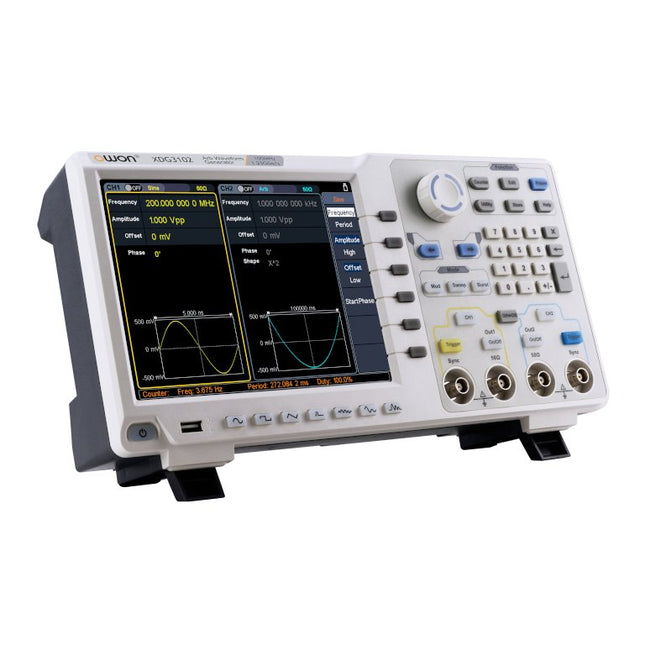
OWON OWON XDG3102 2-Kanal Arbiträrwellenformgenerator (100 MHz)
Features Fortschrittliche DDS-Technologie, bis zu 250 MHz Frequenzausgang 1,25 GS/s Abtastrate und 1 μHz Frequenzauflösung Bis zu 1M beliebige Wellenformlänge Vertikale Auflösung: 14 Bit Umfassende Wellenformausgabe: 6 Gruppenwellenformen und 152 Gruppen integrierter beliebiger Wellenformen Umfassende Modulationsmöglichkeiten: AM, FM, PM, FSK, 3FSK, 4FSK, PSK, OSK, ASK, BPSK, PWM, Sweep und Burst Hochpräziser Frequenzzähler integriert, im Bereich von 100 MHz bis 200 MHz SCPI und LabVIEW werden unterstützt 8-Zoll-LCD-Touchscreen mit 800 x 600 Pixeln Technische Daten XDG3102 Kanal 2 Frequenzausgang 100 MHz Beispielrate 1,25 GSa/s Vertikale Auflösung 14 Bit Wellenform Standardwellenform Sinus, Rechteck, Puls, Rampe, Rauschen und Harmonische Beliebige Wellenform exponentieller Anstieg, exponentieller Abfall, sin(x)/x, Stufenwelle und andere,insgesamt 150 integrierte Wellenformen und benutzerdefinierte beliebige Wellenformen Frequenz (Auflösung 1μHz) Sinus 1 μHz bis 100 MHz Quadrat 1 μHz – 40 MHz Impuls 1 μHz – 25 MHz Rampe 1 μHz bis 5 MHz Harmonisch 1 μHz – 50 MHz Lärm 120 MHz (-3 dB, typisch) Beliebige Wellenform integrierte Wellenform: 1 uHz – 15 MHzbenutzerdefinierte Wellenform: 1 uHz – 50 MHz Genauigkeit ±1 ppm, 0 °C bis 40 °C Amplitude Amplitude (50Ω) 1 mVpp – 10 Vpp (≤ 40 MHz); 1 mVpp – 5 Vpp (≤ 80 MHz)1 mVpp – 2,5 Vpp (≤ 120 MHz); 1 mVpp – 1 Vpp (≤ 250 MHz) Amplitude (hohe Impedanz) 2 mVpp – 20 Vpp (≤ 40 MHz); 2 mVpp – 10 Vpp (≤ 80 MHz);2 mVpp – 5 Vpp (≤ 120 MHz); 2 mVpp – 2 Vpp (≤ 250 MHz) Auflösung 1 mV oder 4 Ziffern DC-Offset Bereich (50Ω) ±(5 Vpk – Amplitude Vpp/2) Reichweite (High-Z, offener Stromkreis) ±(10 Vpk – Amplitude Vpp/2) Genauigkeit ±(1 % der |Einstellung| + 1 mV + Amplitude Vpp x 0,5 %) Auflösung 1 mV oder 4 Ziffern Lastimpedanz 50 Ω (typisch) Genauigkeit ±(1 % der Einstellung + 1 mVpp) (typisch, 1 kHz Sinus, 0 V Offset) Reinheit des Sinuswellenspektrums Harmonische VerzerrungTypisch (0 dB) DC – 1 MHz: <-65 dBc1 MHz – 10 MHz: <-60 dBc10 MHz - 120 MHz: <-50 dBc120 MHz - 200 MHz: <-45 dBc Totale harmonische Verzerrung <0,05 %, 10 Hz bis 20 kHz, 1 Vpp Unecht (nicht harmonisch),Typisch (0 dB) ≤10MHz: <-70dBc>10MHz: <-70dBc + 6dB/ Oktave PhasenrauschenTypisch (0 dBm, 10 kHz Abweichung) 10 MHz: ≤-110 dBc/Hz Quadrat Anstiegs-/Abfallzeit <5 ns Überschwingen <3 % Auslastungsgrad 50,0 % (fest) Jitter (rms) 300 ps + 100 ppm Impuls Impulsbreite 12 ns – 996.875 s Vorder-/Rückflankenzeit ≧7ns Überschwingen <3 % Jitter (rms) 300 ps + 100 ppm Rampe Linearität ≤1 % der Spitzenleistung (typisch, 1 kHz, 1 Vpp, 50 % Symmetrie) Symmetrie 0 % bis 100 % Harmonisch Harmonische Ordnung ≤16 Harmonischer Typ gerade, ungerade, alle, Benutzer Harmonische Amplitude könnte für alle Harmonischen eingestellt werden Harmonische Phase Willkürlich Wellenformlänge 2 Punkte – 1 Million Punkte Vertikale Auflösung 14 Bit Minimale Anstiegs-/Abfallzeit <7 ns Jitter (rms) 3 ns Modulation Typ AM, FM, PM, PWM, FSK, 3FSK, 4FSK, PSK, OSK, ASK, BPSK, Sweep und Burst BIN Trägerwellenform Sinus, Rechteck, Rampe und beliebig (außer DC) Quelle intern extern Modulierende Wellenform Sinus, Quadrat, Rampe, Rauschen und beliebig Tiefe 0,0 % – 100,0 % Modulationsfrequenz 2 MHz – 100 kHz FM Trägerwellenform Sinus, Rechteck, Rampe und beliebig (außer DC) Quelle intern extern Modulierende Wellenform Sinus, Quadrat, Rampe, Rauschen und beliebig Modulationsfrequenz 2 MHz – 100 kHz PM Trägerwellenform Sinus, Rechteck, Rampe und beliebig (außer DC) Quelle intern extern Modulierende Wellenform Sinus, Quadrat, Rampe, Rauschen und beliebig Phasenabweichung 0° - 180° Modulationsfrequenz 2 MHz – 100 kHz PWM Trägerwellenform Impuls Quelle intern extern Modulierende Wellenform Sinus, Quadrat, Rampe, Rauschen und beliebig Breitenabweichung 0 ~ Minimum (Puls-Tastverhältnis, 100 % - Puls-Tastverhältnis) Modulationsfrequenz 2 MHz – 100 kHz FSK / 3FSK / 4FSK Trägerwellenform Sinus, Rechteck, Rampe und beliebig (außer DC) Quelle intern extern Modulierende Wellenform Quadrat mit 50% Einschaltdauer Schlüsselfrequenz 2 MHz – 1 MHz PSK Trägerwellenform Sinus, Rechteck, Rampe und beliebig (außer DC) Quelle intern extern Modulierende Wellenform Quadrat mit 50% Einschaltdauer Schlüsselfrequenz 2 MHz – 1 MHz OSK Trägerwellenform Sinus, Rechteck, Rampe und beliebig (außer DC) Quelle intern Schwingungsdauer Quadrat mit 50% Einschaltdauer Schlüsselfrequenz 2 MHz – 1 MHz FRAGEN Trägerwellenform Sinus, Rechteck, Rampe und beliebig (außer DC) Quelle intern extern Modulierende Wellenform Quadrat mit 50% Einschaltdauer Schlüsselfrequenz 2 MHz – 1 MHz BPSK Trägerwellenform Sinus, Rechteck, Rampe und beliebig (außer DC) Quelle intern Modulierende Wellenform Quadrat mit 50% Einschaltdauer Schlüsselfrequenz 2 MHz – 1 MHz Fegen Trägerwellenform Sinus, Rechteck, Rampe und beliebig (außer DC) Typ linear und log Richtung auf und ab Sweep-Zeit 1 ms bis 500 s, ± 0,1 % Triggerquelle intern, extern und manuell Platzen Trägerwellenform Sinus, Rechteck, Rampe, Puls und beliebig (außer DC) Burst-Anzahl 1 bis 50.000 Periode, unendlich, Gating Interner Zeitraum 10 ns - 500 s Gegatete Quelle Externer Auslöser Frequenzzähler Funktion Frequenzperiode, +Breite, -Breite, +Tastverhältnis und -Tastverhältnis Frequenzbereich 100 MHz – 200 MHz Frequenzauflösung 7 Ziffern Input-Output Anzeige 8-Zoll-LCD-Touchscreen mit 800 x 600 Pixeln Typ Frequenzzähler, externer Modulationseingang,externer Trigger-Eingang,externer Referenztakt Eingang / Ausgang Kommunikationsinterface USB-Host, USB-Gerät und LAN Abmessungen 340 x 177 x 90 mm Gewicht 2,50 kg
€ 639,26
-

FNIRSI FNIRSI DLA-16/32 Plus Logic Analyzer (16/32 Kanäle)
Die FNIRSI DLA-Serie kombiniert leistungsstarke USB-3.0-Logikanalyse mit flexibler Mehrkanal-Signalerfassung für das Debugging und die Analyse digitaler Schaltungen und eingebetteter Systeme. Die Serie ist in zwei Ausführungen erhältlich: als DLA-16 Plus mit 16 digitalen Kanälen und als DLA-32 Plus mit 32 digitalen Kanälen. Beide Modelle bieten Abtastraten von bis zu 1 GSa/s, 4 Gbit internen Speicher sowie Unterstützung für über 120 Protokoll-Decoder. Dank der Erfassungsmodi "Buffer", "Stream" und "Roll" eignen sie sich sowohl für die Hochgeschwindigkeits-Signalanalyse als auch für die Langzeitüberwachung. Entscheiden Sie sich für das DLA-16 Plus, wenn Sie bei Nutzung aller Kanäle höhere Abtastraten benötigen, oder für das DLA-32 Plus, wenn Sie mehr Kanäle sowie erweiterte serielle und parallele Triggerfunktionen benötigen. Features Erhältlich mit 16 oder 32 digitalen Eingangskanälen Abtastrate bis zu 1 GSa/s DLA-16 Plus: bis zu 500 MSa/s bei allen 16 Kanälen DLA-32 Plus: bis zu 250 MSa/s bei allen 32 Kanälen 4 Gbit interner Speicher High-Speed-USB-3.0-Schnittstelle Erfassungsmodi: Buffer, Stream und Roll Unterstützung für über 120 Protokoll-Decoder Erweiterte Trigger-Optionen 4 PWM-Ausgänge mit einem Frequenzbereich von 1 Hz bis 20 MHz Datenexport im CSV- und BIN-Format Technische Daten DLA-16 Plus DLA-32 Plus Digitale Kanäle 16 32 Max. Abtastrate 1 GSa/s Abtastrate (1 Kanal) 1 GSa/s Abtastrate (8 Kanäle) 1 GSa/s Max. Buffer Abtastrate 16 Kanäle bei 500 MSa/s 32 Kanäle bei 250 MSa/s Max. Stream Abtastrate 16 Kanäle bei 125 MSa/s 32 Kanäle bei 50 MSa/s Hardware-Speicher 4 Gbit Schnittstelle USB 3.0 / USB-C Max. USB-Übertragungsrate 5 Gbit/s Erfassungsmodi Puffer / Stream / Roll Protokoll-Decoder Über 120 Unterstützung für benutzerdefinierte Protokolle Ja Trigger-Modi Steigende Flanke, fallende Flanke, High, Low, beliebige Flanke Erweiterter Trigger Standard-Triggerung Seriell und parallel Parallele Trigger-Stufen – Bis zu 16 PWM-Ausgänge 4 PWM-Ausgangsspannung 3,3 V PWM-Frequenz 1 Hz–20 MHz Datenexport CSV, BIN Abmessungen 90 x 81 x 11,5 mm Lieferumfang 1x FNIRSI DLA-16/32 Plus Logic Analyzer 4 Sets à 5 abgeschirmte Kabel 18x Mini-IC-Prüfklemmen (High-End-Ausführung) 1x USB 3.0 Datenkabel 10x IC-Prüfklemmen 1x Transparente Aufbewahrungsbox für Prüfklemmen 1x Aufbewahrungstasche 1x Manual Downloads Manual









-

, von Clemens Valens FNIRSI SG-003A Signalgenerator
Der multifunktionale Signalgenerator FNIRSI SG-003A ist eine Art Prozessmessgerät zur Erzeugung und Messung von Spannungen, Strömen und Frequenzen, das mit SPS und anderen (industriellen) Prozesssteuerungssystemen...
-
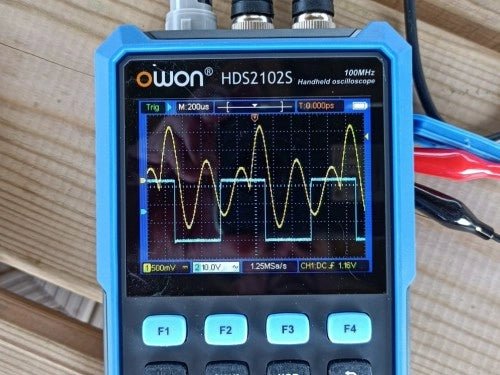
, von Clemens Valens Review: Owon HDS2102S Handheld 2-Kanal 100-MHz-Oszilloskop, Multimeter & Signalgenerator
[Gesponsert] Das Owon HDS2102S ist ein Handgerät, das ein Zwei-Kanal-Oszilloskop, ein Multimeter und einen Arbiträr-/Signalgenerator in sich vereint. Das Oszilloskop hat eine Bandbreite von 100...

